- Product Description Description
- Table of Contents TOC
- List of Table & Figure LOT
- Get Free Sample PDF Sample PDF
Market Size, 2025
$7.41 BnMarket Estimate, 2026
$8.33 BnMarket Forecast, 2034
$9.36 BnCAGR, 2026–2034
12.40%Executive Summary: U.S. Healthcare Cloud Computing Market
- Market Scope: Comprehensive market analysis covering healthcare provider and payer solutions, deployment models, components, pricing models, service models, and national adoption metrics across the U.S.
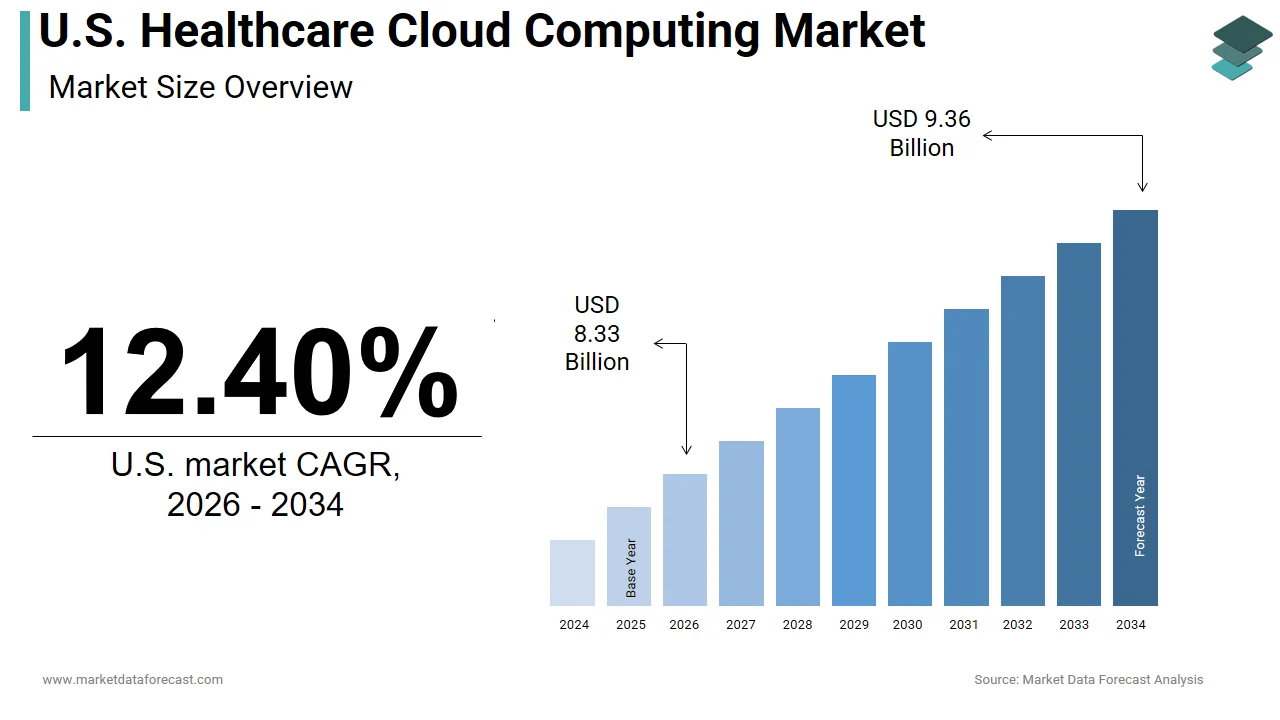
- Market Valuation: Valued at USD 7.41 billion (2025), estimated at USD 8.33 billion (2026), and projected to reach USD 21.22 billion by 2034, registering a robust CAGR of 12.4% (2026–2034).
- Primary Growth Drivers: Growing adoption of electronic health records (EHRs) by physicians (~4 out of 5 U.S. physicians use EHRs), rising deployment of digital healthcare platforms like telehealth and e-health services, increasing prevalence of chronic diseases requiring remote patient monitoring, and integration of advanced technologies like artificial intelligence (AI) and machine learning. Major restraints include strict data privacy and security concerns, lack of standardization, limited interoperability, and resistance to new technology adoption among healthcare providers.
Key Market Segment Metrics (2026–2034)
| Category | Leading Segment (2025 Position) | Fastest-Growing Segment |
|---|---|---|
| By Product | Healthcare Provider Solutions (Clinical Information Systems including EHR/EMR and Telehealth Solutions) | Population Health Management (PHM) and Telehealth Solutions |
| By Deployment Model | Private Cloud (traditionally preferred for handling sensitive, secure patient data and compliance mandates) | Hybrid Cloud (expanding due to flexibility, scalability, and cost efficiency) |
| By Service Model | Software-as-a-Service (SaaS) (led market adoption across hospitals and clinics) | Infrastructure-as-a-Service (IaaS) and Platform-as-a-Service (PaaS) |
| By Component | Services (implementation, consulting, and ongoing maintenance) | Software solutions integrated with AI and data analytics |
| By Country / Region | United States (representing 100% of the national market scope, driven by widespread digital infrastructure and EHR mandates) | Ambulatory surgical centers and outpatient care facilities nationwide |
Major Market Players & Market Structure
Market Structure: Highly competitive and evolving ecosystem featuring major technology giants, specialized health IT vendors, and cloud service providers competing on secure EHR infrastructure, AI-driven clinical analytics, interoperability, and regulatory compliance.
Key Companies: IBM, CareCloud Corporation, Agfa-Gevaert N.V., Merge Healthcare Inc., Carestream Corporation, Cerner Corporation, Microsoft Corporation, Oracle Corporation, ClearData Networks Inc., Sectra AB, Nuance Communications, G.E. Healthcare, athenahealth Inc., NextGen Healthcare, Siemens Healthineers, and Dell Inc.
U.S. Healthcare Cloud Computing Market Size
The U.S. healthcare cloud computing market was valued at USD 7.41 billion in 2025. The market is estimated at USD 8.33 billion in 2026 and is projected to reach USD 21.22 billion by 2034, growing at a CAGR of 12.4% from 2026 to 2034.
The growing adoption of electronic health records (EHRs) in hospitals and clinics across the U.S. is one of the major factors propelling the U.S. healthcare cloud computing market. Almost four out of five physicians in the United States use EHRs. These records serve as a comprehensive repository of patient data, encompassing critical information such as treatment plans, immunization schedules, health reports, allergies and diagnostic images. Given the large amount of data stored in EHRs, cloud computing has emerged as a viable solution to facilitate secure and efficient storage and retrieval of patient data. The cloud-based infrastructure allows healthcare providers and insurance companies to store EHR data in a centralized database that can be accessed remotely via a network. The quick access to patient information from EHRs enables healthcare providers to make informed decisions for better patient outcomes. The increasing use of EHRs and cloud computing in healthcare underscores the growing need for modernizing healthcare delivery and information management systems. As a result, healthcare organizations invest in various types of EHRs and cloud-based technologies to enhance patient care, drive operational efficiency, and ensure data security and privacy.
The growing use of digital healthcare platforms such as e-health and telehealth services by the U.S. population contributes to the growth of the U.S. healthcare cloud computing market. Cloud computing is an optimal remedy for addressing digital healthcare issues. In the wake of the COVID-19pandemic, a significant portion of the population and the healthcare industry has embraced digital platforms to mitigate the spread of the virus. Telehealth provides an avenue for patients to receive treatment through video or audio-based calls. Patients residing in remote areas and far from hospitals stand to benefit immensely from telehealth technology. In view of the rising cases of chronic illnesses such as cardiovascular disease, diabetes, and hypertension, individuals are increasingly utilizing remote patient monitoring devices to track their health status. The data obtained from these devices are stored in the cloud, which can be accessed by healthcare providers and patients from any location at any time through the user's ID.
The adoption of cloud computing by the healthcare industry in the U.S. is on the rise and this trend is poised to continue and result in U.S. market growth during the forecast period. Among the advanced technologies fueling this growth are artificial intelligence and machine learning, which play a vital role in cloud computing services. These technologies facilitate clinical decision-making processes and enable the retrieval of patient information from vast troves of data, driving efficiencies and improving patient outcomes.
The growing need for cost-efficient healthcare delivery systems, rising chronic diseases, increasing need for remote patient monitoring, rising trend of telehealth and virtual care services and regulatory mandates for ensuring data security and privacy boost the growth rate of the U.S. healthcare cloud computing market. Furthermore, an increasing number of collaborations and partnerships between healthcare providers and cloud computing vendors, rising emphasis on data analytics and population health management and the availability of large volumes of healthcare data for analysis and storage in the cloud fuel the U.S. healthcare cloud computing market growth.
Concerns regarding data privacy and security, especially with the sensitive nature of healthcare data and lack of standardization in cloud computing solutions for the healthcare industry majorly hamper the growth of the U.S. healthcare cloud computing market. In addition, resistance to change and adoption of new technologies among healthcare providers, limited technical expertise among healthcare professionals in managing cloud-based systems and potential issues with connectivity and bandwidth in remote and rural areas that can affect the delivery of cloud-based healthcare services hinder the U.S. market growth. Furthermore, limited interoperability between different EHR systems and cloud-based platforms, regulatory barriers such as restrictions on data storage and sharing across the state and national borders, issues related to data ownership and control particularly when using third-party cloud computing vendors and concerns about the reliability and availability of cloud-based systems in critical situations such as natural disasters or cyber-attacks impede the growth rate of the U.S. market.
This research report on the United States healthcare cloud computing market has been segmented & sub-segmented into the following categories.
By Product:
- Healthcare Provider Solutions
- Clinical Information Systems (CIS)
- EHR/EMR
- PACS and VNA
- RIS
- LIS
- PIS
- PHM Solutions
- Telehealth Solutions
- Other CIS
- Non-clinical Information Systems (NCIS)
- RCM Solutions
- Financial Management Solutions
- HIE Solutions
- Supply Chain Management Solutions
- Billing & Accounts Management Solutions
- Other NCIS
- Clinical Information Systems (CIS)
- Healthcare Payer Solutions
- Claims Management Solutions
- Payment Management Solutions
- Customer Relationship Management Solutions
- Provider Network Management Solutions
- Fraud Management Solutions
By Deployment Model:
- Private Cloud
- Hybrid Cloud
- Public Cloud
By Component:
- Services
- Software
By Pricing Model:
- Pay-as-you-go
- Spot Pricing
By Service Model:
- Software-as-a-Service (SaaS)
- Infrastructure-as-a-Service (IaaS)
- Platform-as-a-Service (PaaS) Payers
By Country:
- United States
KEY MARKET PLAYERS:
A few of the promising companies operating in the U.S. healthcare cloud computing market profiled in this report are IBM, CareCloud Corporation, Agfa-Gevaert N.V., Merge Healthcare Inc., Carestream Corporation, Cerner Corporation, Microsoft Corporation, Oracle Corporation, ClearData Networks Inc., Sectra AB, Nuance Communications, G.E. Healthcare, athenahealth Inc., NextGen Healthcare, Siemens Healthineers, and Dell Inc.