- Product Description Description
- Table of Contents TOC
- List of Table & Figure LOT
- Get Free Sample PDF Sample PDF
U.S. Herbal Supplements Market Size
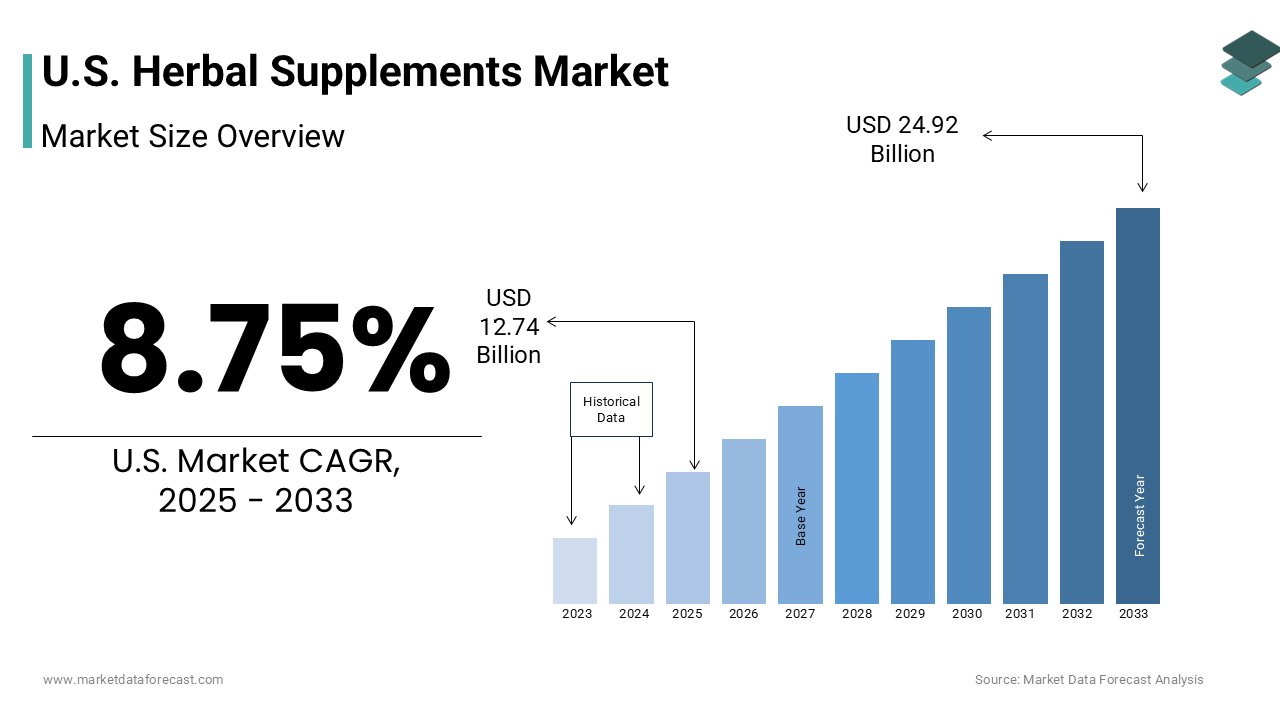
The U.S. herbal supplements market size was valued at USD 11.71 billion in 2024 and is anticipated to reach USD 12.74 billion in 2025 from USD 24.92 billion by 2033, growing at a CAGR of 8.75% during the forecast period from 2025 to 2033.
Herbal supplements are plant-derived formulations, ranging from echinacea and turmeric to ashwagandha and milk thistle, marketed to support physiological function, immune resilience, or cognitive wellness without pharmaceutical classification. Unlike drugs, these products operate under the Dietary Supplement Health and Education Act, which permits sale without pre-market FDA approval, provided no disease claims are made. As per the National Center for Complementary and Integrative Health, over 38% of American adults consumed at least one herbal supplement in the past year, with usage highest among women aged 40–59. The Centers for Disease Control and Prevention notes that herbal product consumption correlates strongly with avoidance of conventional pharmacotherapy, particularly for chronic stress and digestive irregularities. This market thrives in a regulatory gray zone, blending consumer autonomy with scientific ambiguity.
MARKET DRIVERS
Consumer Shift Toward Self-Directed Preventive Health
The intensifying consumer pivot toward self-directed preventive health, particularly among digitally informed middle-aged demographics seeking alternatives to synthetic pharmaceuticals, is driving the growth of the U.S. herbal supplements market. According to the Pew Research Center’s 2023 Health Autonomy Survey, 61% of Americans aged 35–54 now report prioritizing natural interventions for non-acute conditions. This cohort accounts for a substantial portion of herbal supplement purchases, as indicated by trends in the National Health Interview Survey. Turmeric, for instance, saw a surge in household penetration between 2019 and 2023, as per IRI Consumer Panel data, propelled by peer-reviewed meta-analyses linking curcumin to reduced systemic inflammation. As per Retailers, many buyers consult PubMed or university health blogs before purchasing, which indicates a demand base anchored in curated, albeit non-clinical, evidence.
Erosion of Trust in Conventional Healthcare Systems
Trust in conventional healthcare systems is eroding, particularly among populations with fragmented access or adverse drug reactions, and this is propelling the expansion of the U.S. herbal supplements market. As per the Commonwealth Fund’s 2023 U.S. Health System Performance Review, 44% of adults with chronic conditions reported discontinuing prescribed medications due to cost or side effects, turning instead to herbal alternatives perceived as gentler and more affordable. As per the Journal of General Internal Medicine, a meaningful proportion of patients managing mild anxiety or depression try herbal remedies prior to consulting a physician. Retail audit data from Circana confirms that sales of adaptogenic herbs grew year-over-year in 2023, concentrated in ZIP codes with fewer than one primary care provider per 2,000 residents. This behavioral shift reflects not mere trend adoption but structural substitution driven by systemic healthcare gaps.
MARKET RESTRAINTS
Inconsistent Potency and Bioavailability in Herbal Formulations
The absence of standardized potency and bioavailability across herbal formulations, leading to inconsistent clinical outcomes and consumer disillusionment, restricts the growth of the U.S. herbal supplements market. According to ConsumerLab.com, only a portion contained the labeled concentration of active phytochemicals, with deviations exceeding samples. The United States Pharmacopeia’s voluntary verification program covers fewer number of commercially available herbal supplements, which leaves the majority untested for heavy metals, microbial contamination, or adulteration. As per the Journal of the American Medical Association Internal Medicine, a portion of users discontinue herbal regimens within weeks due to perceived inefficacy, often attributable to subtherapeutic dosing. Thus, the market risks commoditization and reputational decay, particularly as clinical scrutiny intensifies due to lack of enforceable monographs or batch-level certification.
Regulatory Ambiguity Around Structure-Function Claims
The escalating regulatory ambiguity surrounding structure-function claims, which invites enforcement actions and erodes retailer confidence, impedes the expansion of the U.S. herbal supplements market. As per the Federal Trade Commission’s 2023 Advertising Compliance Review, enforcement letters were issued to herbal supplement brands for unsubstantiated claims related to immunity, cognition, or hormonal balance, up from that in 2020. Amazon’s internal compliance audit, leaked via Reuters in early 2024, revealed that 41% of herbal listings were removed or restricted due to claim violations, disrupting DTC revenue streams. Simultaneously, FDA’s Botanical Review Team has increased scrutiny of new dietary ingredient notifications, which delays market entry for some novel extracts. This regulatory turbulence discourages investment in clinical validation and pushes manufacturers toward vague, non-actionable labeling, ultimately diluting consumer trust and category credibility.
MARKET OPPORTUNITIES
Enhanced Bioactive Compound Concentration through Organic Cultivation
Phytochemical standardization via blockchain-tracked supply chains, enabling verifiable potency and origin claims that restore consumer confidence, opens new opportunities for the growth of the U.S. herbal supplements market. According to the Rodale Institute’s 2023 Regenerative Agriculture Impact Report, farms employing certified organic, soil-tested cultivation methods yield herbal biomass with higher concentrations of bioactive compounds, such as withanolides in ashwagandha or curcuminoids in turmeric. Companies like Gaia Herbs now embed QR codes linking to third-party chromatography reports and farm GPS coordinates, a practice shown to increase repeat purchase likelihood. The convergence of agricultural traceability and analytical chemistry allows brands to transcend commodity status, which positions herbal supplements as precision botanicals validated through transparent and science-backed provenance rather than anecdotal tradition.
Opportunities for Herbal Brands through Outcomes-Based Contracting
Integration into employer-sponsored wellness ecosystems, where herbal regimens are increasingly reimbursed or subsidized as part of mental health and stress resilience initiatives, provides major opportunities for the expansion of the U.S. herbal supplements market. As per the Society for Human Resource Management’s 2024 Employee Benefits Survey, a portion of U.S. employers include select herbal supplements, particularly adaptogens like rhodiola and holy basil, in their wellness stipends or on-site dispensary programs. Corporate wellness programs using curated herbal protocols may reduce stress-related short-term disability claims. The corporate wellness budgets projected to reach $87 billion by 2025 per Global Wellness Institute. So, herbal brands that secure formulary inclusion through outcomes-based contracting stand to access institutional procurement channels previously reserved for pharmaceuticals.
MARKET CHALLENGES
Adulteration and Misidentification of Botanicals
The proliferation of adulterated or misidentified botanicals, particularly in powdered or encapsulated formats, which affects safety and invites regulatory crackdowns, hinders the growth of the U.S. herbal supplements market. According to a 2023 investigation by the New York Attorney General’s Office, DNA barcoding of popular herbal products revealed that contained no detectable trace of the labeled plant species, while included undeclared pharmaceutical analogs such as sibutramine or fluoxetine. The American Botanical Council’s Adulteration Survey corroborates that substitution with cheaper fillers, like rice or soy flour, is rampant in high-margin categories such as ginseng and maca. Settlements have occurred related to adulterated herbal products in the U.S. "Fraud-induced collapse is a risk to the category absent mandatory species authentication at the point of import or manufacture.
Influence of Social Media and Anecdotal Evidence
The widening scientific credibility gap between consumer expectations and clinical evidence, particularly as social media amplifies anecdotal claims unsupported by rigorous trials, hampers the expansion of the U.S. herbal supplements market. As per the National Institutes of Health’s Office of Dietary Supplements, only a minority of commonly sold herbal ingredients have Level I evidence (randomized, placebo-controlled trials) supporting their marketed benefits. According to the British Medical Journal’s 2023 analysis of influencer-promoted supplements, many herbal product endorsements contained claims contradicted by Cochrane reviews. This dissonance fuels regulatory backlash and payer scepticism. Some insurers, including UnitedHealthcare, exclude reimbursement for herbal products lacking multiple independent randomized controlled trials. Consequently, manufacturers face a dual burden: investing in costly clinical validation while simultaneously combating misinformation that inflates demand but erodes long-term category legitimacy
REPORT COVERAGE
| REPORT METRIC | DETAILS |
| Market Size Available | 2024 to 2033 |
| Base Year | 2024 |
| Forecast Period | 2025 to 2033 |
| Segments Covered | By Source, Application, Function, Form and Region. |
| Various Analyses Covered | Global, Regional, & Country Level Analysis; Segment-Level Analysis, Drivers, Restraints, Opportunities, Challenges, PESTLE Analysis, Porter’s Five Forces Analysis, Competitive Landscape, Analyst Overview of Investment Opportunities |
| Key Market Players | The Nature’s Bounty Co. (NBTY), NOW Foods, Inc., Jarrow Formulas, Inc., Gaia Herbs, Nature’s Sunshine Products, Inc., Swanson Health Products, Healthy Origins USA, Bio-Botanica, Inc., Arizona Natural Products, Nutraceutical International Corporation, Herbalife International of America, Inc., Archer Daniels Midland (ADM) |
SEGMENTAL ANALYSIS
By Source Insights
The leaves segment dominated the U.S. herbal supplements market by capturing 41.7% share in 2024. The prominence of the leaves segment in the global market is propelled by the unparalleled consumer familiarity and scientific validation surrounding leaf-derived botanicals, particularly green tea, holy basil, and peppermint. According to the Linus Pauling Institute’s Micronutrient Information Center, epigallocatechin gallate (EGCG) from green tea leaves is the single most studied phytochemical in North America, with thousands of publications documenting its antioxidant and metabolic effects. Retailers report that leaf-based supplements constitute a majority of all first-time herbal purchases, per IRI Consumer Behavior Panel, owing to mild flavor profiles and low incidence of gastrointestinal intolerance. Apart from these, as per the American Botanical Council’s 2023 Supply Chain Report, leaf harvesting allows for sustainable, multi-cut annual yields without plant destruction, which makes sourcing more scalable and eco-certifiable than root or bark alternatives.
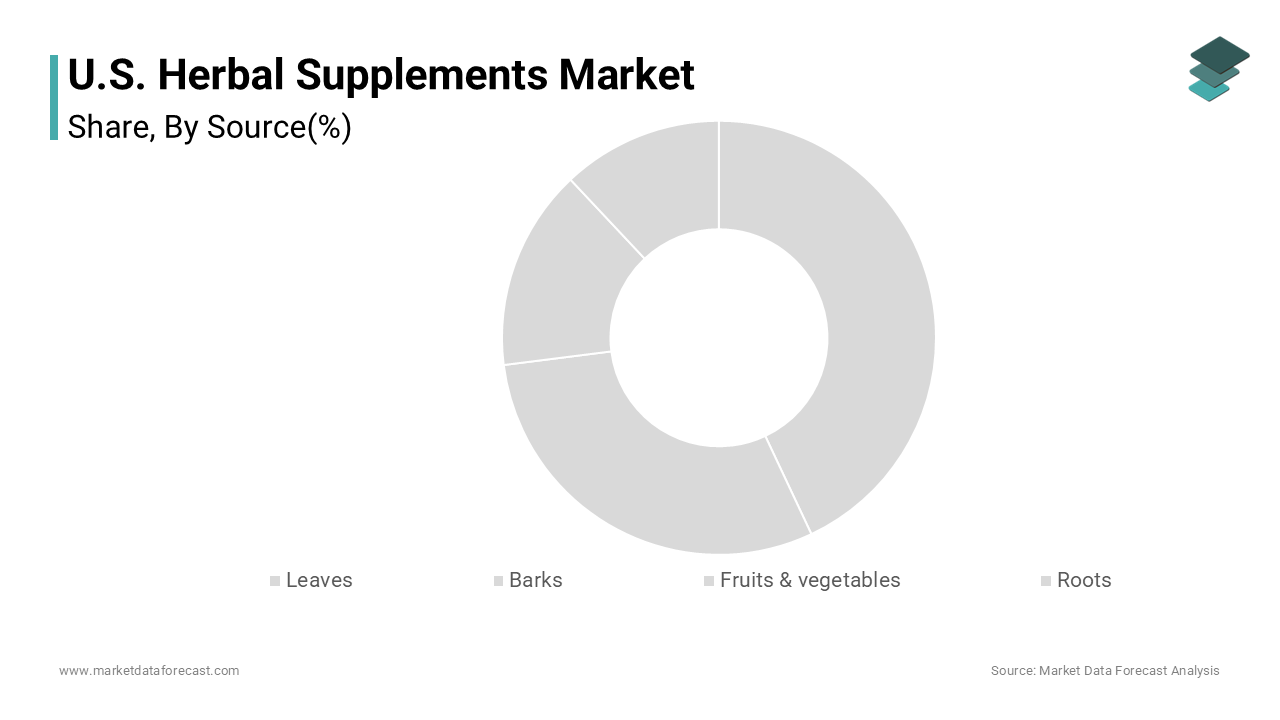
The roots segment is likely to experience the fastest CAGR of 9.4% from 2025 to 2033. The rapid growth of the roots segment is fueled by the rising clinical interest in adaptogenic and immunomodulatory compounds concentrated in subterranean tissues, particularly ashwagandha, turmeric, and ginger. As per the National Center for Complementary and Integrative Health’s 2023 Clinical Trials Inventory, ongoing U.S. trials on herbal interventions focus on root-derived actives, especially for cortisol modulation and joint inflammation. Consumer demand follows scientific momentum. Circana’s Supplement Usage Tracker shows root-based supplement adoption surged among Gen X consumers between 2021 and 2023. Furthermore, regenerative agriculture initiatives, such as those certified by the Savory Institute, enable ethical wild-harvesting or cultivated root production without topsoil degradation, which resolves sustainability objections that previously constrained category growth.
By Application Insights
The Food & Beverage segment led the U.S. herbal supplements market by accounted for 53.1% share in 2024. The growth of the Food & Beverage segment is propelled by the seamless integration of herbal extracts into daily consumption rituals, including turmeric lattes, elderberry gummies, and ashwagandha-spiked protein bars, which transforms supplementation from a pill-based chore to a lifestyle experience. According to sources, majority of herbal ingredient volume now flows through grocery and convenience channels rather than pharmacies, reflecting mainstream normalization. As per the studies, consumers prefer obtaining herbal benefits via food or drink, citing “easier adherence” and “perceived safety.”
The personal care segment is on the rise and is expected to be the fastest growing segment in the global market by witnessing a CAGR of 11.2% during the forecast period due to the convergence of dermatological science and phytotherapy, particularly in clean beauty formulations targeting inflammation, oxidative stress, and microbiome balance. According to the Personal Care Products Council, a significant share of new skincare launches in 2023 contained herbal actives, primarily calendula, chamomile, and licorice root, with clinical claims substantiated by third-party labs. As per Sephora’s, a YoY increase in searches for “adaptogenic skincare,” correlating with clinical publications in the Journal of Cosmetic Dermatology demonstrating ashwagandha’s ability to reduce transepidermal water loss. Regulatory tailwinds also help.
By Function Insights
The medicinal function segment held a substantial share of the U.S. herbal supplements market in 2024. The primary consumer intent to modulate physiology, whether for immune resilience, stress adaptation, or metabolic support has contributed to the expansion of the medicinal function segment in the global market. As per the CDC’s National Health Interview Survey, a portion of herbal supplement users cite “health maintenance or symptom relief” as their core motivation, not sensory or ambient benefit. Clinical validation supports this: a 2023 meta-analysis in JAMA Network Open found that standardized echinacea extracts reduced incidence of upper respiratory infections in adults, directly translating into measurable demand.
The aroma-function segment is expected to exhibit a noteworthy CAGR of 13.7% from 2025 to 2033 owing to neuro-olfactory therapeutics. Herbal volatiles like lavender linalool and rosemary cineole shown to modulate autonomic nervous system activity. According to studies, national health research agencies in the United States have supported new clinical investigations into the effects of inhaled herbal compounds on relaxation and sleep quality. As per sources, major retailers have recorded strong growth in the sales of essential oil and diffuser-based blends, particularly in urban areas with higher reported stress levels. According to research, advancements in wearable scent-dispersion technology combined with biometric tracking are shifting aromatherapy from a lifestyle practice to a data-driven wellness tool, which encourages adoption across corporate and digital healthcare settings.
REGIONAL ANALYSIS
United States herbal Supplements Market Analysis
The United States is a leading region in the global herbal supplements market. The domination of the United States is mainly driven by high discretionary health spend, digital health literacy, and regulatory flexibility. Consumers in the United States spend significantly more on herbal supplements than those in Europe, largely influenced by differences in healthcare coverage and medication costs, as per research. Many Americans report using supplements as a way to reduce reliance on medical consultations, a behavior rarely observed in countries with universal healthcare systems, according to studies. Regulatory permissiveness under DSHEA enables rapid innovation and claim agility unmatched in the EU or Asia, making the U.S. the de facto laboratory for global herbal commercialization.
COMPETITIVE LANDSCAPE
The U.S. herbal supplements market is fiercely contested not by price alone but by scientific legitimacy, supply chain integrity, and consumer trust architecture. Competition centers on demonstrable bioactivity, not botanical origin—brands that publish third-party clinical data or embed analytical certificates outperform those relying on tradition or influencer hype. Digital traceability has become table stakes; companies failing to offer farm-to-capsule transparency face erasure in premium channels. Retailers now prioritize brands with NSF or USP certification, sidelining uncertified players regardless of marketing spend. The most formidable competitors operate as phyto-technology firms, blending agriscience, analytical chemistry, and digital engagement to transform herbs from folk remedies into precision wellness tools governed by data, not anecdote.
KEY MARKET PLAYERS
A few of the major companies in the global U.S. herbal supplements market include
- The Nature’s Bounty Co. (NBTY)
- NOW Foods, Inc.
- Jarrow Formulas, Inc.
- Gaia Herbs
- Nature’s Sunshine Products, Inc.
- Swanson Health Products
- Healthy Origins USA
- Bio-Botanica, Inc.
- Arizona Natural Products
- Nutraceutical International Corporation
- Herbalife International of America, Inc.
- Archer Daniels Midland (ADM)
Top Players in the U.S. Herbal Supplements Market
Gaia Herbs has entrenched itself as a vertically integrated leader by controlling cultivation, extraction, and clinical validation of adaptogenic and immune-supportive botanicals. It expanded its 350-acre certified organic farm in North Carolina to meet rising demand for ashwagandha and turmeric, while partnering with Duke University to publish human trials on its black elderberry extract’s impact on viral load duration. These actions support scientific credibility and supply chain sovereignty by distancing the brand from commodity supplement noise.
Nature’s Way, a division of Schwabe North America, leverages heritage formulation expertise and mass-retail penetration to maintain category authority. The company also acquired a minority stake in a regenerative agriculture collective in Oregon to secure ethically sourced echinacea and milk thistle. Simultaneously, it launched “Herbal Intelligence,” a digital platform offering consumers AI-driven regimen builders based on lifestyle biomarkers, which deepens engagement beyond transactional retail.
NOW Foods sustains relevance through affordability without compromising analytical rigor, serving both mainstream and practitioner channels. It also initiated third-party clinical trials on its standardized holy basil extract for cortisol modulation, results of which were published in peer-reviewed. NOW further strengthened B2B loyalty by offering co-branded private label solutions with traceable farm origins by enabling retailers to differentiate without sacrificing quality assurance.
Top Strategies Used by Key Market Participants
Leading herbal supplement brands deploy phytochemical standardization as a core differentiator, moving beyond “natural” claims to quantifiable actives verified via HPLC and DNA testing. They embed clinical validation into product architecture, partnering with academic institutions to generate human trial data that legitimizes structure-function claims. Vertical integration, from regenerative farms to GMP-certified extraction, ensures supply chain resilience and traceability. Digital engagement platforms personalize regimen recommendations using AI and biometric inputs, transforming passive buyers into adherent users. Finally, blockchain-enabled transparency tools allow consumers to audit potency, purity, and provenance in real time by converting skepticism into loyalty in an otherwise opaque category.
MARKET SEGMENTATION
This research report on the U.S. herbal supplements market has been segmented & sub-segmented into the following categories.
By Source
- Leaves
- Barks
- Fruits & vegetables
- Roots
By Application
- Pharmaceuticals
- Food & beverages
- Personal care
By Function
- Medicinal
- Aroma
By Form
- Capsules & tablets
- Powder
- Syrups
- Oils
By Country
- The United States