- Product Description Description
- Table of Contents TOC
- List of Table & Figure LOT
- Get Free Sample PDF Sample PDF
Market Size, 2025
$1.16 BnMarket Estimate, 2026
$1.23 BnMarket Forecast, 2034
$1.95 BnCAGR, 2026–2034
5.92%Executive Summary: U.S. Hospital Beds Market
- Market Scope: Comprehensive U.S. hospital beds market analysis covering usage types, power configurations, end-user facilities, regional dynamics, and technological and manufacturing advancements.
- Market Valuation: Valued at USD 1.16 billion (2025), estimated at USD 1.23 billion (2026), and projected to reach USD 1.95 billion by 2034, registering a solid CAGR of 5.92% (2026–2034).
- Primary Growth Drivers: Rising prevalence of chronic diseases affecting ~133 million Americans, growing geriatric population requiring specialized fall-prevention and smart beds, and an increasing incidence of road accidents, burn injuries, and infections. Key operational and technology metrics include the integration of advanced robotic and sensor technologies, foam-based pressure-relief mattresses, and expanding home healthcare utilization following the COVID-19 pandemic.
Key Market Segment Metrics (2026–2034)
| Category | Leading Segment (2025 Position) | Fastest-Growing Segment |
|---|---|---|
| By Usage | Acute care beds (held the dominant position for managing high-acuity and emergency admissions) | Long-term and psychiatric care beds (expanding due to rising chronic illness and geriatric care needs) |
| By Power | Electric Bed (dominated market demand owing to advanced patient safety and automated adjustments) | Semi-Electric Bed (growing rapidly as a cost-effective alternative for home and sub-acute care) |
| By End-User | Hospitals (represented the largest end-user segment backed by advanced healthcare infrastructure) | Ambulatory services and home healthcare settings (driven by post-surgery home care trends) |
| By Country | The United States (held the leading worldwide share with advanced healthcare facilities and stringent patient safety rules) | The United States (projected to sustain continuous high-demand growth throughout the forecast period) |
Major Market Players & Market Structure
Market Structure: Highly competitive U.S. landscape featuring key medical bed manufacturers competing on product innovations, smart hospital integrations, enhanced safety features, sensor technology, and strategic market expansion.
Key Companies: Invacare Corporation, Paramount Bed Holdings Co. Ltd., Gendron Inc., Medline Industries Inc., LINET spol. s r.o., Savaria Corporation, Savion Industries, Hill-Rom Holdings Inc., Stryker Corporation, and Getinge Group.
 Download Free Sample Report
U.S. Hospital Beds Market Size
The U.S. hospital beds market was valued at USD 1.16 billion in 2025. The market is estimated at USD 1.23 billion in 2026 and is projected to reach USD 1.95 billion by 2034, growing at a CAGR of 5.92% from 2026 to 2034.
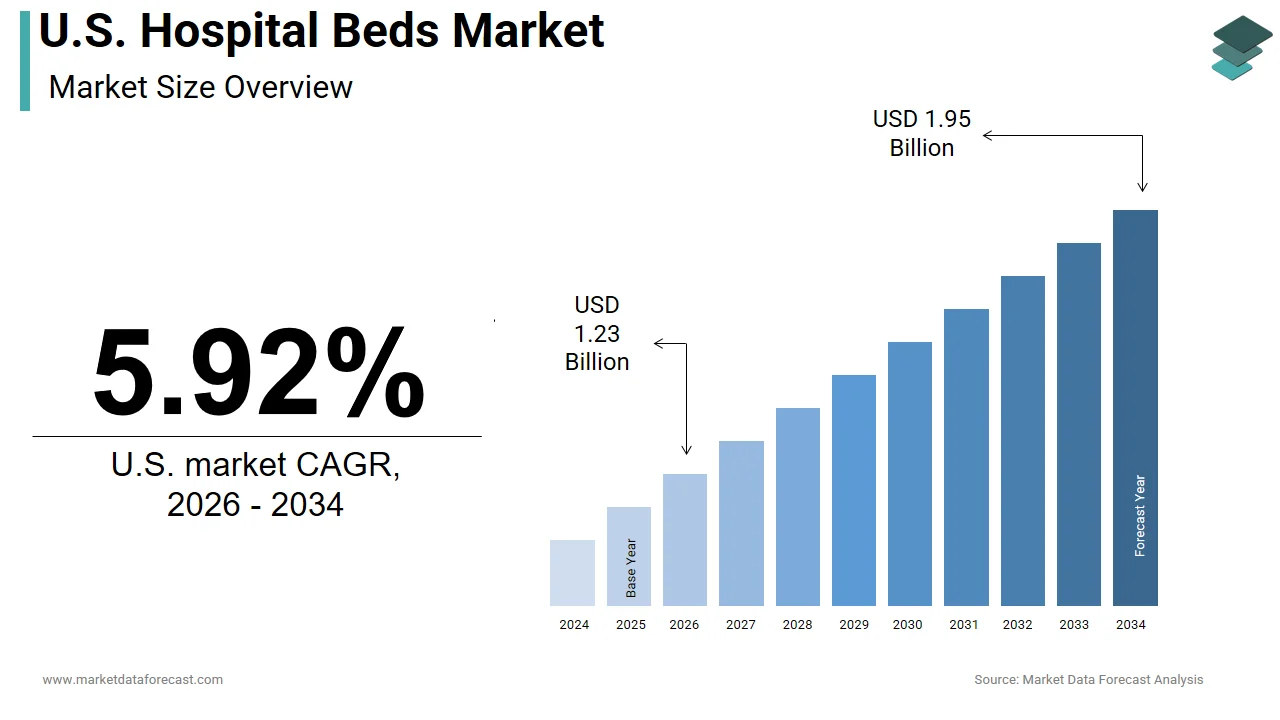
Hospital beds are specialized medical furniture designed for patient care in acute care, long-term care, and home health settings. These beds feature adjustable mechanisms, safety rails, and integrated monitoring systems to enhance patient comfort and clinical efficiency. The vast inventory necessitates continuous replacement and upgrades to meet evolving safety standards and technological advancements. As per the American Hospital Association, the average length of stay for Medicare beneficiaries is 55 days, indicating high turnover rates that drive demand for durable and easily sanitizable bed designs. Modern hospital beds integrate with electronic health records to track patient movement and prevent pressure ulcers, thereby improving outcomes. As the population ages, the need for bariatric and intensive care beds increases significantly. Manufacturers focus on ergonomic designs that reduce caregiver strain and prevent workplace injuries.
MARKET DRIVERS
Aging Population and Rising Chronic Disease Prevalence
The rapidly aging population is creating sustained demand for specialized care equipment in hospitals and long-term facilities, which is a major factor boosting the growth of the US hospital beds market. Older adults are more susceptible to chronic conditions, such as heart disease, diabetes, and mobility issues, which require prolonged hospitalization and supportive bedding solutions. According to the U.S. Census Bureau, the number of people aged 65 and older is projected to reach 95 million by 2060, representing nearly one quarter of the total population. According to the National Council on Aging, 6 in 10 adults in the United States have at least one chronic disease, while 4 in 10 have two or more, necessitating extensive medical intervention. Hospitals must upgrade their fleets to handle higher patient volumes and complex care requirements efficiently. Advanced beds with pressure redistribution features help prevent bedsores, which are common among immobile elderly patients. The increasing prevalence of obesity also boosts demand for heavy-duty beds capable of supporting higher weight limits safely.
Technological Advancements in Smart Hospital Infrastructure
The integration of advanced technology into healthcare facilities by enhancing patient monitoring and improving clinical workflow efficiency that is accelerating the growth of the US hospital beds market. Modern smart beds are equipped with sensors that track patient movement, vital signs, and exit alerts, which integrate seamlessly with hospital information systems. The digital transformation encourages facilities to replace traditional beds with intelligent models that provide real-time data to nursing stations. The smart bed technology can reduce patient fall rates by alerting staff immediately when a patient attempts to leave the bed unsupervised. These safety features are crucial for reducing liability and improving patient outcomes in busy hospital environments. Additionally, smart beds help optimize staffing by automating routine checks, allowing nurses to focus on critical care tasks. The ability to monitor pressure points remotely helps prevent pressure ulcers, reducing treatment costs and length of stay.
MARKET RESTRAINTS
High Capital Expenditure and Budget Constraints
The substantial acquisition costs are limiting the ability of healthcare facilities, particularly smaller rural hospitals, to upgrade their equipment fleets, which is degrading the growth of the US hospital beds market. Advanced smart beds and bariatric models command premium prices that may exceed the financial capabilities of institutions operating on thin margins. This financial constraint forces many facilities to extend the lifespan of existing beds through repairs rather than purchasing new units. The operating margins for US hospitals have declined significantly in recent years, prompting administrators to prioritize essential clinical supplies over infrastructure upgrades. High maintenance costs for complex electronic beds further add to the total cost of ownership, discouraging widespread adoption. Reimbursement rates from government payers like Medicare often do not cover the full cost of advanced equipment, leaving hospitals to absorb the difference. Without adequate funding or grants, smaller providers struggle to keep pace with technological advancements.
Stringent Regulatory Compliance and Safety Standards
The rigorous regulatory requirements by imposing strict safety and performance standards that increase manufacturing complexity and time is additionally hampering the growth of the US hospital beds market. Manufacturers must comply with regulations set by the Food and Drug Administration and international standards organizations, which mandate rigorous testing for electrical safety, mechanical stability, and infection control. The regulatory hurdles require significant investment in research, development, and quality assurance processes, raising production costs for manufacturers. The Association for the Advancement of Medical Instrumentation emphasizes that compliance with updated electrical safety standards often requires redesigning existing models, delaying product launches. Healthcare providers also face strict accreditation standards from The Joint Commission, which require regular inspection and maintenance of bed equipment to ensure patient safety. Failure to meet these standards can result in fines, loss of accreditation, or legal liability. The complexity of navigating varying state and federal regulations creates administrative burdens for both manufacturers and buyers.
MARKET OPPORTUNITIES
Expansion of Home Healthcare Services
The growing preference for home-based care is solely to fuel new opportunities for the growth of the US hospital beds market. Patients with chronic conditions or those recovering from surgery increasingly choose to receive care at home to reduce costs and improve comfort. The trend creates substantial demand for lightweight, adjustable, and aesthetically pleasing hospital beds suitable for domestic environments. Manufacturers can capitalize on this by developing beds that blend with home decor while offering clinical features such as pressure relief and easy positioning. Insurance coverage for durable medical equipment in home settings further facilitates adoption by reducing out-of-pocket costs for patients. Partnerships with home health agencies and medical supply distributors can expand market reach beyond traditional hospital channels. As the aging population seeks to age in place, the demand for high-quality home care beds continues to rise, establishing a lucrative segment for industry players.
Integration with Internet of Things and Remote Monitoring
The emergence of hospital beds with Internet of Things technology, enabling proactive patient care and data-driven decision-making, is also to bolster the growth of the US hospital beds market. Smart beds equipped with connectivity modules can transmit real-time data on patient status, bed occupancy, and maintenance needs to central management systems. This connectivity allows hospitals to optimize bed utilization rates, reduce wait times, and improve staff allocation through predictive analytics. Healthcare providers can leverage aggregated data to identify trends in patient movement and pressure distribution by enhancing clinical protocols for injury prevention. Remote monitoring capabilities also support telehealth initiatives by allowing clinicians to assess patient conditions without physical presence. As 5G networks expand, the reliability and speed of data transmission will further enhance the capabilities of connected beds.
MARKET CHALLENGES
Supply Chain Disruptions and Raw Material Shortages
The supply chain vulnerabilities are causing delays in production and increasing costs for manufacturers reliant on imported components, which is a major challenge for the growth of the US hospital beds market. Shortages of steel, electronics, and specialized plastics have disrupted the manufacturing of hospital beds, leading to longer lead times for customers. These delays hinder the ability of hospitals to expand capacity or replace aging equipment quickly in response to surging patient demand. Bed manufacturers struggle to source necessary parts for their own assemblies, creating bottlenecks that ripple through the entire healthcare ecosystem. Customers face extended wait times for new installations or upgrades, forcing them to rely on older, less efficient models. This instability undermines confidence in the reliability of supply chains and encourages companies to seek alternative sourcing strategies or hold larger inventory buffers, increasing working capital requirements.
Workforce Shortages and Training Gaps
A deficit of skilled healthcare personnel is complicating the effective operation and maintenance of advanced medical equipment and is also contributing to the decline in the growth of the US hospital beds market. Proper use of smart beds requires comprehensive training to utilize features such as automatic adjustments, monitoring systems, and safety alerts, which many staff members lack due to inadequate educational programs. The workforce gap leads to underutilization of advanced features or improper usage that can compromise patient safety and device longevity. The turnover rates in healthcare remain high, requiring constant retraining efforts that divert resources from direct patient care. Without sufficient staff, hospitals struggle to maintain rigorous protocols for equipment management, increasing the risk of errors despite having advanced tools. Training programs are often resource-intensive and time-consuming, adding to the operational burden on already stretched teams. High turnover rates among healthcare professionals further disrupt continuity of care and require constant retraining efforts.
REPORT COVERAGE
| REPORT METRIC | DETAILS |
| Market Size Available | 2025 to 2034 |
| Base Year | 2025 |
| Forecast Period | 2026 to 2034 |
| Segments Covered | By Usage, Power, End-Users, and Country. |
| Various Analyses Covered | Global, Regional, and Country-Level Analysis, Segment-Level Analysis, Drivers, Restraints, Opportunities, Challenges; PESTLE Analysis; Porter’s Five Forces Analysis, Competitive Landscape, Analyst Overview of Investment Opportunities |
| Countries Covered | New York, Massachusetts, Pennsylvania, Illinois, Ohio, Michigan, Texas, Florida, Georgia, California, Washington, Colorado. |
| Market Leaders Profiled | Invacare Corporation, Paramount Bed Holdings Co. Ltd., Gendron Inc., Medline Industries Inc., LINET spol. S r.o., Lincoln Medical Group, Savaria Corporation, Savion Industries, Hill-Rom Holdings Inc., Stryker Corporation, and Getinge Group. |
SEGMENTAL ANALYSIS
By Usage Insights
The acute care beds segment was the largest, accounting for 56.2% of the US hospital beds market share in 2025 due to their essential role in emergency departments, intensive care units, and general medical-surgical wards. These beds are designed for short-term treatment of severe injuries or illnesses requiring immediate and intensive medical attention. According to the American Hospital Association, there were approximately 35 million admissions to U.S. hospitals in 2021, highlighting the massive volume of patients requiring acute care infrastructure. This high turnover rate drives continuous demand for durable and versatile beds that can support various clinical procedures and patient positioning needs. Heart disease and cancer remain the leading causes of death in the United States, necessitating advanced care facilities equipped with specialized beds. Acute care beds often feature integrated monitoring systems and pressure redistribution surfaces to prevent complications during extended stays. Hospitals prioritize these beds for their ability to facilitate rapid patient transfer and enhance nursing efficiency through ergonomic designs. The prevalence of trauma cases and post-surgical recovery further sustains the dominance of this segment.
The long-term care beds segment is to exhibit the fastest CAGR of 8.4% during the forecast period, with the increasing elderly population and rising prevalence of chronic conditions requiring extended supervision. These beds are specifically designed for nursing homes, assisted living facilities, and rehabilitation centers, where patients reside for prolonged periods. According to the U.S. Census Bureau, the number of Americans aged 65 and older is projected to double to 95 million by 2060, creating substantial demand for residential care solutions. This demographic shift accelerates the construction of new long-term care facilities and the renovation of existing ones with modern bedding equipment. As per the National Center for Health Statistics, over 13 million adults received long-term services and supports in 2018, indicating a robust base of users requiring specialized furniture. Long-term care beds focus on comfort, safety, and ease of use for both residents and caregivers, featuring adjustable heights and side rails to prevent falls. The growing preference for aging in place also boosts demand for home care versions of these beds. Government reimbursement policies for skilled nursing facilities further support market expansion by enabling upgrades to meet regulatory standards.
By Power Insights
The electric bed segment was the largest, holding 60.1% of the US Hospital Beds Market share in 2025 due to its superior functionality, ease of operation, and enhanced patient comfort features. These beds utilize motors to adjust height, head, and foot sections, allowing for precise positioning without physical strain on caregivers. Manual patient handling is a leading cause of workplace injuries among nurses, driving hospitals to adopt powered lifting solutions. This regulatory focus on staff safety propels the widespread replacement of manual beds with electric models in acute and critical care settings. The safe patient handling programs incorporating mechanical lifts and electric beds can reduce musculoskeletal disorders by improving workforce retention and reducing compensation claims. Electric beds also offer better clinical outcomes by enabling frequent position changes to prevent pressure ulcers and improve respiratory function. Integration with smart hospital systems allows for automated adjustments based on patient data, enhancing personalized care. Although initial costs are higher, the long-term benefits in labor savings and injury prevention justify the investment for most healthcare facilities.
The semi-electric bed segment is likely to grow at the fastest CAGR of 15.2% from 2026 to 2034, with cost-conscious buyers in long-term care facilities and home health settings. These beds combine electric adjustment for head and foot sections with manual height adjustment, offering a balance between functionality and affordability. The semi-electric beds provide essential comfort features at a lower price point than fully electric models. The reimbursement rates for durable medical equipment often favor cost-effective solutions, making semi-electric beds an attractive option for providers and patients. These beds are particularly popular in assisted living facilities where budget constraints limit the ability to purchase premium equipment while still requiring some level of automated assistance. Advances in motor reliability have improved the durability of semi-electric models, reducing maintenance concerns.
By End-User Insights
The hospitals segment held a significant share of the US Hospital Beds Market in 2025 due to their high patient volume and requirement for specialized critical care equipment. Hospitals operate intensive care units, emergency departments, and surgical wards that demand robust and technologically advanced beds for diverse medical procedures. According to the American Hospital Association, there are over 6000 registered hospitals in the United States serving millions of patients annually, creating a massive installed base for bed manufacturers. This extensive network drives consistent demand for replacements, upgrades, and expansions as facilities strive to meet accreditation standards and improve patient satisfaction. The Joint Commission mandates strict safety and hygiene protocols, which hospitals address by investing in modern beds with antimicrobial surfaces and integrated safety features. High-acuity patients require beds with advanced monitoring and pressure relief capabilities, which are predominantly supplied to hospital settings. Government funding for hospital infrastructure improvements further boosts procurement activities, especially in public and rural facilities. The concentration of skilled medical professionals in hospitals also facilitates the adoption of complex bed technologies that require specialized training.
The ambulatory services segment is projected to grow at the fastest CAGR of 8.2% during the forecast period, with the shift toward outpatient care and same-day surgical procedures. Ambulatory surgical centers and urgent care clinics are expanding rapidly to offer cost-effective and convenient alternatives to traditional hospital visits. The expansion creates new demand for lightweight and versatile beds suitable for short-term observation and recovery. The surgeries are now performed in outpatient settings, reducing the need for overnight hospital stays. Ambulatory facilities prioritize beds that are easy to clean and maneuver to maximize throughput and efficiency in high-volume environments. Reimbursement policies increasingly favor outpatient procedures, encouraging providers to invest in specialized equipment that supports rapid patient turnover. The rise of minimally invasive techniques also reduces recovery time, making ambulatory beds ideal for post-procedure monitoring.
COMPETITIVE LANDSCAPE
The US Hospital Beds Market features intense competition among established medical device manufacturers and specialized bedding companies. Companies compete primarily on product innovation, safety features, and integration capabilities rather than price alone due to the critical nature of patient care. The landscape is characterized by continuous innovation as firms seek to differentiate their offerings through smart sensors, artificial intelligence, and ergonomic designs. Strategic collaborations between hardware manufacturers and software developers are common, aiming to provide comprehensive solutions that address complex clinical workflow challenges. Market participants focus on expanding their national footprint through localized service centers and distribution partnerships to serve diverse healthcare environments effectively. The entry of cost-competitive manufacturers adds further dynamism to the competitive environment, forcing incumbents to offer value-based packages. Customer retention relies heavily on after-sales support, maintenance contracts, and training programs that ensure optimal equipment performance. Intellectual property protection remains crucial as companies safeguard proprietary mechanisms and software algorithms that constitute their competitive advantage.
KEY MARKET PLAYERS
The leading companies operating in the U.S. hospital beds market include:
- Invacare Corporation
- Paramount Bed Holdings Co. Ltd.
- Gendron Inc.
- Medline Industries Inc.
- LINET spol. s r.o.
- Lincoln Medical Group
- Savaria Corporation
- Savion Industries
- Hill-Rom Holdings Inc.
- Stryker Corporation
- Getinge Group
TOP PLAYERS IN THE MARKET
- Hill-Rom Services Inc. maintains a dominant position in the US Hospital Beds Market through its comprehensive portfolio of smart beds and integrated patient care solutions. The company focuses on developing advanced beds with embedded sensors that monitor patient movement and vital signs to enhance safety. The company continues to invest heavily in research and development to integrate artificial intelligence into bed systems for predictive analytics. Their extensive service network ensures rapid maintenance and support, which strengthens customer loyalty across major hospital systems. Hill-Rom actively collaborates with healthcare providers to customize training programs that optimize bed usage.
- Stryker Corporation contributes significantly to the U.S. Hospital Beds Market by providing robust and durable medical equipment designed for high-acuity environments. The company is renowned for its ProCuity and CareAssist beds, which offer superior ergonomics and infection control features for critical care units. This product launch enhances their portfolio by addressing the growing prevalence of obesity in the United States and ensuring inclusive patient care. Stryker emphasizes seamless integration with hospital information systems, allowing for real-time data sharing and workflow optimization. The company partners with group purchasing organizations to ensure broad market access and competitive pricing for large healthcare networks.
- Lincoln Medical Group plays a pivotal role in the U.S. Hospital Beds Market by offering cost-effective and reliable bedding solutions for diverse healthcare settings. The company specializes in manual and semi-electric beds that cater to budget-conscious facilities such as rural hospitals and long-term care centers. Lincoln Medical expanded its distribution network by partnering with regional medical supply distributors to improve availability in underserved areas. This expansion meets the needs of facilities seeking affordable alternatives without compromising on basic safety and comfort standards. Lincoln Medical focuses on modular design principles, allowing for easy repair and part replacement, which extends product lifespan. The company actively engages in community outreach programs to educate providers on proper bed maintenance and patient handling techniques. Their emphasis on durability and ease of use establishes Lincoln Medical as a preferred provider for value-oriented healthcare organizations.
TOP STRATEGIES USED BY THE KEY MARKET PARTICIPANTS
Key participants employ several strategic approaches to strengthen their position in the US Hospital Beds Market. Product innovation remains the primary strategy, with companies investing heavily in research and development to introduce beds with smaller footprints, longer battery life, and improved cybersecurity features. Strategic partnerships and collaborations with group purchasing organizations enable providers to navigate complex procurement landscapes and ensure timely market entry in large hospital systems. Geographic expansion into underserved rural markets represents another critical strategy as companies establish local distribution channels to meet federal healthcare access goals. Acquisition of smaller technology firms allows major players to integrate specialized expertise in wireless connectivity or data analytics into their existing portfolios quickly. Customer-centric initiatives such as comprehensive clinical training programs and responsive technical support enhance brand loyalty and reduce switching costs for hospitals.
MARKET SEGMENTATION
This research report on the U.S. Hospital Beds Market has been segmented & sub-segmented into the following categories.
By Usage:
- Acute care beds
- Long term care beds
- Psychiatric care beds
- Others (maternity, etc.)
By Power:
- Electric Bed
- Semi-Electric Bed
- Manual Bed
By End-User:
- Hospitals
- Clinics
- Ambulatory services
- Others
By Country:
- The United States
The United States hospital beds market held the leading share of the worldwide market in 2022 and the domination of the U.S. is expected to continue throughout the forecast period owing to the country's advanced healthcare infrastructure facilities. Government and healthcare organization has followed several rules for patient safety in the adoption and arrangement of beds in hospitals. Increasing advertisements about the various types of beds and their benefits through televisions and social media will likely set up growth opportunities for the market.
KEY MARKET PLAYERS:
Companies such as Invacare Corporation, Paramount Bed Holdings Co. Ltd., Gendron Inc., Medline Industries Inc., LINET spol. S r.o., Savaria Corporation, Savion Industries, Hill-Rom Holdings Inc., Stryker Corporation, and Getinge Group play a leading role in the U.S. hospital beds market.