- Product Description Description
- Table of Contents TOC
- List of Table & Figure LOT
- Get Free Sample PDF Sample PDF
Market Size, 2025
$4.36 BnMarket Estimate, 2026
$4.61 BnMarket Forecast, 2034
$7.22 BnCAGR, 2026–2034
5.75%Executive Summary: U.S. Intraoperative Neuromonitoring (IONM) Market
- Market Scope: Comprehensive national assessment of the U.S. intraoperative neuromonitoring sector, mapping product classes, sourcing models, monitoring modalities, and regional clinical hubs.
- Market Valuation: Valued at USD 4.36 billion in 2025, reaching USD 4.61 billion in 2026, and projected to expand to USD 7.22 billion by 2034, growing at a CAGR of 5.75% across the forecast period from 2026 to 2034.
- Primary Growth Drivers: Surgeon-led adoption driven by medical malpractice risk mitigation, rising neurological injury claims, and the integration of IONM alerts into minimally invasive and robotic-assisted neurosurgical platforms.
Key Market Segment Metrics
| Category | Leading Segment (Base Position) | Fastest-Growing / High-Growth Segment |
|---|---|---|
| By Product & Service | Services (largest segment, driven by essential human expertise required for real-time signal interpretation in high-stakes procedures) | Systems (projected at an 11.8% CAGR, fueled by AI-enhanced hardware, automated signal processing, and wireless sensor arrays) |
| By Source Type | Outsourced Monitoring (held a significant market share due to neurophysiologist shortages and capital expenditure constraints) | Insourced Monitoring (projected at a 14.9% CAGR, supported by one-touch setups, automated baselines, and simplified billing codes) |
| By Monitoring Modality | Somatosensory Evoked Potentials (SSEPs) (universal starting baseline due to non-invasive nature and low anesthesia interference) | Motor Evoked Potentials (MEPs) (projected at a 16.3% CAGR, driven by rising complex spine and awake craniotomy procedures) |
| By Region | New York (leading state market at 16.3% share anchored by academic neurosurgery and strict malpractice mandates) | California (positioned second at 14.3% share, driven by medtech innovation and advanced remote telemetry integration) |
Major Market Players & Industry Landscape
Market Structure: A specialized medical technology and clinical service market dominated by proprietary hardware ecosystems and outsourced monitoring providers prioritizing AI-driven anomaly detection.
Key Companies: Natus Medical Incorporated, Medtronic plc, NuVasive, Inc., SpecialtyCare, and Nihon Kohden Corporation.
 Download Free Sample Report
U.S. Intraoperative Neuromonitoring (IONM) Market Size
The U.S. intraoperative neuromonitoring (IONM) market size was valued at USD 4.36 billion in 2025 and is anticipated to reach USD 4.61 billion in 2026 from USD 7.22 billion by 2034, growing at a CAGR of 5.75% during the forecast period from 2026 to 2034.
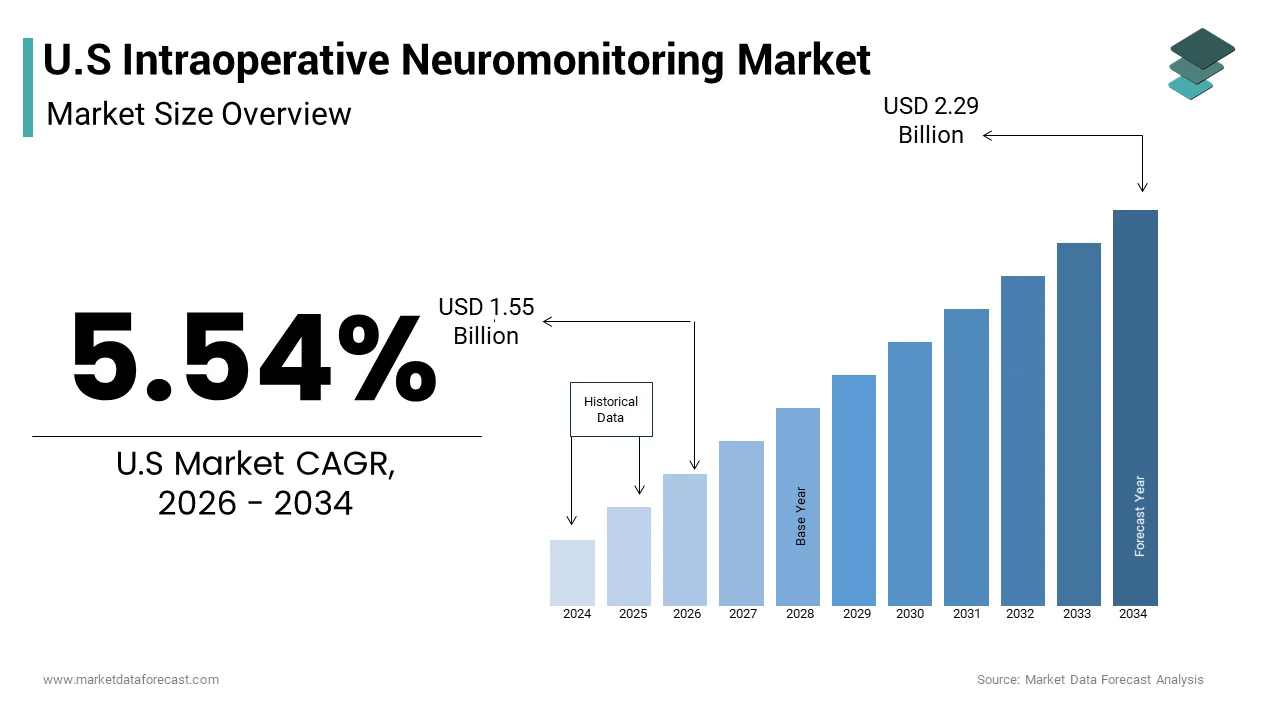
Intraoperative neuromonitoring (IONM) is a safeguard woven into the fabric of high-risk neurosurgical and spinal interventions, where milliseconds of delayed signal detection can mean the difference between paralysis and preservation of function.
MARKET DRIVERS
Surgeon-Led Adoption Driven by Malpractice Risk Mitigation and Surgical Precision Demands
The escalation in neurological injury-related malpractice claims is propelling the growth of U.S. intraoperative neuromonitoring (IONM) market. According to the National Practitioner Data Bank, surgical negligence claims involving permanent nerve damage increased by 43% between 2018 and 2023. In response, hospital risk management teams now require IONM protocols as mandatory pre-authorization for high-risk cases, especially in states like California and New York, where jury awards for sensory or motor deficits are among the nation’s highest.
Proliferation of Minimally Invasive and Robotic-Assisted Neurosurgical Procedures
The penetration of minimally invasive and robotic assisted neurosurgical procedures are bolstering the growth of U.S. intraoperative neuromonitoring (IONM) market. The FDA cleared 14 new robotic-assisted spine systems between 2020 and 2023, including the Mazor X and Globus ExcelsiusGPS platforms, all of which integrate IONM alerts directly into their guidance interfaces.
MARKET DRIVERS
Workforce Shortages in Certified Neurophysiologists and Technical Staff
The U.S. faces a shortage of qualified neurophysiologists trained to interpret IONM signals in real time, which is degrading the growth of U.S. intraoperative neuromonitoring (IONM) market. Training programs produce fewer than 150 new specialists annually, while the number of complex surgeries requiring IONM has risen by 29% since 2020, according to the Centers for Medicare & Medicaid Services.
Reimbursement Ambiguity and Insurance Denial Patterns
The inconsistent and often adversarial reimbursement from private insurers and even Medicare is also hindering the growth of U.S. intraoperative neuromonitoring (IONM) market. Insurers frequently challenge billing when multiple modalities are used simultaneously even though guidelines from the American Clinical Neurophysiology Society endorse multimodal monitoring for high-risk cases. Hospitals report spending up to $180,000 annually on appeals and legal fees to recover denied payments, diverting resources from staffing and equipment upgrades.
MARKET OPPORTUNITIES
Integration of AI-Powered Real-Time Signal Interpretation and Anomaly Detection
The integration of AI-powered real time signal interpretation and anomaly detection is creating new opportunities for the growth of U.S. intraoperative neuromonitoring (IONM) market. These systems reduce false negatives by 47% and decrease cognitive load on technologists, allowing one specialist to monitor up to four simultaneous cases safely. The FDA has granted Breakthrough Device designation to three AI-enhanced IONM platforms, including Medtronic’s NeuroGuard AI and Natus’ IntelliMonitor Pro, paving the way for regulatory approval as adjunctive decision-support tools.
Expansion into Non-Traditional Surgical Environments and Outpatient Settings
The ambulatory surgery centers (ASCs) and outpatient spine clinics performing high-volume cervical and lumbar fusions are also to show up new opportunities for the growth of U.S. intraoperative neuromonitoring (IONM) market. Portable, wireless IONM systems with cloud-based telemetry enable real-time monitoring in decentralized settings, which is reducing patient transport risks and lowering overall costs.
MARKET CHALLENGES
Fragmentation of Standards and Lack of Universal Protocol Alignment
Fragmentation of standards and lack of universal protocol alignment are sophistically leveraging the growth of U.S. intraoperative neuromonitoring (IONM) market. As per 2022 multi-institutional audit by the Joint Commission, 56% of facilities lacked standardized documentation templates for IONM events, and 31% did not have written escalation protocols for signal loss. This inconsistency undermines research validity, complicates training, and exposes institutions to liability if outcomes vary due to procedural divergence rather than surgical skill.
Technological Obsolescence Due to Rapid Innovation Cycles and Vendor Lock-In
The IONM systems are highly specialized, proprietary ecosystems dominated by a handful of manufacturers such as Natus, Medtronic, and Cadwell. A 2023 survey by Health Affairs revealed that 41% of rural hospitals continue using IONM systems over eight years old, lacking the capital to upgrade despite declining reliability and increased false alarms
REPORT COVERAGE
| REPORT METRIC | DETAILS |
| Market Size Available | 2025 to 2034 |
| Base Year | 2025 |
| Forecast Period | 2026 to 2034 |
| Segments Covered | By Product & Service, Source Type, Monitoring Modality and Region. |
| Various Analyses Covered | Global, Regional, & Country Level Analysis; Segment-Level Analysis, Drivers, Restraints, Opportunities, Challenges, PESTLE Analysis, Porter’s Five Forces Analysis, Competitive Landscape, Analyst Overview of Investment Opportunities |
| Regions Covered | North America, Europe, Asia Pacific, Latin America, Middle East, and Africa |
| Key Market Players | Natus Medical Incorporated, Medtronic plc, NuVasive, Inc., SpecialtyCare, Nihon Kohden Corporation, IntraNerve Neuroscience Holdings, Accurate Monitoring, Neural Monitoring Associates, Procirca, and Moberg Research, Inc. |
SEGMENTAL ANALYSIS
By Product & Services Insights
The services segment was the largest and held a dominant share of U.S. intraoperative neuromonitoring (IONM) market in 2025. This dominance arises not from equipment cost but from the irreplaceable human expertise required to interpret complex neurophysiological signals in real time during high-stakes procedures.
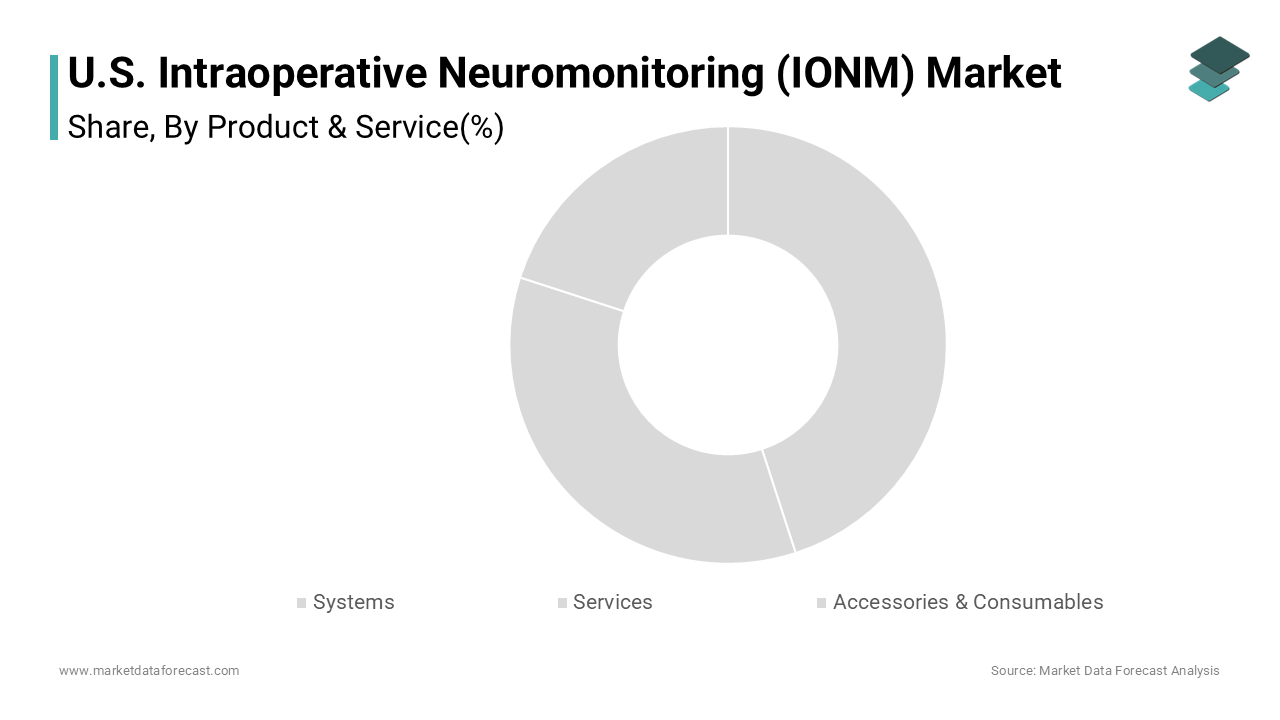
The systems segment is projected to expand at a CAGR of 11.8% in coming years with the integration of AI-enhanced hardware platforms, wireless sensor arrays, and automated signal processing tools that reduce dependence on manual interpretation. Companies like Natus Medical and Medtronic have launched next-generation IONM consoles with embedded machine learning algorithms that flag early amplitude decay or latency shifts before human technologists detect them byreducing false negatives by up to 47%. These systems also feature modular, interoperable components allowing hospitals to scale incrementally without full-suite overhauls.
By Source Type Insights
The Outsource Monitoring segment held a significant share of the U.S. intraoperative neuromonitoring (IONM) market in 2025 with the acute shortage of certified neurophysiologists and the prohibitive cost of maintaining in-house teams capable of 24/7 coverage across multiple operating rooms. In rural and community hospitals, outsourcing eliminates the need for $500,000+ capital expenditures on equipment and training while ensuring compliance with Joint Commission standards.
The insource monitoring segment is likely to grow with an expected CAGR of 14.9% during the forecast period. Newer systems now feature one-touch setup, automated baseline generation, and color-coded alert thresholds that allow anesthesiologists or perioperative nurses to initiate basic monitoring with minimal training. Medicare’s 2023 update to CPT code 95940 now permits “incident-to” billing when services are rendered under physician supervision, making it financially viable for ASCs and small hospitals to invest in their own systems.
By Monitoring Modality Insights
The Somatosensory Evoked Potentials (SSEP) segment is attributed in holding a significant share of U.S. intraoperative neuromonitoring (IONM) market in 2025. Its non-invasive nature, low susceptibility to anesthesia interference, and well-established normative data make it the universal starting point for any procedure involving the spinal axis.
The Motor Evoked Potentials (MEP) segment is likely to grow with an expected CAGR of 16.3% during the forecast period with the increasing prevalence of anterior spinal approaches, robotic-assisted fusion, and awake craniotomies procedures where motor pathway preservation is paramount and SSEP alone is insufficient. MEP directly assesses corticospinal tract function, detecting impending paralysis before irreversible damage occurs, with sensitivity exceeding 90% in lumbar decompression cases, per a 2023 meta-analysis in Neurosurgery. Additionally, new integrated systems from Medtronic and Natus now synchronize MEP with navigation software, triggering automatic alerts when trajectory deviations threaten motor tracts.
REGIONAL ANALYSIS
New York Intraoperative Neuromonitoring (IONM) Market Analysis
New York held 16.3% of U.S. intraoperative neuromonitoring (IONM) market share in 2025 with its position as the epicenter of academic neurosurgery and high-volume tertiary care drives unmatched demand for advanced, multimodal IONM. The state’s stringent malpractice environment mandates IONM for nearly all spinal fusions, and its Medicaid program explicitly reimburses for comprehensive monitoring protocols.
California Intraoperative Neuromonitoring (IONM) Market Analysis
California was positioned second by holding 14.3% of share in 2025. Home to Silicon Valley’s medtech innovation ecosystem, California leads in adopting AI-enhanced IONM platforms and wireless telemetry systems that enable remote expert oversight across geographically dispersed hospitals. UC San Francisco pioneered the use of real-time IONM data dashboards integrated into EHRs, allowing surgical teams to review trends retrospectively for quality improvement.
KEY MARKET PLAYERS
A few of the major companies in the U.S. intraoperative neuromonitoring (IONM) market include
- Natus Medical Incorporated
- Medtronic plc
- NuVasive, Inc.
- SpecialtyCare
- Nihon Kohden Corporation
- IntraNerve Neuroscience Holdings
- Accurate Monitoring
- Neural Monitoring Associates
- Procirca
- Moberg Research, Inc.
MARKET SEGMENTATION
This research report on the U.S. intraoperative neuromonitoring (IONM) market has been segmented based on following categories.
By Product & Service
- Systems
- Services
- Accessories & Consumables
By Source Type
- Insourced Monitoring
- Outsourced Monitoring
By Monitoring Modality
- Somatosensory Evoked Potentials (SSEPs)
- Motor Evoked Potentials (MEPs)
- Electroencephalography (EEG)
- Electromyography (EMG)
- Auditory & Visual Evoked Potentials (BAEPs, VEPs)
By Surgical Application
- Spinal Surgery
- Neurosurgery
- Orthopedic Surgery
- ENT & Thyroid Surgery
- Vascular & Cardiovascular Surgery
- Other Complex Procedures