- Product Description Description
- Table of Contents TOC
- List of Table & Figure LOT
- Get Free Sample PDF Sample PDF
Market Size, 2025
$675 MnMarket Estimate, 2026
$736.43 MnMarket Forecast, 2034
$1,478 MnCAGR, 2026–2034
9.10%Executive Summary: U.S. Medical Simulation Market
- Market Scope: Comprehensive market assessment of the U.S. medical simulation sector, covering products and services, end-user settings, and core clinical training frameworks.
- Market Valuation: Valued at USD 675 million in 2025, estimated at USD 736.43 million in 2026, and projected to reach USD 1,478 million by 2034, registering a robust CAGR of 9.10% from 2026 to 2034.
- Primary Growth Drivers: High rates of medical errors necessitating practice-based risk mitigation, rising chronic disease burdens, adoption of advanced surgical infrastructures, and growing integration of simulation-based teaching in medical curricula.
Key Market Segment Metrics (2026–2034)
| Category | Leading Segment Position | Fastest-Growing / Key Growth Segment |
|---|---|---|
| By Products & Services | Healthcare Simulation Software & Training Services (driven by software advances and structured training modules) | Web-Based Simulators & Anatomical Models (surging due to remote accessibility and tactile surgical planning) |
| By End-User | Academic Institutes & Hospitals (dominant users integrating simulation centers to train students and refine hospital surgical precision) | Military Organizations & Specialized Centers (scaling crisis-response and advanced tactical medicine training) |
| By Country | The United States (exclusive focus market featuring nearly 1,000 advanced medical simulation centers) | Hospital-based simulation expansions driven by competitive healthcare delivery models |
Major Market Players & Market Structure
Market Structure: Competitive and technology-driven landscape characterized by continuous innovation in interactive software, fidelity enhancement of anatomical models, and strategic partnerships with healthcare simulation institutions.
Key Companies: 3D Systems, Canadian Aviation Electronics (CAE) Inc., Kyoto Kagaku Co. Ltd, Laerdal Medical, Limbs & Things Ltd, Mentice AB, and Simulab Corporation.
 Download Free Sample Report
U.S. Medical Simulation Market Size
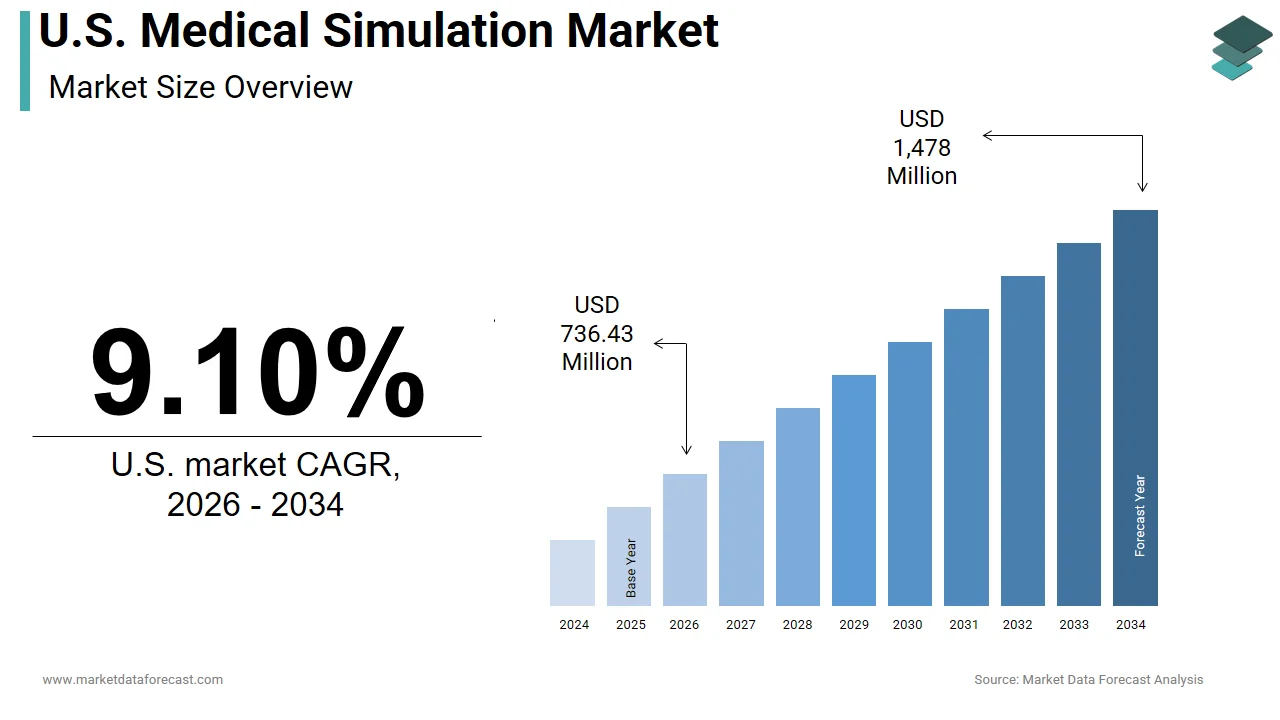
The U.S. medical simulation market was valued at USD 675 million in 2025. The market is estimated at USD 736.43 million in 2026 and is projected to reach USD 1,478 million by 2034, growing at a CAGR of 9.10% from 2026 to 2034.
The growing adoption and usage of simulation in the U.S. healthcare industry are primarily driving growth in the U.S. medical simulation market. Medical simulation is one of the advanced technologies to ensure perfection while surgeries are performed on an actual patient through immense practice on the simulation models. However, treatment methods have been changing for years due to the increasing number of chronic diseases and infections among many populations. As a result, simulation methods are used in the healthcare sector to increase the success rate of the treatment.
The growing mortality rate due to medical errors in the United States is expected to favor the U.S. medical simulation market. According to a recent survey, an estimated 1.2 million medical errors occur in the U.S. yearly. In addition, due to the increasing adoption of advanced infrastructure and devices at hospitals, the healthcare provider may make mistakes due to incomplete knowledge of the device used for the patient's treatment. As a result, simulation methods help the medical trainee (yet to be an official surgeon) to make mistakes and learn from the mistake in the simulation model. It is also found that stimulation helps improve patient safety and reduce healthcare costs by producing more efficient medical providers.
The growing adoption of technological advancements in medical simulation methods for various purposes is expected to promote the U.S. medical simulation market. Owing to the increasing adoption of medical simulation for various treatment purposes, the key market players are focusing on developing advanced simulation methods which help the trainees and the healthcare professionals provide better treatment to the patients and provide them with a quality life.
However, the high costs associated with the simulation methods are expected to hamper the U.S. medical simulation market growth. In addition, the lack of training simulation programs is expected to negatively impact market growth. The appearance of new challenges in real life after practice with the simulation methods also leads to errors in medical treatment, which impedes market growth.
MARKET SEGMENTATION
This market research report on the U.S. medical simulation market has been segmented and sub-segmented into the following categories.
By-Products & Services
- Healthcare Anatomical Models
- Web-Based Simulators
- Healthcare Simulation Software
- Simulation Training Services
By End-User
- Academic institutes
- Military organizations
- Hospitals
- Others
By Country
- The United States
Regional Analysis
The U.S. is anticipated to hold a significant share of the global market during the forecast period owing to the growing usage of medical simulation in medical colleges and universities. In the medical curriculum development scenario, colleges and universities introduced simulation-based medical teaching-learning. This is the way of representing the artificial presence of a real human. This helps provide quality education to the student to achieve their goals effectively. In addition, increasing simulation centers in the U.S. is predicted to aid the market growth in the U.S. According to a recent survey, nearly 1000 simulation centers are present in the United States. These centers help improve patient outcomes with effective programs which help in promoting skills, teamwork, and inter-discipline collaboration in the healthcare provider. Furthermore, increasing medical simulation centers in the individual hospitals in the region also help in the market growth. Due to increasing competition between hospitals, they are increasing the establishment of simulation centers which helps the healthcare provider to give better treatment after practicing simulation methods in new surgery cases.
KEY MARKET PLAYERS
3D Systems, Canadian Aviation Electronics (CAE) Inc., Kyoto Kagaku Co. Ltd, Laerdal Medical, Limbs & Things Ltd, Mentice AB, and Simulab Corporation are noteworthy players operating in the U.S. medical simulation market.