- Product Description Description
- Table of Contents TOC
- List of Table & Figure LOT
- Get Free Sample PDF Sample PDF
U.S. Melanoma Market Report Summary
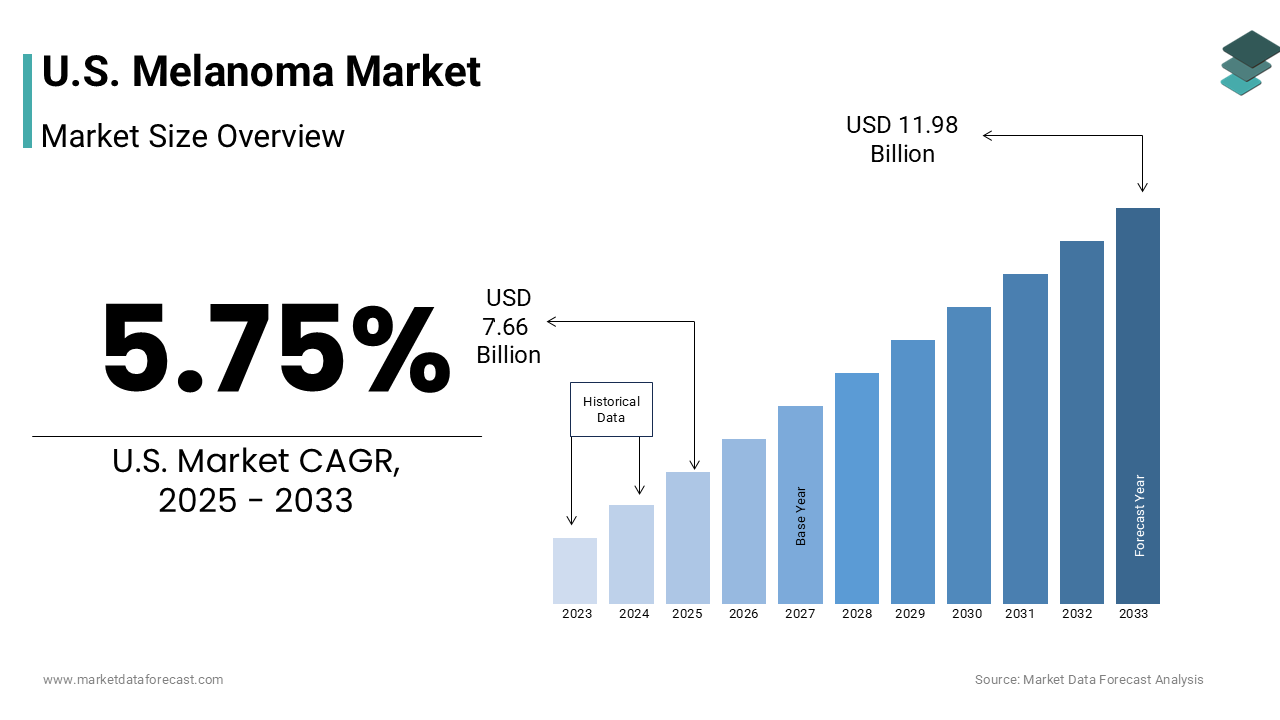
The U.S. melanoma market was valued at USD 7.24 billion in 2024, is estimated to reach USD 7.66 billion in 2025, and is projected to reach USD 11.98 billion by 2033, growing at a CAGR of 5.75% from 2025 to 2033. The growth of the U.S. melanoma market is driven by the rising prevalence of skin cancer, increasing public awareness about early diagnosis, and the growing adoption of advanced immunotherapies and targeted treatments. Additionally, advancements in genetic testing, personalized medicine, and early-stage detection technologies are further contributing to improved treatment outcomes and expanding market potential.
Key Market Trends
- Rising incidence of melanoma and non-melanoma skin cancers due to increasing UV exposure and lifestyle factors.
- Growing adoption of checkpoint inhibitor-based immunotherapies such as PD-1 and CTLA-4 inhibitors for advanced melanoma treatment.
- Increasing use of targeted therapies focusing on BRAF and MEK gene mutations to improve patient survival rates.
- Expansion of AI and teledermatology tools for early detection and diagnosis of melanoma.
- Rising investments in R&D for combination therapies and personalized treatment approaches.
Segmental Insights
- Based on type, the superficial spreading melanoma (SSM) segment accounted for a significant share of the U.S. melanoma market in 2024, as it is the most common form of melanoma diagnosed in the country, driven by rising awareness and regular skin screening practices.
- Based on treatment, the immunotherapy segment held 61.2% of the U.S. melanoma market share in 2024, attributed to its strong efficacy in managing advanced-stage melanoma and the increasing adoption of immune checkpoint inhibitors such as pembrolizumab and nivolumab.
- Based on end user, the hospitals segment held 54.3% of the U.S. melanoma market share in 2024, supported by the availability of specialized oncology centers, multidisciplinary care, and advanced diagnostic and treatment technologies.
Competitive Landscape
- The U.S. melanoma market is highly competitive, with key players focusing on innovation in immuno-oncology, targeted therapy development, and clinical collaborations.
- Companies are investing in combination drug regimens, biomarker-driven therapies, and next-generation treatment approaches to improve efficacy and minimize adverse effects.
- Prominent players in the U.S. melanoma market include Bristol Myers Squibb Company, Merck & Co., Inc., Novartis AG, Amgen Inc., F. Hoffmann-La Roche Ltd., Regeneron Pharmaceuticals, Inc., Pfizer Inc., Eli Lilly and Company, Iovance Biotherapeutics, Inc., and OncoSec Medical Incorporated.
- These companies are emphasizing strategic partnerships, regulatory approvals, and expanded clinical trials to strengthen their therapeutic portfolios and meet the growing demand for advanced melanoma treatments in the U.S.
U.S. Melanoma Market Size
The U.S. melanoma market size was valued at USD 7.24 billion in 2024 and is anticipated to reach USD 7.66 billion in 2025 from USD 11.98 billion by 2033, growing at a CAGR of 5.75% during the forecast period from 2025 to 2033.
The melanoma is the therapeutic, diagnostic, and surveillance interventions targeting malignant melanoma with a cutaneous malignancy arising from melanocytes, distinguished by aggressive metastatic potential and immunogenic profile. Mortality, however, has declined by 4% per year since 2015, according to National Cancer Institute SEER data, attributable to checkpoint inhibitors and BRAF/MEK-targeted therapies transforming once-fatal metastatic disease into manageable chronicity.
MARKET DRIVERS
The sustained escalation in melanoma incidence linked to cumulative UV exposure, tanning bed use, and delayed diagnosis in aging populations is driving the growth of U.S. melanoma market. According to the Journal of the American Academy of Dermatology, 7.8 million U.S. adults still use tanning beds annually, elevating melanoma risk by 75% for those initiating before age 35. The behavioral risk and demographic aging that ensures a continuously growing patient pool requiring biopsy, genomic profiling, surgical intervention, and systemic therapy, anchoring market volume irrespective of therapeutic innovation cycles.
The paradigm shift toward immunotherapy and targeted therapy in both adjuvant and metastatic settings, which has redefined survival expectations and expanded treatable patient cohorts is levelling up the growth of U.S. melanoma market. The U.S. Food and Drug Administration approved six new melanoma indications between 2022 and 2024, including relatlimab-nivolumab for LAG-3-positive disease and encorafenib-binimetinib for BRAF V600E-mutated tumors.
MARKET RESTRAINTS
The persistent underutilization of dermatologic screening among rural and socioeconomically disadvantaged populations, which delays diagnosis and inflates treatment complexity is restraining the growth of U.S. melanoma market. As per the American Academy of Dermatology Association, only 19% of Medicare beneficiaries receive annual skin exams, despite melanoma being the fifth most common cancer in Americans over 65. Screening gaps suppress market efficiency by shifting demand from low-cost prevention to high-cost salvage therapy.
The prohibitive cost and logistical complexity of combination immunotherapies and biomarker-guided regimens, which strain payer budgets and restrict equitable access is degrading the growth of U.S. melanoma market. Express Scripts reported that 34% of melanoma drug claims required peer-to-peer review in 2023, which is delaying therapy initiation by a median of 18 days. Simultaneously, 22% of community oncology practices lack in-house NGS testing capability, per the Community Oncology Alliance, forcing referrals that extend time-to-treatment.
MARKET OPPORTUNITIES
The integration of AI-assisted dermoscopy into primary care and tele-dermatology workflows by enabling earlier, algorithm-guided detection without specialist dependency is anticipated to fuel the growth of U.S. melanoma market. UnitedHealthcare’s pilot program reimbursing primary care providers for AI-assisted skin screenings increased stage I diagnosis rates by 37% in participating practices. The FDA cleared 11 AI-based dermatology decision-support devices in 2023 alone.
The repurposing of neoadjuvant immunotherapy to shrink operable tumors pre-surgery with a new treatment window with curative intent and biomarker discovery potential is leveraging the growth of U.S. melanoma market. This approach not only improves surgical outcomes but generates rich tumor microenvironment data for resistance mechanism research. This therapeutic resequencing unlocks premium revenue per patient while generating scientific value unmatched by adjuvant or metastatic use alone.
MARKET CHALLENGES
The emergence of acquired resistance to targeted and immune checkpoint therapies, which truncates durability of response and necessitates costly is impelling the growth of U.S. melanoma market. As per Society for Immunotherapy of Cancer, only 18% of community practices have molecular tumor boards to guide resistance management.
The geographic and socioeconomic fragmentation of melanoma care, where access to genomic testing, clinical trials, and multidisciplinary tumor boards is limiting the growth of U.S. melanoma market. Medicaid patients are 44% less likely to receive combination immunotherapy than privately insured counterparts, per a Health Affairs analysis, despite identical NCCN eligibility. This inequity creates a two-tiered market: innovation-rich for the insured and urban, innovation-starved for the marginalized.
REPORT COVERAGE
| REPORT METRIC | DETAILS |
| Market Size Available | 2024 to 2033 |
| Base Year | 2024 |
| Forecast Period | 2025 to 2033 |
| Segments Covered | By Type, Treatment, End User and Region. |
| Various Analyses Covered | Global, Regional, & Country Level Analysis; Segment-Level Analysis, Drivers, Restraints, Opportunities, Challenges, PESTLE Analysis, Porter’s Five Forces Analysis, Competitive Landscape, Analyst Overview of Investment Opportunities |
| Regions Covered | North America, Europe, Asia Pacific, Latin America, Middle East, and Africa |
| Key Market Players | Bristol Myers Squibb Company, Merck & Co., Inc., Novartis AG, Amgen Inc., F. Hoffmann-La Roche Ltd., Regeneron Pharmaceuticals, Inc., Pfizer Inc., Eli Lilly and Company, Iovance Biotherapeutics, Inc., and OncoSec Medical Incorporated. |
SEGMENTAL ANALYSIS
By Type Insights
The Superficial spreading melanoma (SSM) segment was accounted in holding a significant share of the U.S. melanoma market in 2024. According to the National Cancer Institute’s SEER, 68% of SSM cases are diagnosed at localized stage that often triggered by patient-noticed asymmetry or border irregularity, which is making it the most commonly biopsied subtype.
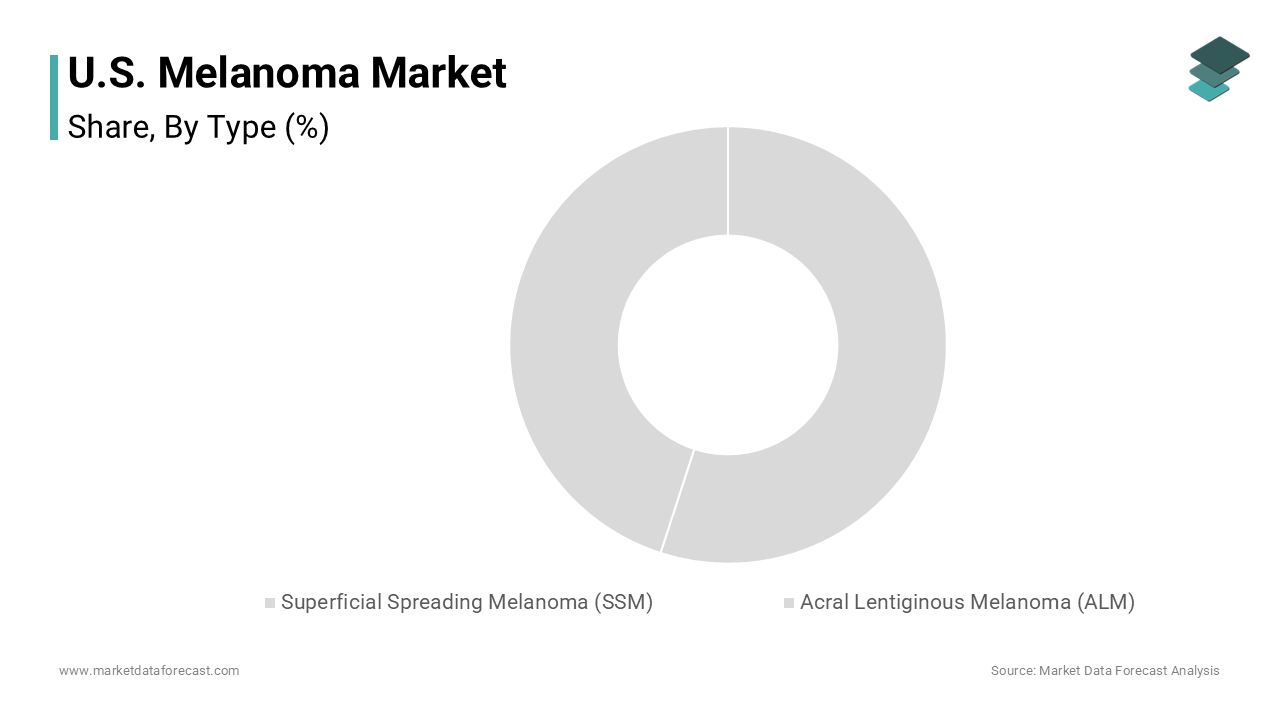
The Acral lentiginous melanoma (ALM) segment is esteemed to grow with a CAGR of 9.4% throughout the forecast period with the rising incidence but by heightened clinical awareness of its disproportionate burden among skin-of-color populations. ALM’s aggressive biology that often presenting at advanced stage due to location on palms, soles, or nail beds fuels demand for novel therapies.
By Treatment Insights
The immunotherapy segment was accounted in holding 61.2% of the U.S. melanoma market share in 2024 with the first-line adoption for both metastatic and adjuvant settings. The U.S. Food and Drug Administration’s 2023 approval of relatlimab-nivolumab for LAG-3-positive disease expanded treatable populations without requiring BRAF mutation. Payers reinforce position: Medicare Part B covers pembrolizumab with no prior authorization for stage III–IV, while UnitedHealthcare’s oncology pathways designate it as preferred first-line.
The Neoadjuvant immunotherapy segment is lucratively to grow with an expected CAGR of 31.7% during the forecast period with the paradigm-shifting clinical data: the SWOG S1801 trial, published in The New England Journal of Medicine, demonstrated that pre-surgical pembrolizumab improved event-free survival by 63% versus adjuvant-only in resectable stage III–IV melanoma. This approach not only improves surgical outcomes but generates rich tumor microenvironment data for resistance research.
By End–User Insights
The hospitals segment held 54.3% of the U.S. melanoma market share in 2024 with integrated hubs for diagnosis, surgery, systemic therapy, and surveillance. 340B drug pricing programs allow academic medical centers to access discounted therapeutics, reinforcing economic viability. Hospitals don’t merely deliver care they orchestrate the entire melanoma value chain, from biopsy to biomarker to biologic.
The research centers segment is lucratively grow with projected CAGR of 22.3% during the forecast period wit the explosion of translational melanoma research. The rise of neoadjuvant trials where pre- and post-treatment tumor biopsies yield mechanistic insights has turned operating rooms into live laboratories.
KEY MARKET PLAYERS
A few of the major companies in the U.S. melanoma market include
- Bristol Myers Squibb Company
- Merck & Co., Inc.
- Novartis AG
- Amgen Inc.
- F. Hoffmann-La Roche Ltd.
- Regeneron Pharmaceuticals, Inc.
- Pfizer Inc.
- Eli Lilly and Company
- Iovance Biotherapeutics, Inc.
- OncoSec Medical Incorporated
Top Players in the Market
Bristol Myers Squibb anchors the U.S. melanoma landscape through its immuno-oncology portfolio, notably Opdivo (nivolumab) and the Opdualag (nivolumab/relatlimab) combination. The company launched a real-world evidence collaboration with Flatiron Health to correlate LAG-3 expression levels with progression-free survival by enabling biomarker-guided prescribing. BMS also initiated the Neodurva trial evaluating neoadjuvant Opdualag in resectable stage IIIB–IV melanoma, positioning itself at the forefront of pre-surgical innovation.
Merck & Co., Inc. commands influence via Keytruda (pembrolizumab), the most widely prescribed anti-PD-1 agent in melanoma, backed by robust adjuvant and metastatic data. In 2023, it received FDA approval for Keytruda in stage IIB–IIC resected melanoma, capturing a previously untreated population. Merck strengthened its position by publishing five-year survival data from KEYNOTE-716, showing 61% reduction in recurrence risk, per The Lancet Oncology. It partnered with Tempus to integrate AI-driven genomic profiling into community oncology workflows, accelerating biomarker identification.
Novartis AG leads in targeted therapy with Tafinlar (dabrafenib) and Mekinist (trametinib), the standard BRAF/MEK inhibitor combination. Novartis received FDA approval in January 2024 for a weight-based pediatric dosing regimen, expanding into adolescent populations. The company launched a ctDNA monitoring program with Guardant Health to detect molecular relapse pre-radiographically, enabling early intervention. It also initiated Project LIBERTY, providing free genomic testing and navigation services to Medicaid and uninsured patients.
MARKET SEGMENTATION
This research report on the U.S. melanoma market has been segmented based on following categories.
By Type
- Superficial Spreading Melanoma (SSM)
- Acral Lentiginous Melanoma (ALM)
By Treatment
- Immunotherapy
- Neoadjuvant Immunotherapy
By End User
- Hospitals
- Research Centers
By Country
- The United States