- Product Description Description
- Table of Contents TOC
- List of Table & Figure LOT
- Get Free Sample PDF Sample PDF
U.S. Nursing Care Market Size
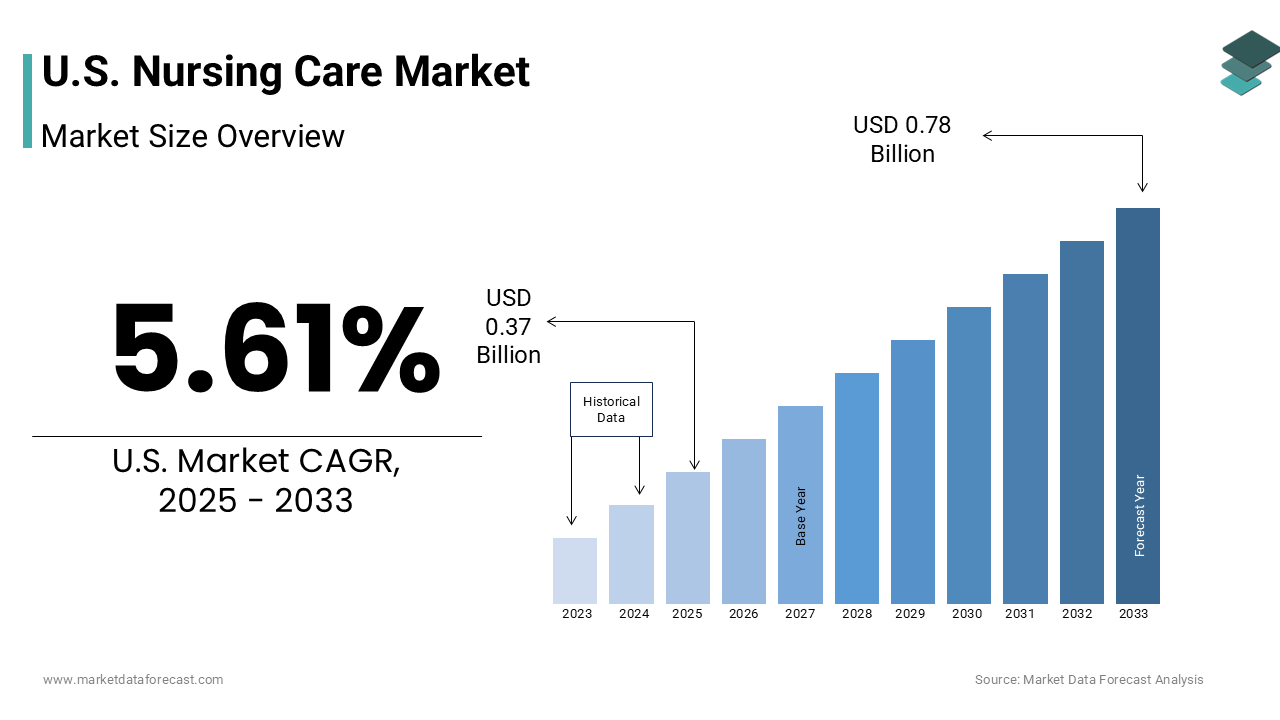
The U.S. nursing care market size was valued at USD 0.35 billion in 2024 and is anticipated to reach USD 0.37 billion in 2025 from USD 0.78 billion by 2033, growing at a CAGR of 5.61% during the forecast period from 2025 to 2033.
Nursing care is skilled, intermediate, and custodial care delivered by licensed and certified nursing personnel across institutional, residential, and community-based settings, including hospitals, long-term care facilities, home health agencies, and hospice programs. According to the Bureau of Labor Statistics, over 3.1 million registered nurses and 1.1 million licensed practical nurses were actively employed in clinical roles as of 2024, forming the backbone of American healthcare delivery. As per the Centers for Medicare & Medicaid Services, nearly 1.5 million Americans reside in skilled nursing facilities, each requiring daily nursing oversight for chronic disease management or post-acute recovery. The Health Resources and Services Administration confirms that 89% of U.S. counties report shortages in home health nursing staff, emphasizing systemic dependency on this workforce to sustain care continuity beyond hospital walls.
MARKET DRIVERS
The accelerating demographic shift toward an aging population requiring sustained and multi-morbidity nursing oversight, a trend structurally embedded in national epidemiology, drives the growth of the U.S nursing care market. According to the U.S. Census Bureau, adults aged 65 and older constituted 17.3% of the total population in 2024, a figure projected to reach 22% by 2040. As per the National Institute on Aging, 80% of seniors live with at least one chronic condition, and 68% manage two or more, including heart failure, diabetes, COPD, and dementia, which necessitates daily medication administration, wound care, and mobility assistance. Simultaneously, as per the Centers for Disease Control and Prevention, 36% of all hospital discharges involve patients over 75, most of whom transition to home or facility-based nursing care. This irreversible demographic momentum compels systemic expansion of nursing-dependent care models.
The policy-driven migration of post-acute and chronic care from hospitals to lower-cost, community-anchored settings further boosts the expansion of the U.S. nursing care market. It is a transition explicitly incentivized by federal and state reimbursement reforms. Most Medicare beneficiaries in the United States who are discharged after major medical procedures now receive mandatory skilled nursing support either at home or in dedicated care facilities, according to sources. Bundled payment initiatives aimed at managing chronic conditions have helped lower hospital dependency while promoting the use of home nursing services, as per research. Apart from these, national programs encouraging the shift from institutional to home-based care have moved a large number of individuals into community settings, where continuous nursing oversight remains essential, according to sources. Payer architecture now structurally favors decentralized and nurse-led care delivery.
MARKET RESTRAINTS
The acute and worsening shortage of licensed nursing personnel, particularly in rural and underserved urban communities, which constrains the growth of the U.S. nursing care market. According to the Health Resources and Services Administration, the U.S. faces a projected deficit of 109,000 registered nurses by 2030, with vacancy rates exceeding 18% in long-term care facilities. As per the American Nurses Association, 45% of RNs surveyed in 2023 cited burnout as their primary reason for reducing hours or leaving direct patient care. Compounding this, as per the National Council of State Boards of Nursing, first-time NCLEX pass rates declined by 6.2% between 2022 and 2023, signaling pipeline erosion. Well-funded care models will fail due to human capital scarcity without aggressive investment in tuition support preceptorship expansion and workload rebalancing.
Inconsistent state-level scope-of-practice regulations that restrict advanced practice registered nurses from practicing to the full extent of their education and certification holds back the expansion of the U.S. nursing market. According to the National Academy of Medicine, only 27 states grant full practice authority to nurse practitioners, allowing them to evaluate, diagnose, and prescribe without physician oversight. In U.S. states with tighter regulations, clinics led by nurse practitioners often face longer patient wait times and lower success rates in managing chronic conditions, according to sources. The Federal Trade Commission has cautioned that these rules limit healthcare capacity and raise costs. Patients in states granting full practice authority to nurse practitioners tend to have fewer preventable hospital visits, which shows that varied regulations can strongly influence access, efficiency, and health results, as per research.
MARKET OPPORTUNITIES
The integration of predictive analytics and remote monitoring tools to extend the reach and efficiency of nursing staff without compromising clinical vigilance provides new opportunities for the growth of the U.S. nursing care market. AI-based alert systems introduced in home care settings have helped cut down emergency transfers while enabling nurses to manage a larger number of patients safely, according to sources. The Veterans Health Administration in the United States has also noted that using connected monitoring devices with automated response systems has significantly reduced after-hours nursing interventions, as per research. The National Science Foundation has funded 14 university-hospital partnerships to develop ambient sensing systems that detect falls or agitation in dementia patients before clinical manifestation. This technological augmentation does not replace nurses but amplifies their capacity, which transforms scarcity into strategic oversight.
The formalization of nurse-led care coordination models embedded within value-based payment structures, particularly for dual-eligible and chronically complex populations, opens fresh opportunities for the U.S. nursing market. Most Medicare-Medicaid Plans in the United States now have dedicated nurse care managers responsible for coordinating treatment, reviewing medications, and addressing social health factors, as per research. According to sources, clinics that use registered nurse–led care teams for managing chronic conditions such as diabetes and hypertension have achieved noticeably better patient outcomes than physician-only setups. Over 12.5 million Americans are enrolled in Medicare Advantage Special Needs Plans, according to KFF, and another 28 million are covered by commercial ACOs. Nursing professionals who structure outcomes-based care pathways can leverage this shift to transition from task-based labor to strategic clinical architects, which commands premium reimbursement and institutional influence.
MARKET CHALLENGES
The misalignment between nursing education curricula and the evolving demands of community-based, technology-enabled, and socially complex care delivery challenges the growth of the U.S. nursing care market. As per research, a limited number of nursing education programs in the United States currently include mandatory training in telehealth, remote monitoring, or managing social health factors, even though most graduates move into roles that demand these skills. According to sources, clinical placements continue to focus mainly on hospital environments, with only a small portion of students gaining hands-on experience in home health or skilled nursing settings. As per research, a large share of safety incidents in post-acute care stems from poor coordination between nurses and community providers, often due to training shortfalls.
The absence of standardized metrics and financial recognition for the non-procedural, preventive, and relational work that constitutes the majority of nursing value, particularly in chronic and palliative care, is also a major obstacle for the U.S. nursing care market. According to the RAND Corporation, over 60% of nursing time in home and long-term care is spent on care coordination, family education, and anticipatory guidance, activities rarely captured in billing codes or productivity dashboards. According to sources, the existing Medicare fee-for-service approach pays only for specific physical tasks such as dressing wounds or giving injections, overlooking the critical cognitive work nurses do to prevent hospital stays. As per research, healthcare units adopting value-based productivity measures for nurses have achieved better staff retention and improved patient satisfaction. Challenges like burnout and workforce loss will likely continue despite nurses' essential contributions to care unless payment structures account for their preventive and coordinating roles.
REPORT COVERAGE
| REPORT METRIC | DETAILS |
| Market Size Available | 2024 to 2033 |
| Base Year | 2024 |
| Forecast Period | 2025 to 2033 |
| Segments Covered | By Service Type, End User Gender, Type of Expenditure and Region. |
| Various Analyses Covered | Global, Regional, & Country Level Analysis; Segment-Level Analysis, Drivers, Restraints, Opportunities, Challenges, PESTLE Analysis, Porter’s Five Forces Analysis, Competitive Landscape, Analyst Overview of Investment Opportunities |
| Key Market Players | The Ensign Group, Life Care Centers of America, ProMedica Senior Care, and The Evangelical Lutheran Good Samaritan Society. |
SEGMENTAL ANALYSIS
By Service Type Insights
The nursing care facilities segment dominated the U.S. nursing care market by accounting for 47.1% share in 2024. The growth of the nursing care facilities segment is driven by the clinical complexity of post-hospitalization recovery. As per the Agency for Healthcare Research and Quality, 22% of all Medicare discharges transition directly to SNFs, primarily for stroke, joint replacement, or heart failure rehabilitation. Apart from these, as per the National Center for Health Statistics, over 1.3 million Americans reside in licensed nursing facilities, each requiring 24/7 RN or LPN oversight for medication, mobility, and chronic disease management. Regulatory mandates for daily skilled assessments further entrench institutional reliance on facility-based nursing labor.
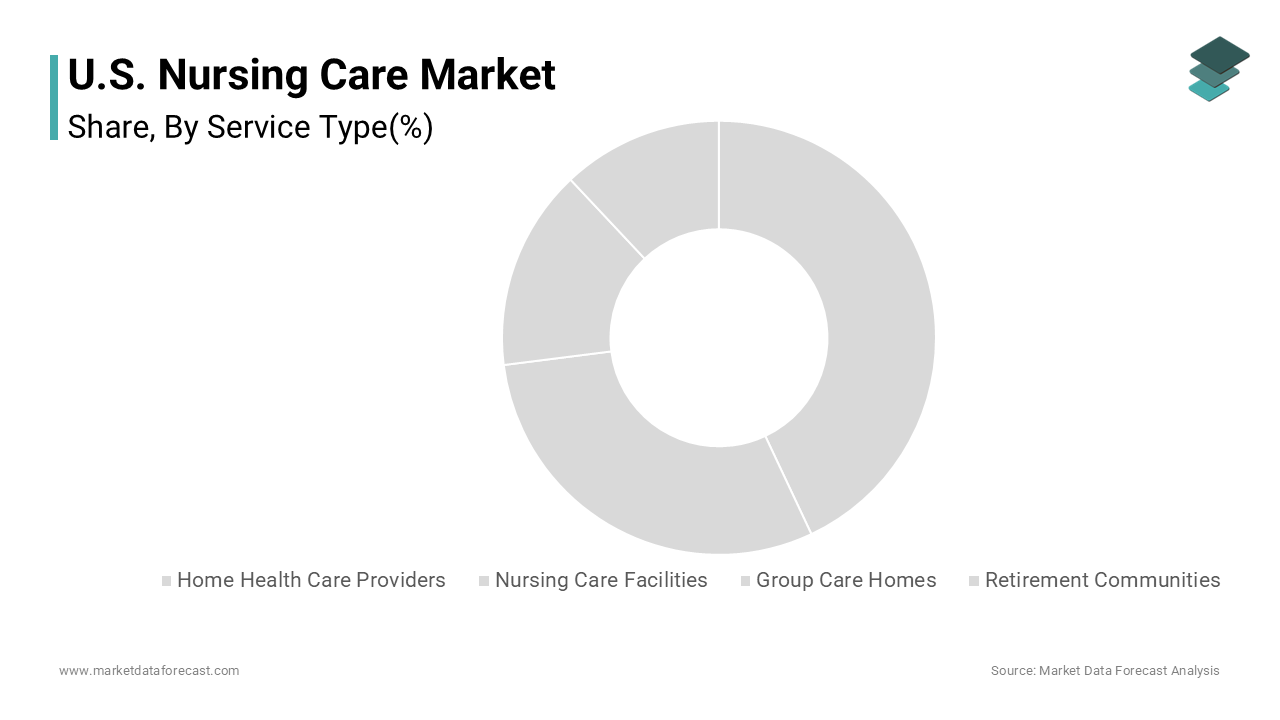
The home health care providers segment is estimated to register the fastest CAGR of 9.8% from 2025 to 2033. The swift expansion of the home health care providers segment is propelled by patient preference and payer policy. AARP’s 2024 National Home & Community Preferences Survey reveals that 79% of adults over 50 prefer aging in place with professional support. Simultaneously, CMS’s Home Health Value-Based Purchasing Model now financially rewards agencies that reduce hospital readmissions through skilled nursing visits. As per the ECRI Institute, home health RNs now manage increasingly complex cases previously confined to facilities, including ventilator weaning and post-chemotherapy monitoring.
By End-User Gender Insights
In 2024, the female nursing care recipients segment led the U.S. nursing care market by accounting for a substantial share in 2024. The predominance of the female nursing care recipients segment is because to longevity and morbidity patterns. The U.S. Census Bureau confirms that women comprise 56% of the population aged 65 and older, and 68% of those over 85. Besides, as per studies, widowed women outnumber widowed men by nearly 4 to 1 in the 75+ cohort, which reduces availability of spousal caregiving and increases reliance on professional nursing services.
The male nursing care recipients segment is anticipated to witness the fastest CAGR of 7.2% between 2025 and 2033. The growth of the male nursing care recipients segment is due to the shifting social norms and rising prevalence of male-specific chronic conditions. As per research, men represent a significant portion of new heart failure cases each year, many of whom need skilled nursing care after leaving the hospital. According to sources, the Department of Veterans Affairs has seen rising participation among male veterans in home health nursing programs, influenced by service-related conditions and growing acceptance of personal assistance. As per research, more elderly men are now open to receiving help from professional caregivers by reflecting a broader cultural shift toward normalizing nursing support.
By Expenditure Insights
The public expenditure segment held the largest segment and held 63.7% share in 2024. The dominance of the public expenditure segment is driven by eligibility demographics. According to the Centers for Medicare & Medicaid Services, Medicaid alone finances 62% of all nursing facility residents, primarily low-income seniors and individuals with disabilities. Medicare, meanwhile, covers 100% of post-hospital skilled nursing for up to 100 days per spell of illness, which funds over 2.1 million SNF stays annually. As per the Congressional Budget Office, federal and state spending on long-term nursing care exceeded $210 billion in 2023, dwarfing private out-of-pocket and insurance contributions. Public programs remain the default payer due to the high cost and prolonged nature of nursing-dependent care.
The private expenditure segment is likely to experience the fastest CAGR of 8.1% from 2025 to 2033 owing to the rising middle-class demand for premium and non-Medicaid nursing options. Growing number of older employees are setting aside funds in health savings accounts to cover future long-term care costs, according to sources. Insurance plans that combine life coverage with long-term care benefits have also seen strong sales growth in the past year. Many people nearing retirement now consider private funding necessary to stay independent from public healthcare programs, which leads to increased preference for direct-pay options in home health and premium nursing services, as per sources.
REGIONAL ANALYSIS
The United States remains the largest region in the nursing care market. The prominence of the United States is primarily driven by disproportionate public investment. The Centers for Medicare & Medicaid Services disbursed $187 billion for nursing and home health services in 2023 alone. However, access remains uneven. Some U.S. states such as Minnesota and Oregon maintain stronger nurse-to-patient ratios and more adequate Medicaid reimbursement structures, according to sources. In contrast, states like Alabama and Nevada record notably fewer licensed nursing hours per resident, as per research.
COMPETITIVE LANDSCAPE
The U.S. nursing care market is characterized by intensifying rivalry among national facility operators, regional home health agencies, and hospital-integrated post-acute networks, each competing on clinical outcomes, workforce retention, and regulatory agility rather than price or bed count. Differentiation hinges on nurse satisfaction metrics, readmission reduction, and dementia-specific programming, particularly as value-based reimbursement expands. Incumbents leverage scale to absorb Medicaid rate volatility, while niche players target premium private-pay or culturally tailored models. Talent wars focus on preceptor-trained RNs and bilingual care coordinators. Mergers target complementary geographies or workforce development platforms. Barriers to entry escalate as states mandate minimum staffing ratios and electronic care planning, which marginalize undercapitalized or analog-dependent providers despite demographic demand.
KEY MARKET PLAYERS
A few of the major companies in the U.S. nursing care market include
- Genesis HealthCare
- The Ensign Group
- Life Care Centers of America
- ProMedica Senior Care
- The Evangelical Lutheran Good Samaritan Society
Top Players in the Market
Kindred at Home, a division of ScionHealth, operates the nation’s largest network of home health and hospice clinicians, delivering skilled nursing, therapy, and palliative care across 40 states. In Asia Pacific, it collaborates with Japan’s regional long-term care insurers to adapt U.S. clinical pathways for home-based post-stroke and dementia care. The company also initiated nurse preceptor exchange programs with South Korea’s National Health Insurance Service to standardize competency assessments, strengthening clinical credibility and operational transferability across Pacific markets.
Genesis HealthCare delivers post-acute and long-term nursing care through over 300 skilled nursing facilities concentrated in the Northeast and Midwest. In the Asia Pacific, Genesis partnered with Singapore’s Agency for Integrated Care to co-develop dementia-specific staff training modules now deployed in public nursing homes. It also launched a bilingual caregiver training academy in partnership with the University of the Philippines, preparing Filipino nurses for U.S. licensure while embedding culturally competent care models adaptable to ASEAN geriatric populations.
Encompass Health provides facility-based rehabilitative nursing through its national network of inpatient rehabilitation hospitals and home health agencies. In Asia Pacific, it licenses its neuro-rehabilitation protocols to hospital groups in Taiwan and Australia, emphasizing interdisciplinary nurse-therapist collaboration. The company also initiated a clinical simulation lab partnership with Thailand’s Ministry of Public Health to train nurses in U.S.-style post-surgical mobility and fall prevention, which supports its role as a knowledge exporter beyond direct service delivery.
Top Strategies Used by Key Market Participants
Leading players deploy five core strategies: implementing predictive acuity tools to optimize nurse-patient ratios and reduce burnout, forging public-private partnerships to co-fund workforce pipelines, exporting U.S. clinical protocols to Asia Pacific via licensing and training academies, integrating telehealth-enabled nursing consults to extend reach into rural zones, and developing nurse navigator roles to streamline transitions and reduce avoidable readmissions. Companies increasingly embed cultural competency modules for diverse populations and lobby for scope-of-practice expansion. Simulation-based competency validation replaces tenure-based promotion. Private-pay concierge tiers offset Medicaid underfunding. Cross-border credentialing partnerships with Asian nursing schools secure future talent while establishing brand authority regionally.
MARKET SEGMENTATION
This research report on the U.S. nursing care market has been segmented & sub-segmented into the following categories.
By Service Type
- Home Health Care Providers
- Nursing Care Facilities
- Group Care Homes
- Retirement Communities
By End User Gender
- Female Nursing Care
- Male Nursing Care
By Type of Expenditure
- Public Expenditure
- Private Expenditure
By Country
- The United States