- Product Description Description
- Table of Contents TOC
- List of Table & Figure LOT
- Get Free Sample PDF Sample PDF
U.S. Oncology Market Report Summary
The U.S. oncology market was valued at USD 85.64 billion in 2024, is estimated to reach USD 93.54 billion in 2025, and is projected to reach USD 189.55 billion by 2033, growing at a CAGR of 9.23% from 2025 to 2033. The growth of the U.S. oncology market is driven by the increasing prevalence of cancer, rapid advancements in targeted and immunotherapy drugs, and growing investments in precision medicine. Additionally, the expansion of oncology research, the introduction of biosimilars, and the rise of AI-driven diagnostic and treatment technologies are further fueling market development across the country.
Key Market Trends
- Growing adoption of targeted therapies and immunotherapies offering higher efficacy and fewer side effects.
- Rising investments in biomarker discovery and precision oncology for personalized cancer treatment.
- Increasing availability of biosimilars and cost-effective cancer drugs enhancing patient accessibility.
- Expanding use of AI, big data analytics, and genomics in cancer diagnosis and drug development.
- Growing emphasis on early cancer screening and prevention programs across the U.S. healthcare system.
Segmental Insights
- Based on therapy, the targeted therapy segment was the largest, holding 58.3% of the U.S. oncology market share in 2024, driven by the growing use of molecularly targeted drugs that offer improved survival outcomes in various cancer types.
- Based on distribution channel, the hospital pharmacies segment held a dominant share of the U.S. oncology market in 2024, supported by the increasing number of hospital-based cancer centers and access to comprehensive oncology care facilities.
- Based on the indication, the breast cancer segment was the largest, accounting for 24.3% of the U.S. oncology market share in 2024, fueled by rising disease prevalence, increased awareness about early screening, and strong availability of advanced treatment options such as targeted biologics and hormonal therapies.
Competitive Landscape
- The U.S. oncology market is highly competitive and innovation-driven, with key players focusing on new drug development, clinical trials, and strategic collaborations.
- Companies are investing in precision medicine, immuno-oncology, and combination therapies to address unmet clinical needs and improve patient outcomes.
- Prominent players in the U.S. oncology market include Bristol Myers Squibb, Merck & Co., Novartis, Amgen, F. Hoffmann-La Roche, Regeneron Pharmaceuticals, Pfizer, Eli Lilly, Iovance Biotherapeutics, and OncoSec Medical Incorporated.
- These companies are emphasizing R&D investments, regulatory approvals, and partnerships with healthcare providers to expand their oncology portfolios and maintain a competitive edge in the rapidly evolving cancer treatment landscape in the U.S.
U.S. Oncology Market Size
The global U.S. Oncology Market size was valued at USD 85.64 billion in 2024 and is anticipated to reach USD 93.54 billion in 2025 from USD 189.55 billion by 2033, growing at a CAGR of 9.23% during the forecast period from 2025 to 2033.
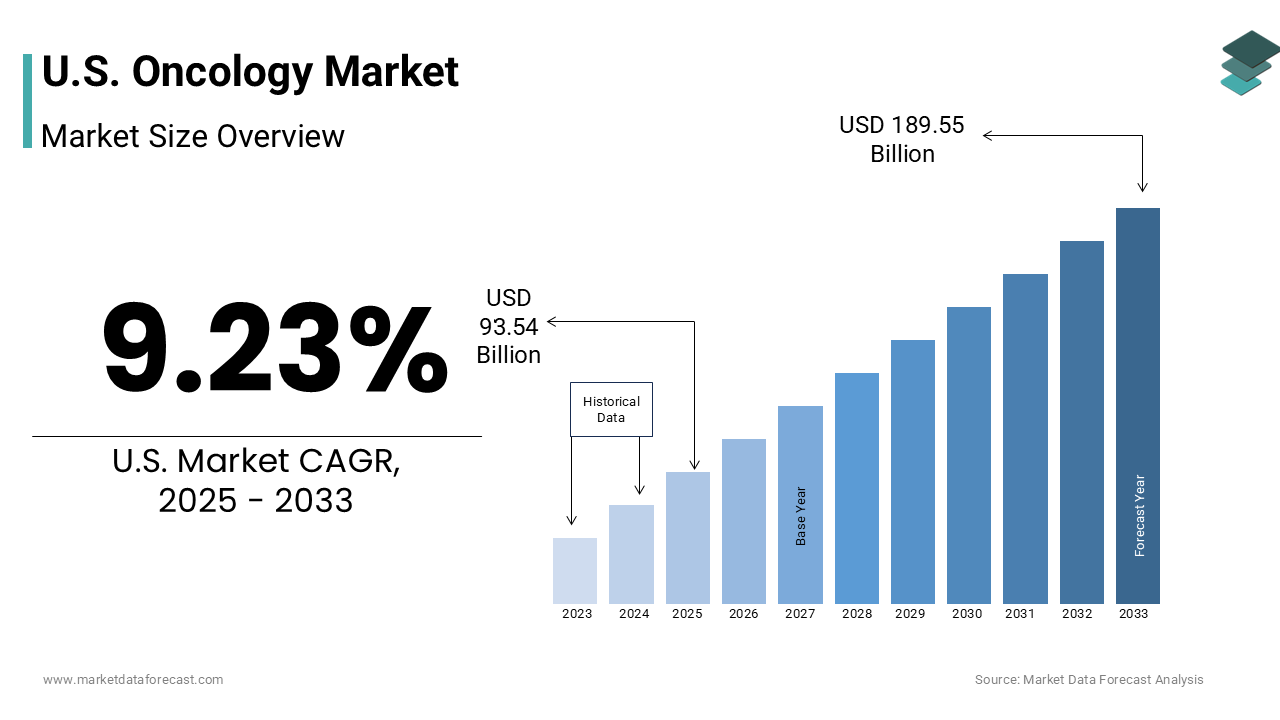
The oncology therapeutics are governed by multidisciplinary tumor boards and value-based payment models. It is not merely a therapeutic domain but a precision ecosystem integrating molecular pathology, real-world evidence, and adaptive clinical pathways.
MARKET DRIVERS
The demographic inevitability of an aging population, which inherently elevates cancer susceptibility due to accumulated genomic instability and immunosenescence is a major factor propelling the growth of U.S. oncology market. Medicare claims data analyzed by the Centers for Medicare & Medicaid Services reveal that beneficiaries aged 75–84 receive 3.2 times more oncology interventions per capita than those aged 50–64.
The proliferation of biomarker-guided therapies that mandate companion diagnostics as a prerequisite for treatment initiation, thereby expanding the diagnostic-therapeutic cascade is additionally to bolster the growth of U.S. oncology market. The College of American Pathologists’ 2023 Molecular Testing Survey confirms that 91% of accredited U.S. labs now offer next-generation sequencing panels covering at least 50 cancer-associated genes, up from 34% in 2018.
MARKET RESTRAINTS
The unsustainable cost trajectory of novel oncology agents, which triggers payer resistance, access delays, and therapeutic rationing even for clinically validated regimens is restricting the growth of U.S. oncology market. Express Scripts’ Drug Trend Report confirms that oncology accounts for 42% of all specialty drug spend despite representing only 2.1% of total prescriptions.
The acute shortage of medical oncologists and genomic pathologists, which creates geographic and temporal bottlenecks in delivering timely, biomarker-informed care is also hampering the growth of U.S. oncology market. The National Comprehensive Cancer Network’s Access Audit documents that patients in non-metropolitan regions wait an average of 28 days longer for genomic test results and 41 days longer to initiate targeted therapy compared to urban counterparts.
The integration of real-world evidence platforms to dynamically refine treatment pathways by enabling adaptive therapy selection based on longitudinal patient outcomes rather than static clinical trial data is creating new opportunities for the growth of U.S. oncology market. Companies investing in RWE partnerships with community oncology networks can accelerate label expansions, neutralize payer skepticism, and transform post-market surveillance into a clinical decision engine that personalizes therapy in near real time.
MARKET OPPORTUNITIES
The embedding financial navigation and toxicity management directly into care delivery, thereby mitigating non-clinical barriers to treatment adherence is creating new opportunities for the growth of U.S. oncology market. The Oncology Nursing Society’s 2023 Practice Innovation Survey confirms that clinics with embedded financial navigators achieve 22% higher 6-month treatment persistence. Providers who systematize affordability and tolerability as core clinical metrics will capture loyalty and outcomes premium in an increasingly consumer-driven oncology landscape.
MARKET CHALLENGES
The fragmentation of genomic data across siloed platforms, such as hospital EHRs, commercial labs, and payer databases, which impedes longitudinal tracking of biomarker evolution and therapeutic resistance is limiting the growth of U.S. oncology market. This data discontinuity prevents clinicians from detecting emergent resistance mutations or clonal evolution in real time, forcing reactive rather than predictive regimen changes.
The misalignment between value-based payment models and the episodic, high-cost nature of oncology innovation, which disincentivizes adoption of curative-intent therapies with front-loaded expense is also to degrade the growth of U.S. oncology market. The Brookings Institution’s 2023 Payment Reform Analysis notes that current alternative payment models reimburse based on 6-month episode costs, penalizing providers who invest in potentially curative therapies with delayed savings.
REPORT COVERAGE
| REPORT METRIC | DETAILS |
| Market Size Available | 2024 to 2033 |
| Base Year | 2024 |
| Forecast Period | 2025 to 2033 |
| Segments Covered | By Therapy, Indication, Distribution Channel and Region. |
| Various Analyses Covered | Global, Regional, & Country Level Analysis; Segment-Level Analysis, Drivers, Restraints, Opportunities, Challenges, PESTLE Analysis, Porter’s Five Forces Analysis, Competitive Landscape, Analyst Overview of Investment Opportunities |
| Regions Covered | North America, Europe, Asia Pacific, Latin America, Middle East, and Africa |
| Key Market Players | Bristol Myers Squibb, Merck & Co., Novartis, Amgen, F. Hoffmann-La Roche, Regeneron Pharmaceuticals, Pfizer, Eli Lilly, Iovance Biotherapeutics, and OncoSec Medical Incorporated. |
SEGMENTAL ANALYSIS
By Therapy Insights
The targeted therapy segment was the largest and held 58.3% of the U.S. oncology market share in 2024. The Journal of Clinical Oncology’s Practice Patterns Study confirms that oncologists now initiate targeted agents in 83% of metastatic cases where a driver mutation is identified seven when chemotherapy has higher historical response rates due to superior tolerability and progression-free survival.
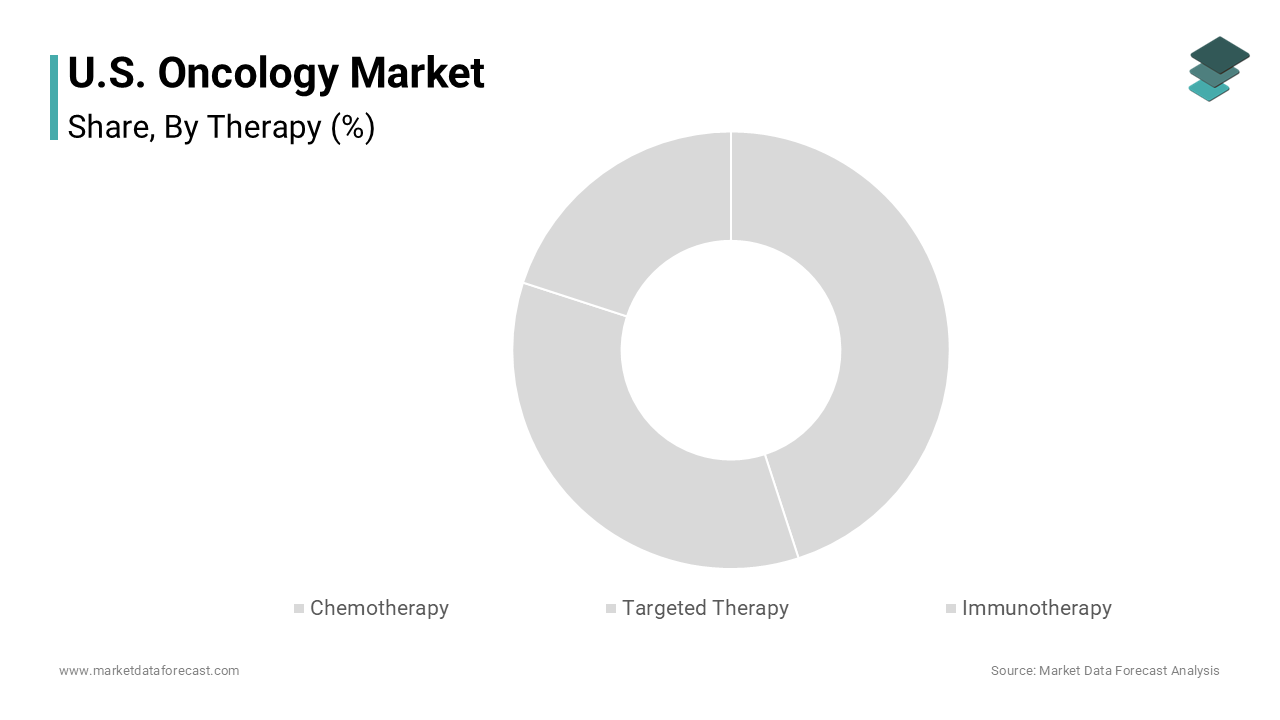
The immunotherapy segment is likely to grow with a CAGR of 15.1% throughout the forecast period with the FDA approved neoadjuvant nivolumab for resectable NSCLC in 2023 after trials showed 37% improvement in event-free survival. Additionally, the rise of subcutaneous and fixed-dose formulations, such as atezolizumab SC that reduces chair time by 45%, enabling higher patient throughput.
By Indication Insights
The breast cancer segment was the largest by occupying 24.3% of the U.S. oncology market share in 2024 with the molecular heterogeneity enabling sequential lines of targeted therapy. Additionally, 89% of early-stage ER+ patients now receive extended adjuvant endocrine therapy guided by genomic recurrence scores like Oncotype DX, locking in 5–10 years of pharmacotherapy per patient.
The lung cancer segment is lucratively growing with a significant CAGR of 12.7% throughout the forecast period with the integration of early detection via LDCT screening. The NCCN’s 2024 NSCLC Guidelines endorse osimertinib for EGFR-mutated stage IB–IIIA disease after adjuvant trials showed 80% reduction in recurrence.
By Distribution Channel Insights
The hospital pharmacies segment held a dominant share of the U.S. oncology market in 2024. The American Hospital Association’s 2023 Medication Management Survey confirms that 93% of hospitals embed oncology drugs into electronic order sets with auto-substitution protocols for biosimilars, ensuring 85% penetration within 90 days of approval.
The online pharmacies segment is growing lucratively with a CAGR of 18.9% during the forecast period, such as Amazon Pharmacy and Capsule that guarantee next-day delivery of oral oncolytics with nurse hotline support and copay assistance. GoodRx’s 2023 Consumer Behavior Tracker reveals that 41% of patients on kinase inhibitors or hormonal therapies now refill exclusively online, citing price transparency and auto-refill reliability.
KEY MARKET PLAYERS
A few of the major companies in the U.S. oncology market include
- Bristol Myers Squibb
- Merck & Co.
- Novartis
- Amgen
- F. Hoffmann-La Roche
- Regeneron Pharmaceuticals
- Pfizer
- Eli Lilly
- Iovance Biotherapeutics
- OncoSec Medical Incorporated
MARKET SEGMENTATION
This research report on the U.S. oncology market has been segmented based on following categories.
By Therapy
- Chemotherapy
- Targeted Therapy
- Immunotherapy
By Indication
- Lung
- Stomach
- Colorectal
- Breast
- Prostate
- Others
By Distribution Channel
- Hospital Pharmacies
- Retail
- Online Pharmacies
By Country
- The United States