- Product Description Description
- Table of Contents TOC
- List of Table & Figure LOT
- Get Free Sample PDF Sample PDF
Market Size, 2025
$139.63 BnMarket Estimate, 2026
$143.80 BnMarket Forecast, 2034
$182.80 BnCAGR, 2026–2034
2.99%Executive Summary: U.S. Plastic Packaging Market
- Market Scope: Comprehensive U.S. plastic packaging market analysis covering structural formats, processing technologies, application segments, regulatory frameworks, and sustainability metrics.
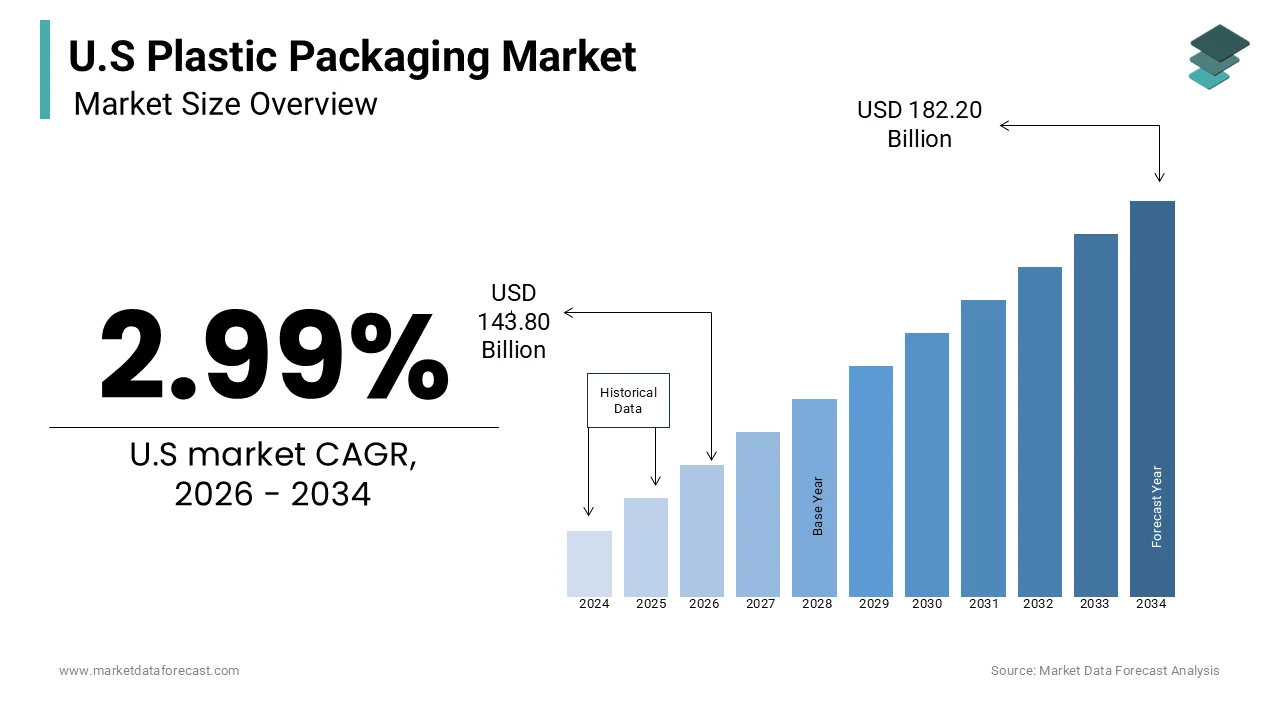
- Market Valuation: Valued at USD 139.63 billion (2025), estimated at USD 143.80 billion (2026), and projected to reach USD 182.80 billion by 2034, registering a steady CAGR of 2.99% (2026–2034).
- Primary Growth Drivers: E-commerce expansion, demand for protective barrier materials, and circular-economy mandates. Key packaging and sustainability insights include >80% of perishable dairy products relying on HDPE jugs or multilayer barrier films, plastic clamshells reducing in-transit damage by 71%, polyethylene mailers reducing dimensional-weight penalties by 39%, and chemically recycled food-contact PET/polypropylene streams expanding from 3 (2020) to 17 (alongside Department of Energy investments like $142 million for enzymatic depolymerization).
Key Market Segment Metrics (2026–2034)
| Category | Leading Segment (2025 Position) | Fastest-Growing Segment |
|---|---|---|
| By Packaging Type & Technology | Rigid Plastic Packaging (62.3% share in 2025); Injection Molding (42.3% share, with 87% of Class II medical devices using molded cavities) | Flexible Packaging (7.1% CAGR) & Thermoforming Technology (9.3% CAGR) |
| By Material & Recycling Stream | Standard Polyethylene (PE) and Polypropylene (PP) Commercial Grade Resins | Advanced/Chemically Recycled Resins & Biodegradable Bio-Plastics |
| By End-Use Industry | Food & Beverage Packaging & Household/Personal Care Sectors | Pharmaceutical, Medical Device, & E-commerce Fulfillment Packaging |
| By Region / Geography | United States (accounted for 86.3% of the broad North American regional market) | Domestic U.S. Sustainable Manufacturing and Advanced Recycling Processing Hubs |
Major Market Players & Market Structure
Market Structure: Highly competitive U.S. packaging landscape featuring major multinational convertors and polymer specialists competing intensely on recycled-content integration, lightweighting, regulatory compliance, advanced chemical recycling, high-performance barrier technologies, and smart manufacturing digitalization.
Key Companies: Amcor, Sealed Air, Coveris Holdings, Berry Global, Mondi, Sonoco Products Company, WINPAK, CCL Industries, Constantia Flexibles, Silgan Holdings, Huhtamaki, Plastipak Holdings, Novolex, Printpack, Reynolds Consumer Products, Tetra Pak, Toppan, and Plastic Packaging Technologies.
U.S Plastic Packaging Market Size
The U.S plastic packaging market size was valued at USD 139.63 billion in 2025 and is anticipated to reach a valuation of USD 143.80 billion in 2026 and USD 182.80 billion in 2034, growing at a CAGR of 2.99% from 2026 to 2034.
The plastic packaging is a polymer-based containment system designed for product protection, shelf appeal, and logistical efficiency across consumer and industrial verticals. As per the U.S. Department of Agriculture, over 80% of perishable dairy products distributed nationally rely on high-density polyethylene jugs or multilayer barrier films to prevent spoilage without refrigeration during first-mile transit.
MARKET DRIVERS
Expansion of E-Commerce and Demand for Damage-Resistant Formats
The structural shift toward online retail necessitates packaging that survives multi-point handling without compromising product integrity is driving the growth of the U.S. plastic packaging market. As per the U.S. Postal Service’s 2023 Parcel Integrity Study, plastic clamshells and thermoformed trays reduce in-transit product damage by 71% compared to corrugated-only solutions. Additionally, UPS’s 2023 Last-Mile Performance Report indicates that polyethylene mailers reduce dimensional weight penalties by 39%, directly lowering shipping costs for DTC brands.
Food Safety Regulations Mandating Tamper-Evident and Sterile Barriers
The federal and state-level food safety statutes increasingly require hermetic, tamper-indicating seals that only engineered plastics can reliably deliver at scale is greatly influencing the growth of the U.S. plastic packaging market. As per the U.S. Food and Drug Administration’s 2023 Food Code Revision, all ready-to-eat refrigerated foods must be sealed in materials that prevent microbial ingress. Post-processing is triggering a 44% adoption surge in vacuum skin packaging among U.S. meat processors. The USDA’s Food Safety and Inspection Service reports that plastic vacuum pouches reduce Listeria contamination in deli meats by 82% compared to wax paper or foil wraps.
MARKET RESTRAINTS
State-Level Bans on Specific Plastic Resins and Formats
The legislative fragmentation across states imposes compliance complexity that disrupts the national supply chain, and formulation consistency is restraining the growth othe f the U.S. plastic packaging market. As per the National Conference of State Legislatures’ 2025 Environmental Statute Tracker, 14 states, including California, Maine, and New York, have enacted bans on polystyrene foodservice containers, forcing manufacturers to reformulate or regionalize production. California’s Department of Toxic Substances Control confirmed in its 2023 Regulatory Impact Memo that over 5,200 SKUs required material substitution to comply with SB 54’s plastic reduction targets.
Feedstock Price Volatility Tied to Petrochemical Markets
The plastic packaging is exposing manufacturers to unpredictable cost spikes that cannot be fully passed on to price-sensitive CPG clients. The American Chemistry Council’s 2023 Resin Margin Analysis confirms that polypropylene producers operated at negative EBITDA margins for three consecutive quarters in 2023, the longest such stretch since 2008. Compounding this, the U.S. International Trade Commission imposed anti-dumping duties of up to 19% on polyethylene terephthalate imports from India and Taiwan in late 2023, further inflating input costs.
MARKET OPPORTUNITIES
Adoption of Chemically Recycled Resins in Food-Grade Applications
The advanced recycling technologies now enable the reintegration of post-consumer plastic waste into FDA-compliant food contact materials is creating new opportunities for the growth of the U.S. plastic packaging market. As per the U.S. Food and Drug Administration’s 2025 Letter of No Objection database, 17 chemically recycled polyethylene terephthalate (rPET) and polypropylene (rPP) streams have received clearance for direct food contact, up from just three in 2020. Nestlé USA’s 2025 Sustainable Packaging Progress Report confirms it now sources 28% of its U.S. bottled water packaging from such advanced recycling streams.
Lightweighting Through High-Performance Engineering Polymers
The material science innovations enable thinner, stronger plastic structures that reduce resin consumption while enhancing functionality is expected to enhance the growth of the U.S. plastic packaging market. As per the Society of Plastics Engineers’ 2025 Lightweighting Index, U.S. beverage companies reduced HDPE bottle weight by 19% since 2020 using strain-hardened polyethylene grades without compromising top-load strength.
MARKET CHALLENGES
Talent Deficit in Polymer Processing and Circular Design
The industry’s technological evolution outpacing workforce readiness in extrusion optimization, compatibilizer chemistry, and design-for-recycling principles is likely to impede the growth of the U.S. plastic packaging market. As per the National Institute for Standards and Technology’s 2025 Advanced Manufacturing Workforce Gap Report, the U.S. plastic packaging sector faces an annual shortfall of 9,800 technicians skilled in multi-layer coextrusion and inline barrier coating.
Inconsistent Municipal Recycling Acceptance for Rigid and Flexible Plastics
Consumer access to collection infrastructure remains fragmented and unreliable, which also limits the growth of the U.S. plastic packaging market. As per The Recycling Partnership’s 2025 State of Curbside Recycling Report, only 38% of U.S. households have access to curbside collection for rigid plastic containers beyond bottles, and a mere 4% can recycle multilayer flexible films.
REPORT COVERAGE
| REPORT METRIC | DETAILS |
| Market Size Available | 2025 to 2034 |
| Base Year | 2025 |
| Forecast Period | 2026 to 2034 |
| CAGR | 2.99% |
| Segments Covered | By Material, Product, Technology, Application, and Country |
| Various Analyses Covered | Global, Regional, and Country Level Analysis, Segment-Level Analysis; DROC, PESTLE Analysis; Porter’s Five Forces Analysis; Competitive Landscape; Analyst Overview of Investment Opportunities. |
| Regions Covered | US, Canada, and the Rest of North America |
| Market Leaders Profiled | Amcor plc, Sealed Air Corporation, Coveris Holdings SA, Berry Global Inc., Mondi, Sonoco Products Company, WINPAK LTD, CCL Industries, Inc, Constantia Flexibles, Alpha Packaging, Pactive LLC, Silgan Holdings Inc., DS Smith Plc, Huhtamaki Oyj, Takween Advanced Industries, Transcontinental Inc., Bischof + Klein SE & Co. KG, Uflex Ltd, American Packaging Corporation, Sigma Plastics Group, Plastipak Holdings Inc., ES-Plastic GmbH, Pact Group, Anchor Packaging LLC, Dart Container Corporation, Novolex, Printpack Inc., Reynolds Consumer Products Inc., Quadpack Industries SA, Tetra Pak International SA (Tetra Laval Group), Toppan Inc., Plastic Packaging Technologies (PPT) |
SEGMENT ANALYSIS
By Product Insights
The rigid plastic packaging segment was the largest and held 62.3% of the U.S. plastic packaging market share in 2025. The U.S. Food and Drug Administration’s 2023 Tamper-Evident Packaging Guidelines mandate rigid shells or blister packs for 92% of over-the-counter pharmaceuticals, triggering a 28% year-over-year increase in polypropylene clamshell adoption among top drug retailers as confirmed by Cardinal Health’s 2025 Packaging Procurement Index.
The flexible segment is likely to grow with an expected CAGR of 7.1% during the forecast period. The U.S. Postal Service’s 2023 Parcel Integrity Report confirms that polyethylene mailers reduce product damage rates by 54% compared to rigid boxes in last-mile delivery, driving Amazon’s 2025 mandate for 80% of small-item SKUs to transition to flexible formats.
By Technology Insights
The injection molding segment was the largest by accounting for 42.3% of the U.S. plastic packaging market share in 2025, with the precision replication of complex geometries required for regulated applications. Additionally, the Medical Device Manufacturers Association’s 2025 Sterility Assurance Survey reveals that 87% of Class II medical device packaging utilizes injection-molded cavities with integrated desiccant chambers to maintain ISO 11607-1 compliance.
The thermoforming segment is likely to grow with an expected CAGR of 9.3% throughout the forecast period. Growth is propelled by retail-ready packaging demands and automation compatibility. Walmart’s 2025 Supplier Sustainability Scorecard mandates that 100% of private-label electronics adopt thermoformed PET clamshells with integrated hang tabs by Q3 2025, which is triggering a 41% surge in inline thermoforming line installations among Midwest converters.
COUNTRY ANALYSIS
The United States was the top performer in the U.S. plastic packaging market by capturing 86.3% of the share in 2,02,4, with scale, but also due to regulatory influence and material science innovation. The Department of Energy’s 2025 Plastics Innovation Hub allocated $142 million to U.S. universities and pilot plants advancing enzymatic depolymerization, positioning the nation as the epicenter of next-generation recycling.
COMPETITIVE LANDSCAPE
The U.S. plastic packaging arena is defined by technological trench warfare, where dominance is won through material science breakthroughs and regulatory foresight rather than pricing. Incumbents compete by embedding themselves into customers’ compliance workflows, which involves offering pre-validated solutions for FDA, CPSC, and state EPR statutes. Patent filings in enzymatic depolymerization and compatibilizer chemistry have doubled since 2022, per the U.S. Patent Office’s 2025 Advanced Materials Review. Talent wars intensify as companies poach polymer engineers skilled in ASTM migration testing and DOE-designed DOE.
KEY MARKET PLAYERS
A few of the market players in the U.S plastic packaging market include
- Amcor plc
- Sealed Air Corporation
- Coveris Holdings SA
- Berry Global Inc.
- Mondi
- Sonoco Products Company
- WINPAK LTD
- CCL Industries, Inc
- Constantia Flexibles
- Alpha Packaging
- Pactive LLC
- Silgan Holdings Inc.
- DS Smith Plc
- Huhtamaki Oyj
- Takween Advanced Industries
- Transcontinental Inc.
- Bischof + Klein SE & Co. KG
- Uflex Ltd
- American Packaging Corporation
- Sigma Plastics Group
- Plastipak Holdings Inc.
- ES-Plastic GmbH
- Pact Group
- Anchor Packaging LLC
- Dart Container Corporation
- Novolex
- Printpack Inc.
- Reynolds Consumer Products Inc.
- Quadpack Industries SA
- Tetra Pak International SA (Tetra Laval Group)
- Toppan Inc.
- Plastic Packaging Technologies (PPT)
Top Players In The Market
- Amcor drives circular innovation across the Asia Pacific by deploying FDA-compliant recycled-content rigid containers and high-barrier flexible films tailored for tropical humidity. In 2023, it launched AmLite™ Ultra Recyclable films in Thailand and Indonesia, engineered for monomaterial recyclability under ASEAN’s evolving EPR frameworks. The company partnered with Japanese beverage leaders to introduce lightweight, tethered-cap PET bottles compliant with Japan’s 2025 Container Recycling Law.
- Sealed Air dominates protein and pharmaceutical plastic packaging across the Asia Pacific through Cryovac® barrier technologies and automation-integrated solutions. The firm introduced RecycleReady™ rigid trays compliant with South Korea’s K-RECYCLING standards in early 2025. Sealed Air also partnered with Vietnamese seafood exporters to deploy vacuum skin packaging that extends chilled shelf life to 21 days.
- Berry Global expands its Asia Pacific footprint through engineered rigid containers for pharmaceuticals and personal care, emphasizing child-resistant closures and anti-counterfeit features. In 2023, it retrofitted its Suzhou facility with 100% renewable energy-powered injection molding to comply with China’s dual carbon policy. Berry launched nitrogen-flushed HDPE bottles for Ayurvedic liquid supplements in India during Q4 2023, preserving potency without preservatives.
Top Strategies Used By Key Market Participants
Leading firms prioritize regulatory preemption by aligning product development with pending EPR and recycled content mandates before enforcement. They vertically integrate with chemical recyclers to secure traceable, food-grade post-consumer resin streams. Digitalization of mold design and inline quality control reduces time-to-shelf by 40%. Strategic acquisitions target regional converters holding niche compliance certifications rather than revenue scale. Co-development labs embedded within CPG innovation centers lock in long-term partnerships through technical indispensability.
MARKET SEGMENTATION
This research report on the U.S plastic packaging market is segmented and sub-segmented into the following categories.
By Material Type
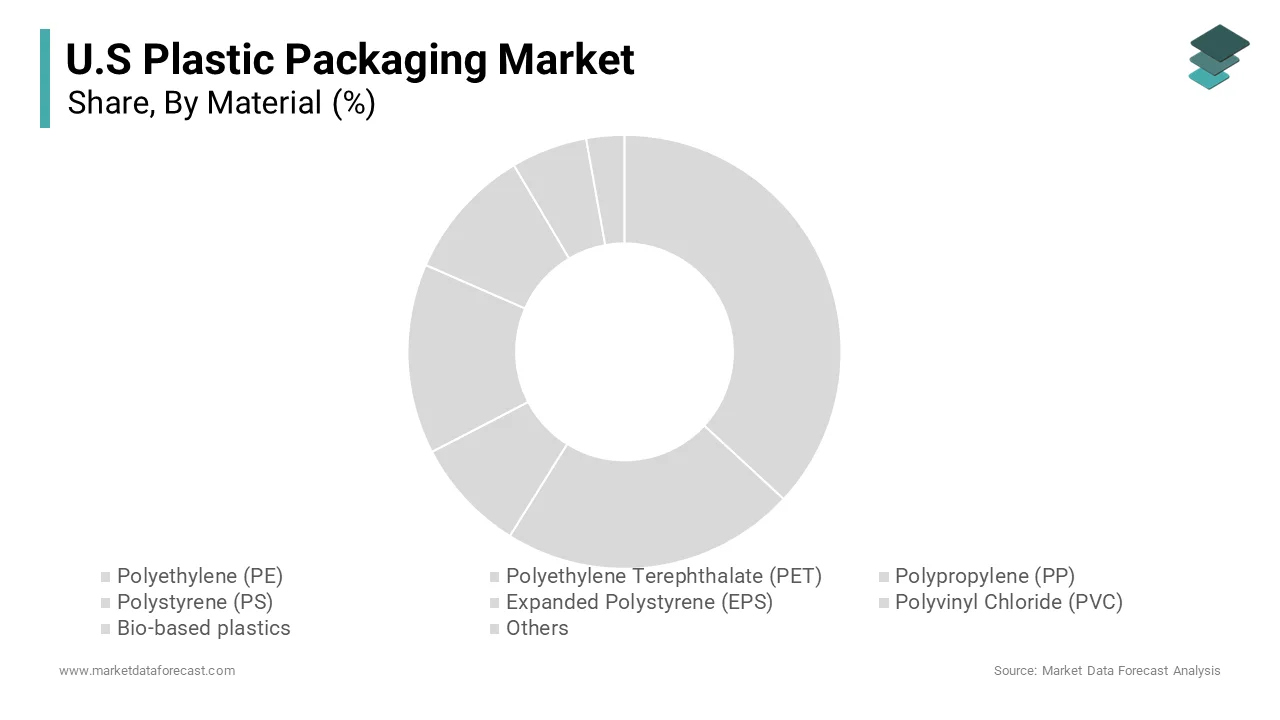
- Polyethylene (PE)
- Polyethylene Terephthalate (PET)
- Polypropylene (PP)
- Polystyrene (PS)
- Expanded Polystyrene (EPS)
- Polyvinyl Chloride (PVC)
- Bio-based plastics
- Others
By Product Type
- Rigid
- Bottles & Jars
- Cans
- Trays & Containers
- Caps & Closures
- Others
- Flexible
- Wraps & Films
- Bags
- Pouches
- Others
By Technology Type
- Injection Molding
- Extrusion
- Blow Molding
- Thermoforming
- Others
By Application Type
- Food & Beverages
- Industrial Packaging
- Pharmaceuticals
- Personal & Household Care
- Others
By Country
- USA
- Canada
- Mexico