- Product Description Description
- Table of Contents TOC
- List of Table & Figure LOT
- Get Free Sample PDF Sample PDF
Market Size, 2025
$63.32 BnMarket Estimate, 2026
$70.56 BnMarket Forecast, 2034
$167.85 BnCAGR, 2026–2034
11.44%U.S. Revenue Cycle Management Market Summary
The U.S. revenue cycle management (RCM) market was valued at USD 63.32 billion in 2025, is estimated to reach USD 70.56 billion in 2026, and is projected to reach USD 167.85 billion by 2034, growing at a CAGR of 11.44% during the forecast period from 2026 to 2034. The growth of the U.S. revenue cycle management market is driven by the increasing adoption of digital health solutions, rising healthcare expenditures, the transition toward value-based care, and growing demand for automation and analytics in billing and claims processing.
Key Market Trends
- Growing integration of artificial intelligence (AI) and machine learning (ML) in RCM platforms to improve claim accuracy and reduce denials.
- Increasing demand for cloud-based RCM solutions for scalability and cost-efficiency.
- Rising healthcare data complexity driving the need for advanced analytics and automation.
- Expansion of outsourced RCM services among small and mid-sized healthcare providers.
- Growing emphasis on patient-centric billing and transparent payment systems.
Segmental Insights
- Based on structure, the in-house operations segment was the largest and held 62.1% of the U.S. revenue cycle management market share in 2025, attributed to healthcare providers’ preference for maintaining data control and compliance within their organizations.
- Based on type, the software segment dominated the market with 59.1% share in 2025, driven by increasing demand for integrated RCM platforms offering real-time analytics, automated billing, and denial tracking.
- Based on segment, the claims and denial management segment accounted for 34.2% of the market share in 2025, owing to rising claim complexity and the need for effective denial prevention strategies.
- Based on end-user, the hospitals segment led the market, occupying 54.3% of the U.S. revenue cycle management market share in 2025, due to large-scale patient volumes, complex billing processes, and the growing push toward digital transformation in hospital operations.
Competitive Landscape
The U.S. revenue cycle management market is highly competitive and technology-driven, with major players focusing on AI integration, automation, and end-to-end RCM service offerings. Companies are increasingly forming partnerships and acquisitions to strengthen service portfolios and expand client bases. Leading players include Allscripts Healthcare, LLC, Cerner Corporation, Conifer Health Solutions, LLC, Epic Systems Corporation, GeBBS Healthcare Solutions, Athenahealth, Inc., MEDHOST, McKesson Corporation, Medical Information Technology, Inc. (MEDITECH), Optum Inc., and R1 RCM, Inc.
U.S Revenue Cycle Management Market Size
The U.S revenue cycle management market size was valued at USD 63.32 billion in 2025 and is anticipated to reach a valuation of USD 70.56 billion in 2026 and USD 167.85 billion by 2034, growing at a CAGR of 11.44% from 2026 to 2034.
The revenue cycle management is the integrated administrative and clinical functions that capture, manage, and collect patient service revenues across the healthcare continuum. Furthermore, as per the Medical Group Management Association, physician practices lose approximately 5% to 10% of potential revenue due to coding inaccuracies or missed charges, independent of market growth metrics.
MARKET DRIVERS
The escalating administrative burden imposed by regulatory and payer complexity is driving the growth of the U.S. revenue cycle management market. As per the American Medical Association, physicians spend nearly two hours on administrative tasks for every one hour of direct patient care, with 34% of that time devoted to billing and insurance-related activities. The transition to value-based reimbursement models mandated by CMS has increased documentation requirements, compelling providers to adopt sophisticated RCM platforms. The persistent labor shortage in healthcare administrative roles is also propelling the growth of the U.S. revenue cycle management market. As per the Healthcare Financial Management Association, over 60% of revenue cycle departments report vacancies exceeding 15% of staffing capacity, directly correlating with a 19% increase in days in accounts receivable.
MARKET RESTRAINTS
The entrenched fragmentation of electronic health record systems across provider networks is significantly hampering the growth of the U.S. revenue cycle management market. As per the Office of the National Coordinator for Health IT, only 38% of U.S. hospitals possess fully interoperable EHR systems capable of seamless billing data exchange with external entities. RCM platforms struggle to automate end-to-end workflows, which results in manual reconciliation that inflates error rates.
The provider's resistance to workflow disruption during RCM system implementation also hinders the growth of the U.S. revenue cycle management market. This operational friction is compounded by training deficits. As per the American Academy of Family Physicians, only 31% of small practices allocate structured onboarding time for RCM software, leading to suboptimal utilization. The ROI realization is deferred, which is discouraging further investment despite long-term efficiency gains.
MARKET OPPORTUNITIES
The expansion of AI-powered predictive analytics for pre-service financial clearance is expected to significantly enhance the growth of the U.S. revenue cycle management market. As per Stanford Medicine’s 2023 AI in Healthcare Index, predictive models can accurately forecast patient payment likelihood with 89% precision when integrating socioeconomic and historical payment data. This enables providers to tailor financial counseling or payment plans preemptively, reducing bad debt. The migration of RCM functions to cloud-native, modular platforms is expected to propel the growth of the U.S. revenue cycle management market. According to the University of California Health system, a 28% acceleration in claim adjudication cycles after shifting to a microservices-based RCM architecture. This architectural agility future-proofs revenue operations amid care delivery decentralization.
MARKET CHALLENGES
The rising sophistication of medical billing fraud, which directly undermines RCM integrity, is additionally hampering the growth of the U.S. revenue cycle management market. As per the Government Accountability Office, 1 in 5 Medicare Advantage organizations failed audit checks for improper risk adjustment coding in 2022, exposing providers to clawbacks. The misalignment between clinical documentation and billing requirements, which is creating revenue leakage at the point of care, shall hamper the growth of the U.S. revenue cycle management market. As per a 2023 study in the New England Journal of Medicine Catalyst, 41% of clinical notes lack sufficient specificity to support optimal coding, resulting in an estimated $35 billion in annual underpayments. Bridging this semantic chasm requires real-time clinical decision support embedded in EHRs with a functionality most RCM platforms lack, creating persistent capture gaps despite technological maturity.
REPORT COVERAGE
| REPORT METRIC | DETAILS |
| Market Size Available | 2025 to 2034 |
| Base Year | 2025 |
| Forecast Period | 2026 to 2034 |
| CAGR | 11.44% |
| Segments Covered | By Structure, Type, Segment, End-User, and Country |
| Various Analyses Covered | Global, Regional, and Country Level Analysis, Segment-Level Analysis; DROC, PESTLE Analysis; Porter’s Five Forces Analysis; Competitive Landscape; Analyst Overview of Investment Opportunities. |
| Regions Covered | US, Canada, and the Rest of North America |
| Market Leaders Profiled | Allscripts Healthcare, LLC (U.S.), Cerner Corporation (U.S.), Conifer Health Solutions, LLC (U.S.), Epic Systems Corporation (U.S.), GeBBS Healthcare Solutions (U.S.), MEDHOST (U.S.), McKesson Corporation (U.S.), Medical Information Technology, Inc. (MEDITECH) (U.S.), Optum Inc. (U.S.), R1 RCM, Inc. (U.S.). |
SEGMENT ANALYSIS
By Structure Insights
The in-house operations segment was the largest and held 62.1% of the U.S. revenue cycle management market share in 2025, with providers’ desire to retain direct control over sensitive financial workflows and patient data. As per the Becker’s Hospital Review 2024 Finance Survey, 83% of CFOs at hospitals with over 300 beds prefer in-house teams for denial appeals, which is citing higher success rates and nuanced payer contract knowledge.
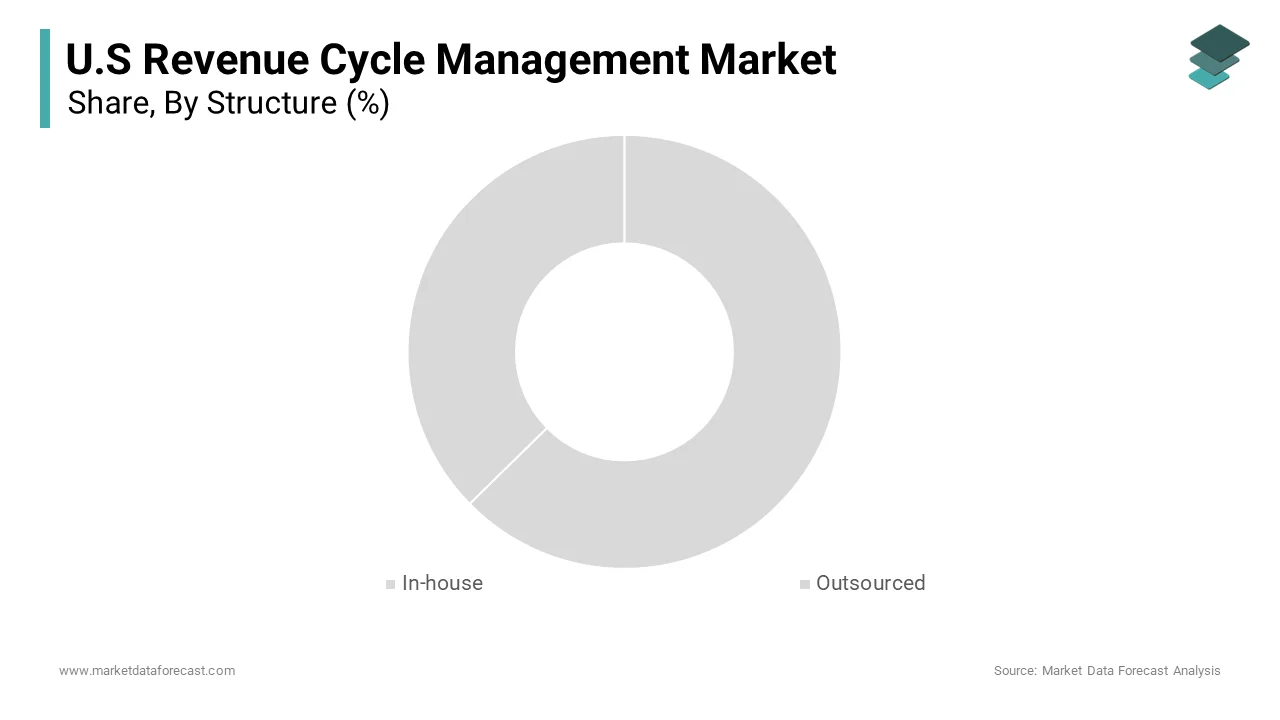
The outsourced RCM segment is likely to grow with an anticipated CAGR of 11.7% during the forecast period, with acute staffing shortages. Small and rural providers, which constitute 48% of all U.S. clinics according to the National Rural Health Association, increasingly outsource to avoid $215,000 average annual overhead per full-time coder, as calculated by MGMA.
By Type Insights
The software segment held 59.1% the U.S. revenue cycle management market share in 2025, with the automation’s capacity to compress revenue leakage. Software also enables real-time adjudication for Epic Systems users, processing 92% of claims within 48 hours versus 67% with legacy manual systems.
The services segment is expected to grow with a CAGR of 13.2% during the forecast period, with the complexity of value-based contracting. Additionally, as per the American Medical Group Association, 68% of multispecialty groups now contract external RCM consultants to manage payer-specific edits, reducing denials by up to 31%. Software cannot yet replicate the contextual judgment required when a surgeon’s note omits laterality or severity modifiers.
By Segment Insights
The claims and denial management segment accounted in holding 34.2% of the U.S. revenue cycle management market share in 2025, with the payer behavior. The UnitedHealthcare’s 2025 Transparency Report admits to an initial denial rate of 18% across commercial lines, forcing providers to deploy specialized teams.
The clinical documentation improvement segment is anticipated to grow with a CAGR of 15.8% during the forecast period, with the risk-adjustment imperatives in Medicare Advantage. Simultaneously, 63% of denials now stem from “clinical validation” requests, where payers demand pproof thata condition existed at the time of service.
By End-User Insights
The hospitals segment was the largest by occupying 54.3% of the U.S. revenue cycle management market share in 2025, with a function of volume and complexity.
The physician offices segment is isexpectedd to grow with a CAGR of 14.1% in next coming years, with the consolidation where many of the U.S. physicians now work in groups of 10 or more by creating centralized billing hubs that demand enterprise-grade RCM tools. Outsourced RCM vendors, which offer per-claim pricing models that enable small practices to access hospital-grade capabilities without capital outlay, which is fueling adoption velocity.
COMPETITIVE LANDSCAPE
The U.S. revenue cycle management market is fiercely contested among EHR-integrated giants, cloud-native disruptors, and specialized outsourcers, each vying through technological differentiation and workflow intimacy. Incumbents leverage scale and regulatory entrenchment, while agile entrants exploit AI and automation to undercut legacy inefficiencies. Competition centers not on price but on denial reduction velocity, interoperability depth, and revenue recovery precision.
KEY MARKET PLAYERS
A few of the market players in the U.S revenue cycle management market include
- Allscripts Healthcare, LLC (U.S.)
- Cerner Corporation (U.S.)
- Conifer Health Solutions, LLC (U.S.)
- Epic Systems Corporation (U.S.)
- GeBBS Healthcare Solutions (U.S.)
- Athenahealth, Inc.
- MEDHOST (U.S.)
- McKesson Corporation (U.S.)
- Medical Information Technology, Inc. (MEDITECH) (U.S.)
- Optum Inc. (U.S.)
- R1 RCM, Inc. (U.S.)
Top Players In The Market
- Epic dominates U.S. hospital RCM infrastructure by embedding end-to-end billing, eligibility, and denial management directly into its EHR. Epic strengthened its position by integrating real-time payer rule engines from major insurers, enabling instant edits at the point of service.
- Cerner’s RCM suite, now under Oracle Health, leverages AI-driven charge capture and robotic process automation to streamline hospital billing workflows. Oracle Health expanded its U.S. footprint by embedding RCM analytics into Oracle Cloud Infrastructure. In the Asia Pacific, it partners with Singaporean and Indian hospital chains to deploy cloud-hosted RCM modules, adapting U.S. logic to local payer rules while maintaining centralized audit and compliance frameworks aligned with American regulatory templates.
- athenahealth targets physician groups with cloud-native RCM services emphasizing automation and transparency. Its 2023 “Payment Integrity Suite” reduced underpayments by 18% through real-time contract analytics. The company fortified its position by acquiring Epocrates in early 2024 to embed clinical decision support directly into billing workflows. While not operating RCM services directly in Asia Pacific, athenahealth licenses its API-driven billing engine to telehealth platforms in Australia and South Korea by enabling them to replicate U.S.-style real-time eligibility and patient payment estimation without full-scale EHR adoption.
Top Strategies Used by Key Market Participants
Leading players deploy AI-integrated denial prediction engines to slash revenue leakage, embed payer-specific rule libraries for real-time claim scrubbing, and migrate legacy platforms to cloud-native microservices for scalability. They acquire niche innovators to absorb specialized capabilities like clinical documentation integrity or patient payment estimation. Strategic partnerships with insurers enable direct adjudication pathways, while modular API architectures allow third-party developers to extend functionality.
MARKET SEGMENTATION
This research report on the U.S revenue cycle management market is segmented and sub-segmented into the following categories.
By Structure
- In-house
- Outsourced
By Type
- Services
- Software
By Function
- Claims & Denial Management
- Medical Coding & Billing
- Clinical Documentation Improvement (CDI)
- Insurance
- Others
By End-user
- Hospitals
- Physician’s Office
- Others
By Country
- USA
- Canada
- Mexico