- Product Description Description
- Table of Contents TOC
- List of Table & Figure LOT
- Get Free Sample PDF Sample PDF
Market Size, 2025
$204 BnMarket Estimate, 2026
$210 BnMarket Forecast, 2034
$267 BnCAGR, 2026–2034
3.05%Executive Summary: U.S. Specialty Chemicals Market
- Market Scope: Comprehensive U.S. specialty chemicals market analysis covering product categories, industrial application sectors, regional leadership frameworks, and economic impact metrics.
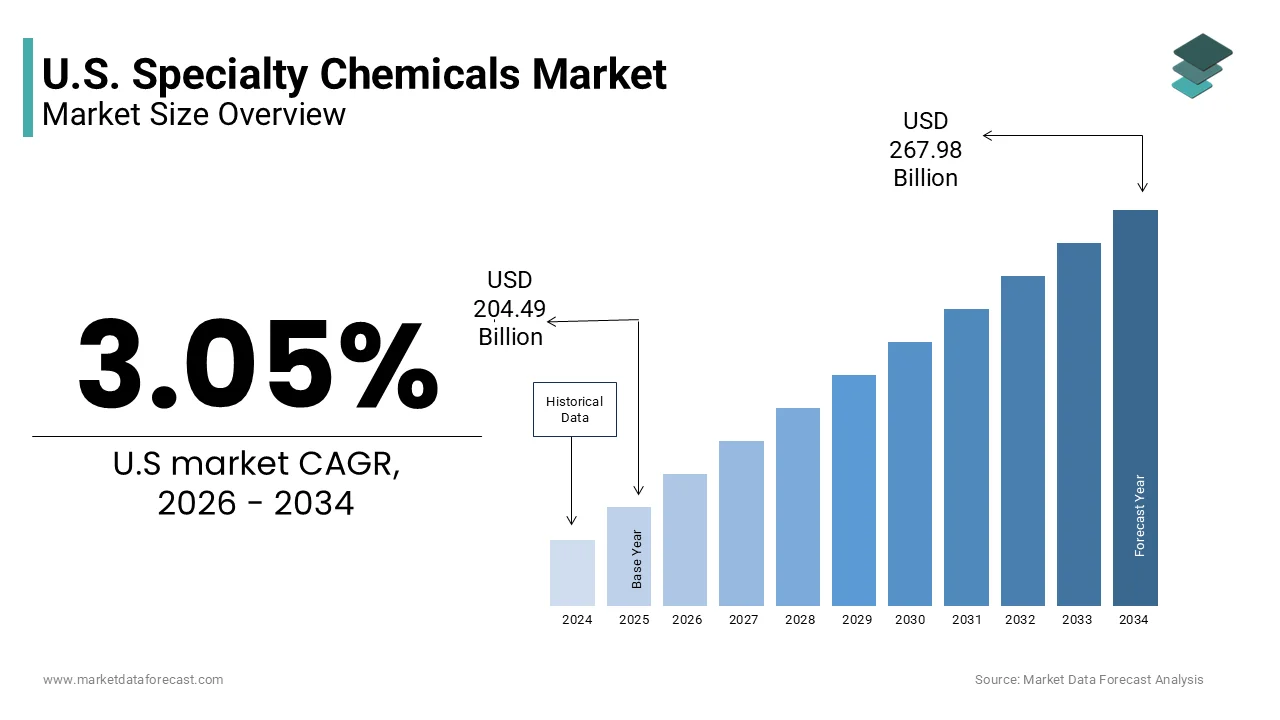
- Market Valuation: Valued at USD 204.49 billion (2025), estimated at USD 210.73 billion (2026), and projected to reach USD 267.98 billion by 2034, registering a steady CAGR of 3.05% (2026–2034).
- Primary Growth Drivers: High R&D investments, pharmaceutical demand, semiconductor manufacturing expansion, and stringent hygiene/safety regulations. Key economic and operational highlights include the U.S. chemical industry investing ~USD 14.8 billion annually in R&D (employing ~895,000 workers), the biopharmaceutical sector supporting ~4.8 million jobs and contributing >USD 1.4 trillion in annual economic output, regulatory compliance costs averaging roughly USD 11 million annually per facility, and procurement lead times extending past 90 days during global material bottlenecks.
Key Market Segment Metrics (2026–2034)
| Category | Leading Segment (2025 Position) | Fastest-Growing Segment |
|---|---|---|
| By Product & Application Type | Institutional & Industrial Cleaners (held 26.9% of the U.S. market in 2025) | Advanced Electronic, Semiconductor, & Bio-Based Specialty Chemicals |
| By End-Use Industry | Commercial Cleaning, Pharmaceuticals, & Manufacturing Industries | Biopharmaceutical Formulations & Advanced Technology Materials |
| By Formulation Type | Standard Industrial Formulations & Regulatory-Compliant Blends | Sustainable, Low-Emission, & Bio-Based Specialty Formulations |
| By Region / Country | United States (accounted for 77.5% of the North American specialty chemicals market in 2025) | U.S. Regional Technology & Semiconductor Manufacturing Hubs |
Major Market Players & Market Structure
Market Structure: Highly competitive U.S. chemical manufacturing and advanced materials landscape featuring major multinational corporations competing intensely on proprietary product innovation, sustainable and bio-based formulations, robust R&D investments, strategic acquisitions, digital manufacturing processes, and customized solutions for specialized end-use industries.
Key Companies: Dow, DuPont, Eastman Chemical Company, Celanese Corporation, Albemarle Corporation, Huntsman Corporation, PPG Industries, Sherwin-Williams, Lubrizol Corporation, Ashland Global Holdings, W. R. Grace & Co., and Solenis.
U.S. Specialty Chemicals Market Size
The U.S. specialty chemicals market size was valued at USD 204.49 billion in 2025, and the market size is expected to be worth USD 267.98 billion by 2034 from USD 210.73 billion by 2026. The market is growing at a CAGR of 3.05% during the forecast period.
Specialty Chemicals are a diverse array of high value added substances engineered to deliver specific performance functions rather than serving as bulk raw materials. These chemicals are integral to various end use industries including agriculture pharmaceuticals electronics automotive and personal care where they enhance product efficacy durability and safety. Unlike commodity chemicals which are traded based on volume and price specialty chemicals are differentiated by their technical specifications and application expertise. The sector is characterized by intense research and development activities aimed at creating innovative solutions for complex industrial challenges. According to data from the American Chemistry Council, the chemical industry in the United States invests approximately $14.8 billion annually in research and development, underscoring its heavy private-sector commitment to innovation. The Environmental Protection Agency regulates the production and use of these substances under the Toxic Substances Control Act ensuring that new formulations meet stringent safety and environmental standards. As tracked by the U.S. Bureau of Labor Statistics, the chemical manufacturing sector employs nearly 895,000 workers in the United States, highlighting its substantial contribution to the national industrial workforce. The shift towards sustainable manufacturing practices has further influenced the market dynamics with companies increasingly focusing on bio based and biodegradable alternatives. This transition is driven by both regulatory pressures and consumer demand for greener products. The market's resilience is supported by its essential role in critical supply chains particularly in healthcare and agriculture where specialized formulations are indispensable for operational efficiency and product quality.
MARKET DRIVERS
Expansion of the Pharmaceutical and Healthcare Sector
The robust growth of the pharmaceutical and healthcare industries in the country serves as a primary driver for the United States specialty chemicals market. This is due to the critical need for high purity intermediates and active pharmaceutical ingredients. Specialty chemicals such as solvents catalysts and excipients are essential for drug formulation synthesis and packaging ensuring efficacy and stability of medical products. According to the Pharmaceutical Research and Manufacturers of America (PhRMA), the biopharmaceutical sector in the United States supports approximately 4.8 million jobs across the economy and contributes over $1.4 trillion in annual economic output. The increasing prevalence of chronic diseases and an aging population have accelerated the demand for novel therapeutics which in turn boosts the consumption of specialized chemical compounds. The U.S. Food and Drug Administration (FDA) approved 50 novel drug therapies in 2024 alone, with both small-molecule chemical synthesis and complex biological processes required to manufacture these diverse treatments. Furthermore the rise in personalized medicine and biologics has created a niche demand for highly specialized reagents and purification materials. The National Institutes of Health (NIH) provides more than $47 billion in federal funding annually for biomedical research, driving foundational innovation and the discovery of new drug candidates across global laboratories. This sustained investment in healthcare infrastructure and research ensures a steady demand for high quality specialty chemicals. Additionally the shift towards contract manufacturing organizations has streamlined the supply chain allowing for more efficient procurement of specialized materials. These factors collectively propel the growth of the specialty chemicals segment within the healthcare domain.
Advancements in Electronics and Semiconductor Manufacturing
The rapid advancement of the electronics and semiconductor industries in the country significantly fuels the demand for ultra high purity specialty chemicals used in fabrication processes, which propels the expansion of the United States specialty chemicals market. These chemicals including photoresists etchants and cleaning agents are critical for producing integrated circuits displays and printed circuit boards with nanometer scale precision. According to data from the Semiconductor Industry Association (SIA), global semiconductor sales reached a historic record of $791.7 billion in 2025, reinforcing the foundational role of advanced materials in global technology supply chains. The CHIPS and Science Act has allocated billions of dollars to boost domestic semiconductor production leading to the construction of new fabrication facilities across several states. These facilities require vast quantities of specialized chemicals to maintain yield and quality standards. The National Science Foundation emphasizes that advancements in materials science are crucial for next generation electronics driving innovation in chemical formulations. As devices become smaller and more powerful the tolerance for impurities decreases necessitating higher grades of specialty chemicals. Additionally the growth of electric vehicles and renewable energy systems has increased the demand for electronic components further amplifying the need for these materials. The Department of Energy notes that the transition to clean energy technologies relies heavily on advanced electronics which depend on precise chemical processing. This technological evolution ensures a consistent and growing demand for specialty chemicals tailored to the rigorous requirements of the electronics sector.
MARKET RESTRAINTS
Stringent Environmental Regulations and Compliance Costs
The imposition of stringent environmental regulations poses a significant restraint on the United States specialty chemicals market. This increases operational costs and limits the use of certain hazardous substances. Regulatory frameworks such as the Toxic Substances Control Act and the Clean Air Act mandate rigorous testing and reporting requirements for chemical manufacturers ensuring that products do not pose undue risks to human health or the environment. Under U.S. Environmental Protection Agency (EPA) regulations, such as the final Hazardous Organic NESHAP (HON) rule, chemical manufacturers must deploy capital-intensive pollution control technologies, including thermal oxidizers and real-time fenceline monitoring systems. Data from the American Chemistry Council (ACC) indicates that the cumulative burden of federal regulations costs the average US chemical manufacturing facility roughly $11 million annually, directly impacting net operational margins. Additionally the restriction of certain volatile organic compounds and persistent chemicals forces companies to reformulate products which can be time consuming and expensive. The European Union’s strict REACH regulation legally requires US chemical exporters to formally register any substance shipped to Europe exceeding one metric ton annually, creating an unavoidable technical barrier to international trade. State-level mandates, notably California’s Proposition 65, further complicate the domestic supply chain by legally requiring clear warnings for consumer exposure to a rolling list of more than 900 regulated chemical substances. These cumulative regulatory pressures can delay product launches and increase the cost of goods sold. Furthermore the uncertainty surrounding future regulatory changes creates hesitation in long term investment decisions. Governments worldwide are tightening environmental standards. Consequently, US manufacturers must continuously adapt their processes, which can strain resources and hinder competitiveness in the global market.
Volatility in Raw Material Prices and Supply Chain Disruptions
The volatility in raw material prices and ongoing supply chain disruptions also impede the expansion of the United States specialty chemicals market. This affects profitability and production stability. Specialty chemical manufacturers rely on a complex network of feedstocks including petroleum derivatives natural gas and rare earth elements whose prices are subject to global market fluctuations. Monthly data from the U.S. Bureau of Labor Statistics (BLS) shows that the Producer Price Index (PPI) for Chemical Manufacturing exhibits high volatility, driven directly by fluctuating global upstream feedstocks like crude oil and natural gas. Geopolitical tensions and trade disputes can exacerbate these fluctuations leading to sudden spikes in prices for key intermediates. The pandemic exposed vulnerabilities in global supply chains causing delays in the availability of critical raw materials and components. The Institute for Supply Management (ISM) tracks these disruptions through its Supplier Deliveries Index, noting that global material bottlenecks routinely stretch average chemical procurement lead times well past 90 days. Additionally transportation bottlenecks and labor shortages in the logistics sector have increased freight costs further straining margins. Specialty chemical producers often operate on thin margins making them particularly sensitive to cost increases. The inability to pass these costs onto customers due to competitive pressures can erode profitability. Furthermore the reliance on imported raw materials from specific regions creates dependency risks that can disrupt operations. Companies are forced to hold larger inventories to mitigate these risks tying up capital and increasing storage costs. This economic uncertainty complicates strategic planning and investment in new capacities.
MARKET OPPORTUNITIES
Adoption of Bio Based and Sustainable Chemical Solutions
The growing emphasis on sustainability and circular economy principles offers a significant opportunity for the United States specialty chemicals market. This is driven by the adoption of bio-based and environmentally friendly solutions. Consumers and corporations are increasingly prioritizing products with lower carbon footprints and reduced environmental impact driving demand for renewable alternatives to petroleum based chemicals. According to the Department of Energy bio based chemicals offer a viable pathway to reduce greenhouse gas emissions and dependence on fossil fuels. The USDA BioPreferred Program certifies products that meet strict minimum bio-based content thresholds, creating a mandatory purchasing requirement for federal agencies and serving as a trusted ecolabel to drive voluntary adoption by private sector buyers. Companies are investing in research to develop bio based surfactants polymers and solvents derived from agricultural feedstocks such as corn soy and cellulose. The Biotechnology Innovation Organization highlights that advancements in synthetic biology are enabling the production of complex molecules with higher efficiency and lower waste. Additionally regulatory incentives such as tax credits for sustainable manufacturing practices further stimulate investment in this sector. Major chemical firms are partnering with startups to accelerate the commercialization of green technologies. The global trend towards ESG environmental social and governance criteria is prompting companies to reformulate products to meet sustainability goals. This shift not only opens new market segments but also enhances brand reputation and customer loyalty. Bio-based specialty chemicals are poised to capture a larger market share as technology matures and costs decrease. This growth will offer a competitive advantage to early adopters.
Growth in Electric Vehicle and Battery Technology Applications
The rapid expansion of the electric vehicle EV market and associated battery technologies unlocks potential for the United States specialty chemicals market. EVs require specialized chemicals for battery electrolytes separators cathodes and anodes which differ significantly from those used in internal combustion engines. According to the Alliance for Automotive Innovation electric vehicle sales in the United States have surged reflecting a decisive shift in consumer preference and regulatory mandates. The Department of Energy states that the development of advanced battery chemistries such as lithium ion and solid state batteries relies heavily on high purity specialty chemicals. Materials such as lithium salts fluorinated solvents and conductive additives are critical for enhancing battery performance safety and longevity. The Inflation Reduction Act provides incentives for domestic production of EV components including batteries stimulating investment in local supply chains. Chemical manufacturers are collaborating with automakers to develop customized solutions that improve energy density and charging speeds. Additionally the recycling of EV batteries presents an emerging opportunity for recovering valuable materials and reducing waste. The Environmental Protection Agency promotes battery recycling initiatives which require specialized chemical processes for separation and purification. As the EV market continues to grow the demand for these specialized materials will increase proportionally. Companies that innovate in this space can secure long term contracts with major automotive manufacturers positioning themselves as key suppliers in the transitioning automotive landscape.
MARKET CHALLENGES
Intellectual Property Protection and Counterfeiting Risks
Protecting intellectual property (IP) and combating counterfeiting remain significant challenges for the United States specialty chemicals market. In this market, innovation is a key competitive advantage. Specialty chemical formulations often involve proprietary knowledge and complex synthesis processes that require substantial investment in research and development. Data from the United States Patent and Trademark Office (USPTO) indicates that complex chemical patent applications face an average prosecution pendency of over two years, driving industry-wide demand for faster initial examinations to reduce market uncertainty. Counterfeit products which mimic genuine specialty chemicals can enter the supply chain posing safety risks and damaging brand reputation. Global economic impact data from the International Chamber of Commerce (ICC) and OECD indicates that counterfeit and pirated goods siphon more than $500 billion annually from the global economy, with illicit chemical formulations, such as fake fertilizers and crop protection products, posing direct financial and environmental risks. These illicit products often fail to meet quality and safety standards leading to potential liabilities for manufacturers and end users. Additionally the global nature of the chemical supply chain makes it difficult to monitor and enforce IP rights across different jurisdictions. Trade secret theft through cyber espionage or employee mobility further exacerbates the risk of proprietary information leakage. The U.S. Department of Justice (DOJ) has intensified its focus on safeguarding trade secrets through specialized bodies like the Disruptive Technology Strike Force, proactively prosecuting corporate theft and economic espionage targeting proprietary chemical and material formulations. Companies must invest in robust legal frameworks and security measures to protect their assets. The fear of IP theft can deter collaboration and open innovation slowing down the pace of technological advancement. Ensuring the integrity of the supply chain and maintaining trust with customers requires continuous vigilance and investment in anti counterfeiting technologies.
Talent Shortage and Skilled Workforce Gap
The shortage of skilled talent and a widening workforce gap are a formidable barrier to the United States specialty chemicals market. This impacts innovation and operational efficiency. The industry requires highly specialized professionals including chemists engineers and data scientists to drive research development and manufacturing processes. A workforce study by The Manufacturing Institute and Deloitte projects that the US manufacturing sector will face a net need for 3.8 million jobs through 2033, with up to 1.9 million positions remaining unfilled if the current skills and applicant gaps are not resolved. The aging workforce in the chemical industry means that experienced professionals are retiring without sufficient replacements entering the field. Educational institutions are struggling to produce graduates with the necessary interdisciplinary skills in chemistry digital technologies and sustainability. The American Chemical Society (ACS) notes that while higher-education enrollment pathways remain stable, a critical labor deficit exists among chemical technical professionals, creating an urgent industrial demand for specialized mid-tier lab support and technical workforce talent. This talent scarcity leads to increased competition for qualified candidates driving up labor costs and delaying project timelines. Additionally the rapid evolution of technology requires continuous upskilling of the existing workforce which can be resource intensive. Companies face difficulties in attracting young talent to traditional manufacturing roles due to perceptions of the industry as less dynamic compared to tech sectors. The lack of diversity in the workforce also limits perspective and innovation potential. Addressing this challenge requires collaborative efforts between industry academia and government to promote STEM education and vocational training. Without a robust pipeline of skilled workers the industry risks stagnation and reduced competitiveness in the global market.
REPORT COVERAGE
| REPORT METRIC | DETAILS |
| Market Size Available | 2025 to 2034 |
| Base Year | 2025 |
| Forecast Period | 2026 to 2034 |
| CAGR | 3.05% |
| Segments Covered | By Product, and Region |
| Various Analyses Covered | Global, Regional, and Country Level Analysis; Segment-Level Analysis; DROC; PESTLE Analysis; Porter’s Five Forces Analysis; Competitive Landscape; Analyst Overview of Investment Opportunities |
| Regions Covered | New York, Massachusetts, Pennsylvania, Illinois, Ohio, Michigan, Texas, Florida, Georgia, California, Washington, Colorado |
| Market Leaders Profiled | Dow, DuPont, Eastman Chemical Company, Celanese Corporation, Albemarle Corporation, Huntsman Corporation, PPG Industries, Sherwin-Williams, Lubrizol Corporation, Ashland Global Holdings, W. R. Grace & Co., and Solenis |
SEGMENTAL ANALYSIS
By Product Type Insights
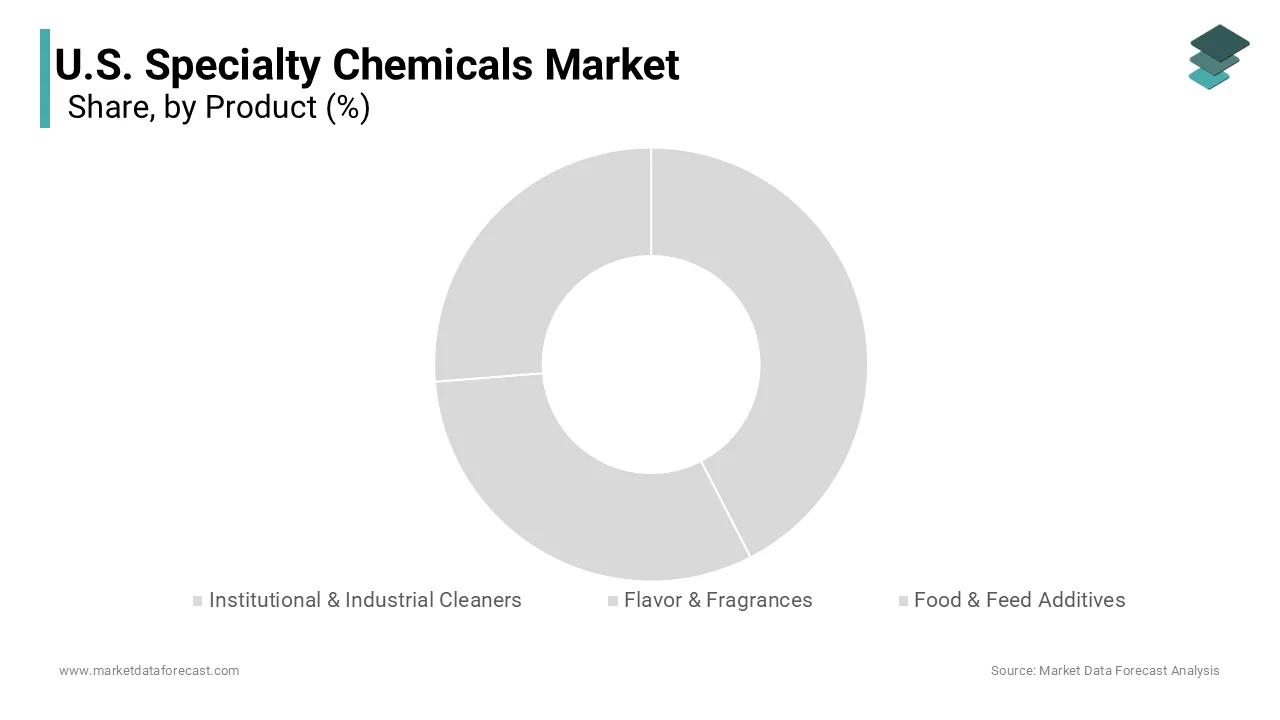
The institutional and industrial cleaners segment held the majority share of 26.9% of the United States specialty chemicals market in 2025. This supremacy of the segment was supported by rigorous hygiene regulations and the critical need for safety in commercial and industrial environments. Regulatory bodies such as the Occupational Safety and Health Administration mandate strict sanitation protocols in manufacturing facilities healthcare institutions and food processing plants to prevent contamination and ensure worker safety. According to the Centers for Disease Control and Prevention (CDC), healthcare-associated infections (HAIs) affect roughly 700,000 patients annually in the US, driving medical facilities to invest heavily in advanced disinfectants that comply with EPA registration standards. The food and beverage industry also adheres to stringent guidelines set by the Food and Drug Administration which require regular and thorough sanitization of equipment and facilities to prevent foodborne illnesses. The National Restaurant Association reports that the US food service industry comprises over one million locations each requiring consistent use of industrial grade cleaning chemicals to maintain compliance and customer trust. Furthermore the post pandemic era has heightened awareness regarding surface transmission of pathogens leading to sustained demand for high efficacy antimicrobial cleaners in public spaces schools and offices. This regulatory framework ensures a baseline demand that is resilient to economic fluctuations as compliance is non negotiable. Additionally the complexity of industrial soils in sectors like automotive and aerospace requires specialized degreasers and solvents that offer superior performance compared to general purpose cleaners. These factors collectively sustain the dominance of the institutional and industrial cleaners segment by embedding these products into the operational backbone of critical industries.
In addition, the robust expansion of commercial real estate and the professionalization of facility management services significantly drive the consumption of institutional and industrial cleaning chemicals. As the United States sees continued development in office complexes retail centers and hospitality venues the demand for professional cleaning services escalates correspondingly. Professional facility managers prioritize the use of specialized cleaning agents that preserve asset value extend the lifespan of building materials and enhance indoor air quality. Moreover the rise of smart building technologies has integrated cleaning schedules with occupancy data optimizing the use of cleaning supplies and reducing waste. This data driven approach encourages the adoption of concentrated and eco friendly cleaning formulations that align with corporate sustainability goals. The hospitality sector alone which includes hotels and resorts relies heavily on industrial cleaners for laundry housekeeping and kitchen sanitation. This widespread infrastructure combined with the outsourcing of cleaning services to specialized contractors ensures a steady and growing market for institutional and industrial cleaners solidifying their leading position.
On the other hand, the flavor and fragrances segment is expected to exhibit a noteworthy CAGR of 7.2% during the forecast period due to a shifting consumer preference towards premium natural and authentic sensory experiences. Modern consumers are increasingly scrutinizing ingredient labels seeking products free from synthetic additives and artificial flavors which has prompted manufacturers to reformulate using natural extracts and bio based aroma chemicals. The International Organization of the Flavor Industry (IOFI) indicate that global demand for natural flavors continues to outpace synthetic alternatives as consumers align their purchasing with health and wellness trends. In the personal care and home care sectors consumers are willing to pay a premium for products with sophisticated and long lasting fragrances derived from essential oils and sustainable sources. This trend extends to the food and beverage industry where innovative flavor profiles are used to differentiate products in a crowded marketplace. Companies are investing in extraction technologies such as supercritical CO2 extraction to obtain pure and potent natural flavors without residual solvents. Additionally the rise of plant based diets has created a need for masking agents and flavor enhancers that improve the palatability of alternative proteins. These evolving consumer preferences drive continuous innovation and higher value transactions in the flavor and fragrance segment accelerating its growth rate compared to other product categories.
Furthermore, innovation in functional foods and personalized nutrition is propelling the rapid expansion of the flavor and fragrances segment as manufacturers seek to enhance the sensory appeal of health focused products. Functional foods fortified with vitamins minerals probiotics and adaptogens often possess bitter or unpleasant tastes that require sophisticated flavor masking technologies to ensure consumer acceptance. Flavor houses are developing proprietary masking agents that neutralize off notes from ingredients like whey protein plant extracts and herbal supplements without compromising the desired taste profile. Personalized nutrition trends are also driving demand for custom flavor solutions that cater to individual dietary restrictions and preferences such as sugar free keto friendly or low sodium options. Additionally the integration of aromatherapy principles into food and beverage products is emerging as a niche trend where scents are used to influence mood and well being. This convergence of health functionality and sensory enjoyment requires advanced chemical expertise driving higher margins and faster growth for the flavor and fragrances segment. As consumers seek holistic health solutions the role of specialty flavors in making these products enjoyable becomes increasingly vital.
COUNTRY LEVEL ANALYSIS
The United States dominated the North America specialty chemicals market and accounted for a 77.5% share in 2025. This position of the country’s market was driven by a highly developed and diversified industrial base that serves as a global hub for chemical innovation and production. The country's robust infrastructure including extensive pipeline networks port facilities and research institutions supports the efficient production and distribution of specialty chemicals. The presence of major global chemical corporations headquartered in the United States fosters a competitive environment that drives technological advancements and product differentiation. Regulatory frameworks established by the Environmental Protection Agency and the Food and Drug Administration set high standards for safety and efficacy influencing product development across all segments. The Department of Commerce reports that the chemical sector is a key exporter with trade surpluses in specialty segments such as pharmaceuticals and agricultural chemicals. Regional clusters in states like Texas Louisiana and Delaware provide synergies through shared resources and skilled labor pools. The market is also influenced by federal initiatives such as the CHIPS Act and the Inflation Reduction Act which stimulate demand for specialty chemicals in electronics and energy sectors. Consumer trends towards sustainability and health further shape the market dynamics encouraging the adoption of bio based and natural products. The resilience of the US economy and its leadership in research and development ensure that the specialty chemicals market remains dynamic and responsive to global trends. This comprehensive ecosystem positions the United States as a dominant force in the global specialty chemicals landscape driving innovation and setting industry standards.
COMPETITIVE LANDSCAPE
The competition in the United States specialty chemicals market is intense and characterized by a mix of large multinational corporations and specialized niche players. Leading companies compete on the basis of innovation product quality and technical service rather than price alone. The market features high barriers to entry due to significant research and development costs and strict regulatory requirements. Established players leverage their extensive distribution networks and long standing customer relationships to maintain dominance. However agile smaller firms often disrupt the market by introducing novel formulations or targeting underserved segments. Sustainability has become a key differentiator with companies racing to develop eco friendly alternatives to traditional chemicals. Regulatory compliance also shapes competitive dynamics as firms must navigate complex environmental and safety standards. Collaboration with customers for co creation of solutions is increasingly common fostering deep integration into supply chains. The threat of substitution from alternative materials or technologies remains constant driving continuous innovation. Overall the market rewards companies that can balance technical expertise with strategic agility and sustainability commitments to meet evolving customer needs effectively.
KEY MARKET PLAYERS
A few of the dominating players in the U.S. specialty chemicals market include
- Dow
- DuPont
- Eastman Chemical Company
- Celanese Corporation
- Albemarle Corporation
- Huntsman Corporation
- PPG Industries
- Sherwin-Williams
- Lubrizol Corporation
- Ashland Global Holdings
- W. R. Grace & Co.
- Solenis
Top Players in the Market
- Dow Inc operates as a global leader in material science providing a broad portfolio of specialty chemicals including silicones industrial intermediates and coatings. The company plays a pivotal role in the United States market by supplying essential materials for construction automotive and consumer care industries. Dow has recently focused on advancing its sustainability agenda by investing in circular economy initiatives and developing low carbon footprint products. The company launched new silicone based solutions for electric vehicle batteries enhancing thermal management and safety. Dow also expanded its manufacturing capabilities in Texas to support growing demand for high performance polymers. By leveraging digital technologies to optimize supply chain efficiency Dow ensures reliable delivery to customers. Their commitment to innovation and sustainability strengthens their position as a key supplier of specialized chemical solutions that address complex industrial challenges and meet evolving regulatory standards in the United States.
- Eastman Chemical Company is a prominent specialty chemical manufacturer known for its advanced materials and additives segments serving diverse end markets. In the United States Eastman contributes significantly by producing high value polymers films and fibers used in packaging transportation and health applications. The company has strengthened its market position through strategic investments in molecular recycling technologies which convert plastic waste into raw materials for new products. Eastman recently inaugurated a major molecular recycling facility in Tennessee marking a significant step towards circularity. This initiative allows the company to offer certified circular products to brands seeking sustainable solutions. Additionally Eastman continues to innovate in cellulose esters and specialty plastics that enhance product performance and durability. Their focus on creating value through innovation and sustainability drives growth and reinforces their reputation as a trusted partner for customers requiring specialized chemical ingredients and materials in the US market.
- International Flavors and Fragrances Inc is a leading creator of flavors fragrances and food ingredients that enhance sensory experiences in consumer products. The company holds a strong presence in the United States market by partnering with major food beverage and personal care brands to develop unique taste and scent profiles. IFF has recently expanded its capabilities through the integration of DuPont’s Nutrition and Biosciences business which broadened its portfolio of health and wellness ingredients. This strategic move enables IFF to offer comprehensive solutions ranging from probiotics to texturants. The company invests heavily in research and development to create natural and clean label ingredients that align with consumer preferences. IFF also focuses on sustainable sourcing practices ensuring the integrity of its raw materials. By combining scientific expertise with creative innovation IFF delivers differentiated products that help customers stand out in competitive markets thereby solidifying its leadership in the US specialty chemicals sector.
Top Strategies Used by Key Market Participants
Key players in the United States specialty chemicals market primarily employ innovation and sustainability driven strategies to maintain competitive advantage. Companies invest heavily in research and development to create bio based and biodegradable alternatives that meet stringent environmental regulations and consumer demands. Strategic mergers and acquisitions are frequently utilized to expand product portfolios and access new technologies or geographic markets. Partnerships with end use industries such as automotive and healthcare enable co development of customized solutions that address specific performance needs. Digital transformation is another critical strategy with firms adopting artificial intelligence and data analytics to optimize manufacturing processes and supply chain efficiency. Capacity expansion in key regions ensures reliable supply and reduces logistical costs. Additionally companies focus on talent acquisition and workforce development to drive innovation and operational excellence. These multifaceted approaches allow market participants to adapt to changing dynamics while delivering high value specialized products that differentiate them from competitors in the evolving landscape.
MARKET SEGMENTATION
This research report on the U.S. specialty chemicals market is segmented and sub-segmented into the following categories.
By Product
- Institutional & Industrial Cleaners
- Flavor & Fragrances
- Food & Feed Additives
By Region
- New York
- Massachusetts
- Pennsylvania
- Illinois
- Ohio
- Michigan
- Texas
- Florida
- Georgia
- California
- Washington
- Colorado