- Product Description Description
- Table of Contents TOC
- List of Table & Figure LOT
- Get Free Sample PDF Sample PDF
U.S. Therapeutic Plasma Exchange Market Report Summary
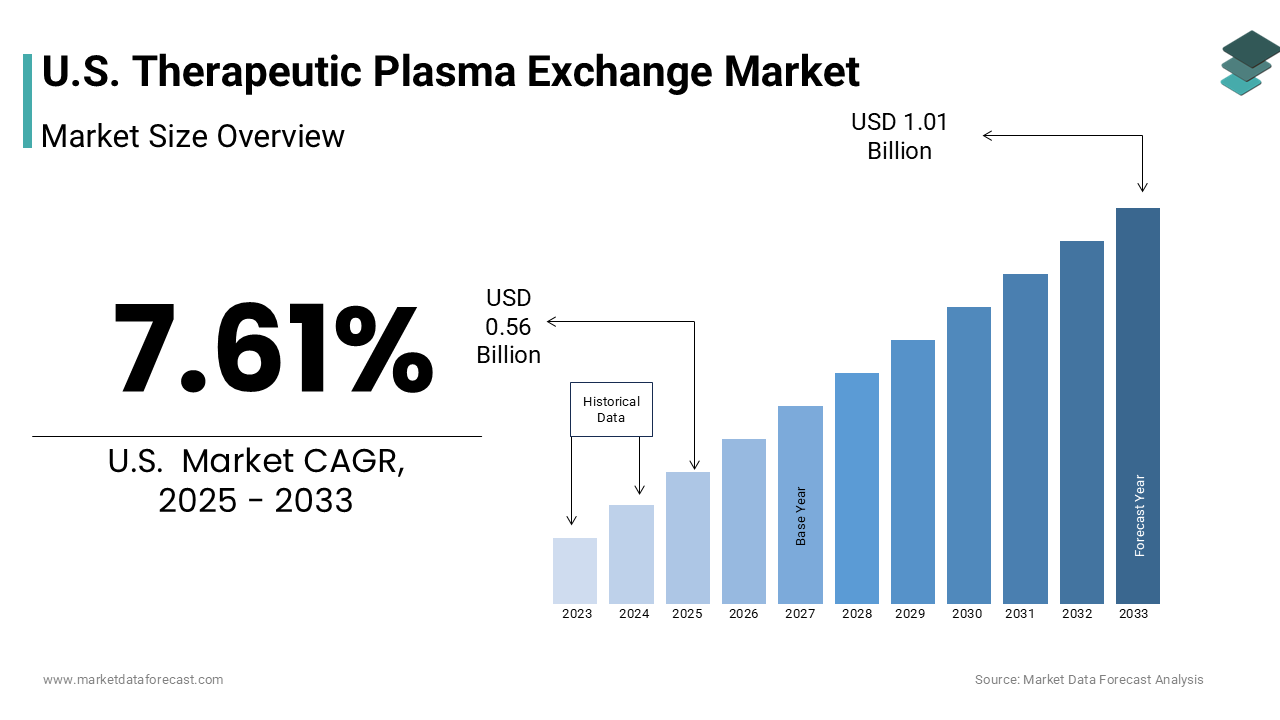
The U.S. therapeutic plasma exchange market was valued at USD 0.52 billion in 2024, is estimated to reach USD 0.56 billion in 2025, and is projected to reach USD 1.01 billion by 2033, growing at a CAGR of 7.61% from 2025 to 2033. The growth of the U.S. therapeutic plasma exchange market is driven by the rising prevalence of autoimmune and neurological disorders, increasing demand for advanced plasma therapies, and growing adoption of plasmapheresis procedures in hospitals and specialty clinics. Furthermore, continuous advancements in medical device technology and expanding clinical applications of plasma exchange in critical care are contributing to market expansion.
Key Market Trends
- Rising incidence of neurological and autoimmune diseases such as myasthenia gravis and Guillain-Barré syndrome.
- Increasing adoption of apheresis technologies in hospitals and specialized treatment centers.
- Growing use of automated plasma exchange systems to enhance procedure safety and efficiency.
- Expanding applications of therapeutic plasma exchange in critical care and hematologic disorders.
- Increasing collaborations and FDA approvals for innovative therapeutic plasma exchange devices in the U.S. healthcare sector.
Segmental Insights
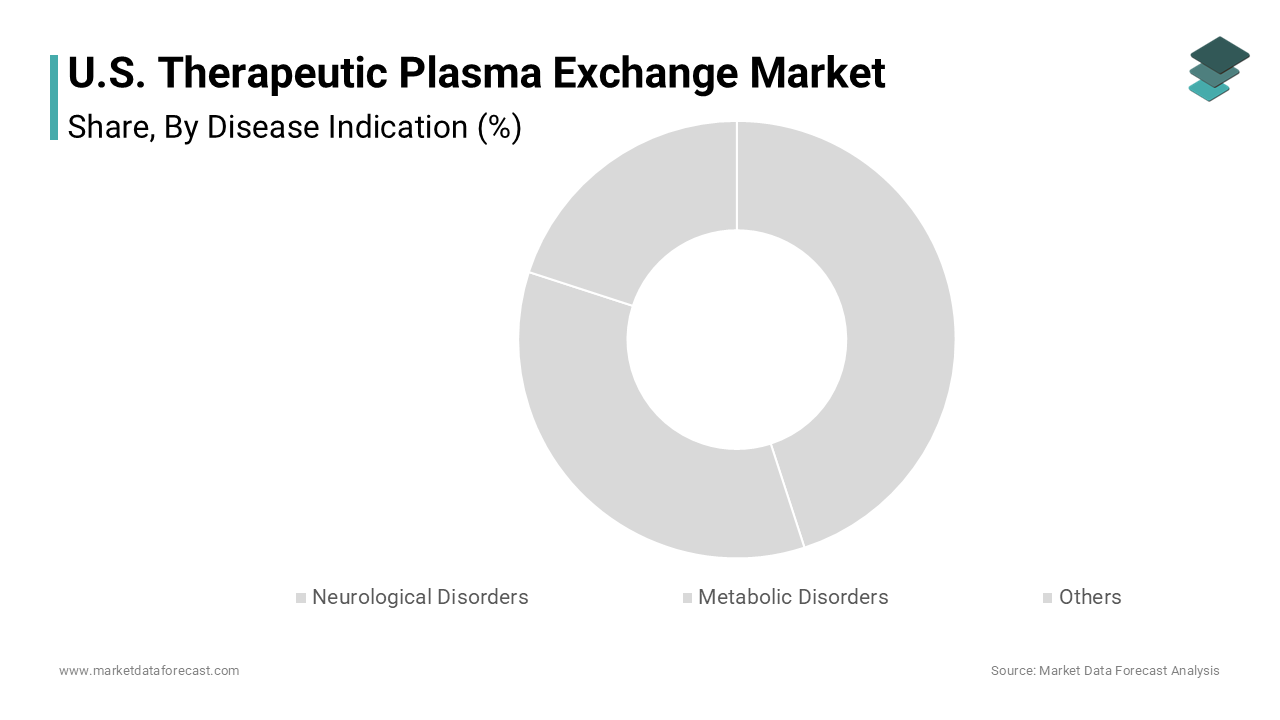
- Based on disease indication, the neurological disorders segment held 43.3% of the U.S. therapeutic plasma exchange market share in 2024, driven by the high treatment volume for autoimmune neurological conditions such as multiple sclerosis and myasthenia gravis.
- Based on end-user, the hospitals segment was the largest and held a significant share of the market in 2024, supported by the growing number of plasma exchange procedures, availability of specialized equipment, and presence of skilled healthcare professionals.
Regional Insights
- The U.S. therapeutic plasma exchange market exhibits widespread adoption across key regions due to advanced healthcare infrastructure and increasing patient awareness.
- The Northeast region, led by states such as New York and Massachusetts, shows strong market growth owing to the presence of top-tier hospitals and research institutions.
- The South region records significant adoption driven by the rising prevalence of autoimmune diseases and growing healthcare access.
- The Midwest region demonstrates steady growth, supported by increasing clinical adoption in academic medical centers and regional hospitals.
- The Western U.S., particularly California, is witnessing high demand due to advanced medical technology adoption and large patient volumes.
Competitive Landscape
- The U.S. therapeutic plasma exchange market is moderately consolidated, with major players focusing on technological innovation, clinical efficacy, and expanding treatment applications.
- Companies are investing in automated systems, product approvals, and clinical partnerships to strengthen their market position.
- Key players in the U.S. therapeutic plasma exchange market include Haemonetics Corporation, Terumo BCT, Inc., Fresenius SE & Co. KGaA, Asahi Kasei Medical Co., Ltd., Baxter International Inc., B. Braun Melsungen AG, Cerus Corporation, Kaneka Corporation, Miltenyi Biotec, Kawasumi Laboratories, Inc., Shandong Weigao Group Medical Polymer Company Limited, Nikkiso Co., Ltd., Cytosorbents Corporation, Mallinckrodt Pharmaceuticals, and Otsuka Holdings Co., Ltd.
- These companies are focusing on expanding their therapeutic portfolios, enhancing plasma exchange device efficiency, and forming partnerships with healthcare providers to cater to the growing demand for advanced plasma therapies in the U.S.
U.S. Therapeutic Plasma Exchange Market Size
The U.S. therapeutic plasma exchange market size was valued at USD 0.52 billion in 2024 and is anticipated to reach USD 0.56 billion in 2025 from USD 1.01 billion by 2033, growing at a CAGR of 7.61% during the forecast period from 2025 to 2033.
The therapeutic plasma exchange is the clinical application of apheresis technology to remove pathogenic antibodies, immune complexes, or toxins from a patient’s circulation, which is replacing them with donor plasma or colloid solutions to treat autoimmune, neurological, hematologic, and metabolic disorders.
MARKET DRIVERS
The rising incidence of antibody-mediated autoimmune and neurological disorders is driving TPE adoption.
The rising incidence of antibody-mediated autoimmune and neurological disorders, which is propelling the growth of U.S. therapeutic plasma exchange market. According to the Guillain-Barré Syndrome Foundation International, 3,000 to 6,000 Americans develop GBS each year, with plasma exchange shown in randomized trials to reduce mechanical ventilation duration by 50% compared to supportive care alone.
Expanding role of TPE in solid organ and stem cell transplantation for pre- and post-transplant management
The expansion of solid organ and stem cell transplantation, where TPE is increasingly deployed to manage pre- and post-transplant antibody-mediated rejection is additionally to level up the growth of U.S. therapeutic plasma exchange market. As per the American Society of Transplantation, 18% of living-donor kidney recipients exhibit pre-formed donor-specific antibodies with the pre-transplant desensitization via TPE. Post-transplant, antibody-mediated rejection affects 10–15% of recipients within the first year, according to data published in the American Journal of Transplantation.
MARKET RESTRAINTS
An acute shortage of apheresis-trained professionals is limiting procedural capacity.
The acute shortage of apheresis-trained nursing and technical personnel, which constrains procedural capacity despite clinical demand and technological availability is also hampering the growth of U.S. therapeutic plasma exchange market. The Health Resources and Services Administration identifies apheresis as a “high-need, low-supply” clinical specialty, with training programs graduating fewer than 300 new credentialed operators annually. The ECRI Institute documented 117 near-miss events in 2023 linked to procedural delays or staff inexperience during TPE, primarily in non-academic hospitals.
Inconsistent insurance coverage and reimbursement for off-label or emerging TPE indications
The inconsistent insurance coverage and reimbursement policies for off-label or emerging TPE indications, which is creating new opportunities for the growth of the U.S. therapeutic plasma exchange market. The private insurers exhibit even greater variability, where UnitedHealthcare requires three lines of failed pharmacotherapy before approving TPE for myasthenia gravis.
MARKET OPPORTUNITIES
Integration of real-time biomarker analytics enabling precision apheresis and optimized treatment protocols
The integration of real-time biomarker analytics with TPE delivery systems to enable precision apheresis is expected to boost the growth of the US therapeutic plasma exchange market. According to the National Institutes of Health, pilot programs at Massachusetts General Hospital using anti-PLA2R antibody monitoring in membranous nephropathy reduced TPE sessions by 40% while maintaining remission rates. According to the Defense Advanced Research Projects Agency, funded projects are adapting biosensor-integrated apheresis circuits for battlefield autoimmunity which is demonstrating civilian translatability.
Strategic collaboration between hospitals, payers, and referral networks for bundled, outcome-based reimbursement models
The strategic alignment of hospital apheresis units with regional referral networks and payers to create bundled, outcomes-based reimbursement models for high-cost autoimmune indications, which is also levelling up the growth of US therapeutic plasma exchange market. According to the Centers for Medicare & Medicaid Services, 23 accountable care organizations now include TPE within bundled episode payments for Guillain-Barré and TTP, which shares savings from avoided ICU days and mechanical ventilation.
MARKET CHALLENGES
High logistical complexity and the resource-intensive nature of TPE procedures are impacting operational efficiency.
The inherent logistical complexity and resource intensity of TPE, which demands specialized equipment, prolonged nursing time, and large-volume plasma products, which is propelling the growth of US therapeutic plasma exchange market. As per the Joint Commission, 29% of TPE delays in 2023 were attributed to equipment unavailability or plasma shortages.
Lack of standardized outcome metrics and long-term efficacy data for various off-label TPE applications
The absence of standardized outcome metrics and long-term efficacy data for many off-label TPE applications, which is hampering the growth of US therapeutic plasma exchange market. The American Academy of Neurology acknowledges that evidence for TPE in chronic inflammatory demyelinating polyneuropathy remains “moderate,” despite widespread use.
REPORT COVERAE
| REPORT METRIC | DETAILS |
| Market Size Available | 2024 to 2033 |
| Base Year | 2024 |
| Forecast Period | 2025 to 2033 |
| Segments Covered | By Disease Indication, End-User and Region. |
| Various Analyses Covered | Global, Regional, & Country Level Analysis; Segment-Level Analysis, Drivers, Restraints, Opportunities, Challenges, PESTLE Analysis, Porter’s Five Forces Analysis, Competitive Landscape, Analyst Overview of Investment Opportunities |
| Key Market Players | Haemonetics Corporation, Terumo BCT, Inc., Fresenius SE & Co. KGaA, Asahi Kasei Medical Co., Ltd., Baxter International Inc., B. Braun Melsungen AG, Cerus Corporation, Kaneka Corporation, Miltenyi Biotec, Kawasumi Laboratories, Inc., Shandong Weigao Group Medical Polymer Company Limited, Nikkiso Co., Ltd., Cytosorbents Corporation, Mallinckrodt Pharmaceuticals, and Otsuka Holdings Co., Ltd. |
SEGMENTAL ANALYSIS
By Disease Indication Insights
The neurological disorders segment was accounted in holding 43.3% of US therapeutic plasma exchange market share in 2024 with the life-saving imperative of rapid antibody clearance in acute neuroimmunological conditions. Additionally, as per the Multiple Sclerosis Association of America, over 18% of neuromyelitis optica spectrum disorder patients require TPE during acute relapses unresponsive to steroids.
The metabolic disorders segment is lucratively growing with an expected CAGR of 11.9% throughout the forecast period with the recognition of TPE as a rescue therapy for refractory hypertriglyceridemia-induced pancreatitis. As per the American Journal of Gastroenterology, triglyceride levels exceeding 2,000 mg/dL, present in 3,200 U.S. admissions annually, respond to TPE with 70% faster resolution than conventional therapy. Simultaneously, the Food and Drug Administration granted orphan drug designation in 2023 to apheresis protocols for familial hypercholesterolemia refractory to PCSK9 inhibitors.
By End-User Insights
The hospitals segment was the largest and held a significant share of the US therapeutic plasma exchange market in 2024 with the clinical acuity and resource dependency. The ECRI Institute confirms that 92% of TTP cases are managed in academic medical centers due to the need for ADAMTS13 testing and cryoprecipitate-poor plasma matching. Additionally, as per the AABB, hospitals maintain 94% of the nation’s licensed apheresis machines, with over 80% concentrated in institutions performing solid organ transplantation.
The specialty clinics segment is expected to register a CAGR of 14.3% during the forecast period with the decentralization of maintenance-phase TPE for chronic conditions such as antibody-mediated nephropathy and myasthenia gravis. Simultaneously, CMS expanded coverage in 2023 for clinic-based TPE under Chronic Disease Management codes, reducing facility fees by 38% compared to hospital outpatient departments.
COMPETITIVE LANDSCAPE
The U.S. therapeutic plasma exchange market is defined by high-barrier, technology-intensive rivalry among global medtech firms, each competing on device intelligence, clinical validation, and ecosystem integration rather than price or volume. Incumbents leverage academic partnerships to generate peer-reviewed outcomes, while niche entrants target adsorption or pediatric-specific innovations. Talent wars focus on apheresis-certified biomedical engineers and clinical liaisons. Mergers target biomarker detection IP or regional training infrastructure.
KEY MARKET PLAYERS
A few of the major companies in the U.S. therapeutic plasma exchange market include
- Haemonetics Corporation
- Terumo BCT, Inc.
- Fresenius SE & Co. KGaA
- Asahi Kasei Medical Co., Ltd.
- Baxter International Inc.
- B. Braun Melsungen AG
- Cerus Corporation
- Kaneka Corporation
- Miltenyi Biotec
- Kawasumi Laboratories, Inc.
- Shandong Weigao Group Medical Polymer Company Limited
- Nikkiso Co., Ltd.
- Cytosorbents Corporation
- Mallinckrodt Pharmaceuticals
- Otsuka Holdings Co., Ltd.
Top Players in the Market
Terumo BCT is a global leader in blood component technologies, supplies the majority of U.S. hospital apheresis systems used for therapeutic plasma exchange, including its Spectra Optia platform optimized for neurological and transplant indications. In Asia Pacific, Terumo collaborates with Japan’s Red Cross Society and South Korea’s National Health Insurance Service to adapt U.S. clinical protocols for antibody-mediated disorders.
Asahi Kasei Medical, through its Plasmapheresis Division, delivers highly specialized plasma separators and adsorption columns used in complex TPE cases such as ABO-incompatible transplantation and autoimmune encephalitis. In Asia Pacific, Asahi dominates Japan’s domestic apheresis market and licenses its endotoxin-removal filters to Australian and Taiwanese transplant centers.
Fresenius Kabi provides integrated plasma exchange solutions, including replacement fluids, anticoagulants, and disposables compatible with major apheresis platforms across U.S. hospitals and specialty clinics. In the Asia Pacific, it supplies albumin and immunoglobulin solutions to TPE centers in India and Thailand under WHO-GMP standards. Fresenius also co-developed a nurse training simulator with the University of Melbourne, which replicates TPE complications for competency validation. This positions the company not merely as a consumables vendor but as a workflow and safety partner across global apheresis ecosystems.
Top Strategies Used by Key Market Participants
Leading players deploy five core strategies: embedding real-time biomarker feedback into apheresis devices to enable precision volume adjustment, co-developing clinical protocols with academic medical centers to validate off-label applications, establishing regional training academies in Asia Pacific to export U.S. safety and efficacy standards, integrating serialized logistics for plasma products to reduce wastage and ensure traceability, and partnering with payers to generate outcomes data that justifies reimbursement for emerging indications. Companies increasingly pursue FDA breakthrough designation for novel filters and circuits. They lobby for inclusion in clinical guidelines. Simulation-based competency programs replace tenure-based credentialing. Cross-border clinical registries validate efficacy in diverse populations, accelerating global regulatory approvals.
MARKET SEGMENTATION
This research report on the U.S. therapeutic plasma exchange market has been segmented based on the following categories.
By Disease Indication
- Neurological Disorders
- Metabolic Disorders
- Others
By End-user
- Hospitals
- Specialty Clinics
- Ambulatory Surgical Centers
By Country
- United States