- Product Description Description
- Table of Contents TOC
- List of Table & Figure LOT
- Get Free Sample PDF Sample PDF
Market Size, 2025
$4.43 BnMarket Estimate, 2026
$4.79 BnMarket Forecast, 2034
$8.89 BnCAGR, 2026–2034
8.04%U.S. Timber Market Size
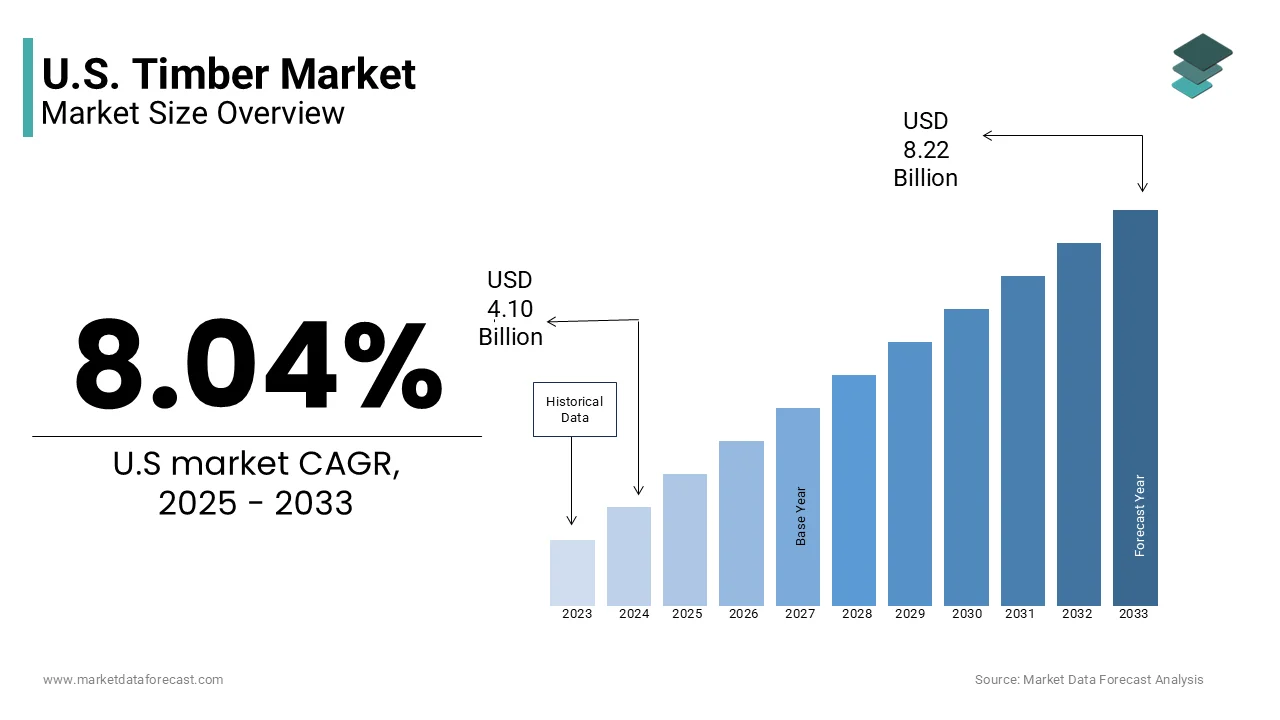
The U.S. timber market size was valued at USD 4.43 billion in 2025, and is expected to be worth USD 8.89 billion by 2034 from USD 4.79 billion by 2026. The market is growing at a CAGR of 8.04% during the forecast period.
The timber is a living infrastructure shaped by ecological boundaries, cultural building traditions, and the slow rhythm of forest regeneration. The average mature tree in the Pacific Northwest reaches 80–120 years before harvest, embedding time itself into the material’s value. Timber from these forests fuels everything from rural homes to urban mass-timber skyscrapers, with each cubic foot carrying the legacy of watershed protection, wildlife corridors, and Indigenous stewardship practices that predate colonial logging.
MARKET DRIVERS
Mass Timber Construction and Urban Density Policies
The rise of engineered wood products such as cross-laminated timber (CLT) has redefined architectural possibilities in high-density urban environments, which is levelling up the growth of U.S. timber market. Cities like Portland, Seattle, and Boston now mandate or incentivize timber use in structures up to 18 stories under updated building codes, recognizing its lower embodied carbon compared to steel and concrete. This regulatory momentum, paired with public appetite for biophilic design, has shifted timber from a rural commodity to a symbol of sustainable urbanism.
Rural Housing Demand and Infrastructure Resilience Post-Disaster
The rebuilding efforts in vulnerable regions have intensified demand for locally sourced, durable timber is also escalating the growth of U.S. timber market. As per the Federal Emergency Management Agency, over 1.3 million residential units were damaged or destroyed between 2020 and 2023 due to extreme weather events, triggering emergency procurement programs that prioritize domestic wood over imported alternatives. Simultaneously, the Census Bureau reports a 19% increase in single-family housing permits in non-metro counties between 2021 and 2023, driven by remote work trends and affordability pressures.
MARKET RESTRAINTS
Forest Health Decline Due to Bark Beetle Infestations and Drought
The integrity of the U.S. timber resource base is being eroded by cascading ecological stressors, which is particularly bark beetle outbreaks fueled by prolonged drought and warmer winters. In 2023, the Forest Service estimated that 28% of commercially viable timber in the Southern Rockies was already compromised rendering it unsuitable for structural applications due to internal decay and reduced strength.
Regulatory Delays and Permitting Bottlenecks in Federal Land Harvesting
Complex environmental reviews under the National Environmental Policy Act, coupled with litigation from advocacy groups, delay or cancel nearly 30% of proposed timber sales annually is limiting the growth of U.S. timber market. These delays create instability for regional mills dependent on consistent feedstock; in Oregon, seven small sawmills closed between 2020 and 2023 because they could no longer secure long-term supply agreements.
MARKET OPPORTUNITIES
Carbon Sequestration Credits and Timber as a Climate Asset
The increasing recognized not as a harvested product but as a stored carbon asset, which is unlocking new revenue streams is likely to create new opportunities for the growth of U.S. timber market. Companies like Weyerhaeuser and Rayonier now bundle timber harvests with verified carbon sequestration contracts by allowing developers to offset emissions from new construction while maintaining harvest yields.
Domestic Substitution of Imported Softwood Lumber
The persistent trade disruptions and geopolitical volatility have reignited efforts to replace Canadian softwood imports, which historically supplied 60% of U.S. framing lumber is creating new opportunities for the growth of U.S. timber market. States like Georgia and Alabama expanded plantation forestry by 1.1 million acres between 2021 and 2023, primarily using fast-growing loblolly pine.
MARKET CHALLENGES
Labor Scarcity in Forestry and Mill Operations
The deepening crisis of workforce attrition, with the median age of loggers and mill operators reaching 54.6 years is likely to hinder the growth of U.S. timber market. Fewer than 15 vocational schools nationwide offer accredited training in sustainable forestry or heavy equipment operation, and rural recruitment remains stagnant despite wage premiums averaging 22% above national averages. The consequence is operational inefficiency: in Maine, delayed harvest schedules due to understaffing caused 18% of scheduled timber volumes to rot before extraction in 2023, according to the Maine Forest Service.
Fragmentation of Private Forest Ownership and Lack of Coordinated Management
The fragmentation impedes large-scale, ecologically sound management with only 12% of these small holdings have formal forest management plans, which is degrading the growth of U.S. timber market. In the Southeast, where 40% of national timber production occurs, this disorganization has contributed to a 17% decline in average stumpage prices since 2019, as smaller landowners compete for spot-market buyers rather than securing long-term contracts.
REPORT COVERAGE
| REPORT METRIC | DETAILS |
| Market Size Available | 2025 to 2034 |
| Base Year | 2025 |
| Forecast Period | 2026 to 2034 |
| CAGR | 8.04% |
| Segments Covered | By Type, and Region |
| Various Analyses Covered | Global, Regional, and Country Level Analysis; Segment-Level Analysis; DROC; PESTLE Analysis; Porter’s Five Forces Analysis; Competitive Landscape; Analyst Overview of Investment Opportunities |
| Regions Covered | New York, Massachusetts, Pennsylvania, Illinois, Ohio, Michigan, Texas, Florida, Georgia, California, Washington, Colorado |
| Market Leaders Profiled | Weyerhaeuser Company, UFP Industries Inc., Sierra Pacific Industries, PotlatchDeltic Corporation, Rayonier, Boise Cascade Company, West Fraser Timber Co. Ltd., and Louisiana-Pacific Corporation (LP). |
SEGMENTAL ANALYSIS
By Type Insights
The industrial roundwood segment was the largest and held a dominant share of the U.S. timber market in 2025 with its irreplaceable role as the foundational feedstock for structural lumber, engineered wood products, and millwork materials essential to residential, commercial, and institutional construction.

The fuelwood segment is estimated to witness a CAGR of 6.9% throughout the forecast period with two converging trends like rural energy resilience and the expansion of biomass power generation. The USDA Forest Service reports that 42 million dry tons of low-value forest residues previously left to decay or burn are now being collected annually for fuel, thanks to improved chipping technology and regional logistics hubs.
REGIONAL ANALYSIS
Washington State timber market growth is likely to wotness a significant CAGR during the forecast period with primary supplier of premium structural timber for high-rise and seismic-sensitive construction. Washington produces 35% of all CLT-grade lumber in the country, with mills like Weyerhaeuser’s Longview facility certified under strict structural grading protocols required for tall wood buildings. The state’s aggressive forest stewardship policies, including mandatory riparian buffers and reforestation mandates, have preserved timber quality despite decades of harvest, earning it recognition from the Forest Stewardship Council for sustainable yield practices.
COMPETITIVE LANDSCAPE
KEY MARKET PLAYERS
A few of the dominating players in the U.S. timber market include
- Weyerhaeuser Company
- UFP Industries, Inc.
- Sierra Pacific Industries
- PotlatchDeltic Corporation
- Rayonier
- Boise Cascade Company
- West Fraser Timber Co. Ltd.
- Louisiana-Pacific Corporation (LP)
MARKET SEGMENTATION
This research report on the U.S. timber market is segmented and sub-segmented into the following categories.
By Type
- Industrial round wood
- Fuel woods
- Others
By Region
- New York
- Massachusetts
- Pennsylvania
- Illinois
- Ohio
- Michigan
- Texas
- Florida
- Georgia
- California
- Washington
- Colorado