- Product Description Description
- Table of Contents TOC
- List of Table & Figure LOT
- Get Free Sample PDF Sample PDF
U.S. Wound Care Market Summary
The U.S. wound care market was valued at USD 6.69 billion in 2024, is estimated to reach USD 7.74 billion in 2025, and is projected to reach USD 12.05 billion by 2033, growing at a CAGR of 6.76% during the forecast period from 2025 to 2033. The growth of the U.S. wound care market is driven by the rising prevalence of chronic wounds such as diabetic foot ulcers and pressure ulcers, an aging population, the increasing adoption of advanced wound care products, and the expansion of outpatient and home healthcare services.
Key Market Trends
- Increasing use of advanced foam and hydrocolloid dressings to accelerate wound healing.
- Growing focus on chronic wound management supported by government healthcare programs.
- Rising adoption of biologics and growth factor-based dressings for complex wound types.
- Expanding telewound care services enabling remote monitoring and faster intervention.
- Integration of AI and digital wound assessment tools in clinical workflows.
Segmental Insights
- Based on type, the foam dressings segment held 31.2% of the U.S. wound care market share in 2024, driven by high absorbency, comfort, and the ability to maintain a moist healing environment.
- Based on application, the diabetic foot ulcers segment accounted for 38.2% of the U.S. wound care market share in 2024, owing to the growing incidence of diabetes and related complications leading to chronic wounds.
- Based on end user, the hospitals segment was the largest, capturing 47.3% of the U.S. wound care market share in 2024, supported by advanced infrastructure for surgical wound treatment and post-operative care.
Competitive Landscape
The U.S. wound care market is moderately consolidated, with key players focusing on innovation, digitalization, and advanced wound healing solutions. Companies are investing in biological dressings, negative pressure wound therapy (NPWT) systems, and strategic partnerships to enhance product portfolios. Leading players in the market include 3M Company, Smith & Nephew plc, Johnson & Johnson (Ethicon), Coloplast A/S, ConvaTec Group plc, Mölnlycke Health Care AB, Medline Industries, B. Braun Melsungen AG, Baxter International Inc., Derma Sciences (Integra LifeSciences), Cardinal Health, Hollister Incorporated, Organogenesis Inc., Medtronic plc, and DeRoyal Industries, Inc.
U.S. Wound Care Market Size
The U.S. wound care market size was valued at USD 6.69 billion in 2024 and is anticipated to reach USD 7.74 billion in 2025 from USD 12.05 billion by 2033, growing at a CAGR of 6.76% during the forecast period from 2025 to 2033.
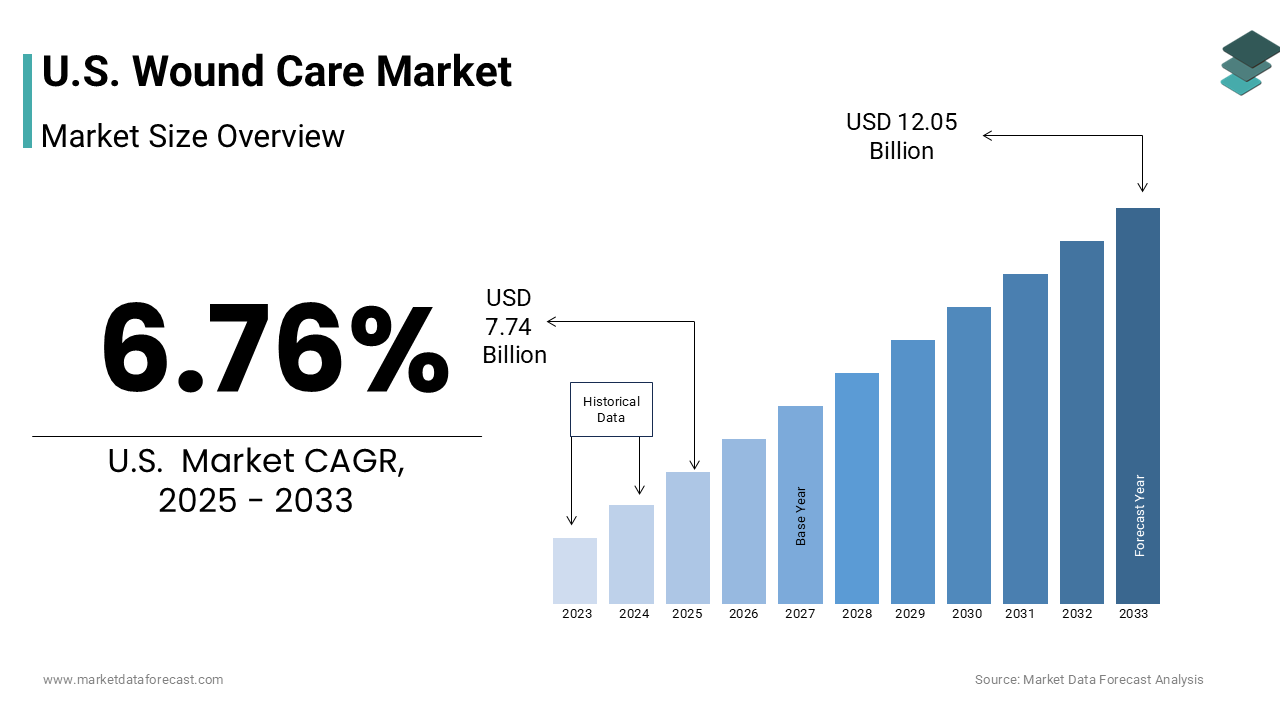
The wound care is a clinical-therapeutic continuum addressing acute, chronic, and surgical tissue injuries through advanced dressings, biologics, negative pressure systems, and adjunctive technologies.
MARKET DRIVERS
Rising Prevalence of Diabetes and Vascular Complications Driving Demand for Advanced Wound Care
The surging prevalence of diabetes and its vascular complications, which directly impair tissue perfusion and delay epithelialization is significantly propelling the growth of U.S. wound care market. As per the Journal of the American Podiatric Medical Association, diabetic ulcers precede 85% of all diabetes-related amputations, with average treatment costs exceeding $30,000 per episode. This pathophysiological burden compels providers to adopt moisture-retentive hydrogels, antimicrobial silver dressings, and cellular tissue substitutes that modalities proven to reduce healing time by up to 40% compared to passive care.
Aging Population and Increased Incidence of Pressure Ulcers Boosting Market Growth
The aging demographic profile and its correlation with immobility-related tissue breakdown is bolstering the growth of U.S. wound care market. As per the National Institutes of Health, 70% of nursing home residents exhibit at least one pressure injury during extended stays, with Stage III and IV ulcers requiring surgical intervention in 38% of cases. Regulatory mandates from CMS further compel facilities to implement prevention bundles or face reimbursement penalties.
MARKET RESTRAINTS
Fragmented Reimbursement Policies Hindering Adoption of Advanced Wound Care Modalities
The fragmented reimbursement policies that disincentivize early adoption of advanced modalities is restraining the growth of U.S. wound care market. As per the Medicare Payment Advisory Commission, only 17 states reimburse for bioengineered skin substitutes under Medicaid, while Medicare Part B imposes strict documentation requirements for negative pressure wound therapy, which is rejecting nearly 34% of initial claims, according to the American Hospital Association’s audit.
Shortage of Specialized Wound Care Clinicians Limiting Patient Access and Treatment Quality
The persistent deficit in specialized wound care clinicians relative to patient volume is hampering the growth of U.S. wound care market. As per the Association for the Advancement of Wound Care, fewer than 6,000 board-certified wound specialists serve the entire U.S. population, translating to one specialist per 55,000 individuals with a ratio grossly inadequate for managing 8.2 million chronic wounds annually.
MARKET OPPORTUNITIES
Integration of Smart Dressings and Biosensor Technologies Enhancing Real-Time Wound Monitoring
The integration of smart dressings with embedded biosensors capable of real-time biomarker tracking is leveraging the growth of U.S. wound care market. As per the National Science Foundation, $22 million in grants since 2022 to accelerate commercialization of such responsive hydrogels, which interface with clinician dashboards via Bluetooth.
Expansion of Home-Based and Telewound Management Platforms Driving Market Penetration
The decentralized, home-based wound management enabled by telewound platforms and portable NPWT devices is also levelling up the growth of U.S. wound care market. As per the Food and Drug Administration, cleared five new home-use negative pressure systems between 2021 and 2023, including single-use, battery-operated units retailing under $300.
MARKET CHALLENGES
Lack of Standardized Wound Assessment Protocols Across Care Settings Creating Treatment Inconsistencies
The lack of standardized wound assessment protocols across care settings is leading to inconsistent treatment pathways that is ascribed to inhibit the growth of U.S. wound care market. This variability results in misclassification of wound etiology in 47% of referrals to specialty centers, which is delaying appropriate intervention by an average of 19 days.
Biofilm Persistence and Rising Antimicrobial Resistance Undermining Treatment Effectiveness
The biofilm persistence and its role in antimicrobial resistance, which undermines even advanced topical therapies is limiting the growth of U.S. wound care market. Fewer than 15% of outpatient facilities routinely perform molecular diagnostics to identify biofilm composition, which is relying instead on empiric silver or iodine dressings with a practice shown in Clinical Infectious Diseases to fail in 58% of recalcitrant cases.
REPORT COVERAGE
| REPORT METRIC | DETAILS |
| Market Size Available | 2024 to 2033 |
| Base Year | 2024 |
| Forecast Period | 2025 to 2033 |
| Segments Covered | By Type, Application, End-User, and Region. |
| Various Analyses Covered | Global, Regional, & Country Level Analysis; Segment-Level Analysis, Drivers, Restraints, Opportunities, Challenges, PESTLE Analysis, Porter’s Five Forces Analysis, Competitive Landscape, Analyst Overview of Investment Opportunities |
| Key Market Players | 3M Company, Smith & Nephew plc, Johnson & Johnson (Ethicon), Coloplast A/S, ConvaTec Group plc, Mölnlycke Health Care AB, Medline Industries, B. Braun Melsungen AG, Baxter International Inc., Derma Sciences (Integra LifeSciences), Cardinal Health, Hollister Incorporated, Organogenesis Inc., Medtronic plc, and DeRoyal Industries, Inc. |
SEGMENTAL ANALYSIS
By Type Insights
The foam dressings segment held 31.2% of the US wound care market share in 2024 with the physiological versatility, where foam’s high absorbency, non-adherent surface, and thermal insulation make it the default for moderate-to-heavy exudate wounds, particularly pressure injuries and venous ulcers. Additionally, Medicare’s Local Coverage Determinations explicitly reimburse foam under HCPCS code A6243, ensuring institutional adoption.
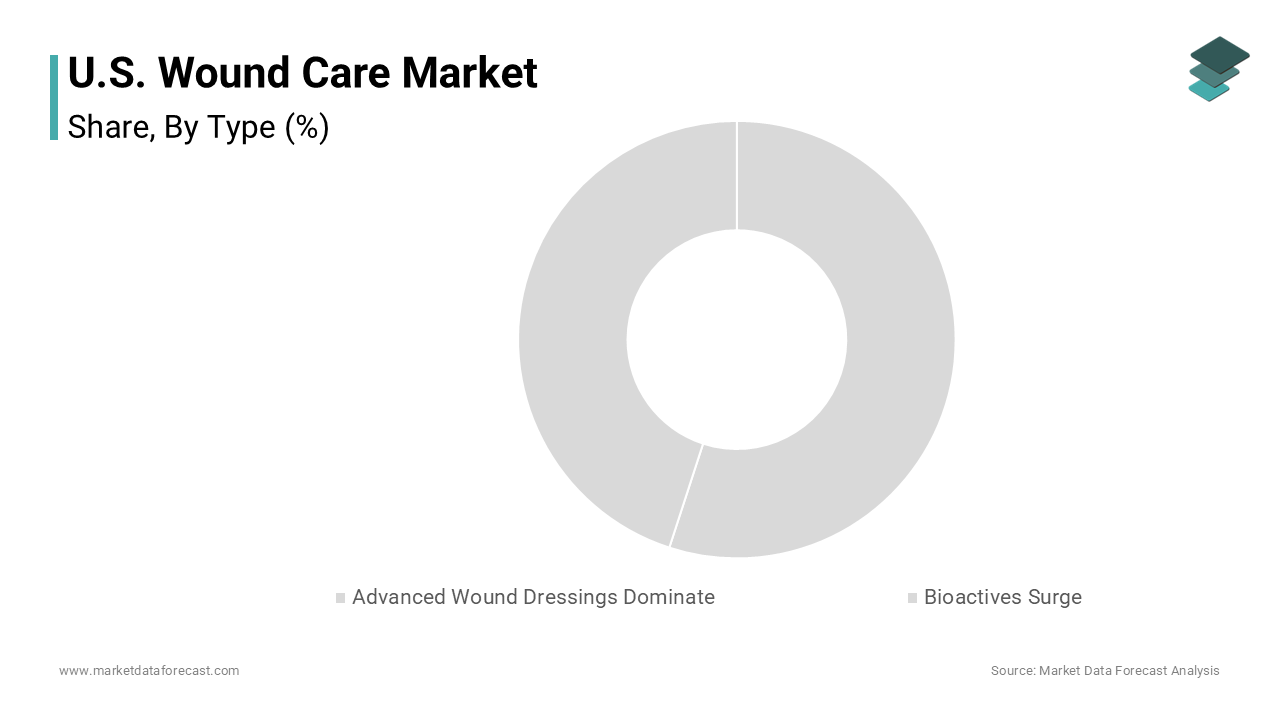
The bioactives segment is likely to grow with an anticipated CAGR of 12.7% during the forecast period with the clinical evidence of superior healing kinetics. Payer policy shifts are equally catalytic: CMS’s recent inclusion of cellular and tissue-based products under the Outpatient Prospective Payment System has reduced prior authorization denials by 41%, according to the American College of Wound Healing.
By Application Insights
The diabetic foot ulcers segment was accounted in holding 38.2% of the U.S. wound care market share in 2024. As per the American Podiatric Medical Association, DFUs precede 80% of non-traumatic lower-limb amputations, which is driving aggressive adoption of offloading boots, antimicrobial dressings, and cellular matrices. Furthermore, the American Diabetes Association’s 2023 Standards of Care mandate multidisciplinary foot teams in all diabetes centers, institutionalizing early intervention and consolidating DFU as the anchor indication for advanced modalities.
The pressure ulcers segment is likely to witness a CAGR of 9.4% in next coming years with the rising incidence, which has plateaued in acute hospitals but to shifting care locus and regulatory accountability. Simultaneously, litigation risk has driven nursing homes to adopt high-specification support surfaces, which is fueling product demand despite stable prevalence.
By End User Insights
The hospitals segment was the largest and held 47.3% of U.S. wound care market share in 2024 with the procedural volume and regulatory mandates, where CMS requires all acute facilities to implement pressure injury prevention bundles, triggering institutional procurement of silicone foam dressings, barrier creams, and NPWT systems. Furthermore, inpatient reimbursement under DRG codes bundles wound care costs, incentivizing hospitals to standardize high-efficacy, low-complication products.
The homecare settings segment is likely to grow with an expected CAGR of 15.1% in next coming years with the CMS’s Patient-Driven Groupings Model, which reimburses home health agencies based on clinical condition rather than visit count, incentivizing early discharge with portable NPWT and telewound monitoring.'
KEY MARKET PLAYERS
A few of the major companies in the U.S. wound care market include
- 3M Company
- Smith & Nephew plc
- Johnson & Johnson (Ethicon)
- Coloplast A/S
- ConvaTec Group plc
- Mölnlycke Health Care AB
- Medline Industries
- B. Braun Melsungen AG
- Baxter International Inc.
- Derma Sciences (Integra LifeSciences)
- Cardinal Health
- Hollister Incorporated
- Organogenesis Inc.
- Medtronic plc
- DeRoyal Industries, Inc.
MARKET SEGMENTATION
This research report on the U.S. wound care market has been segmented based on following categories.
By Type
- Advanced Wound Dressings Dominate
- Bioactives Surge
By Application
- diabetic foot ulcers
- pressure ulcers
By End User
- Hospitals Anchor
- Homecare Explodes
By Country
- The United States