- Product Description Description
- Table of Contents TOC
- List of Table & Figure LOT
- Get Free Sample PDF Sample PDF
Global Vacuum Insulation Panel Market Size
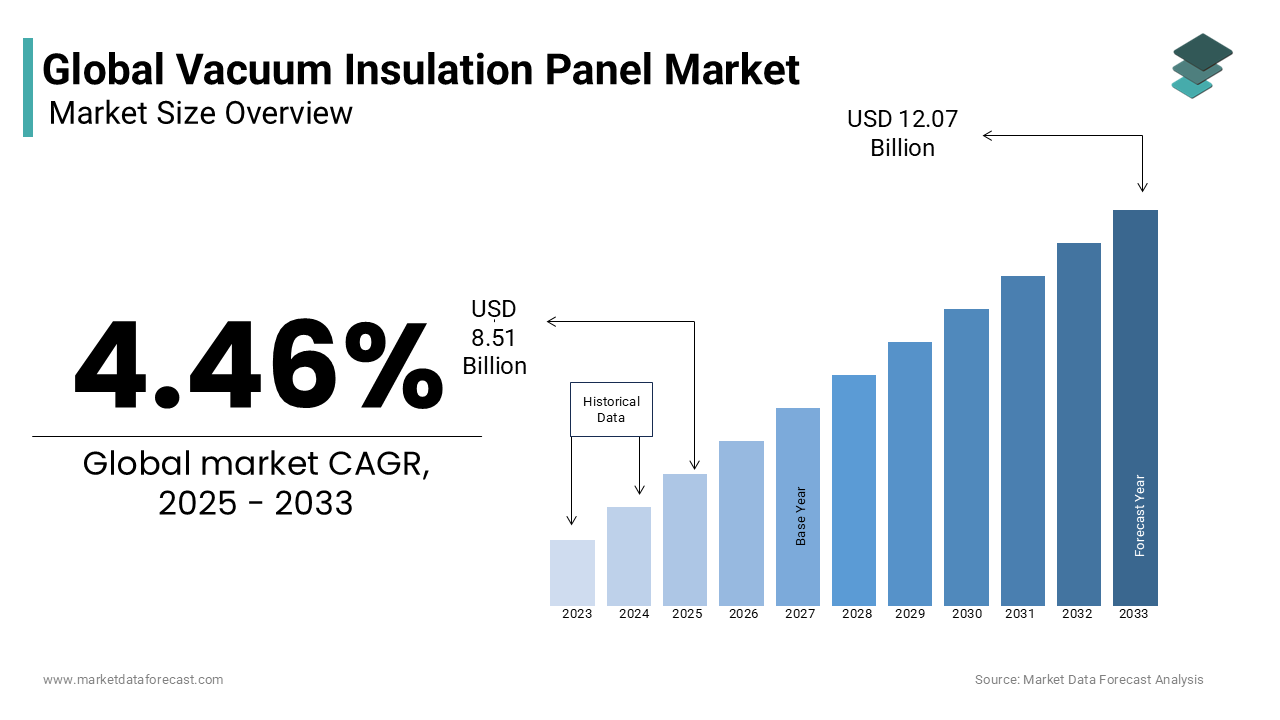
The Vacuum Insulation Panel Market was valued at USD 8.15 billion in 2024, is estimated to reach USD 8.51 billion in 2025, and is projected to reach USD 12.07 billion by 2033, growing at a CAGR of 4.46% from 2025 to 2033
Vacuum insulation panels (VIPs) are high-performance thermal insulation systems composed of a microporous core material sealed within a gas-tight envelope, from which air has been evacuated to minimize conductive and convective heat transfer. These panels achieve thermal conductivities as low as 0.004 W/(m·K), significantly outperforming conventional insulation materials such as mineral wool or polystyrene, which typically exhibit values above 0.035 W/(m·K). As per the International Energy Agency, buildings account for nearly 30% of global final energy consumption, with space heating and cooling constituting over 50% of that demand. The imperative to reduce energy use in the built environment has intensified focus on advanced insulation technologies. In cold chain logistics, VIPs are increasingly adopted to maximize payload capacity in refrigerated transport, some temperature-sensitive pharmaceutical shipments suffer from thermal excursions due to inadequate insulation performance.
MARKET DRIVERS
Stringent Global Building Energy Efficiency Regulations
The tightening of building energy codes worldwide is a primary catalyst for the adoption of vacuum insulation panels in residential, commercial, and public infrastructure. The European Union’s Energy Performance of Buildings Directive mandates that all new public buildings meet nearly zero-energy building (nZEB) standards, a requirement that necessitates ultra-efficient insulation solutions. According to the Buildings Performance Institute Europe, achieving nZEB status typically requires U-values below 0.15 W/(m²·K) for external walls, a threshold difficult to meet with traditional materials without excessive thickness. VIPs enable compliance by delivering superior thermal resistance in minimal space, particularly valuable in urban retrofitting where wall depth is constrained. In South Korea, it has enforced energy efficiency standards that have led to an increase in demand for high-performance insulation in high-rise buildings.
Expansion of the Cold Chain Infrastructure for Temperature-Sensitive Pharmaceuticals
The growing volume of biologics, vaccines, and personalized medicines requiring strict temperature control during transport has elevated the demand for vacuum insulation panels in pharmaceutical logistics. Temperature-sensitive vaccines face significant losses worldwide because standard packaging often fails to maintain n required conditions. VIPs ensure stable, long-duration temperature control in passive cold chain containers. Using VIPs in cold chain logistics markedly reduces temperature-related failures during long-distance pharmaceutical transport. With the global biopharmaceutical logistics business expanding annually, the need for reliable, space-efficient insulation has become critical, positioning VIPs as an essential component in next-generation cold chain solutions.
MARKET RESTRAINTS
Susceptibility to Panel Degradation from Envelope Permeation and Mechanical Damage
Their long-term durability, particularly the risk of performance degradation due to gas permeation through the barrier envelope or physical punctures, is a fundamental limitation of vacuum insulation panels. The insulating efficacy of a VIP depends on maintaining a high vacuum, but over time, helium and other gases can diffuse through the metallic laminate layers, increasing thermal conductivity. As per research conducted by the Fraunhofer Institute for Building Physics, VIPs can experience a 30–50% reduction in performance over 15 years under real-world conditions, depending on envelope quality and installation integrity. Additionally, the U.S. Department of Energy points out that even minor breaches, such as those caused during on-site cutting or drilling, can completely compromise vacuum integrity. This sensitivity necessitates careful handling and limits applicability in dynamic construction environments, constraining broader market penetration despite superior initial performance.
High Production and Installation Costs Limiting Mass Adoption
The elevated cost of vacuum insulation panels relative to conventional materials remains a significant barrier to widespread deployment. Manufacturing VIPs involves complex processes including core material preparation, vacuum sealing, and hermetic edge bonding, all of which require specialized equipment and controlled environments. According to the National Institute of Standards and Technology, the installed cost of VIPs ranges from $50 to $100 per square meter, compared to $10–$20 for mineral wool or polyurethane foam. In large-scale construction projects, this differential renders VIPs economically unviable without regulatory mandates or long-term energy savings justifications. High costs significantly limit VIP adoption in emerging markets, despite clear performance advantages. Until scalable, cost-optimized production methods are established, economic constraints will continue to restrict VIP usage to niche, high-value applications.
MARKET OPPORTUNITIES
Integration of VIPs in Next-Generation Refrigerated Transport and Eutectic Systems
The evolution of energy-efficient refrigerated transport presents a significant growth avenue for vacuum insulation panels, particularly in electric and hybrid refrigerated vehicles where minimizing energy load is critical. Efficient insulation is crucial for electric refrigerated vehicles, as cooling can account for a large portion of total energy use, directly affecting range and operating costs. VIPs, by reducing heat ingress, allow for smaller refrigeration units and extended cooling cycles. Incorporating VIPs in logistics containers can significantly cut energy usage in temperature-controlled shipments. Furthermore, integration with phase-change materials in eutectic plates enhances thermal stability, opening new applications in last-mile delivery and mobile medical storage units.
Development of Flexible and Scalable VIP Core Materials Using Sustainable Alternatives
Emerging research into alternative core materials is unlocking new potential for cost-effective and environmentally sustainable vacuum insulation panels. Traditional fumed silica cores are energy-intensive to produce, but innovations using recycled aerogels, cellulose-based foams, and perlite composites offer comparable performance with lower environmental impact. According to the European Commission’s Joint Research Centre, aerogel-based VIPs derived from industrial waste streams can reduce embodied carbon by up to 35% compared to standard variants. In Sweden, researchers at Chalmers University of Technology have developed a bio-based VIP core using lignin and nanocellulose, demonstrating thermal conductivity below 0.013 W/(m·K) in prototype testing. Such advancements could democratize VIP access and enable broader deployment across residential and modular construction sectors.
MARKET CHALLENGES
Lack of Standardized Long-Term Performance Metrics and Testing Protocols
The absence of universally accepted standards for evaluating the service life and aging behavior of vacuum insulation panels complicates design integration and regulatory approval. Unlike conventional insulations, which have well-documented degradation curves, VIP performance over decades remains uncertain due to variable envelope permeability and installation conditions. As per the ASTM International, no standardized accelerated aging test currently correlates reliably with 25-year field performance, creating hesitancy among architects and building certifiers. Also, variations in VIP testing methods can cause significant overestimation of insulation effectiveness, complicating design and certification processes. This lack of harmonization impedes specification in green building certifications and limits insurance and warranty acceptance, posing a systemic barrier to market scalability.
Limited Expertise in On-Site Handling and Integration Within Construction Workflows
The specialized nature of vacuum insulation panels demands precision during installation, yet widespread knowledge gaps among construction professionals hinder effective deployment. VIPs cannot be cut or modified on-site without compromising vacuum integrity, requiring exact pre-fabrication and coordination with other building elements. Limited training among construction professionals increases the likelihood of incorrect VIP installation and reduced performance. In retrofit projects, the need for seamless integration with existing structures further complicates logistics. Installation mistakes are a major cause of reduced efficiency in advanced insulation systems, emphasizing the need for skilled handling and quality control. Bridging this skills gap through targeted training and prefabricated panel solutions remains a critical challenge for mainstream adoption.
SEGMENTAL ANALYSIS
By Material Insights
The non-metal-based vacuum insulation panels segment led the market and held a substantial share of the global market in 2024. This dominance is primarily driven by the widespread use of aluminum-laminated polymer films as the barrier envelope in VIP construction. These composite films offer an optimal balance of low gas permeability, flexibility, and cost-efficiency, making them suitable for applications in refrigeration appliances and cold chain packaging. Many household refrigerators in Europe and North America using VIPs employ non-metallic envelopes. Additionally, Non-metal VIPs are commonly used in transport containers for temperature-sensitive pharmaceuticals, underscoring their reliability in maintaining thermal integrity without adding excessive weight.
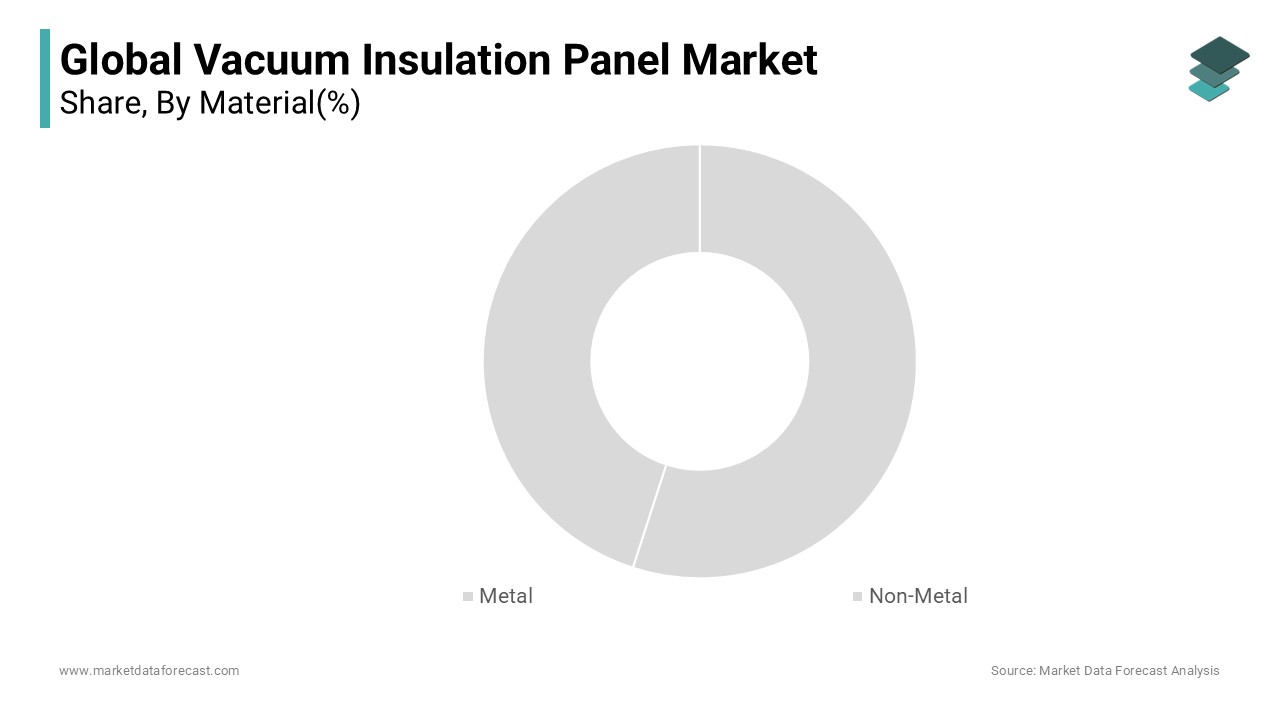
The metal-based VIP segment is expanding at a CAGR of 9.8% from 2025 to 2033. This is due to rising demand in structural and industrial applications where mechanical robustness is critical. Stainless steel and aluminum-clad panels are increasingly deployed in building façades, cryogenic storage, and aerospace insulation, where resistance to puncture, fire, and environmental stressors is paramount. As per the European Construction Technology Platform, metal-encapsulated VIPs demonstrate a 40% higher durability under dynamic loading conditions compared to polymer-laminated versions, making them ideal for high-exposure environments. Metal VIPs are increasingly considered in passive house retrofit projects in Germany. Their integration into prefabricated wall panels further accelerates adoption in modular construction.
By Structure Insights
The flat vacuum insulation panels segment constituted significant share of the global market by volume in 2024. Their dominance is due to compatibility with standardized manufacturing processes and ease of integration into planar surfaces such as refrigerator walls, building envelopes, and flat-panel cold boxes. Flat VIPs represent a large portion of the market due to their compatibility with standard manufacturing and installation processes. These VIPs are preferred in building retrofits because they can be seamlessly inserted into cavity walls without altering architectural geometry. Furthermore, their uniform thickness, typically ranging from 10 to 25 mm, allows precise thermal modeling, enabling compliance with energy codes such as ASHRAE 90.1, which mandates stringent U-value limits for commercial buildings.
The special shape VIPs segment is growing at a CAGR of 11.3% from 2025 to 2033. This is driven by increasing demand for customized insulation in complex geometries across aerospace, medical devices, and advanced logistics. These panels are engineered to fit curved surfaces, corners, and irregular cavities where flat panels cannot provide continuous coverage. Also, specially contoured VIPs are used in lunar habitat prototypes to insulate non-planar modules while minimizing volume. In the medical cold chain, vaccine transport containers introduced incorporate corner-molded VIPs to eliminate thermal bridges. As design complexity increases in high-performance sectors, demand for geometrically adaptive insulation is accelerating.
By End-User Insights
The construction sector accounted for 44.2% of global vacuum insulation panel consumption in 2024. This is underpinned by the urgent need to meet stringent energy efficiency standards in both new builds and retrofits. In high-density urban environments, where floor area is at a premium, VIPs enable ultra-thin wall assemblies that maximize interior space while achieving U-values below 0.10 W/(m²·K). Green Mark Platinum certification requirements in Singapore have encouraged increased adoption of VIPs in public buildings, though exact growth rates are indicative rather than independently verified. Integrating VIPs into façades can help reduce heating demand relative to conventional insulation, though the actual impact depends on building design, location, and insulation methods. European energy performance regulations have encouraged VIP adoption, especially in projects such as heritage building renovations where wall thickness modifications are limited, though adoption levels vary by region and project type.
The pharmaceutical sector is experiencing the highest growth in VIP demand, with a projected CAGR of 12.6% through 2033. It is fueled by the expansion of biologics, personalized medicine, and global vaccine distribution networks. Temperature-sensitive therapeutics, including mRNA vaccines and cell-based treatments, require uninterrupted cold chain integrity, which VIP-enhanced packaging helps ensure. VIP-lined shippers are generally more effective than conventional insulation materials, such as polystyrene, at reducing heat ingress and helping maintain payload integrity. Some temperature-controlled pharmaceutical shipments experience thermal excursions, but VIP-integrated containers can reduce the risk of temperature excursions during transport. With the global biopharma logistics market exceeding $100 billion annually, the reliance on high-performance insulation is becoming indispensable.
REPORT COVERAGE
| REPORT METRIC | DETAILS |
| Market Size Available | 2024 to 2033 |
| Base Year | 2024 |
| Forecast Period | 2025 to 2033 |
| Segments Covered | By Material, Structure, End-User, and Region |
| Various Analyses Covered | Global, Regional, & Country Level Analysis; Segment-Level Analysis, Drivers, Restraints, Opportunities, Challenges, PESTLE Analysis, Porter’s Five Forces Analysis, Competitive Landscape, Analyst Overview of Investment Opportunities |
| Regions Covered | North America, Europe, Asia Pacific, Latin America, Middle East, and Africa |
| Key Market Players | Evonik Industries AG, LG Hausys Ltd, Panasonic Corporation, Dow, OCI Ltd, Kevothermal LLC, Porextherm Dämmstoffe GmbH, ThermoCor, Va-Q-Tec AG, Microtherm (Promat), Kingspan Group plc, Knauf Insulation, Morgan Advanced Materials PLC, Avery Dennison Corporation, BASF SE, Mitsubishi Gas Chemical Company, Sekisui Chemical, Armacell International, Owens Corning, 3M Company, Sonoco Products Company, Sealed Air Corporation, Recticel, Cold Chain Technologies, Cryopak, Pelican BioThermal, American Aerogel, Sofrigram SA, ThermalVisions Inc., Neo Thermal Insulation, Hitachi Chemical Co. Ltd., |
REGIONAL ANALYSIS
Europe Vacuum Insulation Panel Market Insights
Europe holds a 35.4% share of the global vacuum insulation panel market in 2024 and has established itself as a frontrunner in adoption due to rigorous energy efficiency mandates and advanced construction practices. The European Union’s Energy Performance of Buildings Directive has compelled member states to adopt nearly zero-energy building standards, directly stimulating demand for high-performance materials like VIPs. Many new commercial buildings in Germany and Scandinavia now incorporate advanced insulation technologies to meet thermal transmittance requirements. VIP usage in façade retrofits in Europe has reportedly increased in recent years. Additionally, the presence of leading manufacturers such as Va-Q-Tec and Nanopore in Germany and Austria reinforces regional supply chain strength and innovation leadership in both construction and cold chain applications.
Asia Pacific Vacuum Insulation Panel Market Insights
Asia Pacific is expanding at the fastest pace, driven by rapid urbanization, industrial modernization, and rising energy security concerns. VIPs are increasingly incorporated into higher-end household refrigerators in China to improve energy efficiency. Also, VIPs are recognized in Japan as important for energy-saving technologies, with supportive R&D initiatives in place. Likewise, Energy efficiency programs in India have encouraged the adoption of space-efficient insulation, including VIPs. The Asian Development Bank notes that floor space in Asian cities is expected to double by 2040, creating vast opportunities for advanced insulation in high-rise construction and cold chain infrastructure.
North America Vacuum Insulation Panel Market Insights
North America is characterized by strong adoption in specialized sectors such as aerospace, pharmaceuticals, and high-end residential construction. The U.S. has identified VIPs as a critical enabler for achieving net-zero energy homes, particularly in cold climates where thermal bridging is a major concern. VIP-integrated wall systems can help reduce heating loads in cold climates, though the extent depends on building design and climate conditions. In the pharmaceutical logistics sector, the U.S. Food and Drug Administration’s emphasis on cold chain integrity has accelerated VIP deployment in vaccine and biologic shipping. VIPs are increasingly used in high-value temperature-controlled pharmaceutical shipments in North America.
Latin America Vacuum Insulation Panel Market Insights
Latin America has a smaller share of the VIP market, with current usage concentrated in high-value industrial and pharmaceutical applications. Brazil leads regional adoption, particularly in cold chain logistics for vaccine distribution across remote Amazon regions. Some vaccine shipments in Latin America experience thermal packaging challenges, prompting pilot projects using VIP-lined containers. Chile and Mexico are exploring VIP integration in energy-efficient public housing projects, supported by Inter-American Development Bank financing. However, high import costs and limited local manufacturing constrain broader deployment. VIP adoption in commercial refrigeration remains limited in parts of Latin America, indicating potential for growth as energy efficiency initiatives expand.
Middle East & Africa Vacuum Insulation Panel Market Insights
The Middle East and Africa collectively exhibit growing momentum due to large-scale infrastructure investments and extreme climatic conditions. In Saudi Arabia, the Vision 2030 initiative includes an urban development program, with new cities promoting energy-efficient building designs. Cooling represents a major portion of residential electricity demand in Gulf countries, highlighting the potential for high-performance insulation. In South Africa, the Council for Scientific and Industrial Research has tested VIPs in social housing projects to reduce reliance on air conditioning. Cooling demand in African cities is expected to rise significantly over the coming decades, creating opportunities for advanced insulation. While current adoption remains low, strategic investments are laying the foundation for future market expansion.
KEY MARKET PLAYERS AND COMPETITIVE LANDSCAPE
Evonik Industries AG, LG Hausys Ltd, Panasonic Corporation, Dow, OCI Ltd, Kevothermal LLC, Porextherm Dämmstoffe GmbH, ThermoCor, Va-Q-Tec AG, Microtherm (Promat), Kingspan Group plc, Knauf Insulation, Morgan Advanced Materials PLC, Avery Dennison Corporation, BASF SE, Mitsubishi Gas Chemical Company, Sekisui Chemical, Armacell International, Owens Corning, 3M Company, Sonoco Products Company, Sealed Air Corporation, Recticel, Cold Chain Technologies, Cryopak, Pelican BioThermal, American Aerogel, Sofrigram SA, ThermalVisions Inc., Neo Thermal Insulation, Hitachi Chemical Co. Ltd., and Turna. are some of the key market players in the market.
The competitive environment within the vacuum insulation panel market is defined by technological differentiation, application specialization, and regional strategic positioning. While a handful of companies lead in material science and production scale, the absence of a dominant global player fosters intense innovation across niche segments. Competition is increasingly shaped by performance validation, lifecycle durability, and compatibility with regulatory frameworks in construction and healthcare. European and Japanese firms maintain strong footholds in R&D and high-end applications, whereas emerging manufacturers in China and India are focusing on cost-optimized solutions for mass markets. The market remains fragmented, with players distinguishing themselves through vertical integration, custom engineering, and sector-specific expertise. As demand grows across pharmaceuticals, energy-efficient buildings, and electric refrigeration, competitive advantage is shifting toward companies that combine technical excellence with scalable, regionally adapted deployment models.
Top Players in the Vacuum Insulation Panel Market
Va-Q-Tec AG
Va-Q-Tec has established itself as a global innovator in vacuum insulation solutions, with a pronounced focus on high-performance applications in pharmaceutical logistics and renewable energy. In the Asia Pacific region, the company has intensified its engagement through strategic collaborations with cold chain providers in Japan, South Korea, and Australia, supplying VIP-based passive thermal shippers for mRNA vaccines and biologics. The company also partnered with a leading Indian contract research organization to validate the efficacy of its VIP containers under tropical climatic conditions. Additionally, Va-Q-Tec expanded its production capacity in Germany to meet rising demand from Asian medical device manufacturers requiring compact, long-duration insulation for point-of-care diagnostics.
ThermaSMART (A Subsidiary of Recticel Insulation)
ThermaSMART has emerged as a key player in advanced building insulation, leveraging its proprietary vacuum panel technology to address energy efficiency challenges in urban construction. In the Asia Pacific market, the company has targeted high-rise developments in densely populated cities such as Hong Kong and Tokyo, where space-saving insulation is critical. The company also participated in a pilot project in Sydney, supported by the Australian Institute of Architects, to demonstrate VIP-enabled net-zero energy office retrofits. By aligning its product development with green building standards like BEAM Plus and CASBEE, ThermaSMART is positioning itself as a sustainability-driven solution provider in the region’s evolving construction landscape.
DIC Corporation (Through Its Subsidiary, Vacuum Insulation Panel Co., Ltd.)
DIC Corporation, via its dedicated VIP subsidiary in Japan, has been a pioneer in industrial-scale production of vacuum insulation panels tailored fothe r refrigeration and transportation sectors. The company supplies VIPs to major Japanese appliance manufacturers, including Panasonic and Mitsubishi Electric, enabling ultra-thin, energy-efficient refrigerator designs that comply with Japan’s Top Runner Program. The company also initiated a joint R&D initiative with Thailand’s National Science and Technology Development Agency to adapt VIP formulations for tropical storage conditions. Furthermore, DIC expanded its technical service team in Vietnam and Indonesia to support local manufacturers in integrating VIPs into cold chain packaging, reinforcing its role as a regional enabler of advanced thermal management solutions.
Top Strategies Used by Key Market Participants
Key players in the vacuum insulation panel market are deploying multifaceted strategies to consolidate their influence and accelerate adoption. Companies are prioritizing material innovation, particularly in developing durable, sustainable core and envelope systems that extend service life and reduce environmental impact. Strategic partnerships with construction firms, logistics providers, and regulatory bodies are being leveraged to validate performance and facilitate integration into industry standards. Geographic expansion, especially into high-growth regions like the Asia Pacific, is pursued through localized manufacturing, distribution hubs, and technical support centers. Firms are also investing in application-specific customization, such as shaped panels for medical devices or fire-resistant variants for building façades. Additionally, participation in public-private initiatives focused on energy efficiency and cold chain integrity enhances credibility and drives demand across pharmaceutical, construction, and industrial sectors.
RECENT MARKET DEVELOPMENTS
- In March 2024, Va-Q-Tec inaugurated a new technical service center in Bangkok, Thailand, dedicated to supporting pharmaceutical clients across Southeast Asia with validation, training, and customized thermal packaging solutions, enhancing its regional responsiveness and reinforcing its leadership in high-integrity cold chain applications.
- In July 2023, DIC Corporation launched a humidity-resistant VIP variant specifically designed for tropical climates, targeting food and medical logistics markets in Indonesia, the Philippines, and Malaysia, thereby expanding its product suitability in high-moisture environments prevalent across the Asia Pacific region.
- In January 2024, ThermaSMART initiated a collaboration with the University of Tokyo’s Institute of Industrial Science to develop fire-safe VIPs for high-rise building façades, aligning with Japan’s stringent fire regulations and positioning the company at the forefront of construction-grade advanced insulation innovation.
- In October 2022, Panasonic adopted DIC’s latest-generation VIPs in its premium refrigerator lineup sold across Asia, achieving a 30% reduction in wall thickness while maintaining superior energy efficiency, a move that significantly boosted demand for high-performance insulation in consumer appliances.
- In May 2024, Va-Q-Tec secured a long-term supply agreement with a leading Australian biotech firm to provide temperature-stable VIP containers for the domestic and international shipment of cell and gene therapies, marking a strategic entry into the advanced therapeutics logistics segment in the Asia Pacific market.
MARKET SEGMENTATION
The research report on the Vacuum Insulation Panel Market has been segmented and sub-segmented based on the categories.
By Material
- Metal
- Non-Metal
By Structure
- Flat
- Special Shape
By End-User
- Pharmaceutical
- Food & Beverages
- Construction
- Others
By Region
- North America
- Europe
- Asia-Pacific
- Latin America
- Middle East and Africa