- Product Description Description
- Table of Contents TOC
- List of Table & Figure LOT
- Get Free Sample PDF Sample PDF
Market Size, 2025
$17.09 BnMarket Estimate, 2026
$18.65 BnMarket Forecast, 2034
$37.43 BnCAGR, 2026–2034
9.10%Executive Summary: Global Variable Air Volume Systems Market
- Market Scope: In-depth global analysis covering VAV system types (single-duct, dual-duct, fan-powered, and induction-based), applications (commercial, industrial, and residential buildings), and key geographical regions.
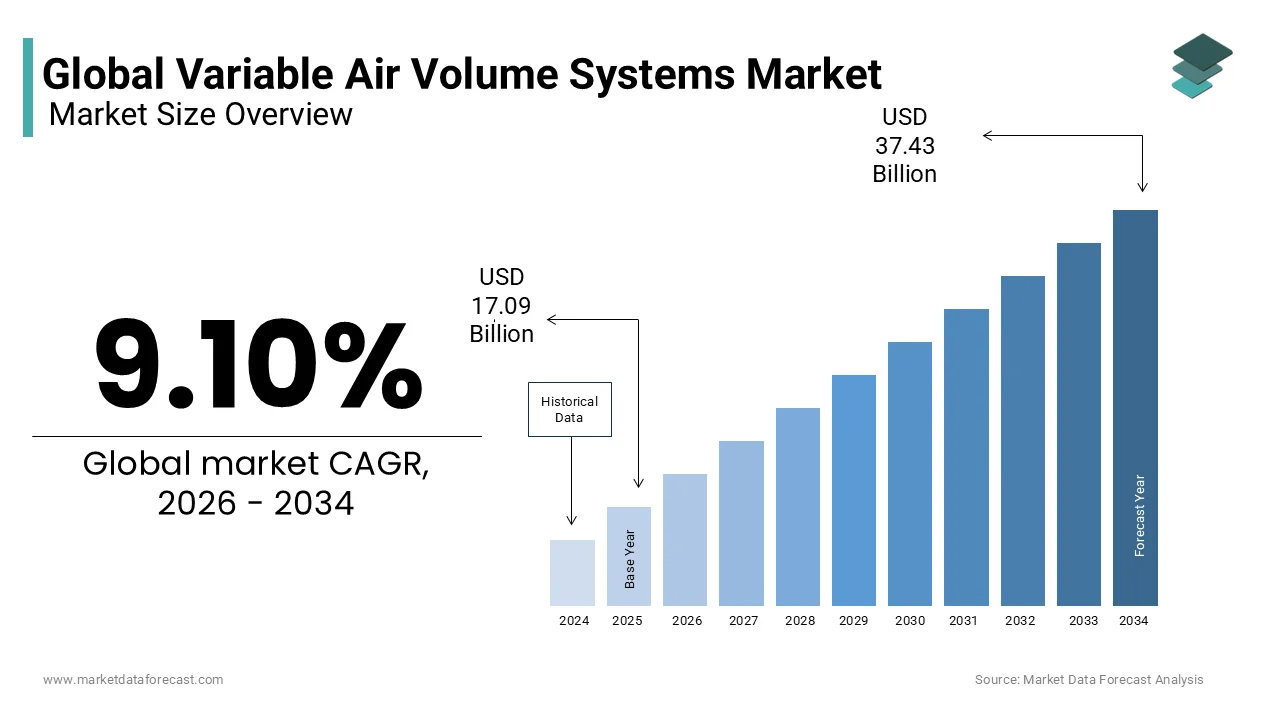
- Market Valuation: Valued at USD 17.09 billion in 2025, estimated at USD 18.65 billion in 2026, and projected to reach USD 37.43 billion by 2034, registering a robust compound annual growth rate (CAGR) of 9.10%.
- Primary Growth Drivers: Escalating demand for energy-efficient HVAC solutions in commercial construction, stricter sustainability regulations, rising disposable incomes, and the continuous expansion of modern infrastructure worldwide.
Key Market Segment Metrics (2026–2034)
| Category | Leading Segment Focus | Fastest-Growing / Key Structural Trends |
|---|---|---|
| By Type | Single-Duct VAV Systems (accounts for the largest market share, boosted by high adoption in industrial and commercial buildings across developing economies) | Fan-Powered & Dual-Duct Systems (expanding due to precise multi-zone temperature control needs and advanced airflow configurations) |
| By Application | Commercial Buildings (dominant end-use sector driven by corporate offices, retail complexes, hospitality, and warehouse spaces) | Industrial & Residential Buildings (growing rapidly as energy efficiency and automated indoor climate control become standard requirements) |
| By Region | North America (leads the global market in revenue, anchored by high standards of living, extensive commercial construction, and advanced HVAC infrastructure) | Asia-Pacific & Middle East (exhibiting high expansion rates driven by rapid urbanization, infrastructure investments, and construction booms in China and India) |
Major Market Players & Market Structure
Market Structure: A highly competitive global landscape characterized by strategic joint ventures, technological innovations in smart building automation, and extensive distribution networks managed by leading HVAC equipment manufacturers.
Key Companies: Johnson Controls, Ingersoll-Rand plc, Honeywell International Inc., United Technologies Corporation, Daikin Industries, Ltd., Siemens, Emerson Electric Co., TROX GmbH, KMC Controls, Schneider Electric, Systemair AB, KAD Air Conditioning, Metal Industries, Inc., Halton Group, Dynacraft Air Controls, Advanced Air UK Ltd, Waterloo Air Products Plc, and Airmaster Equipments Emirates LLC.
Global Variable Air Volume Systems Market Size
The global variable air volume systems market size was valued at USD 17.09 billion in 2025 and is expected to reach USD 37.43 billion by 2034 from USD 18.65 billion in 2026. The market is projected to grow at a CAGR of 9.10%.
Variable air volume systems are advanced climate control technology that regulates indoor thermal comfort by varying the flow rate of conditioned air at a constant temperature to match changing building thermal loads. According to the International Energy Agency global building energy reviews, the building construction sector accounts for 30% of worldwide energy consumption, heavily positioning the variable air volume systems market as a critical target for operational efficiency improvements. According to the World Green Building Council market transformation updates, sustainable HVAC retrofits reduce commercial electricity waste by 25%, directly expanding the commercial adoption footprint of the variable air volume systems market. These specialized mechanical assemblies utilize electronic controllers, motorized dampers, and duct sensors to optimize airflow distribution across individual architectural zones. By dynamically adjusting fan speeds and supply volumes rather than maintaining a constant blast of air, these systems lower utility overhead and enhance indoor environmental quality.
MARKET DRIVERS
Strict Energy Efficiency Regulations and Building Codes
Stringent government efficiency standards and mandatory green building codes significantly propel the variable air volume systems market by forcing property developers to adopt advanced climate control technologies. According to the International Energy Agency energy efficiency policy reports, national decarbonization mandates targeting commercial real estate emissions were adopted across 45 major economies, actively driving the expansion of the variable air volume systems market. According to the U.S. Energy Information Administration commercial building energy utilization metrics, space conditioning represents nearly 32% of total energy expenditures in commercial properties, creating an urgent operational demand that boosts the variable air volume systems market. Building owners face severe financial penalties and mandatory carbon caps if their facilities fail to meet prescribed energy performance benchmarks. Consequently, engineering teams specify variable air volume setups because their modulation capabilities satisfy rigid government codes while slashing overall electrical grid consumption. This regulatory pressure ensures continuous, compliance-driven capital allocation toward modern climate control infrastructure across metropolitan development sectors.
Rapid Growth of Smart Commercial Real Estate
The massive expansion of intelligent commercial office complexes and corporate workspaces further contributes to variable air volume systems market expansion through heightened demands for zone-specific automated climate management. According to the International Data Corporation smart buildings tracking briefs, global investments in Internet of Things enabled commercial building automation platforms surged by 22%, heavily boosting the variable air volume systems market. According to the World Urbanization Prospects real estate data summaries, urban commercial floor space expanded by 1.8 billion square feet globally, directly stimulating the deployment metrics of the variable air volume systems market. Modern tenants and property operators demand responsive indoor environments equipped with digital thermostats, occupancy sensors, and real-time airflow diagnostics. Variable air volume units integrate seamlessly with centralized building management software to deliver customized temperature control tailored to fluctuating room occupancy levels. This commercial shift toward data-driven facility management establishes a robust, high-volume project pipeline for mechanical contractors and equipment manufacturers.
MARKET RESTRAINTS
Prohibitive Upfront Installation and Maintenance Costs
High initial capital requirements and complex component servicing is hampering the growth of the variable air volume systems market by discouraging budget-constrained property developers from selecting advanced multi-zone setups. According to the Associated General Contractors of America construction cost indexes, specialized mechanical installation expenditures rose by 14%, creating a substantial financial barrier that restricts the variable air volume systems market. According to the International Facility Management Association operational expense audits, complex pneumatic and digital control calibration needs increased annual maintenance outlays by 18%, directly hindering the growth velocity of the variable air volume systems market. Unlike simple constant volume systems, variable air volume networks require intricate balancing, precise duct pressure sensors, and skilled technicians for periodic troubleshooting. Small and medium-sized commercial building owners often opt for cheaper, lower-efficiency packaged units to avoid steep upfront procurement bills and ongoing specialist service contracts. This heavy capital burden limits market penetration primarily to high-end corporate towers and institutional developments.
Technical Complexity and Airflow Balancing Challenges
Severe engineering complexities and chronic airflow balancing deficiencies is further hindering the variable air volume systems market by causing persistent indoor comfort complaints and operational inefficiencies. According to the American Society of Heating, Refrigerating and Air-Conditioning Engineers technical troubleshooting bulletins, improper duct static pressure control accounts for 30% of chronic commercial ventilation failures, directly impeding the reliability of the variable air volume systems market. According to the Indoor Air Quality Association engineering assessments, sub-optimal minimum airflow adjustments led to a 22% rise in occupant thermal discomfort incidents, actively hindering the expansion of the variable air volume systems market. When systems are improperly designed or poorly maintained, dampers can become stuck, leading to stagnant air zones and excessive fan energy consumption. Diagnosing volumetric imbalances across complex multi-story duct networks demands advanced diagnostic tools and highly trained engineering personnel. These technical hurdles create friction for facility managers who prefer simpler, less labor-intensive HVAC alternatives for everyday commercial operations.
MARKET OPPORTUNITIES
Integration with Artificial Intelligence and IoT Analytics
The convergence of artificial intelligence algorithms and Internet of Things sensors is a notable opportunity in the variable air volume systems market. According to the World Economic Forum digital transformation studies, artificial intelligence-driven predictive maintenance and automated building optimization tools expanded by 34%, opening significant growth channels within the variable air volume systems market. According to the International Data Corporation smart workplace forecasts, enterprise software investments in cloud-connected HVAC telemetry grew by 27%, directly validating the modernization potential of the variable air volume systems market. Modern machine learning models can analyze historical weather patterns, occupancy schedules, and thermal loads to automatically adjust damper positions before temperature fluctuations occur. Vendors that successfully package predictive intelligence with standard mechanical hardware can command premium profit margins from enterprise clients seeking net-zero carbon operations. This technological integration unlocks powerful new commercial avenues for software developers and equipment manufacturers alike.
Massive Retrofitting of Aging Urban Infrastructure
The urgent need to upgrade obsolete, energy-wasting climate control systems in legacy commercial buildings is another prominent opportunity in the variable air volume systems market. According to the United Nations Environment Programme global status report for buildings and construction, over 50% of existing urban commercial stock was constructed more than 3 decades ago, establishing a massive addressable modernization target for the variable air volume systems market. According to the World Green Building Council retrofitting economic briefs, municipal green renovation subsidies injected into urban real estate upgrades exceeded 2.5 billion dollars, directly strengthening the financial foundation of the variable air volume systems market. Building owners face mounting regulatory pressures and tenant demands to decarbonize older properties without demolishing existing structures. Installing modern variable air volume terminals into legacy ductwork represents a cost-effective pathway to drastically improve energy ratings and extend building lifespans. Consequently, large-scale urban infrastructure renewal provides a clear, high-volume pipeline for sustained market expansion.
MARKET CHALLENGES
Indoor Air Quality and Ventilation Compliance Risks
Stricter post-pandemic air exchange mandates and the risk of pathogen accumulation is primarily challenging the variable air volume systems market. According to the World Health Organization indoor air safety updates, recommended minimum fresh air ventilation rates per occupant were revised upward by 25%, posing a critical technical challenge that challenges the variable air volume systems market. According to the Federation of European Heating, Ventilation and Air Conditioning Associations technical guidelines, balancing increased outdoor air intake with energy conservation targets created a 20% engineering compliance deficit, directly testing the design limits of the variable air volume systems market. Traditional variable air volume units configured to throttle airflow during low-occupancy periods can inadvertently reduce fresh air dilution below safe biological thresholds. Redesigning systems to maintain continuous air purity without triggering excessive heating or cooling loads requires complex redesigns of terminal boxes and filtration units. These evolving biological safety standards demand costly engineering adjustments across both new and existing installations.
Severe Shortage of Specialized HVAC Technicians
Acute deficits in skilled control technicians and certified automation engineers are further challenging the variable air volume systems market expansion. According to the International Labor Organization vocational skills tracking briefs, global technical workforce vacancies within specialized HVAC controls engineering rose by 38%, severely challenging the human resource capacity of the variable air volume systems market. According to the Air Conditioning Contractors of America workforce development reports, technical training pipeline shortfalls left 42% of commercial contracting firms unable to fulfill advanced automation service contracts, directly challenging the operational stability of the variable air volume systems market. Commissioning sophisticated variable air volume networks requires deep expertise in digital controls, network protocols, and fluid dynamics. The aging demographic of traditional mechanical technicians combined with a slow influx of digitally trained labor leaves many installed systems operating below peak efficiency. Therefore, chronic workforce deficiencies remain a formidable operational obstacle for the global market.
REPORT COVERAGE
| REPORT METRIC | DETAILS |
| Market Size Available | 2025 to 2034 |
| Base Year | 2025 |
| Forecast Period | 2026 to 2034 |
| CAGR | 9.10% |
| Segments Covered | By Type, Application, and Region |
| Various Analyses Covered | Global, Regional & Country Level Analysis, Segment-Level Analysis, DROC, PESTLE Analysis, Porter’s Five Forces Analysis, Competitive Landscape, Analyst Overview on Investment Opportunities |
| Regions Covered | North America, Europe, Asia Pacific, Latin America, and Middle East & Africa |
| Market Leaders Profiled | Johnson Controls; Ingersoll-Rand plc; Honeywell International Inc; United Technologies Corporation; Daikin Industries, Ltd.; Siemens; Emerson Electric Co.; TROX GmbH; KMC Controls; Schneider Electric; Systemair AB; KAD AIR CONDITIONING; METAL INDUSTRIES, INC.; Halton Group; Dynacraft Air Controls; Advanced Air UK Ltd; Waterloo Air Products Plc; Airmaster Equipments Emirates LLC |
SEGMENTAL ANALYSIS
By Type Insights
The single-duct segment led the market by holding 50.4% of the global market share in 2025. The growth of the single-duct segment in the global market is majorly driven by its simple mechanical design, lower initial equipment cost, and straightforward installation across standard commercial floor plans. According to the Air-Conditioning, Heating, and Refrigeration Institute equipment shipment statistics, single-duct terminal units accounted for nearly 60% of all commercial damper assembly sales, solidifying the market leadership of this segment within the variable air volume systems market. According to the International Data Corporation commercial construction surveys, architectural specifications favoring single-duct configurations over complex multi-zone alternatives increased by 17%, which is directly fuelling the dominant market share of this segment within the variable air volume systems market. Single-duct systems deliver conditioned air from a central air handling unit through a single duct pathway to individual terminal boxes, where dampers modulate volume based on local thermostat readings. This straightforward operational architecture minimizes mechanical points of failure and reduces ongoing maintenance expenditures for building operators. Universal contractor familiarity and cost-efficiency ensure that single-duct systems maintain their preeminent market share position within the variable air volume systems market.
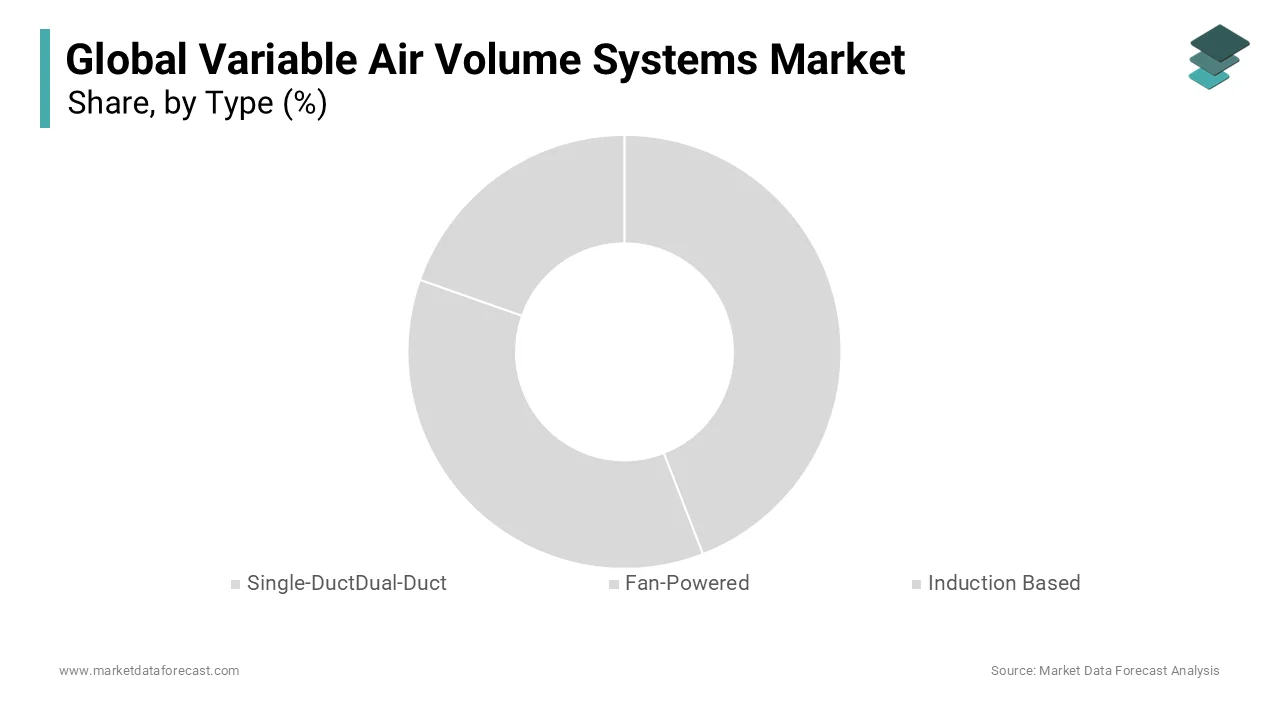
However, the fan-powered stands segment is predicted to record a prominent CAGR of 11.4% over the forecast period in the global market owing to the growing demand for superior perimeter zone temperature control and enhanced indoor air mixing capabilities. According to the International Society of Automation technical reviews, commercial deployment rates of parallel and series fan-powered terminal units rose by 28%, accelerating the adoption velocity of this segment within the variable air volume systems market. According to the World Green Building Council thermal comfort analyses, enterprise investments in advanced fan-powered mixing boxes to support open-plan office layouts exceeded 900,000,000 dollars, directly driving the rapid developmental pace of this segment in the variable air volume systems market. Fan-powered units incorporate an internal blower that draws plenum air and mixes it with primary cold air, maintaining constant airflow into the occupied space even when the central air handler reduces supply volume. This capability prevents stagnant air pockets and provides precise thermal regulation for perimeter zones exposed to harsh external weather fluctuations. This superior comfort performance and adaptability explain why fan-powered systems register the fastest growth momentum across the variable air volume systems market.
By Application Insights
The commercial buildings segment led the market by accounting for 64.2% of the global market share in 2025. The dominance of commercial buildings segment in the global market is attributed to the extensive high-rise office construction, shopping malls, and institutional complex developments requiring multi-zone climate control. According to the U.S. Energy Information Administration commercial building stock updates, total commercial floor space across major global economies expanded by 2.1% annually, solidifying the market leadership of this segment within the variable air volume systems market. According to the Council on Tall Buildings and Urban Habitat construction reports, completions of large-scale commercial office towers equipped with centralized variable air volume infrastructure rose by 19%, directly fueling the dominant market share of this segment within the variable air volume systems market. Commercial high-rises experience diverse thermal loads driven by varying solar exposure, internal electronic equipment heat output, and fluctuating occupant densities across different floors. Variable air volume systems provide the precise zonal modulation necessary to maintain comfort and minimize energy waste across these massive structures. This structural alignment between building physics and system capabilities ensures that commercial applications maintain their preeminent market share position within the variable air volume systems market.
However, the industrial buildings segment is estimated to register a prominent CAGR of 10.5% over the forecast period in the global market owing to the rapid expansion of precision manufacturing facilities, data centers, and cleanroom environments. According to the International Facility Management Association industrial sector surveys, advanced climate automation upgrades within modern manufacturing plants increased by 25%, accelerating the adoption velocity of this segment within the variable air volume systems market. According to the International Data Corporation industrial automation trackers, global capital investments in high-precision environmental control systems surpassed 1,400,000,000 dollars, directly driving the rapid developmental pace of this segment in the variable air volume systems market. Industrial operations require exacting temperature and humidity parameters to protect sensitive electronics, pharmaceuticals, and specialized manufacturing processes from environmental degradation. Variable air volume systems offer the rigorous airflow precision and rapid load response required to maintain strict environmental tolerances in heavy industrial settings. This growing industrial need for advanced process-air management explains why industrial applications register the fastest growth momentum across the variable air volume systems market.
REGIONAL ANALYSIS
North America Variable Air Volume Systems Market Analysis
North America held 35.5% of the global market share in 2025 and served as the dominant core within the variable air volume systems market through highly stringent energy conservation building codes and an extensive inventory of aging commercial real estate ripe for retrofitting. According to the U.S. Energy Information Administration commercial energy metrics, regional expenditures on advanced HVAC efficiency upgrades exceeded 14,000,000,000 dollars, establishing a robust operational standing within the North American regional landscape. According to the American Society of Heating, Refrigerating and Air-Conditioning Engineers operational indexes, commercial building adoption of digital variable air volume controllers rose by 18%, directly supporting the exponential growth metrics of the variable air volume systems market. Supported by mature engineering networks, strict environmental regulations, and aggressive corporate net-zero commitments, North American markets maintain cutting-edge commercialization pipelines. Domestic technology leaders successfully leverage sophisticated building automation platforms to supply high-value terminal units, positioning the continent as the undeniable revenue leader and technological benchmark of the variable air volume systems market.
Europe Variable Air Volume Systems Market Analysis
Europe occupies a highly advanced position characterized by aggressive decarbonization targets, nearly zero-energy building mandates, and sophisticated climate control architectures within the variable air volume systems market. According to the European Environment Agency climate policy reports, regional capital allocations directed toward green building envelope and HVAC retrofits rose by 21%, reinforcing its elite market position in the variable air volume systems market. According to the Federation of European Heating, Ventilation and Air Conditioning Associations annual operational reviews, nationwide deployments of smart ventilation and variable air volume gateway systems increased by 24%, driving steady clinical and commercial progress within the variable air volume systems market. European municipalities maintain stringent carbon emission caps that penalize commercial real estate owners for excessive energy consumption, forcing rapid adoption of variable air volume technologies. This collaborative regulatory environment, paired with world-class mechanical engineering clusters located in Germany, France, and the United Kingdom, ensures that European institutions enjoy reliable access to cutting-edge climate control solutions within the variable air volume systems market.
Asia Pacific Variable Air Volume Systems Market Analysis
Asia Pacific maintains a rapidly expanding position fueled by massive urbanization waves, booming commercial construction, and expanding industrial infrastructure within the variable air volume systems market. According to the United Nations Economic and Social Commission for Asia and the Pacific urban development bulletins, regional commercial floor space construction expanded by 4.5% annually, securing a competitive regional posture within the variable air volume systems market. According to the International Energy Agency regional energy demand reports, commercial cooling investments across developing Asian economies grew by 32%, continuously bolstering the geographic footprint of the variable air volume systems market. Rapid economic development, rising disposable incomes and government-backed smart city initiatives are driving unprecedented demand for energy-efficient climate control networks. Domestic and international manufacturing enterprises are scaling up local production facilities to supply cost-effective variable air volume modules, successfully transforming Asia Pacific into the fastest-growing operational hub in the region with an expected regional CAGR of 10.5%.
Latin America Variable Air Volume Systems Market Analysis
Latin America represents a developing regional market supported by emerging commercial hubs, tourism infrastructure projects, and gradual adoption of international building standards within the variable air volume systems market. According to the Economic Commission for Latin America and the Caribbean infrastructural summaries, regional commercial real estate investments exceeded 3,500,000,000 dollars, establishing a vital economic and technological stronghold for the variable air volume systems market. According to the Inter-American Development Bank urban development indexes, commercial property network upgrades incorporating modern energy-saving HVAC systems rose by 14%, significantly contributing to the technological elevation of the variable air volume systems market. Latin American commercial developers increasingly utilize efficient climate control frameworks to attract multinational corporate tenants seeking LEED-certified office spaces. By actively upgrading metropolitan business districts and commercial centers, Latin America continues to strengthen its economic self-sufficiency and market resilience within the variable air volume systems market.
Middle East and Africa Variable Air Volume Systems Market Analysis
Middle East and Africa functions as a specialized high-demand frontier characterized by extreme cooling requirements, massive mega-project developments, and state-of-the-art smart city initiatives within the variable air volume systems market. According to the Gulf Organisation for Research and Development regional advisories, national sustainable building projects successfully integrated advanced cooling networks across 30 major commercial complexes, creating a disruptive positive impact within the variable air volume systems market. According to the Arab Union for Sustainable Development performance reviews, commercial procurement contracts for high-performance variable air volume terminal units grew by 20%, heavily expanding the inclusive reach of the variable air volume systems market. Government bodies across the region are partnering with international engineering conglomerates to build climate-resilient commercial hubs that overcome extreme ambient temperatures. By integrating advanced digital thermostats and variable airflow controls into modern desert architecture, the region is rapidly increasing its baseline technological sophistication, establishing a vital long-term innovation frontier within the variable air volume systems market.
COMPETITIVE LANDSCAPE
Competition in the variable air volume systems market is defined by intense rivalry among multinational industrial conglomerates and specialized mechanical equipment manufacturers controlling the vast majority of commercial project volume. Market dynamics are heavily influenced by high barriers to entry, including stringent energy efficiency compliance standards, massive capital requirements for precision manufacturing tooling, and complex global distribution networks. While established market leaders dominate large corporate construction sectors through economies of scale, regional mechanical engineering firms are increasingly disrupting traditional pricing models by supplying customized, cost-effective retrofit alternatives. Technological disruption remains a core competitive battleground, with firms racing to transition from standard pneumatic controls toward advanced digital and cloud-connected smart terminal platforms. Strategic asset acquisitions, intellectual property management, and bidding wars for lucrative commercial real estate tenders continuously reshape the competitive hierarchy, resulting in a highly consolidated yet fiercely contested market environment.
KEY MARKET PLAYERS
Some of the key players in the global variable air volume systems market are
- Johnson Controls
- Ingersoll-Rand plc
- Honeywell International Inc.
- United Technologies Corporation
- Daikin Industries, Ltd.
- Siemens
- Emerson Electric Co.
- TROX GmbH
- KMC Controls
- Schneider Electric
- Systemair AB
- KAD AIR CONDITIONING
- METAL INDUSTRIES, INC.
- Halton Group
- Dynacraft Air Controls
- Advanced Air UK Ltd
- Waterloo Air Products Plc
- Airmaster Equipments Emirates LLC
Top Players in the Market
- Johnson Controls International plc contributes extensively to the market through the global commercialization of advanced building management systems and high-efficiency variable air volume terminal units. The company actively participates in the market by expanding its smart manufacturing facilities and partnering with international real estate developers to supply integrated climate automation solutions. Recent actions to strengthen its market position include completing advanced software integration upgrades at its primary research laboratories and securing expanded commercial distribution agreements across international commercial construction sectors.
- Trane Technologies plc maintains a vital contribution to the market by producing innovative heating, ventilation, and air conditioning equipment designed to minimize commercial carbon footprints. The company actively participates in the market by investing heavily in sustainable refrigerant technologies and optimizing global supply chain distribution networks for modular air handlers. Recent actions to strengthen its market position include increasing manufacturing output at its main production plants and initiating strategic distribution alliances across fast-growing urban commercial sectors.
- Carrier Global Corporation contributes significantly to the market through pioneering research in digital climate control algorithms and high-performance airflow management systems. The company actively participates in the market by collaborating with academic institutions to evaluate novel indoor air quality technologies and enhance mechanical energy efficiency. Recent actions to strengthen its market position include launching comprehensive commercial sustainability initiatives and receiving priority regulatory certifications for advanced HVAC integration platforms.
Top Strategies Used by Key Market Participants
Key market participants in the variable air volume systems market deploy sophisticated strategic initiatives to maintain competitive advantages and navigate complex regulatory landscapes. Companies frequently establish strategic alliances and long-term equipment supply contracts with major commercial real estate developers to secure guaranteed procurement orders for large construction projects. Organizations heavily invest in Internet of Things connectivity and advanced digital control software to differentiate their product offerings in mature regional markets. Industry leaders prioritize diversified product portfolios by building specialized modular terminal lines to fit exact architectural duct dimensions. Furthermore, key players actively pursue expansion through strategic mergers, targeted distribution partnerships, and aggressive research and development spending on artificial intelligence-driven predictive maintenance platforms to stay ahead of evolving industry trends.
Global Variable Air Volume Systems Market News
- In April 2024, Johnson Controls International plc, a building automation provider, acquired Lakeland Engineering Equipment, an electrical and HVAC distribution company. This acquisition is anticipated to allow Johnson Controls International plc to offer more comprehensive climate control solutions and strengthen the variable air volume systems market.
- In July 2024, Trane Technologies plc formed a strategic distribution alliance with a major European smart building technology distributor. This partnership is expected to allow Trane Technologies plc to streamline modular equipment transport and strengthen the variable air volume systems market.
- In October 2024, Carrier Global Corporation initiated a multi-center commercial evaluation protocol across several regional research facilities. This clinical milestone is projected to allow Carrier Global Corporation to evaluate novel airflow balancing formulations and strengthen the variable air volume systems market.
- In January 2025, Daikin Industries secured expanded regulatory review status for advanced inverter-driven compressor platforms through international building authorities. This regulatory milestone is designed to allow Daikin Industries to accelerate commercial tenant access and strengthen the variable air volume systems market.
- In March 2025, Schneider Electric completed the acquisition of a regional energy management software hub to localize digital control production. This operational expansion is predicted to allow Schneider Electric to reduce integration bottlenecks and strengthen the variable air volume systems market.
MARKET SEGMENTATION
This research report on the global variable air volume systems market has been segmented and sub-segmented based on type, application, and region.
By Type
- Single-DuctDual-Duct
- Fan-Powered
- Induction Based
By Application
- Commercial Buildings
- Industrial Buildings
- Residential Buildings
By Region
- North America
- Europe
- Asia Pacific
- Latin America
- Middle East & Africa