- Product Description Description
- Table of Contents TOC
- List of Table & Figure LOT
- Get Free Sample PDF Sample PDF
Market Size, 2025
$6.66 BnMarket Estimate, 2026
$8.14 BnMarket Forecast, 2034
$40.53 BnCAGR, 2026–2034
22.22%Global Vehicle-to-Grid (V2G) Market Summary
Market Size & Growth
- The global V2G market was valued at USD 6.66 billion in 2025.
- Expected to reach USD 8.14 billion in 2026 and USD 40.53 billion by 2034, growing at a CAGR of 22.22% from 2026 to 2034.
- North America led the market in 2025; Asia-Pacific is the fastest-growing region.
Key Market Segments
- By Component: Electric Vehicles (largest share, 2025); V2G Charging Stations (fastest CAGR, 28.5%)
- By Application: Commercial (largest share, 2025); Individual (fastest CAGR, 22.3%, 2026–2034)
- By Vehicle Type: Battery Electric Vehicles (largest share, 2025); Plug-in Hybrid Electric Vehicles (fastest CAGR, 19.8%)
Key Drivers
- Rising renewable energy penetration requires fast-responding grid balancing, which V2G systems provide through sub-second frequency regulation.
- Financial incentives let EV owners earn GBP 300–600 annually in the UK by exporting energy during peak hours.
- Falling battery costs (down 89% since 2010 to USD 139/kWh in 2023, per BloombergNEF) lower the financial risk of grid participation.
Key Players
Nuvve Holding Corp., ABB Ltd., Siemens AG, Schneider Electric SE, Hitachi Energy Ltd., Nissan Motor Co., Toyota Motor Corporation, Mitsubishi Motors Corporation, Honda Motor Co., Enel X S.r.l., Fermata Energy LLC, Wallbox N.V.
Global Vehicle-to-Grid (V2G) Market Size
The Global Vehicle-to-Grid Market is projected to grow from USD 6.66 billion in 2025 to USD 8.14 billion in 2026 and reach USD 40.53 billion by 2034, registering a CAGR of 22.22% during the forecast period from 2026 to 2034.
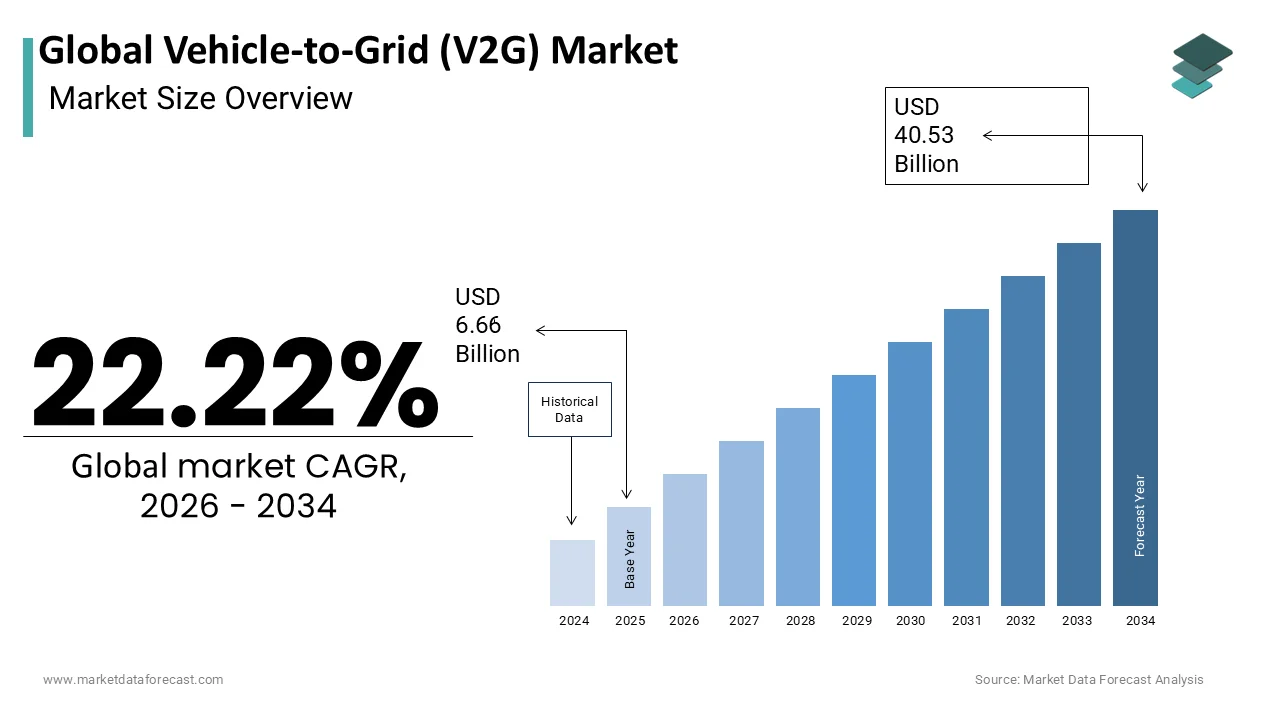
Vehicle-to-grid (V2G) technology is a bidirectional energy exchange system that enables electric vehicles to discharge stored battery power back into the electrical grid during periods of high demand or low renewable generation. This innovative approach transforms passive transportation assets into active distributed energy resources capable of stabilizing grid frequency and providing ancillary services. According to the International Energy Agency, global electric car sales reached 14 million units in 2023, creating a massive potential reservoir of stored energy that remains largely untapped for grid support functions. As reported by Eurostat, renewable energy sources supplied a record 45.3% of the European Union’s gross electricity consumption in 2023, accelerating the regional demand for flexible grid storage systems. Sources show average electric vehicle battery capacities exceed 60 kilowatt-hours, indicating that a fleet of one million vehicles holds a theoretical storage volume of 60 gigawatt-hours. Utility operators increasingly recognize this latent capacity as a critical component of future grid resilience strategies. Regulatory frameworks in several jurisdictions now permit aggregated vehicle fleets to participate in energy markets, allowing owners to monetize their idle battery capacity. The integration of smart charging infrastructure facilitates automated energy flows based on real-time price signals and grid conditions. This symbiotic relationship between transportation and energy sectors promises to reduce overall system costs while accelerating the transition away from fossil fuel-based peaking plants.
MARKET DRIVERS
Grid Stability Requirements Amid Renewable Energy Expansion Drive Adoption
The rapid proliferation of variable renewable energy sources creates significant challenges for grid operators who must maintain a precise balance between supply and demand to prevent blackouts and equipment damage, which in turn fuels the growth of the vehicle-to-grid market. Wind and solar generation fluctuate unpredictably due to weather patterns, requiring fast-responding reserves that traditional thermal power plants cannot provide efficiently. Vehicle-to-grid systems offer sub-second response times for frequency regulation services, far surpassing the ramp-up capabilities of gas turbines or coal-fired units. Findings from the National Renewable Energy Laboratory emphasize that balancing highly renewable power sectors will require scaling grid-scale and distributed diurnal energy storage capacity up to 200 gigawatts by mid-century. Electric vehicles collectively possess the technical capability to meet a substantial portion of this requirement without additional infrastructure investment beyond bidirectional chargers. The California Independent System Operator, grid managers increasingly rely on demand response mechanisms during peak thermal weather seasons to secure grid margins and mitigate rolling blackouts. Academic and industrial research hubs in Denmark have successfully piloted bidirectional vehicle-to-grid aggregation frameworks to provide vital frequency containment reserves for northern European power pools. The economic value of these ancillary services exceeds simple energy arbitrage, with frequency regulation commands commanding premium prices in wholesale markets. This operational necessity drives regulatory mandates and incentive structures that encourage widespread adoption of bidirectional charging hardware.
Economic Incentives and Revenue Potential Motivate Consumer Participation
Financial compensation mechanisms transform electric vehicle ownership from a pure cost center into a potential revenue-generating asset, which significantly enhances the total cost of ownership proposition for consumers and fleet operators, and thereby propels the expansion of the vehicle-to-grid market. Vehicle-to-grid participants earn income by selling electricity back to the grid during peak pricing periods when wholesale rates spike due to constrained supply. The United Kingdom implemented a dynamic tariff structure in 2024 that pays electric vehicle owners up to 0.30 pounds per kilowatt hour for exported energy during evening peak hours, compared to 0.08 pounds for off-peak charging. A typical household participating in such schemes can generate annual revenues between 300 and 600 pounds, offsetting a significant portion of charging costs. Fleet operators managing commercial delivery vans realize even greater benefits due to larger battery capacities and predictable parking schedules at depots. European transport policy analyses on ScienceDirect recommend that nations introduce specialized tax breaks and fiscal frameworks to stimulate consumer trust in decentralized vehicle-to-grid trading markets. Insurance products specifically covering battery degradation risks have emerged, mitigating consumer concerns about warranty voidance. The aggregation of thousands of individual vehicles creates virtual power plants that negotiate bulk contracts with utilities, ensuring stable income streams for participants. This financial viability accelerates hardware adoption as consumers seek to maximize return on their substantial electric vehicle investments.
MARKET RESTRAINTS
Battery Degradation Concerns Deter Widespread Consumer Acceptance
Consumer anxiety regarding accelerated battery wear caused by frequent charge and discharge cycles beyond normal driving patterns hampers the growth of the vehicle-to-grid market. Lithium-ion batteries degrade over time due to chemical changes in electrode materials, with cycle life typically rated between 1000 and 3000 full equivalents depending on chemistry and thermal management. Most manufacturers warrant batteries for 8 years or 100000 miles, but these guarantees often exclude damage resulting from non-standard usage such as vehicle-to-grid operations. Replacement costs remain prohibitively high, averaging 15000 dollars for a mid-size sedan pack, creating substantial financial risk for owners who participate in energy markets. While advanced battery management systems can mitigate some degradation by limiting depth of discharge and maintaining optimal temperatures, they cannot eliminate physical wear entirely. Consumer surveys indicate that 65 percent of electric vehicle owners would decline vehicle-to-grid participation if it voided their warranty, highlighting the psychological barrier. Secondhand market values for electric vehicles depend heavily on remaining battery health, meaning accelerated degradation directly impacts resale potential. Mass market adoption will remain limited to early adopters willing to accept higher maintenance risks. This will continue until manufacturers offer extended warranties for grid service usage or provide guaranteed buyback programs.
Inadequate Charging Infrastructure Limits Operational Feasibility
The current charging ecosystem lacks the necessary hardware and software integration to support seamless bidirectional energy flows at the scale required for meaningful grid impact, which further hinders the expansion of the vehicle-to-grid market. Less than 5 percent of public charging stations in Europe and North America currently support vehicle-to-grid functionality, forcing users to rely exclusively on home installations for participation. The installation of bidirectional chargers requires significant electrical upgrades, including dedicated circuits and smart metering capabilities that many older residential properties lack. Commercial fleets face similar infrastructure hurdles, as depot charging systems must be redesigned to manage complex energy routing between vehicles and the grid simultaneously. The absence of universal communication standards means chargers from different manufacturers often fail to interoperate with vehicle battery management systems, leading to compatibility issues. The CharINe consortium is working to establish common protocols, but widespread implementation remains years away. Grid connection agreements require extensive paperwork and approval processes that can take months, discouraging casual participation. Rural areas suffer from weak grid connections that cannot absorb injected power without causing voltage spikes, necessitating expensive local transformer upgrades. Without a dense network of compatible charging points, vehicle-to-grid remains a niche capability accessible only to wealthy homeowners with new constructions. This exclusivity severely limits its potential contribution to grid stability.
MARKET OPPORTUNITIES
Integration With Smart City Energy Management Systems Creates New Value Streams
Urban planning initiatives increasingly incorporate V2G technology as a core component of smart city infrastructure, which offers a major opportunity for the growth of the vehicle-to-grid market. This enables holistic energy optimization across transportation, buildings, and utility networks. Smart cities utilize artificial intelligence platforms that coordinate electric vehicle charging and discharging with building energy consumption, solar generation, and grid constraints to minimize overall system costs. Supported by the Energy Market Authority of Singapore, regional tech consortia are testing localized V2G testbeds to evaluate how coordinated electric vehicle fleets can eventually mitigate urban peak electricity demand spikes. These integrated systems allow vehicles to charge when renewable generation is abundant and discharge when building air conditioning loads surge during hot afternoons. The data generated by these interactions provides valuable insights for urban planners designing future energy infrastructure. Municipalities can leverage aggregated vehicle capacity to defer costly substation upgrades, saving millions in capital expenditure. Barcelona implemented a district-level vehicle-to-grid scheme where neighborhood clusters share energy locally, reducing transmission losses and enhancing community resilience. The convergence of Internet of Things sensors, cloud computing, and electric mobility creates a digital ecosystem where energy flows automatically based on real-time optimization algorithms. This systemic integration transforms isolated vehicles into nodes within a larger intelligent network, unlocking efficiencies impossible to achieve through standalone operations. Government grants supporting smart city pilots accelerate technology maturation and demonstrate proof of concept for broader replication.
Expansion Into Heavy-Duty Commercial Fleets Offers Scalable Impact
Heavy-duty electric trucks and buses provide superior opportunities for V2G applications, which is likely to drive the expansion of the vehicle-to-grid market. This is primarily because passenger vehicles, which receive most of the attention, lack the massive battery capacity and predictable routines of commercial fleets. A single electric transit bus carries a 400-kilowatt-hour battery, equivalent to six passenger cars, and spends 18 hours daily parked at depots where grid connection is readily available. Delivery trucks returning to distribution centers overnight offer similar potential, with companies like Amazon and FedEx exploring ways to monetize idle battery assets. The standardized nature of fleet operations simplifies software integration and control logic compared to diverse consumer behaviors. Regulatory bodies are beginning to recognize commercial fleets as distinct resource categories eligible for specialized compensation structures. The sheer scale of energy involved makes fleet-based vehicle-to-grid economically viable even with conservative degradation assumptions. Industrial parks hosting multiple fleet operators can create microgrids powered partially by parked trucks, enhancing energy independence and reliability. This segment offers the quickest path to significant grid impact due to centralized management and high utilization rates of available battery capacity.
MARKET CHALLENGES
Standardization Fragmentation Hinders Interoperability And Scale
The lack of unified technical standards for V2G communication protocols creates a fragmented landscape where hardware from different manufacturers struggles to interact seamlessly, which inhibits the growth of the vehicle-to-grid market. Multiple competing standards, including ISO 15118, CHAdeMO, and proprietary manufacturer-specific interfaces, confuse consumers and complicate infrastructure deployment. A charger compliant with one standard may not recognize the bidirectional capabilities of a vehicle using another, rendering the feature useless despite both devices technically supporting it. The International Electrotechnical Commission has been working since 2022 to harmonize these protocols, but full global alignment remains elusive due to conflicting interests among automotive and charging industry stakeholders. This fragmentation increases development costs for manufacturers who must support multiple interfaces, delays time to market for new products, and frustrates users experiencing compatibility failures. Utilities hesitate to invest in aggregation platforms when they cannot guarantee consistent communication with diverse vehicle types. The absence of clear certification marks makes it difficult for consumers to identify truly interoperable equipment. Regulatory mandates in some regions favor specific standards, creating trade barriers and limiting choice. Until a single global standard emerges and achieves critical mass adoption, V2G (Vehicle-to-Grid) will remain a cumbersome experience. This careful matching of compatible components stifles mass-market growth and prevents the network effects that drive down costs.
Regulatory Uncertainty And Complex Market Access Rules Create Barriers
Navigating the legal and regulatory framework governing V2G participation proves exceptionally complex, which constrains the expansion of thevehicle-to-gridd market. This is due to overlapping jurisdictions and evolving policies that vary significantly by region. Many electricity markets were designed for large centralized generators and lack clear rules for small distributed resources like individual electric vehicles. Aggregators must navigate intricate registration processes, metering requirements, and performance penalties that differ between transmission- anddistribution-levell markets. In the United States, Federal Energy Regulatory Commission Order 2222 aims to remove barriers for distributed energy resources, but implementation depends on individual regional transmission organizations, leading to inconsistent access. Europe faces similar fragmentation, with each member state defining its own compensation mechanisms and technical requirements. Some jurisdictions classify vehicle-to-grid exports as commercial generation, subjecting participants to business licensing and tax obligations that deter casual users. Data privacy regulations restrict the sharing of vehicle location and usage data necessary for optimal grid coordination, creating tension between security and efficiency. The legal liability for grid disturbances caused by malfunctioning vehicle equipment remains undefined in many areas, exposing owners to potential lawsuits. This regulatory maze requires specialized legal expertise that average consumers and small fleet operators cannot afford, effectively limiting participation to large, sophisticated entities. Clearer,r simplified frameworks are essential to unlock the full potential of distributed vehicle storage.
REPORT COVERAGE
| REPORT METRIC | DETAILS |
| Market Size Available | 2025 to 2034 |
| Base Year | 2025 |
| Forecast Period | 2026 to 2034 |
| Segments Covered | By Component, Application, Vehicle Type, and Region |
| Various Analyses Covered | Global, Regional and Country-Level Analysis, Segment-Level Analysis, Drivers, Restraints, Opportunities, Challenges; PESTLE Analysis; Porter’s Five Forces Analysis, Competitive Landscape, Analyst Overview of Investment Opportunities |
| Countries Covered | North America Europe Asia-Pacific Latin America Middle East & Africa |
| Market Leaders Profiled | Nuvve Holding Corp., ABB Ltd., Siemens AG, Schneider Electric SE, Hitachi Energy Ltd., Nissan Motor Co., Ltd., Toyota Motor Corporation, Mitsubishi Motors Corporation, Honda Motor Co., Ltd., Enel X S.r.l., Fermata Energy LLC, Wallbox N.V. |
SEGMENTAL ANALYSIS
By Component Insights
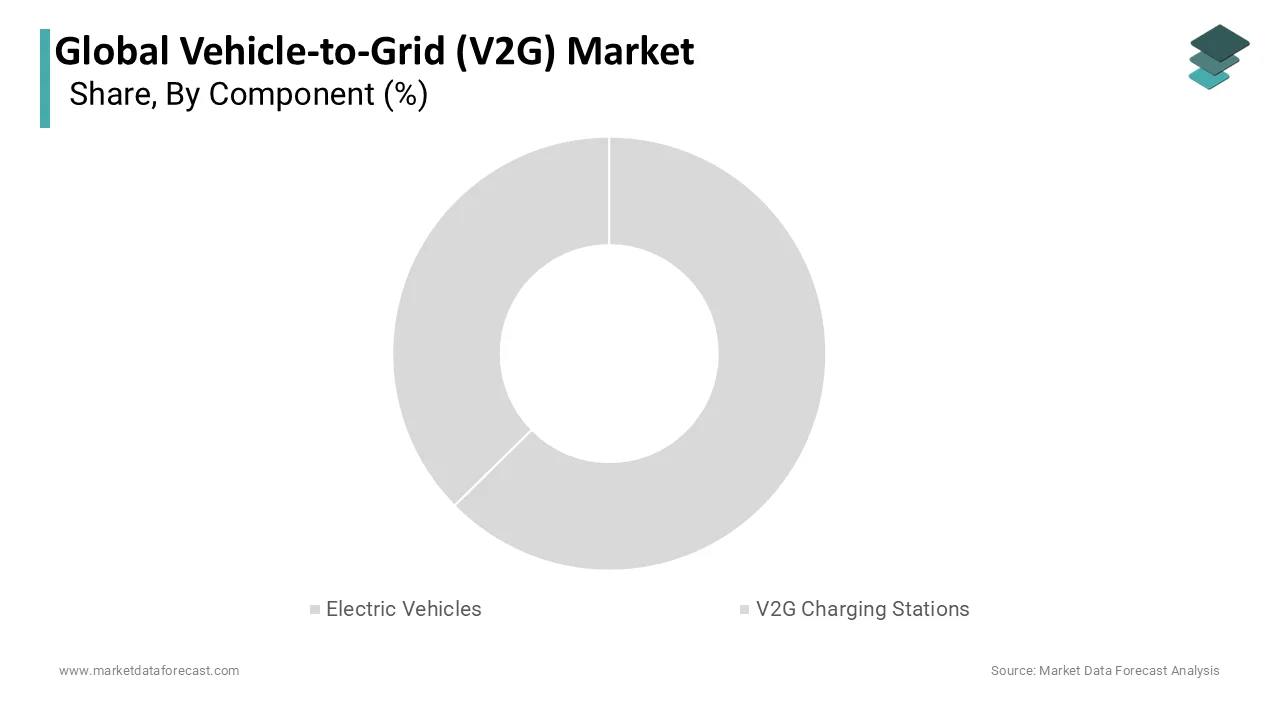
The electric vehicles segment was the largest in the vehicle-to-grid market and accounted for a substantial share in 2025. This dominance of the segment was driven by their role as the primary stored energy source and the physical asset required for bidirectional power flow. Without a critical mass of compatible vehicles, the entire ecosystem lacks the necessary capacity to impact grid operations meaningfully.
The exponential growth in electric vehicle adoption globally provides the fundamental hardware base required for vehicle-to-grid scalability, transforming private cars into distributed storage assets. According to the International Energy Agency, the global stock of electric passenger cars surpassed 40 million units in 2023, with annual sales reaching 14 million units, creating a massive reservoir of potential grid storage capacity. Each new electric vehicle adds approximately 60 kilowatt hours of battery capacity to the collective network, meaning the total available storage potential now exceeds 2400 gigawatt hours worldwide. This sheer volume of distributed energy resources allows grid operators to conceptualize vehicle fleets as virtual power plants capable of absorbing excess renewable generation or supplying peak demand. The average daily driving distance remains under 50 kilometers for most users, leaving over 90 percent of battery capacity idle and available for grid services. This utilization gap represents an untapped economic resource that incentivizes both utilities and consumers to participate in energy exchange programs. The continuous influx of new vehicles ensures that the aggregate storage capacity grows annually without requiring separate infrastructure investments, making electric vehicles the dominant and most scalable component in the market.
Improvements in lithium-ion battery technology significantly extend cycle life and thermal stability, addressing previous concerns about degradation from frequent charging and discharging cycles associated with grid participation. Modern nickel manganese cobalt and lithium iron phosphate batteries now withstand over 3000 full charge cycles before reaching 80 percent capacity retention, according to testing data published by the Argonne National Laboratory in 2024. This durability allows vehicles to participate in daily vehicle-to-grid operations for eight to ten years without significant performance loss, aligning with typical vehicle ownership periods. Advanced battery management systems actively monitor cell health and adjust charge rates to minimize stress, enabling safe integration with grid frequency regulation services that require rapid response times. The cost of battery packs has declined by 89 percent since 2010, reaching an average of 139 dollars per kilowatt hour in 2023, as reported by BloombergNEF, making the economic case for using vehicle batteries for grid support more compelling. Lower replacement costs reduce the financial risk for owners who worry about warranty voidance, encouraging broader participation. Manufacturers are increasingly offering software updates that optimize battery usage patterns specifically forvehicle-to-gridd applications, further enhancing longevity. These technological strides remove technical barriers that previously limited vehicle-to-grid to niche demonstrations, allowing it to become a mainstream feature in standard electric vehicle configurations.
The V2G charging stations segment is predicted to witness the highest CAGR of 28.5% over the forecast period due to the urgent need for infrastructure that enables bidirectional energy flow and smart communication between vehicles and the grid.
Regulatory frameworks in major economies increasingly mandate the installation of bidirectional charging capabilities in public and private infrastructure, forcing rapid expansion of V2G-compatible station networks to support policy goals. The United States Department of Energy allocated 2.5 billion dollars in 2024 through the Bipartisan Infrastructure Law specifically for building a national network of electric vehicle chargers, prioritizing sites that can support vehicle-to-grid functionality. The policy directives create guaranteed demand for V2G stations, reducing investment risk for infrastructure developers and utilities. The regulatory push ensures that infrastructure deployment keeps pace with vehicle sales, preventing the bottleneck that plagued early electric vehicle adoption. Standardization efforts led by the CharINe consortium are harmonizing technical requirements, allowing manufacturers to produce universal chargers that work across different vehicle brands. This regulatory certainty drives capital expenditure into the sector, resulting in double-digit growth rates as countries race to meet statutory deadlines for grid-interactive infrastructure.
Electric utilities are aggressively investing in V2G charging stations as part of broader smart grid modernization strategies aimed at managing peak load and integrating renewable energy sources efficiently. Utilities recognize that V2G stations provide two-way communication channels essential for aggregating thousands of small batteries into a cohesive grid asset. The ability to remotely control charging and discharging through these stations allows utilities to balance local grid constraints without curtailing renewable generation. As utilities transition from passive distributors to active energy managers, V2G (Vehicle-to-Grid) stations become critical nodes in their digital infrastructure. This drives sustained procurement and installation activities that fuel the rapid growth of this segment.
By Application Insights
The commercial application segment led the vehicle-to-grid market and captured a significant share in 2025. This leading position of the segment was attributed to the centralized management, predictable usage patterns, and large battery capacities of fleet vehicles, which simplify aggregation and maximize economic returns.
Commercial fleet operators prioritizevehicle-to-gridd adoption primarily to reduce total cost of ownership by monetizing idle battery capacity and lowering energy expenses through strategic charging and discharging cycles. Logistics companies such as DHL and FedEx operate thousands of electric delivery vans that return to central depots nightly, providing a consistent and predictable window for grid interaction. The scale of commercial operations allows for sophisticated energy management software that optimizes thousands of vehicles simultaneously, achieving efficiencies impossible for individual owners. Bus transit authorities in Los Angeles and London have deployed electric buses with vehicle-to-grid capabilities, using them to power depot facilities and sell excess energy, generating revenue streams that offset high upfront vehicle costs. The centralized nature of fleet charging infrastructure simplifies the installation of bidirectional chargers and grid connections, avoiding the regulatory and technical hurdles faced by residential users. Fleet managers can negotiate bulk contracts with utilities, securing favorable rates and guaranteed payments for grid services. This economic advantage, combined with corporate sustainability goals, makes commercial fleets the earliest and most enthusiastic adopters of vehicle-to-grid technology, driving the dominance of this application segment.
Strict environmental regulations and corporate social responsibility commitments compel commercial entities to adopt vehicle-to-grid technologies as part of their broader decarbonization strategies. Many multinational corporations have pledged to achieve net-zero emissions by 2050, requiring them to not only electrify their fleets but also ensure that this electrification supports grid stability and renewable integration. Regulatory frameworks in Europe and North America increasingly require large energy consumers to demonstrate grid flexibility and contribution to renewable energy integration. Commercial vehicle-to-grid participation allows companies to earn carbon credits and green certifications, enhancing their brand reputation and compliance status. The ability to report measurable contributions to grid decarbonization provides tangible value for sustainability reporting. Furthermore, some jurisdictions offer tax incentives and grants specifically for commercial entities that implement vehicle-to-grid systems, further improving the financial case. This alignment of regulatory pressure, corporate values, and financial incentives creates a powerful driver for commercial adoption, solidifying its position as the leading application segment in the market.
The individual application segment is estimated to register the fastest CAGR of 22.3% from 2026 to 2034 owing to increasing consumer awareness, improved home charging technology, and attractive financial incentives for residential participants.
Growing awareness among electric vehicle owners about the potential to earn income from their parked cars is driving rapid adoption of vehicle-to-grid technology in the residential sector. Utility companies in regions like California and the United Kingdom have launched user-friendly programs that pay homeowners for allowing their vehicles to support the grid, with earnings ranging from 300 to 600 dollars annually. The simplicity of modern apps allows users to set preferences for minimum battery levels and charging times, removing the complexity that previously deterred participation. The introduction of time-of-use electricity rates encourages individuals to charge when prices are low and discharge when prices are high, creating a direct financial benefit. Surveys indicate that 70 percent of electric vehicle owners are interested in vehicle-to-grid if it reduces their charging costs, highlighting a great latent demand. Home charger manufacturers are responding by bundling vehicle-to-grid-capable hardware with easy-to-install packages, reducing the barrier to entry. Government rebates for installing smart bidirectional chargers further lower the initial investment, making the technology accessible to middle-income households. As more neighbors participate, community-level benefits such as improved local grid reliability become visible, fostering social acceptance and peer-to-peer promotion. This combination of financial reward, ease of use, and community benefit is accelerating individual adoption at a pace that surpasses other segments.
The integration of vehicle-to-grid systems with home energy management platforms is simplifying the user experience and expanding the value proposition for individual consumers. Modern smart home systems can coordinate electric vehicle charging with rooftop solar production and home battery storage, optimizing energy usage across the entire household. Tesla and other manufacturers offer seamless integration where the vehicle acts as a backup power source for the home during outages, providing energy security that appeals to homeowners in areas prone to extreme weather. The development of plug-and-play bidirectional chargers that require minimal electrical upgrades has made installation faster and cheaper, often completing within a single day. Software updates delivered over the air enable new vehicle-to-grid features without hardware changes, keeping systems current and functional. The rise of virtual power plant aggregators allows individual homeowners to join large networks that participate in wholesale energy markets, sharing in revenues that were previously only available to large commercial entities. This democratization of energy trading empowers individuals to become prosumers, actively contributing to the energy system. The convenience of automated operation, where the system manages charging and discharging based on user preferences and grid signals, removes the need for active management. This technological ease and enhanced functionality are key drivers behind the rapid growth of the individual application segment.
By Vehicle Type Insights
The battery electric vehicles segment dominated the vehicle-to-grid market and accounted for a substantial share in 2025. This dominance of the segment was driven by its large battery capacities, pure electric architecture, and lack of internal combustion engine complexity, making it ideal for the frequent and deep cycling required for grid services.
Battery electric vehicles offer significantly larger usable battery capacities compared to plug-in hybrid electric vehicles, providing more energy for grid services and greater economic potential for owners. Unlike hybrids, BEVs do not have complex mechanical systems that limit their ability to dedicate full battery resources to grid interaction. The simplified powertrain of BEVs allows for more efficient energy conversion during charging and discharging, reducing losses and heat generation. Automakers design BEVs with thermal management systems optimized for high power cycling, ensuring longevity even with regular vehicle-to-grid use. The absence of a gasoline engine means that all energy storage is dedicated to electric propulsion and grid support, maximizing the utility of the battery pack. This architectural advantage makes BEVs the preferred choice for utilities seeking reliable and high-capacity distributed storage resources. The growing availability of BEVs across all vehicle segments, from compact cars to large SUVs, ensures a broad base of compatible vehicles. As battery costs continue to fall, BEVs become more affordable, expanding the pool of potential vehicle-to-grid participants. Their technical superiority in terms of energy density and cycling capability solidifies their dominance in the vehicle-to-grid market.
Major automotive manufacturers are increasingly standardizing vehicle-to-grid capabilities across their BEV lineups, ensuring that new models are ready for grid interaction out of the box. The standardization reduces confusion for consumers and simplifies infrastructure planning for utilities. Manufacturers are working closely with charging standard bodies to ensure that their BEVs comply with global protocols like ISO 15118, enabling interoperability with various charger brands. The commitment from original equipment manufacturers signals long-term viability for vehicle-to-grid technology, encouraging investment in supporting infrastructure. Software-defined vehicle architectures allow manufacturers to enable or enhance vehicle-to-grid features through over-the-air updates, extending the lifespan and functionality of existing BEVs. This proactive approach by automakers removes technical barriers and builds consumer confidence, driving the widespread adoption of BEVs for vehicle-to-grid applications. The focus on BEVs reflects their suitability for the rigorous demands of grid service, cementing their position as the leading vehicle type in the market.
The plug-in hybrid electric vehicles segment is anticipated to witness the fastest CAGR of 19.8% during the forecast period. This swift expansion of the segment is propelled by their role as a transition technology and recent advancements in enabling bidirectional charging for smaller batteries.
Plug-in hybrid electric vehicles are gaining traction in the vehicle-to-grid market as a bridge technology that offers electric driving benefits while alleviating range anxiety, with newer models increasingly supporting bidirectional charging. Although their batteries are smaller, typically around 15 to 20 kilowatt-hours, they are sufficient for short-duration grid services such as frequency regulation. Consumers who are hesitant to switch fully to electric vehicles find PHEVs a comfortable entry point that still allows them to participate in vehicle-to-grid programs. Utilities recognize the value of aggregating large numbers of PHEVs, as their collective capacity can provide significant grid support. The lower cost of PHEVs compared to BEVs makes them accessible to a wider demographic, increasing the potential participant base. Recent technological improvements have enabled efficient bidirectional power flow in PHEVs without compromising their hybrid functionality. This expanded compatibility and consumer appeal drive the rapid growth of the PHEV segment in the vehicle-to-grid market, offering a complementary resource to BEVs.
PHEVs are particularly well suited for short-duration, high-frequency grid services such as frequency regulation, where rapid response is more important than large energy capacity. Their smaller batteries can handle frequent shallow cycles with minimal degradation, making them ideal for these specific applications. Grid operators value the fast response times of PHEVs, which can adjust power output in seconds to stabilize grid frequency. The distributed nature of PHEVs allows for granular control of grid parameters, enhancing overall system stability. As grid needs evolve towards more frequent but smaller adjustments, the role of PHEVs becomes increasingly important. The ability to participate in these niche markets provides additional revenue streams for PHEV owners, incentivizing adoption. The growth of this segment is supported by specialized aggregation platforms that optimize PHEV participation in frequency regulation markets. This focused application and technological suitability drive the fast growth rate of the PHEV segment in the vehicle-to-grid market.
COUNTRY LEVEL ANALYSIS
North America Vehicle-to-Grid Market Analysis
North America was the top performer in the global vehicle-to-grid market and accounted for a substantial share in 2025. This dominance of the North American market was driven by strong government incentives, advanced grid infrastructure, and high electric vehicle adoption rates in the United States and Canada. The United States leads the region with substantial federal funding through the Bipartisan Infrastructure Law, which allocates billions for electric vehicle charging infrastructure, including vehicle-to-grid-capable stations. Led by the California Energy Commission, California leads regional V2G piloting alongside utilities like PG&E while advancing legislative frameworks to incentivize bidirectional charging readiness. The presence of major technology companies and automotive manufacturers fosters innovation in battery management and grid integration software. Canada supports growth through federal zero-emission vehicle mandates and provincial incentives for smart charging infrastructure. The region benefits from a mature electricity market structure that allows for participation in ancillary services, providing financial incentives for vehicle-to-grid adoption. High consumer awareness and environmental consciousness further drive demand. The collaborative efforts between utilities, automakers, and government agencies create a favorable ecosystem for market expansion. The focus on grid resilience against extreme weather events also accelerates adoption, as vehicle-to-grid offers a decentralized backup power solution. This combination of policy support, technological leadership, and market maturity positions North America as a key driver of global vehicle-to-grid growth.
Europe Market Vehicle-to-Grid Market Analysis
Europe was positioned second in the vehicle-to-grid market because of stringent environmental regulations, ambitious renewable energy targets, and strong government support for electric mobility and grid modernization. The European Union’s Green Deal and Fit for 55 package drive the transition to electric vehicles and smart grids, creating a favorable regulatory environment for vehicle-to-grid. Countries like Germany, France, and the Netherlands lead in implementation, with extensive pilot projects and supportive tariff structures. High electricity prices in Europe make the economic case for vehicle to grid compelling for consumers, who can save significantly by optimizing charging times. The region has a dense network of renewable energy sources, creating a strong need for flexible storage solutions that vehicle-to-grid can provide. Strong collaboration between automotive manufacturers and utility companies facilitates seamless integration. Consumer interest in sustainability and energy independence further boosts adoption. The harmonization of standards across member states reduces fragmentation and encourages cross-border innovation. Europe’s commitment to decarbonization and grid stability ensures sustained growth in the vehicle-to-grid market, making it a global leader in policy and implementation.
Asia-Pacific Vehicle-to-Grid Market Analysis
Asia Pacific is emerging as a rapidly growing region in the vehicle-to-grid market, led by China, Japan, and South Korea, driven by massive electric vehicle adoption, government mandates, and grid modernization initiatives. China dominates the region with the world’s largest electric vehicle market and aggressive policies promoting vehicle-to-grid technology as part of its smart grid strategy. According to the Ministry of Industry and Information Technology, China uses standardized pilot programs across major cities to rapidly deploy thousands of bidirectional V2G stations without implementing a strict nationwide infrastructure mandate. Japan focuses on vehicle-to-grid for disaster resilience, with widespread adoption of home energy management systems that integrate electric vehicles. South Korea invests heavily in smart grid pilots and vehicle-to-grid demonstrations, leveraging its advanced technology sector. The region benefits from strong manufacturing bases for both electric vehicles and charging infrastructure, keeping costs competitive. Rising energy demand and the need to integrate renewable sources drive utility interest in vehicle-to-grid solutions. Government subsidies and incentives accelerate consumer adoption. The presence of leading battery manufacturers ensures a steady supply of advanced battery technology. The region’s focus on technological innovation and scale positions it for significant growth in the vehicle-to-grid market, contributing substantially to global expansion.
Latin America Vehicle-to-Grid Market Analysis
Latin America grew steadily in the vehicle-to-grid market, with early adoption driven by pilot projects in Brazil and Chile, supported by growing electric vehicle interest and renewable energy expansion. Brazil leads the region with its abundant hydroelectric power and increasing electric bus fleets, exploring vehicle-to-grid for grid stability. Chile promotes electric mobility through tax incentives and infrastructure investments, focusing on the mining and public transport sectors. The region faces challenges related to grid infrastructure limitations and higher costs, but international partnerships and development bank funding support pilot initiatives. Growing awareness of climate change and energy security drives government interest in smart grid technologies. The potential for vehicle-to-grid to support renewable integration, particularly solar and wind, is recognized by utilities. Local manufacturers and importers begin offering vehicle-to-grid compatible vehicles and chargers. While market size remains small compared to other regions, the foundational steps being taken suggest future growth potential as economic conditions improve and policy frameworks mature.
Middle East and Africa Vehicle-to-Grid Market Analysis
The Middle East and Africa region is anticipated to see a notable expansion in the vehicle-to-grid market during the forecast period. This growth is primarily driven by sustainability initiatives in Gulf states and renewable energy projects in South Africa and Morocco. The United Arab Emirates and Saudi Arabia invest in smart city projects that include vehicle-to-grid as part of their diversification strategies away from oil. According to researchers in the World Electric Vehicle Journal, South Africa is evaluating the long-term utility of V2G systems, though current national efforts remain focused on baseline grid stabilization and basic charging rollouts. The region benefits from high solar potential, creating a need for storage solutions that vehicle-to-grid can provide. Limited electric vehicle penetration and infrastructure remain barriers, but government visions and international collaborations are fostering initial developments. The focus on economic diversification and energy security drives incremental progress. As electric vehicle adoption slowly increases, the potential for vehicle-to-grid grows, supported by strategic national plans.
COMPETITIVE LANDSCAPE
The vehicle-to-grid market features intense competition among specialized technology firms, established charging infrastructure providers, and automotive manufacturers vying for dominance in this emerging sector. Differentiation occurs through proprietary software algorithms that optimize battery usage while minimizing degradation concerns for participants. Hardware manufacturers compete on charger efficiency, compatibility breadth, and installation simplicity to capture market share across residential and commercial segments. Aggregation platforms distinguish themselves through superior market access and revenue optimization capabilities that directly impact participant earnings. Strategic alliances between charging companies and automakers create integrated solutions that reduce friction for end users seeking bidirectional functionality. New entrants face significant barriers, including certification requirements, utility interconnection approvals, and the need for extensive pilot validation before commercial scaling. Established players leverage existing customer relationships and brand recognition to accelerate adoption while startups focus on niche applications or innovative business models. The competitive landscape remains fragmented as no single entity controls all necessary components, fostering collaboration alongside rivalry. Success increasingly depends on ecosystem integration rather than standalone product superiority, rewarding companies that build comprehensive partnerships across the value chain.
KEY MARKET PLAYERS
Some of the companies that are playing a dominant role in the Global Vehicle-to-Grid (V2G) Market include
- Nuvve Holding Corp.
- ABB Ltd.
- Siemens AG
- Schneider Electric SE
- Hitachi Energy Ltd.
- Nissan Motor Co., Ltd.
- Toyota Motor Corporation
- Mitsubishi Motors Corporation
- Honda Motor Co., Ltd.
- Enel X S.r.l.
- Fermata Energy LLC
- Wallbox N.V.
TOP LEADING PLAYERS IN THE MARKET
- Fermata Energy specializes exclusively in bidirectional electric vehicle charging technology and aggregation services for commercial fleets globally. The company develops proprietary hardware and software that enables seamless vehicle-to-grid integration without voiding manufacturer warranties through certified partnerships. Recent actions include launching advanced DC bidirectional chargers compatible with multiple vehicle standards to expand interoperability across diverse fleet types. Fermata Energy actively collaborates with utilities to create tailored tariff structures that maximize revenue for fleet operators participating in frequency regulation markets. Their focus on commercial applications simplifies deployment complexity while demonstrating proven economic models that encourage broader industry adoption of bidirectional energy exchange systems worldwide.
- Wallbox manufactures smart charging solutions, including bidirectional chargers designed for residential and commercialvehicle-to-gridd applications across international markets. The company introduced its Quasar 2 bidirectional charger, specifically engineered for home use with integrated energy management capabilities supporting solar integration. Wallbox recently expanded manufacturing capacity in Europe and North America to meet surging demand for grid-interactive charging infrastructure. Strategic partnerships with automotive manufacturers ensure compatibility with emerging vehicle platforms while software updates enhance functionality over time. Their comprehensive ecosystem approach combines hardware, cloud platforms, and user-friendly applications to lower barriers for individual consumers seeking to monetize their electric vehicle batteries for grid support services effectively.
- Nuvve Holding Corp provides intelligent vehicle-to-grid platforms that aggregate distributed electric vehicle batteries into virtual power plants for grid services globally. The company’s proprietary software optimizes charging and discharging schedules based on real-time market signals and battery health parameters to maximize participant revenue. Nuvve recently secured contracts with major transit authorities and school districts to deploy vehicle-to-grid-enabled electric bus fleets across multiple continents. Strategic alliances with charging hardware manufacturers ensure seamless integration between vehicles and grid infrastructure. Their platform demonstrates scalable business models where aggregated vehicle capacity participates in wholesale energy markets, proving commercial viability while accelerating global adoption of bidirectional energy technologies.
TOP STRATEGIES USED BY KEY MARKET PARTICIPANTS
Key players in the vehicle-to-grid market employ strategic partnerships with automotive manufacturers to ensure seamless hardware and software compatibility across diverse vehicle platforms. Companies invest heavily in research and development to improve bidirectional charger efficiency and reduce installation costs for widespread adoption. Aggregation service providers focus on creating user-friendly platforms that simplify participation for individual consumers and fleet operators alike. Strategic collaborations with utility companies enable the development of favorable tariff structures and regulatory frameworks that incentivize grid participation. Geographic expansion into regions with supportive policies allows firms to establish early mover advantages in emerging markets. Product diversification beyond charging hardware into energy management software creates recurring revenue streams and deeper customer relationships. These combined strategies build comprehensive ecosystems that address technical, economic, and regulatory barriers simultaneously while positioning companies as indispensable enablers of the bidirectional energy transition globally.
MARKET SEGMENTATION
This research report on the global vehicle-to-grid (v2g) market is segmented and sub-segmented into the following categories.
By Component
- Electric Vehicles
- V2G Charging Stations
By Application
- Commercial
- Individual
By Vehicle Type
- Battery Electric Vehicles (BEVs)
- Plug-in Hybrid Electric Vehicles (PHEVs)
By Country
- North America
- Europe
- Asia-Pacific
- Latin America
- Middle East & Africa