- Product Description Description
- Table of Contents TOC
- List of Table & Figure LOT
- Get Free Sample PDF Sample PDF
Market Size, 2025
$40.35 BnMarket Estimate, 2026
$47.65 BnMarket Forecast, 2034
$180.34 BnCAGR, 2026–2034
18.10%Executive Summary: Global Vehicle Tracking Systems Market
- Market Scope: Global market analysis covering electronic tracking hardware, telematics software, and GPS/cellular tracking solutions deployed across passenger and commercial vehicle networks.
- Market Valuation: Valued at USD 40.35 billion (2025), estimated at USD 47.65 billion (2026), and projected to reach USD 180.34 billion by 2034, registering a strong CAGR of 18.10% (2026–2034).
- Primary Growth Drivers: Rapid adoption of intelligent transportation systems (ITS), strict safety/security protocols, and the deployment of 5G connectivity for enhanced real-time fleet analytics.
Key Market Segment Metrics (2026–2034)
| Category | Leading Segment (2025 Position) | Fastest-Growing Segment |
|---|---|---|
| By Vehicle Type | Passenger cars (dominated due to rising individual car ownership, safety features, and emerging market demand) | Commercial and light commercial vehicles (LCVs) |
| By Industry Vertical | Transport and logistics (dominant worldwide due to widespread use in route optimization and delivery tracking) | Transport & logistics and construction/manufacturing sectors |
| By Type / Technology | Active tracking systems (favored for real-time data monitoring) & Cellular/GPS technologies | Advanced software analytics and 5G-enabled dual-mode tracking platforms |
| By Region | North America (major technology hub supported by ecosystem restructuring and strong solution providers) | Asia-Pacific (fastest-expanding regional market driven by rapid GDP growth and high vehicle sales) |
Major Market Players & Market Structure
Market Structure: Moderately fragmented global marketplace characterized by strategic mergers, acquisitions, IoT product integrations, and telecom-automotive partnerships.
Key Companies: Cartrack Holdings Limited, AT&T Inc., Continental AG, Verizon Communications Inc., Robert Bosch GmbH, Spireon, Inc., Inseego Corp., Geotab Inc., TomTom, Inc., and Teletrac Navman.
 Download Free Sample Report
Global Vehicle Tracking Systems Market Size
The global vehicle tracking systems market size was valued at USD 40.35 billion in 2025 and is anticipated to reach a valuation of USD 47.65 billion in 2026 and USD 180.34 billion by 2034, growing at a CAGR of 18.10%, from 2026 to 2034.
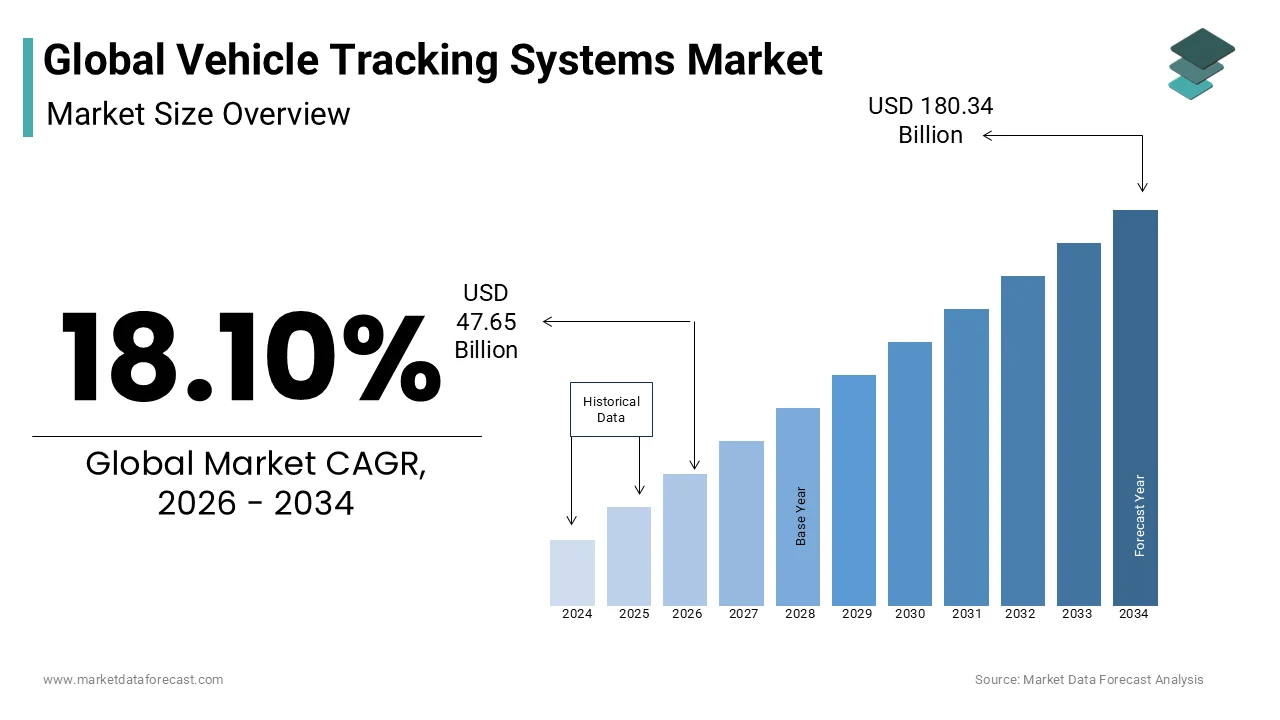
The vehicle tracking systems market encompasses advanced telematics solutions that utilize global positioning systems and cellular networks to monitor vehicle location, movement, and status in real time for commercial and personal applications. This critical technology sector enables fleet managers to optimize routes, enhance driver safety, and reduce operational costs through data-driven insights across logistics, transportation, and public sectors. According to the International Transport Forum, road freight transport accounts for approximately 7% of global greenhouse gas emissions, which drives the urgent adoption of tracking systems to monitor fuel efficiency and idle times. According to the National Highway Traffic Safety Administration, speeding and aggressive driving contribute to over 25% of all traffic fatalities, highlighting the role of tracking in promoting safer driving behaviors. These operational and safety imperatives define the strategic importance of the Vehicle Tracking Systems Market as organizations transition from reactive management to proactive digital oversight. The integration of Internet of Things sensors with tracking platforms allows for comprehensive monitoring of engine health, cargo conditions, and driver performance. Consequently, the market serves as the technological backbone for modern logistics operations seeking to balance regulatory compliance with profitability and sustainability goals in an increasingly connected global supply chain environment.
MARKET DRIVERS
Stringent Regulatory Mandates for Fleet Compliance
Strict governmental regulations regarding driver hours, electronic logging, and emission standards is propelling the global vehicle tracking systems market expansion by making telematics a legal necessity for commercial operators. According to the Federal Motor Carrier Safety Administration, the Electronic Logging Device mandate requires commercial drivers to automatically record their hours of service, which has increased the adoption of integrated tracking systems by over 40% among US fleets since implementation. According to the European Union Agency for Railways, similar tachograph regulations in Europe require precise digital recording of driving times, rest periods, and vehicle speeds to ensure road safety and fair competition. These regulatory frameworks make manual record-keeping obsolete and legally risky due to potential fines and license suspensions. Vehicle tracking systems provide the automated, accurate data trails required for compliance audits, avoiding substantial penalties. Facilities must upgrade legacy fleets with compatible hardware to meet these standards, ensuring continuous operation. The correlation between legislative pressure and technology investment ensures sustained demand as non-compliant operators face existential business threats. This policy-driven procurement cycle creates a stable baseline for market growth independent of broader economic fluctuations.
Rising Fuel Costs and Operational Efficiency Needs
Volatile global fuel prices significantly favor the vehicle tracking systems market growth by creating a financial imperative for organizations to minimize consumption through intelligent route optimization and behavior monitoring. According to the U.S. Energy Information Administration, diesel prices fluctuated by over 30% in recent years, prompting logistics companies to seek automated solutions to reduce unnecessary mileage and idling. According to the American Trucking Associations, fuel represents approximately 24% of total operating costs for trucking companies, making even small efficiency gains financially significant. This financial burden drives adoption of tracking technologies that identify inefficient driving patterns, such as harsh braking and excessive idling. Automated systems enable dynamic route adjustments based on traffic conditions, reducing fuel waste by up to 15% for large fleets. The return on investment for tracking systems has shortened to under six months, making it an attractive capital expenditure even in tight budget environments. Companies recognize that telemetry is no longer optional, but essential for maintaining competitiveness in high-cost energy markets. This economic necessity drives widespread replacement of manual dispatch methods with automated tracking platforms.
MARKET RESTRAINTS
High Initial Implementation and Subscription Costs
Prohibitive upfront investments and recurring subscription fees are impeding the vehicle tracking systems market expansion by preventing small and medium-sized enterprises from adopting advanced telematics solutions. According to the Small Business Administration, implementing a comprehensive fleet tracking system for a small business requires initial hardware costs exceeding 200 USD per vehicle, plus monthly software subscriptions that can range from 20 to 50 USD per unit. According to the World Bank, 45% of small logistics firms in emerging economies lack access to affordable financing for technology upgrades, forcing them to rely on manual tracking methods. This financial barrier creates a disparity where large corporations enjoy efficiency gains while smaller players struggle with rising operational costs. The long payback period of 12 to 18 months further discourages investment in uncertain economic climates. Companies often defer automation projects to preserve cash flow, resulting in prolonged use of inefficient management practices. High maintenance costs for hardware replacements add to the total cost of ownership, making budget planning difficult. Until modular, low-cost solutions become widely available, this capital intensity will continue to suppress market penetration among the vast majority of potential users globally.
Data Privacy Concerns and Employee Resistance
Growing concerns regarding employee privacy and surveillance is further hindering the expansion of the global vehicle tracking systems market by causing resistance from drivers and labor unions against constant monitoring. According to the International Labour Organization, studies indicate that 60% of drivers feel stressed and distrusted when subjected to continuous GPS tracking and behavioral scoring, leading to lower job satisfaction and higher turnover rates. According to the General Data Protection Regulation in Europe mandates strict consent and data handling protocols for employee monitoring, requiring companies to invest heavily in compliance and transparency measures. This regulatory complexity forces many organizations to limit the scope of tracking features to avoid legal repercussions. The fear of misuse of personal location data outweighs the operational benefits for many risk-averse employers. Implementing robust privacy policies and anonymization techniques requires specialized legal expertise and additional software costs that strain already tight budgets. Regulatory uncertainty regarding liability for data breaches further complicates decision-making for private operators. Until standardized ethical guidelines are universally adopted and trusted, this privacy concern will remain a significant brake on the adoption of comprehensive driver monitoring features.
MARKET OPPORTUNITIES
Integration with Autonomous Driving Technologies
The rapid development of autonomous and semi-autonomous vehicles is a major opportunity for the vehicle tracking systems market by creating demand for high-precision, real-time location data for navigation and safety. According to the Society of Automotive Engineers, Level 4 and Level 5 autonomous vehicles require centimeter-level accuracy in positioning, which advanced tracking systems equipped with Real-Time Kinematic GPS can provide. According to the National Highway Traffic Safety Administration, vehicle-to-infrastructure communication relies on precise location data to coordinate traffic flow and prevent collisions in smart city environments. This technological requirement opens new revenue streams for tracking providers capable of integrating with autonomous driving stacks. Fleet operators seek automated solutions to manage mixed fleets of human-driven and autonomous vehicles efficiently. The ability to track asset status and battery levels remotely enhances operational planning for electric autonomous fleets. Government incentives for smart transportation infrastructure lower the financial risk for early adopters of these technologies. This sector expansion diversifies the customer base beyond traditional logistics clients, reducing market cyclicality. Vendors who develop specialized APIs for autonomous platforms will capture first-mover advantage in this high-growth segment.
Expansion into Electric Vehicle Fleet Management
The global transition to electric vehicles offers substantial opportunities for the vehicle tracking systems market by driving demand for specialized monitoring of battery health, charging status, and range optimization. According to the International Energy Agency, global electric car sales reached 14 million units in 2023, requiring sophisticated tracking systems to manage charging schedules and prevent range anxiety in commercial operations. According to the Edison Electric Institute, utility companies offer dynamic pricing for EV charging, which tracking systems can leverage to schedule charging during off-peak hours, reducing energy costs by up to 30%. These efficiency gains create compelling economic arguments for fleet operators to adopt EV-specific tracking modules. Automated systems enable predictive maintenance of battery packs by monitoring voltage and temperature trends. The integration of charging station availability data with route planning ensures uninterrupted operations. Climate change mitigation goals drive corporate commitments to electrify fleets, increasing demand for compatible tracking solutions. This urgency drives investment in smart EV management platforms that mirror the sophistication of traditional telematics. Automation providers offering end-to-end EV tracking solutions will benefit from this critical infrastructure modernization trend.
MARKET CHALLENGES
Interoperability Issues Between Legacy and Modern Systems
Persistent incompatibility between older vehicle models and new tracking platforms are major challenges to the vehicle tracking systems market growth by increasing integration complexity and costs. According to the Open Group Forum, 60% of commercial fleets operate with mixed vehicle ages, where proprietary diagnostic ports prevent seamless data exchange between legacy engines and modern telematics devices. According to the International Electrotechnical Commission, lack of universal standards for vehicle data interfaces forces system integrators to develop custom adapters for each vehicle type, adding weeks to project timelines and increasing failure risks. These interoperability barriers discourage holistic fleet upgrades as companies fear disrupting functional legacy components. The resulting siloed data architecture prevents comprehensive fleet visibility and optimization. Vendors must invest heavily in backward-compatibility features that divert resources from innovation. End users face vendor-lock-in situations where switching providers requires complete hardware replacement rather than incremental upgrades. Until open standards like ISO 19794 achieve universal adoption across all vehicle manufacturers, this fragmentation will continue to hinder efficient market expansion and frustrate customers seeking flexible, scalable solutions.
Cybersecurity Vulnerabilities in Connected Vehicles
Increasing threats of cyber-attacks further challenging the global vehicle tracking systems market expansion by raising concerns about unauthorized access to vehicle control systems and sensitive location data. According to the Cybersecurity and Infrastructure Security Agency, connected vehicles experienced a 50% increase in targeted hacking attempts in 2023, leading to potential theft and safety hazards for drivers. According to the United Nations Economic Commission for Europe, new regulations require manufacturers to implement robust cybersecurity management systems for all connected vehicles, leaving many older tracking devices vulnerable to exploitation. This security gap discourages adoption in high-value cargo transport where data confidentiality is essential. Implementing end-to-end encryption and secure boot mechanisms requires additional processing power and hardware costs that can compromise device performance. The fear of intellectual property theft or operational sabotage outweighs the convenience benefits for many risk-averse executives. Regulatory uncertainty regarding liability for cyber-induced accidents further complicates decision-making. Until industry-wide security standards are rigorously enforced and validated, this vulnerability will continue to limit market penetration in high-security environments.
REPORT COVERAGE
| REPORT METRIC | DETAILS |
| Market Size Available | 2025 to 2034 |
| Base Year | 2025 |
| Forecast Period | 2026 to 2034 |
| CAGR | 18.10% |
| Segments Covered | By Vehicle Type, End-User, Technology, Type, Component, and Region. |
|
Various Analyses Covered | Global, Regional & Country Level Analysis, Segment-Level Analysis, DROC, PESTLE Analysis, Porter’s Five Forces Analysis, Competitive Landscape, Analyst Overview of Investment Opportunities |
| Regions Covered | North America, Europe, APAC, Latin America, Middle East & Africa |
| Market Leaders Profiled | Cartrack Holdings Limited, AT&T Inc., Continental AG, Verizon Communications Inc., Robert Bosch GmbH, Spireon, Inc., Inseego Corp., Geotab Inc., TomTom, Inc., and Teletrac Navman. U, and Others. |
SEGMENTAL ANALYSIS
By Vehicle Insights
The heavy commercial vehicles segment accounted for the dominant share of the global vehicle tracking systems market in 2025 because they are subject to the strictest regulatory oversight regarding driver hours, cargo security, and operational safety. According to the Federal Motor Carrier Safety Administration, all commercial motor vehicles engaged in interstate commerce must use Electronic Logging Devices, which has driven near universal adoption of tracking systems in the HCV segment across North America. According to the European Commission mandates the use of smart tachographs in new heavy-duty vehicles registered after 2019, requiring automatic recording of location data every three hours during driving periods. These legal requirements make tracking systems a non-negotiable component of HCV operations rather than an optional efficiency tool. Fleet operators invest heavily in robust telematics hardware to avoid severe penalties and license suspensions associated with non-compliance. The high value of freight transported by HCVs also necessitates real-time visibility to prevent theft and ensure timely delivery. Consequently, manufacturers prioritize developing durable, high-precision tracking solutions specifically designed for the harsh operating conditions of heavy trucks. This regulatory- and security-driven demand cements HCVs as the largest revenue-generating segment, holding a dominant market share of 43.5% in 2025.
However, the light commercial vehicles segment is estimated to register a notable CAGR of 14.4% over the forecast period in the global market owing to the explosive growth of e-commerce and the resulting demand for efficient last-mile delivery solutions. According to the United Nations Conference on Trade and Development, global e-commerce sales reached 26.7 trillion USD in 2023, driving logistics companies to expand their fleets of vans and small trucks for urban deliveries. According to the National Retail Federation, same-day and next-day delivery expectations have increased fleet utilization rates by 40%, necessitating real-time tracking to optimize routes and manage driver schedules. LCVs operate in dense urban environments where traffic congestion and parking challenges require dynamic navigation support provided by tracking systems. Companies use telemetry to prove delivery times and enhance customer satisfaction through accurate arrival estimates. The low cost of entry for LCV tracking compared to HCVs allows smaller courier services to adopt these technologies rapidly.
By End Use Insights
The transportation and logistics segment accounted for the dominating share of the global market in 2025 because real-time visibility is essential for managing complex global supply chains and meeting tight delivery windows. According to the Council of Supply Chain Management Professionals, 90% of top-performing supply chain organizations use advanced tracking technologies to monitor shipments and predict delays. According to the World Bank, efficient logistics can reduce trade costs by up to 20%, making tracking systems a strategic asset for competitiveness. Companies rely on telemetry to coordinate multi-modal transport, ensure cargo integrity, and provide customers with accurate status updates. The high volume of goods moved by this sector generates massive data streams that drive continuous improvement in operational efficiency. Regulatory requirements for hazardous material transport further mandate precise tracking for safety and compliance.
On the other hand, the retail segment is anticipated to record a prominent CAGR of 13.6% over the forecast period owing to the integration of online and offline sales channels requiring seamless inventory and delivery management. According to the National Retail Federation, retailers are increasingly using their physical stores as fulfillment centers for online orders, necessitating precise tracking of local delivery vehicles. According to the International Council of Shopping Centers, curbside pickup and local delivery options have grown by 50% since 2020, requiring retailers to monitor fleet availability and location in real time. Tracking systems enable retailers to optimize last-mile logistics, reducing delivery costs and improving customer satisfaction. The ability to track refrigerated vehicles ensures compliance with food safety standards for grocery retailers. Retailers use data from tracking systems to analyze delivery patterns and optimize store locations.
By Technology Insights
The GPRS and cellular networks segment led the market with 65.9% of the global market share in 2025 because they offer widespread coverage and the ability to transmit data in real time almost anywhere there is a mobile signal. According to the International Telecommunication Union, global mobile cellular subscriptions have reached 8.9 billion, ensuring that tracking devices can maintain connectivity in most populated areas worldwide. According to the GSM Association, 4G and emerging 5G networks provide the bandwidth necessary for transmitting not just location data, but also video telemetry and diagnostic information instantly. This real-time capability is crucial for fleet managers who need immediate alerts for speeding, theft, or accidents. Cellular technology is cost-effective due to the existing infrastructure, eliminating the need for proprietary satellite networks for most land-based applications. The ease of integration with standard smartphones and tablets makes cellular tracking accessible to a broad range of users. Consequently, cellular networks remain the preferred technology for the majority of commercial and personal tracking applications.
On the other end, the dual mode technology segment is estimated to witness a CAGR of 12.6% over the forecast period because it combines cellular and satellite connectivity to ensure uninterrupted tracking even in areas with poor mobile coverage. According to the Satellite Industry Association, hybrid trackers are increasingly adopted by logistics companies operating in remote regions, such as mining sites, rural agricultural areas, and cross-border routes, where cellular signals are unreliable. According to the Federal Communications Commission, while cellular coverage is extensive, it still leaves gaps in rural and mountainous terrains, which satellite connectivity fills effectively. This redundancy is critical for high-value cargo and emergency services where loss of signal is unacceptable. Dual-mode devices automatically switch between networks, ensuring continuous data flow. The peace of mind provided by guaranteed connectivity drives adoption in mission-critical applications. This technological assurance fuels rapid growth in the dual-mode segment.
REGIONAL ANALYSIS
North America Market Analysis
North America accounted for 36.1% of the global market share in 2025 and is likely to maintain its strong economic momentum and technological dominance for the next few years due to stringent regulatory mandates and a mature logistics industry. According to the Federal Motor Carrier Safety Administration, the Electronic Logging Device mandate has driven widespread adoption of tracking systems among commercial carriers in the United States and Canada. According to the American Trucking Associations, over 80% of large fleets in the region use advanced telematics to optimize operations and ensure compliance. High labor costs drive the need for efficiency improvements through automation. The presence of major technology providers fosters innovation and rapid product development. Strong infrastructure support for cellular and satellite connectivity ensures reliable service. These factors sustain North America’s leadership position in the global market.
Europe Market Analysis
Europe is likely to accelerate its green and digital transition through robust policy frameworks for the next few years. Europe occupies the second largest position in the market, characterized by strict environmental regulations and a strong focus on sustainable logistics. According to the European Commission, the Green Deal initiatives encourage the adoption of tracking systems to monitor emissions and optimize fuel efficiency in transport operations. According to the European Railway Agency, smart tachograph requirements are pushing fleet operators to upgrade to connected tracking solutions. High fuel prices and carbon taxes make efficiency tracking economically attractive. Cross-border trade within the EU requires seamless tracking for customs and security purposes. Strong data privacy laws influence the design and deployment of tracking technologies. These regulatory and economic drivers position Europe as a key market for advanced eco-friendly tracking solutions.
Asia Pacific Market Analysis
Asia-Pacific is likely to experience rapid industrial modernization and digital expansion for the next few years. Asia-Pacific demonstrates the highest growth potential in the Vehicle Tracking Systems Market, driven by rapid industrialization and expanding e-commerce sectors in China, India, and Southeast Asia, emerging as the fastest-growing region with an expected CAGR of 14.1%. According to the Asian Development Bank, infrastructure investments in logistics and transportation are accelerating, creating demand for fleet management solutions. According to the China Automobile Dealers Association, the growing number of commercial vehicles is driving adoption of tracking systems for security and efficiency. Rising disposable income supports growth in passenger vehicle tracking for safety and anti-theft purposes. Government initiatives to modernize transport networks promote digital adoption. The large manufacturing base provides a ready market for industrial vehicle tracking. These dynamics ensure Asia-Pacific remains a vital regional market.
Latin America Market Analysis
Latin America is likely to strengthen its trade frameworks and upgrade regional transport corridors for the next few years. Latin America represents a nascent but evolving segment of the market with significant opportunities driven by high vehicle theft rates and growing logistics sectors. According to the Inter-American Development Bank, improving supply chain efficiency is a priority for regional economies, driving adoption of tracking technologies. According to the Brazilian National Confederation of Transport, cargo theft is a major concern, prompting widespread use of tracking systems for security. Mexico’s proximity to the US drives cross-border logistics, requiring reliable tracking for compliance. Economic constraints limit premium adoption, but basic tracking solutions are gaining traction. Government efforts to formalize the transport sector support market growth. These security and efficiency needs drive steady adoption in the region.
Middle East Africa Market Analysis
The Middle East and Africa region is likely to witness sustained economic diversification and large-scale smart city development for the next few years. The Middle East and Africa region shows emerging interest in vehicle tracking systems driven by large-scale infrastructure projects and security concerns. According to the Saudi Arabian Ministry of Transport, the Kingdom’s Vision 2030 includes digitalizing the logistics sector to enhance efficiency and transparency. According to the African Union, improving cross-border trade requires better fleet monitoring to reduce delays and corruption. High temperatures and harsh conditions require ruggedized tracking devices. Oil and gas sectors in the region use tracking for asset security and worker safety. Limited cellular coverage in some areas drives interest in satellite solutions. These specific regional challenges create niche demand for robust and versatile tracking technologies.
COMPETITIVE LANDSCAPE
The competitive landscape of the Vehicle Tracking Systems Market features intense rivalry among established telecommunications giants specialized telematics providers and emerging software startups striving for dominance in a rapidly evolving sector. Leading companies leverage their extensive network infrastructure and brand recognition to maintain leadership positions while navigating complex regulatory environments and data privacy concerns. Emerging competitors gain traction by offering niche solutions tailored to specific verticals like construction or last mile delivery where generic platforms fall short. Innovation remains a key differentiator as firms introduce AI powered video analytics and predictive maintenance tools to move beyond simple GPS tracking. Strategic acquisitions of video safety and workflow automation startups enable traditional tracking providers to offer comprehensive operations platforms. Customer loyalty is driven by superior user experience robust integrations and proven return on investment rather than lowest price alone. Price competition intensifies in commoditized segments forcing manufacturers to focus on value added services and industry specific expertise. The convergence of connectivity video and analytics continues to reshape competitive dynamics requiring constant adaptation from all participants to sustain relevance in this safety and efficiency driven industry.
KEY MARKET PLAYERS
These are the market players that are dominating the global vehicle tracking market
- Cartrack Holdings Limited
- AT&T Inc.
- Continental AG
- Verizon Connect
- Geotab Inc
- Samsara Inc
- Verizon Communications Inc
- Robert Bosch GmbH
- Spireon, Inc
- Inseego Corp.
- Geotab Inc.
- TomTom, Inc.
- Teletrac Navman
Top Players In The Market
- Geotab contributes significantly to the Vehicle Tracking Systems Market through its open platform telematics solutions that prioritize data security and interoperability. The company actively strengthens its position by expanding its marketplace of third party integrations allowing fleets to customize tracking capabilities without vendor lock in. Recent initiatives include launching advanced electric vehicle suitability assessments to help organizations transition to sustainable fleets with confidence. Geotab collaborates with government agencies to provide anonymized traffic data for urban planning and safety improvements. Its focus on API first architecture enables seamless connection with existing fleet management software. These strategic efforts reinforce its reputation as a flexible technology enabler while addressing evolving needs for transparency and sustainability in commercial transportation sectors worldwide.
- Verizon Connect plays a vital role in the Vehicle Tracking Systems Market by leveraging its extensive telecommunications infrastructure to deliver reliable connected vehicle services. The company strengthens its market presence through integrated solutions combining GPS tracking with mobile workforce management and field service optimization. Recent actions involve enhancing AI driven safety scoring algorithms to identify risky driving behaviors more accurately and reduce accident rates. Verizon partners with automotive manufacturers to embed tracking technology directly into new vehicles reducing aftermarket installation complexity. It emphasizes network reliability and cybersecurity to protect sensitive fleet data from breaches. These initiatives solidify its role as a comprehensive connectivity provider enhancing operational efficiency and driver safety for diverse commercial fleets globally.
- Samsara contributes to the Vehicle Tracking Systems Market through its cloud based operations platform that unifies vehicle tracking video safety and compliance management. The company strengthens its position by continuously updating its hardware and software to support emerging regulatory requirements like electronic logging devices. Recent developments include integrating artificial intelligence dashcams that detect distracted driving and provide real time coaching to improve road safety. Samsara expands its international footprint by obtaining certifications for operation in European and Asian markets. It invests heavily in customer success programs to ensure high adoption rates and retention. The company also develops industry specific workflows for construction and logistics. These strategic moves enhance its value proposition by combining real time visibility with actionable insights for safety critical industries.
Top Strategies Used By Key Market Participants
Key players in the Vehicle Tracking Systems Market primarily employ product innovation strategies focusing on integrating artificial intelligence and video analytics to enhance driver safety and operational efficiency beyond basic location monitoring. Companies increasingly prioritize platform openness and API accessibility to enable seamless integration with third party enterprise software fostering ecosystem growth and customer retention. Strategic partnerships with automotive original equipment manufacturers allow for embedded factory installed tracking solutions reducing friction in deployment and improving data accuracy. Expansion into adjacent verticals such as field service management and asset tracking diversifies revenue streams and increases total addressable market. Firms also invest heavily in cybersecurity and data privacy compliance to build trust with enterprise clients concerned about surveillance and data breaches. Adoption of cloud native architectures ensures scalability and rapid feature deployment meeting dynamic customer needs. These multifaceted approaches allow manufacturers to differentiate their offerings and capture value in a highly competitive landscape focused on safety compliance and operational excellence rather than just positioning.
MARKET SEGMENTATION
This research report on the global vehicle tracking system market is segmented and sub-segmented into the following categories.
By Vehicle Type
- Passenger Vehicles
- Light Commercial Vehicles (LCVs)
- Heavy Commercial Vehicles (HCVs)
By End Use
- Transportation & Logistics
- Construction & Manufacturing
- Aviation
- Retail
- Government & Defense
- Others
By Technology
- GPS/Satellite
- GPRS/Cellular Networks
- Dual Mode
By Type
- Active
- Passive
By Component
- Hardware
- OBD Device/Tracker & Advanced Tracker
- Standalone Tracker
- Software
- Performance Measurement
- Vehicle Diagnostics
- Fleet Analytics & Reporting
- Driver Behavior Monitoring
- Others
By Country
- North America
- Europe
- Asia-Pacific
- Latin America
- Middle East and Africa