- Product Description Description
- Table of Contents TOC
- List of Table & Figure LOT
- Get Free Sample PDF Sample PDF
Market Size, 2025
$6.83 BnMarket Estimate, 2026
$7.09 BnMarket Forecast, 2034
$9.63 BnCAGR, 2026–2034
3.9%Global Walking Assist Devices Market Research Report: Size, Share, Trends & Forecasts (2026–2034)
- Market Scope: Comprehensive global walking assist devices market analysis covering product types, wheelchairs, smart technology integration, regional leadership frameworks, and rehabilitation applications.
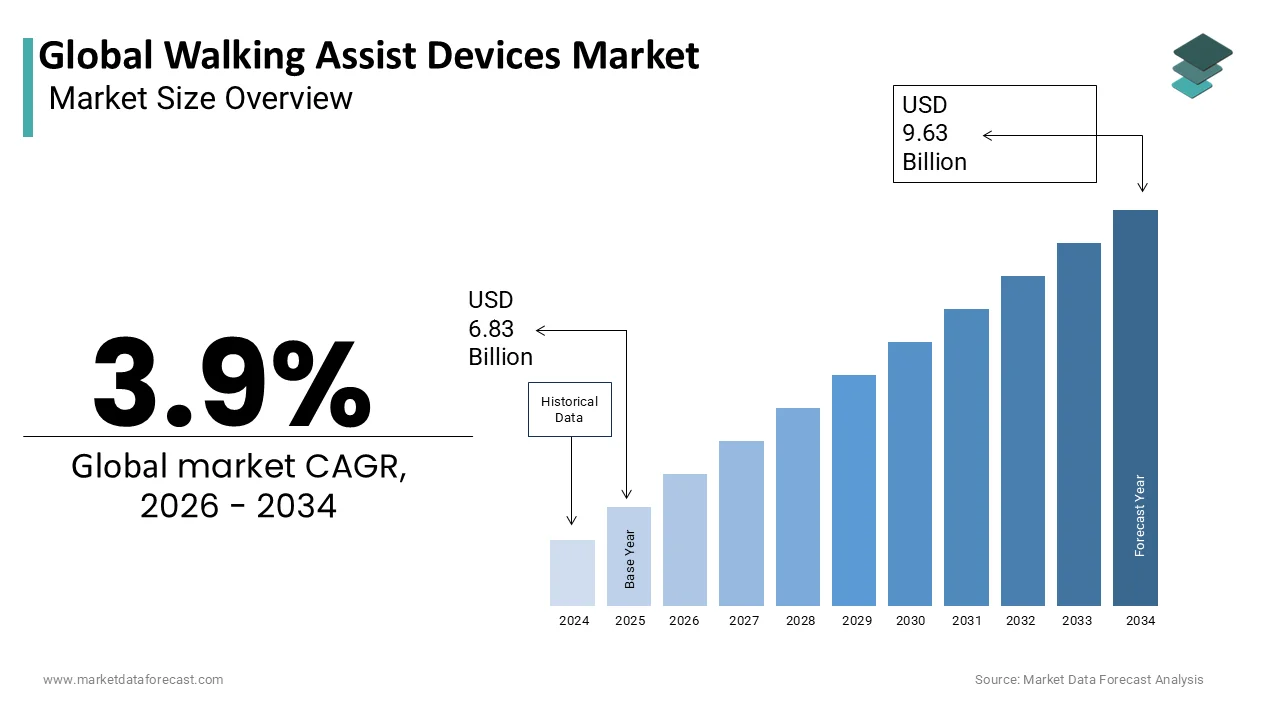
- Market Valuation: Valued at USD 6.83 billion in 2025, estimated at USD 7.09 billion in 2026, and projected to reach USD 9.63 billion by 2034, registering a steady CAGR of 3.90% from 2026 to 2034.
- Primary Growth Drivers: Exponential aging of the global population (the number of people aged 60 and older expected to double from 1 billion in 2020 to 2.1 billion by 2050), rising prevalence of chronic musculoskeletal and neurological disorders, and growing demand for home-use mobility devices.
Key Global Walking Assist Devices Market Segment Metrics (2026–2034)
| Category | Leading Segment (2025 Position) | Fastest-Growing Segment |
|---|---|---|
| By Product Type | Walkers (held 34.2% of the market share in 2025 due to superior stability, wide base of support, and weight-bearing capacity) | Electric wheelchairs (projected to grow at the fastest CAGR of 8.2% driven by battery tech and independent mobility demand) |
| By Application / End Use | Elderly care and home-use mobility devices (led traditional manual aid adoption across domestic and clinical settings) | Rehabilitation, sports performance, and smart IoT-connected assistive devices |
| By Distribution Channel | Pharmacies, medical supply stores, and established retail dealer networks | E-commerce and direct-to-consumer online platforms |
| By Region | North America (top performer, holding a 33.9% share in 2025 due to high healthcare expenditure and advanced medical infrastructure) | Asia-Pacific (driven by rapid urbanization, elder care investments, and rising middle-class disposable incomes) |
Major Walking Assist Device Manufacturers & Competitive Landscape
Market Structure: Highly competitive global mobility aid landscape featuring established multinational corporations and specialized regional manufacturers competing on product durability, ergonomic innovations, smart connectivity, pricing strategies, and comprehensive distributor networks.
Key Companies: Honda Motor Co., Ltd., Permobil Inc., G.F. Health Products, Inc., Invacare Corporation, Besco Medical Co., Ltd., Betterlifehealthcare Ltd., C.T.M. Homecare Product, Inc., Ottobock SE & Co. KGaA, Ossenberg GmbH, Pride Mobility Products Corp., Aetna Inc., Sunrise Medical LLC, and Karma Medical Products Co., Ltd.
Global Walking Assist Devices Market Size
The global walking assist devices market was valued at USD 6.83 billion in 2025, and it is expected to reach USD 9.63 billion by 2034 from USD 7.09 billion in 2026, growing at a CAGR of 3.90 %. From 2026 to 2034.
The walking assist devices are mobility aids designed to support balance, stability, and locomotion for individuals with physical impairment, age-related mobility decline, or post-surgical rehabilitation needs. The primary objective is to enhance independence, reduce fall risk,k and improve quality of life for users across various care settings. As per the World Health Organization, approximately 15% of the global population lives with some form of disability, many of whom require mobility assistance to perform daily activities. Furthermore, the United Nations Department of Economic and Social Affairs projects that the number of people aged 60 years or older will reach 2.1 billion by 2050, creating an unprecedented demand for supportive technologies. Regulatory bodies such as the Food and Drug Administration classify these devices based on risk levels,s ensuring safety standards for both manual and powered units. The integration of ergonomic design and lightweight materials has transformed these aids from stigmatized medical necessities into lifestyle-enhancing tools.
MARKET DRIVERS
Rapidly Aging Global Population and Increased Longevity
The exponential growth of the geriatric demographic due to the direct correlation between aging and mobility impairment is accelerating the growth of the walking assist devices market. As life expectancy increases globally, the prevalence of age-related conditions such as osteoarthritis, muscle weakness, and balance disorders rises, necessitating external support for safe ambulation. According to the World Health Organization, the number of people aged 60 years and older is expected to double from 1 billion in 2020 to 2.1 billion by 2050. This demographic shift creates a sustained and expanding customer base for mobility aids. The National Institute on Aging states that more than 50% of adults over 65 experience difficulty with walking or climbing stairs, which directly translates to increased adoption of canes, walkers, and rollators. In developed nations with robust healthcare systems such as Japan and Germany, the penetration rate of walking aids is particularly high due to comprehensive insurance coverage and cultural acceptance. The desire among older adults to age in place rather than move to assisted living facilities further drives demand for home-use mobility devices that enable independent living. Governments are increasingly recognizing the economic benefits of supporting independent mobility through subsidized device programs.
Rising Prevalence of Chronic Musculoskeletal and Neurological Disorders
The increasing incidence of chronic conditions that affect motor function and balance is accelerating the growth of the walking assist devices market. Disorders such as Parkinson’s disease, multiple sclerosis, stroke sequelae, and spinal cord injuries significantly impair gait and stability, requiring specialized support for safe movement. As per the Global Burden of Disease Study, musculoskeletal conditions are the second largest contributor to disability worldwide, affecting nearly 1.71 billion people. As per the Parkinson’s Foundation, nearly one million people in the United States are living with Parkinson’s disease,e a number projected to rise to 1.2 million by 2030. These patients often experience freezing of gait or postural instability, making standard canes insufficient and driving demand for advanced weighted walkers or robotic assistance. As per the American Heart Association, 795000 people suffer a stroke annually in the U, S many of whom require gait training and long-term mobility support. Rehabilitation protocols increasingly incorporate walking aids to prevent secondary complications such as falls and joint deformities. The growing awareness of early intervention among healthcare providers leads to earlier prescription of assistive devices.
MARKET RESTRAINTS
Social Stigma and Psychological Resistance to Use
Despite the functional benefits of walking assist devices, significant psychological barriers and social stigma hinder their widespread adoption, particularly among younger users and those in the early stages of mobility decline. The social stigma and psychological resistance to use are major factors hindering the growth of the walking assist devices market. Many individuals associate canes and walkers with frailty,y old age,e and loss of independence,ce leading to denial of their condition and refusal to use available aids. This resistance delays intervention until after a fall or injury occurs, resulting in more severe health consequences and higher healthcare costs. The aesthetic design of traditional medical devices often reinforces negative stereotypes,s appearing clinical and unattractive compared to consumer electronics or fashion accessories. Manufacturers have attempted to address this through sleeker designs, ns but deep-seated cultural attitudes change slowly. Healthcare providers often struggle to convince patients to adopt these tools early enough to prevent accidents. The emotional impact of accepting a mobility aid can lead to depression and social withdrawal, further reducing quality of life.
Lack of Proper Training and Incorrect Usage
The absence of standardized training protocols and professional guidance for selecting and using walking assist devices leads to improper usage, which can cause injury and reduce effectiveness. The lack of proper training and incorrect usage are additional factors impeding the growth of the walking assist devices market. Many users purchase devices over the counter or online without consulting a physical therapist or occupational therapist, resulting in incorrect height adjustment, grip placement,nt and gait mechanics. The improper use of walkers and canes contributes to upper body strain, poor posture,e and an increased risk of falls rather than prevention. Healthcare systems often lack the resources to provide comprehensive training for every patient prescribed a mobility aid. Insurance reimbursement models frequently cover the cost of the device but not the associated therapy sessions needed for proper fitting and education. This gap in service delivery results in suboptimal outcomes and user frustration, leading to abandonment of the device.
MARKET OPPORTUNITIES
Integration of Smart Technology and IoT Connectivity
The integration of Internet of Things sensors with artificial intelligence and connectivity features is promoting new opportunities for the growth of the walking assist devices market. Smart walkers and canes equipped with pressure sensors,s accelerometers, and GPS modules can detect gait abnormalities, predict fall risks, and alert caregivers in real time during emergencies. These connected devices generate valuable data for healthcare providers, enabling remote monitoring of rehabilitation progress and early detection of neurological decline. Companies are developing algorithms that analyze walking patterns to provide feedback on posture and stride length,th helping users improve their technique. The ability to share data with electronic health records supports value-based care models by demonstrating functional improvements. Insurance providers are increasingly interested in covering smart devices due to their potential to reduce hospital readmissions and emergency visits. Furthermore, voice-activated controls and haptic feedback systems make these devices more accessible for users with visual or cognitive impairments.
Expansion into Rehabilitation and Sports Performance Segments
Beyond traditional elderly care, the application of walking assist devices in sports medicine, athletic performance, and acute rehabilitation offers significant growth potential. The expansion into rehabilitation and sports performance is also expected to escalate the growth of the walking assist devices market. Advanced robotic exoskeletons and powered orthoses are increasingly used to help athletes recover from injuries faster and enhance endurance training by reducing metabolic cost. Professional sports teams and fitness enthusiasts are adopting wearable assistive technology to optimize biomechanics and prevent overuse injuries. Universities and research institutions are collaborating with manufacturers to develop lightweight carbon fiber devices tailored for high-performance applications. The stigma associated with medical devices is lower in sports contexts, where technology is viewed as an enhancement rather than a disability compensation. Additionally, vocational rehabilitation programs utilize walking assists to help workers return to physically demanding jobs after injury. This diversification expands the customer base beyond the geriatric population to include younger active individuals willing to pay premium prices for high-tech performance-enhancing gear.
MARKET CHALLENGES
High Cost of Advanced Robotic and Powered Devices
While basic manual walking aids are affordable, the high cost of advanced robotic exoskeletons and powered walking assistants is a specific challenge for the growth of the walking assist devices market. These sophisticated devices incorporate motors, batteries, sensors, rs and complex control systems, which drive up manufacturing expenses and retail prices significantly. Insurance coverage for the high-tech devices is often limited or non-existent, as payers classify them as experimental or luxury items rather than medically necessary equipment. The lack of standardized reimbursement codes further complicates access,s leaving patients to bear the full financial burden. Maintenance and repair costs for electronic components add to the total cost of ownership, making long-term sustainability challenging for users. Small and medium-sized healthcare facilities cannot afford to stock these expensive units, limiting patient access during rehabilitation. Although prices are expected to decrease with scale and technological maturity,y current affordability issues restrict the market to wealthy individuals and well-funded research institutions.
Regulatory Hurdles and Safety Certification Complexities
The complex regulations for medical devices, particularly those with electronic and robotic components, also inhibit the growth of the walking assist devices market. Walking assist devices classified as Class I or Class II medical devices must undergo rigorous testing for safety, efficacy,y and electromagnetic compatibility before receiving approval from bodies like the Food and Drug Administration or European Medicines Agency. Recent updates to regulations such as the European Union Medical Device Regulation have tightened requirements for clinical evidence and post-market surveillance, adding administrative burdens. Any software update or hardware modification may require re-certification, causing delays in product improvement cycles. Liability concerns regarding device malfunction leading to falls or injuries make insurers cautious and manufacturers hesitant to release novel features without extensive validation. The lack of clear guidelines forAI-drivenn mobility aids creates uncertainty regarding accountability and safety standards. These regulatory complexities favor large established players with dedicated compliance teams, while stifling innovation from smaller startups.
SEGMENTAL ANALYSIS
By Product Type Insights
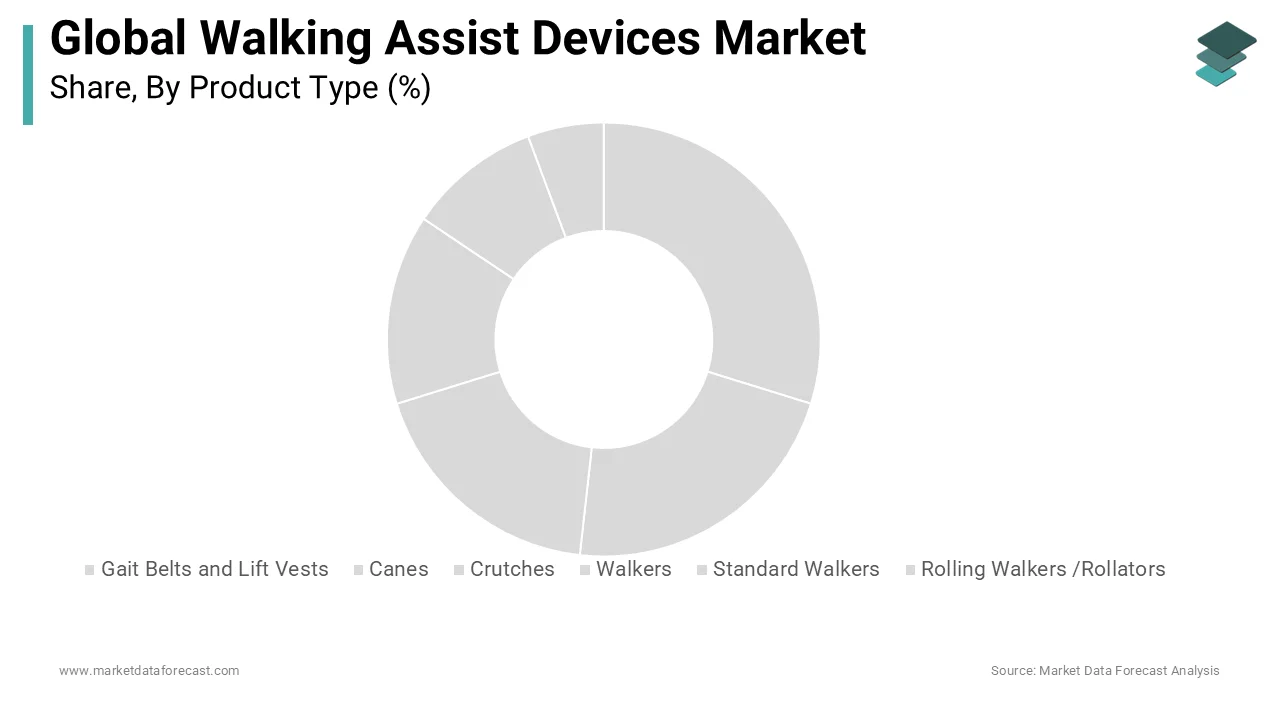
The walkers segment was the largest, holding 34.2% of the walking assist devices market share in 2025 due to their superior stability and weight-bearing capacity, which makes them the preferred choice for individuals with significant balance impairments or lower body weakness. This category includes standard walkers, rolling walkers,s and rollators, which provide a wide base of support that reduces the risk of falls compared to canes or crutches. Falls are the leading cause of injury-related death among adults aged 65 and older, driving the clinical recommendation for stable mobility aids. Older adults use a walker as their primary mobility device, reflecting its widespread acceptance in both home and clinical settings. Rollators in particular have gained popularity because they combine the stability of a walker with the convenience of wheels and a built-in seat by allowing users to rest during ambulation. The walkers promote upright posture and reduce strain on the wrists and shoulders compared to other aids. Healthcare providers frequently prescribe walkers for patients recovering from hip or knee replacements as they allow for partial weight bearing while maintaining safety. The versatility of walkers in navigating various terrains, including indoor carpets and outdoor pavements, further enhances their utility. Manufacturers continue to innovate with lightweight aluminum frames and ergonomic handles, improving user comfort.
The electric wheelchairs segment is projected to grow at the fastest CAGR of 8.2% during the forecast period owing to technological advancements increasing affordability and the growing demand for independent mobility among individuals with severe disabilities. Unlike manual wheelchairs, electric models empower users with limited upper body strength to navigate their environment autonomously, enhancing social participation and quality of life. As per the World Health Organization, only 5 to 15% of people who need assistive technology currently have access to it,t but this gap is narrowing in developed nations due to improved insurance coverage. Advances in battery technology such as lithium-ion cells have reduced weight and increased range,ge making electric wheelchairs more practical for daily use. Smart features, including obstacle detection, voice control,l and smartphone integration, are attracting younger users and tech-savvy seniors. Medicare and private insurers are expanding coverage criteria for power mobility devices, recognizing their role in preventing secondary health complications like pressure ulcers and muscle atrophy. The rise of compact and foldable designs addresses storage and transportation challenges,s further boosting adoption. As manufacturing costs decrease through economies of scale, le electric wheelchairs are becoming accessible to a broader demographic beyond the wealthiest users.
REPORT COVERAGE
| REPORT METRIC | DETAILS |
| Market Size Available | 2025 to 2034 |
| Base Year | 2025 |
| Forecast Period | 2026 to 2034 |
| Segments Analysed | By Product, Type, Route of Administration, and Region |
| Various Analyses Covered | Global, Regional & Country Level Analysis, Segment-Level Analysis; DROC, PESTLE Analysis; Porter's Five Forces Analysis, Competitive Landscape, Analyst Overview of Investment Opportunities |
| Regions Analysed | North America, Europe, Asia Pacific, Latin America, Middle East, and Africa |
| Market Leaders Profiled | Honda Motor Co., Ltd., Permobil Inc., G.F. Health Products, Inc., Invacare Corporation, Besco Medical Co., LTD., Betterlifehealthcare C.T.M. Homecare Product, Inc., Ottobock, Ossenberg GmbH, Pride Mobility Products Corp., Aetna Inc., Sunrise Medical L.L.C., and Karma Healthcare Ltd. |
SEGMENTAL ANALYSIS
By Product Type Insights
The walkers segment was the largest, holding 34.2% of the walking assist devices market share in 2025 due to their superior stability and weight-bearing capacity, which makes them the preferred choice for individuals with significant balance impairments or lower body weakness. This category includes standard walkers, rolling walkers,s and rollators, which provide a wide base of support that reduces the risk of falls compared to canes or crutches. Falls are the leading cause of injury-related death among adults aged 65 and older, driving the clinical recommendation for stable mobility aids. Older adults use a walker as their primary mobility device, reflecting its widespread acceptance in both home and clinical settings. Rollators in particular have gained popularity because they combine the stability of a walker with the convenience of wheels and a built-in seat by allowing users to rest during ambulation. The walkers promote upright posture and reduce strain on the wrists and shoulders compared to other aids. Healthcare providers frequently prescribe walkers for patients recovering from hip or knee replacements as they allow for partial weight bearing while maintaining safety. The versatility of walkers in navigating various terrains, including indoor carpets and outdoor pavements, further enhances their utility. Manufacturers continue to innovate with lightweight aluminum frames and ergonomic handles, improving user comfort.
The electric wheelchairs segment is projected to grow at the fastest CAGR of 8.2% during the forecast period owing to technological advancements increasing affordability and the growing demand for independent mobility among individuals with severe disabilities. Unlike manual wheelchairs, electric models empower users with limited upper body strength to navigate their environment autonomously, enhancing social participation and quality of life. As per the World Health Organization, only 5 to 15% of people who need assistive technology currently have access to it, but this gap is narrowing in developed nations due to improved insurance coverage. Advances in battery technology such as lithium-ion cells have reduced weight and increased range,e making electric wheelchairs more practical for daily use. Smart features, including obstacle detection, voice control,l and smartphone integration, are attracting younger users andtech-savvyy seniors. Medicare and private insurers are expanding coverage criteria for power mobility devices, recognizing their role in preventing secondary health complications like pressure ulcers and muscle atrophy. The rise of compact and foldable designs addresses storage and transportation challenges,s further boosting adoption. As manufacturing costs decrease through economies of scale, le electric wheelchairs are becoming accessible to a broader demographic beyond the wealthiest users.
COUNTRY LEVEL ANALYSIS
North America Walking Assist Devices Market Analysis
North America walking assist devices market was the top performer, holding a 33.9% share in 2025, with high healthcare expenditure, advanced medical infrastructure, and strong reimbursement frameworks. The region benefits from a large aging population and high prevalence of chronic conditions such as obesity and arthritis, which drive demand for mobility aids. As per the United States Census Bureau, the population aged 65 and older is projected to reach 95 million by 2060, creating sustained demand for mobility aids. The presence of major manufacturers such as Invacare and Pride Mobility fosters innovation and competitive pricing. High consumer awareness and acceptance of assistive technology reduce stigma and encourage early adoption. The robust e-commerce sector facilitates easy access to a wide variety of products with home delivery services. Regulatory standards enforced by the Food and Drug Administration ensure high safety and quality benchmarks.
Europe Walking Assist Devices Market Analysis
Europe walking assist devices market was ranked second, holding a 21.2% share in 2025, with universal healthcare systems, stringent regulatory standards, and a rapidly aging demographic profile. The region emphasizes cost-effectiveness and clinical evidence, leading to selective but high-quality adoption of mobility aids. Countries like Germany, France, and the United Kingdom have established national health services that subsidize the cost of walking aids for eligible patients, ensuring equitable access. The European Union Medical Device Regulation imposes rigorous requirements for safety and performance,e influencing product design and manufacturing processes. Europe has one of the highest rates of noncommunicable diseases, es driving demand for supportive technologies. Public transportation systems in many European cities are increasingly designed to be accessible,ble encouraging the use of wheelchairs and walkers outside the home. Strong social welfare programs support home care services, which include provision of mobility equipment. However, budget constraints in some southern European countries limit the availability of premhigh-techtech devices. The focus on active aging and independent living drives innovation in lightweight and ergonomic designs.
Asia-Pacific Walking Assist Devices Market Analysis
The Asia-Pacific walking assist devices market is likely to grow with rapid urbanization, improving healthcare infrastructure, and rising disposable incomes. Countries such as China, India, Japan, and Australia are investing heavily in elder care services to address the challenges of an aging society. As per the United Nations Economic and Social Commission for Asia and the Pacific, the number of older persons in the region is expected to double by 2050, reaching 1.3 billion people. Japan leads the region in adoption due to its super-aged society and advanced robotics industry producing innovative walking assistants and exoskeletons. In China and India, the growing middle class is increasingly able to afford private healthcare and mobility aids, reducing reliance on family care. Governments are implementing national health insurance schemes that gradually expand coverage for durable medical equipment. The prevalence of disability in the region is high due to traffic accidents and occupational hazards,s creating demand for rehabilitative devices. Local manufacturing capabilities are improving, ng reducing costs and increasing availability. Cultural shifts towards nuclear families reduce the availability of informal caregiving, ing driving demand for professional assistive tools. However, disparities in access between urban and rural areas remain a challenge.
Latin America Walking Assist Devices Market Analysis
Latin America walking assist device market growth is likely to grow with improving healthcare access and increasing government focus on disability rights. While economic volatility poses challenges, the region is seeing steady growth in demand for essential mobility aids. Many countries in the region are strengthening their primary care systems to manage the rising burden of noncommunicable diseases and age-related disabilities. Brazil and Mexico are the largest contributors, driven by their large populations and expanding private healthcare sectors. The implementation of universal health coverage programs in countries like Colombia and Chile that improves access to basic mobility equipment. Healthcare expenditure in the region is gradually rising,g supporting the acquisition of medical technologies. Local distributors are partnering with international manufacturers to introduce affordable yet reliable devices. The prevalence of infectious diseases and trauma in some areas creates a unique patient population requiring long-term mobility support. Increasing urbanization and lifestyle changes contribute to higher rates of obesity, necessitating supportive tools. However, currency fluctuations and import tariffs can affect device pricing and availability.
The Middle East and Africa Walking Assist Devices Market Analysis
The Middle East and Africa walking assist devices market is likely to grow with the varying levels of economic development and healthcare infrastructure maturity. Gulf Cooperation Council countries such as Saudi Arabia and the United Arab Emirates are leading the region with significant investments in smart healthcare and digital transformation initiatives. These nations are implementing national health strategies to improve healthcare quality and efficiency, supporting Vision 2030 goals. The establishment of world-class medical cities drives demand for state-of-the-art mobility solutions, including electric wheelchairs and robotic aids. In Africa, countries like South Africa and Kenya are leveraging mobile technology to overcome infrastructure challenges and improve health data collection. Initiatives to combat infectious diseases and improve maternal health require robust healthcare systems that include rehabilitation services. International aid and partnerships support the provision of assistive technologies in low-resource settings. The growing awareness of disability rights encourages governments to invest in inclusive infrastructure.
COMPETITIVE LANDSCAPE
The competitive landscape of the walking assist devices market is characterized by intense rivalry between established multinational corporations and specialized regional manufacturers vying for dominance in various mobility segments. Leading companies differentiate themselves through superior product durability, innovative design features, and comprehensive after-sales support services. Competition extends beyond hardware specifications to include pricing strategies, distribution efficiency, and brand reputation among healthcare professionals and consumers. Price competition is moderate for basic manual aids but intensifies in the powered mobility sector, where technological advantages command premium prices. Regulatory compliance and adherence to safety standards serve as significant barriers to entry, favoring incumbents with robust quality control systems.
KEY MARKET PLAYERS
Some of the companies that are playing a dominant role in the Global Walking Assist Devices Market include:
- Honda Motor Co., Ltd.
- Permobil Inc.
- G.F. Health Products, Inc.
- Invacare Corporation
- Besco Medical Co., Ltd.
- Betterlifehealthcare Ltd.
- C.T.M. Homecare Product, Inc.
- Ottobock SE & Co. KGaA
- Ossenberg GmbH
- Pride Mobility Products Corp.
- Aetna Inc.
- Sunrise Medical LLC
- Karma Medical Products Co., Ltd.
TOP LEADING PLAYERS IN THE MARKET
- Invacare Corporation maintains a leading position in the global walking assist devices market through its extensive portfolio of mobility solutions, including walkers, wheelchairs, and patient handling equipment. The company focuses on delivering high-quality, durable medical equipment that enhances user independence and safety across home care and clinical settings. Recently, Invacare expanded its manufacturing capabilities in Europe to improve supply chain resilience and reduce delivery times for mobility aids. They actively collaborate with healthcare providers to develop ergonomic designs that meet the specific needs of aging populations. Their commitment to sustainability is evident in initiatives to use recyclable materials in product construction.
- Pride Mobility Products Inc serves as a key innovator in the walking assist devices market, specializing in power wheelchairs, scooters, and lift chairs designed for enhanced mobility and comfort. The company leverages advanced engineering to create lightweight yet robust devices that cater to diverse user requirements, from indoor navigation to outdoor travel. Pride Mobility recently launched new smart connectivity features,s allowing users to monitor battery status and device diagnostics via mobile applications. They partner with independent dealers globally to ensure widespread availability and localized service support. Their focus on user-centric design includes customizable seating options and intuitive controls that improve the overall experience.
- Drive Medical holds a significant position in the global walking assist devices market by offering a comprehensive range of affordable and reliable mobility aids, includrollators caness can cane canese,s and transport chairs. company prioritizes value-driven solutions that make essential mobility support accessible to a broad demographic without compromising on quality or safety standards. Drive Medical recently introduced a series of ultra-lightweight aluminum walkers featuring improved folding mechanisms for easier storage and transport. They invest heavily in distribution networks to ensure products are readily available through pharmacies and medical supply stores. Their strategy includes rigorous testing protocols to meet international safety certifications.
TOP STRATEGIES USED BY KEY MARKET PARTICIPANTS
Key players in the walking assist devices market prioritize product innovation, focusing on lightweight materials, ergonomic designs,n s and smart technology integration to enhance user comfort and functionality. Companies expand their distribution networks through partnerships with online retailers and local medical supply stores to improve accessibility and reach underserved areas. Strategic acquisitions of niche manufacturers allow firms to diversify their product portfolios and enter new geographic regions efficiently. Investment in research and development drives the creation of connected devices that offer remote monitoring and data analytics for better health management. Compliance with international safety standards and regulatory requirements remains central to maintaining brand trust and access.
GLOBAL WALKING ASSIST DEVICES MARKET NEWS
-
In 2021, the Invacare AVIVA STORM RX rear-wheel drive power wheelchair was launched by Invacare Corporation. This design allows the user to move closer to objects in their surroundings.
-
In 2019, Honda R&D Americas, Inc. agreed with Ohio State University to increase research on the safety of Honda's Walking Assist Device in helping people with Parkinson's disease.
- In 2022, Cionic announced its first product, the lightweight leg-worn Cionic Neural Sleeve, which F.D.An approved. It is used to improve the lives of people with mobility problems such as foot drop and leg muscle weakness.
- In 2021, Moovit partnered with brilliant cane company WeWALK to improve the mobility of the visually impaired.
- In 2022, CAN Mobilities announced the launch of the world's smartest cane, "CAN Go Itt helps people with mobility challenges stay mobile, safe, and independent.
MARKET SEGMENTATION
This research report on the global walking assist devices market has been segmented and sub-segmented into the following categories.
By Product Type
- Gait Belts and Lift Vests
- Canes
- Quad canes
- Folding canes
- Crutches
- Walkers
- Standard Walkers
- Rolling Walkers /Rollators
- Hemi Walkers
- Wheelchairs
- Electric wheelchairs
- Front-wheel drive
- Center wheel drive
- Rear wheel drive
- Standing power wheelchairs
- Power scooters
- Boot scooters
- Road scooters
- Pavement scooters
By Region
- North America
- Europe
- Asia Pacific
- Latin America
- Middle East & Africa