Global Waste-derived Biogas Market Size, Share, Trends, & Growth Forecast Report By Source (Live Stock Manure, Sewage, Food Waste and Crop Residue), By Application (Residential, Commercial and Industrial) & Region, Industry Forecast From 2025 to 2033
Global Waste-derived Biogas Market Report Summary
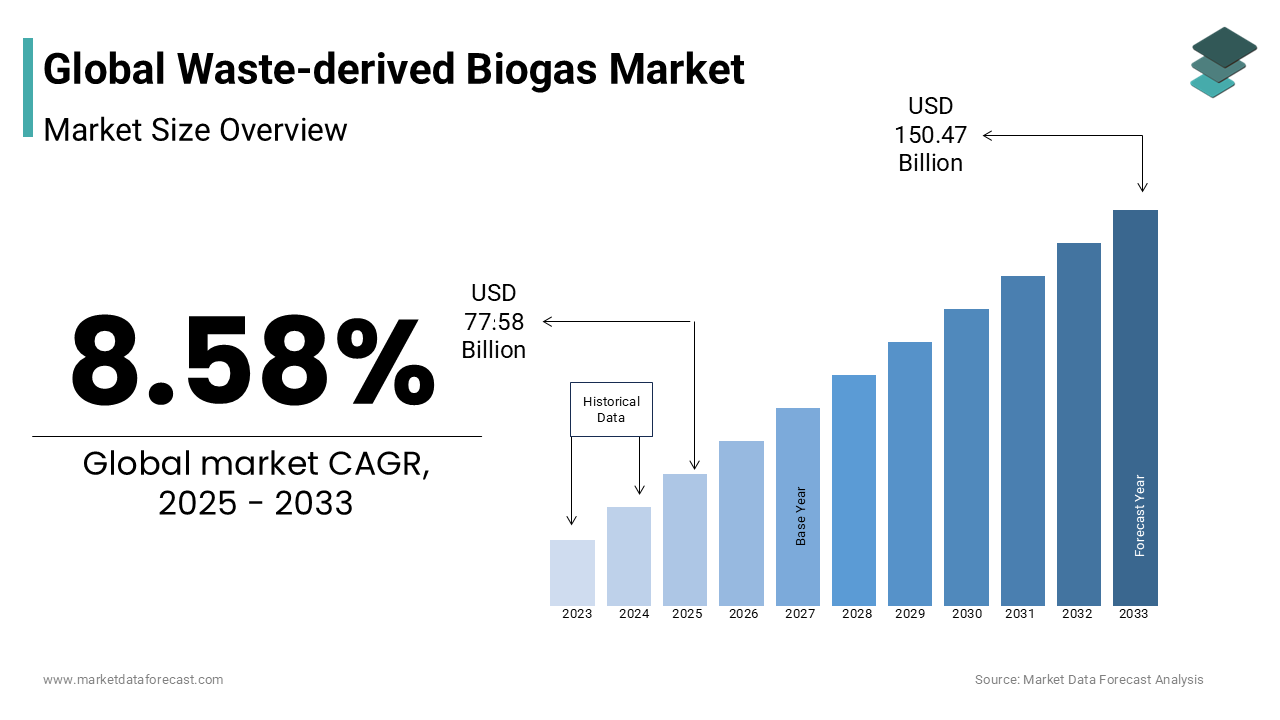
The global waste-derived biogas market was valued at USD 71.73 billion in 2024, is estimated to reach USD 77.88 billion in 2025, and is projected to reach USD 150.47 billion by 2033, growing at a CAGR of 8.58% during the forecast period from 2025 to 2033. The growth of the global waste-derived biogas market is driven by rising environmental awareness, increasing concerns over fossil fuel depletion, and the growing need for sustainable and renewable energy alternatives. Waste-derived biogas, produced through anaerobic digestion of organic waste such as agricultural residues, sewage, food waste, and municipal solid waste, offers a low-carbon energy solution while addressing waste management challenges. Increasing utilization of industrial, agricultural, and municipal waste streams, supportive government policies, and rising investments in renewable energy infrastructure are further fueling market expansion. Additionally, growing consumer awareness of the economic and environmental benefits of biogas and the expanding adoption of decentralized energy generation systems are strengthening global market growth.
Key Market Trends
- Rising adoption of anaerobic digestion technology for converting organic waste into renewable energy.
- Increasing use of agricultural, municipal, and industrial waste as feedstock for biogas production.
- Strong policy support and incentives for renewable energy and circular economy initiatives.
- Growing integration of biogas into power generation, heating, and transportation fuel applications.
- Expanding investments in large-scale and decentralized biogas plants across developed and emerging economies.
Segmental Insights
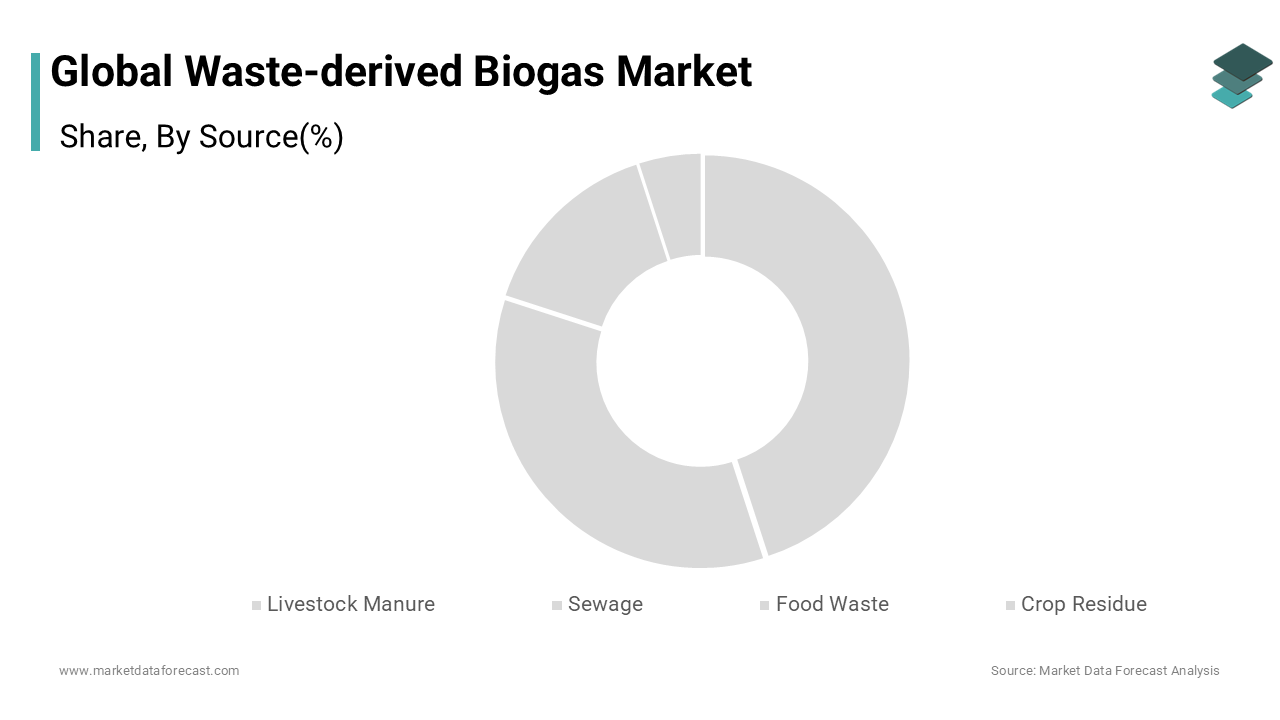
- Based on the source, the crop residue segment accounted for the largest share of the global waste-derived biogas market in 2024, representing approximately 55.4%. The dominance of this segment is attributed to the wide availability of agricultural residues and their high methane yield, making them a cost-effective and efficient feedstock for large-scale biogas production used for power generation, heating, and cooking applications.
- Based on application, the industrial segment dominated the global waste-derived biogas market with a share of 52.8% in 2024. The segment’s leadership is driven by rising industrial energy consumption, increasing energy costs, and the need for low-cost, low-maintenance renewable energy solutions to support manufacturing and processing operations.
Regional Insights
The global waste-derived biogas market is witnessing strong growth across major regions, supported by regulatory mandates, renewable energy targets, and increasing investments in waste-to-energy infrastructure.
- Europe held the largest share of the global waste-derived biogas market, driven by stringent pollution regulations, strong adoption of advanced waste digestion technologies, and the presence of over 13,500 biogas plants across countries such as Germany, France, the United Kingdom, and Italy.
- North America accounted for the second-largest market share, supported by more than 2,000 active large-scale biogas facilities, strong participation from municipalities, farmers, and waste management companies, and continued dominance of the United States in regional biogas production.
- Asia Pacific is expected to register the fastest growth during the forecast period, driven by rapid industrialization, rising energy demand, increasing investments in biogas infrastructure, and supportive government policies in countries such as China, India, and Japan.
- The Middle East and Africa region is projected to witness notable growth, fueled by rising environmental awareness, increasing energy demand, foreign investments, and the need to diversify energy sources amid declining fossil fuel reserves.
Competitive Landscape
The global waste-derived biogas market is characterized by the presence of established technology providers, engineering firms, and renewable energy companies focusing on expanding their biogas production capabilities and improving process efficiency. Leading players are investing in advanced anaerobic digestion technologies, expanding plant capacities, and forming strategic partnerships with municipalities, agricultural producers, and industrial users to secure feedstock supply. Innovation, regulatory compliance, and geographic expansion remain key competitive strategies. Prominent players in the global waste-derived biogas market include AAT Abwasser- und Abfalltechnik GmbH, BEKON GmbH, BIOGEN (UK) Ltd., Cargill, Inc., Environmental Products & Technologies Corporation, Evoqua Water Technologies LLC, N-bio GmbH, Siemens, Weltec Biopower GmbH, Zorg Biogas, and others.
Global Waste-derived Biogas Market Size
The global waste-derived biogas market was worth USD 71.73 billion in 2024 and is anticipated to reach a valuation of USD 150.47 billion by 2033 from USD 77.88 billion in 2025 and is predicted to register a CAGR of 8.58% during the projection period 2025 to 2033.
Biogas is a mixture of gases produced when organic matter breaks down without oxygen. A few examples of the raw materials that can be utilized to create biogas are manure, garbage, plant materials, sewage, municipal trash, green waste, and food waste. It is a renewable energy source with, on average, a lower carbon footprint. Biogas can be easily produced through anaerobic digestion, which uses anaerobic microbes to break down all organic components inside of a closed system.
Biogas, a renewable energy source that is primarily made from waste materials, is thought to be a significant replacement for traditional fossil fuels. Anaerobic digestion is the main source of its production. A waste feedstock is frequently employed in the manufacture of biogas on a commercial scale. Additionally, throughout the anticipated period, a rise in the usage of industrial, sewage, and agricultural waste as raw materials is anticipated to positively affect market growth. Additionally, rising consumer awareness of the financial and environmental advantages offered by the product, along with rising utilization of home and municipal waste residues for biogas production, are anticipated to fuel market growth for waste-derived biogas.
The COVID-19 outbreak is projected to have a minimal effect on the global waste-derived biogas plant industry due to disruptions in the global supply chain and a slight decrease in investment for new biogas projects.
MARKET GROWTH
Increased environmental consciousness and growing supply concerns related to the use of fossil fuels are predicted to be the main drivers of the expansion of the global market for waste-derived biogas.
MARKET DRIVERS
The rising environmental awareness and concerns about supply and price instability related to the usage of fossil fuels.
The global waste-derived biogas market is anticipated to expand rapidly over the forecast period as a result of rising environmental awareness and concerns about supply and price instability related to the usage of fossil fuels. The rising population and depleting fossil fuel supplies are predicted to increase the demand for renewable energy sources over the projection period, creating new opportunities for industry growth. Rising infrastructure investments and rising energy consumption from the commercial and industrial sectors are projected to be the main drivers of demand over the projection period. Demand for waste-derived biogas is anticipated to increase over the projected period as a result of tightening government pollution restrictions, increased environmental awareness, growing worries about excessive fossil fuel consumption, and growing corporate initiatives against CSR activities.
MARKET RESTRAINTS
In the upcoming years, it is anticipated that high initial manufacturing setup costs will limit market expansion.
The COVID-19 outbreak is projected to have a minimal effect on the global waste-derived biogas plant industry due to disruptions in the global supply chain and a slight decrease in investment for new biogas projects. Contrarily, it is anticipated that during the forecast period for the waste-derived biogas market, the surge in demand for renewable energy resources due to the depletion of fossil fuel resources and the exponential rise in population will offer lucrative opportunities for the industry's development.
REPORT COVERAGE
| REPORT METRIC | DETAILS |
| Market Size Available | 2024 to 2033 |
| Base Year | 2024 |
| Forecast Period | 2025 to 2033 |
| CAGR | 8.58% |
| Segments Covered | By Source, Application, and Region. |
| Various Analyses Covered | Global, Regional & Country Level Analysis, Segment-Level Analysis, DROC, PESTLE Analysis, Porter’s Five Forces Analysis, Competitive Landscape, Analyst Overview of Investment Opportunities |
| Regions Covered | North America, Europe, APAC, Latin America, Middle East & Africa |
| Market Leaders Profiled | AAT ABWASSER- UND ABFALLTECHNIK GMBH, BEKON GmbH, BIOGEN (UK) Ltd., Cargill, Inc., Environmental Products & Technologies Corporation, Evoqua Water Technologies LLC, N-bio GmbH, Siemens, Weltec Biopower GmbH, Zorg Biogas and Others. |
SEGMENTAL ANALYSIS
By Source Insights
Depending on the source, the crop residues segment is anticipated to account for 55,4% of the global market for waste-derived biogas. This is because crop residue can be utilized to create biogas, which is mostly made up of methane (CH4) and carbon dioxide (CO2). In many regions of the world, biogas can also be utilized for inexpensive cooking and heating. Additionally, it can produce mechanical or electrical power.
By Application Insights
The industrial sector is anticipated to provide 52.8% in terms of application. The expansion of the waste-derived biogas industry is predicted to be boosted by low cost and maintenance combined with an increase in energy costs.
REGIONAL ANALYSIS
Due to increasingly strict pollution regulations, more knowledge of the benefits of switching to clean fuel, and rising demand from end-use sectors, Europe is predicted to hold the greatest market share. The waste-generated biogas industry is anticipated to experience rapid expansion over the forecast period because the region has been extremely responsive in adopting sophisticated technologies like wastewater digestion technology and solid waste digestion technology. Due to the presence of more than 13,500 biogas plants with an installed capacity of more than 7,400 MW, France, Germany, the United Kingdom, and Italy are anticipated to be the major markets for waste-derived biogas. These facilities are committed to generating premium biogas, which is needed by numerous sectors. Additionally, it is anticipated that over the next seven years, the market will increase in the region due to the rising need for renewable energy sources used in manufacturing facilities.
Due to the presence of more than 2,000 active large biogas production facilities and expanding end-use sectors including automotive, manufacturing, and construction, North America is anticipated to hold the second biggest market share for waste-derived biogas over the projection period. The US currently holds the largest market share in the region, and over the next seven years, this trend is anticipated to continue, largely as a result of the existence of a sizable number of businesses engaged in the production of biogas, including digester designers, municipalities, farmers, multinational engine manufacturers, waste management companies, natural gas providers, nonprofit organizations, engineering firms, and universities.
Due to expanding investments in building up production facilities, rising knowledge of the generation of biogas from various forms of waste, and increasing R&D efforts, Asia-Pacific is predicted to have the quickest development. The primary driver of the market expansion in the region is expected to be government laws aimed at reducing pollution. Due to their rapid industrial development, significant investments in new projects, supportive government policies, and growing consumer awareness, India, China, and Japan are anticipated to be important markets in the Asia Pacific region.
Due to rising foreign investment and rising environmental awareness, the Middle East and Africa are predicted to experience significant growth. The region's growing energy needs and the depletion of fossil fuel supplies have increased the demand for renewable energy sources, which is anticipated to positively affect market growth over the next seven years.
KEY PLAYERS IN THE MARKET
Companies playing a prominent role in the global waste-derived biogas market include
- AAT Abwasser- und Abfalltechnik GmbH
- BEKON GmbH
- BIOGEN (UK) Ltd.
- Cargill, Inc.
- Environmental Products & Technologies Corporation
- Evoqua Water Technologies LLC
- N-bio GmbH
- Siemens
- Weltec Biopower GmbH
- Zorg Biogas
- Others
RECENT HAPPENINGS IN THE MARKET
- In a noteworthy endeavor, Mumbai's D Ward has turned on the city's first biogas plant to produce power, which is made from the wet waste collected daily from the area's 30 or so restaurants. It lessens the burden placed on overflowing landfills, lowers transportation expenses (annual budgets for moving garbage can reach $300 crore and are notoriously corrupt), and produces clean energy. Up to six electric vehicles might potentially be charged daily, although currently only two are being charged.
- Recently, representatives from the civic body and the Punjab Energy Development Authority (PEDA) visited the biogas plant in Haibowel, India, to learn how to operate it at maximum efficiency to stop dairy waste from entering the Buddha Nullah, a seasonal water stream that flows through the Malwa region of Punjab.
MARKET SEGMENTATION
This research report on the global waste-derived biogas market has been segmented and sub-segmented based on source, application and region.
By Source
- Livestock Manure
- Sewage
- Food Waste
- Crop Residue
By Application
- Residential
- Commercial
- Industrial
By Region
- North America
- Europe
- Asia Pacific
- Latin America
- Middle East & Africa
Frequently Asked Questions
Which growth factor dominates the Waste-derived Biogas market?
Rising concern for environmental safety and excessive fuel use will be the main forces behind market expansion.
Mention the market which has the largest share in the Waste-derived Biogas market?
The European market will have the largest market share of the global Waste-derived Biogas market.
On the basis of application which sector will lead the Waste-derived Biogas market?
The industrial sector is anticipated to hold 52.8 percent market share in terms of application.
What is the expected value of the Waste-derived Biogas market by 2033?
The Global Waste-derived Biogas Market is anticipated to reach a valuation of USD 150.47 billion by 2033.
Mention the latest trend in the global Waste-derived Biogas market?
The global Waste-derived Biogas market is seeing an increase in the use environmentally friendly products and thus rise in demand of Waste-derived Biogas.
What is the global waste-derived biogas market?
The market includes the production, distribution, and utilization of biogas generated from organic waste such as agricultural residues, food waste, municipal solid waste, and wastewater sludge.
What end users benefit from waste-derived biogas?
Utilities, municipalities, industrial facilities, agricultural operations, and transportation operators are key end users.
What challenges does the waste-derived biogas market face?
Key challenges include high initial capital costs, feedstock supply variability, and complex regulatory approvals.
What role does biomethane play in this market?
Biomethane, an upgraded form of biogas, can be injected into natural gas grids or used as vehicle fuel, expanding market opportunities.
What is the future outlook for the global waste-derived biogas market?
The market is expected to grow steadily due to expanding renewable energy adoption, improved biogas technologies, and stricter waste management policies.
Related Reports
Access the study in MULTIPLE FORMATS
Purchase options starting from
$ 2500
Didn’t find what you’re looking for?
TALK TO OUR ANALYST TEAM
Need something within your budget?
NO WORRIES! WE GOT YOU COVERED!
Call us on: +1 888 702 9696 (U.S Toll Free)
Write to us: sales@marketdataforecast.com