- Product Description Description
- Table of Contents TOC
- List of Table & Figure LOT
- Get Free Sample PDF Sample PDF
Market Size, 2025
$10.6 BnMarket Estimate, 2026
$11.61 BnMarket Forecast, 2034
$24.00 BnCAGR, 2026–2034
9.50%Executive Summary: Global Water Desalination Equipment Market
- Market Scope: Comprehensive global analysis of water desalination equipment across various technologies, industrial applications, and critical regional hubs facing acute water scarcity.
- Market Valuation: Valued at USD 10.6 billion (2025), estimated at USD 11.61 billion (2026), and projected to reach USD 24.00 billion by 2034, registering a CAGR of 9.50% (2026–2034).
- Primary Growth Drivers: Escalating global water scarcity, technological breakthroughs in energy-efficient Reverse Osmosis (RO), integration of digital process monitoring, and increased government investment in R&D to manage municipal and industrial water demand.
Key Market Segment Metrics (2026–2034)
| Category | Dominant Segment | High-Growth / Emerging Trend |
|---|---|---|
| By Technology | Reverse Osmosis (RO) (widely preferred for energy efficiency and scalability) | Renewable-Integrated Systems (utilizing solar thermal to reduce operational costs) |
| By Product | Membrane Systems (foundational to modern high-yield desalination) | Energy Recovery Pumps (improving operational cost-effectiveness) |
| By Application | Municipal (driven by rapid urbanization and domestic water demand) | Industrial (driven by the need for process water in sectors like oil & gas) |
| By Region | Middle East & Africa (leading revenue share due to chronic water scarcity) | Asia-Pacific (fastest-growing due to industrialization and resource depletion) |
Major Market Players & Market Structure
Market Structure: Highly competitive landscape with key players focusing on R&D for brine disposal management and energy-harvesting technologies. Increasing focus on cost reduction through economies of scale and renewable energy integration.
Key Companies: GE Water and Process Solutions, Genesis Water Technologies, Koch Membrane Systems, Doosan Heavy Industries, IDE Technologies, Degremont SAS, Biwater, Cadagua, Hyflux Ltd., and The Dow Chemical Company.
 Download Free Sample Report
Global Water Desalination Equipment Market Size
The global water desalination equipment market was valued at USD 10.6 billion in 2025 and is anticipated to reach USD 24.00 billion by 2034 from USD 11.61 billion in 2026, witnessing a CAGR of 9.50% during the forecast period.
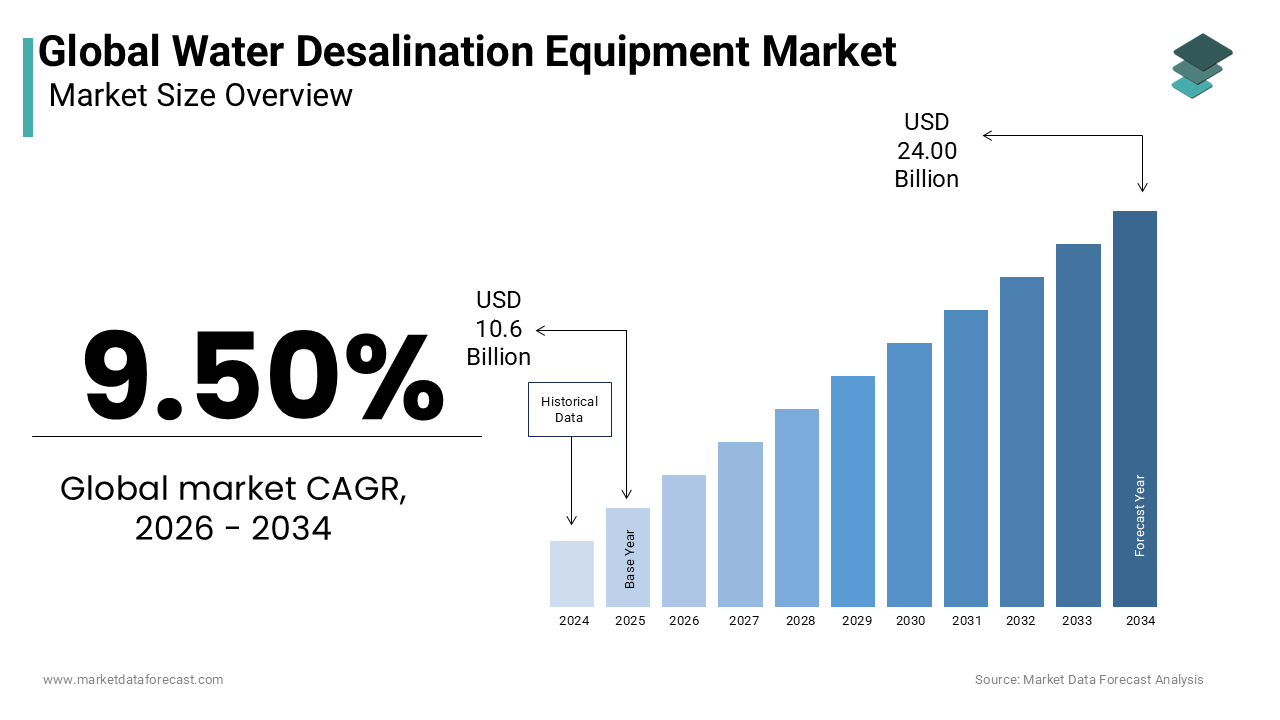
The water desalination equipment are technologies and machinery designed to remove salts and minerals from saline water to produce potable or industrial grade water. As per the United Nations World Water Development Report, approximately 2 billion people globally live in countries experiencing high water stress, which directly necessitates the deployment of advanced desalination infrastructure. Governments and private entities increasingly invest in modular and scalable equipment to address varying demand profiles. The integration of renewable energy sources with desalination plants further drives technological innovation within this domain.
MARKET DRIVERS
Escalating Freshwater Scarcity Due to Climate Change and Population Growth
The rising global temperatures and erratic precipitation patterns, severely diminish natural freshwater reserves, thereby propelling the growth of the water desalination equipment market. The Intergovernmental Panel on Climate Change indicates that climate change has intensified the hydrological cycle, leading to more frequent and severe droughts in arid and semi-arid regions such as North Africa and the Middle East. According to the World Health Organization, nearly half of the global population will be living in areas of high water stress by 2025 by creating an urgent imperative for governments to invest in resilient water infrastructure. This demographic pressure combined with environmental degradation forces municipalities to seek independent water supplies that are not dependent on rainfall or river flows. Desalination plants equipped with advanced reverse osmosis technology offer a consistent output regardless of climatic conditions. The statistical projection of increased water stress directly correlates with higher procurement rates for large scale desalination modules and associated pumping systems. Industries such as power generation and manufacturing also face stringent regulatory requirements to secure water inputs, further driving demand for specialized industrial grade desalination units.
Stringent Environmental Regulations Promoting Sustainable Water Solutions
The strict governmental mandates regarding wastewater discharge and freshwater conservation, significantly fuelling the growth of the water desalination equipment market. The European Environment Agency reports that water abstraction exceeds sustainable levels in many southern European regions, prompting regulatory bodies to enforce stricter limits on groundwater extraction and promote alternative sourcing methods. As per the United States Environmental Protection Agency, industrial facilities must adhere to rigorous effluent guidelines, which encourages the adoption of zero liquid discharge systems that often integrate desalination technologies to recover valuable resources and minimize waste volume. These regulatory frameworks compel industries to invest in high efficiency desalination units that can treat complex wastewater streams while producing reusable water. The legal obligation to reduce environmental footprint drives innovation in energy recovery devices and brine minimization technologies within the desalination equipment market. Companies seek compliance through advanced filtration systems that meet both quality and quantity standards set by local authorities. The correlation between regulatory pressure and equipment adoption is evident in the increasing number of permitted desalination projects in coastal industrial zones.
MARKET RESTRAINTS
High Energy Consumption and Operational Costs
The substantial energy requirements for running desalination, particularly in regions with limited access to affordable electricity is hindering the growth of the water desalination equipment market. The desalination currently accounts for approximately 1% of global electricity consumption, a figure that poses a significant economic burden for developing nations seeking to expand their water infrastructure. According to the World Bank, energy costs can constitute up to 40% of the total operating expenses for reverse osmosis plants, making the final cost of produced water considerably higher than conventional sources. This financial disparity restricts the ability of smaller municipalities and private entities to invest in large scale desalination facilities without substantial subsidies or external funding. The reliance on fossil fuels for power generation further exacerbates operational costs and environmental concerns, creating a barrier to entry for price sensitive markets. High initial capital expenditure combined with ongoing energy bills discourages potential investors from committing to long term desalination projects. The economic viability of desalination equipment remains contingent upon fluctuations in global energy prices, which introduces uncertainty into project planning and budgeting.
Environmental Concerns Regarding Brine Discharge and Marine Ecosystem Impact
The ecological apprehensions surrounding the disposal of concentrated brine byproducts in coastal and marine sensitive areas, which is additionally declining the growth of the water desalination equipment market. As per the study, elevated salinity levels from brine discharge can harm marine life by altering habitat conditions and reducing biodiversity in coastal ecosystems. These environmental risks trigger stringent permitting processes and community opposition, delaying project timelines and increasing compliance costs for developers. The lack of standardized global regulations for brine management creates uncertainty for equipment manufacturers and plant operators who must navigate varying local requirements. Public awareness of marine pollution drives demand for additional treatment technologies to neutralize brine before discharge, adding complexity and cost to desalination projects. The potential for long term ecological damage discourages investment in large scale coastal desalination facilities, forcing proponents to explore inland sites with higher logistical challenges.
MARKET OPPORTUNITIES
Integration of Renewable Energy Sources with Desalination Systems
The emergence of solar and wind energy technologies with desalination processes for reducing operational costs and enhancing sustainability is solely attributed to escalate the growth of the water desalination equipment market. The wind energy capacity additions continue to rise globally, providing a stable and clean power source for large scale desalination plants in coastal regions with consistent wind patterns. This synergy allows for the development of hybrid systems that mitigate the intermittency of renewable sources while ensuring continuous water production. The decreasing cost of battery storage solutions further supports the reliability of renewable driven desalination equipment, enabling 24 hour operation without dependence on fossil fuel grids. Governments offering incentives for green infrastructure projects accelerate the adoption of these integrated systems, creating new revenue streams for equipment suppliers specializing in energy efficient designs. The opportunity lies in designing modular desalination units that can seamlessly connect with existing renewable energy installations, catering to the growing demand for carbon neutral water solutions.
Technological Advancements in Membrane Materials and Energy Recovery
Innovations in nanotechnology and material science for improving the efficiency and longevity of water desalination equipment, are additionally to bolster the growth of the water desalination equipment market. As per the American Chemical Society, recent developments in graphene oxide membranes demonstrate water permeability rates up to 10 times higher than traditional polyamide membranes, significantly reducing the energy required for filtration processes. These technological breakthroughs enable the production of compact and high throughput desalination units suitable for decentralized applications in urban and rural settings. The improved durability of next generation membranes reduces maintenance frequency and replacement costs, making desalination equipment more attractive to cost conscious buyers. Research institutions and private laboratories continue to invest in biomimetic materials that mimic natural water channels, promising further gains in selectivity and flux rates.
MARKET CHALLENGES
Complexity of Brine Management and Disposal Infrastructure
The intricate logistical and technical requirements for handling concentrated brine waste, limiting project feasibility in many regions. The complexity of brine management and disposal infrastructure is a quite challenge for the growth of the water desalination equipment market. As per the World Resources Institute, less than 50% of global desalination plants have adequate brine management systems in place, leading to environmental compliance issues and potential operational shutdowns. As per the International Water Association, constructing dedicated pipelines and injection wells for deep sea brine disposal requires significant capital investment and extensive environmental impact assessments, which can delay project completion by several years. The lack of standardized infrastructure for brine transport and treatment forces plant operators to develop custom solutions, increasing engineering complexity and cost overruns. Regulatory uncertainties regarding permissible salinity levels in discharge zones create legal risks for investors and equipment suppliers who must ensure their systems meet evolving environmental standards. The challenge is compounded in landlocked regions where brine cannot be easily discharged into oceans, necessitating expensive evaporation ponds or zero liquid discharge technologies that are not yet widely commercially viable. This infrastructure gap restricts the geographic expansion of desalination projects, confining them primarily to coastal areas with established disposal mechanisms.
Supply Chain Vulnerabilities for Critical Components and Materials
The disruptions in the global supply chain for specialized membranes, pumps, and corrosion resistant alloys are also to decline the growth of the water desalination equipment market. The geopolitical tensions and trade restrictions have impacted the availability of key raw materials such as titanium and high grade polymers used in desalination components by leading to price volatility and procurement difficulties. These supply side constraints force manufacturers to maintain higher inventory levels, tying up capital and increasing operational overheads. The dependency on single source suppliers for critical technologies like high pressure pumps creates vulnerability to production stoppages if those suppliers face operational issues. Fluctuating freight costs and port congestion further exacerbate the challenge by making it difficult to provide accurate pricing and delivery commitments to clients. The lack of localized manufacturing capabilities in many emerging markets means that equipment must be imported from distant hubs, increasing exposure to international logistics risks.
REPORT COVERAGE
| REPORT METRIC | DETAILS |
| Market Size Available | 2025 to 2034 |
| Base Year | 2025 |
| Forecast Period | 2026 to 2034 |
| Segments Covered | By Technology, Application, Product, and Region. |
| Various Analyses Covered | Global, Regional, & Country Level Analysis; Segment-Level Analysis, Drivers, Restraints, Opportunities, Challenges, PESTLE Analysis, Porter’s Five Forces Analysis, Competitive Landscape, Analyst Overview of Investment Opportunities |
| Regions Covered | North America, Europe, Asia Pacific, Latin America, Middle East, and Africa |
| Key Market Players | GE Water and Process Solutions, Genesis Water Technologies, Koch Membrane Systems, Doosan Heavy Industries and Co., IDE Technologies, and Degremont SAS. Other key players influencing the global market are Biwater, Cadagua, Hyflux Ltd., The Dow Chemical Company, and Others |
SEGMENTAL ANALYSIS
By Technology Insights
The reverse osmosis technology segment held a significant share of the water desalination equipment market in 2025 due to its superior energy efficiency and scalability compared to thermal methods. According to the United States Department of Energy, modern reverse osmosis systems consume between 2.5 and 4 kilowatt hours per cubic meter of produced water, which is significantly lower than the 10 to 15 kilowatt hours required by older thermal technologies. This energy advantage translates directly into lower operational expenditures for municipal and industrial users, making RO the preferred choice for new installations worldwide. The modular nature of reverse osmosis equipment allows for easy expansion and maintenance, reducing downtime and enhancing system reliability. Manufacturers focus on developing high rejection membranes that can handle varying feed water qualities, further solidifying the dominance of this segment. The widespread availability of skilled technicians for RO system maintenance also supports its leading position, as operators prefer technologies with established service networks. The majority of capital investment in new desalination projects is directed toward reverse osmosis infrastructure by ensuring its continued market leadership through technological refinement and cost effectiveness.
The multi effect distillation segment is swiftly emerging at a fastest CAGR of 6.8% throughout the forecast period with the abundant low grade waste heat from power plants, allowing for efficient cogeneration of electricity and water. The ability of MED systems to handle high salinity feed water without extensive pre-treatment makes them suitable for challenging environments such as the Red Sea and Persian Gulf. Advances in material science have reduced the corrosion risks associated with thermal processes, extending equipment lifespan and lowering maintenance costs. Governments promoting industrial symbiosis encourage the adoption of MED technology to maximize resource utilization and minimize environmental impact. The growing emphasis on zero liquid discharge initiatives further boosts MED adoption, as these systems can achieve higher recovery rates than membrane-based alternatives.
By Application Insights
The municipal application segment was the largest by accounting for 54.2% of the water desalination equipment market share in 2025 due to the crucial need for potable water in urban centers facing scarcity. As per the World Health Organization, over 2 billion people lack access to safely managed drinking water services by prompting governments to invest heavily in large scale desalination infrastructure for public supply. According to the United Nations Human Settlements Programme, urban populations are expected to reach 68% of the global total by 2050, intensifying the demand for reliable municipal water sources independent of rainfall. Municipal projects benefit from economies of scale, allowing for the deployment of massive reverse osmosis plants that serve millions of residents efficiently. Regulatory mandates for water quality standards drive municipalities to choose advanced desalination equipment that guarantees consistent purity and safety. Public private partnerships facilitate funding for these capital-intensive projects, accelerating the installation of municipal desalination facilities in coastal regions.
The industrial application segment is likely to grow at a fastest CAGR of 11.2% during the forecast period with the stringent regulatory requirements and the need for process water in manufacturing. This corporate commitment drives investment in specialized industrial desalination units capable of producing high purity water for sensitive processes. The rise of zero liquid discharge policies in industries like textiles and chemicals forces facilities to install advanced desalination equipment to recover and reuse wastewater. Industrial users prioritize equipment durability and customization, leading to higher value contracts for manufacturers offering tailored solutions. The expansion of shale gas and oil extraction activities in arid regions further boosts demand for industrial desalination to treat produced water. Consequently, the industrial segment grows rapidly as companies seek to mitigate operational risks and comply with environmental regulations through self sufficient water management systems.
By Products Insights
The membrane systems segment was accounted in holding 44.3% of the water desalination equipment market share in 2025 due to their central role in reverse osmosis and nanofiltration processes. According to the Journal of Membrane Science, advancements in membrane chemistry have increased salt rejection rates to over 99.5%, ensuring high-quality output that meets strict potable water standards. This performance reliability makes membrane systems the preferred choice for engineers designing new desalination facilities. The modular design of membrane elements allows for easy replacement and upgrades, reducing long term maintenance costs for operators. Manufacturers continuously innovate to produce fouling resistant membranes that extend service life and maintain flux rates under challenging feed water conditions. The widespread standardization of membrane sizes and connections facilitates global trade and simplifies procurement for project developers.
The pumps segment is anticipated to witness a fastest CAGR of 9.8% from 2026 to 2034 owing to the need for high pressure delivery in reverse osmosis systems and energy recovery applications. The energy recovery devices integrated with high pressure pumps can reduce the specific energy consumption of desalination plants by making them for improving operational efficiency. The regulatory push encourages plant operators to replace older pump models with advanced variable speed drives and smart control systems that optimize pressure levels dynamically. The complexity of modern desalination processes requires precise flow control, driving innovation in pump design and materials to withstand corrosive saline environments. Manufacturers focus on developing compact and durable pumps that minimize footprint and maintenance requirements for offshore and remote installations. The integration of IoT sensors in pump systems enables predictive maintenance, reducing unplanned downtime and enhancing system reliability.
REGIONAL ANALYSIS
Middle East and Africa Water Desalination Equipment Market Analysis
The Middle East and Africa was the top performer in the global water desalination equipment market by capturing 22.1% of the water desalination equipment market share in 2025 due to extreme aridity and abundant hydrocarbon resources. According to the study, water scarcity affects over 90% of the population in the Middle East, compelling governments to prioritize desalination as a national security imperative. This urgent need drives continuous investment in both thermal and membrane-based technologies to ensure uninterrupted water supply for growing urban populations. The availability of cheap energy subsidies historically favored thermal methods, but recent shifts toward renewable energy integration are transforming the equipment landscape. Large scale projects such as the NEOM city in Saudi Arabia are pioneering solar powered desalination, creating new opportunities for innovative equipment suppliers. Political stability in key Gulf nations supports long term infrastructure planning and foreign investment in water security projects.
Asia Pacific Water Desalination Equipment Market Analysis
The Asia Pacific water desalination equipment market was ranked second by holding 19.8% during the forecast period with the rapid industrialization and population growth in China and India. According to the study, China aims to increase its seawater desalination capacity to 2.9 million cubic meters per day by 2025, driving significant procurement of reverse osmosis modules and pre-treatment systems. This ambitious target stimulates local manufacturing and international collaborations to meet the surging demand for cost effective equipment. India is also expanding its desalination footprint, with major projects planned in Chennai and Gujarat to address urban water crises. The region benefits from a strong manufacturing base that produces competitive components, lowering overall project costs. Increasing awareness of water quality issues among consumers drives municipal investments in advanced filtration and desalination technologies.
North America Water Desalination Equipment Market Analysis
North America water desalination equipment market growth is expected to grow at a fastest CAGR in coming years with the technological innovation and regulatory driven upgrades. The California alone has over 10 proposed or operational large scale desalination projects by reflecting the state's response to prolonged drought conditions and agricultural water demands. Canada is exploring small scale modular desalination units for remote communities and industrial sites, leveraging its expertise in cold climate engineering and renewable energy integration. This focus on niche applications drives demand for specialized equipment that can operate efficiently in diverse environmental conditions. The United States leads in research and development of next generation membranes and energy recovery devices, exporting technology globally. Strict environmental regulations regarding brine discharge and marine protection influence equipment design and project feasibility in coastal areas. Public private partnerships facilitate funding for innovative pilot projects that test new technologies before full scale deployment.
Europe Water Desalination Equipment Market Analysis
Europe water desalination equipment market growth is likely to grow with the sustainability and integration with renewable energy sources. The several southern European countries, including Spain and Italy, rely on desalination to mitigate the impacts of climate change on agricultural and tourism sectors. The region is a leader in developing hybrid systems that combine wind and solar power with reverse osmosis plants by reducing carbon footprints and operational costs. This commitment to green technology drives demand for energy efficient equipment and smart control systems that optimize performance. The European Union’s Green Deal incentivizes investments in circular economy practices, promoting zero liquid discharge technologies and brine valorization projects. Research institutions in Germany and France contribute to advancements in membrane materials and process optimization, enhancing the competitiveness of European manufacturers. Regulatory frameworks emphasize environmental protection, requiring rigorous impact assessments for new desalination facilities.
Latin America Water Desalination Equipment Market Analysis
Latin America water desalination equipment market growth is driven by increasing water stress in key economic hubs such as Chile and Peru. The Economic Commission for Latin America and the Caribbean reports that mining activities in the Atacama Desert require substantial volumes of process water, leading to a surge in industrial desalination projects along the Pacific coast. The several countries in the region are implementing national water security plans that include desalination as a component for urban and agricultural supply. Chile has established itself as a regional leader, with numerous operational plants supplying water to copper mines and cities. The abundance of solar energy in the region supports the development of renewable powered desalination facilities by aligning with global sustainability trends. Regulatory improvements and increased public awareness of water scarcity further stimulate demand for reliable desalination solutions.
COMPETITIVE LANDSCAPE
The competition in the water desalination equipment market is characterized by intense rivalry among established multinational corporations and emerging regional specialists. Technological differentiation serves as the primary competitive factor with companies striving to offer superior energy efficiency and lower maintenance requirements. Price competitiveness remains crucial, particularly in large scale municipal tenders where budget constraints dictate procurement decisions. Innovation in membrane materials and energy recovery technologies drives continuous product upgrades and patent filings. Strategic alliances with engineering firms and government entities facilitate access to major infrastructure projects and funding opportunities. Regulatory compliance and environmental stewardship have become key differentiators, as clients prioritize sustainable practices. Supply chain resilience and local manufacturing capabilities influence competitive advantage by ensuring timely delivery and reduced logistics costs.
KEY MARKET PLAYERS
Some of the major players dominating the global water desalination equipment market are
- GE Water and Process Solutions
- Genesis Water Technologies
- Koch Membrane Systems
- Doosan Heavy Industries and Co
- IDE Technologies
- Degremont SAS
- Biwater
- Cadagua
- Hyflux Ltd
- The Dow Chemical Company
Top Players in the Water Desalination Equipment Market
Veolia Water Technologies
Veolia Water Technologies plays a pivotal role by offering comprehensive solutions that integrate advanced membrane technologies with digital monitoring systems. The company focuses on sustainability through its Aquasource brand which specializes in ultrafiltration membranes for pre-treatment processes. Recent initiatives include the launch of innovative reverse osmosis modules designed to reduce energy consumption significantly. Veolia actively partners with municipal governments to implement large scale desalination projects that address urban water scarcity. Their commitment to research and development ensures continuous improvement in filtration efficiency and brine management capabilities.
Suez Water Technologies and Solutions
Suez Water Technologies and Solutions contributes extensively by providing specialized equipment for seawater and brackish water desalination applications. The company emphasizes circular economy principles by developing technologies that recover valuable minerals from brine discharge. Recent actions involve expanding their manufacturing capacity for high performance polyamide membranes to meet growing global demand. Suez collaborates with industrial clients to customize zero liquid discharge systems that comply with stringent environmental regulations. Their expertise in thermal desalination technologies complements their membrane offerings creating a versatile portfolio.
DuPont Water Solutions
DuPont Water Solutions leverages its extensive material science expertise to produce high durability filmtec reverse osmosis elements. The company recently introduced next generation membranes that offer higher flux rates and improved resistance to fouling and chlorine damage. DuPont invests heavily in digital tools that help operators optimize plant performance and predict maintenance needs proactively. Their global distribution network ensures timely delivery of critical components to remote project sites. By focusing on product innovation and customer support DuPont maintains a competitive edge in the highly technical desalination equipment sector.
Top Strategies Used by Key Market Participants
Key players in the water desalination equipment market primarily employ strategic partnerships and technological innovation to strengthen their competitive positions. Companies frequently collaborate with renewable energy providers to develop hybrid systems that reduce operational costs and carbon footprints. Mergers and acquisitions allow firms to expand their product portfolios and enter new geographic markets rapidly. Investment in research and development focuses on creating more efficient membranes and energy recovery devices that lower total cost of ownership for clients. Manufacturers also prioritize localization of production facilities to mitigate supply chain risks and reduce logistics expenses. Digitalization strategies involve integrating Internet of Things sensors and artificial intelligence algorithms to enhance predictive maintenance capabilities. These approaches enable companies to offer comprehensive solutions that address both economic and environmental concerns.
RECENT MARKET DEVELOPMENTS
-
DOE releases a desalination price of $ 9 million. Competence to boost the advancement of systems that utilize solar thermal energy to get clean water from water with a high amount of salinity.
MARKET SEGMENTATION
By Technology
- RO
- MSF
- MED
- Others
By Application
- Municipal
- Industrial
- Others
By Product
- Membrane Systems
- Pumps
- Evaporators
- Others
By Region
- North America
- Europe
- Asia Pacific
- Latin America
- Middle East & Africa