- Product Description Description
- Table of Contents TOC
- List of Table & Figure LOT
- Get Free Sample PDF Sample PDF
Market Size, 2025
$3.21 BnMarket Estimate, 2026
$3.39 BnMarket Forecast, 2034
$5.24 BnCAGR, 2026–2034
5.60%Global Waterstops Market Size, Growth, Trends & Forecast (2026–2034)
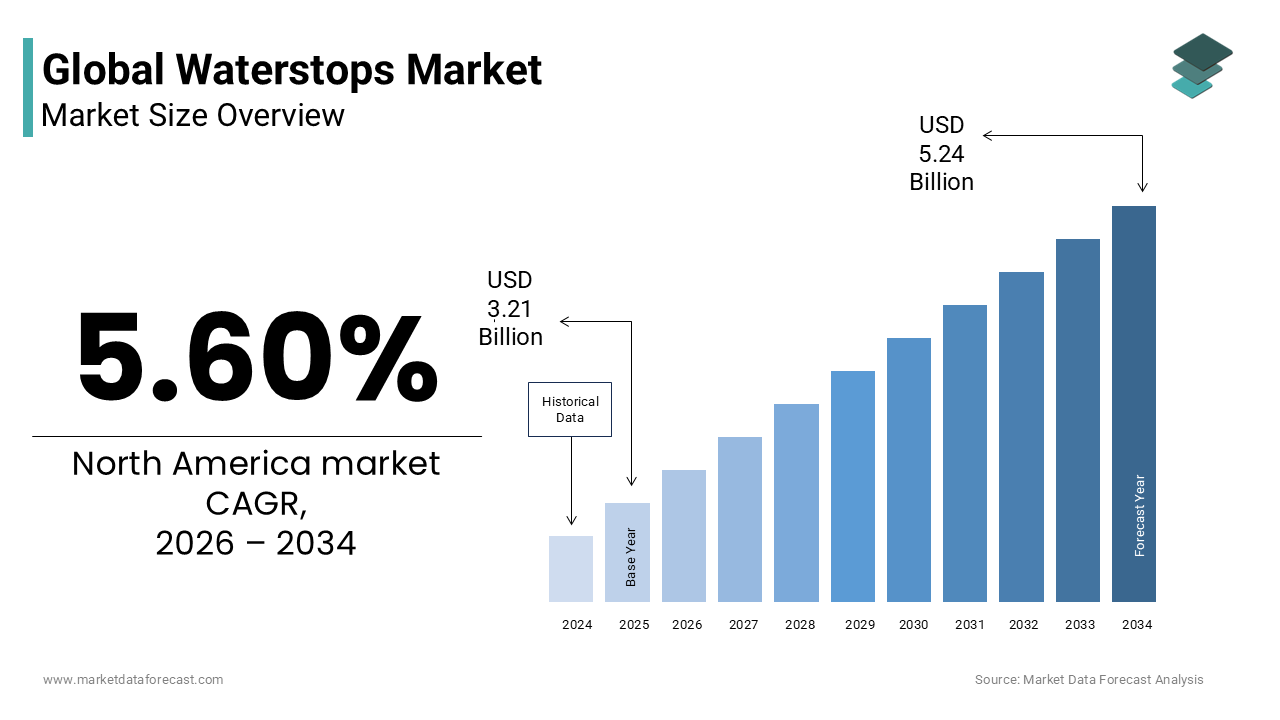
The global waterstops market was worth USD 3.21 billion in 2025, is expected to reach USD 3.39 billion in 2026, and is anticipated to reach a valuation of USD 5.24 billion by 2034, registering a compound annual growth rate (CAGR) of 5.60% during the forecast period from 2026 to 2034. Driven by rapid global urbanization, underground infrastructure expansion, and stringent environmental regulations, the industry continues to expand steadily worldwide.
Key Executive Metrics (At-a-Glance)
- 2025 Base Valuation: USD 3.21 Billion
- 2026 Current Valuation: USD 3.39 Billion
- 2034 Forecast Valuation: USD 5.24 Billion
- Compound Annual Growth Rate (CAGR): 5.60% (2026–2034)
- Dominant Product Type: Internal Waterstops (holding 44.3% market share in 2025 due to permanent structural integration and hydrostatic pressure resistance)
- Dominant Material Segment: Polyvinyl Chloride (PVC) (accounting for 32.1% market share in 2025 due to cost-effectiveness and code compliance)
- Fastest-Growing Type Segment: Expansion Waterstops (projected to witness the fastest CAGR of 7.2% driven by seismic design codes)
- Dominant Region: North America (capturing 34.6% of the share in 2025 due to building codes and infrastructure renewal programs)
Core Market Drivers
- Rapid Urbanization: Accelerating pace of global urbanization and the expansion of underground transportation, utility networks, and subterranean structures.
- Wastewater Regulations: Strict environmental regulations governing wastewater management and zero-discharge mandates for treatment facilities.
Primary Market Restraints & Challenges
- Raw Material Volatility & Complexity: Fluctuations in polymer and crude oil prices alongside installation complexities and skilled labor shortages.
Global Waterstops Market Segmentation Breakdown
| Segment Category | Leading Sub-Segment (2025 Base) | Fastest-Growing Sub-Segment (2026–2034) |
|---|---|---|
| By Type | Internal Waterstops (holding 44.3% market share) | Expansion Waterstops (growing at a CAGR of 7.2%) |
| By Material | Polyvinyl Chloride / PVC (accounting for 32.1% market share) | Rubber Waterstops (growing at a CAGR of 6.8%) |
| By Region | North America (capturing 34.6% market share) | Asia Pacific (rapidly growing through urbanization and infrastructure investments) |
Major Industry Players Profiled
Key enterprises shaping the competitive global waterstops market include Sika AG, BASF SE, Freudenberg Sealing Technologies, Tata Rubber Corporation, Foshan NanhaiFufujing Plastic & Hardware Co., Limited, Trelleborg Ridderkerk BV, JP Specialties, Inc., Emagineered Solutions Inc., Henry Company, and Mapei Construction Products India Pvt Ltd.
Global Waterstops Market Size
The global waterstops market was worth USD 3.21 billion in 2025. The global market is expected to reach USD 3.39 billion in 2026 and is anticipated to reach a valuation of USD 5.24 billion by 2034 and is predicted to register a CAGR of 5.60% during 2026 to 2034.
The waterstops comprises specialized construction materials designed to prevent the passage of fluids through concrete joints and expansion gaps in infrastructure projects. These critical components are manufactured from thermoplastic elastomers polyvinyl chloride rubber and metal alloys ensuring durability against hydrostatic pressure and chemical exposure. Waterstops are indispensable for maintaining structural integrity in dams tunnels basements and wastewater treatment facilities where water leakage can cause severe damage. The global push for sustainable urban development has increased the construction of underground transportation systems and storage facilities which rely heavily on watertight concrete joints. As per the study, approximately 40% of the global population lives in areas prone to flooding driving the need for resilient infrastructure with robust waterproofing measures. Regulatory standards, such as ASTM D657 and EN 12976 govern the performance and testing of waterstop materials ensuring they meet rigorous safety and durability requirements.
MARKET DRIVERS
Rapid Urbanization and Expansion of Underground Infrastructure
The accelerating pace of global urbanization and the consequent expansion of underground infrastructure due to the increasing need for watertight subterranean structures is fuelling the growth of the waterstops market. According to the United Nations Department of Economic and Social Affairs, 68% of the world’s population is projected to live in urban areas by 2050 necessitating massive investments in underground transportation parking and utility networks. Cities like Tokyo London and New York are expanding their metro systems with deep tunnel constructions that require thousands of linear meters of waterstops to seal segmental joints against groundwater ingress. These underground environments exert immense hydrostatic pressure on concrete joints making high performance waterstops essential for preventing leaks that could compromise structural stability and public safety. The construction of underground stormwater storage tanks in flood prone cities further drives demand as municipalities seek to manage excess rainfall effectively. Waterstops made from durable thermoplastic elastomers are preferred for their ability to accommodate structural movement while maintaining a watertight seal.
Stringent Regulations on Wastewater Management and Environmental Protection
The strict environmental regulations governing wastewater management and the prevention of groundwater contamination drive substantial demand for high quality waterstops in treatment facilities and industrial plants. The stringent regulations on wastewater management and environmental protection is additionally fuelling the growth of the waterstops market. According to the United States Environmental Protection Agency, the Clean Water Act mandates that all wastewater treatment facilities maintain zero discharge of untreated effluent requiring impermeable containment structures. Concrete tanks and channels in these facilities are subject to aggressive chemical exposure and constant hydraulic pressure making robust joint sealing critical. Waterstops prevent the leakage of hazardous substances into the soil and groundwater protecting local ecosystems and public health. In Europe, the Urban Wastewater Treatment Directive requires member states to ensure that all treatment plants meet stringent efficiency and containment standards. Industrial facilities handling chemicals and oils also face strict liability laws that compel them to install reliable waterproofing systems. The cost of non compliance including fines and remediation expenses far exceeds the initial investment in premium waterstops.
MARKET RESTRAINTS
Volatility in Raw Material Prices for Polymer Based Products
The fluctuation in raw material prices particularly for polymers, such as polyvinyl chloride and thermoplastic elastomers are affecting production costs and profit margins, which is declining the growth of the waterstops market. According to the International Energy Agency, the price of crude oil which is a key feedstock for polymer production experienced a 40% variance in 2023 due to geopolitical tensions and supply chain disruptions. This volatility directly impacts the cost of manufacturing plastic based waterstops which constitute a major portion of the market. Small and medium sized contractors often operate on fixed bids and struggle to accommodate sudden price hikes leading to project delays or substitution with inferior materials. The lack of long term price stability makes it difficult for suppliers to offer competitive quotes for large infrastructure projects. Additionally, the energy intensive nature of polymer processing exacerbates cost pressures when electricity and natural gas prices rise. In Europe, the energy crisis caused production costs for some plastic manufacturers to double temporarily reducing output capacity. These economic uncertainties discourage investment in new production facilities and limit the ability of companies to innovate.
Complexity of Installation and Labor Shortages in Construction
The technical complexity associated with the proper installation of waterstops combined with a global shortage of skilled construction labor, which is additionally limiting the growth of the waterstops market. Waterstops require precise placement within concrete forms and careful splicing to ensure continuity and watertightness which demands experienced technicians. Improper installation can lead to joint failure rendering the waterstop ineffective and causing costly leaks that require expensive repairs. The intricate nature of installing waterstops in complex geometries such as corners and intersections further increases the risk of errors. Many general contractors lack specialized teams for waterproofing leading to reliance on subcontractors who may vary in skill level. The time consuming process of securing waterstops with nails or adhesives slows down construction progress adding to labor costs. In regions with aging workforces the knowledge gap regarding modern waterstop techniques widens. Training programs are insufficient to meet the demand for skilled installers creating a bottleneck in project execution.
MARKET OPPORTUNITIES
Development of Self Healing and Smart Waterstop Technologies
The emergence of self-healing and smart waterstop technologies is likely to leverage new opportunities for the growth of the waterstops market. Traditional waterstops provide passive protection but new innovations incorporate microcapsules containing healing agents that activate upon crack formation to seal leaks automatically. These smart waterstops can detect moisture ingress and release sealing compounds reducing the need for manual inspection and maintenance. Infrastructure owners are increasingly willing to pay a premium for technologies that reduce lifecycle costs and enhance durability. The integration of sensors within waterstops allows for real time monitoring of joint integrity providing early warnings of potential failures. This proactive approach aligns with the industry’s shift toward predictive maintenance and digital twin technologies. Government agencies managing large assets such as dams and tunnels are piloting these innovative solutions to improve safety and operational efficiency. The European Commission’s Horizon Europe program funds projects focused on resilient infrastructure materials encouraging further development.
Expansion into Emerging Markets with Infrastructure Deficits
The rapid infrastructure development in emerging countries, particularly in Asia Pacific, Latin America, and Africa offers substantial opportunities for waterstop manufacturers to expand their geographic footprint. Countries like India, Brazil, and Nigeria, are launching major initiatives to build roads bridges dams and water supply systems, which inherently require effective waterproofing solutions. These regions often suffer from inadequate drainage and flooding issues making robust waterstops essential for resilient infrastructure. Local manufacturing capabilities are limited leading to reliance on imports from established global suppliers. Governments in these regions are increasingly adopting international construction standards, which mandate the use of certified waterstops in public projects. Partnerships with local distributors and contractors can help international brands penetrate these markets effectively.
MARKET CHALLENGES
Inconsistency in Global Quality Standards and Certification
The lack of harmonized global quality standards and certification protocols for manufacturers operating in international areas is a significant challenge for the growth of the waterstops market. Different regions adhere to varying testing methods and performance criteria making it difficult to ensure uniform product quality and compliance. According to the International Organization for Standardization, while standards such as ISO 9001 exist specific technical specifications for waterstops vary widely between countries. For instance, the American Society for Testing and Materials uses different test parameters compared to the European Committee for Standardization leading to confusion and additional testing costs for exporters. Manufacturers must navigate a complex web of local certifications which increases time to market and administrative burdens. Inconsistent enforcement of standards in some developing markets allows substandard products to enter the supply chain undermining trust in branded solutions. This fragmentation hinders the ability of companies to achieve economies of scale in production and distribution. The absence of a universally accepted benchmark for waterstop performance complicates procurement decisions for multinational engineering firms. Efforts to harmonize standards through international bodies are slow and often face resistance from local industries.
Susceptibility to Physical Damage During Concrete Pouring
The vulnerability of waterstops to physical damage during the concrete pouring and compaction process that affects their long term reliability and performance is also to inhibit the growth of the waterstops market. Heavy machinery and vibrating equipment used in construction can displace tear or puncture waterstops if they are not adequately protected or secured. Once damaged waterstops lose their ability to form a continuous barrier allowing water to bypass the joint and cause leaks. Repairing damaged waterstops after concrete has cured is extremely difficult and costly often requiring extensive demolition and reconstruction. Data from the Concrete Society indicates that retrofitting failed joints can cost up to five times more than initial installation. The thin profile of some waterstop designs makes them particularly susceptible to damage from aggregate impact during pouring. Construction schedules often prioritize speed over precision leading to rushed installations that compromise waterstop integrity. Lack of awareness among site supervisors about the fragility of these components exacerbates the problem. Manufacturers are developing more robust profiles and protective covers but these additions increase material costs.
REPORT COVERAGE
| REPORT METRIC | DETAILS |
| Market Size Available | 2025 to 2034 |
| Base Year | 2025 |
| Forecast Period | 2026 to 2034 |
| Segments Covered | By Type, Material, Application, and Region. |
| Various Analyses Covered | Global, Regional, & Country Level Analysis; Segment-Level Analysis, Drivers, Restraints, Opportunities, Challenges, PESTLE Analysis, Porter’s Five Forces Analysis, Competitive Landscape, Analyst Overview of Investment Opportunities |
| Regions Covered | North America, Europe, Asia Pacific, Latin America, Middle East, and Africa |
| Key Market Players | Tata Rubber Corporation, Foshan NanhaiFufujing Plastic & Hardware Co., Limited, Trelleborg Ridderkerk BV, JP Specialties, Inc., Emagineered Solutions Inc., Henry Company, CE Construction Solutions, Mapei Construction Products India Pvt Ltd., and BoMetals, Inc., and Others. |
SEGMENTAL ANALYSIS
By Type Insights
The internal waterstops segment was accounted in holding 44.3% of the waterstops market share in 2025, they are structurally integrated into concrete joints to provide a permanent barrier against hydrostatic pressure in liquid containment structures. The placement of these waterstops within the concrete cross section protects them from ultraviolet radiation and physical damage ensuring a service life that matches the structure itself. The European Federation of National Associations of Water Services reports that aging infrastructure rehabilitation projects across Europe prioritize internal waterstop replacement to extend asset longevity by decades. This inherent durability makes them the default specification for engineers designing dams tunnels and basements where failure is not an option.
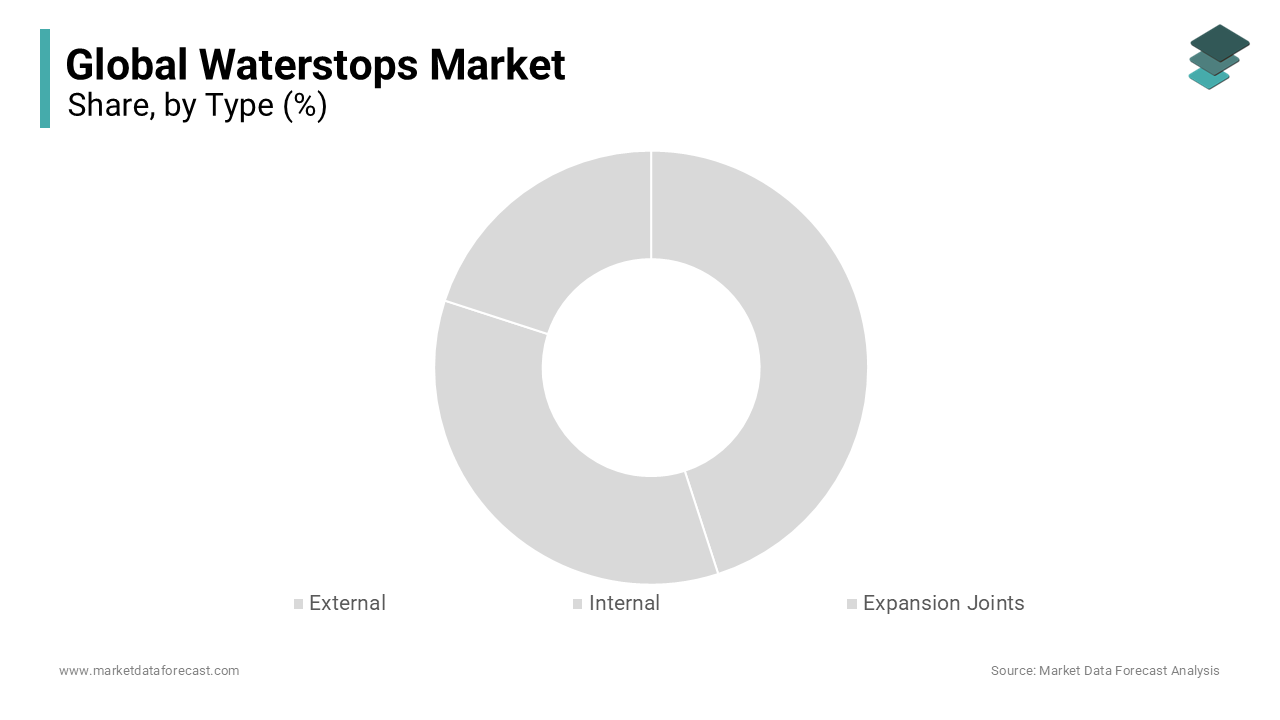
The expansion waterstops segment is projected to witness a fastest CAGR of 7.2% from 2026 to 2034 with the stringent seismic design codes in earthquake prone regions. According to the study, structures in high seismic zones must accommodate significant lateral movement without compromising watertightness necessitating specialized expansion joint systems. These systems feature flexible center bulbs and multiple fins that allow for compression extension and shear movement while maintaining a seal. The Japanese Ministry of Land Infrastructure Transport and Tourism mandates similar resilient joint designs for all public buildings and transportation hubs following recent seismic events. Traditional rigid waterstops fail under cyclic loading whereas expansion profiles are engineered specifically for dynamic stress. As climate change increases, the frequency of extreme weather events that induce thermal expansion and contraction the need for movement accommodating joints grows.
By Material Insights
The polyvinyl chloride segment was the largest by accounting for 32.1% of the waterstops market share in 2025 due to their superior cost effectiveness and adequate performance for the vast majority of municipal and residential applications. As per recent study, over 90% of residential basement waterproofing specifications call for PVC waterstops due to budget sensitivity and code compliance sufficiency. Municipal water authorities in developing nations almost exclusively specify PVC for new treatment facilities to maximize infrastructure coverage within constrained budgets. The material’s ease of fabrication allows for complex profiles to be extruded at high volumes reducing unit costs further. While not suitable for aggressive chemical environments PVC meets standard potable water and sewage containment requirements adequately. The established supply chain and ubiquitous availability make it the default choice for general contractors who prioritize schedule certainty and cost control. This massive volume based demand from price sensitive sectors secures PVC’s dominant position despite the technical superiority of elastomeric options in niche applications.
The rubber waterstops segment is likely to grow at a fastest CAGR of 6.8% from 2026 to 2034 with the increasing industrial and wastewater applications involving aggressive chemicals. According to the Environmental Protection Agency, modern industrial effluents contain higher concentrations of solvents acids and hydrocarbons that degrade PVC but are resisted by EPDM neoprene and nitrile rubbers. Rubber maintains flexibility and sealing integrity across wider temperature ranges and chemical exposures where PVC would become brittle or swell. The mining industry also drives demand as tailings ponds and leach pads contain acidic runoff that requires chemically resistant barriers. As environmental regulations tighten discharge limits, industries must upgrade containment systems to prevent groundwater contamination favoring premium rubber solutions. The longer service life of rubber in harsh conditions justifies its higher upfront cost through reduced lifecycle maintenance expenses.
REGIONAL ANALYSIS
North America Waterstops Market Analysis
North America waterstops market was the largest by capturing 34.6% of the share in 2025 with the stringent building codes and massive infrastructure renewal programs. The United States dominates the region with the Infrastructure Investment and Jobs Act has allocated 550000 million dollars for transportation and water systems directly stimulating waterstop consumption for bridges tunnels and treatment plants. Canada contributes significantly through its resource extraction sector where mining and oil sands operations require specialized chemical resistant sealing systems. Natural Resources Canada reports that mineral exploration spending reached 4000 million dollars in 2023 supporting industrial containment construction. Strict enforcement of ACI and ASTM standards ensures high quality installations throughout the region. The focus on resilience and sustainability in updated building codes favors premium materials and innovative joint designs. Mature distribution networks and skilled contractor base support efficient project execution across diverse climatic zones.
Europe Waterstops Market Analysis
Europe waterstops market was positioned second by holding 22.4% of the share in 2025 with the comprehensive environmental regulations and extensive cross border infrastructure development. Germany, France, and Italy collectively account for over 50% of regional demand according to Euroconstruct, which forecasts 1700000 million euros in European construction output for 2024. The European Green Deal and associated funding mechanisms prioritize sustainable water management and energy efficient infrastructure creating sustained demand for high performance sealing systems. The TEN T transport network expansion involves numerous tunnel and bridge projects requiring advanced expansion and internal waterstops. Nordic countries lead in adopting innovative materials due to extreme climate conditions requiring superior cold weather performance. Stringent REACH regulations influence material selection favoring environmentally certified products. The region’s aging infrastructure stock necessitates continuous rehabilitation work providing stable aftermarket demand. Strong technical standards harmonized through CEN facilitate cross border trade and specification consistency.
Asia Pacific Waterstops Market Analysis
Asia Pacific waterstops market growth is likely to grow with the unprecedented urbanization and infrastructure investment across emerging economies. Massive metro expansions flood control systems and sponge city initiatives create enormous demand for both internal and expansion waterstops. India is experiencing rapid growth with the National Infrastructure Pipeline targeting 111000000 million rupees in spending through 2025 supporting highways dams and urban transit. Japan and South Korea contribute through advanced technology adoption and seismic resilient construction standards. Southeast Asian nations like Vietnam Indonesia and Philippines are accelerating port airport and industrial park development attracting international contractors and material suppliers. Rapid urban migration drives residential and commercial construction requiring basement and foundation waterproofing. Government stimulus packages post pandemic have prioritized infrastructure as economic recovery tool. Local manufacturing capacity is expanding to serve domestic markets reducing import dependence.
Latin America Waterstops Market Analysis
Latin America waterstops market growth is likely to have significant opportunities in next coming years. Sanitation and water treatment projects under the New Sanitation Framework drive significant waterstop consumption as private concessionaires upgrade aging systems. Chile leads in mining related containment infrastructure with copper and lithium extraction requiring chemically resistant sealing solutions. Colombia’s Fourth Generation highway program includes numerous tunnel and bridge projects necessitating expansion and internal waterstops. Mexico’s nearshoring trend boosts industrial construction in northern states creating demand for factory floor and foundation sealing. Economic volatility and currency fluctuations remain challenges affecting project financing and material imports. Multilateral development banks provide crucial funding for public infrastructure enabling procurement of quality materials. Local production capabilities are developing but premium products still rely on imports. Urbanization rates continue rising driving residential and commercial construction activity.
The Middle East and Africa Waterstops Market Analysis
The Middle East and Africa waterstops market growth is propelling with the rising focus on basic water infrastructure development. Saudi Arabia and UAE account for over 60% of regional waterstop consumption according to the Global Construction Review which estimates 1200000 million dollars in MENA construction projects for 2024. Vision 2030 mega projects like NEOM and Red Sea City require unprecedented quantities of premium waterstops for desalination plants airports and luxury developments. Qatar’s post World Cup infrastructure maintenance and Egypt’s New Administrative Capital also contribute significant demand. South Africa leads Sub Saharan Africa with water board infrastructure upgrades and renewable energy projects driving sealing system adoption. Extreme temperatures and saline groundwater conditions in Gulf states necessitate high performance rubber and specialized PVC formulations. Oil and gas sector containment facilities require chemically resistant systems meeting international safety standards. Political instability in some nations hinders consistent development but stable markets attract international suppliers. Desalination capacity expansion across the region creates sustained demand for marine grade waterstops.
COMPETITIVE LANDSCAPE
The competitive landscape of the waterstops market is characterized by a mix of global chemical giants and specialized regional manufacturers who compete on product quality technical expertise and price. Large multinational corporations leverage their extensive research capabilities and global distribution networks to offer comprehensive waterproofing solutions. These companies often bundle waterstops with other construction chemicals creating integrated value propositions for contractors. Innovation in material science serves, as a key differentiator with companies developing advanced polymers that resist harsh environmental conditions. Price competition is intense in standard PVC segments, while premium rubber and specialized profiles command higher margins due to performance benefits. Regulatory compliance and certification requirements create barriers to entry favoring established brands with proven track records
KEY MARKET PLAYERS
Some of the Key players operating in the global Waterstops Market include
- Tata Rubber Corporation
- Foshan NanhaiFufujing Plastic & Hardware Co., Limited
- Trelleborg Ridderkerk BV
- JP Specialties, Inc
- Emagineered Solutions Inc
- Henry Company
- CE Construction Solutions
- Mapei Construction Products India Pvt Ltd
- BoMetals, Inc
Top Players in the Global Waterstops Market
Sika AG
Sika AG is a global leader in specialty chemicals for construction providing high performance waterstop solutions for diverse infrastructure applications. The company offers an extensive portfolio of PVC rubber and hydrophilic waterstops designed to meet rigorous international standards. Sika recently expanded its production facilities in Asia to support growing demand from rapid urbanization projects. Their focus on sustainability drives the development of eco-friendly materials that reduce environmental impact. The company collaborates with engineering firms to provide technical expertise and customized sealing solutions. Sika invests heavily in research to enhance product durability and ease of installation. Their global distribution network ensures reliable supply to major construction sites worldwide. These efforts enable the company to maintain leadership through superior product performance and customer service.
BASF SE
BASF SE contributes significantly to the waterstops market through its advanced polymer technologies and chemical expertise. The company produces high quality polyvinyl chloride and thermoplastic elastomer compounds used in manufacturing durable waterstops. BASF recently launched new material formulations that offer improved resistance to chemicals and extreme temperatures. Their commitment to circular economy principles supports the development of recyclable waterstop materials. The company partners with manufacturers to optimize processing efficiency and product consistency. BASF leverages its global research centers to innovate sustainable solutions for construction challenges. Their technical support services help clients select appropriate materials for specific project requirements.
Freudenberg Sealing Technologies
Freudenberg Sealing Technologies specializes in high precision sealing solutions including premium rubber waterstops for critical infrastructure. The company utilizes advanced elastomer compounds to produce waterstops with exceptional flexibility and durability. Freudenberg recently introduced innovative profiles designed for complex joint geometries in tunnel and dam constructions. Their focus on engineering excellence ensures reliable performance under high hydrostatic pressure. The company expands its capabilities through strategic acquisitions of specialized sealing businesses. Freudenberg collaborates with civil engineers to develop tailored solutions for challenging environments. Their rigorous testing protocols guarantee compliance with stringent safety and quality standards. This dedication to quality and innovation solidifies their role as a preferred supplier for major infrastructure projects globally.
Top Strategies Used by Key Market Participants
Key players in the waterstops market primarily focus on product innovation to develop materials with enhanced durability and chemical resistance. Companies invest in research and development to create eco friendly and recyclable waterstop solutions aligning with sustainability goals. Strategic partnerships with construction firms and engineering consultants facilitate the adoption of specialized sealing technologies. Expanding manufacturing capacities in emerging markets helps meet rising demand from infrastructure development projects. Providing comprehensive technical support and training services strengthens customer relationships and ensures proper installation. Diversifying product portfolios to include smart and self healing waterstops offers competitive advantages. Adhering to strict international quality standards builds trust and facilitates global trade.
MARKET RECENT DEVELOPMENTS
- H&M has introduced a new range of technical outerwear called Water Stop Tech, which combines fashion and functionality. The collection includes four black pieces for men.
- Kryton celebrates 20 years of innovative waterproofing on the Indian coast. An upcoming band, Rock-n-Raaga, greeted guests with live music.
MARKET SEGMENTATION
This research report on the global waterstops market has been segmented and sub-segmented based on categories
By Type
- External
- Internal
- Expansion Joints
By Material
- PVC
- HDPE
- Rubber
- Others
By Application
- Water Reservoirs and Canals
- Bridges and Tunnels
- Storage Tanks
- Wastewater Treatment Facilities
- Others
By Region
- North America
- Europe
- Asia Pacific
- Latin America
- Middle East & Africa