- Product Description Description
- Table of Contents TOC
- List of Table & Figure LOT
- Get Free Sample PDF Sample PDF
Market Size, 2025
$9.39 BnMarket Estimate, 2026
$9.78 BnMarket Forecast, 2034
$13.52 BnCAGR, 2026–2034
4.13%Global Wax Market Report Summary
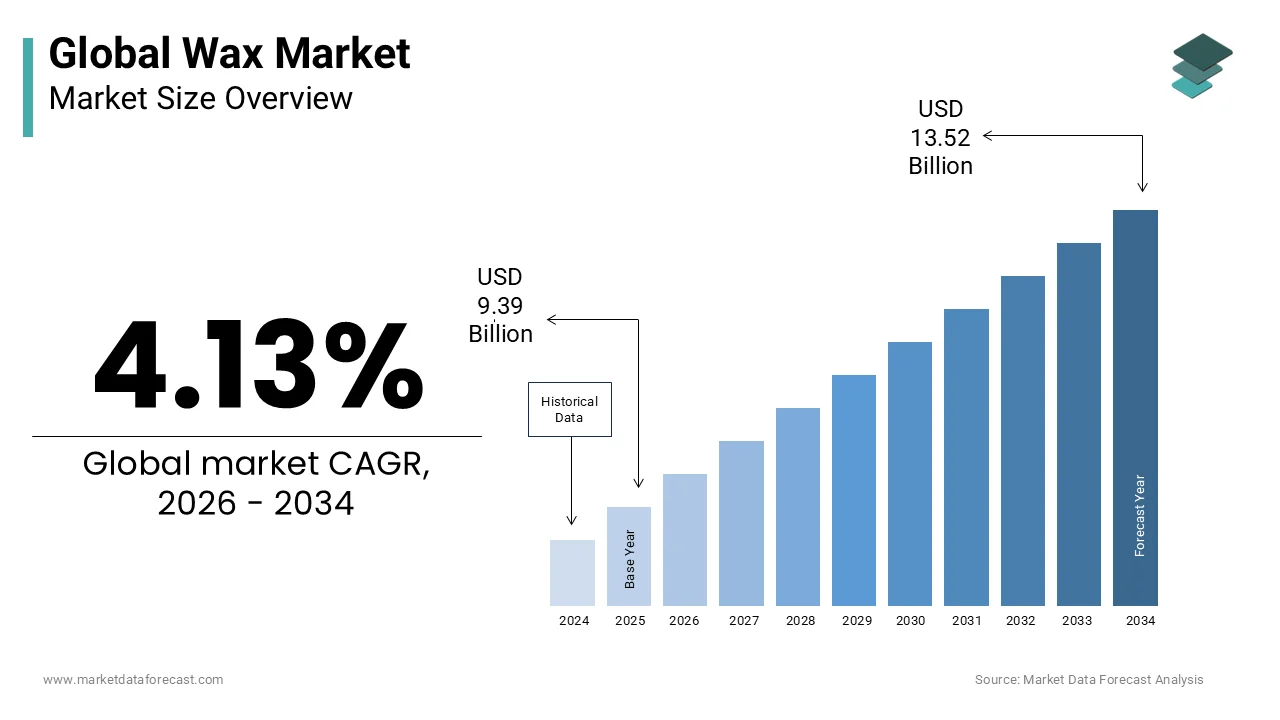
The global wax market was valued at USD 9.39 billion in 2025, is estimated to reach USD 9.78 billion in 2026, and is projected to reach USD 13.52 billion by 2034, growing at a CAGR of 4.13% during the forecast period from 2026 to 2034. The growth of the global wax market is driven by rising demand from candle manufacturing, increasing use of wax in packaging and coatings, and expanding applications across cosmetics, personal care, and food processing industries. Growth in urban lifestyles, decorative home products, and aromatherapy trends is further supporting candle consumption worldwide. Additionally, industrial demand for wax in rubber processing, adhesives, and polishes continues to contribute to steady market expansion.
Key Market Trends
- Strong demand for candles driven by home decor trends, religious usage, and wellness focused products.
- Growing adoption of natural and bio based waxes in cosmetics and personal care applications.
- Increasing use of wax coatings in packaging to enhance moisture resistance and shelf life.
- Rising demand from the rubber and tire industry for processing and performance enhancement.
- Expanding industrial applications in polishes, adhesives, and surface protection products.
Segmental Insights
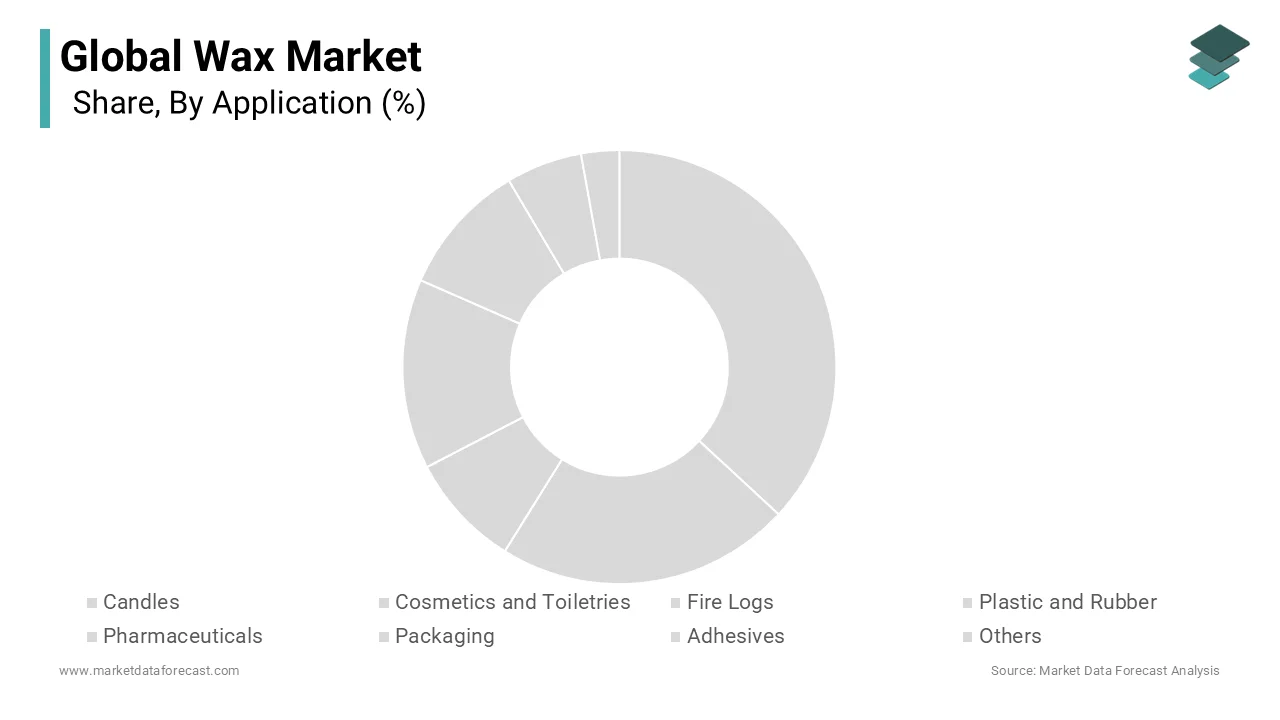
- Based on application, the candles segment led the global wax market by accounting for 35.5% of the market share in 2025.
Regional Insights
- The global wax market is witnessing strong growth across Asia Pacific, North America, Europe, and emerging economies, supported by industrial expansion and consumer product demand.
- Asia Pacific emerged as the leading region, occupying 36.8% of the global wax market share in 2025.
Competitive Landscape
The global wax market is characterized by the presence of multinational oil companies, specialty wax producers, and regional manufacturers. Key players focus on expanding production capacity, developing specialty and eco friendly wax formulations, and strengthening supply chains to meet diverse end use requirements. Strategic partnerships, product innovation, and geographic expansion remain central to competitive positioning. Prominent players operating in the global wax market include Sasol Limited, Sinopec, Royal Dutch Shell PLC, Exxon Mobil Corporation, The International Group Inc., Petróleo Brasileiro S.A., PJSC Lukoil Oil Company, PDVSA, Kerax Limited, DEUREX AG, Nippon Seiro Co. Ltd., Numaligarh Refinery Limited, Strahl and Pitsch, Inc., CALWAX, Poth Hille and Co Ltd., Cargill, Inc., and Samin Chemical.
 Download Free Sample Report
Global Wax Market Size
The global wax market size was valued at USD 9.39 billion in 2025 and is anticipated to reach USD 9.78 billion in 2026 from USD 13.52 billion by 2034, growing at a CAGR of 4.13% during the forecast period from 2026 to 2034.
Wax refers to the natural and synthetic substances, such as paraffin, microcrystalline, beeswax, carnauba, and polyethylene waxes. These are used for their unique properties including water resistance, thermal stability, and textural modification across industrial, cosmetic, food, and pharmaceutical applications. Also, these materials play an important but often overlooked role in enabling functionality in everyday products, from candle wicks and food coatings to protective polishes and polymer additives. According to the study, notable metric tons of fruits and vegetables are coated annually with food-grade waxes to reduce moisture loss and extend shelf life, a practice that has become standard in global supply chains. As per research, a percentage of households in the United States use candles weekly, which emphasizes the enduring consumer demand for wax-based goods.
MARKET DRIVERS
Rising Demand for Food Preservation and Post-Harvest Coatings
The global need to reduce food spoilage, particularly in the fresh produce sector, is a major driver of the wax market. According to study, a portion of the world’s food is lost between harvest and retail, with moisture loss and microbial degradation being primary causes. To combat this, edible waxes, which is derived from carnauba, candelilla, and shellac, are applied to citrus, apples, cucumbers, and tomatoes to form a protective barrier. In India, where post-harvest losses of fruits exceeds, the Ministry of Food Processing Industries has promoted waxing as a low-cost preservation method, leading to an increase in food-grade wax usage.
Expansion of the Cosmetics and Personal Care Industry
The cosmetics and personal care sector is attributing to the expansion of wax market. It is driven by their emollient, thickening, and structuring properties in formulations. According to the research, a portion of adults globally use at least one personal care product daily, ranging from lipsticks and deodorants to moisturizers and sunscreens, many of which rely on beeswax, candelilla, or synthetic ester waxes for texture and stability. The global business for cosmetics expanded, as per study, with Asia-Pacific accounting for a percentage of consumption. In South Korea, known for its advanced skincare formulations, many new cosmetic products launched contained natural waxes as key stabilizers
MARKET RESTRAINTS
Volatility in Crude Oil Prices Affecting Paraffin and Microcrystalline Wax Supply
Paraffin and microcrystalline waxes are derived from petroleum refining, are highly susceptible to fluctuations in crude oil prices and refinery output, which creates supply chain instability, that hinders the growth of wax market. When refineries reduce distillate output due to margin burdens, the wax yields produced as a by-product of lubricant oil refining decline proportionally. In addition, European refineries operated at only a portion of capacity, the lowest in a decade, as per study, leading to a drop in microcrystalline wax supply. This scarcity forced manufacturers in the adhesives and rubber industries to seek alternatives or absorb cost increases.
Environmental and Regulatory Scrutiny on Non-Biodegradable Waxes
Increasing environmental regulations are constraining the use of non-biodegradable synthetic and petroleum-based waxes in consumer-facing applications is hindering the growth of wax market. As per the research, a portion of urban waste in Europe contains wax-coated paper or plastic, which complicates recycling due to contamination.
MARKET OPPORTUNITIES
Growth in Renewable and Bio-Based Wax Alternatives
The push for sustainable materials is accelerating innovation in renewable wax substitutes, which in turn is creating new opportunities for the wax market. These renewable and bio-based wax alternatives are derived from plants, insects, and waste biomass. According to study, global bio-based chemical production is expected to grow annually through 2030, with waxes being a key segment. Brazil, the world’s largest producer of carnauba wax, harvested notable metric tons, as per study, supporting exports to cosmetics and food industries worldwide. In India, startups like EcoWax are producing candelilla wax from cultivated succulents, offering a vegan alternative to beeswax.
Increasing Use of Waxes in Advanced Industrial Applications
High-performance industrial sectors such as 3D printing, electronics, and composite materials, where their low surface energy and thermal properties offer functional advantages, is providing fresh opportunities for the expansion of wax market. In metal injection molding (MIM), a process used to produce precision components for medical devices and aerospace, binders containing paraffin and polyethylene waxes are essential for shaping and debinding. In 3D printing, wax casting is used in jewelry and dental prosthetics, with Formlabs and 3D Systems offering wax-compatible resins that enable high-detail lost-wax casting. Furthermore, phase change materials (PCMs) incorporating paraffin wax are being deployed in building insulation and thermal management systems.
MARKET CHALLENGES
Limited Availability and High Cost of Natural Waxes
Natural waxes such as beeswax, carnauba, and candelilla face supply limitations due to their dependence on specific climates, labor-intensive harvesting, and ecological vulnerabilities are a limiting factor for the wax market. In Brazil, carnauba palm harvesting is highly seasonal and relies on manual labor, with only tons produced yearly, as reported by the Brazilian Agricultural Research Corporation (Embrapa). Climate change is exacerbating this. These supply limitations drive prices upward, which makes them cost-prohibitive for large-scale industrial use and forcing manufacturers to blend or substitute with synthetics.
Technical Limitations in Performance and Compatibility
Technical problems in formulation stability, melting point control, and compatibility with other materials are likely to degrade the growth of wax market. For instance, natural waxes like beeswax exhibit batch-to-batch variability in composition due to floral sources and climate, which affectes consistency in cosmetics and pharmaceuticals. In polymer processing, waxes used as lubricants or release agents can migrate to the surface over time. This causes defects in films or coatings. Besides, blending bio-based and synthetic waxes often results in phase separation by reducing efficacy. The adoption of wax formulations in precision industries will remain constrained by performance unpredictability until standardized, high-purity, and functionally reliable products become widely available.
REPORT COVERAGE
| REPORT METRIC | DETAILS |
| Market Size Available | 2025 to 2034 |
| Base Year | 2025 |
| Forecast Period | 2026 to 2034 |
| CAGR | 4.13% |
| Segments Covered | By Product Type, Application, and Region |
| Various Analyses Covered | Global, Regional & Country Level Analysis, Segment-Level Analysis, DROC, PESTLE Analysis, Porter’s Five Forces Analysis, Competitive Landscape, Analyst Overview of Investment Opportunities |
| Regions Covered | North America, Europe, APAC, Latin America, Middle East & Africa |
| Market Leaders Profiled | Sasol Limited, Sinopec, Royal Dutch Shell PLC, Exxon Mobil Corporation, The International Group Inc., Petróleo Brasileiro S.A., The PJSC Lukoil Oil Company, PDVSA (Petróleos de Venezuela, S.A.), Kerax Limited, DEUREX AG, NIPPON SEIRO CO, and others |
SEGMENTAL ANALYSIS
By Application Insights
The candles application segment led the wax market by accounting for 35.5% share of the global market in 2025. The enduring consumer demand for home fragrance, ambiance, and ritualistic use across cultures and income levels are mainly contributing to the expansion of candles application segment in the global markt. According to the study, U.S. consumers spent significant amount on candles, with premium and scented variants driving growth. Paraffin wax remains the dominant material due to its excellent scent throw, ease of coloring, and low cost. In India, where traditional and religious practices involve daily use of oil lamps and candles, domestic wax consumption for lighting grew annually, as per the research. Besides, the rise of wellness and self-care trends has elevated candles to lifestyle products, with brands like Yankee Candle and Diptyque expanding globally.
The packaging application segment is anticipated to witness a CAGR of 8.1% from 2026 to 2034. This acceleration is driven by The increasing use of wax-coated paper and board in sustainable as well as plastic-free packaging solutions are boosting the acceleration of packaging application segment. As governments and corporations phase out single-use plastics, wax-impregnated paper is being adopted for fast food containers, grease-resistant bags, and moisture-barrier wraps. According to study, millions of tons of plastic packaging waste are generated annually in the EU, prompting substitution with biodegradable alternatives.
REGIONAL ANALYSIS
Asia Pacific Market Analysis
Asia Pacific wax market was top performer by occupying 36.8% of share in 2025. China and India are central to this dominance, with China being the world’s largest producer of paraffin wax, operating refineries that yield notable metric tons annually, as per study. India’s expanding candle, match, and packaging industries drive robust domestic demand. Japan and South Korea are key consumers of high-purity microcrystalline wax for electronics and automotive applications. Apart from these, Indonesia and the Philippines are emerging producers of crude carnauba and beeswax substitutes from local palm and coconut derivatives.
North America Market Analysis
North America wax market held 25.1% of share in 2025. The growth of North America in the global market is driven by a mature refining sector and high consumer demand for specialty products. The United States is the primary market by hosting major paraffin wax producers such as Chevron, ExxonMobil, and Sonneborn, with combined production of notable metric tons annually, as per study. The country’s candle industry alone consumes millions of pounds of wax yearly, according to the study. Apart from these, the U.S. leads in hot-melt adhesives and polymer processing, where microcrystalline wax is used as a dispersant and lubricant. Companies are investing in Fischer-Tropsch and plant-derived waxes because of increasing interest in bio-based alternatives.
Europe Market Analysis
Europe witnessed a sustained rise in the wax market due to its regulatory rigor and prominence in sustainable and specialty applications. The European Union’s REACH and CLP regulations have prompted a shift toward high-purity, low-aromatic paraffin waxes, particularly in food and cosmetics. Germany’s advanced manufacturing sector relies heavily on microcrystalline wax in automotive and machinery lubricants, while Italy is a major consumer in candle and leather polishing industries. Besides, the EU’s Single-Use Plastics Directive has accelerated the adoption of wax-coated paper in food service packaging, with companies like Huhtamäki and Faerch replacing plastic films with compostable waxed board.
Latin America Market Analysis
Latin America is expected to be the most lucrative region in the global wax market, with Brazil and Mexico emerging as key players due to their natural resource base and growing industrial demand. Brazil is the world’s largest producer of carnauba wax, harvesting notable metric tons, as per study. This wax is exported to cosmetics and food industries worldwide, with Germany and the U.S. being top importers. In Mexico, the expansion of automotive and construction sectors has increased demand for microcrystalline wax in adhesives and sealants. Furthermore, Argentina and Chile are developing beeswax export programs to meet global demand for natural cosmetics. However, inconsistent refining capacity and reliance on imported petroleum waxes limit self-sufficiency.
Middle East and Africa Market Analysis
The Middle East and Africa is likely to grow in the global wax market, with the Gulf Cooperation Council (GCC) countries and South Africa leading demand. Saudi Arabia and the UAE are major producers of petroleum-based waxes due to their extensive refining infrastructure, with Saudi Aramco’s refineries generating notable metric tons of paraffin wax annually, as per study. This domestic supply supports local candle, match, and packaging industries.
COMPETITIVE LANDSCAPE
The competition in the wax market is characterized by a blend of global energy giants, regional refiners, and specialty chemical innovators, each vying for dominance across fragmented application sectors. Unlike commoditized markets, differentiation here hinges on purity, consistency, regulatory compliance, and technical support rather than price alone. Petroleum-based wax producers compete with bio-wax startups on sustainability, while performance-driven industries like electronics and cosmetics demand ultra-refined grades that only a few suppliers can deliver. Regional disparities in refining capacity, environmental regulations, and consumer preferences create varied competitive landscapes, Europe favors low-aromatic and natural waxes, while Asia prioritizes cost-effective scalability. Emerging applications in sustainable packaging and 3D printing are reshaping competitive dynamics, favoring companies with R&D agility and cross-sector adaptability.
KEY MARKET PLAYERS
A few of the notable players in the global wax market include
- Sasol Limited
- Sinopec
- Royal Dutch Shell PLC
- Exxon Mobil Corporation
- The International Group Inc.
- Petróleo Brasileiro S.A.
- The PJSC Lukoil Oil Company
- PDVSA (Petróleos de Venezuela, S.A.)
- Kerax Limited
- DEUREX AG
- NIPPON SEIRO CO. LTD.
- Numaligarh Refinery Limited
- Strahl & Pitsch, Inc.
- CALWAX
- Poth Hille & Co Ltd.
- Cargill, Inc.
- Samin Chemical
TOP PLAYERS IN THE MARKET
- ExxonMobil Chemical has a commanding presence in the Asia-Pacific wax market through its high-performance paraffin and microcrystalline wax offerings tailored for industrial, packaging, and consumer applications. The company supplies its Sasolwax and Primol product lines across China, India, and Southeast Asia, where they are widely used in hot-melt adhesives, polymer processing, and candle manufacturing. Besides, the company collaborated with packaging converters in Vietnam to develop wax-impregnated paper solutions as alternatives to plastic laminates.
- Sasol has strengthened its influence in the Asia-Pacific wax market by leveraging its expertise in synthetic and Fischer-Tropsch waxes, which offer superior thermal stability and low odor, ideal for high-end applications in coatings, toners, and personal care. Its investment in sustainable innovation was emphasized by joining the SEA Circular initiative to support eco-design in packaging. Sasol has carved a niche in the premium segment of the Asia-Pacific marke by focusing on high-value, technically advanced waxest.
- Nippon Seiro is a dominant regional player in the Asia-Pacific wax market, particularly in Japan, South Korea, and Taiwan, where it supplies high-purity paraffin, microcrystalline, and beeswax blends for electronics, cosmetics, and food applications. The company also enhanced its cold-chain logistics to supply temperature-sensitive wax grades to semiconductor encapsulation plants in Taiwan Besides. Its deep integration with regional supply chains and focus on regulatory excellence make it a trusted partner in high-performance and compliant wax solutions.
TOP STRATEGIES USED BY THE KEY MARKET PLAYERS
Key players in the wax market are advancing through product differentiation, vertical integration, and strategic regional partnerships to maintain competitive advantage. Companies are investing in high-purity, low-aromatic, and bio-based wax formulations to comply with tightening environmental and health regulations in food, cosmetics, and packaging. Firms like Sasol and ExxonMobil are expanding technical service teams to support customers in reformulation and application optimization. Joint development agreements with end-users in cosmetics, adhesives, and sustainable packaging are enabling co-innovation and faster commercialization. Regional localization of supply chains, such as Nippon Seiro’s logistics upgrades and Sasol’s distribution expansions,ensures reliability and reduces lead times. Furthermore, players are enhancing sustainability credentials by adopting carbon footprint labeling and participating in circular economy initiatives.
MARKET SEGMENTATION
This research report on the global wax market is segmented and sub-segmented into the following categories.
By Type
- Natural Wax
- Synthetic Wax
- Mineral Wax
By Application
- Candles
- Cosmetics and Toiletries
- Fire Logs
- Plastic and Rubber
- Pharmaceuticals
- Packaging
- Adhesives
- Others
By Region
- North America
- Europe
- Asia Pacific
- Latin America
- The Middle East and Africa