- Product Description Description
- Table of Contents TOC
- List of Table & Figure LOT
- Get Free Sample PDF Sample PDF
Market Size, 2025
$1.28 BnMarket Estimate, 2026
$1.41 BnMarket Forecast, 2034
$3.09 BnCAGR, 2026–2034
10.28%Executive Summary: Global Weigh-in-motion System Market Analysis & Growth Forecast (2026-2034)
- Market Scope: Comprehensive industry analysis covering installation types, end-user sectors, core sensor technologies, application frameworks, component classifications, vehicle speed categories, regional performances, and growth drivers.
- Market Valuation: Valued at USD 1.28 billion in 2025, estimated at USD 1.41 billion in 2026, and projected to reach USD 3.09 billion by 2034, registering a robust CAGR of 10.28% from 2026 to 2034.
- Primary Growth Drivers: Worldwide demand to reduce traffic congestion, enforcement of strict vehicle weight limits, boom in Intelligent Transportation Systems (ITS), and advantages over traditional static weighing stations like reduced waiting times and lower maintenance costs.
Key Global Weigh-in-motion System Market Segment Metrics (2026-2034)
| Category | Leading Segment (Position) | Fastest-Growing / High-Impact Segment |
|---|---|---|
| By Installation | In-road & Bridge Systems (traditional infrastructure base for heavy commercial weight enforcement) | Onboard Systems (predicted to record the highest growth rate driven by lower maintenance costs and optimal fleet management) |
| By End-User | Highway Toll (registered the highest share due to surge in automated enforcement of overloaded commercial vehicles) | Logistics (expected to witness considerable growth owing to e-commerce expansion and demand for reduced transit delays) |
| By Technology | Load Cell & Bending Plate (widely deployed for high-precision weighing across major road networks) | Piezoelectric Sensor (estimated to grow at a notable rate due to a wider measurement range and shallow road implementation depth) |
| By Component | Hardware (dominated the market share due to essential data-gathering sensors and physical actuators) | Software & Data Analytics (high-impact sector integrating cloud intelligence with transportation management networks) |
| By Vehicle Speed | Low-Speed Systems (rule the market due to higher precision, easier installation, and lower operational expenses) | High-Speed Weigh-in-Motion (expanding rapidly on highways for free-flow traffic data collection and continuous screening) |
| By Region | North America (holds the dominant portion backed by massive technological investments and heavy-duty logistics operations) | Asia-Pacific (predicted to witness the highest growth rate driven by smart city initiatives and expanding transport networks in China, India, and Japan) |
Major Global Weigh-in-motion System Market Players & Industry Structure
Market Structure: Highly specialized global technology and sensor marketplace where industry leaders compete through product advancements, government infrastructure contracts, and automated cloud-connected telemetry solutions.
Key Companies: Kistler Instruments AG, TE Connectivity, Axis Communications Corporation, FLIR Systems Inc., Avery Weigh-Tronix, International Road Dynamics Inc., EFKON Inc., Kapsch TrafficCom AG, Siemens AG, Mettler Toledo, RoadSys Inc., Q-Free ASA, Raytheon Corp, Reno A&E, SWARCO AG, LeddarTech Inc., TransCore LP, and Celtronic Automation Pvt Ltd.
 Download Free Sample Report
Global Weigh-in-motion System Market Size
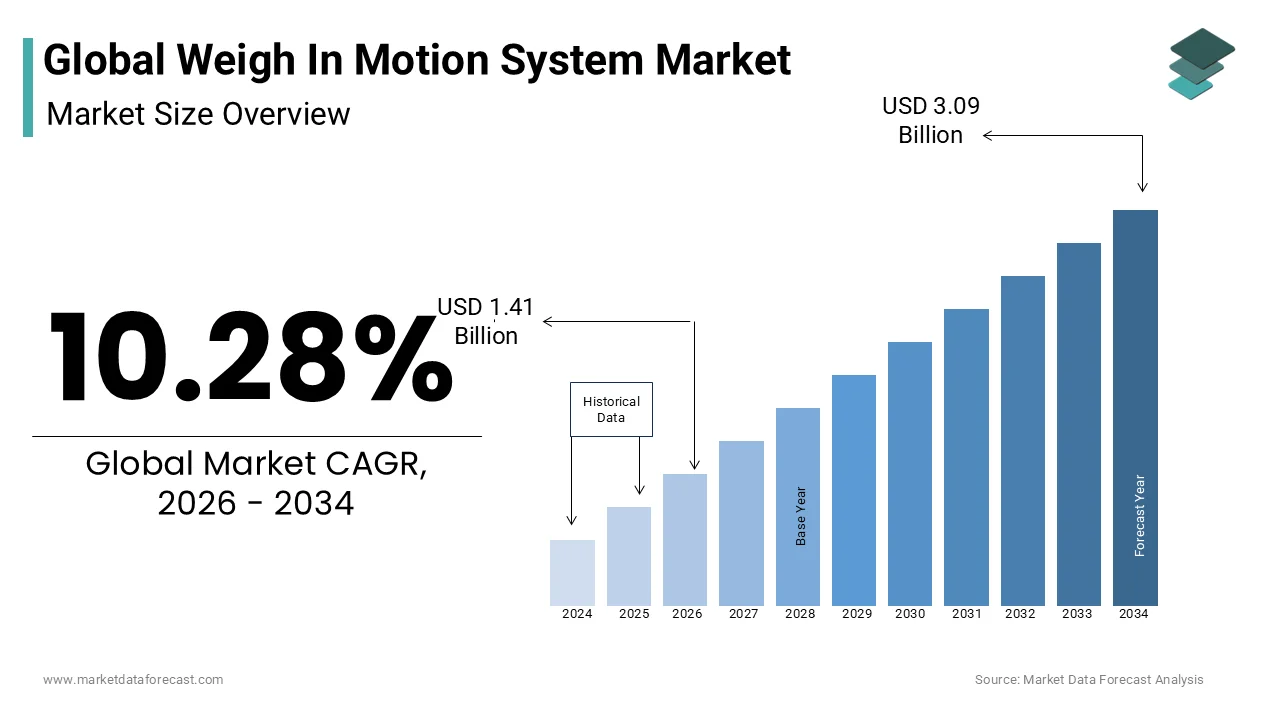
The global weigh-in-motion system market size was valued at USD 1.28 billion in 2025 and is anticipated to reach a valuation of USD 1.41 billion in 2026 and USD 3.09 billion by 2034, growing at a compound annual growth rate (CAGR) of 10.28%, from 2026 to 2034.
The weigh-in-motion system market comprises advanced technological solutions designed to measure the weight of moving vehicles without requiring them to stop. These systems utilize sensors embedded in roadways or bridges to capture axle loads and gross vehicle weights in real time, ensuring continuous traffic flow. According to the International Road Transport Union, heavy goods vehicles account for approximately 15% of total road traffic but are responsible for a disproportionate share of pavement deterioration due to overloading. As per the World Health Organization, road traffic injuries remain a leading cause of death globally, with overloaded trucks contributing significantly to braking failures and accident severity. The deployment of weigh-in-motion technology enables authorities to enforce weight regulations efficiently while minimizing congestion at traditional static weigh stations. Integration with automated license plate recognition and cloud-based data analytics enhances enforcement capabilities and provides valuable logistics insights. This market is critical for infrastructure preservation, as excessive axle loads accelerate road degradation exponentially. Governments increasingly mandate these systems to protect public assets and improve road safety standards. The transition toward smart transportation networks further amplifies the relevance of dynamic weighing solutions in modern traffic management ecosystems.
MARKET DRIVERS
Stringent Overloading Regulations Enhance Enforcement Needs
Strict government mandates against vehicle overloading is one of the major factors propelling the weigh-in-motion system market expansion. According to the European Commission, overloaded trucks cause up to 40% more damage to road infrastructure than compliant vehicles, leading to billions in annual repair costs across member states. This economic burden drives national transport agencies to deploy high-accuracy weigh-in-motion systems at key highway intersections and border crossings. According to the Federal Highway Administration in the United States, overweight vehicles contribute significantly to bridge structural failures, prompting stricter monitoring protocols under federal safety guidelines. Traditional static weigh stations suffer from low throughput and allow non-compliant drivers to bypass inspections during off-hours. Weigh-in-motion technology offers a solution by screening 100% of traffic continuously without disrupting logistics operations. Legal frameworks in countries like Germany and France now require pre-selection systems using weigh-in-motion data to identify suspects for secondary inspection. This regulatory shift transforms weigh-in-motion from an optional tool into a mandatory compliance infrastructure. The inability of manual enforcement to handle growing freight volumes ensures sustained demand for automated dynamic weighing solutions that guarantee consistent regulatory adherence.
Infrastructure Preservation Drives Asset Management Adoption
The urgent need to preserve aging road and bridge infrastructure accelerates the adoption of weigh-in-motion systems for proactive asset management, which is further aiding the global market expansion. According to the American Society of Civil Engineers, one in three major bridges in the United States is structurally deficient or functionally obsolete, largely due to repeated stress from overweight commercial vehicles. Weigh-in-motion systems provide granular data on axle load distributions, enabling engineers to predict wear patterns and schedule maintenance before catastrophic failures occur. As per the Organisation for Economic Co-operation and Development, every dollar spent on preventive maintenance saves up to four dollars in future rehabilitation costs, making data-driven oversight economically vital. Transportation departments use this real-time weight data to optimize pavement design standards and enforce load limits on sensitive structures. Continuous monitoring allows for dynamic load rating adjustments based on actual traffic conditions rather than theoretical models. This precision reduces unnecessary restrictions on compliant traffic while protecting vulnerable infrastructure segments. The integration of weigh-in-motion data with geographic information systems enhances strategic planning for road upgrades. Consequently, the financial imperative to extend asset lifespan and reduce lifecycle costs positions weigh-in-motion technology as an essential component of modern infrastructure management strategies.
MARKET RESTRAINTS
High Installation and Maintenance Costs Limit Deployment
Significant capital expenditure required for installation and ongoing maintenance acts as a primary restraint for the weigh-in-motion system market, particularly in budget-constrained regions. According to the International Association of Bridge Maintenance Managers, installing high-accuracy piezoelectric or bending plate sensors involves extensive roadwork, including lane closures and pavement reconstruction, which can cost upwards of $100,000 per site. These upfront costs deter smaller municipalities and developing nations from adopting comprehensive monitoring networks despite long-term benefits. According to the American Association of State Highway and Transportation Officials, sensor calibration and replacement due to wear from heavy traffic add substantial recurring expenses to operational budgets. Environmental factors such as extreme temperature fluctuations and moisture ingress further degrade sensor performance, requiring frequent technical interventions. Many transport agencies lack the specialized expertise to maintain these sophisticated systems, leading to prolonged downtime and data inaccuracies. The complexity of integrating legacy IT infrastructure with new weigh-in-motion hardware also increases implementation timelines and costs. Without standardized pricing models or government subsidies, the high total cost of ownership remains a barrier. This financial hurdle restricts market penetration to major highways and wealthy jurisdictions, leaving vast secondary road networks unmonitored and vulnerable to overloading damages.
Accuracy Variability Under Diverse Operating Conditions
Inconsistencies in measurement accuracy under varying environmental and traffic conditions hinder the reliability and legal admissibility of weigh-in-motion data, which further hinders the global market growth. According to the National Institute of Standards and Technology, factors such as vehicle speed, acceleration, braking, and lane positioning can introduce errors exceeding 5% in some sensor technologies. This variability prevents many jurisdictions from using weigh-in-motion data for direct fines, limiting its utility to pre-screening purposes only. The International Weigh-in-Motion Group highlights that temperature changes affect the elasticity of piezoelectric sensors, causing drift in readings that requires frequent recalibration. Rain, snow, and ice accumulation on sensor surfaces further distort measurements, creating gaps in enforcement coverage during adverse weather. High traffic congestion and erratic driving behaviors exacerbate these inaccuracies, making it difficult to isolate individual axle weights precisely. The lack of universal certification standards across different countries complicates the validation of system performance for legal proceedings. Operators must invest in additional verification equipment like static scales to confirm violations, adding to operational complexity. Until technological advancements ensure consistent high precision regardless of external variables, the market will face skepticism regarding the dependability of dynamic weighing solutions for strict regulatory enforcement.
MARKET OPPORTUNITIES
Integration with Smart City Infrastructure Creates New Revenue Streams
The convergence of weigh-in-motion systems with broader smart city initiatives is a significant opportunity for market expansion beyond traditional enforcement applications. According to the International Telecommunication Union, smart city investments are projected to reach $250 billion globally by 2025, creating a fertile ecosystem for integrated traffic management solutions. Weigh-in-motion data can be combined with traffic flow analytics to optimize signal timing and reduce congestion in urban logistics hubs. Municipalities can leverage this data to implement dynamic tolling schemes where fees are adjusted based on actual vehicle weight and environmental impact. The World Bank emphasizes that intelligent transport systems improve urban mobility efficiency by up to 20% when multiple data sources are integrated effectively. This holistic approach allows cities to monetize weight data through value-added services for logistics companies seeking route optimization. Partnerships with technology firms enable the development of cloud-based platforms that offer real-time insights to fleet managers. The ability to correlate weight data with emission levels supports green city initiatives by identifying high-polluting heavy vehicles. This multifunctional utility transforms weigh-in-motion systems from isolated enforcement tools into central nodes of smart infrastructure networks, driving broader adoption and investment.
Expansion into Railway and Aviation Weight Monitoring
Diversification into railway and aviation sectors offers untapped growth potential for weigh-in-motion technology providers seeking to reduce dependence on road transport applications. According to the International Union of Railways, global rail freight volume is expected to grow by 30% over the next decade, increasing the need for precise load monitoring to prevent track damage. Weigh-in-motion systems adapted for rail tracks can detect uneven loading in cargo wagons, enhancing safety and preventing derailments. The International Air Transport Association highlights that accurate aircraft weight and balance calculations are critical for fuel efficiency and flight safety, creating demand for dynamic weighing solutions at airports. These sectors face similar challenges regarding infrastructure wear and safety compliance but currently lack widespread automated monitoring solutions. Technological adaptations of road-based sensors for rail and runway applications require minimal reengineering, offering a low-risk entry strategy for manufacturers. Regulatory bodies in aviation and rail are increasingly mandating digital record-keeping for load data, which aligns perfectly with weigh-in-motion capabilities. Expanding into these high-value niche markets allows companies to diversify revenue streams and mitigate risks associated with fluctuating road infrastructure budgets. This strategic broadening of application scope opens new avenues for innovation and market leadership.
MARKET CHALLENGES
Data Privacy and Security Concerns Impede Trust
Growing concerns regarding data privacy and cybersecurity is a significant challenge to the widespread acceptance of weigh-in-motion systems. According to the General Data Protection Regulation in Europe, the collection of license plate and vehicle weight data constitutes personal information, requiring strict compliance with privacy laws. Transport agencies face legal hurdles in storing and sharing this data with third-party logistics providers or insurance companies due to potential misuse. The Cybersecurity and Infrastructure Security Agency warns that connected traffic infrastructure is increasingly targeted by cyberattacks, which could compromise weigh-in-motion data integrity. A successful breach could allow malicious actors to manipulate weight records, enabling illegal overloading or evading tolls. The lack of standardized encryption protocols for weigh-in-motion data transmission creates vulnerabilities in networked systems. Public skepticism about surveillance capitalism further complicates deployment in democratic societies where citizen consent is paramount. Companies must invest heavily in secure cloud architectures and anonymization techniques to build trust. These security requirements increase development costs and slow down project approvals. Until robust cybersecurity frameworks are universally adopted, the fear of data breaches will remain a persistent barrier to market growth.
Lack of Standardized Global Technical Protocols
The absence of unified global technical standards for weigh-in-motion systems creates fragmentation and interoperability challenges that hinder market scalability. According to the International Organization for Standardization, different countries employ varying certification criteria for sensor accuracy, data formats, and communication protocols. This inconsistency forces manufacturers to develop customized solutions for each region, increasing production costs and limiting economies of scale. The European Committee for Standardization has made progress with EN 16975, but global harmonization remains elusive, particularly in emerging markets. Transport operators managing cross-border fleets struggle with incompatible systems that do not share data seamlessly. The lack of standardization also complicates the validation of new technologies, slowing down innovation cycles. Manufacturers must navigate a complex web of local regulations, which delays product launches and market entry. Industry associations advocate for a single global framework to facilitate trade and technology transfer, but political and technical disagreements persist. This regulatory fragmentation increases the burden on end users who must manage multiple proprietary systems. Until international bodies establish a universal standard, the market will remain disjointed, reducing overall efficiency and hindering the potential for global integrated traffic management solutions.
REPORT COVERAGE
| REPORT METRIC | DETAILS |
| Market Size Available | 2025 to 2034 |
| Base Year | 2025 |
| Forecast Period | 2026 to 2034 |
| CAGR | 10.28% |
| Segments Covered | By Installation, End-user, Technology, Application, Component, Vehicle Speed, and Region. |
| Various Analyses Covered | Global, Regional and Country Level Analysis; Segment-Level Analysis; DROC, PESTLE Analysis; Porter’s Five Forces Analysis, Competitive Landscape; Analyst Overview of Investment Opportunities |
| Regions Covered | North America, Europe, APAC, Latin America, Middle East & Africa |
| Market Leaders Profiled | Kistler Instruments AG, TE Connectivity, Axis Communications Corporation, FLIR Systems Inc., Avery Weigh-Tronix, International Road Dynamics Inc., EFKON Inc., Kapsch TrafficCom AG, Siemens AG, Mettler Toledo, RoadSys Inc., Q-Free ASA, Raytheon Corp, Reno A&E, SWARCO AG, LeddarTech Inc., TransCore LP, and Celtronic Automation Pvt Ltd. |
SEGMENTAL ANALYSIS
By Installation Process Insights
The in-road segment held a leading market share of 58.5% of the global market in 2025. The in-road installation segment holds the leading position in the weigh-in-motion system market due to its ability to capture accurate weight data from all lanes of traffic without requiring structural modifications to existing infrastructure. According to the Federal Highway Administration, in-road sensors such as piezoelectric strips and bending plates can be installed directly into pavement, allowing for continuous monitoring of high-volume highways where bridge structures are sparse. This deployment flexibility enables transport authorities to screen 100% of commercial vehicles rather than just those crossing specific bridges, which is critical for effective overload enforcement. The International Road Transport Union notes that in-road systems provide granular axle load data that is essential for calculating pavement damage coefficients accurately. These systems are less susceptible to environmental vibrations compared to bridge-mounted units, ensuring higher data reliability for legal enforcement purposes. The lower initial capital cost relative to bridge instrumentation makes in-road solutions attractive for municipal budgets aiming to expand coverage across secondary roads. Furthermore, advancements in durable sensor materials have extended the lifespan of in-road installations, reducing maintenance frequency. The scalability of in-road networks allows for strategic placement at key logistics hubs and border crossings. Consequently, the combination of accuracy, scalability, and cost-effectiveness secures the dominance of the in-road segment in the global market.
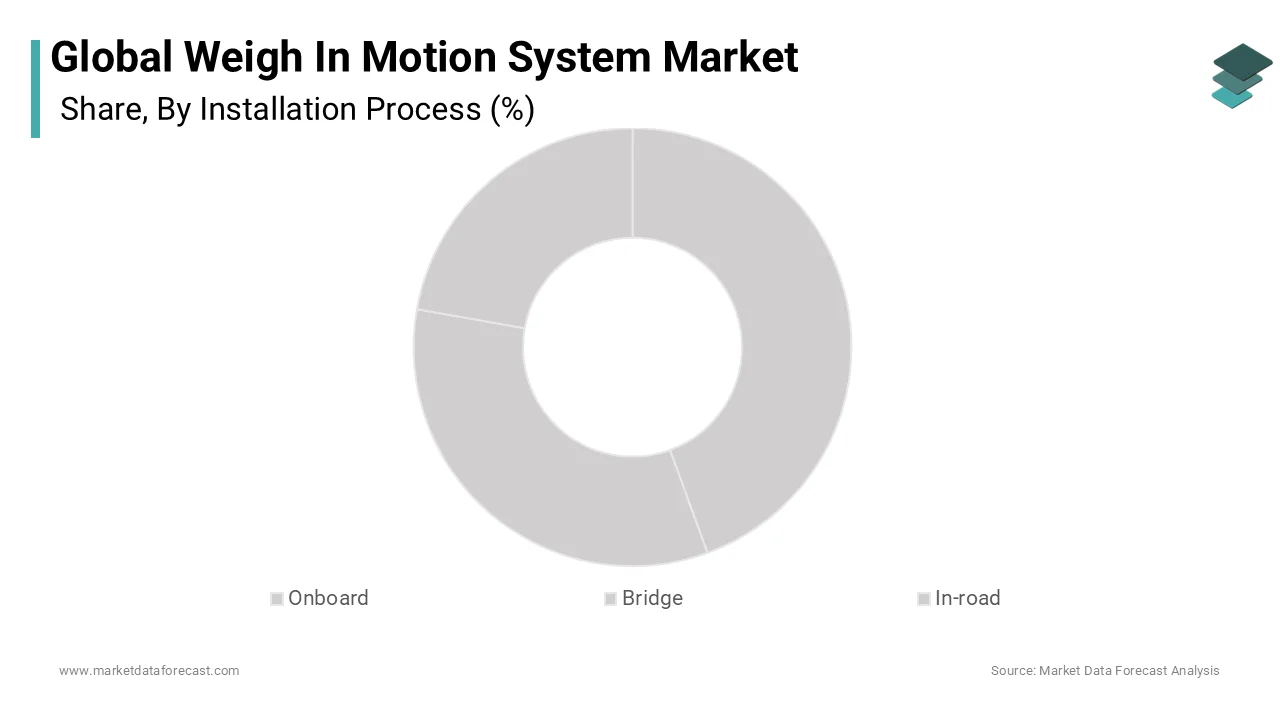
On the other side, the onboard segment is registering the fastest growth and is expected to exhibit a CAGR of 12.2% over the forecast period owing to the rapid adoption of connected vehicle technologies and fleet management telematics. As per the International Telecommunication Union, the number of connected commercial vehicles is projected to exceed 50 million globally by 2025, creating a vast ecosystem for onboard weighing solutions. Onboard systems utilize air pressure sensors or strain gauges within the vehicle suspension to provide real-time weight data to drivers and fleet managers. This immediate feedback allows operators to optimize cargo loading before departure, preventing overloading fines and improving fuel efficiency. The American Trucking Associations highlights that proper load distribution can reduce fuel consumption by up to 10%, providing a clear economic incentive for fleet owners to invest in onboard technology. Integration with cloud-based logistics platforms enables automated reporting and compliance documentation, reducing administrative burdens. The rise of electric trucks further accelerates this trend, as battery weight management is critical for maximizing range and performance. Onboard systems eliminate the need for external infrastructure investment, making them ideal for cross-border operations where static weigh stations vary in availability. The convenience and operational insights provided by onboard weighing drive its rapid adoption among modern logistics enterprises.
By End-User Insights
The highway toll segment dominated the market with 41.5% of the global market share in 2025. The growth of the highway toll segment in the global market can be credited to the critical need for accurate weight-based tolling to protect revenue and ensure fair usage charges. According to the International Bridge, Tunnel and Turnpike Association, many jurisdictions are transitioning from flat-rate tolls to weight-distance taxes, which require precise dynamic weighing to calculate fees correctly. Overloaded vehicles cause disproportionate wear on toll roads and bridges, necessitating higher fees to cover maintenance costs. Weigh-in-motion systems integrated with electronic toll collection tags allow for seamless billing without stopping traffic, enhancing throughput at busy plazas. The European Commission reports that weight-based tolling can increase infrastructure funding by up to 20% in regions with heavy freight traffic. This financial benefit drives widespread adoption of high-accuracy weigh-in-motion sensors at toll gantries. The ability to detect and penalize overloaded vehicles automatically reduces the need for manual inspections and associated labor costs. Furthermore, the data collected helps toll authorities plan maintenance schedules based on actual stress levels rather than estimated traffic volumes. The direct link between accurate weighing and revenue generation ensures that highway toll operators remain the primary investors in weigh-in-motion technology.
However, the logistics segment is anticipated to register a CAGR of 11.4% over the forecast period in the global market as companies seek to optimize supply chain efficiency and comply with strict safety regulations. According to the Council of Supply Chain Management Professionals, logistics costs account for approximately 8% of GDP in developed nations, prompting firms to seek every possible efficiency gain. Weigh-in-motion systems at distribution centers and private terminals allow for rapid verification of outbound loads, reducing dwell time and improving asset utilization. The National Private Truck Council indicates that pre-trip weighing can prevent costly roadside inspections and delays, which average 45 minutes per incident. Real-time weight data integrates with warehouse management systems to automate billing and inventory tracking, reducing human error. The rise of e-commerce has increased the frequency of less-than-truckload shipments, requiring frequent and quick weight checks. Logistics providers use this data to optimize route planning and vehicle selection, ensuring maximum payload without violating legal limits. The competitive pressure to deliver faster and cheaper drives investment in automated weighing technologies. Consequently, the logistics sector's focus on operational excellence and regulatory compliance fuels the rapid expansion of weigh-in-motion applications.
By Technology Insights
The piezoelectric sensor segment led the market by holding 41.4% of the global market share in 2025. The dominance of piezoelectric sensor segment in the global market is attributed to its superior durability and ability to maintain accuracy under high-speed and heavy-load conditions. According to the International Weigh-in-Motion Group, piezoelectric sensors can withstand millions of vehicle passes without significant degradation, making them ideal for high-traffic highways. These sensors generate an electrical charge proportional to the applied force, providing reliable data for axle weight classification. The Federal Highway Administration notes that piezoelectric systems offer accuracy within 5%, which meets the standards for pre-selection and enforcement in many jurisdictions. Their thin profile allows for minimal invasive installation, reducing road disruption during deployment. Piezoelectric sensors are less affected by temperature fluctuations compared to other technologies, ensuring consistent performance in diverse climates. The long service life of these sensors reduces total cost of ownership for transport agencies. Furthermore, their compatibility with various data acquisition systems facilitates easy integration into existing traffic management infrastructure. The proven track record of piezoelectric technology in demanding environments cements its position as the preferred choice for large-scale weigh-in-motion deployments globally.
However, the load cell technology segment is estimated to record a notable CAGR of 10.2% over the forecast period in the global market owing to the growing demand for high-precision weighing for legal enforcement and specialized industrial applications. As per the National Institute of Standards and Technology, load cell-based systems can achieve accuracy levels below 1%, which is making them suitable for direct fining without secondary static verification. This high precision is critical for industries such as mining and agriculture, where product value is directly linked to weight. The American Society for Testing and Materials highlights that advancements in digital load cells have improved resistance to environmental interference and simplified calibration processes. Load cells provide robust performance in low-speed applications such as port terminals and industrial scales, where accuracy is paramount. The ability to measure individual axle weights with high fidelity supports detailed infrastructure damage analysis. Growing regulatory requirements for precise weight reporting in international trade further boost demand for load cell systems. Although more expensive than piezoelectric options, the superior accuracy justifies the investment for high-value applications. Consequently, the need for legally defensible weight data drives the rapid adoption of load cell technology in niche but high-value market segments.
REGIONAL ANALYSIS
Europe Market Analysis
Europe dominated the weigh in motion system market globally in 2025 with 35.6% of the global market share and is likely to accelerate cross-border infrastructure integration and sustainability initiatives for the next few years. Europe operates under a harmonized regulatory framework that promotes the widespread adoption of weigh-in-motion systems for cross-border transport enforcement. As per the European Commission, the Eurovignette directive encourages member states to implement weight-based tolling systems to ensure fair contribution to infrastructure costs. Countries like Germany, France, and the Netherlands have extensive networks of high-accuracy weigh-in-motion sites integrated with automatic license plate recognition. The European Committee for Standardization has established rigorous certification protocols ensuring interoperability and data reliability across borders. The European Green Deal prioritizes sustainable logistics, driving investment in technologies that optimize load efficiency and reduce emissions. Strong government support and funding mechanisms facilitate the modernization of existing weigh stations into dynamic monitoring hubs. The dense road network and high volume of international freight traffic create ideal conditions for scalable weigh-in-motion deployments. Collaboration between neighboring countries enhances data sharing and enforcement effectiveness. These regional initiatives position Europe as a sophisticated market focused on integration and sustainability.
North America Market Analysis
North America is likely to maintain robust regulatory enforcement and steady market expansion for the next few years. North America maintains a mature weigh-in-motion market driven by strict federal and state regulations regarding vehicle weight limits and infrastructure protection. According to the Federal Highway Administration, the United States spends over $100 billion annually on highway maintenance, creating a strong imperative to prevent overload damage through effective monitoring. The implementation of the Electronic Logging Device mandate has complemented weigh-in-motion efforts by providing comprehensive data on truck operations. Canada’s commitment to safe and efficient trade corridors drives investment in border crossing weigh-in-motion systems to facilitate seamless cross-border logistics. The presence of major technology providers and established testing standards ensures high-quality deployments across the region. State departments of transportation actively collaborate with private sector partners to pilot new sensing technologies. The focus on protecting aging bridge infrastructure further sustains demand for precise weight monitoring solutions. Public-private partnerships play a crucial role in funding large-scale weigh-in-motion networks. These factors ensure North America remains a leader in adopting advanced weigh-in-motion technologies for regulatory compliance and asset management.
Asia Pacific Market Analysis
Asia Pacific is likely to witness accelerated infrastructure development and high-speed market growth for the next few years, registering the fastest growing compound annual growth rate at 11.2%. The Asia Pacific region exhibits robust growth in the weigh-in-motion market driven by massive infrastructure development and increasing freight volumes. According to the Asian Development Bank, billions of dollars are being invested in road and bridge construction across China, India, and Southeast Asia, creating opportunities for integrated monitoring systems. Rapid urbanization and the expansion of e-commerce logistics increase the number of heavy vehicles on roads, necessitating better overload control. Governments in countries like China and Japan are implementing smart highway initiatives that include weigh-in-motion technology as a core component. The lack of standardized enforcement in some areas drives demand for automated solutions to reduce corruption and improve compliance. Local manufacturing capabilities are reducing costs and accelerating deployment timelines. The region’s focus on improving road safety and reducing accident rates further supports market growth. Increasing awareness of infrastructure preservation benefits encourages public sector investment. These developmental trends position Asia Pacific as a high-potential market for future weigh-in-motion expansion.
Latin America Market Analysis
Latin America is likely to experience gradual modernization of trade corridors and logistics infrastructure for the next few years. Latin America presents an emerging market for weigh-in-motion systems characterized by efforts to improve trade corridor efficiency and reduce logistical bottlenecks. According to the Economic Commission for Latin America and the Caribbean, inefficient border crossings and poor road conditions significantly increase transport costs in the region. Countries like Brazil and Chile are investing in weigh-in-motion technology to streamline customs procedures and enforce weight limits on key export routes. The Inter-American Development Bank provides funding for infrastructure projects that include intelligent transport systems. Overloading remains a persistent issue, causing premature road deterioration and safety hazards. Governments are increasingly recognizing the economic benefits of automated enforcement in reducing transit times. Pilot projects in major ports and industrial zones demonstrate the viability of dynamic weighing solutions. Limited budget constraints slow widespread adoption, but targeted investments in critical corridors drive steady growth. The focus on enhancing regional competitiveness through better logistics infrastructure supports market development.
Middle East and Africa Market Analysis
Middle East and Africa is likely to expand strategic transport networks and adopt advanced logistics technologies for the next few years. The Middle East and Africa region shows growing interest in weigh-in-motion systems as part of broader strategic infrastructure investment plans. According to the African Union Agenda 2063, aims to create a continent-wide integrated transport network requiring modern monitoring solutions. Countries like Saudi Arabia and the United Arab Emirates are deploying advanced weigh-in-motion systems to manage heavy freight traffic associated with mega projects and oil logistics. South Africa utilizes weigh-in-motion technology to protect its extensive mining transport routes from overload damage. International donors and development agencies support technology transfer initiatives to improve road management capabilities. The harsh climatic conditions require robust and durable sensing solutions, driving demand for high-quality hardware. Growing awareness of the economic impact of road degradation encourages government investment in preventive monitoring. While market size is currently small, the strategic importance of efficient logistics for economic diversification drives positive momentum. These factors indicate a gradual but steady expansion of the weigh-in-motion market in the region.
COMPETITIVE LANDSCAPE
The weigh in motion system market features a specialized competitive landscape characterized by a mix of established sensor manufacturers and integrated technology providers. Major corporations leverage their proprietary sensor technologies and global distribution networks to maintain dominant positions while smaller firms compete on niche customization and local service responsiveness. Competition intensifies as companies strive to differentiate their products through superior accuracy rates and ease of integration with existing traffic management systems. Price sensitivity varies by region with developed markets prioritizing precision and reliability while emerging economies focus on cost effective solutions. Regulatory compliance acts as a significant barrier to entry ensuring that only well capitalized entities with proven testing records can participate. Innovation in data analytics and artificial intelligence becomes a key differentiator for providing actionable insights to transport authorities. Strategic acquisitions allow leading players to acquire specialized software capabilities or expand their geographic footprint rapidly. Customer loyalty is built through reliable after sales support and comprehensive training programs for maintenance staff. The market witnesses ongoing efforts to standardize communication protocols facilitating interoperability between different vendor systems. These factors create a dynamic environment where technological leadership and service quality determine competitive success.
KEY MARKET PLAYERS
They are playing a dominant role in the global weigh-in-motion market.
- Kistler Instruments AG,
- TE Connectivity
- Axis Communications Corporation
- FLIR Systems Inc.
- Intercomp Company
- Avery Weigh-Tronix
- International Road Dynamics Inc.
- EFKON Inc.
- Kapsch TrafficCom AG
- Siemens AG
- Mettler Toledo
- RoadSys Inc
- Q-Free ASA
- Raytheon Corp
- Reno A&E
- SWARCO AG
- LeddarTech Inc.
- TransCore LP,
- Celtronic Automation Pvt Ltd
Top Players In The Market
- Kistler Group stands as a global leader in dynamic measurement technology providing high precision piezoelectric sensors for weigh in motion applications. The company leverages its extensive engineering expertise to deliver robust solutions that withstand harsh environmental conditions and heavy traffic loads. Recent investments in digital signal processing have enhanced the accuracy and reliability of their sensor systems significantly. Kistler focuses on sustainability by developing energy efficient monitoring tools that support infrastructure preservation efforts. Strategic partnerships with system integrators ensure seamless deployment across diverse geographic regions. The company actively engages in standardization committees to shape global technical protocols for dynamic weighing. Compliance with international certification standards reinforces their reputation for quality and dependability among transport authorities. Expansion into emerging markets through localized service centers allows them to respond quickly to regional maintenance needs. These efforts collectively strengthen their position as a preferred supplier for critical highway monitoring infrastructure globally.
- Intercomp Company operates prominently in the weigh in motion sector with a strong focus on durable bending plate and load cell technologies. The company utilizes advanced manufacturing processes to produce sensors that offer long term stability and minimal maintenance requirements. Intercomp has recently expanded its product portfolio to include integrated software solutions for real time data analysis and reporting. Their commitment to customer support drives innovation in user friendly interfaces and remote diagnostic capabilities. Collaborations with government agencies help tailor solutions to specific regulatory enforcement needs in various jurisdictions. The company emphasizes transparency in performance metrics helping clients make informed decisions about system upgrades. Investment in research and development ensures continuous improvement in sensor durability under extreme weather conditions. Intercomp continues to expand its distribution network to reach broader customer bases in North America and Europe. These strategic moves enhance their competitive edge and support long term growth in the intelligent transportation sector.
- FLIR Systems Inc maintains a significant presence in the weigh in motion market through its integration of thermal imaging and weight sensing technologies. The company operates multiple facilities equipped with modern assembly lines to ensure consistent product quality and rapid delivery. FLIR recently implemented artificial intelligence algorithms to improve vehicle classification and axle detection accuracy in complex traffic scenarios. Their focus on comprehensive solutions includes combining weigh in motion data with automated license plate recognition for enhanced enforcement. The company actively participates in industry forums to stay updated on evolving safety and privacy regulations. Strategic alliances with cloud computing providers enable scalable data storage and analytics services for large scale deployments. FLIR invests in cybersecurity measures to protect sensitive traffic data from potential breaches and manipulation. Their dedication to innovation drives continuous improvement in system integration and operational efficiency. These actions solidify their role as a trusted partner for modernizing traffic management and enforcement infrastructure globally.
Top Strategies Used by Key Market Participants
Key players in the weigh in motion system market primarily focus on technological innovation to enhance sensor accuracy and data integration capabilities. Companies invest heavily in research and development to improve durability of piezoelectric and load cell sensors under extreme weather conditions. Strategic partnerships with software developers allow firms to offer comprehensive cloud based analytics platforms for real time monitoring. Expansion into emerging markets through local joint ventures helps reduce installation costs and tailor solutions to regional regulatory frameworks. Sustainability initiatives play a crucial role as companies design energy efficient systems that align with green infrastructure goals. Digitalization of maintenance processes enables predictive servicing which reduces downtime and extends equipment lifespan. Regulatory compliance remains a top priority with firms obtaining certifications for legal enforcement accuracy in major jurisdictions. Customer education programs demonstrate the total cost of ownership benefits of automated weighing over manual inspections. These strategies collectively drive operational excellence and market differentiation in a highly specialized industry landscape.
MARFKET SEGMENTATION
This research report on the global weigh-in-motion market is segmented and sub-segmented into the following categories.
By Installation Process
- Onboard
- Bridge
- In-road
By End User
- Highway Toll
- Logistics
- Oil & Refinery
- Others
By Technology
- Load Cell
- Bending Plate
- Piezoelectric Sensor
- Others
By Application
- Traffic Data Collection
- Axle Counting
- Weight Enforcement
- Vehicle Profiling
- Bridge Protection
- Weight-based Toll Collection
By Component
- Hardware
- Processing and Reporting System
- Software & Services
- Control & Measurement System
- Support Devices & Infrastructure
By Vehicle Speed
- Low
- High
By Region
- North America
- Europe
- Asia Pacific
- Latin America
- The Middle East and Africa