- Product Description Description
- Table of Contents TOC
- List of Table & Figure LOT
- Get Free Sample PDF Sample PDF
Market Size, 2025
$1,323.35 MnMarket Estimate, 2026
$1,471.46 MnMarket Forecast, 2034
$3,440.46 MnCAGR, 2026–2034
11%Global Wi-Fi Range Extender Market Size, Growth, Trends & Forecast (2026–2034)
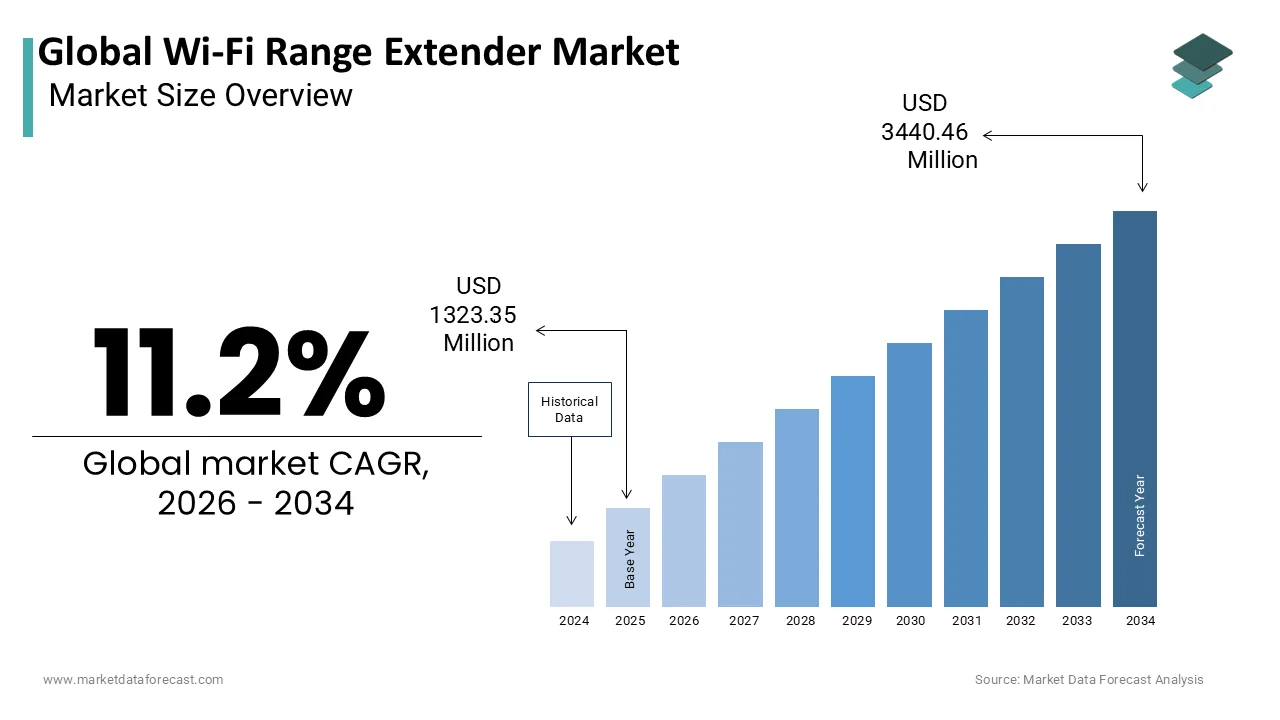
The global Wi-Fi range extender market size was valued at USD 1323.35 million in 2025, is estimated to reach USD 1471.46 million in 2026, and is projected to scale up to USD 3440.46 million by 2034, registering a compound annual growth rate (CAGR) of 11% during the forecast period from 2026 to 2034. Driven by increasing connected devices, remote work cultures, smart city initiatives, and the widespread adoption of BYOD policies, the wireless network infrastructure market continues to expand steadily worldwide.
Key Executive Metrics (At-a-Glance)
- 2025 Base Valuation: USD 1323.35 Million
- 2026 Current Valuation: USD 1471.46 Million
- 2034 Forecast Valuation: USD 3440.46 Million
- Compound Annual Growth Rate (CAGR): 11% (2026–2034)
- Dominant Type: Indoor Wi-Fi (holding major market share due to high deployment in homes and corporate offices)
- Dominant End User: Commercial (dominant share supported by enterprise network requirements and uninterrupted office connectivity)
- Fastest-Growing End User: Public Sector (propelled by smart city infrastructure and digital governance projects)
- Dominant Region: North America (leading due to robust economic growth and high consumer tech penetration)
Core Market Drivers
- Rise in Remote Work Culture: Continued preference for work-from-home arrangements across industries, requiring seamless, uninterrupted internet connections.
- Proliferation of Connected Gadgets: Escalating numbers of smart home appliances, IoT devices, and personal electronics requiring stable wireless access.
- Smart City & Digitization Investments: Government-led initiatives promoting smart grids and public internet connectivity grids.
Primary Market Restraints & Challenges
- High Installation Costs: Substantial setup expenses for advanced configurations that can deter budget-constrained small-scale businesses.
- Physical Signal Obstacles: Interference from structural materials like metals which degrade electromagnetic wave propagation and limit long-distance efficiency.
Global Wi-Fi Range Extender Market Segmentation Breakdown
| Segment Category | Leading Sub-Segment (2025 Base) | Fastest-Growing Sub-Segment (2026–2034) |
|---|---|---|
| By Type | Indoor Wi-Fi (dominant market share used in residential buildings and offices) | Outdoor Wi-Fi (fastest-growing category designed to withstand harsh weather conditions for open spaces) |
| By Product | Extenders and Repeaters (dominant share providing high area coverage and cost efficiency) | Access Points (fastest-growing category driven by enterprise network expansion) |
| By End User | Commercial (dominant segment essential for enterprise workflows and industrial environments) | Public (fastest-growing segment driven by public infrastructure and smart municipal projects) |
| By Region | North America (major consumption hub driven by high economic standing and tech adoption) | Asia-Pacific (fastest-growing regional market expanding via industrial growth in India and China alongside IoT adoption) |
Major Industry Players Profiled
Key enterprises shaping the competitive global Wi-Fi range extender market include D-Link Corporation, Linksys Group, Inc., TRENDnet, Inc., Shenzhen Tenda Technology Co., Ltd., Cisco Systems Inc., Huawei Technologies Co., Ltd., NETGEAR Inc., Aruba Networks (Hewlett Packard Enterprise Development LP), TP-Link Technologies Co. Ltd., Juniper Networks, Inc., Ruckus Wireless, Inc., Motorola Solutions, Inc., and others.
Global Wi-Fi Range Extender Market Size
The size of the global Wi-Fi range extender market was worth USD 1323.35 million in 2025. The global market is anticipated to grow at a CAGR of 11% from 2026 to 2034 and be worth USD 3440.46 million by 2034 from USD 1471.46million in 2026.
MARKET SCENARIO
The Wi-Fi range extender is a device that helps to increase the range of an existing Wi-Fi network. It can widen and even amplify the range of the wireless network to ensure that steady bandwidth and range are maintained throughout the vicinity for stable connections and Wi-Fi coverage. There are many different types of Wi-Fi available, depending on the user’s needs. Wi-Fi range extenders can eliminate the possibility of using multiple Wi-Fi networks and help save on the cost of multiple internet subscriptions. Multiple users get connected to the grid. Wi-Fi range extenders are very useful and can increase the range of networks by up to thousands of square feet.
MARKET DRIVERS
The increased number of connected devices to the internet and the rise in work-from-home culture are the primary market drivers for the Wi-Fi range extender market.
Due to COVID-19, there was a shift towards a working-from-home culture, which still prevails in many industries. To ensure uninterrupted and stable coverage, people started using Wi-Fi range extender devices. There is high internet penetration, and with the number of devices, the market is forecast to keep increasing as the Market share increases with time. The BYOD (Bring Your Own Device) culture is the latest trend, which allows employees to bring and use their own smart devices to work. Companies prefer to use Wi-Fi range extenders for company and commercial use, which has increased the Wi-Fi Range extenders market size. Digitization and growing smart cities: due to digitization, many gadgets and devices, both in homes and commercial spaces, are becoming smarter and Wi-Fi-enabled. Smart grids and smart cities need to be connected to a common grid network; a Wi-Fi range extender is used to widen this network coverage. Governments are trying to bring in digitization, and there are a lot of investments in this direction, which propel the Wi-Fi range extenders market.
MARKET RESTRAINTS
The high cost of the installation of the WiFi range extender, which small-scale industries cannot afford, is a major factor restraining the growth rate of the market.
This requires a whole manual process where the right placement of the Wi-Fi extender needs to be determined for the most optimal results. WiFi is a type of electromagnetic wave, meaning it can’t penetrate some surfaces like metals. This system could not work efficiently on long-distance connections, which is slowly degrading the demand for market value.
REPORT COVERAGE
| REPORT METRIC | DETAILS |
| Market Size Available | 2023 to 2029 |
| Base Year | 2023 |
| Forecast Period | 2024 to 2029 |
| CAGR | 11% |
| Segments Covered | By Type, Product, End User, and Region. |
| Various Analyses Covered | Global, Regional & Country Level Analysis, Segment-Level Analysis, DROC, PESTLE Analysis, Porter’s Five Forces Analysis, Competitive Landscape, Analyst Overview of Investment Opportunities |
| Regions Covered | North America, Europe, APAC, Latin America, Middle East & Africa |
| Market Leaders Profiled | D-Link Corporation, Linksys Group, Inc., TRENDnet, Inc., Shenzhen Tenda Technology Co., Ltd., Cisco Systems Inc., Huawei Technologies Co., Ltd., NETGEAR Inc., Aruba Networks (Hewlett Packard Enterprise Development LP), TP-Link Technologies Co,. Ltd., Juniper Networks, Inc., Ruckus Wireless, Inc., Motorola Solutions, Inc., and Others. |
SEGMENTAL ANALYSIS
By Type Insights
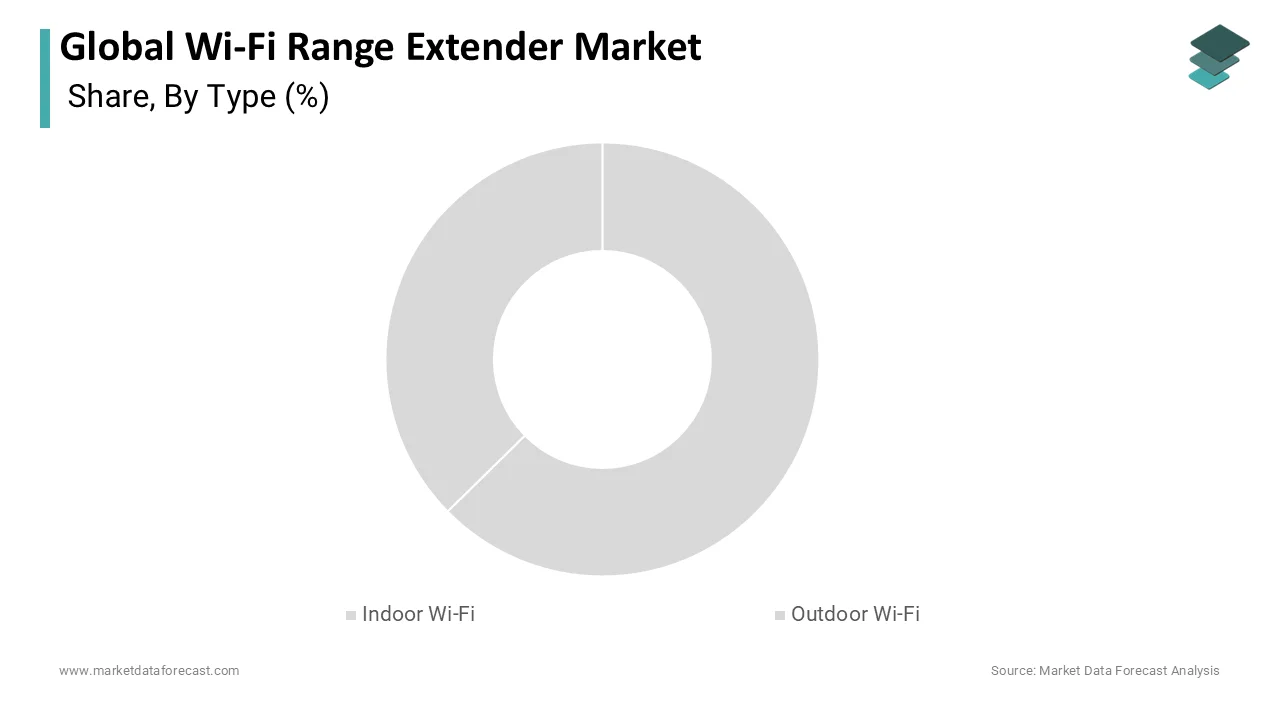
There are primarily two types of Wi-Fi range extenders available on the market: Indoor Wi-Fi and Outdoor Wi-Fi. The Indoor WiFi Segment has the largest share in the Wi-Fi range extender market. Indoor WiFi is used in indoor settings like offices, houses, or residential buildings. Outdoor WiFi is usually used for outdoor purposes and is built to withstand harsh weather and situations, making it suitable for outdoor use.
By Product Insights
Extenders and repeaters register the largest market share due to the functionality and high area of network coverage that they provide. The access points segment is growing at a faster rate during the forecast period.
By End User Insights
The Commercial segment dominates the market as WiFi networks are essential in most office jobs and industries for a seamless flow of work. According to the forecast, the public sector is likely to hit the highest CAGR.
REGIONAL ANALYSIS
North America is leading the dominant shares of the market owing to the increasing economy and rising trend towards wi-fi connectivity applications. Asia Pacific is the fastest-growing region for this market, owing to the growing number of multiple industries in India and China. The growing tendency towards the Internet of Things is majorly leveraging the growth rate of the market.
Latin America and the Middle East & Africa are expected to have steady growth opportunities during the forecast period.
KEY PLAYERS IN THE GLOBAL WI-FI RANGE EXTENDER MARKET
Companies playing a prominent role in the global Wi-Fi range extender market include D-Link Corporation, Linksys Group, Inc., TRENDnet, Inc., Shenzhen Tenda Technology Co., Ltd., Cisco Systems Inc., Huawei Technologies Co. Ltd., NETGEAR Inc., Aruba Networks (Hewlett Packard Enterprise Development LP), TP-Link Technologies Co. Ltd., Juniper Networks, Inc., Ruckus Wireless, Inc., Motorola Solutions, Inc., and Others.
MARKET SEGMENTATION
This research report on the global Wi-Fi range extender market has been segmented and sub-segmented based on type, product, end user, and region.
By Type
- Indoor Wi-Fi
- Outdoor Wi-Fi
By Product
- Extenders and Repeaters
- Access Points
- Antennas
By End User
- Residential
- Commercial
- Public
By Region
- North America
- Europe
- Asia Pacific
- Latin America
- Middle East & Africa