- Product Description Description
- Table of Contents TOC
- List of Table & Figure LOT
- Get Free Sample PDF Sample PDF
Market Size, 2025
$94.68 BnMarket Estimate, 2026
$111.72 BnMarket Forecast, 2034
$419.95 BnCAGR, 2026–2034
18%Executive Summary: Global Wireless Sensor Networks Market
- Market Scope: Comprehensive global wireless sensor networks (WSN) market analysis covering offerings, sensor types, connectivity types, end users, regional leadership frameworks, and industrial adoption metrics.
- Market Valuation: Valued at USD 94.68 billion (2025), estimated at USD 111.72 billion (2026), and projected to reach USD 419.95 billion by 2034, registering a strong CAGR of 18% (2026–2034).
- Primary Growth Drivers: Increasing demand for robust network infrastructure, advancements in Artificial Intelligence (AI), Machine Learning (ML), and Big Data Analytics, rising industrial automation across harsh and remote locations (such as oil & gas, utilities, and manufacturing), and the need to boost overall operational and system efficiency.
Key Market Segment Metrics (2026–2034)
| Category | Leading Segment (2025 Position) | Fastest-Growing Segment |
|---|---|---|
| By Offering | Hardware segment (dominates in terms of market share due to essential physical components like sensors, transceivers, and power units) | Software and Services (projected to expand rapidly with advanced data analytics and integration needs) |
| By Sensor Type | Temperature, Motion, and Pressure Sensors (held substantial baseline deployment across industrial applications) | Wireless Communication Modules (such as BLE, Zigbee, and Wi-Fi modules seeing accelerated deployment) |
| By Connectivity Type | Short-range and Cellular communication protocols (secured widespread commercial and industrial utilization) | Advanced Industrial Wireless Protocols (such as WHART and ISA100 gaining traction in harsh environments) |
| By End User | Industrial and Automotive & Transportation sectors (accounted for major revenue share) | Oil & Gas (one of the fastest-growing application areas for real-time plant monitoring and pipeline tracking) |
| By Region | North America (emerged as a priority option due to critical infrastructure, smart factories, and advanced manufacturing) | Asia-Pacific (projected to experience high growth driven by rapid industrialization and communication infrastructure expansion) |
Major Market Players & Market Structure
Market Structure: Highly competitive global wireless sensor networks landscape featuring prominent automation and semiconductor leaders competing on sensor precision, harsh-environment durability, seamless wireless communication protocols, and industrial IoT solutions.
Key Companies: ABB Ltd, STMicroelectronics, Honeywell International Inc, Texas Instruments Inc, Siemens AG, Endress+Hauser AG, Linear Technology Corporation, NXP Semiconductors, Schneider Electric, and Emerson Electric.
Global Wireless Sensor Networks Market Size
The size of the global wireless sensor network market was worth USD 94.68 billion in 2025. The global market is predicted to reach USD 111.72 billion in 2026 and USD 419.95 billion by 2034, growing at a CAGR of 18% from 2026 to 2034.

MARKET DRIVERS
The market for wireless sensor networks (WSN) is projected to grow significantly over the coming years due to the increasing demand for network infrastructure and advancements in Artificial Intelligence (AI), Machine Learning (ML), and Big Data Analytics. These technologies have enabled companies to analyze large volumes of data collected from multiple types of sensors such as temperature, motion, pressure, gas, flow, and chemical. Emerging economies worldwide focus on improving communication ties between industrial devices to ensure smooth wireless communication. As a result, industries such as oil and gas and utilities are adopting wireless sensor networks because of their ability to operate seamlessly in harsh, remote locations. Increase in the popularity of wireless sensor networks across vertical sectors such as oil & gas, automotive, manufacturing, healthcare, and other industries. Increased need to boost system efficiency and quickly implement the industrial wireless sensor networks. The advantages, such as its easy-to-use and application-specific nature, further drive its adoption.
MARKET RESTRAINTS
Increasing data security and privacy concerns are key factors hindering the market's growth.
REPORT COVERAGE
| REPORT METRIC | DETAILS |
| Market Size Available | 2025 to 2034 |
| Base Year | 2025 |
| Forecast Period | 2026 to 2034 |
| CAGR | 18% |
| Segments Covered | By Offering, Sensor Type, Connectivity Type, End User, and Region |
|
Various Analyses Covered | Global, Regional & Country Level Analysis, Segment-Level Analysis, DROC, PESTLE Analysis, Porter’s Five Forces Analysis, Competitive Landscape, Analyst Overview of Investment Opportunities |
| Regions Covered | North America, Europe, APAC, Latin America, Middle East & Africa |
| Market Leaders Profiled | ABB Ltd, STMicroelectronics, Honeywell International Inc, Texas Instruments Inc, Siemens AG, Endress+Hauser AG, Linear Technology Corporation, NXP Semiconductors, Schneider Electric, Emersion Electric, and Others. |
SEGMENTAL ANALYSIS
By Offering Insights
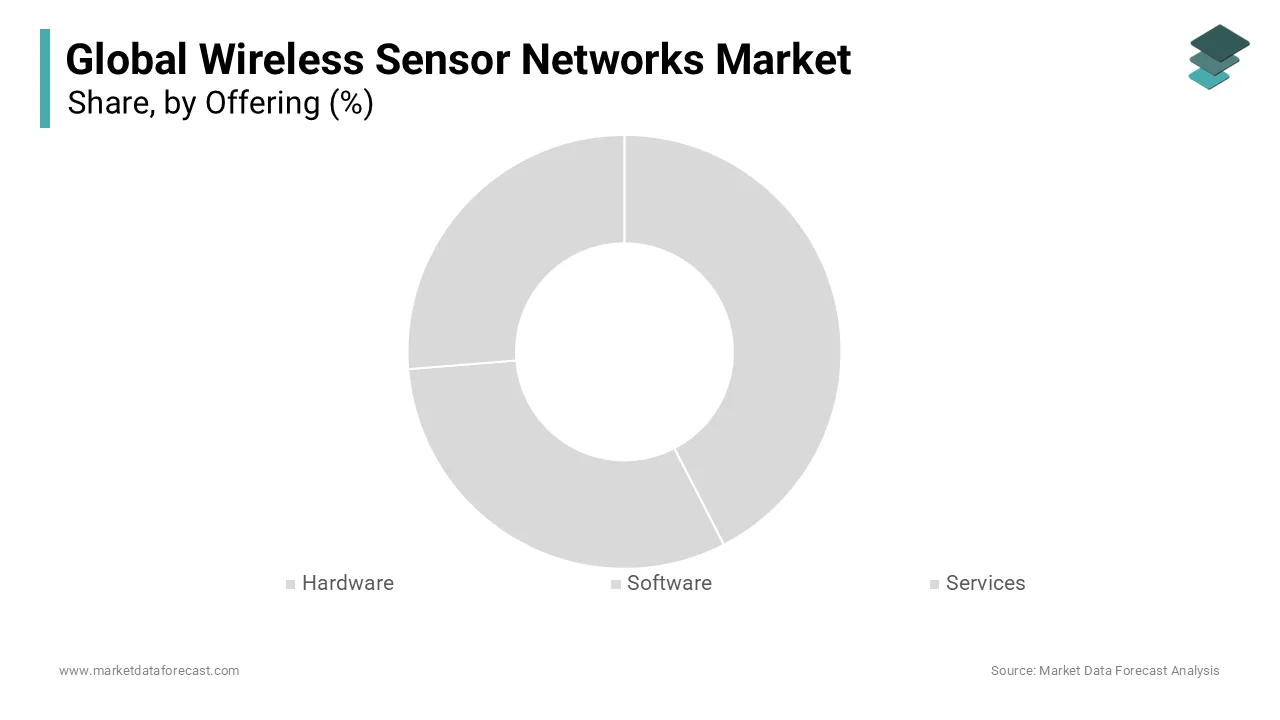
The hardware segment dominates in terms of market share. This is because wireless sensor networks depends on physical components like sensors, transceivers, and power units, which are important for data collection and communication.
By End User Insights
Oil & Gas is one of the fastest-growing application areas for WSNs, as these networks are set up at difficult sites, such as offshore natural gas fields, to detect oil flow and leakage in oil and gas pipelines. Wireless sensor networks are becoming important for companies that need real-time access to data on their plant environment, processes and equipment to avoid disruption.
REGIONAL ANALYSIS
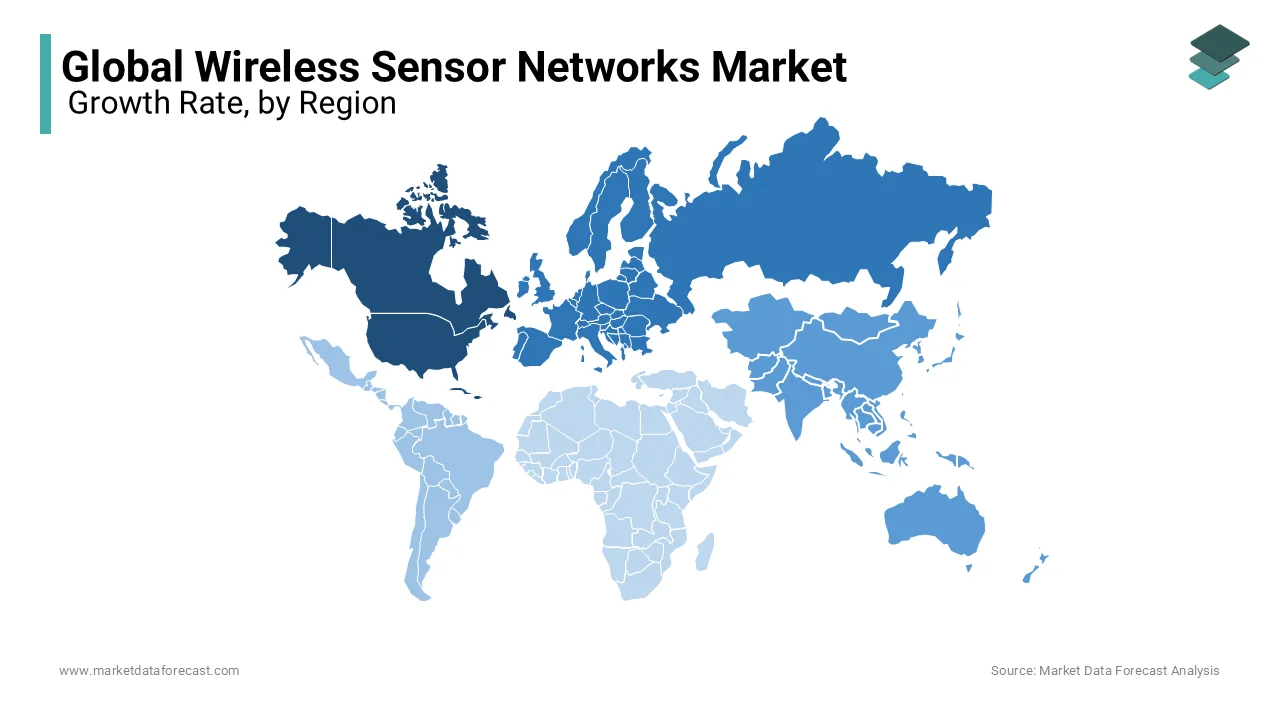
North America has emerged as a priority option for business vendors in the market under research, as the area greatly benefits from the critical infrastructure required for a solution. The introduction of smart factories and smart manufacturing and the involvement of many advanced wireless sensor network manufacturers are expected to drive the growth of the North American market in the near future. Moreover, the North American rail freight industry is also trying to leverage WSN onboard rail cars for automated tracking and alerting. In railway settings, WSN freight trains exhibit a linear chain-like topology of significant length. Also, due to their numerous advantages, wearable devices are becoming increasingly popular for industrial use due to their increasing proliferation in the commercial market.
KEY MARKET PARTICIPANTS
The major companies operating in the global wireless sensor networks market include ABB Ltd., STMicroelectronics, Honeywell International Inc., Texas Instruments Inc., Siemens AG, Endress+Hauser AG, Linear Technology Corporation, NXP Semiconductors, Schneider Electric, and Emersion Electric.
RECENT HAPPENINGS IN THE MARKET
- In November 2018, Honeywell launched the new wired gas sensors to enable secure industrial operations. The new Sense Point XRL is a fixed gas detector that tracks industrial activities for hazardous gasses such as carbon monoxide and methane.
MARKET SEGMENTATION
This research report on the global wireless sensor networks market has been segmented and sub-segmented based on the offering, sensor type, connectivity, end user, and region.
By Offering
- Hardware
- Software
- Services
By Sensor Type
- Ant
- Bluetooth
- Bluetooth Smart/Bluetooth Low Energy (BLE)
- Zigbee
- Wireless Fidelity (Wi-Fi)
- Near-Field Communication (NFC)
- Cellular Network
- Wireless Highway Addressable Remote Transducer (WHART)
- Global Navigation Satellite System (GNSS) Module
- ISA100
- Bluetooth/ Wlan
By Connectivity Type
- Ambient Light Sensors
- Motion and Position Sensors
- Temperature Sensors
- Heart Rate Sensors
- Pressure Sensors
- Inertial Measurement Units (IMU)
- Accelerometers
- Blood Glucose Sensors
- Image Sensors
- Humidity Sensors
- Carbon Monoxide Sensors
- Blood Oxygen Sensors
- Flow Sensors
- Level Sensors
- Chemical Sensors
- Electrocardiogram (ECG) Sensors
- Others
By End User
- Building Automation
- Wearable Devices
- Healthcare
- Automotive & Transportation
- Industrial
- Oil & Gas
- Retail
- Agriculture
- Aerospace & Defense
- Banking, Financial Services, and Insurance
By Region
- North America
- Europe
- Asia-Pacific
- Middle East and Africa
- Latin America