- Product Description Description
- Table of Contents TOC
- List of Table & Figure LOT
- Get Free Sample PDF Sample PDF
Market Size, 2025
$6.72 BnMarket Estimate, 2026
$7.06 BnMarket Forecast, 2034
$10.53 BnCAGR, 2026–2034
5.12%Global Wood Adhesives Market Report Summary
The global wood adhesives market was valued at USD 6.72 billion in 2025 and is estimated to reach USD 7.06 billion in 2026 and USD 10.53 billion by 2034, growing at a CAGR of 5.12% during the forecast period. Market growth is driven by increasing demand for furniture and wood-based products, rising construction and interior design activities, and expanding adoption of engineered wood materials. Wood adhesives play a critical role in enhancing bonding strength, durability, and manufacturing efficiency across furniture, flooring, cabinetry, and construction applications. The growing trend toward sustainable construction materials and customized furniture products is further supporting market expansion globally.
Key Market Trends
- Rising demand for furniture and engineered wood products is driving market growth.
- Increasing residential and commercial construction activities are boosting wood adhesive consumption.
- Growing preference for customized and modular furniture is supporting market expansion.
- Expansion of sustainable and low VOC adhesive technologies is enhancing product adoption.
- Innovation in water based and bio based adhesive formulations is influencing market development.
Segmental Insights
- Based on resin type, the synthetic resins segment accounted for 54.4% of the global wood adhesives market share in 2025. This dominance is attributed to strong bonding performance, durability, and broad industrial applications.
- Based on application, the furniture segment held a significant share of the global wood adhesives market in 2025, driven by rising production of affordable, customized, and ready to assemble furniture products.
Regional Insights
- The global wood adhesives market is experiencing steady growth across regions, supported by increasing urbanization, infrastructure development, and furniture manufacturing activities.
- Asia Pacific was the leading contributor in 2025 and accounted for 45.6% of the global wood adhesives market share, driven by rapid construction growth, expanding furniture production, and rising industrial activities across China, India, and Southeast Asia.
Competitive Landscape
The global wood adhesives market is highly competitive, with key players focusing on sustainable adhesive technologies, product innovation, and expansion of industrial manufacturing capabilities to strengthen their market position. Companies are investing in low emission formulations, water based adhesives, and advanced bonding technologies. Prominent players in the global wood adhesives market include Henkel AG & Co. KGaA, H.B. Fuller, 3M Company, Ashland Inc, Sika A.G, The Dow Chemical Company, AkzoNobel N.V, Bostik SA, Pidilite Industries, and Huntsman Corporation.
 Download Free Sample Report
Global Wood Adhesives Market Size
The global wood adhesives market size was valued at USD 6.72 billion in 2025 and is anticipated to reach USD 10.53 billion by 2034 from USD 7.06 billion in 2026, growing at a CAGR of 5.12%.
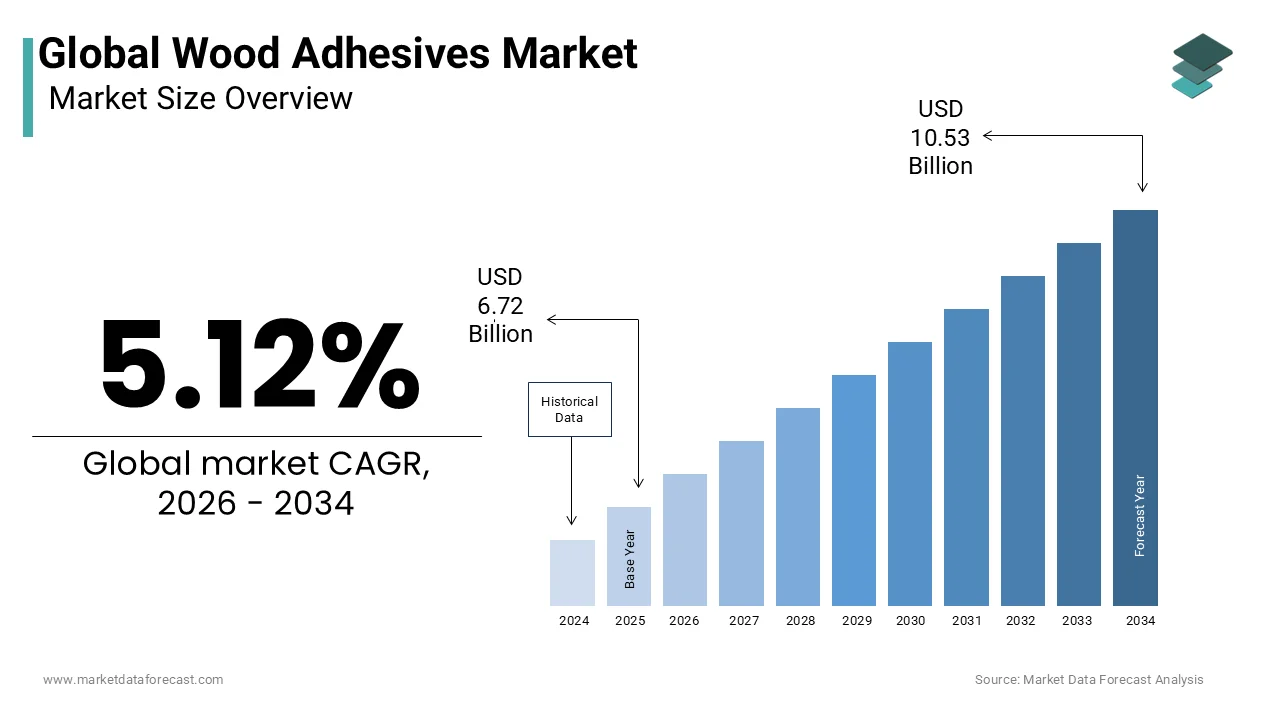
The wood adhesives is to bond wood substrates for applications in furniture manufacturing construction and engineered wood product production. These adhesives, including urea formaldehyde, phenol formaldehyde, polyvinyl acetate, and methylene diphenyl diisocyanate, are critical for creating structural integrity in composite materials, such as plywood medium density fiberboard and particleboard. As per the Food and Agriculture Organization of the United Nations, global industrial roundwood production exceeded 1.9 billion cubic meters in recent years indicating the vast scale of raw material processing that necessitates adhesive usage. The shift towards sustainable forestry practices has increased the utilization of fast-growing species which often require advanced adhesive technologies to ensure performance consistency. According to the United States Census Bureau housing starts remain a key indicator of demand with over 1.4 million units authorized annually driving consumption in structural wood panels. The American Wood Council notes that engineered wood products account for a significant portion of residential construction due to their strength and efficiency. Furthermore, the rise of prefabricated construction methods relies heavily on high performance adhesives for rapid assembly. The integration of bio-based adhesives is gaining traction as manufacturers seek to reduce reliance on petrochemical derivatives.
MARKET DRIVERS
Expansion of Engineered Wood Products in Construction
The expansion of engineered wood products in the construction sector serves due to the superior structural properties and sustainability of these materials, which is majorly propelling the growth of the wood adhesives market. Engineered wood, such as cross laminated timber glulam and oriented strand board requires high performance adhesives to bond layers of wood veneer or strands together. The use of mass timber in commercial and residential buildings has grown significantly with projects exceeding ten stories becoming more common. This trend is driven by the need for lightweight yet strong materials that offer faster construction times compared to concrete and steel. The International Code Council has updated building codes to allow taller wood structures further boosting demand. The engineered wood products utilize adhesives to maximize the strength of smaller diameter trees and fast growing species by making them economically viable. The prefabricated wall panels and roof trusses, which rely heavily on wood adhesives are used in over 80% of new homes. These components require adhesives that cure quickly and provide durable bonds under varying environmental conditions. The shift towards green building certifications such as LEED encourages the use of wood due to its carbon sequestration capabilities. Consequently, the increasing adoption of engineered wood in large scale infrastructure projects directly correlates with higher consumption of industrial wood adhesives. This structural shift ensures sustained demand for advanced adhesive formulations.
Growth in Furniture Manufacturing and Interior Design Trends
The growth in furniture manufacturing and evolving interior design trends, as consumers prioritize aesthetic appeal and durability in home furnishings is another attribute boosting the growth of te wood adhesives market. The global furniture industry relies extensively on wood-based panels, such as medium density fiberboard and particleboard, which are bonded using urea formaldehyde and polyvinyl acetate adhesives. The furniture imports and domestic production remain robust reflecting steady consumer spending on home improvement. The rise of flat pack furniture which requires precise and strong adhesive bonds for easy assembly has transformed manufacturing processes. The European Furniture Industries Confederation notes that the demand for customized and modular furniture is increasing prompting manufacturers to use versatile adhesives that support complex designs. Additionally, the trend towards solid wood finishes and veneers requires high quality adhesives that do not compromise the visual integrity of the surface. The Bureau of Labor Statistics indicates that employment in furniture manufacturing remains stable supporting continuous production volumes. Consumer preference for eco-friendly materials has also led to the adoption of low emission adhesives in furniture production. Retailers and manufacturers are responding by offering products that meet strict indoor air quality standards. The customization of living spaces through built in cabinetry and shelving further amplifies the need for reliable wood bonding solutions.
MARKET RESTRAINTS
Stringent Environmental Regulations on Formaldehyde Emissions
The stringent environmental regulations on formaldehyde emissions by limiting the use of traditional urea formaldehyde resins, which are cost effective but emit harmful volatile organic compounds. This factor is additionally hindering the growth of the wood adhesives market. Governments worldwide are implementing stricter limits on formaldehyde release from wood products to protect indoor air quality and public health. Compliance with these regulations requires manufacturers to reformulate adhesives or switch to low emission alternatives, which can be more expensive and technically challenging. The California Air Resources Board has established some of the most stringent standards globally forcing companies to adopt advanced production techniques. According to the European Chemicals Agency, formaldehyde is classified as a carcinogen leading to tighter restrictions, across the European Union. These regulatory pressures increase research and development costs for adhesive manufacturers who must invest in new technologies such as soy based or polyurethane adhesives. Small and medium sized enterprises often struggle to absorb these costs leading to market consolidation. The transition away from conventional adhesives can also result in initial performance issues such as reduced bond strength or longer curing times. Consumers may face higher prices for compliant products affecting demand in price sensitive segments.
Volatility in Raw Material Prices and Supply Chain Disruptions
The volatility in raw material prices and supply chain disruptions by creating financial instability and production delays for manufacturers is hindering the growth of the wood adhesives market. Wood adhesives are derived from petrochemical feedstocks such as formaldehyde phenol and methanol, which are subject to global oil price fluctuations. As per the United States Energy Information Administration, crude oil prices have experienced significant volatility due to geopolitical tensions and supply constraints affecting downstream chemical costs. When raw material prices surge adhesive producers face margin compression, as they attempt to pass costs onto customers who may resist price increases. Additionally, logistical challenges, such as port congestion and transportation shortages exacerbate the issue making it difficult to maintain consistent inventory levels. The Federal Reserve Bank of New York highlights that input cost inflation has been a persistent challenge for manufacturing sectors. These uncertainties make long-term contracting difficult and discourage investment in capacity expansion. Smaller adhesive manufacturers are particularly vulnerable as they lack the purchasing power to negotiate favorable terms with suppliers. The unpredictability of raw material availability forces companies to hold larger inventories tying up capital.
MARKET OPPORTUNITIES
Development of Bio Based and Sustainable Adhesives
The development of bio-based and sustainable adhesives to align with global environmental goals and consumer preferences is creating new opportunities for the growth of the wood adhesives market. Manufacturers are increasingly investing in research to create adhesives derived from renewable resources such as soy starch lignin and tannins, which reduce reliance on fossil fuels. As per the United States Department of Agriculture, bio-based products offer a lower carbon footprint and are biodegradable appealing to environmentally conscious buyers. The BioPreferred Program encourages the procurement of bio-based products by federal agencies and private sector partners driving demand. Companies are developing soy-based adhesives that match the performance of traditional urea formaldehyde resins, while emitting negligible volatile organic compounds. The innovations in lignin extraction from wood pulp are creating new opportunities for value added adhesive formulations. These advancements allow manufacturers to market their products as green and sustainable enhancing brand reputation. The construction industry is increasingly seeking Leadership in Energy and Environmental Design certification, which rewards the use of bio-based materials. Additionally, regulatory incentives and tax credits for sustainable manufacturing practices further support this transition. The potential for patenting novel bio-based formulations provides a competitive edge.
Expansion into Emerging Markets and Urbanization
The expansion into emerging countries and rapid urbanization is also to bolster new opportunities for the growth of the Wood Adhesives Market. Countries in Asia Pacific, Latin America, and Africa are experiencing significant urban growth leading to higher demand for affordable housing and infrastructure. Rapid urbanization rates in developing regions are projected to rise steadily driving construction activity. This growth fuels the demand for engineered wood products, such as plywood and particleboard, which are cost effective alternatives to solid wood. Local furniture manufacturing industries in these regions are expanding to cater to a growing middle class with increasing disposable income. International adhesive manufacturers are establishing local production facilities to serve these markets efficiently and reduce logistics costs. Partnerships with local distributors enhance market penetration and brand awareness. The adoption of modern construction techniques in emerging economies further boosts demand for high performance adhesives. Government initiatives to improve housing standards and promote industrialization support this trend.
MARKET CHALLENGES
Complexity of Recycling and End of Life Management
The complexity of recycling and end of life management, as bonded wood products are difficult to separate and process for reuse is one of the challenges for the growth of the wood adhesives market. Unlike solid wood engineered, wood products containing adhesives cannot be easily recycled due to the chemical bonds that hold the fibers together. The construction and demolition waste containing treated or bonded wood often ends up in landfills rather than being repurposed. The presence of formaldehyde and other chemicals in adhesives complicates the recycling process and raises environmental concerns. The European Environment Agency notes that current recycling technologies are limited in their ability to recover clean wood fibers from adhesive bonded panels. This limitation contradicts the circular economy principles that many governments and corporations are striving to achieve. Manufacturers face pressure to develop adhesives that allow for easier disassembly or degradation at the end of the product life cycle. The lack of standardized recycling protocols for wood composites creates uncertainty for waste management facilities. Additionally, the cost of disposing of adhesive bonded wood is increasing as landfill space becomes scarce.
Competition from Alternative Bonding Technologies
The competition from alternative bonding technologies, such as mechanical fasteners and welding by offering viable substitutes in certain applications is another factor to impede the growth of the wood adhesives market. Mechanical fasteners, including screws nails and dowels are preferred in scenarios where disassembly or repair is anticipated. As per the American Wood Council, mechanical connections are often used in conjunction with adhesives but in some cases they replace adhesives entirely, particularly in DIY and modular furniture segments. Welding technologies, such as linear friction welding are emerging as solvent free alternatives for joining wood components without adhesives. These alternatives eliminate the need for curing time and reduce health risks associated with chemical exposure. Additionally, the development of interlocking joint designs in prefabricated construction reduces reliance on adhesives. The cost effectiveness and simplicity of mechanical fasteners make them attractive for small scale projects. Adhesive manufacturers must continuously innovate to demonstrate the superior strength and aesthetic benefits of bonding compared to these alternatives. The perception that adhesives are permanent and irreversible can deter users who value flexibility.
REPORT COVERAGE
| REPORT METRIC | DETAILS |
| Market Size Available | 2025 to 2034 |
| Base Year | 2025 |
| Forecast Period | 2026 to 2034 |
| CAGR | 5.12% |
| Segments Covered | By Resin Type, Application, and Region. |
| Various Analyses Covered | Global, Regional & Country Level Analysis, Segment-Level Analysis, DROC, PESTLE Analysis, Porter’s Five Forces Analysis, Competitive Landscape, Analyst Overview of Investment Opportunities |
| Regions Covered | North America, Europe, Asia Pacific, Latin America, Middle East & Africa. |
| Market Leaders Profiled | Henkel AG & Co. KGaA, H.B. Fuller, 3M Company, Ashland Inc, Sika A.G, The Dow Chemical Company, AkzoNobel N.V, Bostik SA, Pidilite Industries, Huntsman Corporation, and Others. |
SEGMENTAL ANALYSIS
By Resin Type Insights
The synthetic resins segment was the largest by holding 54.4% of the wood adhesives market share in 2025 due to their superior bonding strength durability and resistance to environmental factors such as moisture and heat. These adhesives, including urea formaldehyde, phenol formaldehyde, and polyvinyl acetate are engineered to provide consistent performance in demanding industrial applications. The synthetic adhesives are essential for producing structural engineered wood products like cross laminated timber and oriented strand board, which require high load bearing capacity. The consistency of synthetic formulations ensures that manufacturers can meet strict quality standards required for construction and furniture production. This operational advantage is critical for large scale producers, who rely on continuous processing lines. Additionally, synthetic adhesives can be customized to specific viscosity and solid content requirements allowing for versatile application methods such as spraying rolling or curtain coating. The ability of synthetic resins to bond diverse wood species including fast growing softwoods that further enhances their dominance.
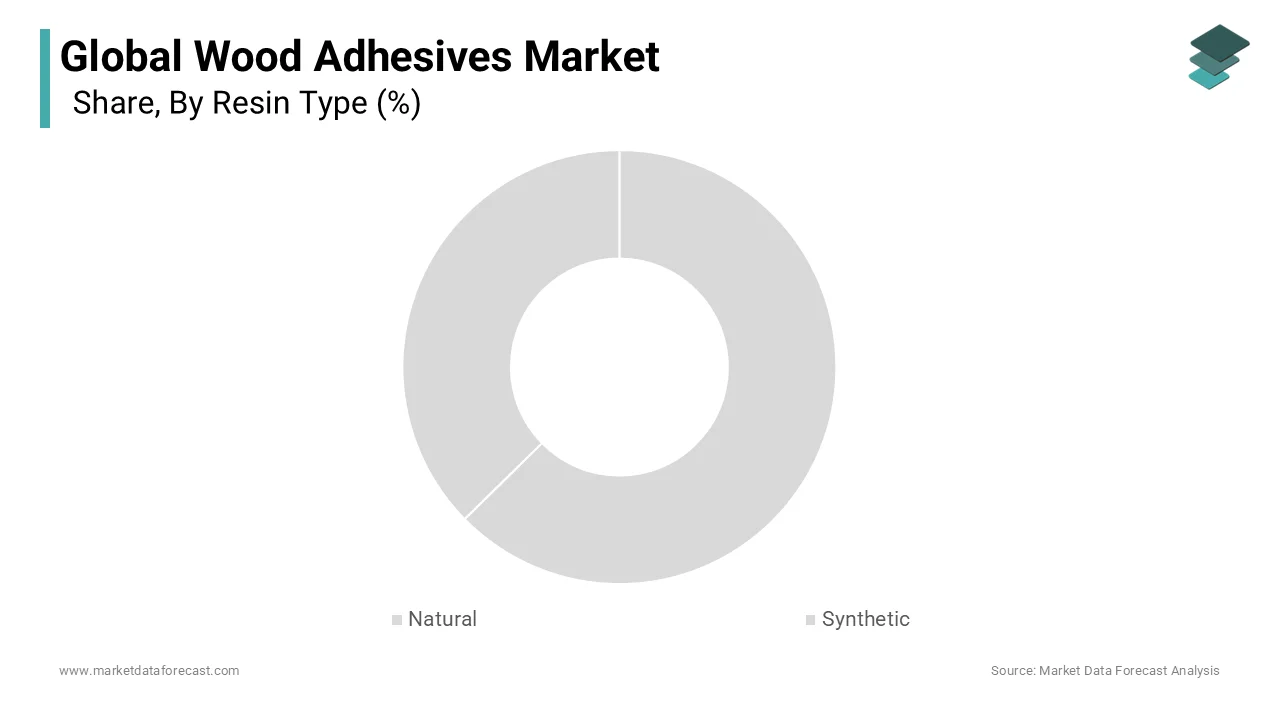
The natural resins segment is projected to witness a fastest CAGR of 6.5% from 2026 to 2034 with the increasing demand for eco-friendly and non-toxic adhesive solutions in response to health and environmental concerns. Consumers and regulators are pushing for alternatives to formaldehyde based adhesives, which are associated with indoor air pollution and potential health risks. The push for low emitting materials in green building certifications, such as LEED and WELL is accelerating the adoption of bio based adhesives. Natural adhesives derived from soy starch lignin and tannins offer a renewable and biodegradable alternative that aligns with sustainability goals. The United States Department of Agriculture promotes the use of bio preferred products through its certification program encouraging manufacturers to switch to natural formulations. Companies are investing in research to improve the water resistance and bond strength of natural adhesives making them viable for more applications. This technological progress is expanding the addressable market for natural resins beyond niche applications.
By Application Insights
The furniture segment held a significant share of the Wood Adhesives Market share in 2025 due to the high volume of production and consistent consumer demand for customized and affordable home furnishings. The global furniture industry relies heavily on wood-based panels, such as particleboard and medium density fiberboard, which are bonded using adhesives. The value of furniture imports and domestic production remains robust reflecting steady consumer spending. The rise of flat pack and ready to assemble furniture has transformed manufacturing requiring efficient and strong adhesive bonds for quick assembly. Additionally, the trend towards replacing solid wood with engineered wood in mass market furniture drives adhesive consumption due to cost and material efficiency. Consumer preferences for varied styles and finishes require adhesives that do not interfere with surface treatments such as veneering and laminating. The ability of modern adhesives to provide invisible bonds enhances the aesthetic appeal of furniture pieces. The frequent replacement cycles of furniture in both residential and commercial sectors ensure recurring demand.
The flooring and decks segment is projected to witness a fastest CAGR of 7.2% from 2026 to 2034 with the expansion of residential construction and renovation activities, particularly in the installation of engineered hardwood and laminate flooring. The flooring upgrades are among the most common home improvement projects undertaken by homeowners. Engineered wood flooring requires high performance adhesives to ensure stability and prevent warping due to moisture and temperature fluctuations. The rise of outdoor living spaces has also boosted demand for durable deck adhesives that can withstand harsh weather conditions. These materials rely on advanced adhesives for layer bonding and structural integrity. Consumer preference for aesthetically pleasing and durable flooring options drives the adoption of premium adhesive solutions. The remodeling market is further supported by an aging housing stock that requires regular updates. The Joint Center for Housing Studies of Harvard University indicates that spending on home improvements remains high providing a steady demand base. The ease of installation offered by adhesive backed flooring systems appeals to DIY enthusiasts and professional installers alike.
REGIONAL ANALYSIS
Asia Pacific Wood Adhesives Market Analysis
Asia-Pacific was the top performer in the global Wood Adhesives Market by capturing 45.6% of share in 2025 owing to the rapid urbanization industrialization and a booming construction sector in countries like China, India, and Southeast Asian nations. As per the United Nations Department of Economic and Social Affairs, the Asia-Pacific region is experiencing the fastest rate of urban growth globally driving demand for housing and infrastructure. China is the world’s largest producer and consumer of wood based panels requiring vast quantities of adhesives. Local manufacturers are expanding capacity to meet rising domestic consumption. Government initiatives to improve housing standards and promote industrialization support this trend. The availability of raw materials, such as rubberwood and bamboo facilitates local production. The adoption of modern construction techniques in emerging economies further boosts demand. The region’s growth trajectory outpaces other mature markets ensuring its continued dominance.
North America Wood Adhesives Market Analysis
North America wood adhesives market was ranked second by holding 22.3% of share in 2025 with the renovation and sustainable construction practices. The United States and Canada have large existing housing stocks that require regular maintenance and upgrades. As per the research, remodeling expenditure in the United States remains robust despite economic fluctuations. The region is a leader in adopting eco-friendly and low formaldehyde emitting adhesives due to stringent environmental regulations. The Environmental Protection Agency sets strict standards that drive innovation in sustainable bonding solutions. Consumer preference for DIY home improvement projects supports retail sales of wood adhesives. The presence of major adhesive manufacturers headquartered in the region fosters innovation and product development. High labor costs encourage the use of efficient and easy to apply adhesive systems. The market is characterized by high brand loyalty and premium product offerings.
Europe Wood Adhesives Market Analysis
Europe wood adhesives market growth is likely to witness a fastest CAGR in coming years with the environmental regulations and a strong focus on sustainability. The European Union’s REACH regulation and Construction Products Regulation mandate low emissions and safe chemical usage influencing product formulations. Consumers in Europe are highly environmentally conscious preferring products with eco labels, such as the EU Ecolabel. The renovation of older building stock is a key driver as governments aim to improve energy efficiency. The European Commission supports renovation waves to reduce carbon emissions from buildings. Countries like Germany, France, and the United Kingdom have strong furniture manufacturing sectors. The architectural heritage in Europe requires specialized adhesives for restoration projects. Innovation in high performance and sustainable adhesives is prominent in this region. The emphasis on health and indoor air quality drives demand for premium products.
Latin America Wood Adhesives Market Analysis
Latin America wood adhesives market growth is driven by urbanization and economic recovery in key countries. Brazil, Mexico, and Argentina are the largest contributors in the region. As per the Economic Commission for Latin America and the Caribbean, urbanization rates are high leading to demand for affordable housing. Government housing programs in Brazil and Mexico support low income housing projects. The middle class is expanding increasing demand for furniture and home improvement products. The region has a strong tradition of wood usage in construction and furniture. Local manufacturers compete on price and distribution reach. The adoption of international quality standards is increasing among leading players. Climate conditions in tropical areas require durable and moisture resistant adhesives. However, long term demographic trends support market growth.
Middle East and Africa Wood Adhesives Market Analysis
The Middle East and Africa wood adhesives market growth is likely to grow steadily in coming years. As per the World Bank, urbanization in Sub Saharan Africa is accelerating creating need for housing. Saudi Arabia’s Vision 2030 includes massive giga projects requiring extensive wood based materials. The hospitality sector in Dubai and Qatar supports demand for high quality furniture and finishes. In Africa the growth of the middle class in countries like Nigeria and Kenya is boosting home improvement spending. The lack of local manufacturing in some areas relies on imports. Climate challenges such as heat and dust require specialized durable adhesives. Government investments in infrastructure are key drivers in North Africa. The market is fragmented with informal sectors playing a significant role. Awareness of quality and brand value is increasing among consumers.
COMPETITIVE LANDSCAPE
The competition in the wood adhesives market is intense and characterized by the presence of large multinational chemical companies alongside specialized regional players. Major competitors differentiate themselves through technological innovation particularly in the development of eco friendly and formaldehyde free adhesives. Regulatory compliance is a key battleground as governments worldwide impose stricter limits on emissions and hazardous substances. Companies invest significantly in research and development to create bio-based alternatives that match the performance of traditional synthetic resins. Price competition remains significant in commodity segments prompting manufacturers to optimize production costs and supply chain efficiency. Strategic partnerships with furniture and construction firms enable co development of tailored solutions that enhance product stickiness. Brand reputation and technical support services are crucial for retaining industrial clients who require consistent quality.
Key Market Players
The major key players in the global wood adhesives market are
- Henkel AG & Co. KGaA
- H.B. Fuller
- 3M Company
- Ashland Inc
- Sika A.G
- The Dow Chemical Company
- AkzoNobel N.V
- Bostik SA
- Pidilite Industries
- Huntsman Corporation
Top Players in the Market
- Henkel AG is a global leader in adhesive technologies with a strong portfolio of wood bonding solutions under brands like Ponal and Loctite. The company serves diverse sectors including furniture construction and DIY markets with innovative water based and solvent free formulations. Recent actions include expanding its production capacity for bio-based adhesives to meet growing sustainability demands. Henkel invests heavily in research and development to create low emission products that comply with stringent environmental regulations. The company actively collaborates with wood panel manufacturers to develop customized bonding solutions. Its commitment to circular economy principles drives the development of recyclable adhesive systems. These strategic initiatives enhance brand loyalty and ensure long term growth in the global wood adhesives sector.
- H.B. Fuller Company is a prominent global adhesive provider offering comprehensive wood bonding solutions for industrial and consumer applications. The company specializes in polyurethane and polyvinyl acetate adhesives known for their durability and versatility. Recent strategies involve acquiring specialized adhesive businesses to expand its geographic reach and product offerings. H.B. Fuller focuses on developing high performance adhesives for engineered wood products such as cross laminated timber. The company prioritizes sustainability by introducing formaldehyde free options and reducing carbon footprints in manufacturing. The company also enhances its supply chain resilience to ensure consistent product availability. These efforts reinforce its reputation as a trusted partner in the wood industry. H.B. Fuller continues to innovate to address evolving market needs and regulatory requirements.
- Arkema S.A. is a key player in the global wood adhesives market through its specialty materials and bonding technologies. The company offers a range of reactive and thermoplastic adhesives used in furniture flooring and construction applications. Recent actions include investing in bio sourced raw materials to create sustainable adhesive formulations. Arkema focuses on innovation in polyurethane technologies which offer superior moisture resistance and strength. The company collaborates with industry partners to develop next generation bonding solutions for mass timber construction. The company expands its production facilities to meet increasing demand in emerging markets. These strategic moves strengthen its competitive position and drive growth. Arkema remains committed to delivering high value solutions that enhance performance and efficiency for wood processing industries worldwide.
Top Strategies Used by Key Market Participants
Key players in the Wood Adhesives Market primarily focus on product innovation to develop sustainable and high performance formulations. Companies invest heavily in research and development to create bio based and low volatile organic compound adhesives that meet strict environmental regulations. Strategic acquisitions allow leading firms to expand their geographic presence and diversify product portfolios. Partnerships with wood panel manufacturers facilitate the development of customized bonding solutions for specific applications. Digitalization of supply chains enhances operational efficiency and ensures timely delivery. Marketing efforts emphasize the health and environmental benefits of green adhesives to appeal to conscious consumers. Capacity expansion in emerging markets addresses growing demand from urbanization and construction activities. Compliance with global safety standards builds trust and credibility among industrial clients.
MARKET SEGMENTATION
This research report on the global wood adhesives market has been segmented and sub-segmented based on resin type, application, and region.
By Resin Type
- Natural
- Synthetic
By Application
- Flooring & Decks
- Plywood
- Furniture
- Cabinet
- Particle Board
- Windows & Doors
By Region
- North America
- Europe
- Asia Pacific
- Latin America
- Middle East and Africa