- Product Description Description
- Table of Contents TOC
- List of Table & Figure LOT
- Get Free Sample PDF Sample PDF
Market Size, 2025
$76.87 MnMarket Estimate, 2026
$83.56 BnMarket Forecast, 2034
$162.87 MnCAGR, 2026–2034
8.7%Executive Summary: Latin America Protein A Resins Market
- Market Scope: Comprehensive regional Latin American protein A resins market analysis covering product categories, matrix types, end-user sectors, country-level leadership frameworks, and downstream purification trends.
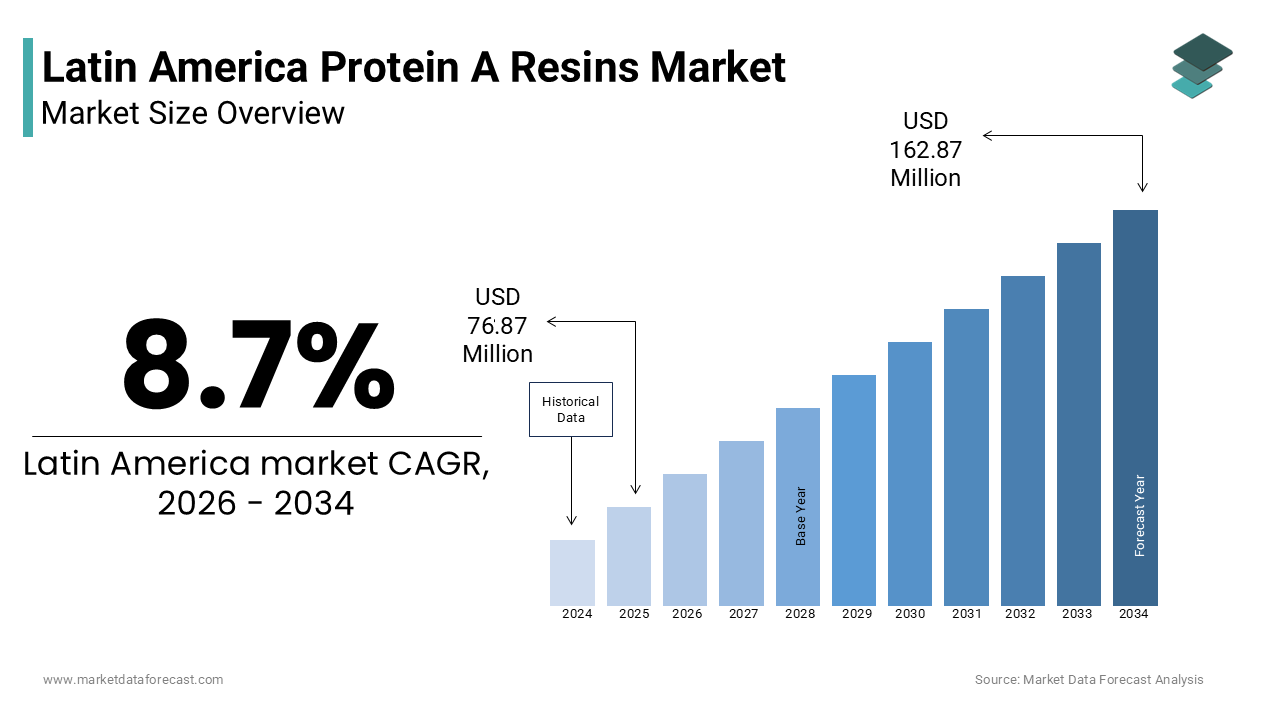
- Market Valuation: Valued at USD 76.87 million (2025), estimated at USD 83.56 million (2026), and projected to reach USD 162.87 million by 2034, registering a robust CAGR of 8.7% (2026–2034).
- Primary Growth Drivers: Strategic expansion of regional biosimilar manufacturing (via Brazil's Productive Development Partnerships), regulatory harmonization, rising continuous bioprocessing adoption, and clinical trial growth.
Key Market Segment Metrics (2026–2034)
| Category | Leading Segment (2025 Position) | Fastest-Growing Segment |
|---|---|---|
| By Product Type | Recombinant Protein A Resins (dominant by product type) | Recombinant Protein A Resins (expanding at a strong CAGR of 14.8%) |
| By Matrix Type | Agarose Matrices (lead by matrix type across regional facilities) | Organic Polymer Matrices (projected as the fastest-growing segment at a 16.2% CAGR) |
| By End-User | Biopharmaceutical Manufacturers (accounted for 68.3% of end-user share in 2025) | Clinical Research Laboratories (expected to grow at the fastest CAGR of 18.5%) |
| By Country Leadership | Brazil (leads regionally with a 42.1% market share in 2025) | Mexico (28.4% share, supported by nearshoring and expanding contract manufacturing) |
Major Market Players & Market Structure
Market Structure: Competitive regional downstream purification consumables landscape where multinational leaders leverage comprehensive validation databases while local distributors compete through inventory availability and currency hedging.
Key Companies: GE Healthcare, Repligen Corporation, Novasep, Tosoh Bioscience, GenScript, Thermo Fisher Scientific, EMD Millipore, and Expedeon Ltd.
Latin America Protein A Resins Market Size
The Latin America protein A resins market was valued at USD 76.87 million in 2025, is estimated to reach USD 83.56 million in 2025, and is projected to reach USD 162.87 million by 2034, growing at a CAGR of 8.7% from 2026 to 2034.
Protein A resins are specialized bead materials used in laboratories and factories to capture and clean antibodies from complex liquid mixtures. They work by sticking tightly and only to specific antibodies, letting scientists separate pure medical or research proteins in a single fast step. This market is intrinsically linked to the maturation of local biologics development rather than generic pharmaceutical production, serving as a critical quality determinant in downstream processing workflows. According to the Pan American Health Organization, the harmonisation of biological medicine guidelines across Latin American nations is expanding the regional biosimilar pipeline and increasing the utilization of high-affinity ligands required for purification validation. As per the Brazilian Health Regulatory Agency (ANVISA), the expansion of the country's local pharmaceutical market is driving domestic demands for advanced biomanufacturing separation media. Furthermore, according to the Inter-American Development Bank, Latin America has transitioned into a key hub for advanced biologics and active pharmaceutical ingredient manufacturing, expanding regional downstream processing capacities where Protein A resins function as essential chromatography media Consequently, this market operates at the intersection of scientific capability, regulatory harmonization, and industrial policy, where demand is derived fundamentally from the complexity of therapeutic molecules being developed locally rather than broader economic indicators or commodity pricing dynamics.
MARKET DRIVERS
Expansion of Regional Biosimilar Manufacturing Capabilities
The strategic pivot toward domestic biosimilar production is the main driver of the Latin America Protein A resins market. According to the Brazilian Ministry of Health, the country’s Productive Development Partnerships framework drives collaborative local biomanufacturing agreements for strategic biological medicines, expanding long-term domestic consumption of Protein A chromatography resins. As per Mexico’s Federal Commission for Protection against Sanitary Risk (COFEPRIS), regulatory evaluation workflows assess complex biosimilar applications against rigorous quality frameworks, validating the downstream purification standards required at regional biological facilities. Unlike innovative biologics developed globally, regional biosimilar projects prioritize cost efficient manufacturing using standardized Protein A platforms to demonstrate comparability with reference products, ensuring consistent resin selection across multiple developers. According to the Argentine Chamber of Pharmaceutical Specialties (CAEME), regional manufacturing expansions for innovative biological treatments drive increased reliance on high-affinity capture mechanisms to optimize industrial downstream separation workflows. The industrial policy driven expansion transforms resin procurement from sporadic research purchasing into predictable commercial scale consumption, anchoring demand in national health sovereignty objectives that remain resilient despite macroeconomic volatility because they address structural dependencies on imported medicines.
Regulatory Harmonization Accelerating Biologics Pipeline Maturation
Convergence toward international regulatory standards is fuelling adoption of premium resins in the Latin America Protein A resins market. These resins are capable of meeting stringent purity and viral clearance specifications. As per the Brazilian Health Regulatory Agency (ANVISA), the enforcement of RDC 658/2022 establishes comprehensive Good Manufacturing Practices for medicines, compelling biological drug manufacturers to validate robust downstream purification protocols to maintain strict safety compliance. According to the Institute of Public Health of Chile (ISP), regional clinical trial protocols require systematic downstream validation for complex biological entities, expanding the utilization of GMP-grade purification media across authorized research centers. As per the National Food and Drug Surveillance Institute (INVIMA), ongoing structural alignment with global benchmarking models enhances the verification of domestic biotechnology platforms and the localized procurement of regulated chromatography consumables. The regulatory elevation eliminates technical barriers that previously confined regional production to simpler molecules, enabling advancement into sophisticated antibody therapies that require advanced Protein A media with superior binding capacity alkali stability and leachate control characteristics essential for global market access aspirations.
MARKET RESTRAINTS
Currency Volatility Disrupting Imported Consumable Procurement
Exchange rate instability severely constrains the consistent acquisition of these resins, which restricts the growth of the Latin America Protein A resins market. These resins are predominantly manufactured in North America, Europe, and Asia and are priced in hard currencies. According to the Economic Commission for Latin America and the Caribbean (ECLAC), significant macroeconomic currency fluctuations across major regional economies inflate the landed procurement costs of imported bioprocessing consumables and chromatography media. As per studies, downstream separation and affinity purification media account for a substantial percentage of total biological development costs, causing regional operational margins to compress during supply chain shocks. According to Banco de México, historical currency conversion values alter foreign procurement capacity for domestic institutions, shifting localized capital allocations for advanced bio-manufacturing components and premium purification consumables. Import tariffs and foreign exchange controls implemented during balance of payments crises further compound accessibility challenges, with Venezuela and Ecuador experiencing chronic stockouts due to inability to secure letters of credit for specialized bioprocessing supplies. This monetary turbulence decouples resin utilization from scientific need because procurement decisions become dictated by liquidity constraints rather than experimental design or production schedules, creating artificial demand suppression that persists until macroeconomic stabilization enables predictable cross border trade flows.
Limited Domestic Manufacturing Base Creating Supply Dependency
Absence of regional production capacity creates structural vulnerability to global supply chain disruptions and geopolitical tensions, which hinders the expansion of the Latin America Protein A resins market. As per the United Nations Industrial Development Organization (UNIDO), regional biological supply chain infrastructure remains highly dependent on international trade networks for critical separation reagents, prolonging lead times for specialized downstream chromatography resins. According to the Latin American Federation of the Pharmaceutical Industry (FIFARMA), systemic logistics friction and international import blockages disrupt therapeutic raw material pipelines, directly forcing production timeline realignments for domestic biological operations. According to sources, commercial Protein A chromatography resins are manufactured using specialized patent-protected ligand technologies, restricting alternative procurement options for regional downstream bioprocessing laboratories. Research institutions face even greater precarity as they lack volume leverage to secure priority allocation during scarcity periods, causing project timelines to slip unpredictably. Until technology transfer initiatives or joint ventures establish localized synthesis capabilities, the market will remain hostage to external production decisions. These decisions are made in distant geographies without consideration for regional supply security imperatives or developmental priorities unique to Latin American biotechnology ecosystems.
MARKET OPPORTUNITIES
Academic Industry Collaboration Enabling Indigenous Technology Development
Strategic partnerships between universities and biopharmaceutical companies offer opportunities to develop regionally adapted Protein A resin technologies, which are predicted to boost the growth of the Latin America Protein A resins market. They also reduce import dependency. According to the São Paulo Research Foundation (FAPESP), targeted institutional funding supports downstream bioprocess intensification and novel affinity ligand optimization research at prominent regional universities. As per Mexico's National Council of Humanities, Sciences and Technologies (CONAHCYT), domestic innovation frameworks incentivize material science and protein engineering research collaborations to improve local biomanufacturing platforms. According to Chile’s Production Development Corporation (CORFO), strategic financial instruments support technological innovation in local biotechnology industries, encouraging downstream purification development across regional enterprises. These initiatives address fundamental knowledge gaps while creating intellectual property assets owned locally rather than licensed perpetually from foreign entities. Success would enable customization of resin properties to match specific antibody subclasses prevalent in regional pipelines or accommodate buffer systems optimized for tropical climate storage constraints. By embedding resin development within national innovation systems rather than treating it as purely commercial procurement, Latin America can cultivate sovereign capabilities that serve long term strategic interests beyond immediate market transactions.
Continuous Bioprocessing Adoption Driving Next Generation Media Demand
Transition toward continuous manufacturing paradigms creates demand for advanced Protein A resins engineered for multicolumn chromatography and extended operational lifetimes, which is expected to propel the expansion of the Latin American market. As per the International Society for Pharmaceutical Engineering (ISPE), regional adoption of continuous biomanufacturing and automated multi-column chromatography drives industrial market demand for highly stable and efficient downstream purification resins. According to the Oswaldo Cruz Foundation (Fiocruz), long-term institutional modernization programs upgrade regional biological manufacturing infrastructure, accelerating competitive sourcing for next-generation automated multi-column Protein A chromatography media. As per research, major local biological manufacturers expand facilities with advanced continuous capture technologies to maximize throughput and improve the processing efficiency of purification resins. The paradigm shift favors premium resin suppliers offering integrated solutions combining media hardware and process expertise rather than commodity vendors competing solely on price. Early movers capturing these emerging installations establish reference sites and validation datasets. These create switching costs and lock in effects persisting through decades of facility operation, positioning them advantageously as regional continuous processing adoption accelerates beyond pioneer adopters toward mainstream implementation.
MARKET CHALLENGES
Technical Expertise Gaps Limiting Optimal Utilization
Insufficient specialized workforce trained in advanced chromatography techniques inhibits the growth of the Latin America Protein A resins market. As a result, this prevents effective deployment of high performance Protein A resins across regional facilities. According to regional biotechnology training network reports, expanding hands-on bioprocess engineering training programs addresses critical knowledge deficits in complex downstream affinity chromatography optimization. This skills deficit manifests as suboptimal column loading premature resin replacement and inadequate cleaning validation, collectively increasing consumable costs above theoretical minimums according to sources. Multinational suppliers provide application support but cannot substitute for embedded institutional knowledge required for day to day decision making and problem solving. Without systematic investment in vocational training programs aligned with evolving technology landscapes, expensive resins will continue underperforming due to human factors rather than product limitations. This underperformance perpetuates skepticism about advanced media value propositions and slows adoption rates regardless of availability or affordability improvements achieved through other interventions.
Cold Chain Integrity Risks Compromising Resin Performance
Inadequate temperature-controlled logistics infrastructure threatens Protein A resin stability during distribution and storage across vast geographic areas with unreliable utilities, which holds back the expansion of the Latin American market. According to the World Bank Logistics Performance Index, enhancing specialized cold chain infrastructure across major developing pharmaceutical transit hubs protects temperature-sensitive biological purification reagents from ambient thermal exposure. As per the Brazilian Health Regulatory Agency (ANVISA), stringent regulatory import guidelines monitor thermal conditions during customs clearance, preventing the degradation of specialized bioprocess separation components. Rural research institutions in Peru and Bolivia face even greater challenges with electricity outages, making compliant storage impossible without expensive backup generators rarely available in academic budgets. Even when resins arrive intact, inconsistent warehouse conditions at distributor facilities can cause latent degradation undetectable upon receipt but manifesting as reduced binding capacity or increased ligand leaching during use. These infrastructural deficits create hidden quality risks that undermine confidence in supply chains and force conservative inventory practices increasing working capital burdens. Technical specifications alone cannot guarantee field performance until cold chain reliability improves through infrastructure investment and regulatory enforcement. This limitation restricts effective market penetration to elite urban centers with robust utility networks while excluding vast regions where biotechnology development could otherwise flourish.
REPORT COVERAGE
| REPORT METRIC | DETAILS |
| Market Size Available | 2025 to 2034 |
| Base Year | 2025 |
| Forecast Period | 2026 to 2034 |
| CAGR | 8.7% |
| Segments Covered | By Product Type, Matrix Type, Application End-User, and Region |
| Various Analyses Covered | Global, Regional and Country Level Analysis, Segment-Level Analysis, Drivers, Restraints, Opportunities, Challenges; PESTLE Analysis; Porter's Five Forces Analysis, Competitive Landscape, Analyst Overview of Investment Opportunities |
| Regions Covered | Mexico, Brazil, Argentina, Chile, and the Rest of Latin America (RoLA). |
| Market Leaders Profiled | GE Healthcare (U.S.), Repligen Corporation (U.S.), Novasep (France), Tosoh Bioscience (Japan), GenScript (China), Thermo Fisher Scientific (U.S.), EMD Millipore (U.S.), and Expedeon Ltd. (U.K.). |
SEGMENTAL ANALYSIS
By Product Type Insights
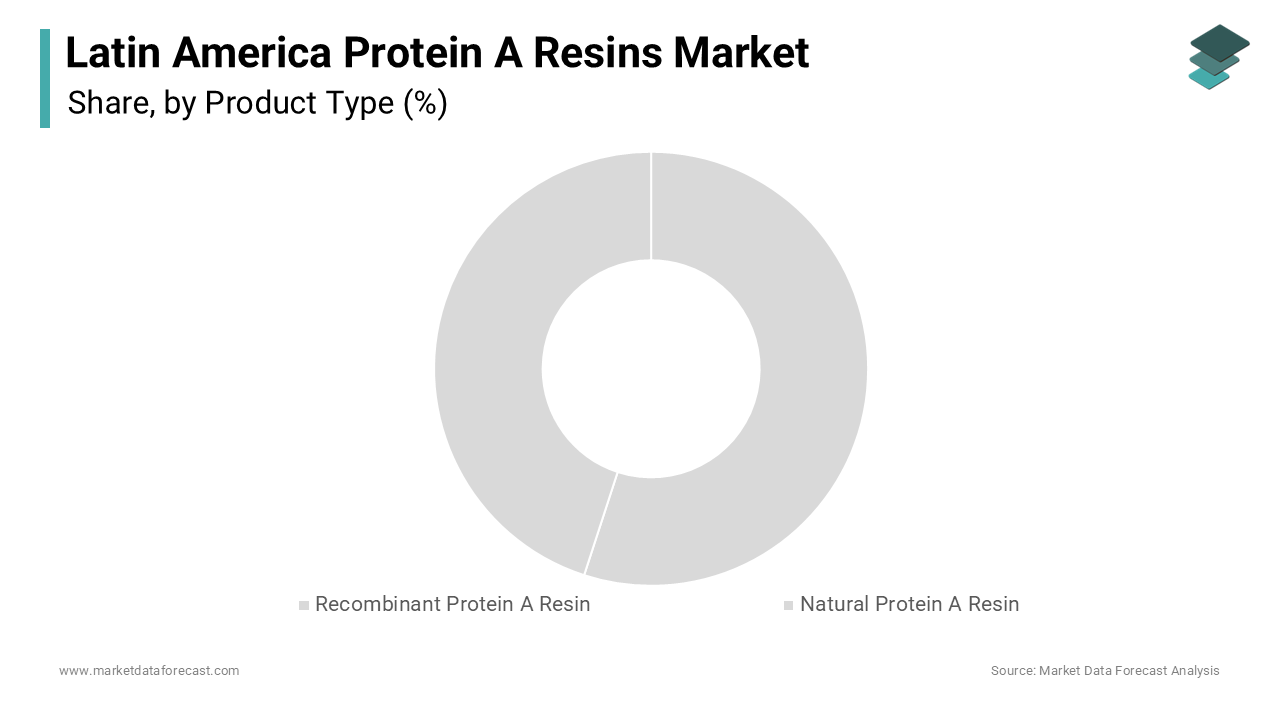
The recombinant Protein A resin segment remained the largest in the Latin America market in 2025 and occupied a commanding share. This supremacy of the segment was credited to regional regulatory harmonization mandates that enforce stringent viral safety and ligand purity standards, which natural variants cannot consistently meet. According to the Pan American Health Organization (PAHO), the ongoing regional alignment of biological product standards with global safety frameworks drives local manufacturers to implement recombinant ligand systems to mitigate endogenous contamination risks. Unlike research applications where cost sensitivity may tolerate higher risk, commercial manufacturing prioritizes regulatory certainty over marginal price differences because approval delays or post marketing compliance failures carry financial consequences far exceeding resin procurement savings. This regulatory driven selection bias ensures recombinant dominance as pipelines advance toward licensure and legacy natural resin processes undergo mandatory upgrades to maintain market authorization under evolving regional standards aligned with global best practices.
Recombinant Protein A resins dominate commercial scale operations due to engineered alkali stability enabling aggressive cleaning protocols that extend column lifetime and reduce cost per gram of purified antibody. As per studies, upgrading to advanced recombinant chromatography media enhances column cycling longevity during harsh sodium hydroxide sanitization cycles, lowering long-term consumable spending. According to research, adopting alkali-stable recombinant purification media across monoclonal antibody platforms reduces downstream consumable expenditures within cost-sensitive regional markets. Natural Protein A degrades rapidly under alkaline conditions forcing manufacturers to use milder sanitants requiring longer contact times and yielding incomplete microbial inactivation, creating both operational inefficiency and compliance risk. This performance advantage transforms recombinant resins from technical upgrade into economic necessity as regional manufacturers compete globally on cost efficiency while maintaining GMP compliance through validated robust cleaning regimes impossible with legacy natural ligands.
The recombinant Protein A resin segment is also expanding at a CAGR of 14.8%, due to regional biosimilar development programs mandating contemporary purification technologies for regulatory acceptance. According to the Brazilian Ministry of Health, Productive Development Partnerships utilize technology transfer agreements for monoclonal antibodies that specify modern recombinant extraction steps to secure regulatory compliance during comparability studies. As per research, multi-million dollar capital allocations into modern biosimilar manufacturing infrastructure expand dedicated multi-column recombinant chromatography capabilities to meet evolving regulatory paths. Unlike established innovator biologics developed decades ago on natural platforms, new entrants lack legacy constraints and adopt current best practices from inception to avoid costly mid development process changes. This greenfield adoption pattern creates structural growth momentum independent of replacement cycles as each new biosimilar program adds incremental recombinant resin demand without cannibalizing existing natural resin installations tied to approved legacy processes.
Transition toward continuous bioprocessing in Latin America drives disproportionate demand for recombinant Protein A resins engineered for multicolumn chromatography and extended operational durability. As per the International Society for Pharmaceutical Engineering (ISPE), industrial adoption of periodic countercurrent chromatography systems requires advanced high-flow recombinant resins with enhanced mechanical strength and accelerated mass transfer kinetics. According to the Oswaldo Cruz Foundation (Fiocruz), the integration of continuous downstream processing modules utilizes high-capacity recombinant resins to minimize industrial footprints and maximize column lifetimes. Early movers establishing continuous processing reference sites generate validation datasets and operator expertise favoring incumbent recombinant suppliers, raising switching costs for competitors and concentrating growth among technology leaders aligned with regional intensification ambitions beyond traditional batch manufacturing paradigms.
By Matrix Type Insights
The agarose matrix segment led the Latin America Protein A resin market and captured a significant share in 2025. This leading position of the segment was attributed to extensive regulatory precedent and universal compatibility with monoclonal antibody purification workflows established over four decades of industrial use. According to regional downstream processing validation guidelines, agarose-based matrices serve as the historical benchmark for commercial biological manufacturing due to their proven regulatory track record and universal compliance parameters. As per the Brazilian Health Regulatory Agency (ANVISA), reference clinical data packages from previously authorized biological therapeutics expedite the technical review pathways for subsequent monoclonal antibody regulatory filings using established chromatography configurations. Unlike synthetic polymers requiring extensive extractables leachables studies and glass silica posing fragility concerns at production scale, agarose offers predictable performance characteristics documented in thousands of peer reviewed publications and regulatory submissions globally. This historical inertia creates formidable switching barriers where perceived risk of alternative matrices outweighs theoretical performance benefits, ensuring agarose maintains leadership as default choice for risk averse manufacturers navigating complex regulatory environments with limited tolerance for unproven technologies.
Agarose matrices dominate large scale manufacturing due to superior mechanical stability under high flow rates and bed heights encountered in production columns exceeding 1 meter diameter. As per commercial downstream performance standards, crosslinked agarose-based purification matrices handle linear flow velocities in industrial production columns effectively, ensuring dynamic binding capacities match upstream harvest fluid volumes. According to regional biopharmaceutical operational records, massive industrial-scale separation columns achieve optimal dynamic binding capacity at low residence times, satisfying essential commercial scalability targets in Latin American biological markets. Glass and silica alternatives fracture under industrial scale pressures while some organic polymers exhibit irreversible deformation causing channeling and yield loss. This physical robustness translates directly into operational reliability and cost predictability critical for manufacturers managing thin margins and tight supply commitments where unplanned downtime or batch losses carry severe financial and reputational consequences exceeding any unit price advantages offered by less durable matrix technologies.
The organic polymer matrices segment is on the rise and is expected to be the fastest growing segment in the market by witnessing a CAGR of 16.2% from 2026 to 2034 owing to demand for faster processing speeds and higher productivity in capacity constrained regional facilities. According to industrial separation matrix performance tests, synthetic organic polymer resins provide elevated volumetric productivity at high linear flow velocities, maximizing downstream purification throughput without requiring greater manufacturing floor space. As per sources, migrating to advanced polymeric purification matrices shortens downstream chromatography steps, improving overall facility asset utilization and commercial output. These performance advantages address acute regional constraints, making process intensification via advanced media economically preferable to greenfield expansion. As manufacturers seek to maximize output from existing infrastructure amid rising demand, polymeric resins offer immediate throughput gains without construction timelines or regulatory revalidation burdens associated with facility modifications.
Superior chemical stability of organic polymer matrices drives adoption as manufacturers implement more stringent sanitization protocols to meet evolving regulatory expectations and extend resin lifetime. As per sources, advanced organic polymer matrices tolerate high-concentration sodium hydroxide exposure during aggressive sanitization cycles, preserving baseline column binding capacities over time. According to research, validating high-concentration caustic washing protocols on chemical-resistant resins yields superior bioburden reduction, reinforcing the viral safety margins required for global biosimilar registrations. The chemical resilience addresses dual pressures of tightening viral clearance requirements and operational efficiency needs where longer resin lifetimes and faster turnaround times directly impact unit economics. As regional regulators align cleaning validation expectations with global standards, polymeric matrices offer compliance pathway unavailable to traditional agarose platforms facing fundamental chemical limitations.
By End User Insights
The Biopharmaceutical manufacturers segment dominated the Latin America Protein A resin market and accounted for a 68.3% share in 2025. This dominance of the segment was driven by commercial production campaigns. According to the Latin American Federation of the Pharmaceutical Industry (FIFARMA), expanding regional manufacturing outputs for innovative biological treatments drive consistent commercial demand parameters for advanced downstream purification reagents. Unlike academic institutions buying milliliter quantities for exploratory work or clinical labs purchasing intermittently for trial material, manufacturers operate continuous production schedules with validated resin inventories replenished through standing supply agreements. This volume concentration creates structural market leadership where manufacturer procurement decisions determine supplier revenue stability and capacity planning horizons. Even modest increases in manufacturing utilization translate to significant resin demand growth, anchoring market fundamentals in industrial production metrics rather than discretionary research funding subject to budgetary volatility.
Commercial manufacturers drive demand for highest specification Protein A resins due to GMP compliance requirements that exceed research grade tolerances for ligand leaching endotoxin and bioburden. As per the Brazilian Health Regulatory Agency (ANVISA), the enforcement guidelines of RDC 658/2022 mandate validated Good Manufacturing Practices across pharmaceutical infrastructure, ensuring full traceability and high quality standards for imported biological extraction materials. The quality tiering creates value segmentation where manufacturers willingly pay premiums for compliance assurance that researchers cannot justify within grant budgets. Consequently, manufacturer segment captures disproportionate revenue share relative to volume because unit prices reflect embedded regulatory value and quality system costs absent in lower tier segments, reinforcing economic dominance beyond mere consumption quantity differentials.
The clinical research laboratories segment is likely to experience the fastest CAGR of 18.5% during the forecast period. This rapid expansion of the segment is propelled by surging biologics clinical trial activity requiring GMP compliant trial material production. According to studies, active development portfolios for novel interventional monoclonal antibody therapies are expanding across major healthcare territories, driving localized demand for clinical-grade purification resins. Unlike academic research funded by unpredictable grants, clinical trial material production follows defined protocols with committed sponsorship funding ensuring reliable resin procurement aligned with trial timelines. As regional sites gain experience and regulatory confidence attracts multinational sponsors, clinical research volume growth compounds creating sustained demand acceleration outpacing mature manufacturing segment growth rates tied to slower capacity expansion cycles.
Expansion of regional contract development and manufacturing organizations creates concentrated clinical research laboratory demand as they establish dedicated preclinical and Phase 1 2 production suites. According to regional contract manufacturing industrial reports, continuous multi-million dollar investments expand local contract development and manufacturing infrastructure, increasing regional clinical-scale bioreactor throughput and downstream consumable procurement. These CDMOs aggregate demand from multiple small developers who individually lack volume to justify direct supplier relationships but collectively represent significant market segment when served through centralized procurement. As outsourcing trends accelerate among cash constrained startups and virtual biotechs, CDMO mediated resin consumption grows faster than direct manufacturer purchasing because it enables access to professional grade materials and expertise without capital investment in dedicated facilities, democratizing access to advanced purification technologies across broader developer ecosystem.
REGIONAL ANALYSIS
Brazil Protein A Resins Market Analysis
Brazil was the top performer in the Latin America Protein A resin market and captured a 42.1% share in 2025. This prominence of the Brazilian market was supported by its advanced biopharmaceutical manufacturing base and strategic government led technology transfer programs. According to the Brazilian Ministry of Health, the country’s Productive Development Partnerships framework drives local biomanufacturing collaborations for monoclonal antibodies across state-owned laboratories and private facilities, expanding the long-term domestic consumption of Protein A chromatography resins. As per the Brazilian Health Regulatory Agency (ANVISA), the enforcement of RDC 658/2022 establishes comprehensive Good Manufacturing Practices for medicines, compelling biological drug manufacturers to optimize downstream purification platforms and validate resin reuse protocols to ensure stringent regulatory compliance. According to the São Paulo Research Foundation (FAPESP), localized academic and institutional funding lines support advanced bioprocess research and downstream intensification projects, fostering an innovation ecosystem aimed at enhancing regional manufacturing capabilities. Brazil’s market leadership reflects unique convergence of industrial policy regulatory sophistication and public health infrastructure creating demand drivers distinct from purely private sector dynamics governing other regional markets.
Mexico Protein A Resins Market Analysis
Mexico followed closely behind in the Latin America Protein A resin market and held an 28.4% share in 2025. This position of the Mexican market was driven by strong private sector biopharmaceutical presence and proximity enabled integration with North American supply chains. According to Mexico's Federal Commission for Protection against Sanitary Risk (COFEPRIS), the evaluation and approval of complex biosimilar therapies require robust downstream validation and high-affinity purification performance to align with international regulatory expectations. As per studies, regional biological companies like Silanes Laboratories and Landsteiner Scientific run commercial-scale formulation and production operations, forming localized private sector demand centers for specialized chromatography resins. According to regional life sciences supply chain studies, Mexico's geographical proximity to the United States provides competitive transit times for biological separation consumables, minimizing inventory carrying costs and reducing downstream logistics disruption risks. As per sources, nearshoring trends drive multi-million dollar investments into Mexican contract manufacturing infrastructure, adding commercial bioprocess capacity that accelerates domestic demand for downstream purification media. Mexico’s market position benefits from NAFTA era regulatory harmonization and logistics infrastructure creating competitive advantages in speed and reliability that partially offset labor and utility cost differentials versus other regional locations.
Argentina Protein A Resins Market Analysis
Argentina is another key player in the Latin America Protein A resin market because of a sophisticated private biotechnology sector operating despite severe macroeconomic headwinds and currency controls. According to the Argentine Chamber of Pharmaceutical Specialties (CAEME), domestic biological drug manufacturing expands local healthcare options within state-regulated markets, thereby accelerating downstream demand for purification materials. As per research, private biopharmaceutical leaders like mAbxience and Elea Phoenix utilize dedicated manufacturing facilities to supply critical biological treatments, anchoring local consumption of Protein A chromatography resins. Government incentives for import substitution including tax credits and preferential financing for local manufacturing partially offset currency disadvantages, preserving demand levels that pure market economics would eliminate. Argentina’s market trajectory demonstrates resilience of technologically capable private sector adapting to extreme volatility through institutional workarounds and policy support mechanisms unavailable in less strategically important industries, maintaining regional relevance despite macroeconomic dysfunction.
Chile Protein A Resins Market Analysis
Chile grew steadily in the Latin America Protein A resin market. It punches above its weight through advanced research infrastructure and an emerging biotechnology startup ecosystem that attracts international investment. As per Chile’s Production Development Corporation (CORFO), strategic state-backed investment channels fund comprehensive technological innovations and biotechnology projects, expanding local infrastructure development for downstream bioprocess components. According to local institutional research parameters, technology centers and biotechnology development entities advance regional cell culture and optimization research, driving clinical-scale utilization of advanced separation media. As per the Undersecretariat for International Economic Relations (SUBREI), Chile’s extensive network of free trade agreements covers markets representing nearly 90% of global GDP, establishing duty-free import advantages for specialized biological purification media. Chile’s market position reflects strategic niche as innovation hub and regulatory gateway where advanced technology adoption occurs earlier than larger neighbors despite smaller absolute volumes, creating demonstration effects and knowledge spillovers influencing regional best practices beyond proportional market share.
COMPETITIVE LANDSCAPE
Competition in the Latin America Protein A resins market features intense rivalry among multinational life science corporations specialized chromatography suppliers and emerging regional distributors vying for position across fragmented national jurisdictions with divergent regulatory frameworks procurement mechanisms and technical maturity levels. Multinational leaders leverage comprehensive portfolios global validation databases and brand recognition to dominate commercial manufacturing segments where regulatory risk aversion favors established platforms with extensive precedent. Specialized suppliers compete through superior technical service responsiveness customized validation support and flexible commercial terms appealing to mid tier manufacturers and clinical research organizations lacking volume leverage with larger vendors. Regional distributors gain ground through local inventory availability currency hedging capabilities and relationship networks enabling access to cash constrained customers unable to navigate complex international procurement processes. Differentiation increasingly derives from embedded technical support regulatory navigation assistance and workforce development services rather than product specifications alone as core resin technologies converge toward functional equivalence. Barriers to entry remain high due to regulatory validation requirements lengthy qualification cycles and trust based purchasing patterns favoring incumbents with proven track records in GMP environments. Success ultimately depends on balancing global technological sophistication with deep contextual adaptation across heterogeneous markets where uniform regional strategies fail without country specific customization reflecting local regulatory priorities infrastructure realities and human capital constraints unique to each national ecosystem.
KEY MARKET PLAYERS
A few prominent companies operating in the Latin America Protein A Resins Market include
- GE Healthcare
- Repligen Corporation
- Novasep
- Tosoh Bioscience
- GenScript
- Thermo Fisher Scientific
- EMD Millipore
- Expedeon Ltd.
Top Players in the Latin America Protein A Resins Market
Cytiva
Cytiva maintains significant involvement in the Latin America Protein A resins market through its comprehensive MabSelect portfolio serving major biopharmaceutical manufacturers across Brazil Mexico and Argentina. The company recently expanded its technical application center in São Paulo during 2024 to provide hands on process development support for continuous bioprocessing adoption using BioSMB platforms. Cytiva partnered with Fiocruz to validate next generation recombinant Protein A resins for vaccine production ensuring compliance with ANVISA RDC 658 requirements implemented in 2024. Educational initiatives trained over 200 regional engineers on alkali stable resin optimization addressing critical workforce gaps limiting advanced media utilization. These strategic actions reinforce commitment to building local technical capacity while supporting sovereign manufacturing objectives beyond transactional supply relationships throughout the region.
Thermo Fisher Scientific
Thermo Fisher Scientific contributes substantially to the Latin America Protein A resins landscape through Poros MabCapture platform optimized for high flow performance demanded by regional process intensification initiatives. The company inaugurated a dedicated bioprocess demonstration lab in Mexico City in 2025 enabling clients to test polymeric resins under actual operating conditions before committing to commercial scale procurement. Thermo Fisher collaborated with Silanes Laboratories to implement continuous capture workflows reducing downstream processing time by 35 percent for biosimilar campaigns targeting COFEPRIS approval pathways. Supply chain enhancements established regional distribution hubs in Panama and São Paulo cutting delivery times from 4 weeks to 7 days mitigating currency volatility impacts on inventory planning. These efforts demonstrate focus on operational enablement and supply reliability tailored to unique Latin American infrastructure constraints rather than global standardized approaches.
Merck MilliporeSigma
Merck MilliporeSigma plays a vital role in the Latin America Protein A resins market through Eshmuno A platform emphasizing chemical robustness and regulatory compliance for demanding GMP environments. The company launched Portuguese and Spanish language technical documentation packages in 2024 specifically addressing ANVISA and COFEPRIS validation requirements reducing regulatory friction for local manufacturers. Merck partnered with Argentina’s mAbxience to validate extended caustic cleaning protocols achieving 200 cycle lifetime on Eshmuno A resin despite challenging water quality conditions common in regional facilities. Training programs conducted across Chile Colombia and Peru certified 150 operators on advanced sanitization techniques maximizing resin value extraction. These localized adaptations reflect deep understanding that success requires more than product specifications but embedded support systems addressing specific operational realities and regulatory landscapes unique to Latin American biomanufacturing ecosystems.
Top Strategies Used by Key Market Participants
Key players in the Latin America Protein A resins market prioritize localization strategies over global standardization to address unique regulatory environments infrastructure limitations currency volatility and workforce capability gaps across diverse national contexts. Companies invest in regional technical application centers demonstration labs and training facilities to build indigenous expertise necessary for advanced resin utilization beyond initial sales transactions. Strategic partnerships with government health institutions universities and private manufacturers facilitate technology transfer regulatory alignment and validation data generation supporting both public health sovereignty objectives and commercial market development. Supply chain resilience initiatives including regional distribution hubs safety stock programs and flexible payment terms mitigate import dependency risks exacerbated by foreign exchange controls and logistics disruptions common across the region. Portfolio adaptation emphasizes alkali stable recombinant platforms compatible with aggressive sanitization protocols required by tropical storage conditions and evolving viral safety standards rather than pushing global best sellers unsuited to local constraints. Educational investments target critical workforce gaps through vocational training university curriculum collaboration and certification programs ensuring human capital development matches technological sophistication of supplied media. Public private engagement aligns commercial offerings with national industrial policies productive development partnerships and import substitution incentives creating shared value propositions transcending traditional vendor customer dynamics. These multifaceted approaches reflect sophisticated understanding that sustainable market position requires embedding within local innovation ecosystems rather than maintaining distant transactional relationships vulnerable to macroeconomic shocks and political shifts.
MARKET SEGMENTATION
This research report on the Latin America Protein A Resins market has been segmented and sub-segmented into the following categories
By Product Type
- Recombinant Protein A Resin
- Natural Protein A Resin
By Matrix Type
- Agarose
- Organic Polymer
- Glass or Silica
By Application
- Immunoprecipitation
- Antibody Purification
By End User
- Biopharmaceutical Manufacturers
- Clinical Research Laboratories
- Academic Institutions
By Country
- Mexico
- Brazil
- Argentina
- Chile
- Rest of Latin America