- Product Description Description
- Table of Contents TOC
- List of Table & Figure LOT
- Get Free Sample PDF Sample PDF
Market Size, 2025
$1,159.43 MnMarket Estimate, 2026
$1,300.77 MnMarket Forecast, 2034
$1,945.57 MnCAGR, 2026–2034
5.92%Executive Summary: Medical Power Supply Market
- Market Scope: Global medical power supply market analysis covering current types, application sectors, regional leadership frameworks, and healthcare device deployment metrics.
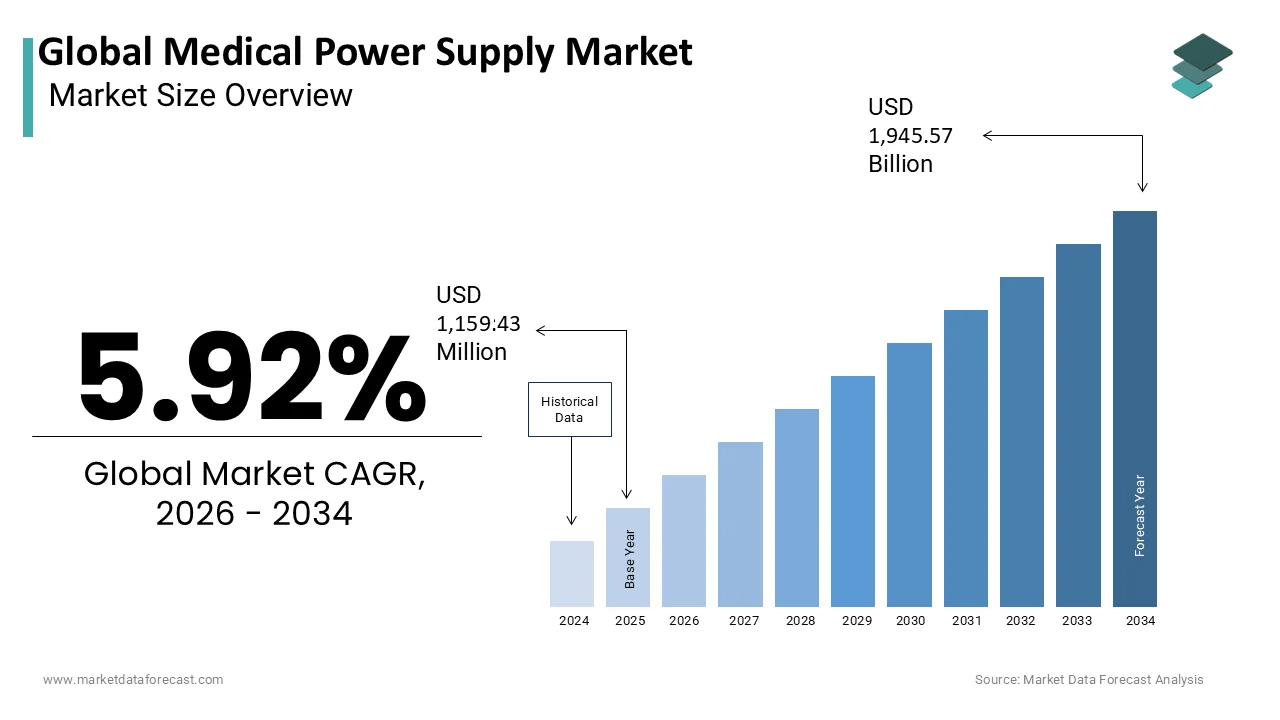
- Market Valuation: Valued at USD 1,159.43 million in 2025, estimated at USD 1,300.77 million in 2026, and projected to reach USD 1,945.57 million by 2034, registering a CAGR of 5.92% from 2026 to 2034.
- Primary Growth Drivers: Increasing number of healthcare facilities, rising prevalence of chronic diseases, growing demand for portable and wearable medical devices, technological advancements in healthcare equipment, and expanding healthcare expenditure worldwide.
Key Market Segment Metrics (2026–2034)
| Category | Leading Segment (2025 Position) | Fastest-Growing Segment |
|---|---|---|
| By Current / Supply Type | AC-DC power supply segment (held the largest market share in 2025, supported by widespread use across medical equipment) | External medical power supply segment (witnessing fastest growth due to portable, compact, and home healthcare devices) |
| By Application | General clinical monitoring and surgical equipment power systems | Diagnostic equipment (projected to register highest growth rate driven by early disease diagnosis and advanced tech) |
| By Technology & Innovation | Standard enclosed and open-frame AC-DC medical power modules | Compact, energy-efficient power units, wireless/implantable medical power technologies, and portable devices |
| By Region / Country | North America (dominates global market owing to rapid adoption of advanced medical technologies and deployment) | Asia-Pacific (anticipated to experience fastest growth, led by China, India, Taiwan, South Korea, and Singapore) |
Major Market Players & Market Structure
Market Structure: Highly competitive global medical power electronics landscape focused on continuous product innovation, compact and energy-efficient power supply solutions, portable medical technology investments, and strategic expansion.
Key Companies: TDK Lambda, SL Power Electronics, Emerson Network Power, ICCNexergy, Powerbox, Astrodyne Corporation, Delta Electronics Inc., Mean Well Enterprises Co., Ltd., and Excelsys Technology.
 Download Free Sample Report
Global Medical Power Supply Market Size
The Global Medical Power Supply Market is projected to grow from USD 1,159.43 million in 2025 to USD 1,300.77 million in 2026 and reach USD 1,945.57 million by 2034, registering a CAGR of 5.92% from 2026 to 2034.
The medical power supply market encompasses specialized electrical components designed to convert and regulate power for critical healthcare equipment, ensuring patient safety and operational reliability. These devices include internal and external adapters that meet stringent isolation and electromagnetic compatibility standards required by regulatory bodies. According to the World Health Organization, approximately 15% of hospital admissions in developing countries are due to adverse events linked to faulty medical equipment or infrastructure failures, underscoring the vital role of reliable power systems in clinical settings. As per the International Electrotechnical Commission, compliance with IEC 60601-1 standards is mandatory for all medical electrical equipment, driving manufacturers to invest heavily in certified power solutions that prevent electrical shocks and ensure uninterrupted operation. These statistics highlight the non-negotiable requirement for high-quality power supplies in maintaining the integrity of diagnostic and therapeutic devices. The market dynamics are further influenced by the proliferation of portable medical devices, the expansion of home healthcare services, and the increasing complexity of imaging and monitoring systems. As healthcare facilities prioritize patient safety and equipment uptime, the demand for robust, compliant, and efficient medical power supplies continues to rise across global healthcare infrastructures.
MARKET DRIVERS
Proliferation of Portable and Home Healthcare Devices
The rapid expansion of portable medical devices and the shift towards home-based care directly fuel the medical power supply market expansion. Patients increasingly prefer managing chronic conditions such as diabetes, sleep apnea, and respiratory disorders at home that require reliable battery charging and power conversion solutions. According to the Centers for Disease Control and Prevention, the number of adults using home health care services in the United States has increased by over 20% in recent years, driven by an aging population and the desire for cost-effective care. This trend necessitates lightweight, durable, and safe external power adapters that can operate in diverse domestic environments without compromising safety standards. As per the Journal of Medical Internet Research, remote patient monitoring devices, which rely on consistent power delivery for data transmission, are becoming integral to modern healthcare management. These devices require power supplies that offer low leakage current and high efficiency to ensure continuous operation and data accuracy. The miniaturization of medical electronics also demands smaller form-factor power modules that do not sacrifice performance. As healthcare providers expand telehealth and home care programs, the volume of portable devices deployed rises, creating a sustained need for specialized medical-grade power solutions that guarantee patient safety outside clinical settings.
Stringent Regulatory Standards and Patient Safety Requirements
Strict regulatory frameworks and the imperative for patient safety significantly favor the adoption of certified medical power supplies over generic industrial alternatives, which is another major market driver. Healthcare regulations mandate rigorous testing for electrical isolation, electromagnetic interference, and thermal management to prevent harm to patients and operators. According to the International Electrotechnical Commission, medical power supplies must comply with IEC 60601-1 standards, which specify strict limits on leakage current and require enhanced insulation barriers. This regulatory pressure compels original equipment manufacturers to source power components from specialized suppliers who can provide documented compliance and traceability. As per the Food and Drug Administration, extensive validation is required for power systems used in critical care equipment such as ventilators and infusion pumps to ensure fail-safe operation during power fluctuations. According to the Association for the Advancement of Medical Instrumentation, power-related failures account for a significant portion of medical device recalls, highlighting the critical nature of component quality. Hospitals and clinics prioritize equipment with certified power supplies to mitigate liability risks and ensure uninterrupted care. Consequently, the inability of non-compliant generic power supplies to meet these rigorous standards drives healthcare providers and device manufacturers to invest in premium medical-grade solutions, sustaining market growth through mandatory adherence to safety protocols.
MARKET RESTRAINTS
High Costs of Certification and Compliance Testing
The substantial costs associated with obtaining and maintaining regulatory certifications for medical power supplies significantly restrain the medical power supply market growth. Achieving compliance with global standards such as IEC 60601-1, UL 60601, and EN 60601 requires extensive testing, documentation, and third-party verification, which can be prohibitively expensive for smaller manufacturers. According to Underwriters Laboratories, the certification process for a new medical power supply model can take several months and cost tens of thousands of dollars, depending on the complexity and target markets. This financial burden limits the ability of small and medium-sized enterprises to compete with established players who have amortized these costs over large production volumes. Furthermore, the need for regular recertification when standards are updated adds to ongoing operational expenses. As per the European Committee for Electrotechnical Standardization, frequent updates to safety norms require manufacturers to continuously invest in redesign and retesting to maintain compliance. These high entry barriers result in higher unit costs for medical power supplies compared to industrial equivalents, making them less attractive for cost-sensitive applications. Consequently, the expense of compliance restricts market fragmentation and keeps prices elevated, limiting adoption in resource-constrained healthcare settings where budget constraints are acute.
Complexity of Global Regulatory Harmonization
The lack of harmonized global regulatory standards for medical power supplies creates significant complexities and delays in market access for manufacturers. Each region maintains distinct certification requirements, testing protocols, and approval timelines, forcing companies to navigate a fragmented landscape. According to the World Health Organization, regulatory divergence between major markets such as the United States, Europe, and Asia increases the time to market for new products by up to 40% due to redundant testing and administrative hurdles. This fragmentation forces manufacturers to develop multiple variants of the same product to meet different regional specifications, increasing production complexity and inventory costs. As per the International Medical Device Regulators Forum, while efforts toward harmonization are ongoing, significant differences remain in the interpretation and enforcement of safety standards. These inconsistencies create uncertainty for suppliers and delay the availability of advanced power solutions in emerging markets. The need to manage multiple certification bodies also strains resources and slows down innovation cycles. Until greater regulatory alignment is achieved, manufacturers will continue to face inefficiencies that hinder their ability to respond quickly to global demand, thereby restraining overall market growth and limiting the widespread availability of standardized medical power technologies.
MARKET OPPORTUNITIES
Integration of Smart Power Management and IoT Connectivity
The integration of smart power management features and Internet of Things connectivity presents a promising opportunity for the global medical power supply market. Modern power units equipped with digital communication interfaces can monitor energy consumption, detect faults, and transmit diagnostic data to central management systems. According to the Institute of Electrical and Electronics Engineers, smart grid technologies and IoT-enabled devices are expected to reduce energy waste in healthcare facilities by up to 15% through optimized power distribution and load balancing. This capability allows hospitals to track the usage patterns of medical equipment and predict maintenance needs before failures occur. As per the Journal of Clinical Monitoring Systems, real-time power status monitoring improves patient safety by alerting staff to potential battery depletion or power irregularities in critical care devices. Manufacturers can leverage this trend by offering power supplies with embedded sensors and software platforms that integrate with hospital information systems. This shift towards intelligent power solutions opens new revenue streams through software subscriptions and data services. As healthcare facilities digitize their operations and prioritize energy efficiency, the demand for smart medical power supplies is poised to grow, creating a lucrative niche for innovators who can seamlessly integrate these technologies into existing infrastructure.
Growth in Renewable Energy and Green Healthcare Initiatives
The growing emphasis on sustainability and green healthcare initiatives offers significant opportunities for the development of energy-efficient and eco-friendly medical power supplies. Hospitals are increasingly adopting renewable energy sources and seeking to reduce their carbon footprint, driving demand for power supplies with high efficiency ratings and minimal environmental impact. According to the World Green Building Council, the healthcare sector accounts for approximately 4.4% of global greenhouse gas emissions, prompting institutions to implement strict energy conservation measures. High-efficiency medical power supplies with active power factor correction and low standby power consumption help facilities meet these sustainability goals. Additionally, the use of recyclable materials and reduced hazardous substances in power supply manufacturing aligns with global environmental regulations such as the Restriction of Hazardous Substances Directive. Manufacturers can differentiate their offerings by providing detailed environmental impact assessments and energy-saving certifications. As per the American Hospital Association, members are encouraged to adopt sustainable practices, including the procurement of energy-efficient medical equipment. As regulatory pressure and corporate social responsibility goals intensify, the demand for green medical power solutions will rise. This trend creates opportunities for manufacturers to innovate in materials and design, capturing market share among environmentally conscious healthcare providers.
MARKET CHALLENGES
Supply Chain Disruptions and Component Shortages
Persistent supply chain disruptions and shortages of critical electronic components pose significant challenges to the consistent production and delivery of medical power supplies. The global semiconductor crisis and logistical bottlenecks have led to extended lead times and increased costs for key ingredients such as microcontrollers and capacitors. According to the Semiconductor Industry Association, lead times for essential electronic components have doubled in recent years, affecting the ability of power supply manufacturers to meet urgent healthcare demands. These delays disrupt the production schedules of medical device manufacturers who rely on just-in-time inventory models, potentially delaying the availability of critical equipment like ventilators and monitors. Additionally, the reliance on single-source suppliers for specialized magnetics and semiconductors increases vulnerability to geopolitical tensions and natural disasters. As per the Resilience Supply Chain Initiative, diversification strategies are often costly and time-consuming, leaving many manufacturers exposed to risk. These disruptions force companies to hold larger inventories, tying up capital and increasing storage costs. Until supply chains become more resilient and diversified, the medical power supply market will remain susceptible to external shocks that hinder consistent growth and service reliability, impacting the broader healthcare ecosystem.
Rapid Technological Obsolescence and Innovation Pressure
The rapid pace of technological advancement in medical devices creates pressure for continuous innovation in power supplies, leading to short product life cycles and high research and development costs. As medical equipment becomes more sophisticated with higher power densities and advanced features, power supplies must evolve to meet these changing requirements. According to IEEE Spectrum, the miniaturization of medical devices requires power modules that are smaller yet more powerful, demanding significant investment in new materials and design techniques. Manufacturers struggle to keep up with these evolving specifications while maintaining compliance with rigorous safety standards. The fast obsolescence of older technologies forces companies to frequently update their product lines, increasing operational complexity and costs. Additionally, the emergence of new wireless charging technologies and battery chemistries requires power supply designers to adapt quickly to stay relevant. The constant need for innovation strains resources and increases the risk of product failure if new designs are not thoroughly validated. This dynamic environment challenges manufacturers to balance speed to market with reliability, making it difficult to maintain a competitive edge without substantial ongoing investment in research and development.
REPORT COVERAGE
| REPORT METRIC | DETAILS |
| Market Size Available | 2025 to 2034 |
| Base Year | 2025 |
| Forecast Period | 2026 to 2034 |
| Segments Covered | By Current Type, Type, Application, and Region |
| Various Analyses Covered | Global, Regional & Country-Level Analysis, Segment-Level Analysis, Drivers, Restraints, Opportunities, Challenges, PESTLE Analysis, Porter’s Five Forces Analysis, Competitive Landscape, Analyst Overview of Investment Opportunities |
| Regions Covered | North America, Europe, Asia Pacific, Latin America, Middle East & Africa |
| Market Leader Profiled | TDK Lambda, SL Power Electronics, Emerson Network Power, ICCNexergy, Powerbox |
SEGMENTAL ANALYSIS
By Current Type
The AC-DC power supplies segment occupied 65.6% of the global market share in 2025. The dominance of the AC-DC power supplies segment in the global market can be credited to its fundamental role in converting alternating current from wall outlets into direct current required by most medical devices and its universal compatibility with existing electrical infrastructure in hospitals and clinics worldwide. Most medical facilities rely on standard AC mains power, necessitating efficient and safe conversion to low-voltage DC for sensitive electronic components. According to the International Electrotechnical Commission, over 90% of medical electrical equipment requires AC-DC conversion to operate safely within patient care environments, ensuring a massive baseline demand. As per the World Health Organization, reliable power conversion is critical for maintaining the functionality of essential diagnostic and therapeutic devices in both developed and developing regions. This widespread dependency ensures that AC-DC power supplies remain the backbone of medical device electrification. The need for isolation transformers and leakage current protection in these units further cements their importance in patient safety protocols. As healthcare facilities expand and upgrade their equipment, the requirement for certified AC-DC converters grows proportionally. The standardized nature of AC power distribution means that these supplies are indispensable across all medical specialties, from intensive care units to outpatient clinics, sustaining their market leadership through continuous replacement and new installation cycles.

On the other side, the DC-DC power supplies segment is estimated to register a CAGR of 9.03% over the forecast period in the global market owing to the surge in portable and battery-operated medical devices that require efficient internal voltage regulation. Wearable health monitors, handheld diagnostic tools, and mobile infusion pumps rely on batteries that provide variable voltage levels, necessitating precise DC-DC conversion to power specific components. According to the Journal of Medical Engineering and Technology, the market for portable medical devices has grown by over 25% in recent years, driven by the shift towards home healthcare and remote patient monitoring. This trend directly increases the demand for compact and high-efficiency DC-DC converters that maximize battery life and minimize heat generation. According to the Institute of Electrical and Electronics Engineers, advanced power management techniques using DC-DC converters can extend battery life by up to 30%, a critical factor for user acceptance of wearable technologies. As patients increasingly manage chronic conditions at home, the need for reliable and long-lasting portable devices rises. Manufacturers are integrating sophisticated DC-DC topologies to support multiple voltage rails within small form factors. This technological necessity drives the fast growth of the segment, as every portable medical device requires one or more DC-DC converters to function effectively and safely.
By Type Insights
The external power supplies segment led the market by holding 54.9% of the global market share in 2025. The growth of the external power supplies segment in the global market is attributed to its ease of use, simplified certification processes for device manufacturers, flexibility in deployment, and the simplified regulatory compliance it offers to original equipment manufacturers of medical devices. By using a pre-certified external power supply, device makers can leverage the existing safety certifications of the power unit, significantly reducing the time and cost required for their own product approvals. According to the International Electrotechnical Commission, modular power supplies certified to IEC 60601-1 allow device manufacturers to focus on the safety of the medical device itself rather than the power input stage. This streamlining of the validation process accelerates time to market for new medical innovations. As per the Food and Drug Administration, the use of standardized components is encouraged to enhance supply chain reliability and safety tracking. External supplies also facilitate global distribution, as manufacturers can simply swap the plug configuration for different regions without redesigning the entire device. This operational efficiency makes external power supplies the preferred choice for a wide range of medical equipment, from consumer health gadgets to professional diagnostic tools. The ability to quickly replace a faulty power supply without returning the entire medical device for repair also enhances customer satisfaction and reduces downtime. These advantages sustain the segment's leadership through widespread adoption across diverse medical applications.
On the other hand, the configurable power supplies segment is predicted to witness a CAGR of 10.3% over the forecast period in the global market owing to the increasing demand for flexibility in research and development and prototyping of new medical technologies. Innovators and engineers require power sources that can be easily adjusted to test various voltage and current combinations without designing custom circuits from scratch. According to the National Institutes of Health, investment in biomedical research and development has increased significantly, leading to a surge in experimental medical devices that require adaptable power solutions. Configurable power supplies allow researchers to simulate different operating conditions and optimize device performance efficiently. As per IEEE Spectrum, modular and configurable power platforms reduce development time by up to 40%, enabling faster iteration and innovation. This agility is crucial in the competitive medical technology landscape where speed to market is a key success factor. Universities and corporate R&D labs are increasingly adopting configurable units to support diverse projects ranging from wearable sensors to robotic surgical tools. The ability to reconfigure a single power supply for multiple applications reduces inventory costs and simplifies laboratory management. As medical innovation accelerates, the demand for versatile and adaptable power solutions continues to rise, driving the segment’s exceptional growth rate.
By Application Insights
The medical monitoring equipment segment had 45.9% of the global market share in 2025 due to the ubiquitous presence of patient monitors in hospitals, clinics, and home care settings and the critical need for continuous and accurate tracking of patient vital signs in acute and chronic care settings. Patient monitors are essential in intensive care units, emergency rooms, and general wards, where uninterrupted power is vital for patient safety. According to the Society of Critical Care Medicine, hemodynamic monitoring is performed on millions of patients annually, creating a massive installed base of devices that require reliable power supplies. Any failure in power delivery can lead to missed alerts and delayed interventions, posing serious risks to patient health. As per the American Heart Association, the importance of continuous cardiac monitoring for early detection of arrhythmias is emphasized, driving the deployment of advanced monitoring systems in both hospital and home environments. These devices rely on stable DC power to ensure sensor accuracy and data transmission integrity. The high volume of monitoring equipment in healthcare facilities ensures consistent demand for medical-grade power supplies. As healthcare providers focus on improving patient outcomes through real-time data, the reliance on robust monitoring systems grows. This operational necessity sustains the segment's leadership, as power supplies are fundamental to the functionality of every monitor in use.
However, the home patient care equipment segment is projected to witness a prominent CAGR of 9.05% over the forecast period owing to the rising prevalence of chronic diseases and the demographic shift towards an aging population. Conditions such as sleep apnea, chronic obstructive pulmonary disease, and kidney failure require ongoing management that is increasingly being delivered at home. According to the World Health Organization, noncommunicable diseases account for 74% of all deaths globally, with many patients requiring daily therapeutic interventions using home medical devices. This epidemiological reality creates a sustained and growing demand for reliable home care equipment. As per the United Nations Department of Economic and Social Affairs, the number of people aged 65 and older is projected to double by 2050, increasing the pool of individuals needing home-based medical support. These devices rely on efficient and safe power supplies to operate continuously in domestic environments. The convenience and comfort of home care drive patients to adopt these technologies, boosting market volume. As healthcare systems seek to reduce hospital burdens, the promotion of home care intensifies. This demographic and clinical trend ensures that home patient care equipment remains the fastest-growing application for medical power supplies.
COUNTRY LEVEL ANALYSIS
North America Medical Power Supply Market Analysis
North America occupied 40.5% of the global market share in 2025 and is likely to experience steady market expansion and technological modernization over the next few years due to the advanced healthcare infrastructure, high healthcare expenditure, and stringent regulatory standards. The United States is the primary contributor, with a mature market characterized by widespread adoption of advanced medical technologies. According to the Centers for Medicare and Medicaid Services, national health expenditure in the US exceeded 4 trillion dollars annually, supporting significant investment in medical equipment and infrastructure. This financial capacity drives demand for high-quality and compliant power supplies. The presence of major medical device manufacturers and regulatory bodies like the FDA ensures rigorous adherence to safety standards, favoring premium power solutions. The shift towards value-based care and home healthcare is also prominent, increasing demand for portable and home care devices. The region leads in the adoption of smart and connected medical devices, requiring sophisticated power management systems. Strong intellectual property protection and a robust supply chain further support market stability. North America serves as a hub for innovation, with early adoption of new technologies such as AI-enabled diagnostics and robotic surgery. These factors combine to make the region the most lucrative and technologically advanced market for medical power supplies globally.
Europe Medical Power Supply Market Analysis
Europe is expected to maintain steady clinical modernization and high safety compliance standards over the next few years, representing a significant and mature market in the Medical Power Supply sector, characterized by strong public healthcare systems and comprehensive regulatory frameworks. Countries like Germany, France, and the United Kingdom are key contributors, with high standards of clinical care and widespread access to medical technologies. According to the European Commission, healthcare spending in the EU averages around 10% of GDP to ensure steady funding for medical equipment upgrades. The implementation of the Medical Device Regulation has raised safety and quality benchmarks, driving demand for certified and reliable power supplies. An aging population in Western Europe contributes to a higher prevalence of chronic diseases, increasing the need for monitoring and home care devices. The region is also a leader in sustainability initiatives, promoting energy-efficient medical equipment and green power solutions. Regulatory harmonization across member states facilitates market access for manufacturers. Reimbursement policies generally support essential medical technologies, although cost containment measures influence purchasing decisions. The focus on interoperability and digital health integration drives demand for smart power supplies. Despite economic variations, the commitment to universal healthcare ensures stable market performance and continued investment in advanced medical infrastructure.
Asia Pacific Medical Power Supply Market Analysis
Asia Pacific is projected to experience rapid healthcare infrastructure development and aggressive digital adoption over the next few years, emerging as the fastest-growing region in the global market owing to rapid economic development, expanding healthcare infrastructure, and increasing government investment in health. China, Japan, and India are the primary growth engines, with large populations and rising incidence of chronic diseases. According to the World Health Organization, healthcare expenditure in the Asia Pacific region is growing at twice the global average, reflecting increased prioritization of health services. Government initiatives in countries like China and India are improving access to healthcare, leading to higher procurement of medical equipment. Japan has an advanced aging society, driving demand for home care and monitoring devices. The rising middle class in emerging economies is increasing out-of-pocket spending on health, facilitating access to private medical services. Medical tourism in countries like Thailand and Singapore attracts international patients, boosting demand for high-end medical technologies. Local manufacturing is growing, reducing costs and improving supply chain resilience. The region’s vast population base offers immense potential for market expansion as healthcare coverage improves. Technological adoption is accelerating, with hospitals investing in modern infrastructure to meet growing demand.
Latin America Medical Power Supply Market Analysis
Latin America is likely to witness incremental growth driven by private hospital investments and expanding urban healthcare coverage over the next few years, presenting an emerging market for Medical Power Supplies, characterized by improving healthcare access and growing medical tourism. Brazil and Mexico are the largest markets, with expanding private healthcare sectors and increasing prevalence of chronic diseases. According to the Pan American Health Organization, noncommunicable diseases are rising in the region, leading to higher demand for diagnostic and monitoring equipment. Public health systems are working to expand coverage, though resource constraints limit widespread adoption of advanced technologies. Private hospitals in major cities are investing in state-of-the-art medical equipment to cater to affluent patients and medical tourists. The region faces challenges related to uneven distribution of healthcare resources, with urban centers having better access than rural areas. Regulatory frameworks are evolving to align with international standards, facilitating market entry for global players. Economic volatility can impact purchasing power, but the long-term trend towards improved healthcare infrastructure supports growth. Local distributors play a key role in navigating complex regulatory and logistical landscapes. As awareness of preventive care grows, the demand for reliable medical power supplies is expected to rise steadily.
Middle East and Africa Medical Power Supply Market Analysis
The Middle East and Africa is expected to record steady public-private healthcare investments and modernization projects over the next few years, showing varied performance in the Medical Power Supply Market, with Gulf Cooperation Council countries leading in adoption due to high healthcare spending and infrastructure development. Saudi Arabia and the United Arab Emirates are investing heavily in modernizing healthcare facilities, including advanced diagnostic and surgical equipment. According to the World Health Organization, cancer and cardiovascular disease incidence is rising in the region, driving demand for sophisticated medical technologies. Public health initiatives are focusing on early detection and treatment, supporting market growth. In contrast, many African nations face significant challenges related to limited infrastructure and a shortage of skilled specialists. Access to advanced medical equipment is often restricted to major urban centers and private hospitals. International aid and partnerships are helping to improve capacity in some countries. The region has potential for growth as healthcare systems develop and economic conditions improve. Medical tourism in Dubai and other hubs drives demand for premium devices. Regulatory harmonization efforts in the GCC are facilitating market access. While current market size is smaller compared to other regions, the commitment to healthcare improvement suggests positive long-term prospects.
COMPETITIVE LANDSCAPE
The competition in the Medical Power Supply Market is characterized by the presence of established global electronics manufacturers and specialized niche providers who compete on reliability certification and technical support. Major corporations dominate the segment for high-power and complex imaging systems due to their extensive research capabilities and proven track records in safety compliance. They differentiate themselves through superior engineering customization options and comprehensive global certification portfolios. Smaller specialized players focus on specific niches such as ultra-low leakage current supplies or compact external adapters for portable devices, offering agile service and cost-effective solutions. Competitive dynamics are driven by continuous innovation in power density and efficiency as well as the ability to navigate complex regulatory landscapes across different regions. Price competition is moderate in the premium segment where safety and reliability are paramount but intense in the standard external adapter market. Companies also compete on after-sales support, offering rapid replacement services and detailed technical documentation to build institutional loyalty. The entry of new technologies like wireless power transfer challenges incumbents to accelerate their research and development cycles. Strategic acquisitions and partnerships are common tactics used to expand product portfolios and geographic reach. This dynamic environment encourages constant improvement and ensures that customers benefit from increasingly sophisticated and reliable power solutions tailored to diverse medical needs.
KEY MARKET PLAYERS
Notable companies dominating the global medical power supply market profiled in this report are
- TDK Lambda,
- SL Power Electronics,
- Emerson Network Power,
- ICCNexergy, Powerbox,
- Astrodyne Corporation,
- Delta Electronics, Inc.,
- Mean Well Enterprises Co., Ltd.
- Excelsys Technology.
TOP LEADING PLAYERS IN THE MARKET
- Mean Well Enterprises Co Lt. maintains a strong presence in the Medical Power Supply Market through its extensive portfolio of certified external and internal power adapters. The company focuses on delivering high reliability and compliance with stringent medical safety standards such as IEC 60601. Recent initiatives include expanding its range of ultra-compact medical-grade power supplies designed for portable and wearable healthcare devices. Mean Well collaborates with global original equipment manufacturers to provide customized power solutions that meet specific voltage and current requirements. Their commitment to quality assurance ensures consistent performance in critical care environments. By offering robust warranty programs and technical support, Mean Well strengthens customer trust. These strategic efforts reinforce their reputation for dependability and strengthen their competitive position in the evolving medical electronics landscape.
- Delta Electronics Inc contributes significantly to the market by providing advanced power management solutions tailored for high-end medical imaging and diagnostic equipment. The company emphasizes energy efficiency and miniaturization to support the development of next-generation medical devices. Delta has recently strengthened its market position by launching a new series of high-density AC-DC converters that reduce heat generation and improve system reliability. These innovations address the growing demand for compact and efficient power modules in crowded medical device enclosures. The company actively participates in industry forums to share expertise on thermal management and electromagnetic compatibility. Their focus on sustainable manufacturing practices aligns with global environmental goals. These actions enhance brand loyalty and drive sustained growth by addressing critical engineering challenges in complex medical systems.
- TDK Corporation plays a pivotal role in the market by offering a comprehensive range of medical power supplies, including configurable and encapsulated units. The company is dedicated to advancing power technology through continuous research and development in magnetic components and semiconductor materials. TDK has recently expanded its production capabilities for medical-grade power modules to ensure supply chain stability and faster delivery times. This localization strategy helps mitigate risks associated with global logistics disruptions. The company also introduces smart power solutions with integrated monitoring features that enable predictive maintenance in hospital settings. TDK partners with leading medical device manufacturers to co-develop specialized power architectures. Their commitment to innovation and reliability solidifies their position as a key provider of essential power infrastructure for the healthcare industry.
TOP STRATEGIES USED BY KEY MARKET PARTICIPANTS
Key players in the Medical Power Supply Market employ several strategic approaches to strengthen their competitive standing and expand their reach. One primary strategy involves continuous product innovation focused on miniaturization and higher efficiency to meet the demands of portable and wearable medical devices. Companies are integrating advanced thermal management techniques to ensure safe operation in compact enclosures. Another critical strategy is obtaining and maintaining comprehensive global certifications such as IEC 60601 and UL 60601 to facilitate market access and build trust with medical device manufacturers. Providers also invest in customizable power platforms that allow for rapid prototyping and flexible configuration for diverse applications. Strategic partnerships with original equipment manufacturers enable co-development of specialized power solutions tailored to specific clinical needs. Additionally, firms are focusing on supply chain resilience by diversifying sourcing and establishing local production facilities. By combining technological advancement with rigorous compliance and agile manufacturing,g market participants create long-term value and maintain leadership positions in this highly regulated sector.
MARKET SEGMENTATION
This research report on the global medical power supply market has been segmented and sub-segmented based on current type, type, application, and region.
By Current Type
- AC-DC Power Supply
- DC-DC Power Supply
By Type
- Enclosed
- External
- Open Frame
- Configurable
- Encapsulated
By Application
- Medical Monitoring Equipment
- Diagnostic Equipment
- Dental Equipment
- Home Patient Care Equipment
- Surgical Equipment
By Region
- North America
- Europe
- Asia Pacific
- Latin America
- The Middle East and Africa