- Product Description Description
- Table of Contents TOC
- List of Table & Figure LOT
- Get Free Sample PDF Sample PDF
Market Size, 2025
$24.80 BnMarket Estimate, 2026
$30.75 BnMarket Forecast, 2034
$179.89 BnCAGR, 2026–2034
24%Global 3D Printer Market Size
The global 3D printer market reached USD 24.8 billion in 2025, is expected to grow to USD 30.75 billion in 2026, and is anticipated to touch USD 179.89 billion by 2034, at a CAGR of 24% from 2026 to 2034.

A 3D printer refers to the additive manufacturing technologies that fabricate physical objects layer by layer from digital models, enabling rapid prototyping, customized production, and complex geometries unattainable through traditional methods. These systems span multiple material classes, polymers, metals, ceramics, and composites, and are deployed across industries such as aerospace, healthcare, automotive, and education. Unlike conventional subtractive techniques, 3D printing minimizes material waste and supports decentralized, on-demand manufacturing. According to the World Intellectual Property Organization, thousands of patents related to additive manufacturing are filed annually, highlighting active innovation in the field. These advancements are transforming manufacturing from mass production to mass customization.
MARKET DRIVERS
Healthcare Adoption of 3D Printing for Patient-Specific Devices
The increasing adoption of additive manufacturing in healthcare for patient-specific medical devices and surgical planning is a primary driver of the 3D printer market. Custom prosthetics, dental aligners, and cranial implants require anatomical precision that mass production cannot deliver. 3D printing is widely adopted in orthodontics and aligner production. Hospitals are also deploying in-house printers for surgical guides; as per a Mayo Clinic study, 3D-printed models improved surgical planning and outcomes in complex cardiac and orthopedic procedures. This clinical validation is accelerating institutional investment in medical-grade printers.
Integration of 3D Printing in Aerospace and Defense Supply Chains
The integration of 3D printing into aerospace and defense supply chains for lightweight, high-performance components is another major driver. The technology enables topology-optimized designs that reduce part weight without sacrificing strength, critical for fuel efficiency in aviation. According to NASA, the Space Launch System rocket incorporates over 100 3D-printed parts, including fuel nozzles and combustion chambers, which consolidated 258 individual components into a single printed unit, reducing assembly time and failure points. Similarly, GE Aviation’s ATP engine, used in the Cessna Denali, features 85% fewer parts due to additive manufacturing. The European Space Agency has documented significant mass reduction when using 3D-printed titanium structures compared to machined parts. With certification standards now established by bodies like SAE International, aerospace firms are transitioning from prototyping to serial production, driving demand for industrial-grade metal printers and post-processing systems.
MARKET RESTRAINTS
Limited Availability of Standardized High-Performance Materials
The limited availability of standardized, high-performance materials suitable for end-use parts, particularly in regulated industries, is a significant restraint in the 3D printer market. While polymers like ABS and PLA dominate consumer and educational printers, they lack the thermal, mechanical, or biocompatible properties required for industrial applications. According to the American Society for Testing and Materials (ASTM), onlya few commercially available 3D printing materials meet aerospace-grade certification for fatigue resistance and dimensional stability. In healthcare, fewer than 20 polymers are approved for long-term implantable devices, constraining innovation in patient-specific implants. Besides, metal powders such as titanium and Inconel are expensive and require strict handling due to explosivity risks. As per the Fraunhofer Institute, material costs account for a notable share of total printing expenses in industrial settings, limiting scalability and adoption in cost-sensitive sectors.
Shortage of Skilled Additive Manufacturing Professionals
The shortage of skilled professionals capable of operating advanced 3D printing systems, optimizing print parameters, and performing post-processing and quality assurance is another critical restraint. The technology demands interdisciplinary knowledge in design, materials science, and mechanical engineering, skills not widely taught in traditional curricula. According to the Manufacturing Institute and Deloitte, the U.S. faces a significant skilled manufacturing labor shortage, and additive manufacturing specialists are among the hardest roles to fill. Many European SMEs face adoption delays due to a lack of trained staff. Even when equipment is available, improper calibration or support structure design can lead to significant print failure rates, as observed in a study by the National Institute of Standards and Technology. This skills gap impedes the transition from prototyping to full-scale production, particularly in small and mid-sized enterprises.
MARKET OPPORTUNITIES
Expansion of Distributed Manufacturing Networks
An emerging opportunity lies in the expansion of distributed manufacturing networks, where 3D printing enables localized, on-demand production closer to end users, reducing inventory costs and supply chain vulnerabilities. The concept gained traction during the pandemic when hospitals printed PPE and ventilator parts amid global shortages. The UNIDO has promoted additive manufacturing for resilient supply chains. Companies like Siemens and HP are developing digital inventory platforms that allow customers to download and print spare parts locally, eliminating the need for physical warehousing. The World Economic Forum estimates that digital part distribution could reduce logistics emissions and cut lead times from weeks to hours. As intellectual property protection and quality control improve, distributed manufacturing is poised to disrupt traditional supply models across automotive, rail, and energy sectors.
Advancements in Bioprinting for Tissue Engineering and Regenerative Medicine
The advancement of bioprinting for tissue engineering and regenerative medicine, where 3D printers deposit living cells and biomaterials to create functional biological structures, is another transformative opportunity. Researchers have successfully printed skin grafts, cartilage, and vascularized tissues for transplantation and drug testing. Wake Forest Institute has pioneered the bioprinting of skin tissues. While full organ printing remains years away, interim applications in wound care and personalized implants are creating commercial pathways for medical device firms and research hospitals to adopt bioprinting platforms.
MARKET OPPORTUNITIES
Lack of Quality Assurance and Certification Frameworks
The lack of universally accepted quality assurance and certification frameworks for printed parts, particularly in safety-critical industries, is a major challenge facing the 3D printer market. Unlike traditional manufacturing, which has decades of standardized inspection protocols, additive processes introduce variability in layer adhesion, porosity, and residual stress. According to SAE International, inconsistencies in powder bed fusion processes can lead to fatigue life reductions if not properly monitored. In aerospace, the Federal Aviation Administration requires rigorous non-destructive testing for every printed component, increasing costs and slowing adoption. The European Committee for Standardization has been developing standards for additive manufacturing. Surface defects often require rework in 3D-printed aerospace parts, showing the need for real-time in-process monitoring and closed-loop feedback systems.
Intellectual Property Infringement and Digital File Piracy
Intellectual property (IP) infringement and digital file piracy, which threaten the commercial viability of 3D-printed products, is another persistent challenge. Digital design files can be easily copied, shared, or reverse-engineered, undermining product exclusivity and revenue models. Luxury brands have reported unauthorized replication of their 3D-printed midsoles through online file-sharing platforms. The World Intellectual Property Organization notes that existing copyright and patent laws are ill-equipped to address decentralized, user-driven manufacturing. While blockchain-based digital rights management and watermarking technologies are being explored, widespread adoption is hindered by interoperability issues. As 3D printing becomes more accessible, protecting IP will require new legal frameworks, encryption protocols, and industry collaboration to secure digital supply chains.
REPORT COVERAGE
| REPORT METRIC | DETAILS |
| Market Size Available | 2025 to 2034 |
| Base Year | 2025 |
| Forecast Period | 2026 to 2034 |
| Segments Covered | By Component, Technology, Printing Type, Material Type, End User Application, and Region. |
| Various Analyses Covered | Global, Regional and Country-Level Analysis, Segment-Level Analysis, Drivers, Restraints, Opportunities, Challenges; PESTLE Analysis; Porter’s Five Forces Analysis, Competitive Landscape, Analyst Overview of Investment Opportunities |
| Countries Covered | North America, Europe, Asia-Pacific, Latin America, the Middle East, and Africa |
| Market Leaders Profiled | Stratasys Ltd. (U.S.), 3D Systems Corporation (U.S.), HP Inc. (U.S.), General Electric Company – GE Additive (U.S.), EOS GmbH (Germany), SLM Solutions (Germany), voxeljet AG (Germany), Materialise NV (Belgium), Desktop Metal Inc. (U.S.), Formlabs (U.S.), Envisiontec, Inc. (Germany), Protolabs (U.S.), Renishaw plc (U.K.), and Canon, Inc. (Japan). |
SEGMENTAL ANALYSIS
By Component Insights

The hardware segment dominated the 3D printer market by capturing 54.7% of total revenue in 2025. This preeminence is because of the tangible capital investment required for 3D printing systems, ranging from desktop extrusion printers to multi-million-dollar metal additive machines. The high initial cost of industrial-grade equipment, particularly in metal and polymer powder-bed fusion systems, is a primary driver. Industrial 3D printers can cost from hundreds of thousands up to and over a million dollars (metal systems are often in the high-cost bracket). These machines represent long-term assets for manufacturers, with lifespans exceeding a decade, justifying substantial upfront expenditure. In aerospace and medical device manufacturing, companies like GE Additive and Stryker have deployed entire production lines of 3D printers, further amplifying hardware demand. A further critical factor reinforcing hardware dominance is the increasing complexity and performance requirements of modern 3D printers. Advanced features such as multi-laser arrays, in-situ monitoring, and automated powder handling are now standard in high-end systems. Like many of the new industrial 3D printers shipped in 2023 included integrated sensors for real-time melt pool monitoring, enhancing quality control. Further, the expansion of material compatibility, such as biocompatible polymers and high-strength alloys, requires specialized print chambers and nozzles, increasing hardware sophistication. Many German industrial firms upgraded their 3D printer hardware between 2021 and 2023 to meet evolving production standards. As additive manufacturing transitions from prototyping to certified production, hardware remains the primary enabler of performance, scalability, and regulatory compliance.
The software segment is the quickest developing component of the 3D printer market and is projected to grow at a CAGR of 18.7% from 2025 to 203. This segment is driven by the rising demand for digital workflow integration and intelligent design tools. The need for advanced slicing algorithms, simulation software, and generative design platforms that optimize print success and material efficiency is a key factor behind this growth. Also, its generative design software reduced material usage while maintaining structural integrity in industrial projects. These tools enable engineers to create topology-optimized parts that are lighter and stronger, particularly in aerospace and automotive applications. Software is increasingly embedded in cloud-based platforms that allow remote monitoring, predictive maintenance, and fleet management of 3D printers across global facilities. A different pivotal driver is the integration of AI and machine learning to enhance print reliability and reduce failure rates. Companies like Materialise and Additive Manufacturing Technologies (AMT) have developed AI-powered pre-print analysis tools that detect potential warping, support inadequacy, or thermal stress before printing begins. Additionally, cybersecurity and digital rights management software are gaining importance as companies protect proprietary design files from unauthorized replication. As additive manufacturing becomes more data-centric, software is emerging as the intelligence layer that governs hardware performance and production integrity.
By Technology Insights
The Fused Deposition Modeling (FDM) segment was the prominent technology in the global 3D printer market by accounting for 33.5% of total revenue in 2025. Its dominance is due to widespread accessibility, cost-effectiveness, and compatibility with a broad range of thermoplastic materials such as ABS, PLA, and PETG. And its adoption in education, prototyping, and small-scale manufacturing, where ease of use and low entry cost are critical, is a primary driver. FDM printers are widely used in U.S. engineering and design programs. Besides, open-source platforms like RepRap and Ultimaker have democratized access, enabling customization and community-driven innovation. FDM printers represent over 80% of all desktop 3D printing units deployed globally, reinforcing their role as the foundational technology in additive manufacturing ecosystems. A further key factor sustaining FDM’s leadership is continuous material innovation and industrial adaptation. While traditionally associated with prototyping, advancements in reinforced filaments, such as carbon fiber, glass-filled, and high-temperature PEEK, have expanded its use into functional end-use parts. Companies like Stratasys and Markforged now offer industrial FDM systems capable of producing jigs, fixtures, and ducting with mechanical properties rivaling injection-molded components. The National Institute of Standards and Technology noted that FDM-printed composite tooling reduced production costs in Boeing’s manufacturing facilities. This evolution from hobbyist machines to industrial-grade systems has solidified FDM’s position across both entry-level and advanced applications.
The Multi Jet Fusion (MJF) technology is the fastest-growing segment in the 3D printer market and is projected to expand at a CAGR of 21.3% from 2025 to 2033. This rapid growth is driven by its superior balance of speed, surface finish, and mechanical consistency, making it ideal for medium-volume production of functional polymer parts. Unlike traditional SLS, MJF uses inkjet arrays to selectively apply fusing and detailing agents across nylon powder, enabling faster print cycles and more uniform energy distribution. According to HP Inc., which pioneered the technology, MJF systems can produce parts up to 10 times faster than conventional SLS printers while achieving isotropic mechanical properties. Volkswagen adopted MJF for the mass production of components, printing a substantial volume of parts annually across its European plants. A different and major driver is MJF’s scalability in industrial digital manufacturing, particularly in automotive and consumer goods. The technology supports batch production with minimal post-processing, reducing labor and lead times. Like, MJF-printed nylon parts demonstrated a higher tensile strength and better dimensional accuracy than SLS equivalents in comparative testing. Apart from these, the closed-loop powder handling and recycling system in MJF reduces material waste to less than 5%, aligning with circular economy goals. Companies like Siemens and Jabil have integrated MJF into their digital factories for on-demand spare parts and tooling, signaling a shift from prototyping to serial production. As software optimization and material portfolios expand, MJF is emerging as a cornerstone of industrial additive manufacturing.
By Printing Type Insights
The industrial 3D printer segment holds the largest share of the market at 61.5% of total revenue in 2025. This dominance is driven by the shift from prototyping to end-use part production in high-value industries such as aerospace, healthcare, and energy. Industrial printers offer superior precision, repeatability, and material performance compared to desktop models, making them suitable for certified components. A further major factor is the integration of industrial 3D printers into digital manufacturing cells and smart factories. These systems are increasingly networked with CNC machines, robotics, and MES platforms to enable lights-out production. Companies like Siemens and BMW have established additive manufacturing centers where industrial printers produce spare parts on demand, reducing inventory costs and supply chain delays. As industries prioritize supply chain resilience and customization, industrial printers are becoming essential infrastructure in next-generation manufacturing.
The desktop 3D printer segment is the fastest-growing by unit volume and is projected to grow at a CAGR of 16.4% from 2023 to 2030. It is driven by expanding accessibility and adoption in education, small businesses, and maker communities. A primary catalyst is the declining cost of reliable FDM and resin-based systems, with entry-level printers now available under $300. The Maker Movement has further fueled grassroots innovation. A different key driver is the integration of user-friendly software and plug-and-play features that lower technical barriers. Companies like Prusa, Creality, and Bambu Lab have introduced auto-leveling, filament sensors, and Wi-Fi connectivity, making desktop printers more reliable and accessible. Additionally, the rise of home-based micro-manufacturing, such as custom prosthetics, hobbyist models, and educational kits, has created a sustainable demand base. The World Bank notes that in developing economies, desktop 3D printers are being used in vocational training centers to teach digital fabrication skills. As affordability and ease of use improve, desktop printers are evolving from educational tools into viable instruments for localized, small-batch production.
REGIONAL ANALYSIS
North America 3D Printer Market Insights
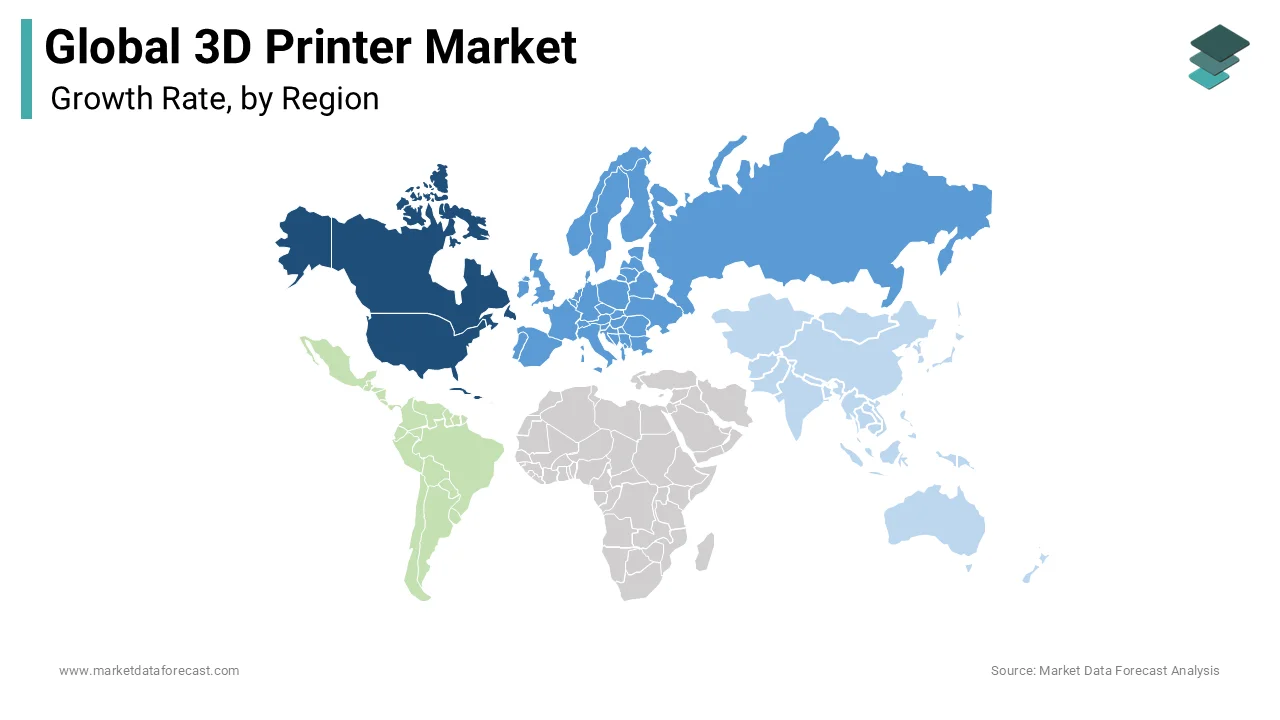
North America led the global 3D printer market by capturing 36.7% of total revenue in 2025, with the United States serving as the epicenter of innovation and industrial adoption. The U.S. hosts the world’s largest concentration of additive manufacturing research institutions, including the Manufacturing USA institutes like America Makes. According to the U.S. Department of Defense, many military branches and defense contractors, including Lockheed Martin and Raytheon, are using 3D printing for rapid prototyping and field repair of equipment. With strong venture capital investment and a robust ecosystem of startups and OEMs, North America remains the leader in both technological development and commercial deployment of additive manufacturing.
Europe 3D Printer Market Insights
Europe is distinguished by its deep integration of 3D printing into high-precision engineering and healthcare sectors. Germany is the technological leader, hosting key players like EOS, Concept Laser (now part of GE Additive), and Trumpf, which collectively supply over 40% of the world’s industrial metal printers. The European Space Agency has adopted additive manufacturing for satellite propulsion systems, with 3D-printed combustion chambers demonstrating higher efficiency. With strong industrial policy support and a focus on quality and sustainability, Europe remains a powerhouse in high-end additive manufacturing applications.
Asia Pacific 3D Printer Market Insights
Asia Pacific accounts for a significant share of the global 3D printer market, with China, Japan, and South Korea driving industrial and consumer adoption. China is the largest producer and consumer of desktop 3D printers. In Japan, companies use metal 3D printing for energy and robotics applications, while South Korea has funded additive manufacturing to boost domestic production of medical and aerospace components. With rising R&D investment and expanding manufacturing automation, Asia Pacific is rapidly closing the innovation gap with Western markets.
Latin America 3D Printer Market Insights
Latin America represents a notable share of the market, with Brazil and Mexico emerging as regional hubs for 3D printing in education, healthcare, and niche industrial applications. The country’s aerospace sector, led by Embraer, has adopted additive manufacturing for lightweight cabin components. In Mexico, nearshoring trends have spurred investment in digital manufacturing, with 3D printing integrated into automotive supply chains near the U.S. border. While infrastructure and investment remain limited, the region’s growing focus on innovation and import substitution is creating fertile ground for additive manufacturing expansion.
Middle East & Africa 3D Printer Market Insights
Middle East & Africa region is witnessing accelerated adoption due to government-led industrial diversification and healthcare modernization. The UAE, particularly Dubai and Abu Dhabi, has positioned itself as a regional innovation hub, launching the Dubai 3D Printing Strategy with a target to print 25% of new buildings by 2030. In South Africa, the Council for Scientific and Industrial Research has developed 3D-printed prosthetics for amputees at a fraction of international costs.
KEY MARKET PLAYERS
The key competitors in the global 3D printer market are Stratasys Ltd. (U.S.), 3D Systems Corporation (U.S.), HP Inc. (U.S.), General Electric Company – GE Additive (U.S.), EOS GmbH (Germany), SLM Solutions (Germany), voxeljet AG (Germany), Materialise NV (Belgium), Desktop Metal Inc. (U.S.), Formlabs (U.S.), Envisiontec, Inc. (Germany), Protolabs (U.S.), Renishaw plc (U.K.), and Canon, Inc. (Japan).
TOP LEADING PLAYERS IN THE MARKET
Stratasys has established a significant presence in the Asia Pacific 3D printing market through its focus on industrial-grade polymer systems and strategic collaborations with manufacturing and educational institutions. The company has expanded its sales and support network across China, Japan, South Korea, and India, providing FDM and PolyJet solutions for aerospace, automotive, and healthcare applications. It also introduced localized service hubs in Shanghai and Bangalore to accelerate technical support and training. By integrating its GrabCAD software with regional design ecosystems, Stratasys has enhanced user accessibility and workflow integration, enabling enterprises to transition from prototyping to production. These initiatives underscore its commitment to driving industrial adoption and technical capacity building across the region.
EOS has strengthened its footprint in Asia Pacific by positioning itself as a leader in industrial metal and polymer additive manufacturing, particularly in high-precision sectors such as medical devices and energy. The company has established technology centers in Japan, South Korea, and Singapore to demonstrate end-to-end production workflows and support certification processes for regulated industries. It also launched a regional training program in partnership with the Singapore Institute of Manufacturing Technology to upskill engineers in powder-bed fusion operations. EOS has further localized its supply chain by partnering with material suppliers in China to ensure compliance with regional quality and traceability requirements. These efforts have solidified its reputation as a provider of certified, production-ready additive solutions in critical industrial applications.
HP Inc. has emerged as a transformative force in the Asia Pacific 3D printing market through its Multi Jet Fusion (MJF) technology, which enables high-speed, scalable production of functional polymer parts. The company has invested heavily in building a regional ecosystem of partners, including material suppliers, service bureaus, and system integrators, across India, Thailand, and Australia. It also partnered with Vietnam’s FPT Corporation to integrate MJF into smart factory initiatives under Industry 4.0 programs. By offering cloud-connected printing platforms and lifecycle sustainability assessments, HP is helping enterprises reduce waste and energy use. Its focus on digital inventory and decentralized manufacturing aligns with regional supply chain resilience goals, positioning HP as a key enabler of next-generation production models in the region.
TOP STRATEGIES USED BY KEY MARKET PARTICIPANTS
Key players in the 3D printer market are leveraging vertical integration, ecosystem development, digital platform expansion, strategic partnerships, and sustainability innovation to strengthen their market positions. Companies are consolidating hardware, software, and material supply chains to ensure compatibility and performance consistency. There is a strong emphasis on building open or semi-open ecosystems that attract developers, designers, and service providers. Firms are investing in cloud-based workflow platforms for remote monitoring, generative design, and predictive maintenance. Partnerships with academic institutions, certification bodies, and industry consortia are being used to validate technology for regulated sectors. Additionally, companies are promoting circular economy models through powder recycling, bio-based materials, and carbon footprint tracking, aligning with global ESG mandates and enhancing long-term customer engagement across industrial and commercial segments.
COMPETITION OVERVIEW
The competition in the 3D printer market is evolving from a race in hardware specifications to a broader contest of ecosystem maturity, application expertise, and digital integration. Incumbents face pressure from agile startups offering specialized materials or software solutions, while industrial users demand certified, repeatable, and scalable production systems. Differentiation is increasingly based on workflow completeness, regulatory compliance, and total cost of ownership rather than print speed or resolution alone. The rise of digital inventories and on-demand manufacturing is reshaping business models, with leaders investing in cloud platforms and service networks. Geopolitical trends favoring supply chain resilience are accelerating regional adoption, particularly in healthcare and defense. Companies that combine technological depth with industry-specific solutions and sustainability credentials are gaining a strategic advantage in a market transitioning from prototyping to mainstream industrial production.
RECENT MARKET DEVELOPMENTS
- In March 2025, Stratasys launched a localized version of its GrabCAD Print software in Tokyo, optimized for Japanese engineering workflows and integrated with major CAD platforms used in automotive and electronics manufacturing.
- In January 2025, EOS opened a metal additive manufacturing training center in Singapore, certified by the German Chamber of Industry and Commerce, to address the regional skills gap in industrial 3D printing operations.
- In August 2023, HP Inc. partnered with Tata Motors in India to implement Multi Jet Fusion for the rapid production of custom jigs, fixtures, and low-volume interior components, reducing lead times by 65%.
- In May 2025, 3D Systems introduced a new biocompatible resin for dental applications at the Asia Dental Exhibition in Seoul, expanding its material portfolio for the fast-growing orthodontic aligner market.
- In February 2025, Formlabs deployed 500 desktop stereolithography printers across public hospitals in Indonesia in collaboration with the Ministry of Health, enabling on-site production of surgical guides and prosthetics.
MARKET SEGMENTATION
This research report on the global 3D printer market has been segmented and sub-segmented based on component, technology, printing type, material type, application, end user, and region.”
By Component
- Hardware
- Software
- Services
By Technology
- Fused Deposition Modeling (FDM)
- Selective Laser Sintering (SLS)
- Stereolithography (SLA)
- Direct Metal Laser Sintering (DMLS)/Selective Laser Melting (SLM)
- Polyjet
- Multi Jet Fusion
- Digital Light Processing (DLP)
- Binder Jetting
- Electron Beam Melting (EBM)
- Continuous Liquid Interface Production (CLIP)/Continuous Digital Light Projection (CDLP)
- Selective Deposition Lamination (SDL)
- Laminated Object Manufacturing (LOM)
By Printing Type
- Desktop 3D Printer
- Industrial 3D Printer
By Material Type
- Metal
- Polymer
- Ceramics
By Application
- Prototyping
- Production
- Proof of Concept
- Others (R&D, Tooling, and Others)
By End User
- Automotive
- Aerospace and Defense
- Healthcare
- Architecture and Construction
- Consumer Products
- Education
- Others (Food, Fashion, and Others)
By Region
- North America
- Europe
- Asia-Pacific
- Latin America
- Middle East and Africa