- Product Description Description
- Table of Contents TOC
- List of Table & Figure LOT
- Get Free Sample PDF Sample PDF
Market Size, 2025
$3.77 BnMarket Estimate, 2026
$4.51 BnMarket Forecast, 2034
$18.88 BnCAGR, 2026–2034
19.6%Global 3D Telepresence Market Report Summary
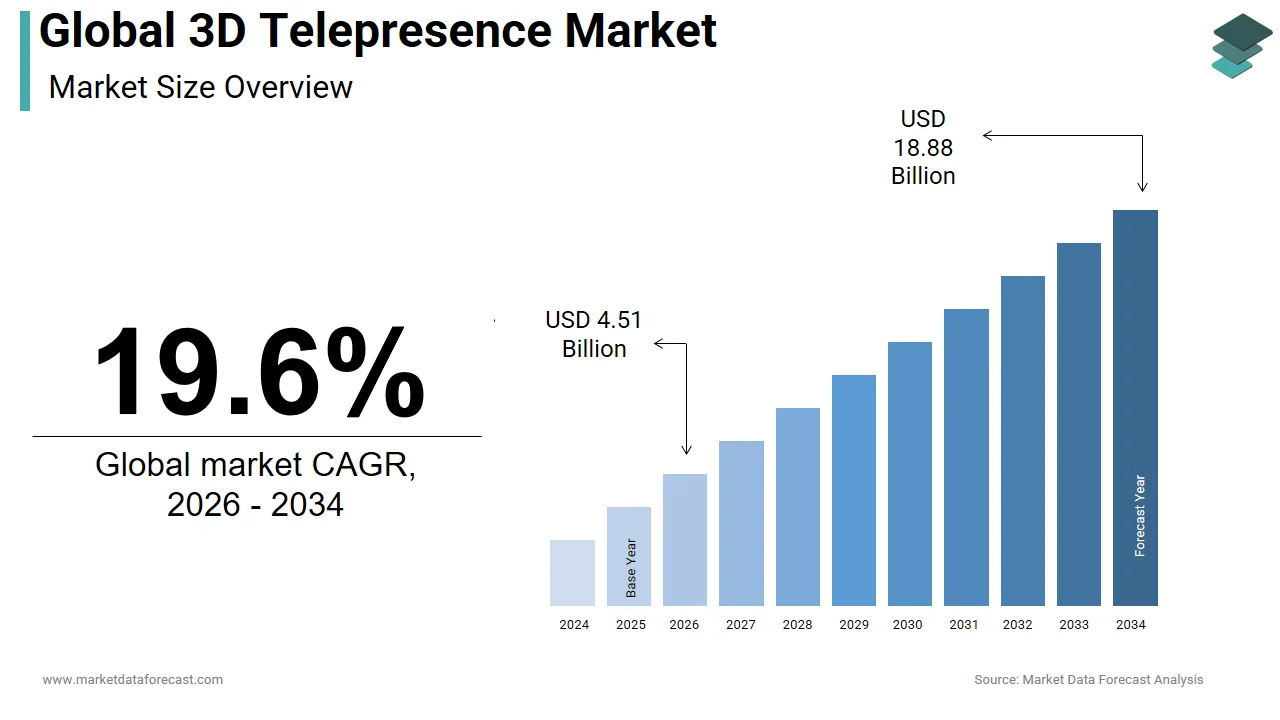
The global 3D telepresence market was valued at USD 3.77 billion in 2025 and is projected to grow from USD 4.51 billion in 2026 to USD 18.88 billion by 2034, registering a CAGR of 19.6% from 2026 to 2034. Market growth is driven by the increasing adoption of immersive communication technologies, rising demand for virtual collaboration, and rapid advancements in holographic displays, augmented reality (AR), virtual reality (VR), and artificial intelligence (AI). Organizations across enterprise, healthcare, education, and entertainment sectors are increasingly deploying 3D telepresence solutions to enhance remote collaboration, reduce travel costs, and deliver more engaging virtual experiences. Expanding high-speed internet infrastructure and 5G connectivity are further accelerating market growth.
Key Market Trends
- Increasing adoption of immersive virtual collaboration and communication technologies.
- Growing integration of AI, AR, VR, and holographic display technologies into telepresence solutions.
- Rising demand for high-quality virtual conferencing and remote workforce collaboration.
- Expansion of 5G networks and cloud-based telepresence platforms.
- Increasing investments in digital transformation across enterprise, healthcare, education, and entertainment sectors.
Segmental Insights
- Based on solution type, the hardware segment dominated the global 3D telepresence market by accounting for 32.1% market share in 2025, driven by increasing demand for advanced cameras, holographic projection systems, sensors, displays, and specialized telepresence equipment.
- Based on application, the conferencing segment held the largest market share with 44.6% in 2025, supported by the growing adoption of immersive virtual meetings, hybrid work environments, executive collaboration, and global business communication.
Regional Insights
The global 3D telepresence market continues to expand across major regions, supported by digital transformation initiatives, high-speed connectivity, and increasing investments in immersive communication technologies.
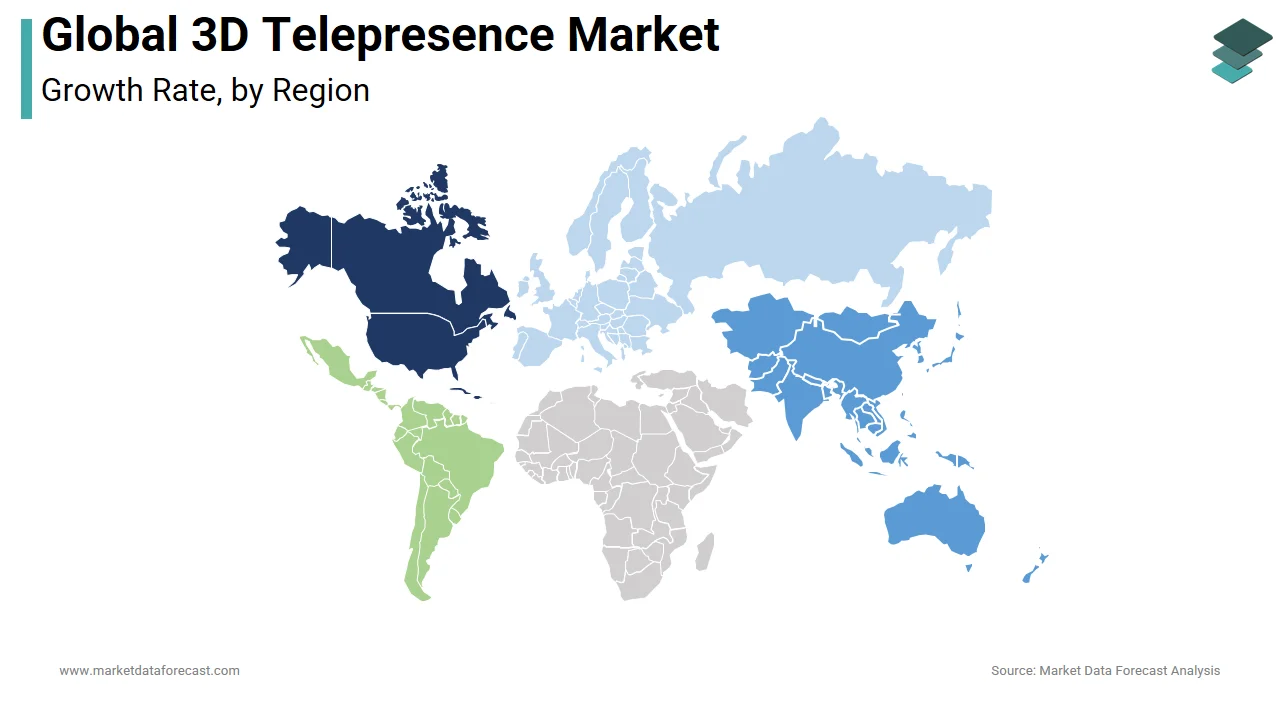
- North America dominated the global market in 2025 by accounting for 40.2% share, driven by advanced digital infrastructure, early adoption of emerging technologies, widespread enterprise digitization, and the presence of leading technology companies.
- Europe held the second-largest position with 30.2% share in 2025, supported by stringent data privacy regulations, strong sustainability initiatives, increasing enterprise digitalization, and growing investments in advanced collaboration technologies.
- Asia-Pacific is projected to register the fastest growth during the forecast period, driven by rapid digitalization, expanding internet connectivity, increasing 5G deployment, and rising technology investments across China, Japan, India, and South Korea.
Competitive Landscape
The global 3D telepresence market is highly competitive, with leading technology companies focusing on holographic communication, immersive collaboration platforms, cloud-based telepresence solutions, and AI-powered virtual interaction technologies. Market participants are investing in research and development, strategic partnerships, product innovation, and expansion into emerging markets to strengthen their competitive position. Continuous advancements in AR, VR, mixed reality, and holographic visualization continue to shape the market landscape.
Prominent companies operating in the global 3D telepresence market include Microsoft Corporation, Cisco Systems Inc., Polycom, Digital Video Enterprises Inc., ZTE, Dimension Data, Meta Platforms Inc., Musion, HYPERVSN, MDH Hologram Ltd., Holoxia, and Realfiction.
 Download Free Sample Report
Global 3D Telepresence Market Size
The global 3D Telepresence market was valued at USD 3.77 billion in 2025. The global market is expected to reach USD 4.51 billion in 2026 and USD 18.88 billion by 2034, growing at a CAGR of 19.6% during the forecast period 2026 to 2034.
3D telepresence is remote communication technology that utilizes volumetric video capture, holographic projection, and augmented reality to create immersive, lifelike interactions between distant participants. This advancement is for industries requiring high-fidelity collaboration, such as healthcare, engineering, and executive leadership. According to the International Telecommunication Union, global internet bandwidth capacity has increased by 45% annually since 2020, providing the necessary infrastructure for the high data throughput required by volumetric streams. The large enterprises in Europe are exploring immersive technologies to reduce carbon emissions associated with business travel. In the United States, the Occupational Safety and Health Administration reports that remote expert assistance via telepresence can reduce workplace accidents by 30% by allowing specialists to guide on-site personnel without physical exposure to hazards. As per Cisco Systems, the volume of global IP traffic is projected to reach 396 exabytes per month by 2025, driven largely by immersive media applications. The integration of 5G networks further enables low-latency transmission, which is essential for real-time 3D interaction.
MARKET DRIVERS
Escalating Demand for Immersive Remote Collaboration in Enterprise Sectors
The increasing necessity for high-fidelity remote collaboration in global enterprise environments, as organizations seek to overcome the limitations of flat screen communication. According to research, over 75% of hybrid workforces report feelings of isolation and disconnection when relying solely on traditional video conferencing tools, which lack spatial context and non-verbal cues. 3D telepresence addresses this deficit by restoring eye contact, body language, and spatial proximity, which are crucial for building trust and effective teamwork. The financial sector, particularly investment banking and legal services, relies on secure and realistic interactions for high-stakes negotiations where nuance is paramount. Furthermore, the manufacturing industry uses these systems for remote design reviews, allowing engineers from different continents to inspect three-dimensional prototypes simultaneously. This capability reduces product development cycles by enabling real-time feedback without the delay of shipping physical models. As globalization continues to expand distributed teams, the demand for communication tools that mimic physical presence becomes essential for maintaining organizational cohesion and operational efficiency.
Advancements in 5G Connectivity and Edge Computing Infrastructure
The rapid deployment of fifth-generation wireless networks and edge computing infrastructure, resolving historical latency and bandwidth hurdles, is additionally boosting the growth of the 3D telepresence market. Volumetric video data requires immense processing power and transmission speed to render realistic avatars or holograms in real time. The global 5G connections surpassed 1 billion in 2023, offering download speeds up to 10 gigabits per second and latency as low as 1 millisecond, as per the study. This technical capability is synchronizing audio-visual and haptic data streams without the lag that causes motion sickness or breaks immersion. The European Telecommunications Standards Institute highlights that edge computing reduces data travel distance by processing information closer to the user, which is vital for real-time 3D rendering. Healthcare providers utilize this connectivity for remote surgical consultations where even minor delays can be critical. The ability to transmit high-resolution 3D data reliably allows for broader adoption in mobile scenarios such as field service and emergency response. As network coverage expands into rural and underserved areas, the accessibility of 3D telepresence increases, democratizing access to expert knowledge and collaborative tools.
MARKET RESTRAINTS
Prohibitive Hardware Costs and Implementation Complexity
The high initial capital expenditure required for specialized hardware and the complexity of integrating systems for small and medium-sized enterprises is hindering the growth of the 3D telepresence market. High-quality volumetric capture rigs, multi-view camera arrays, and holographic display units often cost between 50000 and 200000 dollars per installation, making them inaccessible for budget-constrained organizations. According to the research, only 15% of mid-range companies have allocated budgets for immersive communication technologies due to these prohibitive costs. Additionally, the maintenance of such sophisticated equipment requires specialized technical staff, which adds to the total cost of ownership. Data from Deloitte indicates that implementation timelines for 3D telepresence systems average six to nine months, involving extensive calibration, network configuration, and software customization. This lengthy deployment period disrupts normal business operations and delays return on investment. Small businesses often lack the physical space to accommodate large display walls or capture studios, further limiting feasibility. The rapid pace of technological obsolescence also poses a financial risk as hardware may become outdated within three to five years, necessitating frequent upgrades. Many organizations opt for lower-cost virtual reality alternatives or stick to traditional video conferencing despite the superior engagement offered by 3D telepresence.
Lack of Standardized Interoperability Across Platforms
The absence of universal standards for data formats, communication protocols, and hardware interfaces is another factor limiting the growth of the 3D telepresence market. Currently, most 3D telepresence systems operate within proprietary ecosystems, meaning that a user on one platform cannot seamlessly interact with a user on another without complex bridging software. According to the Institute of Electrical and Electronics Engineers, over 60 different proprietary formats exist for volumetric video data, leading to fragmentation and incompatibility issues. This lack of standardization forces organizations to commit to single vendors, creating vendor lock-in and limiting flexibility. The inability to integrate with existing enterprise resource planning and customer relationship management systems further complicates adoption. Users often face friction when switching between different telepresence providers, resulting in fragmented communication experiences. The development of open standards such as glTF for 3D assets is ongoing, but adoption remains slow among major hardware manufacturers.
MARKET OPPORTUNITIES
Integration with Digital Twins for Industrial Maintenance and Training
The emergence of 3D telepresence with digital twin technology presents a significant opportunity for enhancing industrial maintenance training and operational efficiency. Digital twins are virtual replicas of physical assets that allow for real-time monitoring and simulation. By integrating 3D telepresence, experts can inhabit these digital environments to guide on-site technicians through complex repair procedures with precise spatial accuracy. According to the research, industrial companies using digital twin and telepresence combinations report a reduction in maintenance downtime and a decrease in training costs. Siemens Energy utilizes this approach to train technicians on gas turbine maintenance, allowing them to practice on virtual models before touching physical equipment. This method minimizes safety risks and accelerates skill acquisition. The aerospace industry also benefits by enabling remote inspections of aircraft components where specialists can annotate specific parts in 3D space for ground crews to see. As industries move toward Industry 4.0, the demand for immersive tools that bridge the physical and digital worlds will grow. This synergy creates new revenue streams for telepresence providers who can offer specialized industrial solutions beyond general communication.
Expansion into Healthcare for Remote Diagnosis and Surgical Assistance
The healthcare sector offers substantial opportunities for 3D telepresence by enabling remote diagnosis, patient consultation, and surgical assistance with unprecedented realism. The expansion into healthcare for remote diagnosis and surgical assistance is also expected to create new opportunities for the growth of the 3D telepresence market. Traditional telemedicine lacks the depth perception and tactile cues necessary for certain medical evaluations. 3D telepresence allows specialists to examine patients from a distance, observing subtle physical signs that two-dimensional video might miss. Surgeons can use augmented reality overlays to guide local teams through complex procedures, providing real-time visual instructions overlaid on the patient’s anatomy. Data from Johns Hopkins Medicine shows that remote surgical mentoring via 3D systems reduced procedure errors in pilot programs. Mental health professionals also benefit from the increased sense of presence, which enhances therapeutic rapport and patient engagement. The aging global population and shortage of specialists in rural areas drive the need for such remote capabilities. As regulatory bodies approve more remote care protocols, the adoption of 3D telepresence in healthcare will accelerate.
MARKET CHALLENGES
High Bandwidth Requirements and Network Latency Issues
Despite advancements in connectivity, the immense bandwidth requirements and sensitivity to latency are likely to be a challenge for the growth of the 3D telepresence market. Volumetric video streams can consume up to 100 megabits per second per user, which is significantly higher than standard high-definition video. According to the study, nearly 30% of global broadband connections still lack the consistent upload speeds necessary for smooth 3D transmission. Packet loss or jitter, even at low levels, can cause visual artifacts, freezing or desynchronization, which breaks immersion and causes user discomfort. Rural areas and developing regions often suffer from unstable internet infrastructure, making reliable 3D telepresence impossible. Enterprises must invest in dedicated fiber lines or private 5G networks to ensure quality, which adds to implementation costs. Network congestion during peak hours can also degrade performance, affecting critical business operations. The lack of robust quality of service guarantees from internet service providers further complicates deployment.
User Privacy and Data Security Concerns
The collection and transmission of detailed biometric and spatial data raise significant privacy and security concerns that act as a barrier for the growth of the 3D telepresence market. Volumetric capture records not just appearance but also movement patterns, gestures, and environmental details, which can be exploited for surveillance or identity theft. According to the research, 70% of consumers express concern about the storage and usage of their biometric data in immersive technologies. Current data protection laws such as the General Data Protection Regulation in Europe impose strict requirements on handling personal data, but specific guidelines for volumetric data remain ambiguous. Data breaches involving 3D avatars could lead to deepfake creation or unauthorized impersonation, posing severe reputational and security risks. Organizations must implement advanced encryption and anonymization techniques, which increase computational overhead and cost. The lack of clear legal frameworks regarding ownership of digital likenesses creates liability uncertainties for both providers and users. High-profile security incidents in other tech sectors have heightened scrutiny, making enterprises cautious about adopting new immersive tools. Addressing these concerns requires transparent data policies and robust cybersecurity measures, which many vendors are still developing.
REPORT COVERAGE
| REPORT METRIC | DETAILS |
| Market Size Available | 2025 to 2034 |
| Base Year | 2025 |
| Forecast Period | 2026 to 2034 |
| Segments Covered | By Solution Type, Application, and Region. |
| Various Analyses Covered | Global, Regional, and Country-Level Analysis, Segment-Level Analysis, Drivers, Restraints, Opportunities, Challenges; PESTLE Analysis; Porter’s Five Forces Analysis, Competitive Landscape, Analyst Overview of Investment Opportunities |
| Regions Covered | North America, Europe, APAC, Latin America, Middle East & Africa |
| Market Leaders Profiled | Microsoft Corporation, Cisco Systems Inc., Polycom, Digital Video Enterprises Inc, ZTE, Dimension Data, Meta Platforms Inc., Musion, HYPERVSN, MDH Hologram Ltd, Holoxia, and Realfiction. |
SEGMENTAL ANALYSIS
By Solution Type Insights
The hardware segment was the largest by holding 32.1% of the 3D telepresence market share in 2025 due to the substantial initial investment required for specialized volumetric capture rigs, holographic displays, and high-performance computing units. High-end systems, such as Microsoft Mesh-enabled devices or custom-built holographic portals, often cost between 100000 and 500000 dollars per unit, creating a significant barrier to entry but also generating substantial revenue for manufacturers. The complexity of these systems requires multiple high-resolution cameras, depth sensors, and powerful graphics processing units to render real-time 3D avatars. Furthermore, the need for dedicated physical spaces equipped with optimal lighting and acoustic treatment adds to the hardware expenditure. Large corporations and government entities are the primary buyers prioritizing quality and reliability over cost. The rapid evolution of display technology also necessitates frequent hardware upgrades to maintain compatibility with new software features. This continuous cycle of procurement and replacement sustains the dominance of the hardware segment. As the technology develops, economies of scale may reduce costs, but the foundational requirement for robust physical infrastructure ensures hardware remains the primary revenue generator in the near term.
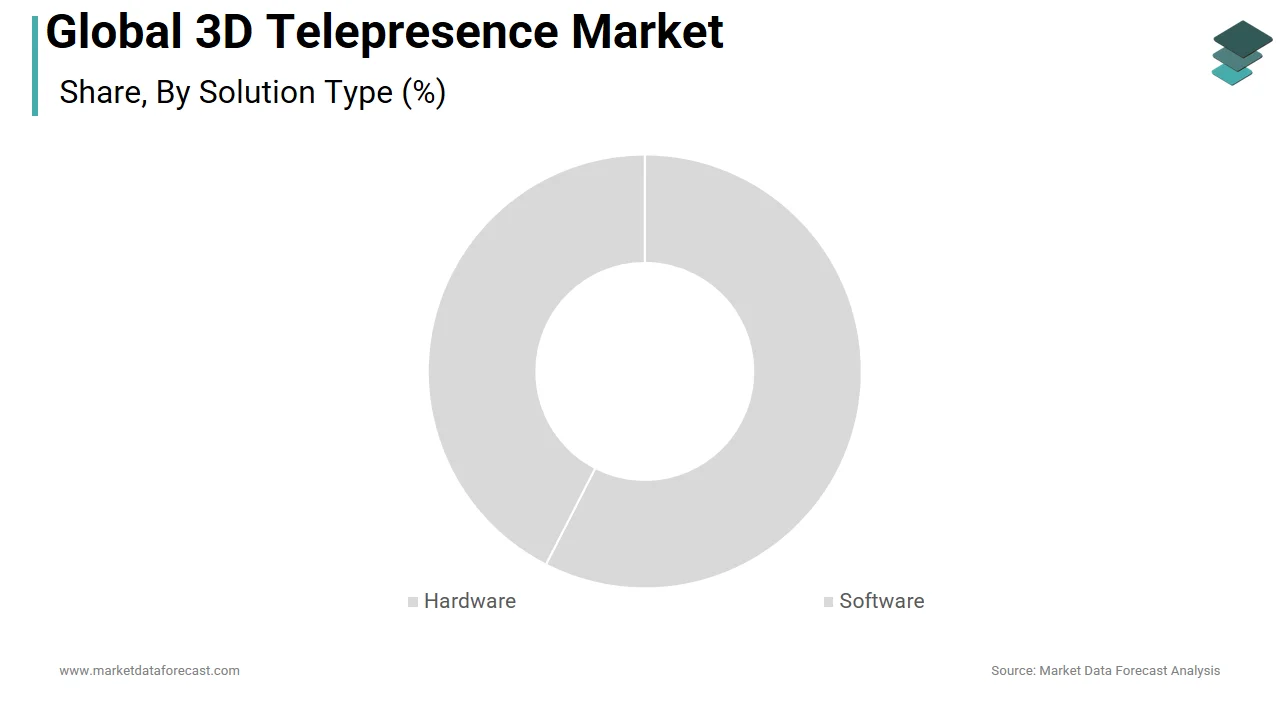
The software segment is likely to grow at the fastest CAGR of 28.5% during the forecast period with the shift toward cloud-based rendering and software as a service models. The immersive applications will be delivered via cloud platforms, reducing the need for expensive local hardware. This transition lowers the barrier to entry for small and medium-sized enterprises who can access high-quality 3D telepresence through subscription-based services. Cloud rendering offloads intensive computational tasks to remote servers, allowing users to participate in 3D meetings using standard devices such as tablets or laptops. This democratization of access expands the potential user base significantly. Furthermore, software updates and feature enhancements can be deployed instantly without requiring physical hardware modifications. Providers are developing interoperable platforms that support various hardware endpoints, fostering a more connected ecosystem. The recurring revenue model associated with SaaS offers predictable income streams for vendors, encouraging continuous innovation. As bandwidth improves and latency decreases, cloud-based software solutions become increasingly viable for real-time interaction.
By Application Insights
The conferencing segment was accounted for holding 44.6% of the 3D telepresence market share in 2025 due to the widespread corporate demand for enhanced remote collaboration tools that overcome the limitations of traditional video calls. According to the study, 85% of executives believe that immersive communication technologies improve team cohesion and decision-making quality compared to flat-screen interactions. The rise of hybrid work models has created a need for solutions that replicate the dynamics of in-person meetings, including spatial awareness and non-verbal cues. Data from Zoom indicates that enterprises using 3D conferencing prototypes reported a 30% increase in meeting satisfaction scores. Financial, legal, and consulting firms are early adopters utilizing these systems for high-stakes negotiations where trust and rapport are critical. The ability to share three-dimensional objects and data visualizations in real time enhances understanding and reduces miscommunication. Furthermore, 3D conferencing reduces the need for international travel, aligning with corporate sustainability goals. As organizations invest in digital transformation, 3D conferencing becomes a strategic priority for maintaining competitive advantage in a distributed workforce environment.
The education segment is expected to grow at the fastest CAGR of 32.1% from 2026 to 2034 with the adoption of immersive learning technologies in remote and hybrid classrooms. According to the research, global investment in education technology reached 20000 million dollars in 2023, with a significant portion allocated to immersive experiences. 3D telepresence allows students to interact with teachers and peers in virtual laboratories, museums, and historical sites, providing experiential learning opportunities that are impossible in traditional settings. Universities are leveraging these systems to offer remote access to specialized equipment and expert instructors, bridging geographical gaps. The ability to visualize complex concepts in three dimensions enhances understanding in subjects such as biology, chemistry, and engineering. Furthermore, 3D telepresence fosters social interaction and collaboration among students, reducing feelings of isolation associated with online learning. As educational institutions prioritize digital equity and engaging pedagogy, the demand for 3D telepresence solutions will continue to surge.
REGIONAL ANALYSIS
North America 3D Telepresence Market Analysis
North America was the largest contributor in the global 3D telepresence market by accounting for 40.2% of the share in 2025, with the early adoption of advanced technologies and strong presence of key market players. The United States 3D telepresence market is likely to have significant opportunities, with major technology companies, such as Microsoft, Cisco, and Meta, investing heavily in research and development. The presence of well-developed broadband infrastructure and high 5G penetration supports the deployment of bandwidth-intensive 3D applications. Canada contributes to the market through its strong healthcare and education sectors, which are exploring 3D telepresence for remote services. The region benefits from a culture of innovation and significant venture capital funding for startups in the immersive technology space. Regulatory frameworks supporting data privacy and security encourage enterprise adoption. The concentration of early adopters in finance, healthcare, and technology sectors ensures continued leadership. Strategic partnerships between hardware manufacturers and software developers further strengthen the ecosystem.
Europe 3D Telepresence Market Analysis
Europe 3D telepresence market was ranked second, holding a 30.2% share in 2025 due to stringent data privacy regulations and a strong focus on sustainability. According to the European Commission, the Green Deal initiative promotes remote work to reduce carbon emissions from business travel, driving interest in 3D telepresence as a viable alternative. Many enterprises in the EU use cloud computing services supporting the shift toward software based 3D solutions. The healthcare sector in Europe is actively piloting 3D telepresence for remote diagnosis and surgical assistance, particularly in rural areas with specialist shortages. Government funding for digital transformation projects under the Digital Decade program accelerates infrastructure development. The region’s strong manufacturing base also drives adoption for remote maintenance and training. Cultural emphasis on work-life balance supports the acceptance of remote collaboration tools.
Asia Pacific 3D Telepresence Market Analysis
Asia Pacific 3D telepresence market growth is likely to grow with the rapid digitalization and expanding internet connectivity in China, Japan, India, and South Korea. According to the study, the country has built over 2 million 5G base stations, providing the necessary infrastructure for low-latency 3D applications. Japan focuses on robotics and aging population care, utilizing 3D telepresence for remote monitoring and companionship. India is emerging as a key contributor to education and healthcare applications supported by government initiatives like Digital India. South Korea leverages its advanced gaming and entertainment industries to drive consumer adoption of immersive technologies. The region benefits from a large young population eager to adopt new technologies. Manufacturing hubs in Southeast Asia are increasingly using 3D telepresence for remote expert assistance. Rising disposable incomes and increasing smartphone penetration further fuel growth.
Latin America 3D Telepresence Market Analysis
Latin America 3D telepresence market growth is likely to grow with the gradual improvements in digital infrastructure. Brazil leads in adopting 3D telepresence for education and healthcare, particularly in remote areas where specialist access is limited. Mexico benefits from proximity to the United States and growing outsourcing industries which require efficient remote collaboration tools. Economic constraints limit widespread adoption, but mobile-based solutions are gaining traction. Prepaid mobile plans are popular, requiring efficient data usage, which optimized 3D software can provide. Social media and entertainment sectors drive consumer interest in immersive experiences. Government efforts to improve digital literacy and infrastructure support market development.
Middle East and Africa 3D Telepresence Market Analysis
The Middle East and Africa 3D telepresence market is steadily growing with government investments in smart cities and digital transformation. According to the Saudi Vision 2030 initiative, the Kingdom is investing billions in digital infrastructure and tourism technologies, including immersive experiences. South Africa serves as a hub for sub-Saharan Africa with a developing fintech and education sector that demands remote collaboration tools. Limited bandwidth in some areas makes efficient 3D software solutions particularly valuable. Governments are promoting digital inclusion through infrastructure investments. The oil and gas sector in the Middle East uses 3D telepresence for remote maintenance and safety training.
COMPETITIVE LANDSCAPE
The competitive landscape of the 3D telepresence market is characterized by intense rivalry among established technology giants, specialized startups, and telecommunications providers. Major players leverage their existing customer bases and infrastructure to offer integrated solutions that combine hardware, software, and network services. Specialized firms compete by offering niche applications tailored to specific industries such as remote surgery or industrial maintenance. Innovation in avatar realism and haptic feedback serves as a key differentiator, attracting users seeking highly immersive experiences. Price competition is moderate as buyers prioritize quality, reliability, and ease of integration over cost alone. Strategic alliances with content creators and platform developers create ecosystems that enhance value propositions. Regulatory compliance regarding data privacy influences competitive dynamics, particularly in Europe and North America.
KEY MARKET PLAYERS
The major players in the global 3D telepresence market include
- Microsoft Corporation
- Cisco Systems Inc.
- Polycom
- Digital Video Enterprises Inc.
- ZTE
- Dimension Data
- Meta Platforms Inc.
- Musion
- HYPERVSN
- MDH Hologram Ltd.
- Holoxia
- Realfiction
TOP PLAYERS IN THE MARKET
- Microsoft Corporation leads the market through its Mesh platform integrated within Microsoft Teams, enabling immersive collaboration with avatars and spatial audio. The company leverages Azure cloud infrastructure to support high-fidelity rendering and low-latency interactions for enterprise users. Microsoft recently enhanced its mixed reality capabilities by partnering with hardware manufacturers to ensure broad device compatibility. Their focus on security and compliance makes their solutions ideal for regulated industries such as healthcare and finance. The company continues to invest in artificial intelligence to improve avatar realism and reduce bandwidth consumption. These strategic initiatives strengthen Microsoft's position as a primary enabler of hybrid work environments globally.
- Cisco Systems Inc. provides robust network infrastructure and Webex Hologram solutions that facilitate life-size 3D projections for remote meetings. The company utilizes advanced compression algorithms to deliver high-quality visual experiences over standard broadband connections. Cisco recently expanded its portfolio by collaborating with display technology providers to enhance holographic output quality. Their expertise in secure networking ensures reliable and protected data transmission, which is crucial for business communications. Cisco focuses on interoperability, allowing seamless integration with third-party devices and existing enterprise systems. The company actively pilots remote expert assistance programs in healthcare and manufacturing sectors. These efforts demonstrate practical applications and drive demand for scalable 3D telepresence solutions across various industries.
- Meta Platforms Inc. drives consumer and enterprise adoption through its Horizon Workrooms application and Quest virtual reality headsets. The company creates shared virtual spaces where users interact as realistic avatars, fostering social presence and collaboration. Meta recently launched new hardware with improved resolution and processing power, enhancing visual fidelity and comfort. The company invests heavily in research to develop advanced haptic feedback systems and more expressive digital representations. Meta encourages developer participation by providing software development kits for custom environment creation. Their extensive user base facilitates rapid scaling of social telepresence applications.
TOP STRATEGIES USED BY KEY MARKET PARTICIPANTS
Key players in the 3D telepresence market primarily focus on strategic partnerships with hardware manufacturers to ensure broad device compatibility and seamless user experiences. Companies invest heavily in research and development to enhance avatar realism and reduce latency through advanced compression algorithms. Expanding cloud infrastructure supports scalable rendering and lowers barriers to entry for small businesses. Developing industry-specific solutions for healthcare education and manufacturing addresses unique operational needs and drives adoption. Emphasizing data security and privacy compliance builds trust among enterprise clients and regulated sectors. Offering subscription-based software models provides recurring revenue and encourages long-term customer relationships. Integrating artificial intelligence improves personalization and automation, making interactions more intuitive and efficient. These strategies collectively strengthen market position and drive sustainable growth in an emerging technology sector.
MARKET SEGMENTATION
This research report on the global 3D telepresence market has been segmented and sub-segmented based on the solution type, application and region.
By Solution Type
- Hardware
- Software
By Application
- Education
- Advertising
- Conferencing
- Customer Service
By Region
- North America
- Europe
- Asia-Pacific
- Latin America
- The Middle East and Africa