- Product Description Description
- Table of Contents TOC
- List of Table & Figure LOT
- Get Free Sample PDF Sample PDF
Market Size, 2025
$16.98 BnMarket Estimate, 2026
$28.37 BnMarket Forecast, 2034
$1,725 BnCAGR, 2026–2034
67.1%Global 5G Infrastructure Market Size, Growth, Trends & Forecast (2026–2034)
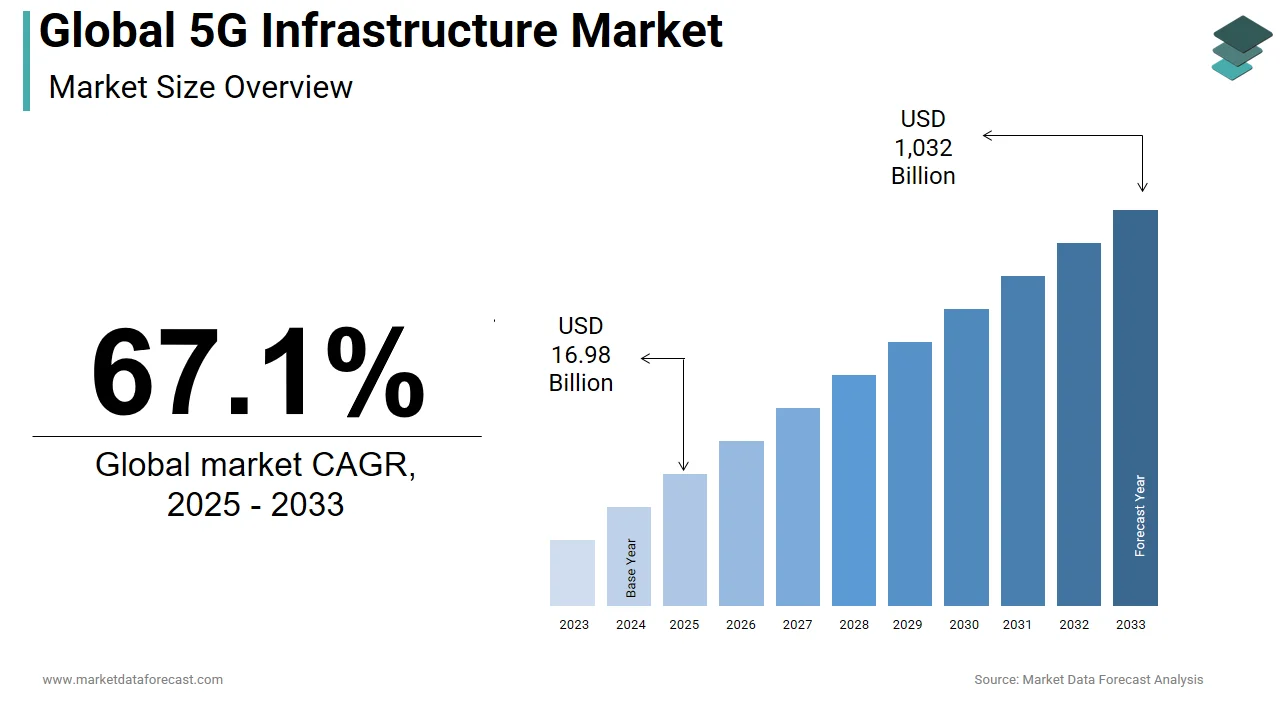
The global 5G infrastructure market size was valued at USD 16.98 billion in 2025, is estimated at USD 28.37 billion in 2026, and is anticipated to reach USD 1,725 billion by 2034, expanding at an extraordinary compound annual growth rate (CAGR) of 67.1% during the forecast period from 2026 to 2034. Market expansion is primarily driven by escalating demand for high-speed mobile internet, machine-to-machine (M2M) communication, IoT and automotive services integration, and widespread government smart city initiatives worldwide.
Key Executive Metrics (At-a-Glance)
- 2025 Base Valuation: USD 16.98 Billion
- 2026 Current Valuation: USD 28.37 Billion
- 2034 Forecast Valuation: USD 1,725 Billion
- Compound Annual Growth Rate (CAGR): 67.1% (2026–2034)
- Key Geographic Footprint: North America, Europe, Asia-Pacific, Latin America, and Middle East & Africa
Global 5G Infrastructure Market Segmentation Breakdown
| Segment Category | Leading / Dominant Segment | Fastest-Growing Segment |
|---|---|---|
| By Product | Network Infrastructure | Managed & Professional Services |
| By Communication Sector | Small Cells & Macro Cells | Small and Micro Cells |
| By Core Network Technology | Network Function Virtualization (NFV) | Software Defined Networking (SDN) |
| By Network Architecture | 5G NR Non-Standalone (NSA) Service | NR-Core Standalone (SA) Service |
| By Operational Frequency | Sub 6 GHz Frequency Base Market | Above 6 GHz (Millimeter Wave) |
| By Region | North America | Asia-Pacific & Europe |
Major Industry Players Profiled
Key market participants shaping the global 5G infrastructure landscape include Huawei (China), Ericsson (Sweden), Samsung (South Korea), Nokia Networks (Finland), ZTE (China), NEC (Japan), CISCO (US), CommScope (US), Comba Telecom Systems (Hong Kong), and Siklu Communication (Israel).
Global 5G Infrastructure Market Size
The global 5G infrastructure market was worth USD 16.98 billion in 2025. The global market is predicted to reach USD 28.37 billion in 2026 and USD 1,725 billion by 2034, growing at a CAGR of 67.1% during the forecast period.
The world continues to change with special formalities in networking, and the network's speed is more important. Providing new features with network and speed facilities is the main aim of this 5G network infrastructure. It is a new technology that provides the best services, such as communication and speed. A 5G network provides a times faster network and speed than a 4G network. The basic purpose of this networking is to provide reliable and best service to people. The whole market is differentiated into ASIC, radio RFIC, and FPGA. According to the communication, the market is based on different segments like RAN, DAS, and small and microcells. The reason for the increasing demand for the 5G networks is the application of internet service in different sectors for better service provided to the customer or its use by the consumer, like mobile broadband service, IT service, government initiatives for smart cities, online business service, banking sectors, etc.
MARKET DRIVERS
Driving factors of the market are telecommunication and mobile internet data service as well as machine-to-machine connection in the IT and automobile service industries. Since 2017, the development of the 5G network system has rapidly increased day by day because of the need for high data transfer speed, mobility in work, wireless data transmission, communication, IoT and automotive services, government initiatives for smart cities, etc. This year, many new investments were made in the world for 5G infrastructure at about USD 4.2 billion. Different mobile industries are also supporting this network system. This system provides a new platform for online and different types of industries, including IT service sectors.
Notable features of 5G infrastructure include providing a 1000 times faster wireless network system, offering secure, reliable, and dependable internet, saving 90% of energy per service provided, reducing the time cycle of work, increasing demand for broadband services and mobile services, and others. These are noteworthy elements in the development of the global 5G infrastructure market.
MARKET RESTRAINTS
All the key players in the 5G networking industry in the global market face some barriers, such as the absence of new trends and technology. Also, government policies and permissions for this service might be harmful to humans and the environment.
REPORT COVERAGE
| REPORT METRIC | DETAILS |
| Market Size Available | 2025 to 2034 |
| Base Year | 2025 |
| Forecast Period | 2026 to 2034 |
| CAGR | 67.1% |
| Segments Covered | By Communication Infrastructure, Core Network Technology, Network Architecture, Operational Frequency, and Region. |
|
Various Analyses Covered | Global, Regional & Country Level Analysis, Segment-Level Analysis, DROC, PESTLE Analysis, Porter’s Five Forces Analysis, Competitive Landscape, Analyst Overview on Investment Opportunities |
| Regions Covered | North America, Europe, APAC, Latin America, Middle East & Africa |
|
Market Leaders Profiled | Huawei (China), Ericsson( Sweden), Samsung (South Korea), Nokia Networks (Finland), ZTE(China), NEC(Japan), CISCO(US), Comscope (US), Comba telecom system (Hong Kong), Alpha Network (Taiwan), Siklu communication (Israel), and others. |
SEGMENTAL ANALYSIS
By Communication Infrastructure Insights
The whole 5G infrastructure market is segmented into various aspects, such as communication infrastructure, small cell, and macro cell. In 2019, the small cell segment accounted for USD 0.5 billion and was expected by 2025 to reach more than USD 3 billion at a CAGR of 37.1% throughout the assessed years.
By Core Network Technology Insights
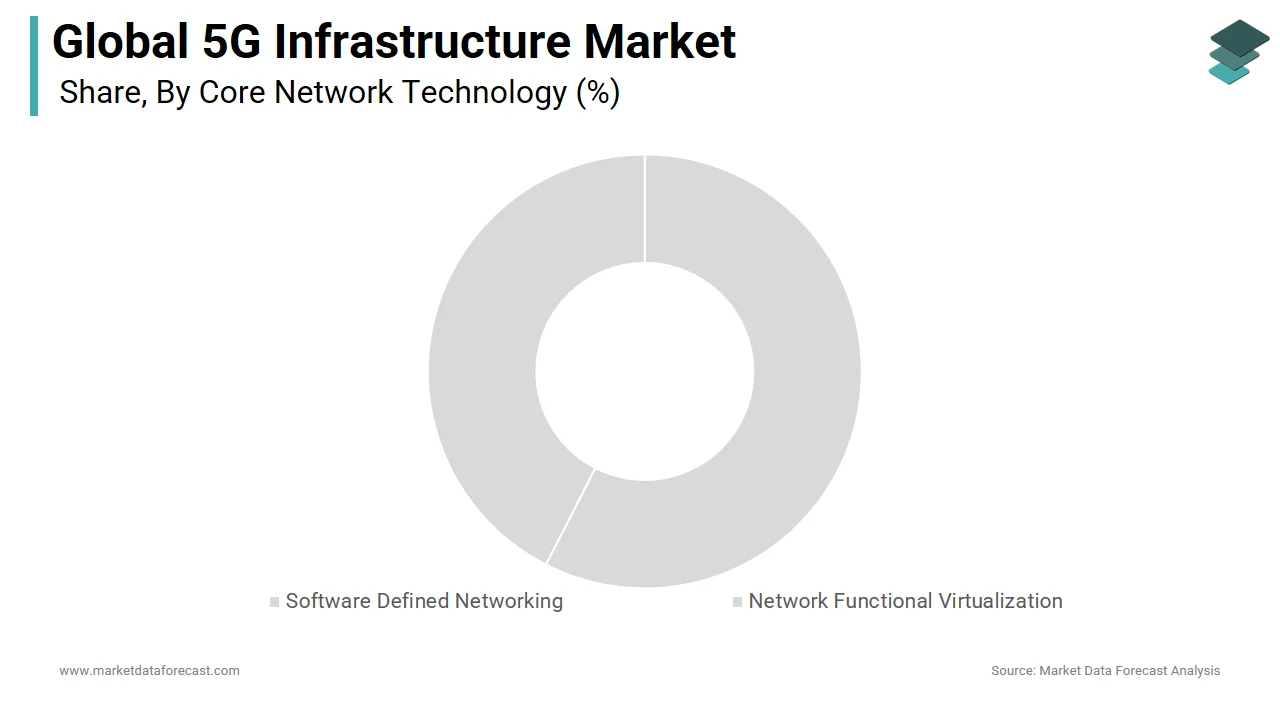
The market includes two types: the first is SDN, i.e., Software Networking, and the second is NFV- Network Function Virtualization. These are the two different structures of the 5G network, which can be easily operated by anyone and can also be implemented in other network systems with the help of different software. It will run on server hardware, so we don’t need to install a new application every time. In 2018, the global market of SDN was at USD 8.8 billion and is expected by 2025 to reach USD 28.9 billion at a CAGR of 26%. The global NFV market size was USD 12.9 billion in 2019 and should be valued at USD 35 billion by 2025 at a 22.8 % CAGR.
By Network Architecture Insights
This market is segmented into two different parts. The first part is the LTE combined-5- 5G NR Standalone services sectors. It includes two types of networks, New Radio and Core market, and is also known as the independent market. In 2019, the market growth of this sector was USD 386.6 million, and the expected value is USD 6091.1 million by the year 2026 at a CAGR of 6.5%. The second part is NR and Core 5G standalone. This will lead to lower-cost operators and help improve the performance of the customers.
By Operational Frequency Insights
Here also, according to the frequency of the network, the market is divided into two groups. First is the Sub 6 GHz frequency base market. In this market, the network is relatively about the minimum or less than 6GHz, and the second is above 6GHz. The total global market for operational frequency market was at about USD 2.03 billion in 2019 and is foreseen to have a market value of USD 22.1 billion by 2026 at 49.25% CAGR. In the 5G infrastructure market, the 6 GHz network held the largest share.
REGIONAL ANALYSIS
North America is the world’s leading market for 5G infrastructure in networking and technology and is also known for its development in technology and autonomous car manufacturing. European countries generated USD 147.5 million in 2018 and anticipate a market value of USD 27.74 billion by 2026 at a 96.2% CAGR.
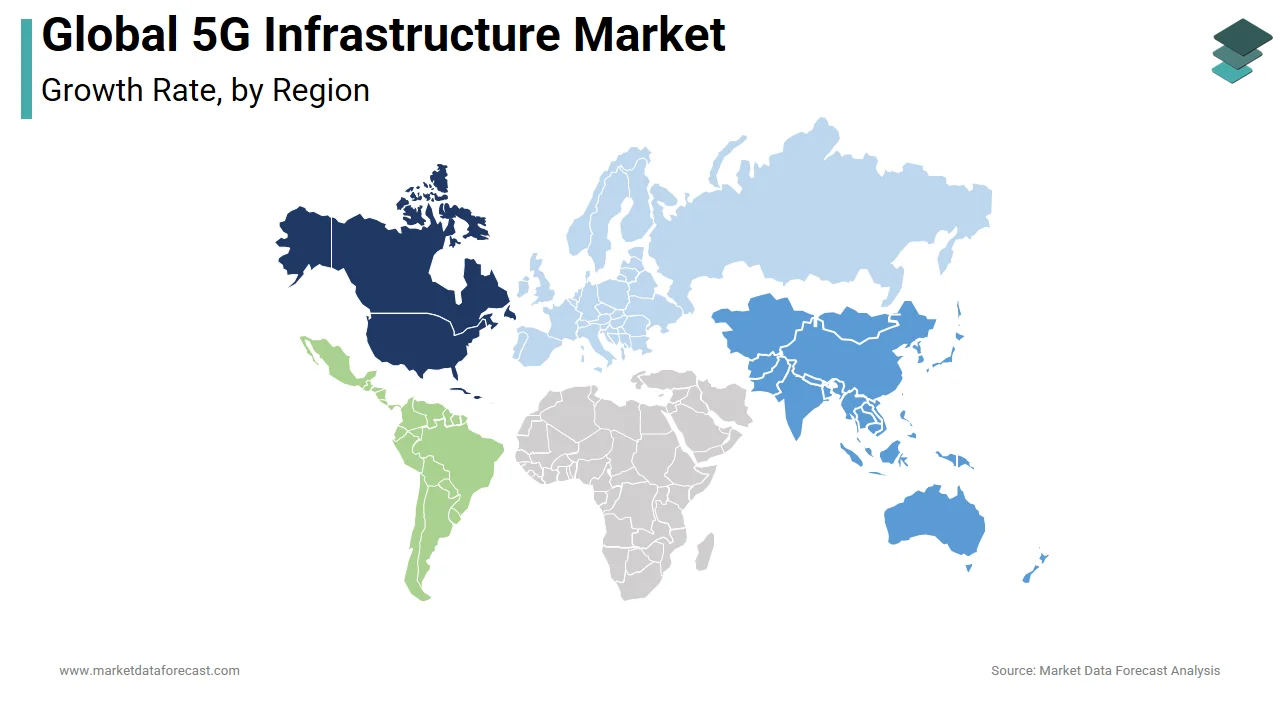
In the Asia Pacific, most countries are underdeveloped, and some are developed countries, but they have also acquired their country's 5G network system. In these countries, an adaptation of 1.14 billion subscribers is available now and will lead to 65% of global subscriptions with a 44% share by 2025. The Middle East, Africa, and South America are also trying to adopt the 5G networking system for their growth of IT services, communication, technology, and services related to networking.
KEY MARKET PLAYERS
All over the world, every nation wants to build its networking infrastructure at high speed and with security. Some key players in the global 5G infrastructure market are Huawei (China), Ericsson( Sweden), Samsung (South Korea), Nokia Networks (Finland), ZTE(China), NEC(Japan), CISCO(US), Comscope (US), Comba telecom system (Hong Kong), Alpha Network (Taiwan), Siklu communication (Israel), and others.
RECENT MARKET DEVELOPMENTS
- The top countries with 5G infrastructure, including South Korea, the UK, Germany, and the US, launched 5G networking in late 2018. South Korea Telecom and Korea Telecom are the main key players in the South Korean market that have acquired spectrum in 3.5 GHz and 28 GHz frequencies to prepare for the deployment of 5 G.
- The recent trend in the industry is a genetic algorithm–based beam refinement, which is prominent for initial access in millimeter wave mobile networks.
MARKET SEGMENTATION
This research report on the global 5G infrastructure market has been segmented and sub-segmented based on the communication infrastructure, core network technology, network architecture, operational frequency, and region.
By Product
- Network
- Service
By Communication Sector
- small
- Micro Cell
By Core Network Technology
- Software Defined Networking
- Network Functional Virtualization
By Network Architecture
- 5G NR Non-Standalone Service
- NR-Core Standalone Service
By Operational Frequency
- Sub 6 GHz
- Above 6 GHz
By Region
- North America
- Europe
- Asia-Pacific
- Latin America
- The Middle East and Africa