- Product Description Description
- Table of Contents TOC
- List of Table & Figure LOT
- Get Free Sample PDF Sample PDF
Market Size, 2025
$285.96 BnMarket Estimate, 2026
$299.54 BnMarket Forecast, 2034
$420.89 BnCAGR, 2026–2034
4.35%Europe Credit Cards Market Report Summary
The Europe credit cards market was valued at USD 285.96 billion in 2025, is estimated to reach USD 299.54 billion in 2026, and is projected to reach USD 420.89 billion by 2034, growing at a CAGR of 4.35% during the forecast period from 2026 to 2034. The growth of the Europe credit cards market is driven by increasing digital payments, expansion of e-commerce, and rising cross-border travel across the region. Credit cards function as a modern financial ecosystem that enables consumers and businesses to access revolving credit while facilitating secure digital transactions. The integration of tokenization technologies, mobile wallets, and embedded finance applications is transforming the traditional credit card model into a digital-first payment instrument. Growing consumer preference for cashless payments and the rapid expansion of online retail are further supporting the growth of the credit cards market across Europe.
Key Market Trends
-
Increasing adoption of contactless payment technology across retail stores and public transportation networks.
-
The rapid growth of e-commerce platforms and subscription-based services driving recurring credit card transactions.
-
Integration of Buy Now Pay Later (BNPL) features into traditional credit card products.
-
Rising popularity of digital and virtual credit cards is integrated with mobile wallets such as digital banking apps.
-
Increasing introduction of sustainable and eco-friendly credit cards made from recycled materials with carbon footprint tracking features.
Segmental Insights
- Based on application, the food and groceries segment accounted for 32.1% of the Europe credit cards market share in 2024. The dominance of this segment is attributed to frequent consumer spending on daily essentials and the widespread use of contactless payments in supermarkets and retail stores.
- Based on card type, the general purpose credit cards segment held the largest share of the Europe credit cards market in 2024. The growth of this segment is driven by the universal acceptance of these cards across millions of merchants and their integration with digital wallets and banking applications.
- Based on provider, the Visa segment accounted for 46.3% of the Europe credit cards market share in 2024 owing to its extensive global acceptance network, advanced security infrastructure, and strong partnerships with major European banks.
Regional Insights
The Europe credit cards market is witnessing steady growth across major economies driven by digital banking adoption, growing online shopping, and increasing travel-related expenditures.
-
United Kingdom dominated the Europe credit cards market by accounting for 24.2% of the regional market share in 2024 due to high credit card penetration, advanced financial services infrastructure, and strong consumer adoption of digital payments.
-
Germany is witnessing gradual growth in credit card adoption as e-commerce and international travel increase, particularly among younger consumers.
-
France benefits from its hybrid payment system combining domestic card schemes with global networks, supporting widespread card usage among residents and tourists.
-
Italy is experiencing increasing adoption of credit cards due to government initiatives promoting digital payments and reducing cash usage.
-
Spain is emerging as a rapidly growing market driven by digital banking expansion, high smartphone penetration, and the strong tourism sector.
Competitive Landscape
The Europe credit cards market is highly competitive and characterized by the presence of global payment networks, large banking institutions, and emerging fintech companies. Market participants compete by introducing advanced digital payment solutions, enhancing security technologies, and offering attractive reward programs to increase customer engagement. Strategic partnerships with fintech firms, travel companies, and retail brands are also helping credit card providers expand their customer base. Continuous innovation in fraud detection systems, tokenization technologies, and mobile payment integration is shaping the competitive dynamics of the market. Prominent players in the Europe credit cards market include Visa Inc., Mastercard Incorporated, American Express Company, Barclays PLC, HSBC Holdings PLC, BNP Paribas, Banco Santander S.A., Deutsche Bank AG, ING Group, and UniCredit S.p.A.
Europe Credit Cards Market Size
The Europe credit cards market size was valued at USD 285.96 billion in 2025 and is anticipated to reach USD 299.54 billion in 2026 from USD 420.89 billion by 2034, growing at a CAGR of 4.35% during the forecast period from 2026 to 2034.
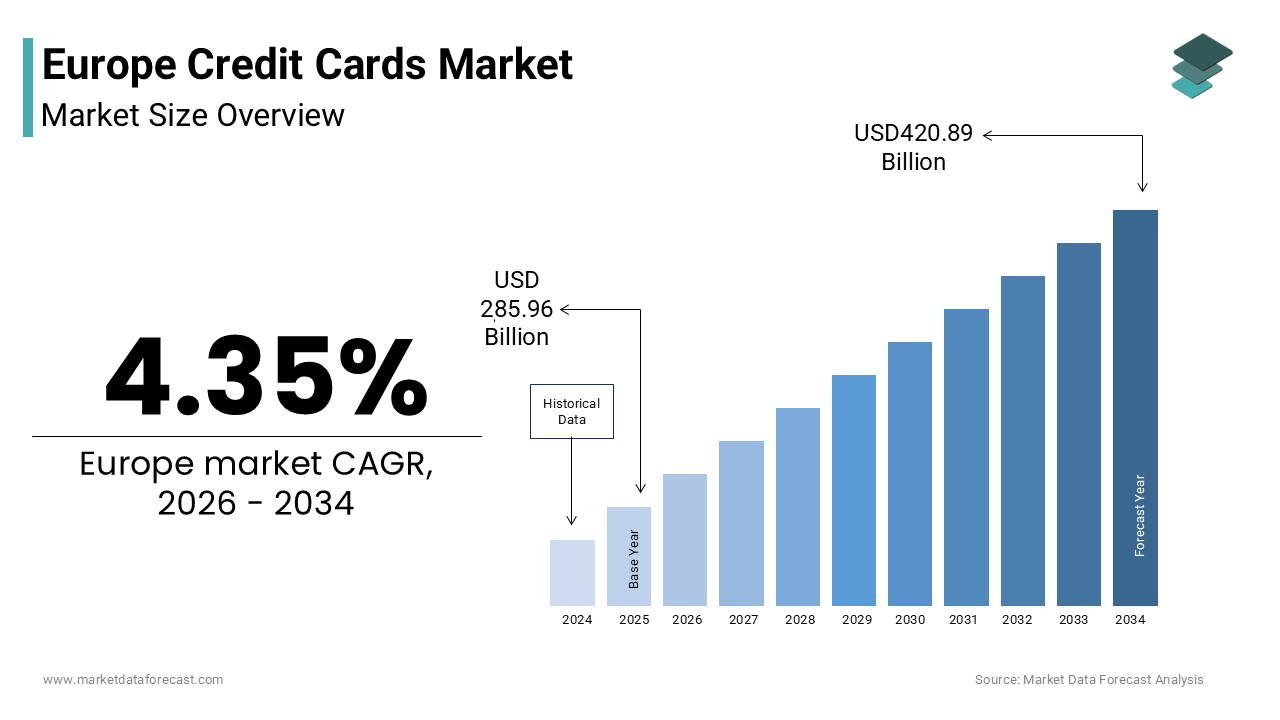
The credit cards are sophisticated financial ecosystem, where issuers provide revolving credit lines to consumers and businesses, facilitating immediate purchasing power while integrating advanced digital payment infrastructures. The definition now encompasses hybrid cards linking directly to buy now pay later services and embedded finance applications within super apps. As per the European countries, the number of non-cash payment transactions surged by reflecting the deep integration of card-based systems into daily commerce. In 2025, the adoption of tokenization standards by ensuring that over online card transactions utilize secure digital identifiers rather than static numbers.
MARKET DRIVERS
Surge in Cross-Border Travel and Tourism Recovery
The robust resurgence of international travel and tourism for the expansion for cards with favorable foreign exchange rates and comprehensive travel insurance is primarily amplifying the growth of Europe credit cards market. European consumers increasingly rely on credit facilities to manage expenses related to flights, accommodation, and dining while abroad, valuing the security and convenience they offer over carrying large amounts of cash. This influx of travelers necessitates cards that offer zero foreign transaction fees and real-time currency conversion, features that issuers are aggressively marketing to capture this high-spending segment. Furthermore, the Schengen Area's border-free policy facilitates seamless movement by encouraging tourists to use a single credit card across multiple countries without friction. Issuers are responding by partnering with airlines and hotel chains to offer co-branded cards with enhanced loyalty points, further stimulating adoption.
Expansion of E-Commerce and Digital Payment Ecosystems
The exponential growth of online retail and the maturation of digital payment ecosystems, fundamentally altering consumer spending habits is also fuelling the growth of Europe credit cards market. Shoppers increasingly prefer credit cards for online purchases due to built-in buyer protection, chargeback rights, and the ability to defer payments, which enhances purchasing power for high-value items. As per Eurostat, e-commerce sales in the European Union grew by 12% in 2024, with over 75% of internet users making at least one online purchase during the year. This shift forces merchants to accept credit cards as a mandatory payment option, thereby increasing issuance and usage rates among the population. Financial institutions are leveraging big data analytics to offer personalized credit limits and instant approval processes by reducing barriers to entry for new users. Additionally, the rise of subscription-based services for streaming, software, and gaming relies heavily on recurring credit card billing, creating a stable base of continuous transaction volume.
MARKET RESTRAINTS
Stringent Regulatory Caps on Interchange Fees
The imposition of strict caps on interchange fees by European regulators is impeding the growth of Europe credit cards market. The Interchange Fee Regulation limits the fees that merchants pay to card issuers by compressing the revenue margins that banks traditionally rely on to fund rewards programs and cover operational costs. According to the European Commission, the cap is set at 0.3% for consumer credit card transactions, that many industry analysts argue is insufficient to support premium service offerings. This regulatory environment discourages issuers from launching aggressive reward schemes or investing in advanced fraud detection technologies, as the return on investment diminishes under tight fee structures. The pressure to maintain profitability, while complying with these caps often results in stricter lending criteria by limiting access to credit for individuals with lower credit scores. Furthermore, the uniformity of fees across the EU reduces competitive differentiation based on merchant pricing, forcing issuers to compete solely on consumer-facing features which may not be sustainable long term.
Cultural Preference for Cash and Debit Alternatives in Specific Regions
A deeply ingrained cultural preference for cash and debit cards in several key European nations presents a formidable barrier to the widespread adoption of credit cards. Countries such as Germany, Austria, and parts of Eastern Europe maintain a strong societal aversion to debt, viewing credit cards with awareness and preferring immediate payment methods that align with budgetary discipline. This cultural mindset limits the addressable market for credit card issuers, who struggle to convince consumers to switch from established debit habits. The prevalence of efficient direct debit systems and instant bank transfer solutions like SEPA, further reduces the perceived need for credit facilities among everyday shoppers. Financial literacy campaigns often emphasize the dangers of overspending, reinforcing the stigma associated with credit card debt. Consequently, issuers face higher customer acquisition costs and lower activation rates in these regions compared to more credit-friendly countries like the UK or Scandinavia.
MARKET OPPORTUNITIES
Integration of Buy Now Pay Later Features into Credit Products
The emergence of traditional credit cards with Buy Now Pay Later functionalities for issuers to capture the attention of younger demographics and modernize their product offerings is creating new opportunities for the growth of Europe credit cards market. By embedding flexible installment plans directly into credit card apps, banks can offer consumers the choice to split large purchases into interest-free or low-interest tranches without needing third-party fintech applications. According to McKinsey, the BNPL market in Europe is projected to reach €45 billion by 2025, indicating massive demand for flexible payment options that credit card issuers are uniquely positioned to fulfill. This integration allows issuers to retain transaction volumes within their own ecosystem, while providing the transparency and regulatory compliance that standalone BNPL providers sometimes lack. Banks can leverage existing customer data to offer personalized installment terms at the point of sale, enhancing user experience and loyalty. Furthermore, offering BNPL options on credit cards can help mitigate the risk of default by structuring payments in manageable amounts, appealing to budget-conscious consumers. The ability to toggle between standard revolving credit and fixed installments provides unparalleled flexibility by making credit cards more relevant in an era of fragmented payment preferences.
Adoption of Sustainable and Green Credit Card Initiatives
The growing consumer demand for environmentally responsible financial products to differentiate itself through sustainability-focused initiatives is also to escalate new opportunities for the growth of Europe credit cards market. Issuers are increasingly launching green credit cards made from recycled materials, ocean plastics, or biodegradable polymers by appealing to eco-conscious consumers, who prioritize ethical consumption. According to a survey by YouGov, 62% of European consumers prefer to bank with institutions that demonstrate a strong commitment to environmental sustainability, driving a shift in product development strategies. Beyond physical materials, banks are introducing carbon footprint tracking features within mobile apps, allowing cardholders to monitor the environmental impact of their spending and offset emissions through integrated donation programs. Some issuers are also tying reward points to sustainable actions, such as using public transport or purchasing from eco-friendly merchants, incentivizing green behavior. The European Green Deal and rising regulatory pressure for corporate social responsibility further encourage financial institutions to align their portfolios with climate goals. By positioning credit cards as tools for positive environmental impact, issuers can attract a new segment of values-driven customers and enhance brand reputation. This trend not only fosters customer loyalty but also opens avenues for partnerships with green tech firms and sustainable retailers by expanding the overall value proposition of credit card products.
MARKET CHALLENGES
Escalating Cyber Fraud and Sophisticated Security Threats
The rising sophistication of cybercriminal activities and the increasing frequency of payment fraud is one of the major challenges for the growth of Europe credit cards market. As digital transactions proliferate, fraudsters employ advanced techniques, such as phishing, account takeover, and synthetic identity theft to exploit vulnerabilities in payment systems. According to Europol, financial fraud losses in the EU exceeded €2.5 billion in 2024, with card-not-present fraud accounting for the majority of these incidents due to the boom in e-commerce. This surge in criminal activity forces issuers to invest heavily in complex security infrastructure, including artificial intelligence-driven anomaly detection and multi-factor authentication, which increases operational costs significantly. Despite advancements like 3D Secure 2.0, fraudsters continuously adapt their methods, creating an arms race that strains resources and impacts customer confidence. High-profile data breaches can lead to reputational damage and regulatory penalties under GDPR, compelling banks to adopt even stricter verification measures that may frictionize the user experience. Balancing robust security with seamless convenience remains a delicate act, as excessive friction can drive customers to alternative payment methods. The constant threat of evolving cyber tactics requires perpetual vigilance and innovation, making fraud prevention a persistent and costly challenge for the entire industry.
Economic Volatility and Rising Cost of Living Pressures
Persistent economic volatility and the escalating cost of living by influencing consumer borrowing behaviors and credit risk profiles is additionally to limit the growth of Europe credit cards market. High inflation rates and stagnant wage growth have squeezed household budgets, leading to increased reliance on credit for essential expenses, while simultaneously raising the risk of defaults and delinquencies. According to Eurostat, inflation in the euro area remained above target levels in early 2025, eroding disposable income and forcing many consumers to carry higher balances on their credit cards. This environment compels issuers to tighten lending standards and reduce credit limits to mitigate potential losses, which in turn restricts market growth and accessibility for marginal borrowers. The rise in interest rates by the European Central Bank to combat inflation has also increased the cost of borrowing, making revolving credit more expensive and less attractive to rate-sensitive consumers. Furthermore, economic uncertainty leads to higher charge-off rates, impacting the profitability of credit card portfolios and necessitating larger provisions for bad debts. Navigating this precarious economic landscape requires issuers to carefully balance risk management with customer support, offering hardship programs while maintaining financial health. The interplay between macroeconomic instability and consumer debt levels creates a complex operating environment that threatens to dampen market expansion.
REPORT COVERAGE
| REPORT METRIC | DETAILS |
| Market Size Available | 2025 to 2034 |
| Base Year | 2025 |
| Forecast Period | 2026 to 2034 |
| CAGR | 4.35% |
| Segments Covered | By Application, Card Type, Card Format, Provider and Region. |
| Various Analyses Covered | Global, Regional & Country Level Analysis, Segment-Level Analysis, DROC, PESTLE Analysis, Porter’s Five Forces Analysis, Competitive Landscape, Analyst Overview of Investment Opportunities |
| Country Covered | UK, France, Spain, Germany, Italy, Russia, Sweden, Denmark, Switzerland, the Netherlands, Turkey, the Czech Republic, and the Rest of Europe. |
| Market Leaders Profiled | Visa Inc., Mastercard Incorporated, American Express Company, Barclays PLC, HSBC Holdings PLC, BNP Paribas, Banco Santander S.A., Deutsche Bank AG, ING Group, and UniCredit S.p.A. |
SEGMENTAL ANALYSIS
By Application Insights
The Food and Groceries segment was the largest by accounting for 32.1% of the Europe credit cards market share in 2024 with the essential nature of food expenditure, which represents a consistent and high-frequency spending category for all demographic groups across the continent. The widespread adoption of contactless payment technology in supermarkets and convenience stores, which has made credit cards the preferred method for daily purchases due to speed and hygiene considerations. According to Eurostat, household expenditure on food and non-alcoholic beverages constituted approximately 12.5% of total consumer spending in the European Union in 2024, creating a massive baseline for card usage. Furthermore, the integration of loyalty programs directly into credit card apps allows consumers to earn points on every grocery trip, incentivizing the use of credit over cash or debit. Data from the European Retail Roundtable indicates that over 85% of grocery transactions in Western Europe are now conducted electronically, with credit cards capturing a significant portion of this volume due to higher spending limits. The rise of online grocery delivery services has further amplified this trend, as these platforms predominantly require card payments for subscription models and one-off orders. As inflation impacts food prices, the nominal value of transactions in this sector increases, reinforcing the revenue dominance of the Food and Groceries segment within the broader credit card ecosystem.
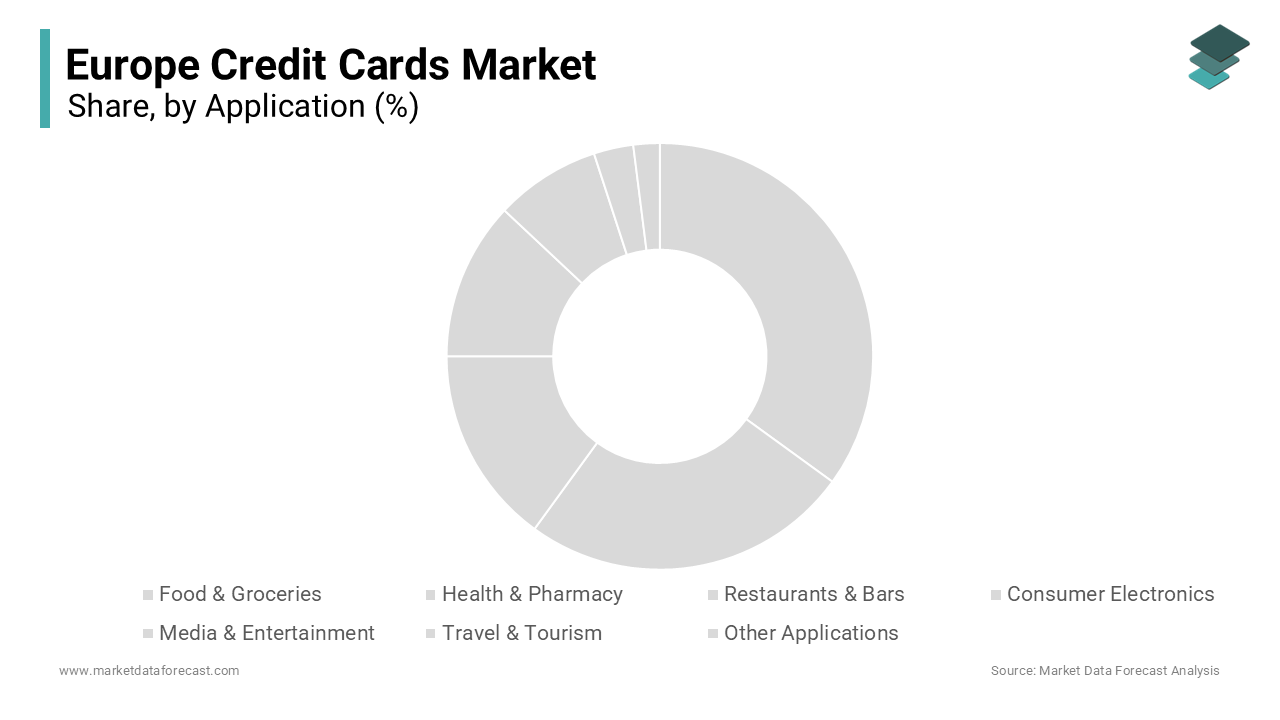
The health and pharmacy segment is emerging at a fastest CAGR of 9.4% from 2025 to 2033 with the aging population, increasing health consciousness, and the rapid digitization of pharmaceutical services across Europe. A key driving factor is the shift towards online pharmacy platforms and telemedicine services, which rely heavily on credit card payments for prescription deliveries and virtual consultations. According to the European Commission, the silver economy, which includes healthcare services for the elderly, is expected to grow significantly as the proportion of citizens aged 65 and above reaches 21% by 2025. This demographic shift drives higher spending on medications, medical devices, and wellness products, often purchased using credit cards for their security and insurance benefits. Additionally, the post-pandemic emphasis on personal health has led to a surge in expenditures on vitamins, supplements, and fitness-related health services, many of which are subscribed to via recurring credit card billing. Credit cards offer the necessary fraud protection and easy expense tracking that consumers demand for high-value medical purchases. As healthcare costs rise and digital access expands, the reliance on credit facilities for health-related spending will continue to drive rapid expansion in this segment.
By Card Type Insights
The general purpose segment was the largest by accounting for a prominent share of the Europe credit cards market in 2024 owing to the versatility and universal acceptance of these cards, which can be used for virtually any transaction type across millions of merchants globally without restriction. The growth of the segment is majorly driven by the extensive network infrastructure provided by major schemes like Visa and Mastercard by ensuring that general purpose cards are accepted everywhere from small local shops to large international retailers. These cards offer a balanced mix of features including revolving credit, cash advances, and standard reward programs that appeal to a broad spectrum of users ranging from students to corporate executives. Financial institutions prefer issuing general purpose cards because they generate steady revenue streams through interchange fees and interest income without the niche limitations of specialty products. The ability to integrate these cards with digital wallets and banking apps further cements their utility in daily life.
The Specialty and Other Credit Cards segment is anticipated to register a CAGR of 11.2% during the forecast period with the increasing demand for personalized financial products that cater to specific lifestyle needs, travel habits, and professional requirements. The growth of the segment is likely to grow with the rise of co-branded cards partnered with airlines, hotel chains, and retail giants, which offer targeted rewards that resonate deeply with niche consumer segments. According to a study by McKinsey, over 60% of European millennials prefer financial products that align with their specific interests and values, driving issuers to develop specialized offerings such as green cards for eco-conscious users or freelancer cards with tailored expense management tools. The growth of the gig economy has also spurred demand for cards designed for self-employed individuals, featuring integrated invoicing and tax estimation capabilities. Issuers are leveraging big data to identify underserved niches and create bespoke products that foster intense brand loyalty.
By Provider Insights
The visa segment was the largest by capturing 46.3% of the Europe credit cards market share in 2024 with its unparalleled global acceptance network and decades of established trust among both merchants and consumers across the continent. The growth of the segment is driven by the extensive infrastructure that allows Visa cards to be processed seamlessly in virtually every country, making it the preferred choice for travelers and cross-border shoppers within the Schengen Area. According to Visa Inc., the company processed over 200 billion transactions globally in 2024, with Europe representing a significant and growing portion of this volume due to the region's high digitization rates. The provider's continuous investment in security technologies, such as tokenization and biometric authentication, has reinforced its reputation for safety by encouraging banks to issue Visa-branded cards over competitors. Furthermore, strategic partnerships with major European banks and fintech startups have expanded its reach into emerging digital payment channels. The brand's strong marketing presence and loyalty program integrations also contribute to high consumer preference.
The other providers segment is projected to expand at a CAGR of 8.7% from 2025 to 2033 with the strategic efforts of these providers to break the duopoly of Visa and Mastercard by offering superior rewards, exclusive benefits, and lower merchant fees in specific niches. According to analysis, American Express saw a 12% increase in card issuance in Western Europe in 2024, driven by high-net-worth individuals seeking premium travel perks and concierge services. Additionally, the rise of domestic payment schemes in countries like France and Germany, supported by government initiatives to reduce reliance on international networks, is contributing to this growth. These local providers often offer cost-effective solutions for domestic transactions, appealing to small businesses sensitive to interchange fees. The introduction of innovative fintech-led credit products by non-traditional providers is also capturing market share among younger demographics, who value digital-first experiences. As competition intensifies and these providers diversify their offerings, their collective market presence is set to grow rapidly, challenging the established order.
REGIONAL ANALYSIS
United Kingdom Credit Cards Market Analysis
The United Kingdom was the largest contributor of the Europe credit cards market by capturing 24.2% of share in 2024 with a long-standing culture of credit usage and a highly developed financial services sector that encourages revolving credit as a standard financial tool. British consumers exhibit high penetration rates, with multiple credit cards per capita being common among the adult population, driven by attractive reward programs and competitive interest rates. According to the Bank of England, outstanding consumer credit in the UK reached record levels in 2024, with credit cards accounting for a significant portion of this debt. The presence of London as a global financial hub fosters intense competition among issuers, leading to innovative product features and aggressive customer acquisition strategies. The regulatory environment, while strict on affordability checks, supports a transparent market where consumers are well-informed about credit terms. Furthermore, the early adoption of contactless technology and mobile wallets in the UK has seamlessly integrated credit cards into daily commerce. The robust e-commerce sector also drives high volumes of card-not-present transactions.
Germany Credit Cards Market Analysis
Germany credit cards market growth is likely to have a significant growth opportunities with the strong preference for debit cards and direct debits, yet the credit card segment is growing rapidly due to the needs of international travel and online shopping. The sheer size of the German economy and the increasing acceptance of credit cards by merchants, who previously resisted them. According to the Deutsche Bundesbank, the number of credit card transactions in Germany grew by 14% in 2024, signaling a cultural shift among younger generations who are more comfortable with digital credit. The rise of e-commerce giants and subscription services has forced a change in payment habits, making credit cards indispensable for online purchases. German issuers are responding by offering cards with no annual fees and integrated budgeting tools to appeal to risk-averse consumers. The country's strong export orientation also means that many businesses issue corporate credit cards to employees for travel and procurement.
France Credit Cards Market Analysis
France credit cards market growth is likely to grow with a unique hybrid system, where debit cards with credit functionality are prevalent. The French market is heavily influenced by the "Carte Bancaire" domestic scheme, which often partners with international providers to offer dual-brand cards that function both domestically and globally. French consumers value the flexibility of deferred debit options, which allow purchases to be deducted from bank accounts at the end of the month without interest, bridging the gap between debit and traditional credit. The government's push for a cashless society and the modernization of payment terminals have facilitated wider acceptance. The tourism sector is a major driver, as France being the world's top tourist destination necessitates robust credit card infrastructure for international visitors. Issuers are increasingly focusing on premium cards with travel insurance and loyalty points to capture the high-spending tourist and local affluent segments.
Italy Credit Cards Market Analysis
Italy credit cards market growth is likely to have a steady growth opportunities in next coming years with the dynamic interplay between traditional cash usage and rapidly adopting digital credit solutions. According to the Bank of Italy, credit card issuance increased by 9% in 2024, fueled by government incentives for digital payments to reduce tax evasion and the shadow economy. Italian consumers are increasingly embracing credit cards for online shopping and large purchases, attracted by installment plans offered by issuers that allow splitting payments without high interest. The prevalence of small and medium-sized enterprises has led to a rise in business credit cards used for managing cash flow and expenses. The cultural shift towards digital banking among the younger population is accelerating adoption rates by moving away from the historical preference for cash
Spain Credit Cards Market Analysis
Spain credit cards market growth is esteemed to grow with the remarkably fast pace of digital transformation and high smartphone penetration. The rapid shift from cash to electronic payments, with credit cards becoming the preferred method for a wide range of transactions from groceries to entertainment is substantially elevating the growth of Europe credit cards market. According to the Bank of Spain, the number of contactless credit card transactions doubled between 2022 and 2024, reflecting the success of national initiatives to promote digital literacy and cashless payments. Spanish banks are highly competitive, offering attractive introductory rates and generous reward programs to capture market share in a saturated banking landscape. The strong tourism industry, particularly in coastal regions and major cities, drives significant volume, as merchants widely accept credit cards to accommodate international visitors. The rise of neobanks and digital-only lenders in Spain has disrupted traditional models, offering instant credit card approval and management via mobile apps. This technological agility appeals to the tech-savvy Spanish population, fostering high engagement rates.
COMPETITIVE LANDSCAPE
The competition in the Europe credit cards market is intensely fierce characterized by a battle for dominance between global network giants, traditional banking institutions, and agile fintech disruptors. Market participants constantly innovate their digital platforms and reward structures to distinguish their offerings in a saturated environment where switching costs for consumers are relatively low. The entry of non-traditional players offering embedded finance solutions has intensified pressure on established issuers to modernize their legacy systems and improve user interfaces. Regulatory frameworks such as interchange fee caps and open banking mandates further complicate the landscape by compressing margins and forcing transparency in pricing. Companies compete not only on interest rates and fees but also on the quality of mobile applications, speed of approval processes, and the exclusivity of benefits provided. Strategic acquisitions and collaborations are common as firms seek to acquire technological capabilities or enter new geographic niches rapidly. The shift towards contactless and biometric authentication has become a standard expectation, driving continuous investment in security infrastructure.
KEY MARKET PLAYERS
Some of the companies that are playing a dominating role in the Europe Credit Cards Market include
- Visa Inc.
- Mastercard Incorporated
- American Express Company
- Barclays PLC
- HSBC Holdings PLC
- BNP Paribas
- Banco Santander S.A.
- Deutsche Bank AG
- ING Group
- UniCredit S.p.A.
Top Players in the Market
Visa Inc.
Visa Inc. operates as a global payments technology leader that connects consumers, merchants, and financial institutions across more than 200 countries and territories. The company does not issue cards directly but facilitates secure and reliable transactions through its advanced processing networks used by European banks. Their global contribution involves setting industry standards for security, speed, and reliability in digital payments while driving financial inclusion worldwide. Recent actions to strengthen their market position include the expansion of tap to phone solutions that allow small European merchants to accept contactless payments without traditional terminals. Visa actively invests in blockchain technology and partnerships with fintech firms to enable real-time cross-border settlements and enhance fraud detection capabilities. They also focus on sustainability initiatives by helping issuers launch carbon footprint tracking features for cardholders. By continuously innovating their infrastructure and fostering strategic alliances, Visa ensures its network remains the preferred choice for European financial institutions seeking robust and scalable payment solutions.
Mastercard Incorporated
Mastercard Incorporated serves as a foremost technology company in the global payments industry, offering a comprehensive range of payment solutions and value-added services to stakeholders across the economic spectrum. The company empowers European banks and credit unions with sophisticated data analytics and cybersecurity tools to manage risk and improve customer experiences. Their global contribution lies in pioneering open banking initiatives and developing inclusive financial products that serve underbanked populations in diverse markets. Recent strategic moves involve the acquisition of specialized AI startups to bolster their real-time decision intelligence platforms for preventing payment fraud. Mastercard strengthens its market position by launching innovative programs like Priceless Cities that offer unique experiential rewards to cardholders in major European capitals. They are also deeply committed to net zero goals, working with partners to create sustainable payment cards from recycled materials. Through relentless innovation and a focus on seamless digital integration, Mastercard maintains its status as a critical enabler of commerce in the evolving European landscape.
American Express Company
American Express Company functions as a globally integrated payments company that provides customers with access to products, insights, and experiences that enrich lives and build business success. Unlike network-only processors, American Express operates a closed-loop model in many regions, allowing direct relationships with both cardmembers and merchants across Europe. Their global contribution includes setting high benchmarks for customer service, premium rewards, and corporate expense management solutions utilized by multinational enterprises. Recent actions to solidify their standing involve aggressive expansion of their merchant acceptance network in key European markets to reduce gaps compared to competitors. The company actively enhances its digital platforms with personalized offers and flexible payment options like Pay Over Time to attract younger demographics. American Express also focuses on sustainability by linking cardmember rewards to charitable donations and green initiatives.
Top Strategies Used by Key Market Participants
Key players in the Europe credit cards market primarily focus on digital transformation by integrating artificial intelligence and machine learning to enhance fraud detection and personalize customer experiences significantly. Companies aggressively pursue strategic partnerships with fintech startups and neobanks to expand their reach into underserved demographic segments and innovate product offerings. Major participants are investing heavily in contactless and mobile payment technologies to ensure seamless transaction experiences across online and offline channels. Firms are developing sustainable credit card products made from recycled materials to align with growing environmental concerns and regulatory pressures. Additionally, market leaders are enhancing loyalty programs with exclusive experiential rewards and flexible payment options to increase cardholder engagement and retention rates.
MARKET SEGMENTATION
This research report on the Europe Credit Cards Market has been segmented and sub-segmented based on the following categories.
By Application
- Food & Groceries
- Health & Pharmacy
- Restaurants & Bars
- Consumer Electronics
- Media & Entertainment
- Travel & Tourism
- Other Applications
By Card Type
- General Purpose Credit Cards
- Specialty & Other Credit Cards
By Card Format
- Physical
- Digital
By Provider
- Visa
- Mastercard
- Other Providers
By Country
- UK
- France
- Spain
- Germany
- Italy
- Russia
- Sweden
- Denmark
- Switzerland
- Netherlands
- Turkey
- Czech Republic
- Rest of Europe