- Product Description Description
- Table of Contents TOC
- List of Table & Figure LOT
- Get Free Sample PDF Sample PDF
Market Size, 2025
$975.8 MnMarket Estimate, 2026
$1066 MnMarket Forecast, 2034
$2168 MnCAGR, 2026–2034
9.28%Europe Student Information System Market Report Summary
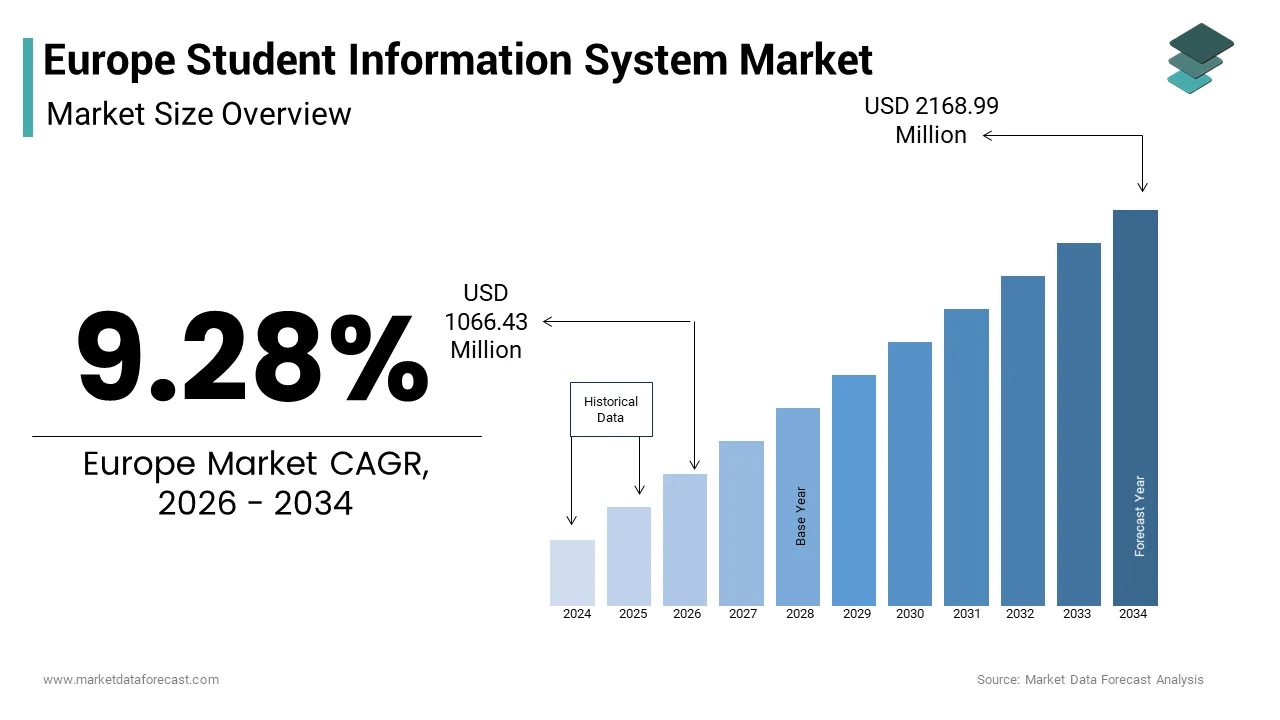
The Europe student information system market was valued at USD 975.87 million in 2025, is estimated to reach USD 1066.43 million in 2026, and is projected to grow to USD 2168.99 million by 2034, expanding at a CAGR of 9.28% during the forecast period from 2026 to 2034. The market growth is driven by accelerated digital transformation in education, rising demand for centralized student data management, and increasing adoption of cloud-based academic administration platforms across schools and higher education institutions.
Growing enrollment volumes, cross-border student mobility, and the need for real-time academic insights are prompting institutions to modernize legacy systems. Additionally, strict data protection regulations such as GDPR are compelling institutions to adopt secure, compliant, and scalable student information systems. The integration of SIS platforms with learning management systems, analytics tools, and mobile applications is further strengthening market expansion across Europe.
Key Market Trends
- Rising adoption of cloud-based and SaaS student information systems for flexibility and cost efficiency.
- Increased focus on automation of enrollment, attendance, grading, and reporting workflows.
- Growing integration of analytics and AI to support student performance monitoring and retention strategies.
- Expansion of self-service portals and mobile-first platforms to enhance student and faculty engagement.
- Strong emphasis on data security, interoperability, and regulatory compliance across institutions.
Regional Insights
The European student information system market demonstrates strong regional adoption supported by national education digitization initiatives.
- United Kingdom leads the regional market, driven by its mature higher education ecosystem, international student inflows, and rapid institutional modernization.
- Germany holds a prominent position due to its large and diversified education base, supported by continuous digital transformation mandates.
- France remains a key market where centralized governance and institutional initiatives emphasize data integration and end-to-end student journey visibility.
- Italy represents a steadily growing market, characterized by gradual modernization efforts and a strong focus on compliance and integration with legacy academic systems.
- Spain ranks among the leading markets, supported by sustained investments in higher education platforms and coordinated digital upgrades across the school sector.
Competitive Landscape
The Europe student information system market is moderately competitive, with a mix of global enterprise software providers and specialized education technology vendors. Leading companies are focusing on cloud-native platforms, modular system architecture, advanced analytics, and seamless LMS integration to strengthen their market presence. Strategic partnerships with educational institutions, continuous feature enhancement, and compliance-focused product development remain core competitive strategies.
Prominent players operating in the Europe student information system market include SAP SE, Oracle Corporation, Tribal Group Plc, Workday, Inc., Jenzabar, Inc., Skyward, Inc., Foradian Technologies Private Limited, Anthology, Inc., Ellucian Company L.P., and Beehively.
Europe Student Information System Market Size
The Europe student information system market size was valued at USD 975.87 million in 2025 and is anticipated to reach USD 1066.43 million in 2026 and USD 2168.99 million by 2034, growing at a CAGR of 9.28% during the forecast period from 2026 to 2034.
A student information system in the European context refers to an integrated digital platform designed to manage academic, administrative, ve and operational processes across primary, secondary,dary and tertiary educational institutions. These systems centralize functions such as enrollment, grading, scheduling,,e scheduli, ng and communication between students, educators, rs and guardians. The adoption of such platforms has become increasingly essential as Europe’s education sector navigates demographic shifts, technological expectations, and policy-driven modernization. According to Eurostat, the vast majority of students in the European Union are enrolled in formal education, which reflects a stable and sizable user base that requires efficient management infrastructure. According to the European Commission’s Digital Decade monitoring reports, more than three‑quarters of educators across EU member states now use digital tools for administrative and teaching tasks, though interoperability and data standardization remain uneven across national systems. The European Education Area initiative emphasizes digital transformation in schools and universities by 2025, which is positioning student information systems as a cornerstone of operational resilience and pedagogical innovation. By embedding digital infrastructure into education policy, the EU aims to ensure equitable access, improved efficiency, and stronger alignment with its broader digital‑sovereignty goals.
MARKET DRIVERS
Digital Transformation Mandates in Public Education Systems
European governments are institutionalizing digital transformation in education through binding policy frameworks, which directly fuel demand for student information systems, which is majorly fuelling the growth of the European student information systems market. According to the European Commission’s Digital Education Action Plan 2021–2027, all member states are required to modernize administrative infrastructure in schools, with national implementation timelines already active. In Germany, for instance, the federal government allocated billions of euros under the Digital Pact for Schools by 2025, with a mandatory requirement that funded institutions adopt interoperable management software. As per the German Federal Ministry of Education and Research, a large majority of publischools initiateded student information system procurement between 2022 and 2024, whichreflectsg rapid adoption. Similarly, France’s Ministry of National Education mandated that all public secondary schools deploy a certified student management platform by September 2023, which is a directive affecting thousands of institutions. In Sweden, the Education Agency reported in 2024 that all municipalities now use centralized student data platforms compliant with national interoperability standards, demonstrating full coverage. Thespolicy-drivenen rollouts create structural and sustained demand not subject to budgetary discretion but embedded in national education modernization agendas.
Rising Student Mobility and Cross-Border Enrolment Complexity
The growing volume of student mobility within Europe has intensified the need for robust student information systems capable of managingcross-institutionall and cross-national academic records, which is further boosting the student information systems market expansion in Europe. According to the European Union’s Erasmus+ program, more than 130,000 higher education students participated in credit‑bearing mobility during the 2022–2023 academic year, which is showinga trong recovery compared to pre‑pandemic levels. As per the European Commission, hundreds of thousands of school‑level learners engaged in international exchange or cross-border schooling arrangements in 2023, many requiring real-time transcript validation and curriculum alignment. Institutions in border regions such as the German‑Dutch‑Belgian tri‑national zone routinely enroll students residing in one country while attending school in another. The European Schools system, which operates institutions across eight EU member states, manages tens of thousands of students from over 100 nationalities, necessitating a unified digital backbone for academic progression. National education ministries, including those of Austria and the Netherlands, do now require student information systems to support the Europass digital credential framework, ensuring automatic recognition of competencies across jurisdictions. This regulatory and demographic reality transforms student information systems from internal tools into critical nodes inpan-Europeanean education data ecosystem.
MARKET RESTRAINTS
Fragmented Data Privacy Regulations Across Member States
Despite the overarching General Data Protection Regulation, student information system deployment faces operational friction due to divergent national interpretations of data handling in educational contexts, which is impeding the regional market growth. According to the European Data Protection Board, national supervisory authorities in countries such as Germany, France, and Italy have issued differing guidance on the lawful basis for processing student biometric data, attendance logs, and behavioural analytics, which is creating uncertainty. As per the Irish Data Protection Commission, educational institutions must obtain explicit parental consent for any digital monitoring beyond basic enrolment data, whereas Sweden permits processing under public interest grounds. This inconsistency complicatesmulti-countryy deployments for system vendors and increases compliance costs for institutions operating across borders. As per the European Commission’s 2023 evaluation of GDPR implementation in education, more than a dozen member states maintain additional sector-specific privacy decrees governing student data, which often impose stricter retention limits or audit requirements. For instance, Spanish law restricts cloud-based student data storage to EU-based servers, while Polish regulations prohibit algorithmic grading without human oversight. These variations fragment the European market and delay procurement cycles as institutions seek legal validation before adopting new platforms.
Legacy Infrastructure and Low Digital Maturity in Rural Schools
Many educational institutions, particularly in Eastern and Southern Europe, continue to operate on outdated administrative systems that lack integration capabilities with modern student information platforms, which further hinders the growth of the student information systems market in Europe. According to the European Institute for Innovation and Technology, fewer than half of rural schools in Romania, Bulgaria, and Greece reported having functional local area networks in 2023, which is limiting their capacity to deplocloud-baseded or even on-premise solutions. As per the OECD Teaching and Learning International Survey, more than 60% of school leaders in these regions cited insufficient technical support staff as a critical barrier to digital system adoption, which indicates human resource constraints. In Italy, the Ministry of Education found that a significant share of public secondary schools still rely on paper-based registers for attendance and grading as of early 2024. Even where connectivity exists, institutional resistance persists due to low digital literacy among staff. According to the European Training Foundation, fewer than 35% of teachers in rural Croatia and Lithuania received formal training in administrative software between 2021 and 2023, which indicates skills gaps. This infrastructure and competency gap creates a two-tier landscape where urban institutions advance rapidly while rural counterparts lag significantly, which is indicating continent wide interoperability goals.
MARKET OPPORTUNITIES
Integration with Emerging National Education Data Hubs
European nations are progressively establishing centralized education data infrastructures, offering significant opportunities for the European student information system market. According to the European Commission, Finland’s National Education Information System, launched in 20,23 aggregates academic data from thousands of basic education institutions, enabling predictive analytics on student performance and dropout risks. As per the Dutch Ministry of Education, Culture and Science, the Netherlands’ Education Data Platform requires student information systems to transmit anonymized learning progression metrics through standardized APIs by 2025, ensuring interoperability. Similarly, Portugal’s SIGO system now covers all public schools and is expanding to include private institutions, creating a unified data layer for policy evaluation and resource allocation. These national hubs rely on consistent, structured inputs from institutional platforms, making interoperability certification a competitive advantage. Vendors that align with emerging European education data models,s such as the European Learning Model promoted by the Commission,n can position themselves as foundational partners in national digital education strategies rather than mere software suppliers.
Expansion of Lifelong Learning and Micro Credential Frameworks
The institutionalization of lifelong learning pathways across Europe is creating demand for student information systems capable of managing non-traditional academic records, including micro credentials, stackable courses, and work-based learning outcomes, which is providing more lucrative opportunities in the European student information systems market. According to the European Centre for the Development of Vocational Training, more than 22 million adults participated in formal continuing education programs across the EU in 2023, which is showing strong growth compared to 2021. As per the European Commission, the European Qualifications Framework now recognizes thousands of distinct micro credentials issued by universities, training providers, and industry bodies, which reflects rapid diversification. Institutions delivering these programs require systems that can track modular progress, validate external competencies, and issue verifiable digital badges. France’s national lifelong learning account system enrolled millions of citizens by 2024 and mandates integration with provider-level management platforms to auto-populate learning histories, which ensures transparency. Germany’s Federal Ministry of Education launched the National Continuing Education Strategy in 2023, requiring accredited providers to maintain auditable learner records compatible with federal data standards, which is reinforcing accountability. This shift expands the market beyond traditional K–12 and university segments into adult education, corporate academies, and hybrid learning ecosystems.
MARKET CHALLENGES
Persistent Interoperability Gaps Between Disparate Systems
Despite policy emphasis on digital integration, student information systems in Europe frequently operate in isolation due to a lack of universal data exchange standards, which is leading to inefficiencies and data silos and is one of the major challenges to the regional market growth. According to the European Commission’s 2024 review of digital education, fewer than one-third of EU member states have implemented mandatory technical specifications for system interoperability in schools, highlighting uneven progress. As per the European Schoolnet network, more than half of institutions use separate platforms for grading, timetabling, communication, and special needs support, with manual data re-entry remaining common practice. This fragmentation increases administrative burden and error rates, particularly during transitions between educational levels. In Belgium, for example, the absence of a unified student identifier across Flemish, French, and German-speaking communities impedes seamless academic tracking. The European Interoperability Framework encourages semantic alignment but lacks enforcement mechanisms, resulting in vendor-specific data models that resist integration. Until a continent-wide schema such as the proposed European Student Identifier becomes operational, institutions will continue to face operational friction undermining the core value proposition of integrated student information systems.
Resistance to Centralized Data Governance in Decentralized Education Systems
In countries where the education authority is constitutionally devolved to regional or municipal levels, the adoption of standardized student information systems encounters institutional resistance rooted in autonomy concerns, which is also challenging the regional market expansion. According to the OECD’s Education Policy Outlook, Germany’s 16 federal states maintain independent curricula, certification rules, and procurement policies, which is resulting in dozens of distinct student data platforms nationwide. As per the Swedish National Agency for Education, the country’s 290 municipalities retain full control over school administration software, which is leading to a fragmented landscape where interoperability is voluntary. In Spain, regional governments such as Catalonia and Andalusia operate entirely separate digital education ecosystems with no obligation to align with national data models. This decentralization complicatespan-Europeann data initiatives and discourages vendors from investing in unified solutions. Even when national frameworks exist, as in Italy, local school consortia often select systems based on historical relationships rather than compliance mandates. This structural reality limits economies of scale and delays the realization of a cohesive European education data space.
REPORT COVERAGE
| REPORT METRIC | DETAILS |
| Market Size Available | 2025 to 2034 |
| Base Year | 2025 |
| Forecast Period | 2026 to 2034 |
| CAGR | 9.28% |
| Segments Covered | By Type, Application, Deployment Mode, End-User, Functional Module, By Region |
| Various Analyses Covered | Global, Regional & Country Level Analysis, Segment-Level Analysis, DROC, PESTLE Analysis, Porter’s Five Forces Analysis, Competitive Landscape, Analyst Overview of Investment Opportunities |
| Regions Covered | UK, France, Spain, Germany, Italy, Russia, Sweden, Denmark, Switzerland, Netherlands, Turkey, Czech Republic, & Rest of Europe |
| Market Leaders Profiled | SAP SE, Oracle Corporation, Tribal Group Plc, Workday, Inc., Jenzabar, Inc., Skyward, Inc., Foradian Technologies Private Limited, Anthology, Inc., Ellucian Company L.P., Beehively
|
REGIONAL ANALYSIS
United Kingdom Student Information System Market Analysis
United Kingdom holds a leading position in the regional market due to its mature higher education ecosystem and rapid institutional modernization. Universities increasingly standardize data governance and automate student lifecycles, prioritizing interoperability across admissions, finance,e and learning analytics. Procurement tracks emphasize cloud-first strategies, which align with the growing shift toward cloud-based student information systems noted in market segmentations. UK demand also reflects the balance between higher education and school sector needs, mirroring the application split identified in industry coverage for student information systems. The regional market’s evolution toward cloud deployment and web-based platforms is consistently highlighted in research that segments Europe by deployment mode and end user, reinforcing the UK’s alignment with these trends. These patterns show the UK’s role as a bellwether for cloud adoption andservices-heavyy implementations within Europe’s student information systems landscape.
Germany Student Information System Market Analysis
Germany occupies a prominent position in the regional market due to its large and diversified education base and continuous digital transformation mandates. Procurement in Länder and university consortia favours scalable solutions and long-term support models, which fit the solutions and professional services structure found in European market analyses. Demand spans K 12 and higher education, with analytics and compliance tooling embedded into student information workflows, matching the end user segmentation emphasized by industry reports. Germany’s approach often pairs staged rollouts with vendor ecosystems that integrate learning platforms and identity management, reflecting the converging trend toward integrated suites. Its contribution aligns with the broader European trajectory that separates cloud and on-premises deployments and differentiates workloads by sector, a frame widely used in regional market coverage for student information systems.
France is a leading market where central and institutional initiatives push data integration and student journey visibility. Universities and grandes écoles invest in configurable workflows for admissions and academic records while secondary institutions pursue standardized reporting and governance. Market analyses consistently describe Europe throughcomponents solutions, and professional services, a pattern that mirrors France’s emphasis on implementation and change management alongside platforms. The regional outlook underscores higher education and K 12 applications and distinguishes cloud from on-premises pathways, structures visible across French projects that balance sovereignty concerns with modernization goals. France’s trajectory is consistent with the European student information systems segmentation by component, end use,r and deployment mode, situating it among the steady performers advancing interoperable and service-supported rollouts.
Italy Student Information System Market Analysis
Italy is a key market characterized by gradual modernization and strong attention to compliance and integration with legacy academic systems. Institutions prioritize lifecycle automation for enrolment, records, and certification while maintaining interoperability with national registries and finance systems. European coverage consistently breaks the market into cloud and on-premises deployment modes, which reflects Italy’s mixed estate and stepwise migration strategies. Reports also frame demand by components, solutions, ns and professional servi,,ces and by end user K 12 and higher education, mapping closely to Italian procurement that blends platform upgrades and service-led transformation. Italy’s performance sits within the broader European evolution toward cloud and web-based student information solutions while accommodating local operational and regulatory constraints highlighted in regional segmentations.
Spain Student Information System Market Analysis
Spain ranks among the leading markets through sustained investment in higher education platforms and coordinated upgrades in the school sector. Universities focus on modular architectures that integrate admissions, curriculum, and analytics, while regional education authorities seek standardized student data models. European market research profiles the region by country,s including Spain, in and by segments, and solutions versus services, K 12 versus higher education,tion and cloud on-premises, all relevant to Spain’s procurement features. The overarching European student information systems market is described as expanding with structured segment growth across these categories, and Spain’s adoption reflects that balanced pattern. Its trajectory aligns with the continent’s preference for scalable cloud offerings tempered by specific institutional needs, consistent with the segment frameworks reported by leading market analyses.
COMPETITIVE LANDSCAPE
The Europe student information system market features a dynamic, competitive landscape where global enterprise vendors,,s regional specialists, sts and emerging EdTech innovators vie for institutional contracts. Competition centers on compliance adaptability and functional depth rather than price alone, given the public funding nature of most procurements. Global players leverage scale and cloud infrastructure while local firms emphasize regulatory familiarity and language support. The market is further shaped by stringent public procurement rules that require open standards data portability and long-term vendor viability assessments. Differentiation increasingly hinges on advanced capabilities such as predictive analytics, interoperability with national education data hubs,s and support for lifelong learning pathways. As institutions seek platforms that align with both operational efficiency and policy mandate,,s vendors must demonstrata e deep understanding of Europe’s fragmented yet converging education governance models to secure long-term partnerships.
KEY MARKET PLAYERS
A few of the market players that are dominating the Europe student information system market
- SAP SE
- Oracle Corporation
- Tribal Group Plc
- Workday, Inc.
- Jenzabar, Inc.
- Skyward, Inc.
- Foradian Technologies Private Limited
- Anthology, Inc.
- Ellucian Company L.P.
- Beehively
Top Players In The Market
- Oracle Corporation maintains a significant presence in the Europe student information system market through its cloud-based PeopleSoft Campus Solutions pplatform widely adopted by large universities and research institutions. The company supports a complex academic structure, multilingual requirements, and compliance with European data sovereignty norms. In 20,24 Oracle enhanced its platform with AI-driven student success analytics aligned with the European Education Area’s retention goals. It also deepened integration with national digital identity frameworks in Germany and the Netherlands, enabling seamless single sign-on for students and staff. These upgrades reinforce Oracle’s role in serving Europe’s higher education sector while contributing to its global education cloud ecosystem across more than 200 countries.
- Workday Inc has expanded its footprint in the Europe student information system market by offering an integrated Student Experience Suite built on its unified cloud architecture. The platform combines academic administration, financial aid, and student engagement tools tailored for modern European universities. In early 202,4 Workday launched localized versions compliant with GDPR and national data handling laws in France and Sweden. The company also partnered with several European research universities to pilot predictive analytics for course planning and mental health support. These initiatives reflect Workday’s broader global strategy to unify human capital and student lifecycle management under a single intelligent platform serving institutions worldwide.
- Tribal Group plc is a Europe native leader in student information systems with deep roots in the UK and expanding operations across continental Europe. Its Tribal SITS platform is used by over 150 higher education institutions for managingadmissions o, ns curriculudeliveryiv,ery and quality assurance. In 2024, Tribal introduced a modular cloud migration pathway enabling legacy clients to transition without operational disruption. The company also aligned its product with the European Qualifications Framework to supmicrocredentialntial tracking and lifelong learning pathways. These actions not only strengthen its regional relevance but also position Tribal as a specialist exporter of education administration technology to similar regulatory environments globally.
Top Strategies Used by the Key Market Participants
Key players in the Europe student information system market prioritize regulatory alignment by embedding GDPR and national education data standards into platform architecture. They invest in cloud native development to ensurescalabilityi securityty and interoperability with national digital infrastructures. Companies actively pursue localization through multilingual inteinterfacesaces currency compliance, ad, integration with public identity systems. Strategic partnerships with m,inistries un,,, and EdTech consortia help co-develop features addressing region-specific pedagogical and administrative needs. Continuous enhancement of student success modules using predictive analytics and well-being indicators responds to Europe’s policy focus on retention and inclusion. These coordinated strategies enable vendors to navigate Europe’s complex yet high-value education technology landscape effectively.
MARKET SEGMENTATION
This research report on the Europe student information system market is segmented and sub-segmented into the following categories.
By Type
- Cloud-based
- On-premises
By Application Type
- K-12 Schools
- Higher Education
- Vocational Training
- Others
By End-user Type
- Public Institutions
- Private Institutions
- International Schools
By Deployment Model Type
- SaaS Solutions
- Custom Implementation
- Hybrid Systems
By Functional Module Type
- Admissions & Enrollment
- Academic Records
- Financial Management
By Country
- UK
- France
- Spain
- Germany
- Italy
- Russia
- Sweden
- Denmark
- Switzerland
- Netherlands
- Turkey
- Czech Republic
- Rest of Europe