- Product Description Description
- Table of Contents TOC
- List of Table & Figure LOT
- Get Free Sample PDF Sample PDF
Market Size, 2025
$10.73 BnMarket Estimate, 2026
$12.06 BnMarket Forecast, 2034
$30.73 BnCAGR, 2026–2034
12.4%Executive Summary: Global Student Information System (SIS) Market Analysis & Growth Forecast (2026-2034)
- Market Scope: Comprehensive industry analysis covering components, user types (K-12 and higher education), deployment types (cloud and on-premises), regional performance across North America, Europe, APAC, Latin America, and MEA, and primary growth catalysts.
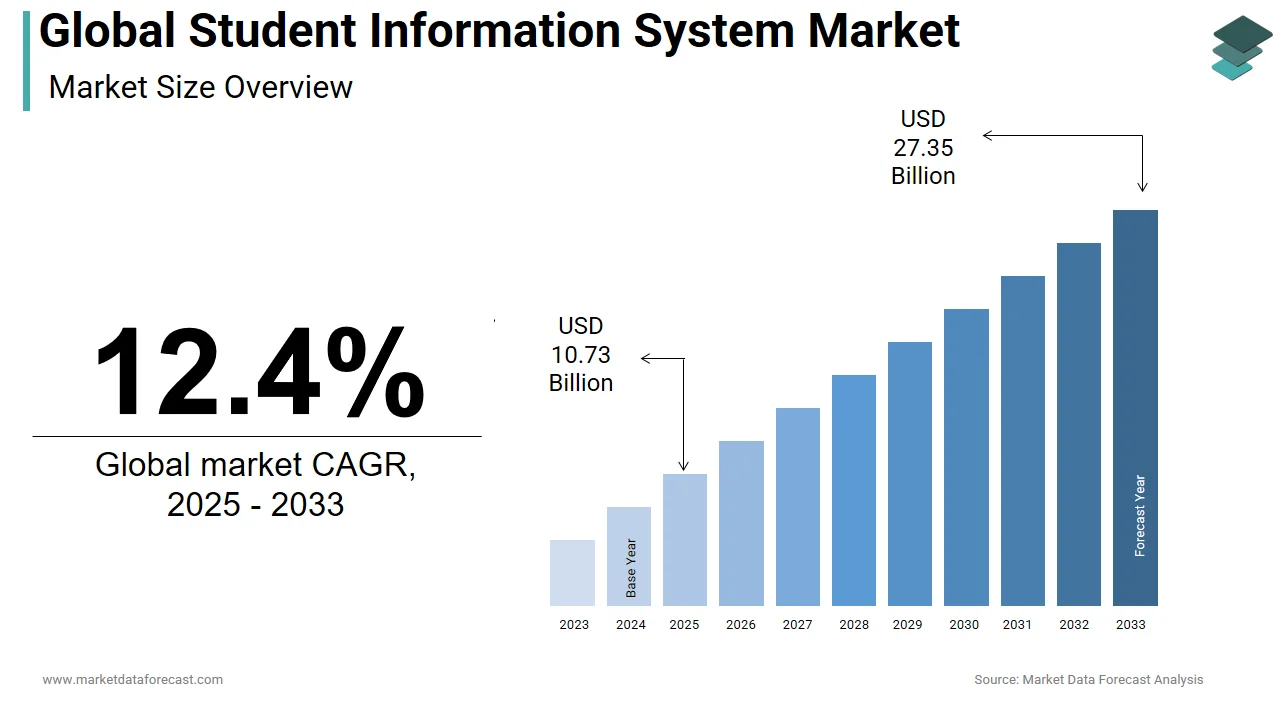
- Market Valuation: Valued at USD 10.73 billion in 2025, estimated at USD 12.06 billion in 2026, and projected to reach USD 30.73 billion by 2034, registering a steady compound annual growth rate (CAGR) of 12.4% from 2026 to 2034.
- Primary Growth Drivers: Heightened institutional focus on operational efficiency and education quality, digital transformation of academic administration, widespread government initiatives, and rising integration of AI, IoT, and mobile devices.
Key Global SIS Market Segment Metrics (2026-2034)
| Category | Leading Segment (Position) | Fastest-Growing / High-Impact Segment |
|---|---|---|
| By User Type | Higher Education (dominated market share due to complex administrative workflows, admissions, and extensive student lifecycle tracking) | K-12 Education (experiencing steady growth driven by school investments in digital tools for attendance, grading, and parent engagement) |
| By Deployment Type | On-Premises (maintains strong historical market adoption due to localized data control and strict security requirements) | Cloud-Based / SaaS (projected to record a higher CAGR driven by scalability, cost reduction, remote accessibility, and lower IT overhead) |
| By Component | Solutions / Software (captures the primary revenue share through core modules like student management, registration, and grade tracking) | Services (expanding through increased demand for system implementation, consulting, and ongoing technical support) |
| By Region | North America (leads the global market, anchored by advanced institutional infrastructure and early adoption of cloud software in the US and Canada) | Asia-Pacific & Emerging Markets (high-potential regions scaling rapidly through expanding internet penetration, mobile devices, and e-governance initiatives) |
Major Global Student Information System Market Players & Industry Structure
Market Structure: Competitive and fragmented EdTech landscape featuring enterprise software giants and specialized educational platform providers competing through comprehensive cloud suites, AI analytics integrations, and modular student lifecycle tools.
Key Companies: SAP SE, Workday, Inc., Jenzabar, Inc., Skyward, Inc., Tribal Group, Oracle Corporation, Illuminate Education, Ellucian Company LP, Arth Infosoft Pvt. Ltd., Foradian Technologies, Campus Management Corp., and ComSpec International, Inc.
Global Student Information System Market Size
The global student information system market was valued at USD 10.73 billion in 2025. The global market is expected to progress from USD 12.06 billion in 2026 to USD 30.73 billion by 2034, at an annual growth rate (CAGR) of 12.4% over the forecast period.
The Student Information System (SIS) is digital software created for academic institutions to introduce structured information that integrates administration and manages student data. These systems generally include packets of software such as the student management system, the student information management system, the student registration system and alike. They have the ability to store and track all information about students, including attendance records, grades, school records, etc. It can be used by students, teachers, and parents to communicate and access relevant information about a student's education to inform students, make payments, and contact school officials. This software also provides features such as student registration for courses, documentation of student exam results, grades, transcripts and other assessment scores, creation of student schedules, attendance tracking and management of other data related to the students.
Student information system solutions are provided independently or as part of an integrated campus suite. These solutions are targeted at recruiting, professional development, student support and relationship management with graduates in the student field and provide more comprehensive campus and business management (ERP) functionalities. SIS solutions can provide educational institutions with greater agility, the ability to automate routine tasks, and the ability to take advantage of advanced artificial intelligence and other emerging technology tools to enhance the overall student and staff experience. The commercially available SIS solutions have the features and functionality that meet most of the student management needs of an establishment, but the choice of solutions is primarily based on geographic region, size of establishment, and mission of each educational entity.
MARKET TRENDS
Educational institutions are looking for a solution that can easily align with their internal processes and improve their efficiency. With the rising concentration on the operational efficiency of academic institutions, the call for the student information system is expanding globally. Institutions take advantage of the student information system to improve the quality of education and keep spending to a minimum.
The cloud-based solution reduces overall costs while providing highly flexible and scalable access to solutions. Businesses are deploying student information systems in the cloud to improve mobility and scalability. The security of the student information system is greater in the type of local implementation; however, the cloud-based student information system allows organizations to reduce solution, storage and technical staff costs. Because of these benefits, many vendors are switching from local deployment mode to SaaS software.
MARKET DRIVERS
The emphasis placed by educational institutions on improving the quality of education and facilitating communication between students and teachers, parents and teachers, and within departments, and government initiatives widespread for technological advancements in the education sector proliferate the integration of various educational systems, such as the student information management system, driving the growth of the global market.
Factors such as the growing penetration of the Internet and mobile devices around the world, the digital transformation of the education sector and the growth of Over the Top (OTT) media services are the main drivers driving adoption of the student information system (SIS). Today, several suppliers offer integrated SIS applications with advanced analysis and artificial intelligence (AI) capabilities. In addition, other factors such as the rise of the Internet of Things (IoT), 5G telecommunications technology and advanced computing are expected to drive market growth.
MARKET RESTRAINTS
However, the lack of awareness on the part of educational institutions of student information systems is a major factor hampering the growth of the market for student information systems.
REPORT COVERAGE
| REPORT METRIC | DETAILS |
| Market Size Available | 2025 to 2034 |
| Base Year | 2025 |
| Forecast Period | 2026 to 2034 |
| CAGR | 12.4% |
| Segments Covered | By Component Type, User Type, Deployment Type, and Region |
|
Various Analyses Covered | Global, Regional & Country Level Analysis, Segment-Level Analysis, DROC, PESTLE Analysis, Porter’s Five Forces Analysis, Competitive Landscape, Analyst Overview on Investment Opportunities |
| Regions Covered | North America, Europe, APAC, Latin America, Middle East & Africa |
|
Market Leaders Profiled | SAP SE, Workday, Inc., Jenzabar, Inc., Skyward, Inc., Tribal Group, Oracle Corporation, Illuminate Education, Ellucian Company LP, Arth Infosoft Pvt. Ltd., Foradian Technologies, Campus Management Corp. and ComSpec International, Inc and Others. |
SEGMENTAL ANALYSIS
By User Type Insights
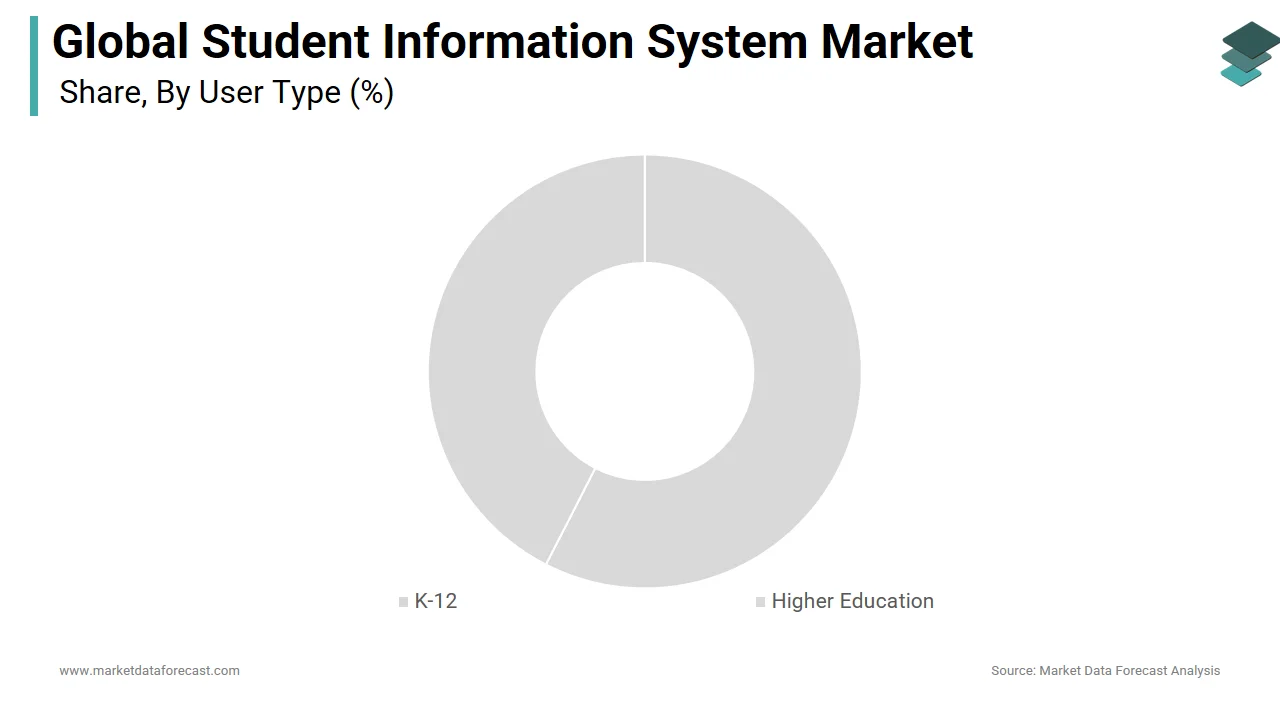
The market has been separated into K-12 education and higher education. The SIS for higher education was the most dominant segment in 2025 and is expected to continue in this way during the forecast period. The growth in the number of universities, the acquisition of educational materials such as projectors, tablets, interactive whiteboards, the exchange of digital content, the implementation of social learning and gamification animate the system of students around the world.
By Deployment Type Insights
The market for student information systems has grown in the cloud and on-site. The local segment is expected to dominate the student information systems market over the forecast period. The cloud deployment type is expected to grow at a higher CAGR during the forecast period
REGIONAL ANALYSIS
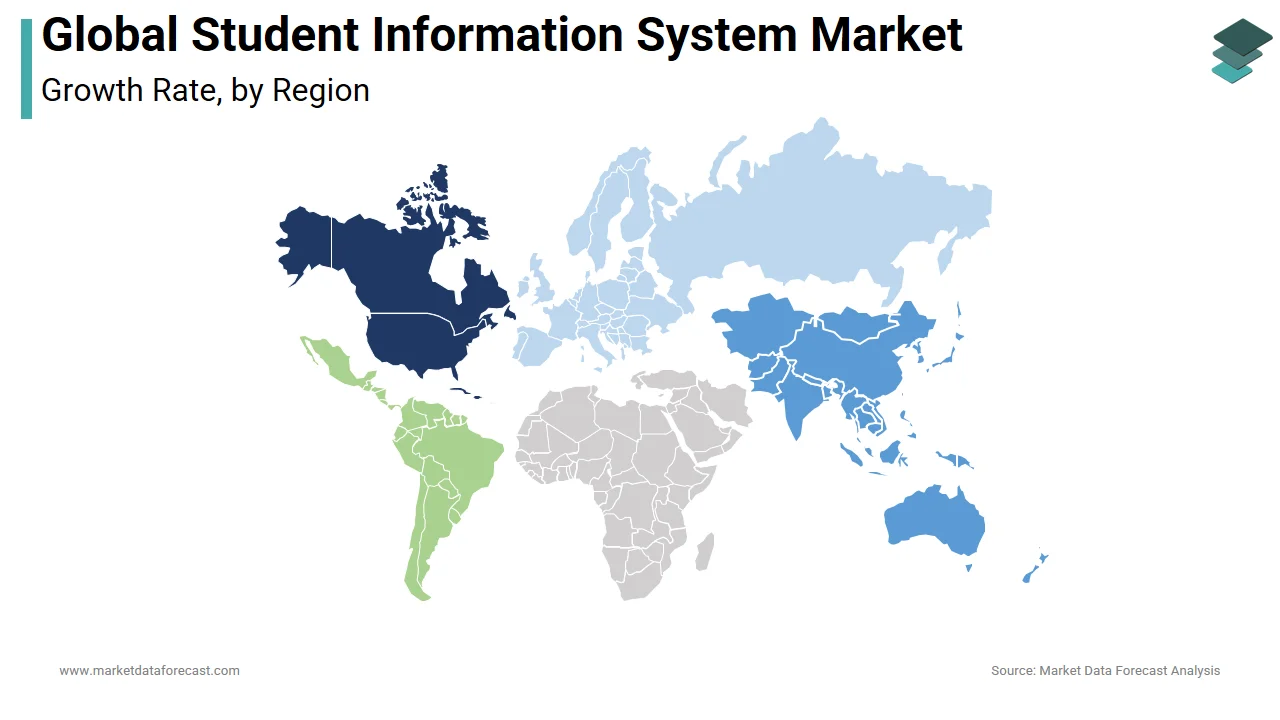
North America had a significant market share and is expected to remain dominant throughout the forecast period. The growing preference for implementing software solutions to help students and school management is an important factor in this region. The United States is one of the major markets for the student information system in North America.
KEY MARKET PLAYERS
The main players described in the global student information system market are SAP SE, Workday, Inc., Jenzabar, Inc., Skyward, Inc., Tribal Group, Oracle Corporation, Illuminate Education, Ellucian Company LP, Arth Infosoft Pvt. Ltd., Foradian Technologies, Campus Management Corp. and ComSpec International, Inc.
RECENT MARKET HAPPENINGS
In October 2018, Oracle Corporation introduced its first comprehensive student life cycle platform, Oracle Student Cloud. It is a set of products that includes a student management function, as well as student recruitment, support and participation. The unique feature of Oracle Student Cloud is its ability to integrate with other Oracle Campus Solutions educational software.
MARKET SEGMENTATION
The global student information system market was divided based on the component, user type, deployment type, and region.
By Component
- Solutions
- Services
By User Type
- K-12
- Higher Education
By Deployment Type
- Cloud
- On-Premises
By Region
- North America
- Europe
- Asia-Pacific
- Latin America
- The Middle East and Africa