- Product Description Description
- Table of Contents TOC
- List of Table & Figure LOT
- Get Free Sample PDF Sample PDF
Market Size, 2025
$676.7 BnMarket Estimate, 2026
$799.18 BnMarket Forecast, 2034
$3,024 BnCAGR, 2026–2034
18.1%Executive Summary: Global Digital Transformation Market
- Market Scope: Comprehensive global digital transformation market analysis covering service segments, enterprise categories, end-user verticals, regional frameworks, and competitive dynamics.
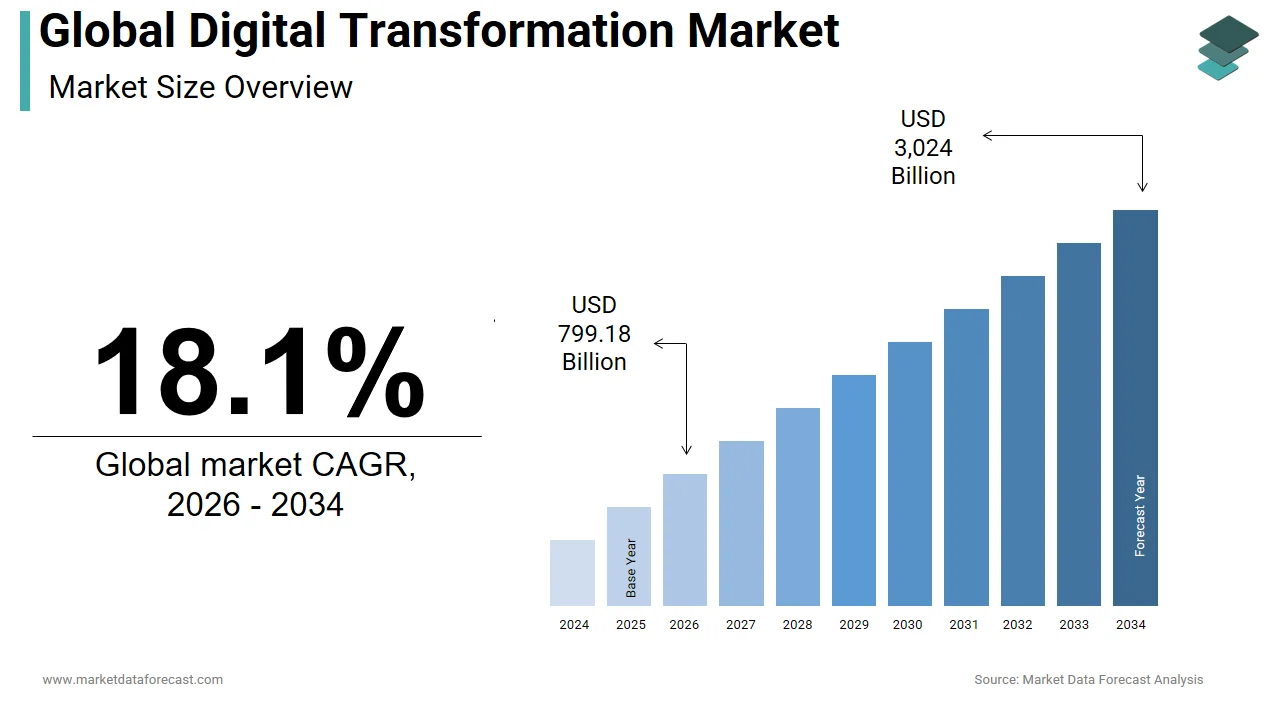
- Market Valuation: Valued at USD 676.70 billion (2025), estimated at USD 799.18 billion (2026), and projected to reach USD 3,024.00 billion by 2034, registering a robust CAGR of 18.1% (2026–2034).
- Primary Growth Drivers: Mobile app and connected device adoption, enhanced customer experience demand, digital business models, and integration of AI, IoT, cloud computing, big data, and cybersecurity. Opportunities include hyperautomation, predictive analytics, and operational agility.
Key Market Segment Metrics (2026–2034)
| Category | Leading Segment (2025 Position) | Fastest-Growing Segment |
|---|---|---|
| By Solution, Service, Enterprise & Vertical | Training (largest service segment); Large Companies (largest enterprise size); BFSI (largest end-user segment; largest solution segment not explicitly stated) | Big Data (fastest-growing solution segment; other specific segment growth rates not specified) |
| By Region | North America (largest regional market) | Asia-Pacific (fastest-growing regional market) |
Major Market Players & Market Structure
Market Structure: Highly competitive global technology and enterprise consulting ecosystem featuring major industry players competing on cloud technologies, artificial intelligence, automation, analytics, and strategic transformation partnerships.
Key Companies: SAP SE, IBM Corporation, Oracle Corporation, Google Inc., Dell EMC, Hewlett Packard Enterprise Co., CA Technologies, Microsoft Corporation, Adobe Systems Incorporated, Accenture PLC, Capgemini Group, Apple Inc., and Kellton Tech Solutions Ltd.
 Download Free Sample Report
Global Digital Transformation Market Size
The global digital transformation market was worth USD 676.7 billion in 2025. The global market size is expected to be worth USD 3,024 billion by 2034 from USD 799.18 billion in 2026, growing at a CAGR of 18.1% from 2026 to 2034.
MARKET DRIVERS
The growing use of mobile apps and devices is driving the global digital transformation market.
The intelligence of mobiles and apps has significantly changed many aspects of life, and that’s what encourages people to adopt digitalization. Individuals can now utilize the internet and other digital services from anywhere at any time due to continuous internet connectivity. This has changed how people engage with services and information from one another and opens new commercial prospects and business models for institutions. Applications and tools on mobile boost efficiency and productivity. It increases the employee’s efficiency and effectiveness in business needs by having access to corporate apps, remote collaboration, and task management capabilities.
Businesses must undergo an effective digital transformation to stay competitive in today's rapidly evolving technological era. Enhancing customer experience is also assisting in the expansion of the global digital transformation market. Tech-savvy customers desire better digital experiences at all touchpoints, such as social media, email, mobile apps, live chats, etc.
Advanced technologies such as IoT, cloud, big data analytics, cybersecurity, artificial intelligence, and social media marketing have raised the level of innovation and digitalization process, and this is accelerating the growth rate of the global digital transformation market. Obtaining actionable insights, real-time information and data, and improving the realization of client demands are some of the prime reasons for companies to rapidly apply these modern technologies. Likewise, the speedy adoption of data-driven analytics solutions, cloud computing, and connected devices has increased the demand for digital transformation in all industries and sectors around the world.
MARKET RESTRAINTS
One of the factors restricting the global digital transformation market is the absence of security and privacy concerns.
Digital transformation activities are significantly hindered by worries over data privacy and security. Much sensitive data will inevitably be collected, stored, and analyzed as businesses use technology more and more to improve customer experiences, expedite operations, and spur innovation. However, customers, authorities, and companies themselves are becoming more concerned about the possible risks related to data breaches, illegal access, and abuse of personal information.
MARKET OPPORTUNITIES
Hyper automation and AI-powered business activities present potential opportunities for the global digital transformation market.
It is anticipated that in 2024, artificial intelligence will go past automation and concentrate on predictive analytics, customized customer experiences, and self-governing decision-making within corporate processes. The emergence of hyper-automation is indicated by the integration of automation, machine learning, and AI. Businesses will benefit from the smooth integration of technologies to simplify procedures, lower operational complexity, and promote agility.
MARKET CHALLENGES
The rapid pace of technological advancements and intense competition are making adoption difficult for companies, which is hindering the expansion of the global digital transformation market. The slow incorporation of digital technologies by traditional businesses in today’s intense competition is limiting market growth. Also, the fast-changing consumer behavior is another challenge for companies in the digital landscape. Furthermore, AI's quick disruption is causing a talent shortage in IT departments, as per a study that stated the problem of finding qualified talent and highlighted missed opportunities for business outcomes.
REPORT COVERAGE
| REPORT METRIC | DETAILS |
| Market Size Available | 2025 to 2034 |
| Base Year | 2025 |
| Forecast Period | 2026 to 2034 |
| CAGR | 18.1% |
| Segments Covered | By Solution, Service, Enterprise Size, End User, and Region |
|
Various Analyses Covered | Global, Regional & Country Level Analysis, Segment-Level Analysis, DROC, PESTLE Analysis, Porter’s Five Forces Analysis, Competitive Landscape, Analyst Overview on Investment Opportunities |
| Regions Covered | North America, Europe, APAC, Latin America, Middle East & Africa |
|
Market Leaders Profiled | SAP SE, IBM Corporation, Oracle Corporation, Google Inc., Dell EMC, Hewlett Packard Enterprise Co., CA Technologies, Microsoft Corporation, Adobe Systems Incorporated, Accenture PLC, Capgemini Group, Apple Inc., Kellton Tech Solutions Ltd., and others. |
SEGMENTAL ANALYSIS
By Solution Insights
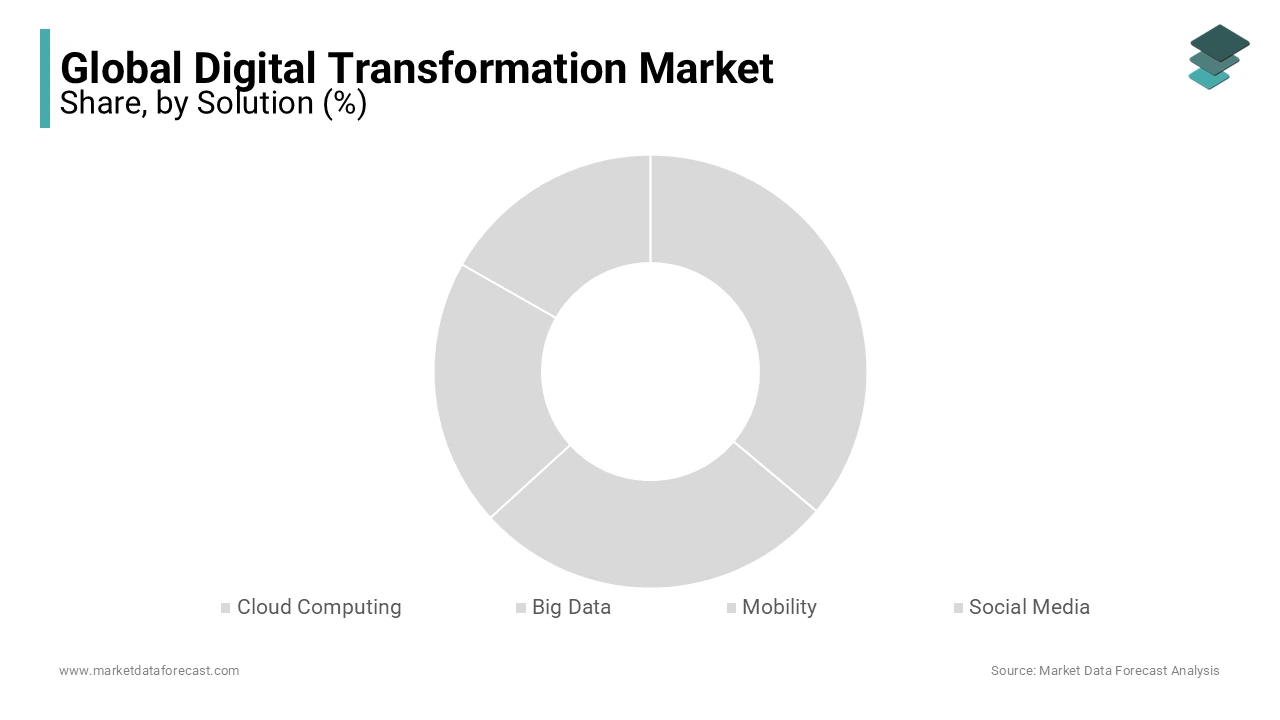
Based on the solution, the big data segment is predicted to move forward with a significant CAGR in the forecast period. AI- and ML-powered big data analytics are key elements of the manufacturing sector that are fuelling the digital transformation. Manufacturers may increase productivity, efficiency, and quality by utilizing these technologies to extract useful insights from their data. Whereas the cloud computing segment is also growing at a considerable pace. With the adoption of cloud-native designs and the use of data analytics and artificial intelligence, cloud computing has revolutionized enterprises by improving scalability, driving innovation, and streamlining procedures.
By Services Insights
Based on services, the training segment is predicted to account for the largest share of the global digital transformation market during the forecast period owing to the lack of skilled talent, regular advancement in technology, and employee training. The rising advanced technologies like AI, cloud computing, and automation require continuous skill development for businesses to remain competitive and adapt.
By Enterprise Size Insights
Based on enterprise size, the large companies segment is expected to have the largest share of the global digital transformation market during the forecast period. These enterprises are investing heavily in digital manufacturing processes to improve or hold onto their market position. Additionally, they are embracing cutting-edge technologies to adapt to shifting industry dynamics. Similarly, companies are implementing several strategic initiatives, including alliances, mergers, and acquisitions, to embrace new technology and boost the effectiveness of manufacturing procedures.
By End-User Insights
Based on the end-user, the BFSI segment is the largest vertical and is expected to occupy the major share of the global digital transformation market during the forecast period. Increasing digital payment methods, hyper-personalized customer experiences, an open banking ecosystem, cybersecurity measures, and the integration of AI in financial services are all propelling the growth of this segment. On the other hand, financial services providers are predicted to struggle in 2024 to fully realize the potential of generative AI. AI integration may be hampered by highly regulated environments and legacy systems.
REGIONAL ANALYSIS
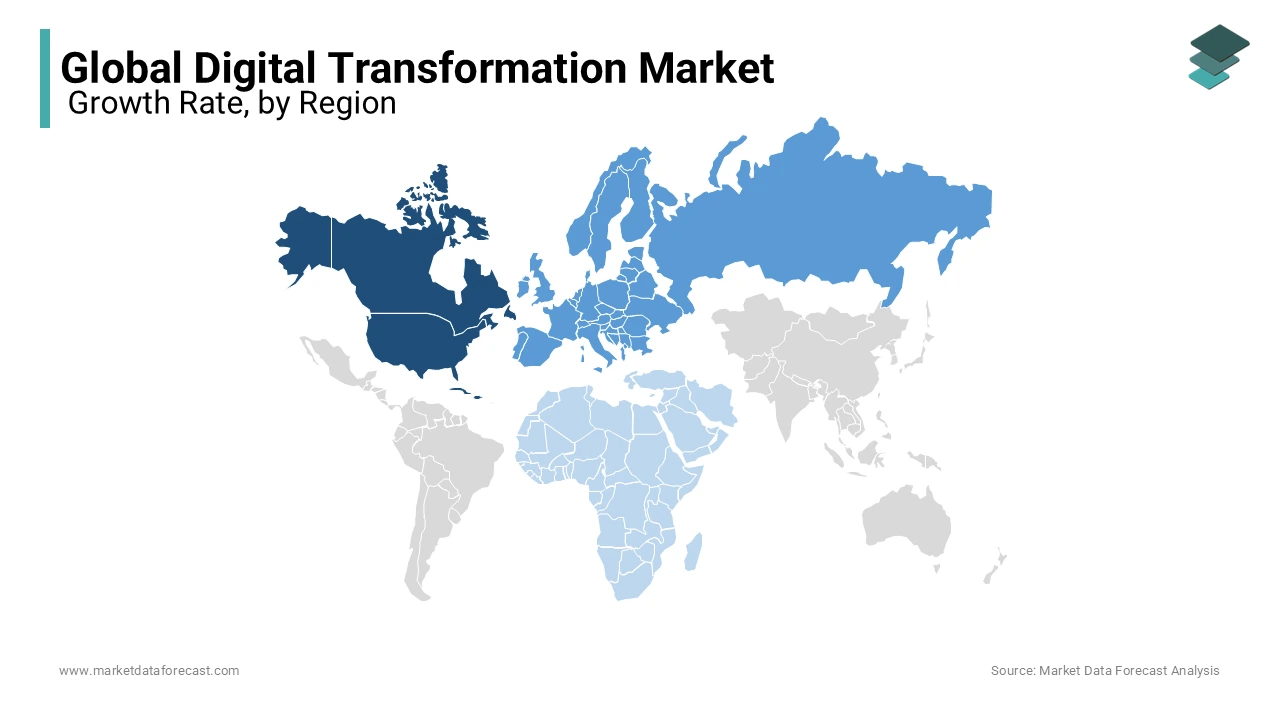
North America is the biggest player in the global market and accounted for 42% of the global digital transformation market in 2025, and the lead of the North American market is expected to continue throughout the forecast period. The growth of the North American market is driven by the elevated demand and acceptance rate of advanced automation technologies. The widespread use of online payment methods in the retail industry and the rising government incentives to encourage the utilization of automation and digital technology in the pharmaceutical, automotive, and healthcare industries are fuelling the growth rate of the North American market. The U.S. is predicted to have the largest share of the North American digital transformation market in 2025, which is 81.4%.
Europe is expected to dive forward at a considerable CAGR in the global market during the forecast period. Netherlands, Germany, and Nordic countries like Denmark, Finland, Sweden, and Norway are leading the regional digital transformation market. European nations are giving specific sectors like cybersecurity, e-government, digital infrastructure, and artificial intelligence priority. To accelerate digitalization throughout the region, projects like the EU's Digital Single Market and Horizon Europe are boosting cooperation and knowledge exchange between nations.
Asia Pacific is the fastest-growing region and is expected to propel even further during the forecast period. It is supported by the rapid economic digitization of the region and the rising ubiquity of smartphone use. The three pillars of Asia's future digital transformation plans are green transformation, connectivity, and inclusion. Additionally, Asian nations are already at the forefront of certain industries. China and Indonesia are the two countries where e-commerce accounts for the largest portion of retail sales in 2025.
The Latin American global digital transformation market is likely to move forward in the coming years. LA countries' current economic situation is not good, and hence, they must enhance social conditions and growth potential. Expanding a digital transformation company in economically weak LA nations presents both challenges and opportunities. Still, there is also untapped potential with high returns on investments and government initiatives.
Middle East and Africa are anticipated to propel at a higher CAGR in the forecast period. The large investments in global brands are fuelling the region's growing need for ICT and digital transformation. The demand for cybersecurity services in the UAE has increased due to the growing usage of digital networked solutions such as cloud computing, data analytics, and the Internet of Things. However, oil output cuts by OPEC+ and nation-specific challenges will hurt economic activity. Economic activity is predicted to improve in 2024, with the growth hitting 3.4 percent as some of these issues subside.
KEY MARKET PLAYERS
Companies playing a major role in the global blockchain market include SAP SE, IBM Corporation, Oracle Corporation, Google Inc., Dell EMC, Hewlett-Packard Enterprise Co., CA Technologies, Microsoft Corporation, Adobe Systems Incorporated, Accenture PLC, Capgemini Group, Apple Inc., and Kellton Tech Solutions Ltd.
We observe that industry players invest massively in research and development activities to increase their market share and guarantee their companies' organic growth. Furthermore, these players actively participate in the development of new products to improve and expand their existing product and service portfolios, thus offering these companies the possibility of acquiring new customers and validating the technology.
RECENT MARKET HAPPENINGS
- In February 2019, IBM signed a deal with COFCO International (CIL), a China-based agrifood company, where SAP will combine and digitally transform CIL's business processes through the implementation of a new SAP platform, which includes SAP S/4 HANA, SAP Ariba, SAP SuccessFactors, and SAP Master Data Governance. IBM services will aid CIL in transforming its operations into a digital form to simplify the existing processes and assimilate its functions.
- Microsoft partnered with Telecom Egypt in February 2019 to expand its current global cloud network to Egypt. Telecom Egypt will provide low-latency connectivity across Egypt to improve performance and increase the reliability of Microsoft service customers. This network partnership is touted to improve Microsoft's service delivery in the Middle East, Egypt, and North Africa.
- In February 2019, SAP launched SAP Leonardo Internet of Things (IoT), the complete technology that generates and stimulates digital transformation for industrial IoT and Industry 4.0. Besides, SAP also confirmed cloud-to-cloud interoperability of Microsoft Azure IoT Hub and SAP Leonardo IoT, delivering customers a choice of connectivity and device management.
MARKET SEGMENTATION
This research report on the global digital transformation market has been segmented and sub-segmented based on solution, service, enterprise size, end-user, and region.
By Solution
- Cloud Computing
- Big Data
- Mobility
- Social Media
By Services
- Training
- Maintenance
- Advice
By Enterprise Size
- Small and Medium Sized Enterprises (SMEs)
- Large Companies
By End-User
- BFSI
- Telecommunications
- Healthcare
- Utilities
- Retail
- Automotive
- ICT
By Region
- North America
- Europe
- Asia-Pacific
- LATAM
- MEA