- Product Description Description
- Table of Contents TOC
- List of Table & Figure LOT
- Get Free Sample PDF Sample PDF
Global Edge Analytics Market Size
The global edge analytics market was valued at USD 12.20 billion in 2024. The global market is expected to expand from USD 16.18 billion in 2025 and USD 154.61 billion by 2033, growing at a CAGR of 32.6% during the forecast period.
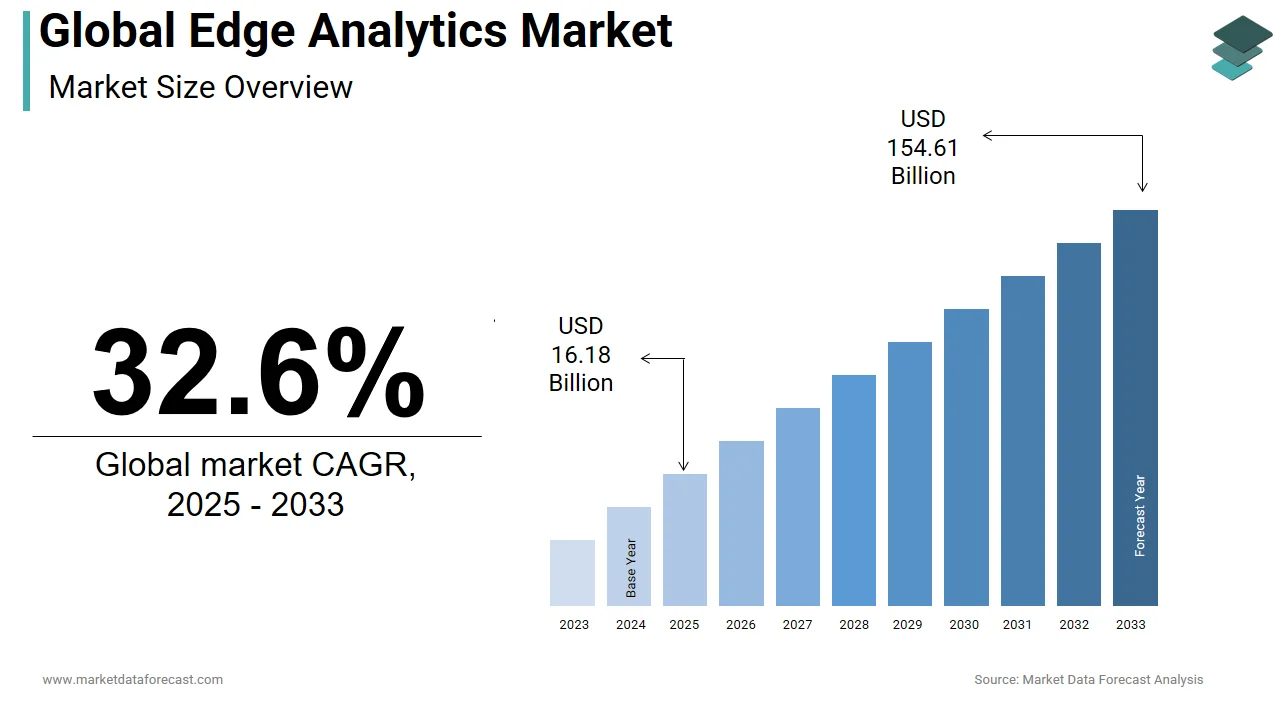
Edge analysis is a means of data collection and interpretation in which a scheduled analytical calculation of data is performed on a sensor, network switch, or other device rather than waiting for the data to be returned to a centralized data warehouse.
Edge analysis is an essential companion option for big data analysis, offering analysis and breakdown of information created at the edge of system devices. Edge Analytics performs an automated logical calculation of the information collected over time instead of sending the information to the centralized data warehouse. Edge scans are speeding up the pace of digital disruption happening across the globe. Due to this approach to web development, information can be accessed through associated devices and continuous knowledge. Edge Analytics is considered one of the most essential developments on the Internet. It is the crucial balance between distributed computing and advanced computing. The beginnings and beginnings of the conceptual precursor and IoT, M2M, is the lifeblood of cloud platforms; they are also used as application agents. Smart frameworks have generally been based on the cloud level for your knowledge, and real devices have been opened in the same way. This alleged statement is shaking up as edge-level recording competition continues to provide faster scalability compared to the cloud level.
MARKET TRENDS
With a traditional data warehousing model, it takes a lot of bandwidth, time, and money to send all the data to a central repository and extract the information necessary to improve operations or customer interactions. Through state-of-the-art analytics, retailers will be able to analyze all kinds of data in real time and take advantage of fleeting opportunities to deliver highly relevant customer experiences and streamline operations, such as streamlining payments or Ensuring that items are in stock.
Retail is experiencing a large amount of data generated by in-store video cameras, in-store Wi-Fi networks, sensors, and data generated by applications. Much of the data produced is unstructured in nature, providing valuable information. Leading retailers use cutting edge analytics to deliver a better user experience and maximize store performance. From location analytics to driving engagement to understanding the buyer model, retail giants Target and Walmart, among others, are using network edge analytics to extract terabyte data.
Retailers can leverage data from a variety of sensors, including parking sensors, shopping cart tags, and store cameras. By applying intelligent analytics to data, they can predict payment terms and pre-emptively alert store managers when more records are needed to open or even automatically open records before customers get there. Render. It also helps retailers change their business model and reform their strategies to gain a major competitive advantage. The idea is not limited to targeting a group of audiences but to offering personalized solutions for all with the help of behavioral support.
MARKET DRIVERS
Edge Analytics performs an automatic analytical calculation of the collected data in real time instead of sending it back to the centralized data warehouse or server. Edge Analytics is growing dramatically around the world, fueled by constant advances in workplace performance improvements and the growing adoption of the Internet of Things (IoT), which is largely driving the growth of the analytics market worldwide.
Edge analytics helps companies get more advanced data faster by using advanced analytics and machine learning at the point of data collection. It also further increases yields, performance, downtime, and efficiency. It is growing in demand due to the emergence and expanding expansion of the Internet of Things (IoT) and the rapid growth in the availability of data through connected devices and real-time intelligence. The adoption of contour analysis increases scalability and cost optimization, which further drives the business.
MARKET RESTRAINTS
On the other hand, concerns like security issues and the lack of universally accepted standards are major limitations in the expansion of the global edge analytics market.
REPORT COVERAGE
| REPORT METRIC | DETAILS |
| Market Size Available | 2024 to 2033 |
| Base Year | 2024 |
| Forecast Period | 2025 to 2033 |
| CAGR | 32.6% |
| Segments Covered | By Solution, Deployment, Industry Vertical, Type, and Region |
|
Various Analyses Covered | Global, Regional & Country Level Analysis, Segment-Level Analysis, DROC, PESTLE Analysis, Porter’s Five Forces Analysis, Competitive Landscape, Analyst Overview on Investment Opportunities |
| Regions Covered | North America, Europe, APAC, Latin America, Middle East & Africa |
|
Market Leaders Profiled | Dell Inc., Equinix, Greenwave Systems, HP Inc., Cisco Systems, Inc., IBM Corporation, Ignazio, Intel Corporation, Microsoft Corporation, Oracle Corporation, and Others. |
REGIONAL ANALYSIS
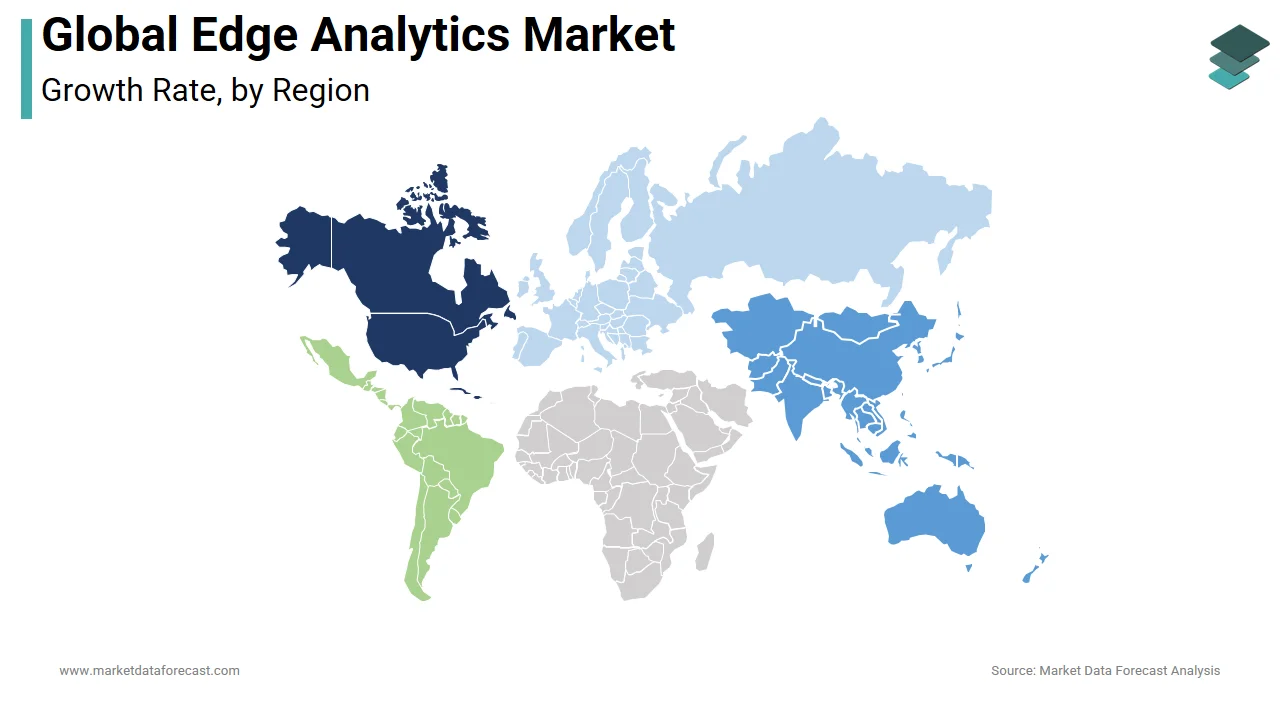
The global edge analytics market is examined in Europe, North America, and Asia Pacific. The development of various related IoT devices and the high demand for advanced and real-time analytics are contributing to the market's development in Europe and North America. In addition, the Middle East, Africa, and Latin America are expected to take control, but development is expected to be stable in the coming years.
KEY MARKET PLAYERS
The major global edge analytics market players are Dell Inc., Equinix, Inc., Greenwave Systems, HP Inc., Cisco Systems, Inc., IBM Corporation, Ignazio, Intel Corporation, Microsoft Corporation, and Oracle Corporation.
RECENT MARKET HAPPENINGS
- In May 2018, Wood and IBM collaborated to transform asset lifecycle management. This partnership should help create and offer new digital products and services that can increase the operational efficiency of customers in the energy and industrial markets. IBM's edge analysis suite helped with the transformation.
- In March 2019, FogHorn announced that NTT Data selected its Lightning software to offer real-time AI and analytics to its industrial customers. NTT Data offers extensive IoT consulting and integration services and expertise that FogHorn uses in the manufacturing, telecom, and energy industries.
MARKET SEGMENTATION
The global edge analytics market is divided based on solution, deployment model, industry vertical, type, and region.
By Solution
- Software
- Service
By Type
- Historical Analysis
- Predictive Analysis
- Prescriptive Analytics
By Deployment Mode
- On-Premise
- Cloud
By Industry Vertical
- Public Sector
- Retail
- IT & Telecom
- Healthcare
- Manufacturing
- Energy & Utility
- Transportation
By Region
- North America
- Europe
- Asia-Pacific
- Latin America
- The Middle East and Africa