- Product Description Description
- Table of Contents TOC
- List of Table & Figure LOT
- Get Free Sample PDF Sample PDF
Market Size, 2025
$228.27 BnMarket Estimate, 2026
$303.83 BnMarket Forecast, 2034
$2,993 BnCAGR, 2026–2034
33.1%Executive Summary: K-12 Online Education Market
- Market Scope: Comprehensive global K-12 online education market analysis covering educational segments, hardware/platform deployments, software tools, regional leadership frameworks, and personalized learning trends.
- Market Valuation: Valued at USD 228.27 billion (2025), estimated at USD 303.83 billion (2026), and projected to reach USD 2,993 billion by 2034, registering a robust CAGR of 33.1% (2026–2034).
- Primary Growth Drivers: Increasing government investment in public education digital infrastructure, rising demand for personalized/adaptive learning, AI integration, cloud-based LMS platforms, and mobile-first accessibility. Key challenges include the digital divide and teacher training gaps.
Key Market Segment Metrics (2026–2034)
| Category | Leading Segment (Position) | Fastest-Growing Segment |
|---|---|---|
| By Educational Segment & Platform | High school segment (largest share at 39.4% in 2025) & Laptops/Chromebooks (48% share) | Elementary school (fastest growth) & Mobile platforms (growing at a CAGR of 16.8%) |
| By Software & Deployment | Learning Management Systems (57% of big data analytics) & Cloud deployment (68% share) | Cloud-based learning management and AI-driven early intervention tools |
| By Region / Country | North America (led with a 36.5% share in 2025, followed by Europe at 27%) | Asia-Pacific (captured 23% of global investment as the fastest-growing region) |
Major Market Players & Market Structure
Market Structure: Highly competitive global educational technology and digital pedagogy landscape featuring major edtech firms, tech giants, and public-private partnerships driving AI analytics deployments and offline-enabled hardware solutions.
Key Companies: Bettermarks, Scoyo, Languagenut, Beness Holding Inc., New Oriental Education & Technology, AMBO, XUEDA, Ifdoo, CDEL, XRS, BYJU’S, Google, and Microsoft.
Global K-12 Online Education Market Size
The global K-12 online education market was worth USD 228.27 billion in 2025. The global market size is expected to be worth USD 2,993 billion by 2034 from USD 303.83 billion in 2026 growing at a CAGR of 33.1% from 2026 to 2034.
K–12 Online Education refers to the digital learning platforms and virtual instructional systems designed to deliver curriculum-aligned academic content to students in primary and secondary education, typically spanning grades kindergarten through twelfth grade. This modality integrates synchronous live classes, asynchronous video modules, adaptive learning software, and cloud-based assessment tools to facilitate remote and hybrid learning experiences. Unlike traditional classroom instruction, K–12 online education leverages internet connectivity, learning management systems (LMS), and multimedia pedagogy to enable flexible, personalized, and scalable education delivery. The model has evolved beyond emergency remote teaching to include full-time virtual schools, supplemental tutoring, credit recovery programs, and flipped classroom models. According to UNESCO, over 1.6 billion students across 190 countries were affected by school closures during the peak of the global pandemic, catalyzing the institutional adoption of online learning frameworks. As governments and educational institutions increasingly recognize digital literacy as a foundational skill, K–12 online education is transitioning from a contingency measure to a permanent component of modern pedagogy, reshaping the architecture of global education delivery.
MARKET DRIVERS
Increasing Government Investment in Digital Infrastructure for Public Education
The growing commitment of national and regional governments to modernize educational infrastructure through digital transformation initiatives is a pivotal driver of K–12 online education expansion. In recent years, public funding has been directed toward equipping schools with high-speed internet, distributing learning devices, and training educators in digital pedagogy. In India, the Ministry of Education launched the PM eVIDYA initiative, unifying online, on-air, and on-demand education across a large number of schools, while distributing a substantial volume of tablets to underprivileged students in rural areas. Similarly, South Korea has invested in upgrading its Smart Education infrastructure, ensuring all K–12 students have access to AI-driven learning portals and digital textbooks. In the United States, the Federal Communications Commission’s E-Rate program allocated significant funds to expand broadband connectivity in schools. These investments are not limited to hardware; teacher training is a critical component. As public education systems institutionalize online learning, the scalability and sustainability of K–12 digital platforms are being reinforced through long-term policy and fiscal support.
Rising Demand for Personalized and Adaptive Learning Experiences
The shift toward student-centric education models has intensified demand for online platforms that offer personalized, data-driven instruction tailored to individual learning paces and cognitive styles. Adaptive learning technologies embedded in K–12 online systems use artificial intelligence to analyze student performance in real time, adjusting content difficulty, pacing, and feedback mechanisms accordingly. Moreover, parents are increasingly seeking supplemental online programs to address learning gaps. Platforms like BYJU’S and Smartick have capitalized on this trend, combining gamification, instant feedback, and progress tracking to enhance engagement. The psychological benefits are also notable. As educational outcomes become increasingly linked to customization, the demand for intelligent, responsive online learning systems continues to accelerate.
MARKET RESTRAINTS
Persistent Digital Divide in Low-Income and Rural Communities
A significant portion of the global student population remains excluded from effective K–12 online education due to inadequate digital access, particularly in low-income, rural, and conflict-affected regions. According to the International Telecommunication Union, 37% of the world’s school-aged children approximately 600 million lacked internet access at home in 2023, with disparities most acute in Sub-Saharan Africa and South Asia. Even when devices are available, bandwidth limitations hinder video streaming and real-time interaction. The United Nations Children’s Fund found that during school closures, 40% of students in Latin America could not participate in online learning due to lack of devices or connectivity. In India, a 2023 National Sample Survey revealed that only 28% of rural households owned a computer, compared to 54% in urban areas. Moreover, multigenerational homes often lack private spaces for focused learning, exacerbating inequities. These structural barriers prevent millions of students from accessing synchronous instruction, submitting assignments, or receiving timely feedback, undermining the inclusivity of digital education. Until equitable infrastructure and affordable access are achieved, the digital divide will continue to limit the reach and effectiveness of K–12 online learning.
Insufficient Teacher Training and Pedagogical Readiness for Digital Instruction
The lack of adequate training for educators in digital pedagogy, classroom management in virtual environments, and effective use of learning technologies is a critical barrier to the successful implementation of K–12 online education. This skills gap results in suboptimal learning experiences, including low student engagement, inconsistent feedback, and poor knowledge retention. Moreover, the transition from physical to virtual classrooms requires a fundamental shift in teaching methodology, one that emphasizes facilitation over lecture, digital literacy, and emotional support in isolated learning environments. Without systemic professional development programs, many educators struggle to adapt, leading to burnout and diminished instructional quality. As online education becomes institutionalized, the absence of standardized digital teaching certification and continuous support mechanisms remains a formidable obstacle to equitable and effective learning outcomes.
MARKET OPPORTUNITIES
Expansion of Public-Private Partnerships to Scale Digital Learning Access
Public-private partnerships (PPPs) are emerging as a transformative mechanism to accelerate the deployment of K–12 online education, particularly in resource-constrained regions. Governments are increasingly collaborating with technology firms, telecom providers, and non-profit organizations to co-develop scalable, sustainable digital learning ecosystems. The collaborations not only enhance access but also improve content quality. The private sector contributes technical expertise, cloud infrastructure, and AI tools, while governments ensure regulatory alignment and equity-focused distribution. As fiscal constraints limit public investment, PPPs offer a viable pathway to bridge the digital education gap, particularly in underserved and off-grid areas.
Integration of Artificial Intelligence and Learning Analytics for Early Intervention
The incorporation of artificial intelligence (AI) and predictive analytics into K–12 online platforms presents a significant opportunity to identify learning gaps, monitor student well-being, and enable timely academic interventions. Modern learning management systems now collect granular data on student engagement, assignment completion, quiz performance, and even keystroke patterns to detect signs of disengagement or difficulty. In Singapore, the Ministry of Education employs AI analytics across its national student learning platform to provide real-time feedback to teachers and recommend personalized remedial content. Furthermore, natural language processing enables automated essay scoring and feedback, reducing teacher workload. As data privacy frameworks mature and ethical AI guidelines are adopted, these technologies are poised to transform online education from reactive to proactive, ensuring no student falls through the cracks in digital learning environments.
MARKET CHALLENGES
Ensuring Data Privacy and Cybersecurity in Student Information Systems
The digitization of K–12 education has exponentially increased the volume of sensitive student data collected, stored, and processed by online platforms, raising critical concerns about privacy breaches and cyber threats. Many ed-tech platforms collect personally identifiable information (PII), academic records, behavioral analytics, and even biometric data, often without transparent consent mechanisms. Cyberattacks are also on the rise. These vulnerabilities erode trust among parents and educators, discouraging platform adoption. Moreover, inconsistent regulatory enforcement across countries complicates compliance for global providers. As schools become data-intensive environments, the lack of standardized security protocols, encryption practices, and student data ownership frameworks poses a systemic challenge to the safe and ethical evolution of online K–12 education.
Maintaining Student Engagement and Social-Emotional Development in Virtual Settings
Sustaining student motivation, participation, and socio-emotional growth in the absence of physical classroom dynamics is one of the most persistent pedagogical challenges in K–12 online education. The absence of peer interaction, teacher presence, and structured routines contributes to diminished attention spans. Moreover, social-emotional learning (SEL), a critical component of K–12 development, is difficult to replicate online. Younger learners, particularly in early elementary grades, struggle with self-regulation and screen fatigue, with pediatricians in Canada observing a rise in attention-related behavioral issues among children engaged in prolonged digital learning. While gamification and breakout rooms attempt to simulate interaction, they often fail to replicate the spontaneity of face-to-face engagement. As online education becomes institutionalized, addressing the human dimensions of learning, belonging, empathy, and collaboration remains a fundamental challenge.
REPORT COVERAGE
| REPORT METRIC | DETAILS |
| Market Size Available | 2025 to 2034 |
| Base Year | 2025 |
| Forecast Period | 2026 to 2034 |
| CAGR | 33.1% |
| Segments Covered | By Component, End User, Deployment, and Region |
|
Various Analyses Covered | Global, Regional & Country Level Analysis, Segment-Level Analysis, DROC, PESTLE Analysis, Porter’s Five Forces Analysis, Competitive Landscape, Analyst Overview of Investment Opportunities |
| Regions Covered | North America, Europe, APAC, Latin America, Middle East & Africa |
| Market Leaders Profiled | Bettermarks, Scoyo, Languagenut, Beness Holding, Inc., New Oriental Education & Technology, AMBO, XUEDA, Ifdoo, CDEL, XRS, and others. |
SEGMENTAL ANALYSIS
By Grade Insights
The high school segment held the largest share of the K–12 online education market at 39.4% in 2025. This dominance is primarily driven by the academic complexity and credit-based structure of secondary education, which aligns well with digital delivery models. High school curricula often include advanced placement (AP), dual-enrollment, and career and technical education (CTE) courses that are increasingly offered online to expand access beyond physical school boundaries. Furthermore, college preparation drives adoption platforms like Khan Academy and Edgenuity are integrated into school systems to support SAT and ACT readiness. The flexibility of asynchronous learning also accommodates part-time work, athletics, and extracurricular commitments common among older students. As academic accountability and graduation requirements intensify, the institutional integration of online learning in high schools continues to solidify its market leadership.
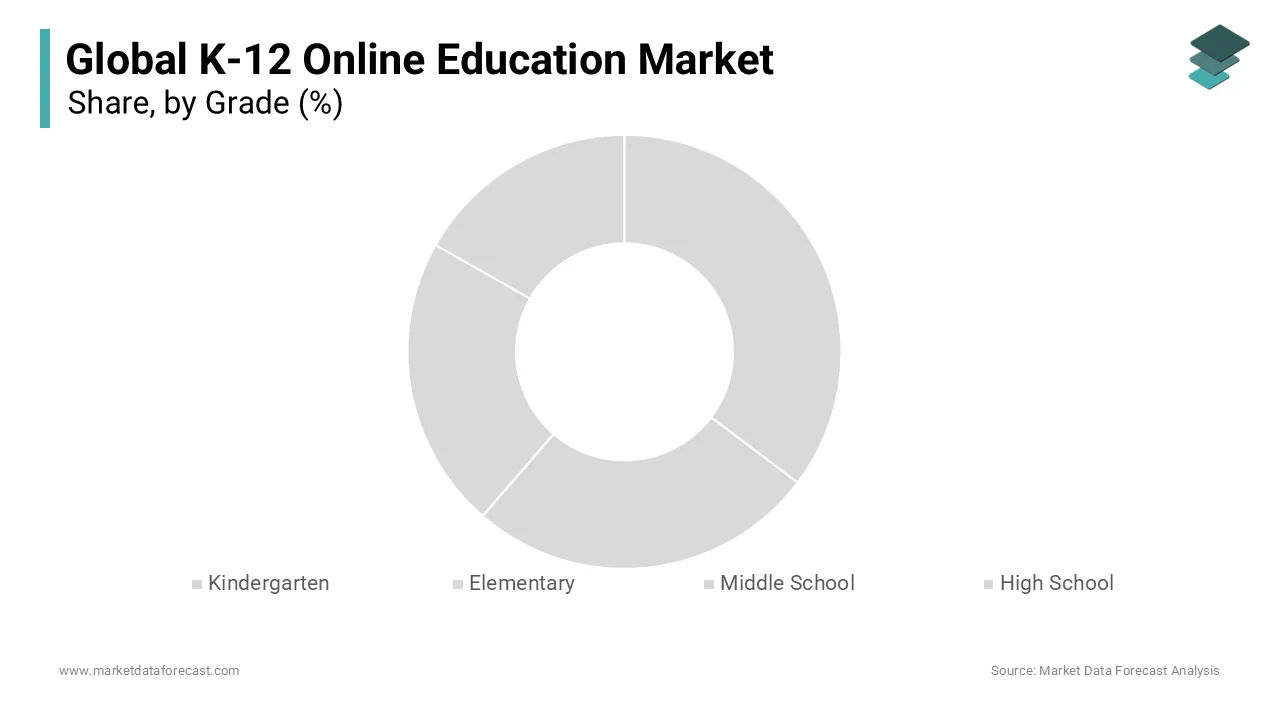
The elementary school segment is experiencing the fastest growth in the K–12 online education market, projected to expand at a CAGR of 14.2% from 2023 to 2030, according to UNESCO’s Global Education Monitoring Report. This surge is fueled by increasing parental involvement in early education and the development of age-appropriate digital pedagogies that blend play-based learning with structured instruction. The rise of gamified learning apps such as ABCmouse, SplashLearn, and Epic! has transformed engagement. Additionally, hybrid models allow working parents to supplement classroom learning with at-home reinforcement, especially in bilingual households where digital tools provide language consistency. As developers refine interfaces for younger users and schools adopt blended models, the elementary segment is redefining the onset of digital education.
By Platform Insights
The laptops and Chromebooks segment dominates the K–12 online education market, capturing 48% of platform-based usage in 2023, as documented by the U.S. Federal Communications Commission’s E-Rate program. This leadership stems from the functional versatility, durability, and institutional procurement strategies that favor full-featured computing devices for academic work. Chromebooks, in particular, have become the standard in public education systems due to their affordability, cloud integration with Google Workspace for Education, and centralized management capabilities. These devices support complex tasks such as coding, research, essay writing, and video conferencing activities essential for middle and high school curricula. Moreover, their compatibility with learning management systems like Canvas and Schoology ensures seamless assignment submission and teacher feedback. The longevity of these devices, typically three to four years, also makes them cost-effective for long-term deployment. As schools institutionalize digital learning, the reliance on robust, multitasking platforms like laptops and Chromebooks remains central to educational continuity and academic rigor.
The mobile platform segment is growing at the fastest rate in the K–12 online education market, projected to expand at a CAGR of 16.8% from 2023 to 2030, according to GSMA Intelligence. This acceleration is driven by the ubiquity of smartphones, particularly in low- and middle-income households where mobile devices are often the only means of internet access. The proliferation of mobile-first learning apps, such as BYJU’S, Duolingo ABC, and Khan Academy Kids ,has enhanced accessibility, with offline modes allowing content download in areas with unstable connectivity. Moreover, mobile platforms support microlearning, push notifications, and instant feedback, increasing engagement among younger learners. The integration of AI-driven chatbots and voice assistants further personalizes the experience. As 5G networks expand and app developers optimize for smaller screens, mobile devices are becoming indispensable tools for equitable and flexible K–12 learning.
By Big Data & Analytics Insights
The Learning Management Systems (LMS) and Virtual Learning Environments (VLE) segment holds the largest share of the K–12 big data and analytics market, accounting for 57% in 2023, as reported by the IMS Global Learning Consortium. This dominance is attributable to the central role these platforms play in organizing, delivering, and tracking digital instruction across schools and districts. Systems like Google Classroom, Canvas, Schoology, and Moodle serve as the operational backbone of online education, enabling teachers to assign work, conduct assessments, and monitor student progress in real time. These platforms generate vast amounts of data on login frequency, assignment completion, quiz scores, and time-on-task, which educators use to identify learning gaps and adjust instruction. Additionally, LMS interoperability with student information systems (SIS) and assessment tools enhances administrative efficiency. As schools transition from emergency remote teaching to structured digital ecosystems, LMS platforms remain the cornerstone of data-driven K–12 education.
The predictive analytics and AI-driven insights segment is emerging as the fastest-growing component of big data in K–12 education, projected to grow at a CAGR of 18.4% from 2023 to 2030, according to the Center for Digital Education. This growth is driven by the increasing demand for early intervention tools that identify at-risk students before academic failure occurs. Predictive models analyze behavioral and performance data such as login patterns, assignment delays, and quiz accuracy to flag students who may need additional support. Platforms like Brightspace and PowerSchool integrate these tools to provide real-time alerts to teachers and counselors. Moreover, AI-driven analytics support personalized learning paths, adapting content based on individual mastery levels. As data privacy frameworks mature and ethical AI standards are adopted, the integration of predictive analytics is transforming K–12 education from reactive to proactive, ensuring more equitable and effective outcomes.
By Deployment Mode Insights
The cloud-based deployment segment commands the largest share of the K–12 online education market, accounting for 68% of total deployments in 2023, as reported by the Software & Information Industry Association (SIIA). This dominance is driven by the scalability, cost-efficiency, and remote accessibility that cloud infrastructure provides, particularly for school districts with limited IT resources. Cloud platforms enable seamless updates, automatic backups, and cross-device synchronization, ensuring continuity during disruptions such as natural disasters or pandemics. The model also supports rapid scalability; during peak usage, cloud systems can dynamically allocate bandwidth. Additionally, cloud deployment reduces the need for on-site servers and technical staff, making it ideal for rural and underfunded schools. As cybersecurity improves and global internet access expands, the cloud remains the preferred architecture for modern K–12 digital ecosystems.
The on-premises deployment segment is experiencing renewed interest and is projected to grow at a CAGR of 6.3% from 2023 to 2030, according to IDC Government Insights. While smaller in market share, this mode is growing due to increasing concerns over data sovereignty, cybersecurity, and regulatory compliance in sensitive educational environments. Several countries, including Germany, Russia, and China, mandate that student data be stored within national borders, driving schools to adopt localized server infrastructure. On-premises systems also offer greater customization for specialized curricula and offline functionality in remote areas with unreliable internet. In Canada, Indigenous school networks in northern territories use on-premises servers to preserve cultural content and language programs without external exposure. As data privacy becomes a global priority, on-premises deployment is re-emerging as a strategic choice for institutions prioritizing control, security, and autonomy in digital education.
REGIONAL ANALYSIS
North America K-12 Online Education Market Insights
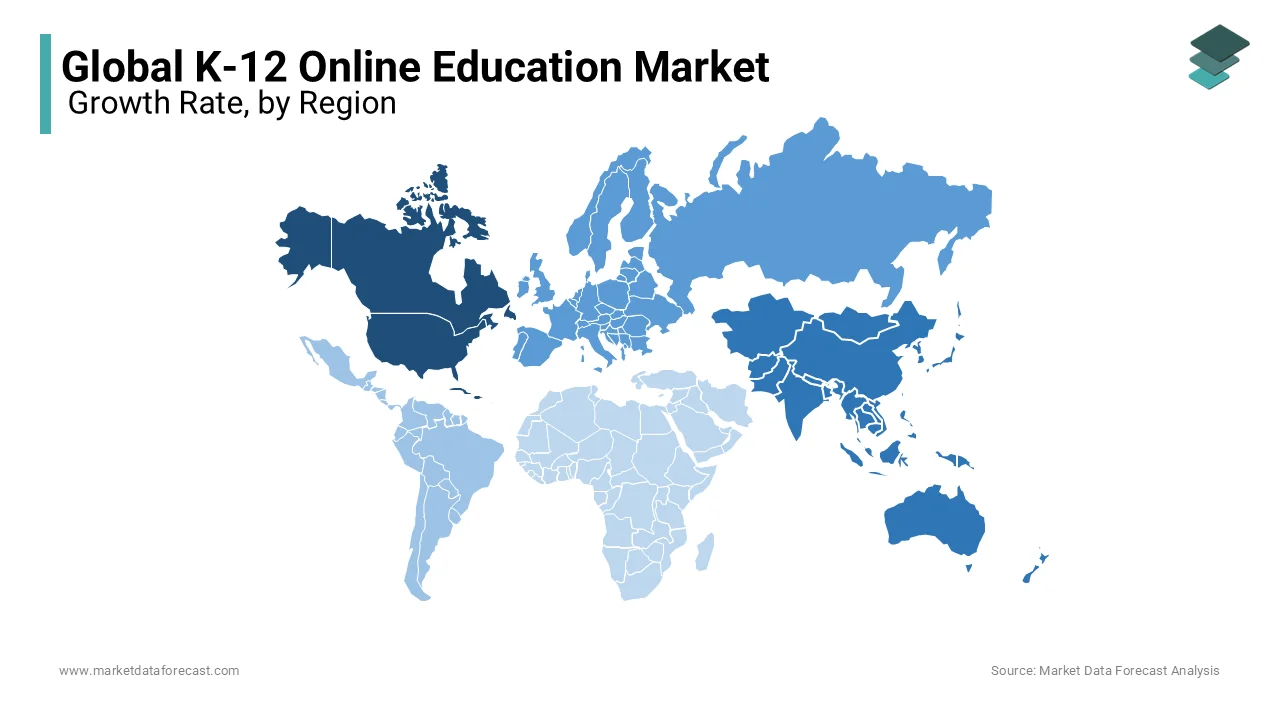
North America held a leading position in the global K–12 online education market by securing an estimated 36.5% share in 2025. The region’s dominance is rooted in its advanced digital infrastructure, high internet penetration, and widespread integration of technology into public education. The United States hosts a robust ecosystem of ed-tech providers, including Google for Education, Khan Academy, and Coursera for Kids, which are embedded in daily instruction. Canada mirrors this trend. The presence of venture capital-backed startups and strong teacher training programs further enhances innovation. As digital literacy becomes a core competency, North America continues to set the benchmark for scalable, equitable, and technologically advanced K–12 education systems.
Europe K-12 Online Education Market Insights
Europe maintains a strong and regulated presence in the K–12 online education market, representing 27% of global revenue in 2023, as stated by the European Commission’s Education and Training Monitor. The region’s approach is characterized by a balance between innovation and data protection, with strict adherence to GDPR shaping platform design and deployment. Countries like Estonia and Finland lead in digital integration. Estonia’s “e-School” system connects all K–12 institutions through a unified digital portal, while Finland’s national curriculum mandates digital competence from grade 1. The European Union’s Digital Education Action Plan has mobilized funds to support teacher training and cross-border online learning initiatives. As Europe prioritizes digital equity and ethical AI, its K–12 online education model emphasizes quality, inclusivity, and regulatory rigor.
Asia-Pacific K-12 Online Education Market Insights
The Asia-Pacific region is the fastest-growing market for K–12 online education, capturing 23% of global investment in 2023, as documented by the Asian Development Bank. Driven by large student populations, rising digital adoption, and government-led modernization, countries like China, India, and South Korea are rapidly scaling online learning infrastructure. India’s DIKSHA portal serves millions of learners across schools, supported by QR-coded textbooks and multilingual content. South Korea’s Smart Education initiative has digitized textbooks for grades 1–12, ensuring nationwide access. The region also leads in mobile-first learning, particularly in Southeast Asia, where platforms like Ruangguru and SEAMEO RETRAC deliver localized content. With sustained public investment and private innovation, the Asia-Pacific is reshaping the future of global K–12 digital education.
Latin America K-12 Online Education Market Insights
Latin America holds a modest but rapidly evolving share of the K–12 online education market. Brazil leads the region, with a portion of public schools using digital platforms for instruction. The country’s “Future-Se” initiative has expanded online teacher training and virtual course offerings across schools. In Colombia, the Ministry of Education’s “Aprender a Distancia” program for education content via TV, radio, and mobile apps during school closures. However, challenges persist. To bridge gaps, countries are leveraging public broadcasting and offline digital kits. Argentina’s “Conectar Igualdad” program distributed 5 million laptops to students, enhancing digital equity. As 5G networks expand and governments prioritize ed-tech, Latin America is emerging as a high-potential market for scalable, inclusive online learning solutions.
Middle East and Africa K-12 Online Education Market Insights
The Middle East and Africa collectively represent a transformative segment, holding 6% of the global K–12 online education market in 2023, as documented by the Gulf Cooperation Council’s Education Initiative. The UAE and Saudi Arabia are driving regional growth through national digital transformation agendas. South Africa’s Department of Basic Education partnered with Vodacom to provide zero-rated access to online learning portals, reaching 3.4 million students, as reported by UNICEF. In Kenya, the DigiSchool program uses mobile networks to deliver lessons to remote areas. However, Sub-Saharan Africa faces significant barriers only 22% of schools have electricity, according to the World Bank. To overcome limitations, governments are adopting offline servers, solar-powered devices, and radio-based instruction. As connectivity improves and digital literacy rises, the region is poised for exponential growth in K–12 online education.
KEY MARKET PLAYERS
Companies such as Bettermarks, Scoyo, Languagenut, Beness Holding, Inc., New Oriental Education & Technology, AMBO, XUEDA, Ifdoo, CDEL and XRS are playing a leading role in the global K-12 online education market.
TOP LEADING PLAYERS IN THE MARKET
Google (Alphabet Inc.)
Google (Alphabet Inc.) has become a foundational force in the Asia Pacific K–12 online education landscape through its Google Workspace for Education, particularly Google Classroom and Chromebooks. The company has embedded its ecosystem into public and private schools across India, Australia, Japan, and Southeast Asia by offering cost-effective, scalable solutions for remote and hybrid learning. In 2023, Google partnered with India’s National Council of Educational Research and Training (NCERT) to integrate DIKSHA curriculum content into its platforms, enabling seamless access for millions of students. It also launched localized teacher training programs in Indonesia and Thailand in collaboration with the ministries of education to enhance digital pedagogy skills. Google’s AI-powered tools, such as speech-to-text and real-time translation, support multilingual classrooms, particularly in linguistically diverse regions like the Philippines and Malaysia. By prioritizing interoperability, data security, and ease of use, Google has positioned its suite as an essential infrastructure layer in institutional digital transformation, fostering long-term dependency across the educational spectrum.
BYJU’S (Think and Learn Pvt. Ltd.)
BYJU’S (Think and Learn Pvt. Ltd.) is a dominant homegrown player in the Asia Pacific K–12 online education market, particularly in India, where it has redefined digital learning through its interactive, video-first platform. The company offers personalized learning paths in STEM, languages, and competitive exam preparation, tailored to national and state-level curricula. In 2022, BYJU’S launched “WeThinkCode_” in South Africa, expanding its footprint into Sub-Saharan Africa with a focus on coding education for underserved youth. It has also acquired several regional ed-tech firms, including WhiteHat Jr and Osmo, to diversify its product offerings. In 2023, BYJU’S collaborated with the Karnataka and Maharashtra state education boards to provide free digital content to government school students. The company has invested heavily in AI-driven adaptive assessments and offline learning modes to address connectivity gaps. Despite financial restructuring, its brand recognition, localized content, and aggressive marketing have solidified its position as a key innovator shaping digital learning behaviors across urban and semi-urban households in the region.
Microsoft
Microsoft has strengthened its presence in the Asia Pacific K–12 education sector through its cloud-based Microsoft 365 Education suite, Teams for Education, and immersive learning tools powered by AI and mixed reality. The company has partnered with education authorities in Singapore, South Korea, and New Zealand to modernize digital classrooms and support hybrid instruction models. In 2022, Microsoft launched the “AI for Accessibility” initiative in Australia, enabling students with disabilities to engage with curriculum content through adaptive tools like Immersive Reader and Seeing AI. It also collaborated with Vietnam’s Ministry of Education to train 50,000 teachers in digital pedagogy using Microsoft Teams and OneNote Class Notebook. The integration of Minecraft: Education Edition fosters experiential learning in STEM subjects across Japanese and Indian schools. Microsoft emphasizes data privacy, compliance with local regulations, and secure cloud infrastructure, making it a preferred partner for government-led digital education projects. By combining enterprise-grade security with pedagogical innovation, Microsoft has established itself as a trusted enabler of institutional digital transformation in the region.
TOP STRATEGIES USED BY KEY MARKET PARTICIPANTS
Key players in the K–12 online education market employ a range of strategic initiatives to expand their influence and adapt to evolving educational demands. Product localization is critical, with companies tailoring content to regional curricula, languages, and cultural contexts to enhance relevance and adoption. Strategic partnerships with governments, school boards, and NGOs enable large-scale deployment and credibility in public education systems. Technology integration is a major focus, as firms embed artificial intelligence, gamification, and analytics to personalize learning and improve outcomes. Investment in teacher training and digital literacy programs ensures effective platform utilization and pedagogical alignment. Cloud infrastructure and mobile-first design are prioritized to maximize accessibility, especially in areas with limited broadband. Data privacy and cybersecurity compliance are emphasized to build institutional trust. Mergers and acquisitions allow rapid expansion of feature sets and market reach. Additionally, companies are developing offline and low-bandwidth solutions to bridge the digital divide. Subscription models, freemium tiers, and public-private financing enhance affordability. These multifaceted strategies collectively drive scalability, engagement, and long-term sustainability in a highly competitive and socially impactful sector.
COMPETITIVE LANDSCAPE
The competitive dynamics of the K–12 online education market are shaped by a convergence of technology giants, specialized ed-tech startups, and public-sector initiatives, all vying for influence in a domain that blends education, equity, and innovation. Established tech firms like Google, Microsoft, and Apple leverage their ecosystem dominance to embed their platforms into institutional infrastructure, offering integrated suites that combine hardware, software, and cloud services. They compete on scalability, interoperability, and security, often partnering with governments to become default providers. Meanwhile, regional players such as BYJU’S, Ruangguru, and Qkids focus on hyper-localized content, vernacular delivery, and supplemental tutoring, capturing consumer loyalty through personalized engagement. Startups are disrupting with niche offerings in adaptive learning, AI tutors, and special education tools, often backed by venture capital. The battlefield extends beyond features to data ethics, accessibility, and pedagogical efficacy, with schools increasingly demanding evidence-based outcomes. Public initiatives like China’s National Cloud Platform and India’s DIKSHA challenge commercial players by offering free, state-sponsored alternatives. Competition is further intensified by shifting regulatory landscapes around data privacy and screen time. As the market matures, differentiation lies not in technology alone but in trust, inclusivity, and the ability to deliver measurable learning gains across diverse socio-economic contexts, redefining what it means to lead in digital education.
RECENT MARKET DEVELOPMENTS
- In January 2022, BYJU’S acquired Osmo, a U.S.-based STEM learning platform for children, to enhance its interactive learning portfolio and expand its product suite for early-grade students in the Asia Pacific region.
- In March 2022, Google launched a partnership with NCERT in India to integrate DIKSHA’s national curriculum content into Google Classroom, enabling 250 million students to access standardized digital lessons through a unified platform.
- In August 2022, Microsoft collaborated with the Singapore Ministry of Education to deploy AI-powered analytics in 200 secondary schools, improving student performance tracking and personalized learning interventions.
- In November 2023, BYJU’S launched free digital learning capsules for government school students in Maharashtra, India, in partnership with the state education board, increasing its reach in underserved communities.
- In February 2024, Google introduced offline-enabled Chromebooks with localized language support in rural Indonesia, in collaboration with the Ministry of Education, to improve digital access for students with limited internet connectivity.
MARKET SEGMENTATION
This research report on the global K-12 online education market has been segmented and sub-segmented based on component, end-user, deployment and region.
By Grade
- Kindergarten
- Elementary
- Middle School
- High School
By Platform
- Gamification
- Mobile
- Tablet
- Laptops / Chrome Books
- Others
- Big Data & Analytics
- LMS / Virtual Learning Environments
- Other
By Deployment Mode
- Cloud
- On-Premises
By Region
- North America
- Europe
- Asia-Pacific
- Latin America
- Middle East and Africa