- Product Description Description
- Table of Contents TOC
- List of Table & Figure LOT
- Get Free Sample PDF Sample PDF
Market Size, 2025
$43.86 BnMarket Estimate, 2026
$57.63 BnMarket Forecast, 2034
$512.19 BnCAGR, 2026–2034
31.4%Executive Summary: Digital Education Market
- Market Scope: Comprehensive global digital education market analysis covering course types, instructional frameworks, end-user categories, regional leadership paradigms, and workforce development trends.
- Market Valuation: Valued at USD 43.86 billion (2025), estimated at USD 57.63 billion (2026), and projected to reach USD 512.19 billion by 2034, registering a robust CAGR of 31.4% (2026–2034).
- Primary Growth Drivers: Demand for flexible self-paced learning, high global smartphone penetration (>7.2 billion devices), scalable educational infrastructure needs, cloud computing integration, AI-driven personalization, and government digital literacy initiatives. Key challenges include certification credibility and course costs.
Key Market Segment Metrics (2026–2034)
| Category | Leading Segment (2025 Position) | Fastest-Growing Segment |
|---|---|---|
| By Delivery & Course Type | Instructor-Led Online Education (estimated to lead due to interactive advantages) & Science and Technology Courses (dominant course type) | Skill-based microlearning platforms and interactive tech curricula |
| By End-User Base | Individual Learners and Academic Institutions (constitute primary end-user base) | Enterprise upskilling and continuous professional development programs |
| By Region / Country | North American educational institutions (recognized as fastest adopters via vendor collaborations) | Asia-Pacific (expected to witness the highest growth driven by emerging industrial developments) |
Major Market Players & Market Structure
Market Structure: Highly competitive global edtech landscape featuring major online learning platforms, developer productivity hubs, and higher education collaborative networks driving free course access and micro-credential programs.
Key Companies: Coursera, edX, BYJU’S, Edureka, Udemy, Udacity, Eduonix, and Pluralsight.
Global Digital Education Market Size
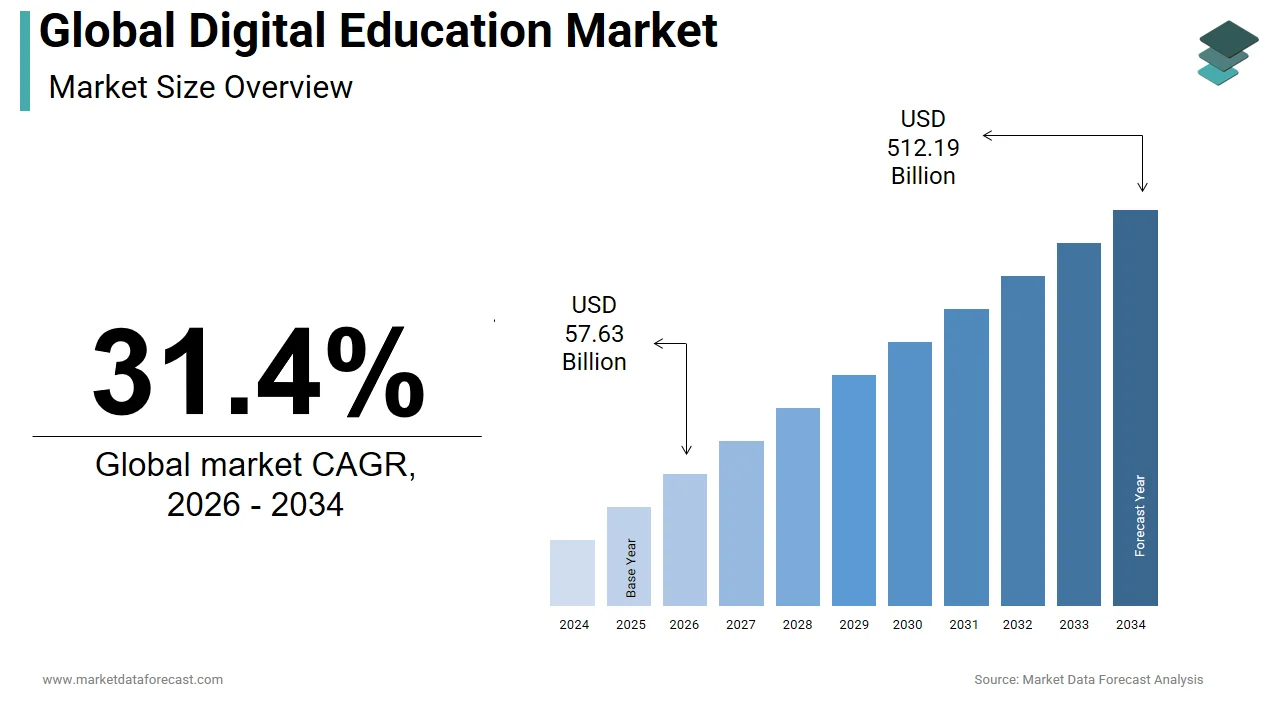
The global digital education market was worth USD 43.86 billion in 2025. The global market size is predicted to grow from USD 57.63 billion in 2026 to USD 512.19 billion by 2034, growing at a stunning CAGR of 31.4% from 2026 to 2034.
Digital education is the use of digital tools, computers, and the internet to teach and learn. It moves away from paper books and chalkboards to use smart screens, apps, and online classes so that students can study from anywhere. This sector has evolved from supplementary elearning tools into foundational educational infrastructure supporting formal academic institutions corporate training programs and lifelong learning initiatives globally. According to UNESCO Institute for Statistics data, nearly 1.6 billion learners in more than 190 countries were impacted by school closures during the global pandemic, accelerating an industry-wide transition toward remote learning modes. As per the International Telecommunication Union Global Connectivity Report, global internet use expands annually with universal access within reach for most of the world's population, though severe disparities persist as low-income countries lag behind in infrastructure and network reliability. According to the Organisation for Economic Co-operation and Development, school systems are increasing implementation funding for digital transformation, forcing institutions to deploy comprehensive digital education policies to address structural access gaps. This market definition extends beyond software and hardware to include teacher training digital pedagogy frameworks assessment technologies and credentialing systems that collectively enable scalable personalized and measurable learning outcomes across diverse educational contexts and demographic segments worldwide.
MARKET DRIVERS
Workforce Skills Gap Accelerates Corporate Digital Learning Adoption
Persistent mismatches between workforce capabilities and employer requirements drive the growth of the digital education market. Organizations seek agile reskilling mechanisms. According to the World Economic Forum Future of Jobs Report 2023, businesses estimate that 44% of workers' core skills will be disrupted in the five years leading up to 2027, with six in ten employees requiring training before that time. As per the European Commission, approximately 42% of Europeans lack basic digital skills, which directly hampers industrial innovation and competitiveness across the region. According to the LinkedIn Workplace Learning Report 2024, organizations with strong learning cultures experience a 57% higher rate of retention and a 23% increase in internal workforce mobility. Unlike degree programs requiring multiyear commitments microcredential and modular digital courses enable just in time skill acquisition aligned with immediate business needs. This structural labor market dysfunction transforms digital education from optional employee benefit into strategic operational necessity ensuring organizational resilience amid technological disruption while providing workers portable credentials valued across employers and industries in rapidly evolving knowledge economies.
Government Policy Mandates Institutionalize Digital Learning Infrastructure
National education strategies and regulatory frameworks increasingly mandate digital integration, which fuels the expansion of the digital education market. This creates non-discretionary demand across public education systems worldwide. As per the OECD, member nations develop comprehensive digital education guidelines to reform pedagogical methodologies and accelerate teacher-led technology integration in public schools. According to the Ministry of Education of India, the central digital public infrastructure for school education, DIKSHA, delivers over 3.73 lakh pieces of digital content and 7,777 energized textbooks across 135 languages. The policy interventions create baseline demand independent of individual institutional budgets or preferences, establishing digital education as a public utility rather than a discretionary enhancement. Compliance requirements generate sustained procurement cycles for infrastructure content and professional development, ensuring market stability even during economic downturns when private spending may contract.
MARKET RESTRAINTS
Digital Divide Persists Despite Infrastructure Expansion Efforts
Unequal access to reliable internet connectivity and appropriate devices limits the reach of digital education, which hampers the growth of the global market. This lack of access particularly affects rural, low-income, and geographically isolated communities. According to the International Telecommunication Union Facts and Figures 2024, approximately 2.6 billion people remain completely offline globally, representing a significant ongoing infrastructure divide between connected and unconnected populations. As per the Federal Communications Commission, national infrastructure deployment initiatives aim to bring high-speed broadband to rural and unserved areas across the United States to replace inadequate telecommunications infrastructure. Even where connectivity exists, device affordability remains problematic. The infrastructural inequities mean digital education often amplifies rather than reduces existing educational disparities forcing providers to develop offline capable solutions and governments to balance digital investments with traditional delivery methods to avoid excluding vulnerable populations from learning opportunities entirely.
Pedagogical Effectiveness Evidence Remains Inconsistent Across Contexts
Lack of robust evidence demonstrating superior learning outcomes from digital versus traditional instruction creates skepticism among educators, parents, and policymakers, which hinders the expansion of the digital education market. As per the OECD PISA 2022 Results, global mean student performance experienced an unprecedented decline of almost 15 score points in mathematics, signifying major post-pandemic educational delivery disruptions. According to the Education Endowment Foundation, digital technology interventions in schools generally produce an attainment impact similar to other pedagogical innovations. As per the Center for Research on Education Outcomes (CREDO) at Stanford University, full-time online charter school students lose the equivalent of 180 days of learning in mathematics annually compared to their traditional public school counterparts. Without clearer evidence linking specific digital approaches to improved outcomes, stakeholders remain cautious about replacing proven traditional methods. This is especially true for foundational skills and younger learners, where social interaction and hands-on experience are pedagogically essential.
MARKET OPPORTUNITIES
Artificial Intelligence Enables Personalized Learning at Scale
Advances in generative artificial intelligence and adaptive algorithms create a pathway for delivering individualized instruction previously impossible at a mass scale, which is likely to accelerate the growth of the digital education market. According to research, rapid generative artificial intelligence adoption scales across specialized corporate and academic workflows to optimize human operational efficiency. As per Khan Academy, the AI-powered learning assistant Khanmigo functions as an interactive dialogue engine to cultivate student critical thinking and structured problem-solving competencies without delivering automated direct solutions. According to the Bill & Melinda Gates Foundation, a multi-million dollar co-investment framework accelerates the development of locally customizable artificial intelligence architectures to optimize global public systems in health, agriculture, and educational infrastructure. Unlike static elearning platforms AI systems continuously adjust difficulty pacing and modality based on individual learner performance engagement patterns and knowledge gaps creating truly responsive educational experiences. Early adopters including Singapore, Finland, and Estonia are integrating AI tutors into national curricula, positioning domestic edtech firms for export growth as global demand accelerates. This technological inflection point enables premium pricing for differentiated personalization features while addressing long-standing scalability limitations of human-intensive individualized instruction models.
Microcredential Ecosystem Expansion Creates New Revenue Streams
Growing employer acceptance of skills-based credentials over traditional degrees opens substantial avenues for short-form verified digital learning products, which is expected to boost the expansion of the global digital education market. As per Coursera, artificial intelligence course enrollments skyrocketed by over 1,000% year-over-year as professionals seek targeted skill acquisitions to prepare for broader digital economy transformations. According to the European Commission, the European Learning Model architecture establishes a unified and long-term technical data standard to facilitate the frictionless, digitally signed issuance of standardized learning data across participating boundaries. Industry partnerships amplify value. Unlike traditional degrees requiring multiyear investments, microcredentials enable continuous revenue through recurring learner engagement throughout careers. Employers increasingly subsidize these credentials as cost-effective alternatives to hiring expensive experienced talent, creating B2B demand streams complementing direct consumer sales. This credential unbundling transforms education from episodic life-stage purchase into an ongoing subscription relationship, expanding lifetime customer value and market size beyond traditional student demographics.
MARKET CHALLENGES
Data Privacy and Security Concerns Erode User Trust
The increasing frequency of data breaches and surveillance controversies is undermining confidence in digital education platforms, which slows down the growth of the global market. This loss of trust is particularly severe regarding the handling of children’s sensitive information. According to the Identity Theft Resource Center, cybercriminals execute complex data compromises and extortion strategies against diverse industries to access sensitive records. As per the Mozilla Foundation, nearly 80% of reviewed popular applications contain false or misleading data safety labels due to critical regulatory disclosure loopholes. According to the Federal Trade Commission, the enforcement of federal online privacy statutes safeguards students from illegal tracking, data minimization failures, and unauthorized surveillance by educational technology providers. As per the European Data Protection Board, online platforms must not use deceptive interface designs or profiling mechanisms that nudge young users into consenting to complex algorithm tracking systems. The trust deficits cause institutions to delay procurement decisions, parents to restrict platform usage, and regulators to impose restrictive frameworks, slowing innovation and market expansion despite genuine educational benefits of data-driven personalization and analytics.
Content Quality Assurance Lacks Standardized Evaluation Frameworks
Absence of universally accepted quality standards for digital learning content creates inefficiencies and consumer confusion in the digital education market. This hinders informed purchasing decisions. As per Coursera, higher education institutions refine distance learning configurations and support structures to secure the academic integrity and pedagogical quality of external digital courseware. According to the What Works Clearinghouse, formal rapid evidence reviews evaluate distance learning designs to determine their impact on pupil performance and to ensure transparent methodological evaluation protocols. Accreditation bodies including WASC and NEASC report increasing complaints from member institutions about vendor misrepresentation of content quality and assessment validity. Without independent certification mechanisms comparable to textbook peer review buyers rely on vendor self assessments testimonials or superficial feature comparisons rather than rigorous effectiveness evidence. This information asymmetry allows low quality products to compete on price and marketing rather than educational merit depressing overall market quality and eroding stakeholder confidence in digital education as legitimate instructional medium worthy of investment.
REPORT COVERAGE
| REPORT METRIC | DETAILS |
| Market Size Available | 2025 to 2034 |
| Base Year | 2025 |
| Forecast Period | 2026 to 2034 |
| Segments Covered | By End User, Learning Type, Course Type, and Region. |
| Various Analyses Covered | Global, Regional, and Country-Level Analysis, Segment-Level Analysis, Drivers, Restraints, Opportunities, Challenges; PESTLE Analysis; Porter’s Five Forces Analysis, Competitive Landscape, Analyst Overview of Investment Opportunities |
| Regions Covered |
|
| Market Leaders Profiled | Coursera, edX, BYJU'S, Edureka, Udemy, LinkedIn Corporation, Udacity, and Eduonix. |
SEGMENTAL ANALYSIS
By Learning Type Insights
In 2025, the self paced learning segment held the majority share in the digital education market because of its alignment with the scheduling constraints and autonomy preferences of adult learners balancing education with employment and family responsibilities. According to the OECD, adulthood skill surveys evaluate cognitive and socio-emotional profiles to guide international labor policies and structured educational interventions. As per Research.com, nearly 90% of modern corporations maintain that offering robust employee training pipelines acts as an essential corporate strategy to mitigate professional retention concerns. Unlike traditional classroom models requiring simultaneous availability of instructors and learners self paced platforms decouple content delivery from temporal constraints enabling global scalability without proportional staffing increases. This structural advantage makes self-paced learning economically viable for serving geographically dispersed and temporally diverse populations, explaining sustained segment leadership despite growing interest in interactive formats.
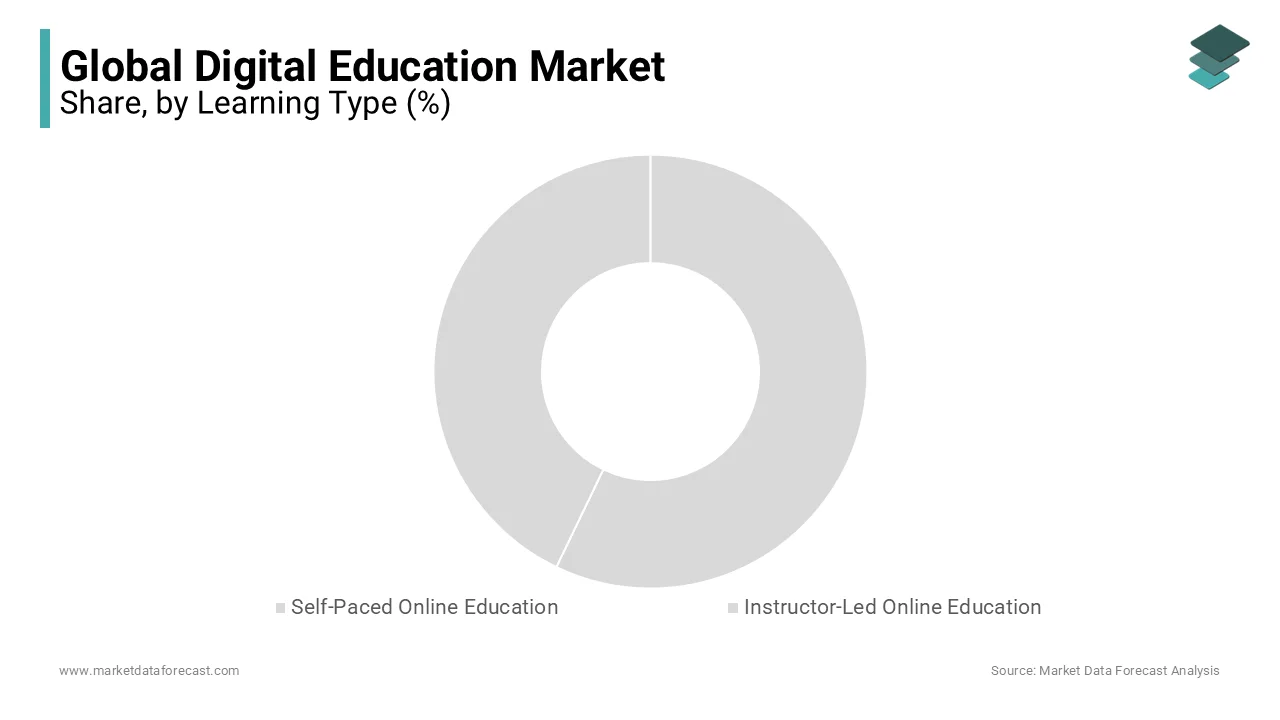
Lower price points relative to instructor led alternatives make self paced learning accessible to broader demographic segments driving volume based market dominance. As per Coursera, online learning networks experience highly accelerated structural shifts as global learners increasingly prioritize generative artificial intelligence certifications to maintain institutional competitiveness. According to the UNESCO Institute for Lifelong Learning, institutional frameworks deploy massive open online courses as centralized digital mechanisms to support equitable upskilling and open-access public resource networks. The economic accessibility expands total addressable market beyond premium segments willing to pay for live interaction establishing self paced learning as default entry point for digital education adoption worldwide.
The instructor-led digital learning segment is anticipated to witness the fastest CAGR of 19.4% from 2026 to 2034 due to recognition that complex skill acquisition requires real-time feedback, collaborative problem solving, and social learning elements absent in purely asynchronous formats. As per studies, commercial firms invest heavily in integrated artificial intelligence architectures to streamline business logistics and accelerate technical capacity across complex modern workflows. According to the U.S. Department of Labor, public postsecondary institutions introduce flexible instructional configurations and credit acceleration pathways to adapt traditional degree models to the constraints of adult students. Premium pricing tolerance supports growth as learners willingly pay more for instructor led formats when pursuing career transformation credentials where outcomes justify investment. This shift toward blended high-touch models reflects maturation of the digital education market beyond content consumption toward genuine capability development requiring human facilitation.
Regulatory requirements and industry certification standards increasingly mandate live instruction components, accelerating instructor-led digital learning growth in regulated sectors. As per the European Commission, specialized continuing education frameworks employ modular digital credentialing rules to simplify structural verification procedures across vocational sectors. According to the Federal Aviation Administration, national civil aviation authorities implement updated safety directives and training curricula to regulate pilot operational qualifications and maintain airspace security profiles. As per the Financial Industry Regulatory Authority, registered financial brokers must comply with standardized regulatory element continuing education windows to keep their market registration credentials valid. Healthcare accreditation bodies including Joint Commission and ACGME similarly strengthened supervision requirements for clinical education limiting purely self paced pathways for patient safety sensitive competencies. These regulatory interventions create non discretionary demand for instructor led digital formats particularly in high stakes professions where accountability and interaction quality are legally mandated rather than pedagogically optional explaining superior growth velocity despite higher costs and scheduling complexity.
By Course Type Insights
The science and technology courses segment remained the largest in 2025 and occupied a commanding share of the digital education market. This prominence of the segment was credited to pervasive digitalization across industries creating sustained demand for technical skills applicable to virtually every occupational sector. According to the World Economic Forum, analytical thinking, creative thinking, and technological literacy rank as the leading core competencies targeted for structural workforce reskilling initiatives globally. As per ISC2, the global cybersecurity workforce talent gap ranges between 3.1 million and 3.5 million unfilled roles, forcing commercial networks to aggressively modify entry-level hiring models. Unlike humanities or arts courses with narrower vocational applicability technology skills transfer across healthcare finance manufacturing government and education sectors maximizing addressable learner population. Continuous technology evolution ensures perpetual reskilling needs as frameworks tools and best practices update quarterly creating recurring enrollment patterns distinct from one time degree completion. This combination of universal relevance compensation premiums and obsolescence driven renewal cycles sustains science and technology segment leadership independent of economic cycles affecting discretionary education spending.
Public policy prioritization of science technology engineering and mathematics education creates subsidized demand streams reinforcing market dominance of tech focused digital courses. As per the OECD, mathematical and scientific student performance standards require comprehensive pedagogical updates to mitigate long-term pandemic learning deficits within public school networks. According to the House Committee on Science, Space, and Technology, the landmark CHIPS and Science Act establishes strict regulatory safeguards to ensure that public manufacturing funding recipients cannot expand high-tech semiconductor operations inside foreign countries of concern. As per the European Commission, regional digital literacy strategies expand the integration of flexible modular credentials to fulfill structural upskilling priorities across the continental tech workforce. These public investments de risk learner investment lower provider customer acquisition costs and signal labor market value of tech credentials creating self reinforcing ecosystem where policy support drives enrollment which validates policy effectiveness justifying continued funding sustaining segment dominance through structural rather than purely market driven mechanisms.
Entrepreneurship and Business Management Courses
The entrepreneurship and business management courses segment is on the rise and is expected to be the fastest-growing segment in the market by witnessing a CAGR of 22.7% during the forecast period owing to the proliferation of independent work, small-business formation, and side-hustle culture requiring practical commercial skills previously reserved for MBA students. As per the International Labour Organization, evolving technological transitions and changing global work structures prompt continuous micro-learning participation as individuals seek to protect their labor market viability. According to Research.com, enterprise learning executives and independent digital workers analyze instructional program expenditures to control budgets and optimize professional output tracking. Unlike theoretical business education emphasizing case studies and frameworks these practical courses focus on immediately applicable tools templates and workflows enabling learners to generate revenue while learning creating direct ROI justification for course purchases. This immediacy of application combined with low barriers to entrepreneurial entry explains superior growth velocity as economic uncertainty pushes individuals toward income diversification strategies requiring accessible business skill development.
Rise of content creators influencers and digital product sellers generates unprecedented demand for specialized business education targeting non traditional entrepreneurs outside conventional corporate career paths. According to Coursera, generative artificial intelligence and emerging content creation tools drive explosive enrollment growth as digital professionals acquire localized economic management skills. As per Research.com, educational product designers integrate interactive learning modules and multi-tiered delivery formats to optimize user retention rates across remote instructional environments. Traditional business schools rarely address these emerging business models creating curriculum gap filled by practitioner led digital courses offering current platform specific strategies unavailable in academic textbooks. This new demographic of micro entrepreneurs expands addressable market beyond traditional business professionals and corporate employees explaining accelerated segment growth as creator economy matures from hobbyist activity to legitimate economic sector requiring systematic business skill development.
By End User Insights
The enterprise segment dominated the digital education market and accounted for a significant share in 2025. This dominance of the segment was driven by substantial, dedicated learning and development budgets allocated for employee upskilling, compliance training, and leadership development that dwarf individual consumer spending capacity. According to Research.com, national corporate talent development directors review annual learning expenditures and operational budget trends to track total capital allocation boundaries across enterprise systems. As per Amazon, a 1.2 billion dollar multi-year corporate upskilling commitment provides free career-advancing education and technology skills training to hundreds of thousands of operations employees. Unlike individual learners making discretionary purchases subject to economic volatility enterprises treat learning as operational necessity with budget allocations tied to headcount regulatory requirements and strategic initiatives providing stable demand floor. Group purchasing power enables negotiated pricing volume licenses and custom content development creating higher lifetime value per account than B2C transactions. This institutional spending foundation sustains enterprise segment leadership regardless of consumer market fluctuations or individual affordability constraints.
Mandatory training obligations across regulated industries generate baseline enterprise digital education demand independent of economic conditions or strategic priorities. According to the Society of Corporate Compliance and Ethics, institutional salary, staffing, and budget benchmark surveys analyze the operational frameworks of cross-industry compliance departments to evaluate modern corporate structures. As per the Occupational Safety and Health Administration, mandatory Hazard Communication standards command employers to implement thorough training and detailed chemical identification labels to shield approximately 32 million workers from daily chemical risks. The regulatory mandates transform compliance training from discretionary expense into operational license to operate ensuring enterprise segment maintains dominant share through legally enforced demand streams unaffected by voluntary learning market dynamics or individual consumer sentiment.
The individual learners segment is likely to experience the fastest CAGR of 24.1% between 2026 and 2034. This rapid expansion of the segment is fuelled by labor market disruption prompting career changers to invest personally in reskilling outside employer sponsored programs. According to Research.com, professional career transitioning trends drive corporate human capital developers to expand instructional design mechanics and adapt internal training architectures to shifting worker requirements. As per Coursera, digital certification networks update curriculum paths to focus heavily on emergent technical categories and prepare users for broader international data economic demands. Economic uncertainty paradoxically accelerates this trend as individuals recognize employer loyalty no longer guarantees career security, prompting proactive skill portfolio diversification. This psychological shift from employer dependent to self directed career management creates structural demand growth independent of corporate training budget cycles explaining superior expansion velocity despite lower per transaction values.
Modular credential architectures allowing learners to accumulate recognized qualifications incrementally reduce upfront financial barriers accelerating individual market penetration. As per research insights shared by digital educational designers on Facebook, interactive digital course elements require balanced textual frameworks to limit user interface fatigue and improve baseline material comprehension boundaries. According to the Australian Government Department of Education, the national microcredentials framework establishes a clear definition, unified principles, and minimal critical information guidelines to standardize short-duration learning qualifications. The progressive investment model expands addressable market to include learners previously excluded by degree cost barriers explaining accelerated individual segment growth as stackable credential ecosystems mature and gain employer acceptance worldwide.
REGIONAL ANALYSIS
North America Digital Education Market Analysis
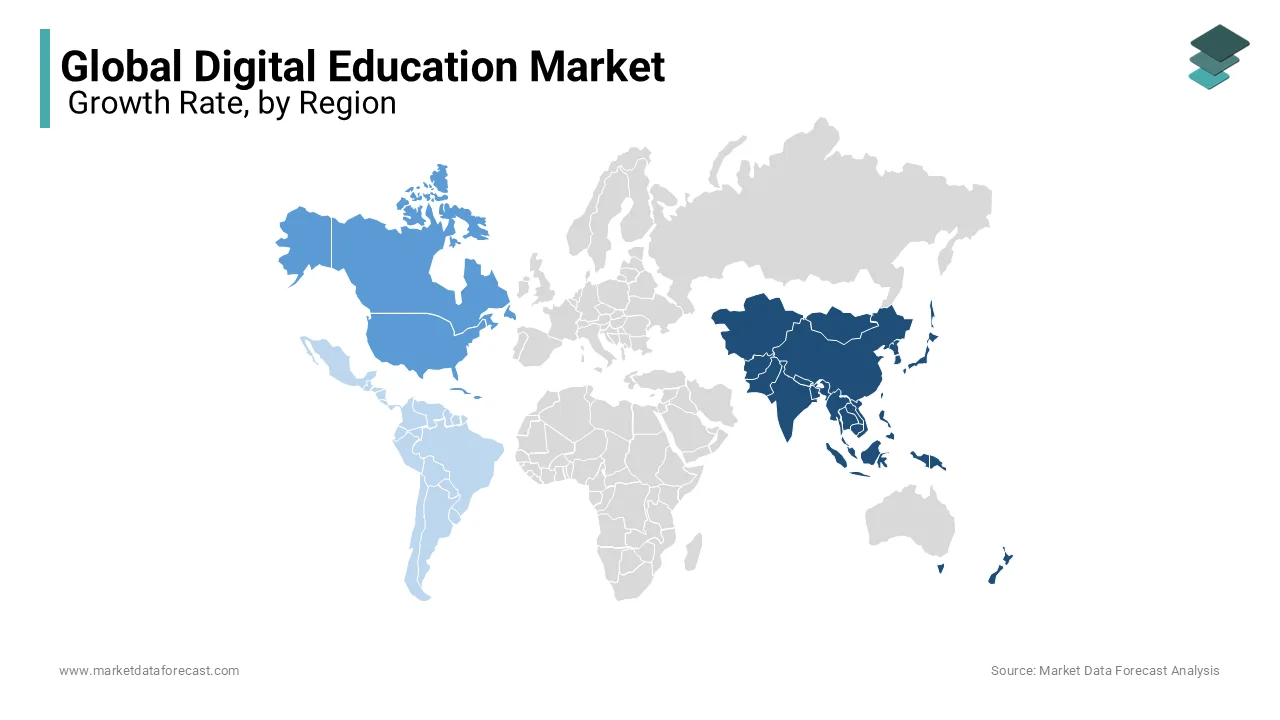
North America was the top performer in the global digital education market and accounted for a 36.7% share in 2025. This leading position of the North American market was attributed to concentrated venture capital investment. ccording to the International Council for Open and Distance Education, global edtech venture funding fell to approximately 8.2 billion dollars in 2023, reflecting a broader startup financing contraction that is pushing providers to prioritize sustainable revenue models. The region hosts headquarters of major platform providers including Coursera Udemy LinkedIn Learning and Khan Academy whose global user bases generate substantial North American revenue through premium subscriptions and enterprise contracts. As per the United States Department of Education National Center for Education Statistics, school systems are increasing deployment of infrastructure resources, forcing a rise in student device access rates across public schools to establish standard hybrid learning benchmarks. Corporate learning maturity further amplifies demand. Strong intellectual property protections and established payment infrastructure enable premium pricing models and subscription retention rates exceeding global averages. However market saturation in K 12 and higher education segments is shifting growth toward corporate reskilling and lifelong learning verticals as traditional enrollment plateaus post pandemic normalization.
Europe Digital Education Market Analysis
Europe followed closely behind in the global digital education market because strong public sector investment, regulatory harmonization, and multilingual content requirements shaped distinctive regional dynamics. As per the European Commission, member states are directing multi-billion euro recovery budgets to digitize connectivity infrastructure, causing a major upswing in regional high-speed network expansions and digital classroom access. GDPR compliance creates both barrier and moat as stringent data protection requirements increase operational costs for non European providers while favoring domestic platforms like FutureLearn UK and FUN MOOC France designed with privacy by design principles. Vocational education strength distinguishes the European market. According to the European Centre for the Development of Vocational Training, structural shifts toward automated workplaces are driving a consumer behavioral shift toward co-funded apprenticeships, raising the demand for embedded digital modules across regional vocational networks. Multilingual fragmentation necessitates localized content investment limiting pan European scalability but creating defensible niches for language specific providers. As per the United Kingdom Department for Education, independent regulatory changes are complicating transnational educational operations, causing a growth trend in bilateral institutional frameworks to preserve post-Brexit professional qualification portability. Aging workforce demographics drive corporate reskilling demand.
Asia Pacific Digital Education Market Analysis
Asia-Pacific is the fastest-growing region in the digital education market due to a massive population base, mobile-first learning adoption, and government-led digital education initiatives. According to the Ministry of Education of the People's Republic of China, the national smart education platform connects approximately 300 million students and 18 million teachers. Southeast Asian markets including Indonesia Vietnam and Philippines show explosive mobile learning adoption. As per the Broadband Commission for Sustainable Development, digital skills training and internet-connected devices function as a multi-utility learning hub across developing markets to accelerate mobile usage. Japan and South Korea maintain advanced infrastructure but face demographic headwinds as declining birth rates reduce K-12 enrollment, shifting focus toward adult reskilling and elderly digital literacy programs. Cross-border credential recognition remains challenging, though the ASEAN Mutual Recognition Arrangement for skilled workers facilitates some regional mobility. Price sensitivity necessitates freemium and ad supported models limiting ARPU but enabling massive user bases that attract global platform investment seeking growth beyond saturated Western markets.
Latin America Digital Education Market Analysis
Latin America is moving ahead steadfastly in the global digital education market. However, growth is constrained by connectivity gaps yet accelerated by government digitization efforts and corporate training modernization. According to the Fundação Lemann, Brazil's national education connectivity initiatives successfully expanded high-quality internet connections to over 60,700 public schools. As per the UNESCO Office Santiago and Regional Bureau for Education in Latin America and the Caribbean, basic educational services are reinforced through multimodal delivery strategies including television, internet, radio, and free textbooks. Corporate digital learning adoption accelerates as multinational manufacturers nearshoring production to Mexico and Central America require local workforce upskilling. According to the International Telecommunication Union, corporate digital learning frameworks accelerate the acquisition of practical technical proficiencies to align local workforces with emerging industrial requirements. Currency volatility and import restrictions complicate foreign platform access favoring domestic providers like Platzi Colombia and Alura Brazil, offering locally priced content in Portuguese and Spanish. Higher education enrollment growth continues despite economic challenges. As per the UNESCO International Institute for Higher Education in Latin America and the Caribbean (IESALC), regional higher education policies prioritize expanding flexible tertiary study paths, blended learning environments, and alternative credentials. Infrastructure deficits persist. According to the International Telecommunication Union, severe geographical digital divides restrict online education access, necessitating targeted public policy measures to deliver universal school connectivity.
Middle East and Africa Digital Education Market Analysis
The Middle East and Africa region is expected to grow significantly in the global digital education market over the forecast period, due to extreme heterogeneity between Gulf states investing heavily in digital transformation and sub-Saharan nations addressing basic access challenges. As per the Ministry of Education of Saudi Arabia, the national digital platform Madrasati serves more than 6 million students and approximately 500,000 teachers as a core pillar for educational digitization. According to the Ministry of Education of the United Arab Emirates, digital transformation strategies deploy smart learning architectures to transition public academic infrastructure toward comprehensive remote and hybrid instructional systems. As per the UNESCO Global Education Monitoring Report, low-bandwidth mobile learning applications and text-based supplementary programs provide scalable remote learning alternatives in regions with low household broadband access. According to the African Union, continental educational strategies emphasize integrating information and communication technologies across curricula to foster foundational digital competencies. As per the United Nations Population Division, expanding youth demographic profiles require robust, low-bandwidth educational models and cross-sector partnerships to secure long-term human capital development.
COMPETITIVE LANDSCAPE
Competition within the digital education market exhibits high intensity characterized by fragmented landscape spanning massive open online course platforms corporate learning management systems niche bootcamps and emerging AI native startups. Barriers to entry remain low for content creation but substantial for achieving scale credibility and learner outcomes differentiation limiting sustainable profitability despite abundant supply. Incumbents compete through exclusive content partnerships credential recognition employer integrations and technological capabilities rather than price alone as free alternatives commoditize basic instruction. Platform effects create winner-take-most dynamics in MOOC and professional certificate segments where network effects attract both learners and employers, reinforcing dominant positions. However, vertical specialization enables niche players to thrive in healthcare compliance, technical certification, and creative skills where generic platforms lack depth or regulatory acceptance. Geographic fragmentation persists due to language regulatory and cultural differences preventing true global consolidation requiring localized strategies even for multinational operators. Buyer power varies significantly with enterprises commanding volume discounts and custom development while individual learners face abundant choice driving price sensitivity and churn. Competitive intensity escalates as AI lowers content production costs, enabling new entrants while simultaneously raising learner expectations for personalization, forcing incumbents to continuously innovate or risk obsolescence. This dynamic environment rewards adaptability, outcome focus, and ecosystem integration over static content libraries or legacy brand equity alone.
KEY MARKET PLAYERS
The leading companies operating in the global digital education market include:
- Coursera
- edX
- BYJU'S
- Edureka
- Udemy
- LinkedIn Corporation
- Udacity
- Eduonix
TOP PLAYERS IN THE MARKET
- Coursera Inc maintains significant influence across the global digital education landscape through partnerships with over 300 universities and industry leaders offering accredited degrees professional certificates and open courses. The company contributes globally by democratizing access to elite institutional content, serving learners in 190 countries with localized interfaces in 45 languages, reducing linguistic barriers to quality education. Their enterprise segment expanded through strategic contracts with governments including Singapore SkillsFuture and UAE Ministry of Education, creating stable public sector revenue streams independent of consumer volatility. Investment in stackable microcredentials enables learners to accumulate recognized qualifications progressively lowering upfront cost barriers and increasing lifetime value. These initiatives reinforce platform stickiness and global reach without relying on market share metrics to demonstrate sustained competitive advantage in credentialing and lifelong learning ecosystems worldwide.
- Udemy Inc plays a pivotal role in the digital education ecosystem through marketplace model enabling instructors to offer courses in 75 languages addressing practical skills gaps across technology business and creative domains. The company contributes globally by providing affordable, just-in-time learning accessible to individual learners and enterprises in developing markets where traditional education infrastructure is limited. Strategic partnerships with cloud providers AWS, Google Cloud, and Microsoft integrate vendor certifications directly into the platform, increasing employability value for learners and B2B appeal for corporate clients. Instructor revenue-sharing model aligns incentives, ensuring continuous content freshness aligned with evolving industry demands, distinguishing marketplace approach from curated platform competitors.
- LinkedIn Corporation has established a substantial presence in digital education through an integrated professional development platform connecting learning directly to career outcomes via profile credentials, job matching, and recruiter visibility. LinkedIn recently strengthened its position by expanding AI-powered career coaching and interview preparation features, bridging the gap between skill acquisition and employment outcomes. Free access initiatives during economic downturns build goodwill and user habits converting to paid subscriptions during recovery periods. Data driven insights published annually in Workplace Learning Report establish thought leadership influencing corporate L&D budget allocation decisions globally. This career outcome integration creates a defensible moat as learning becomes inseparable from professional identity and opportunity discovery, distinguishing LinkedIn from pure content providers.
TOP STRATEGIES USED BY KEY MARKET PARTICIPANTS
Key players in the digital education market employ multifaceted strategic approaches to navigate rapid technological change, learner expectations, and competitive intensity across diverse segments. Content differentiation through exclusive institutional partnerships proprietary IP and practitioner led courses creates defensible moats against commoditization pressures from open educational resources and user generated content platforms. Artificial intelligence integration enhances personalization engagement and operational efficiency through adaptive learning paths automated assessment grading and AI tutoring features justifying premium pricing while reducing human intensive delivery costs. Credential stackability and employer recognition partnerships increase learner ROI perception and completion rates, transforming episodic course purchases into progressive qualification journeys with higher lifetime value. Enterprise B2B expansion provides stable recurring revenue less susceptible to consumer discretionary spending volatility through multiyear contracts, compliance training mandates, and workforce development budgets. Global localization including language translation cultural adaptation and regional payment methods expands addressable market beyond English speaking developed economies capturing growth in emerging regions. Community building through cohorts, peer interaction, and mentorship addresses isolation concerns and improves retention versus purely asynchronous self-paced models. Freemium and subscription pricing experimentation optimizes conversion funnels and revenue per user across diverse willingness-to-pay segments. These interconnected strategies collectively address fundamental market dynamics where learner outcomes, employer validation, and scalable personalization increasingly determine competitive success beyond mere content library size or brand recognition alone.
MARKET SEGMENTATION
This research report on the global digital education market has been segmented and sub-segmented based on the learning type, course type, end-user, and region.
By Learning Type
- Self-Paced Online Education
- Instructor-Led Online Education
By Course Type
- Science and Technology Courses
- Entrepreneurship and Business Management Courses
- Others
By End User
- Individual Learners and Academic Institutions
- Enterprises and Government Organizations
By Region
- North America
- Europe
- APAC
- Latin America
- MEA