- Product Description Description
- Table of Contents TOC
- List of Table & Figure LOT
- Get Free Sample PDF Sample PDF
Global Microlearning Market Size
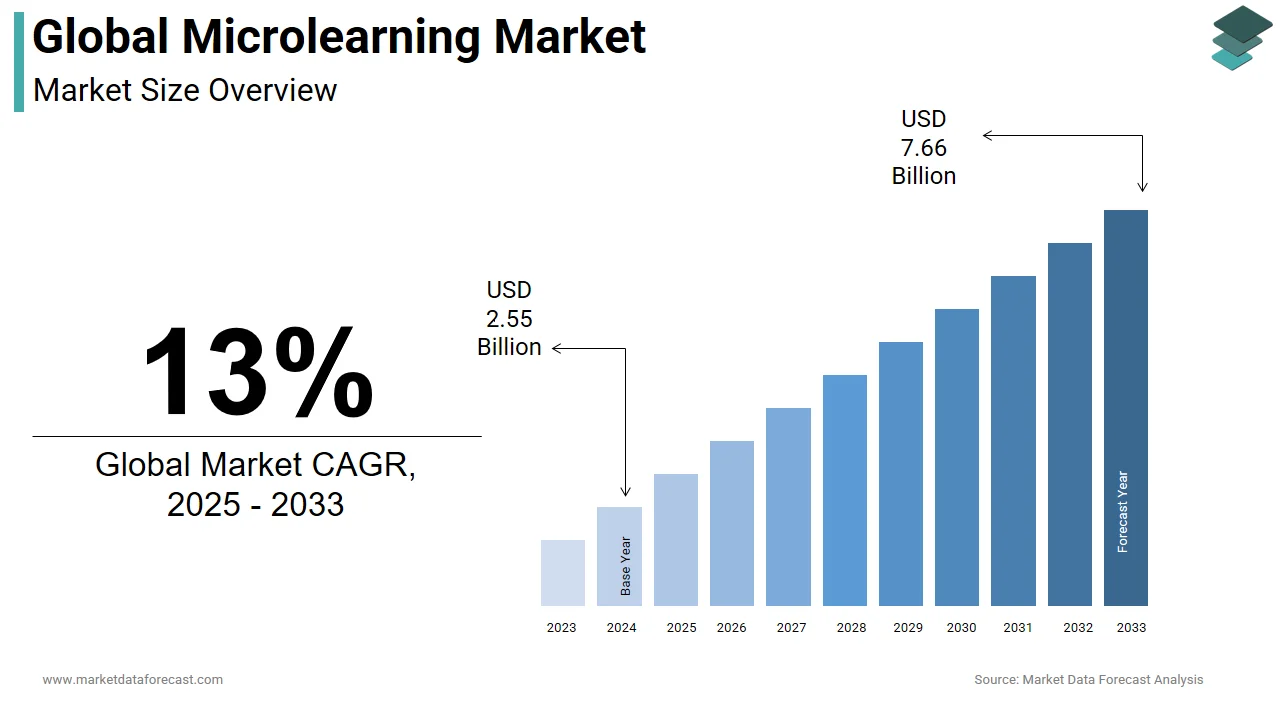
The global microlearning market was worth USD 2.55 billion in 2024 and is projected to reach USD 7.66 billion by 2033, growing at a CAGR of 13% from 2024 to 2033.
Microlearning is the process of dividing employee training into small pieces. The goal is to increase short courses that are easy to learn and quickly applied to employees. It provides additional advantages like smart device access, just-in-time learning, actionable data, etc. Microlearning is used in various industries to support a multitude of training applications. This training is best used when a student needs the information or is most receptive to receiving the information.
MARKET DRIVERS
An increased volume of homeless/mobile workers worldwide at various companies should drive market growth. The growing need to implement skills-based training that can deliver measurable results to companies is another factor driving this market growth.
The high demand for training by the high volume of workers in different companies in various industries also acts as a growth driver. A profitable learning method that increases the preference levels of companies to participate in this training method should improve the adoption rate of this method.
Microlearning in the manufacturing industry and logistics focuses on increasing efficiency, improving quality, and complying with safety policies. Qualified technicians can significantly improve the efficiency of manufacturing and logistics activities and the quality of the final product. By leveraging microlearning, employees can study content while staying on the job site, increasing the business's overall productivity. Technicians, factory workers, drivers, and other staff use training courses to align themselves with machines, processes, and compliance quickly.
The on-premise implementation of the microlearning solution will be deployed on the client's server, which the user has to buy to use. It is also customizable. Configuration and maintenance are performed by the buyer's internal IT staff, who have complete control over the microlearning solution. The local microlearning solution allows companies to create, store, and provide critical data and control access to training programs. However, the share of the on-site microlearning implementations is declining due to their high initial investment and a need for long-term commitment. This kind of implementation is employed by firms that require continuous availability of a learning system to improve the results of a business activity. With the deployment of a local microlearning solution, companies have better control over the investments made to configure the infrastructure, as this reduces the total cost of the network.
MARKET RESTRAINTS
Concerns about companies' lack of preference for incurring large-scale expenses to transform the content of microlearning methods are supposed to hinder market growth. This method is generally not preferred or supported for complex training modules or modules requiring a long-term training period, which impedes business growth. It is not ideal for long-term goals of improving business performance, as it is a set of different modules and training sets that only train workers for a single brief topic, which may slow down the growth of this market.
REPORT COVERAGE
| REPORT METRIC | DETAILS |
| Market Size Available | 2024 to 2033 |
| Base Year | 2024 |
| Forecast Period | 2025 to 2033 |
| CAGR | 13% |
| Segments Covered | By Component, Deployment Mode, Organization Size, End User / Industry Vertical, Learning Mode, Device Type, and Region |
|
Various Analyses Covered | Global, Regional & Country Level Analysis, Segment-Level Analysis, DROC, PESTLE Analysis, Porter’s Five Forces Analysis, Competitive Landscape, Analyst Overview on Investment Opportunities |
| Regions Covered | North America, Europe, APAC, Latin America, Middle East & Africa |
|
Market Leaders Profiled | Saba Software, Mindtree.com, Axonify Inc., IBM Corporation, Bigtincan, SwissVBS,iSpring Solutions Inc., Epignosis, Cornerstone, Qstream Inc.,count5 LLC, pryor.com, GnowbeNeovation Corporation, Multiversity, Trivantis, Aptara Inc., AlertDriving, and Others. |
REGIONAL ANALYSIS
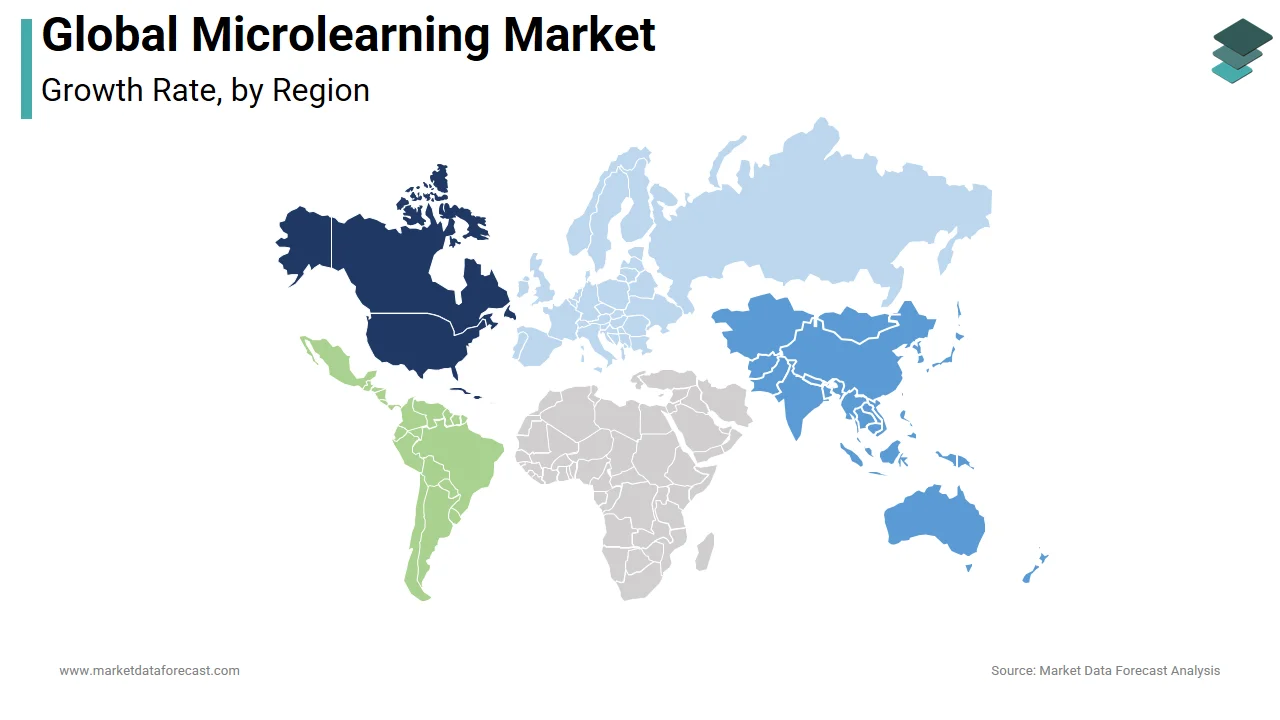
North America is the most mature market for microlearning adoption and is expected to represent a substantial part of the global microlearning business during the forecast period. The market growth in the area is mainly due to the presence of large information technology companies and rapid technological advances, such as digitization in the United States and Canada. The presence of key players in the region's microlearning market should be an essential factor in developing the market in North America. Key players such as IBM, Saba Software, Bigtincan, and several regional start-ups offer improved microlearning solutions to meet customer needs.
KEY MARKET PARTICIPANTS
The major companies operating in the global microlearning market include Saba Software, Mindtree.com, Axonify Inc., IBM Corporation, Bigtincan, SwissVBS, iSpring Solutions Inc., Epignosis, Cornerstone, Qstream Inc., count5 LLC, pryor.com, Gnowbe Neovation Corporation, Multiversity, Trivantis, Aptara Inc., AlertDriving and Others.
RECENT MARKET HAPPENINGS
-
In May 2020, Qstream, a leader in microlearning software that involves sales teams in mobile sales learning programs, was recognized as the best 2020 training company in the sales training industry. Learning and development.
-
In January 2020, Cornerstone OnDemand, Inc., announced the acquisition of Cluster. This French technology company has developed an AI-based skills engine and a broad skills ontology used by leading brands, including Carrefour and SNCF.
MARKET SEGMENTATION
This research report on the global microlearning market has been segmented and sub-segmented based on the component, deployment, organization, size, vertical, and region.
By Component
- Content
- Platform & Tools
- Services
By Deployment Mode
- Cloud-based
- On-premises
By Organization Size
- Small and Medium-sized Enterprises (SMEs)
- Large Enterprises
By End User / Industry Vertical
- Banking, Financial Services, and Insurance (BFSI)
- Information Technology (IT) and Telecom
- Healthcare and Life Sciences
- Retail
- Manufacturing
- Education
- Government and Defense
- Others (Automotive, Energy, etc.)
By Learning Mode
- Instructor-led
- Self-paced
By Device Type
- Desktop
- Mobile
- Tablet
By Region
- North America
- Asia-Pacific
- Europe
- Middle East and Africa
- Latin America