- Product Description Description
- Table of Contents TOC
- List of Table & Figure LOT
- Get Free Sample PDF Sample PDF
Market Size, 2025
$12.56 BnMarket Estimate, 2026
$14.12 BnMarket Forecast, 2034
$35.97 BnCAGR, 2026–2034
12.40%Executive Summary: School Information Management System Market
- Market Scope: Comprehensive global school information management system industry analysis covering deployment models (cloud-based SaaS/PaaS), core institutional modules, regional leadership frameworks, strategic corporate developments, and competitive landscapes.
- Market Valuation: Valued at USD 12.56 billion (2025), estimated at USD 14.12 billion (2026), and projected to reach USD 35.97 billion by 2034, registering a strong CAGR of 12.40% (2026–2034).
- Primary Growth Drivers: Increasing educational digitization, cloud-based solution adoption, data-driven decision-making workflows, student engagement enhancements, government EdTech integration initiatives, and AI-enhanced analytics for personalized learning. Restraints include data privacy concerns, high implementation costs, and resistance to traditional method transitions.
Key Market Segment Metrics (2026–2034)
| Category | Leading Segment / Region (Position) | Fastest-Growing Segment |
|---|---|---|
| By Deployment & Modules | Cloud-based deployment (dominant via SaaS/PaaS models) & Student Assessment, Finance Management, and Human Resources modules | AI-enhanced analytics platforms and scalable cloud-shared multi-institution collaboration systems |
| By End-User Institution | K-12 schools, higher education institutions, and specialist academies requiring comprehensive administration | Higher education specialty providers modernizing digital architectures |
| By Region | North America (dominated landscape with 41.34% market share in 2025 via heavy EdTech investments) | Asia-Pacific (key growth region driven by educational modernization across China, Japan, and South Korea) |
Major Market Players & Market Structure
Market Structure: Highly competitive global educational technology ecosystem driven by strategic institutional partnerships, cloud-based platform transformations (such as Arkansas State University System implementing Ellucian Banner), and digital modernization initiatives.
Key Companies: Ellucian Company L.P., Foradian Technologies, Hobsons, Jenzabar Inc., Oracle Corporation, Web School ERP, Creatrix Campus, Skolaro, feKara, and Gibbon.
 Download Free Sample Report
Global School Information Management System Market Size
The global school information management system market was valued at USD 12.56 billion in 2025. The global market is anticipated to be worth USD 35.97 billion by 2034 from USD 14.12 billion in 2026, growing at a CAGR of 12.40% from 2026 to 2034.
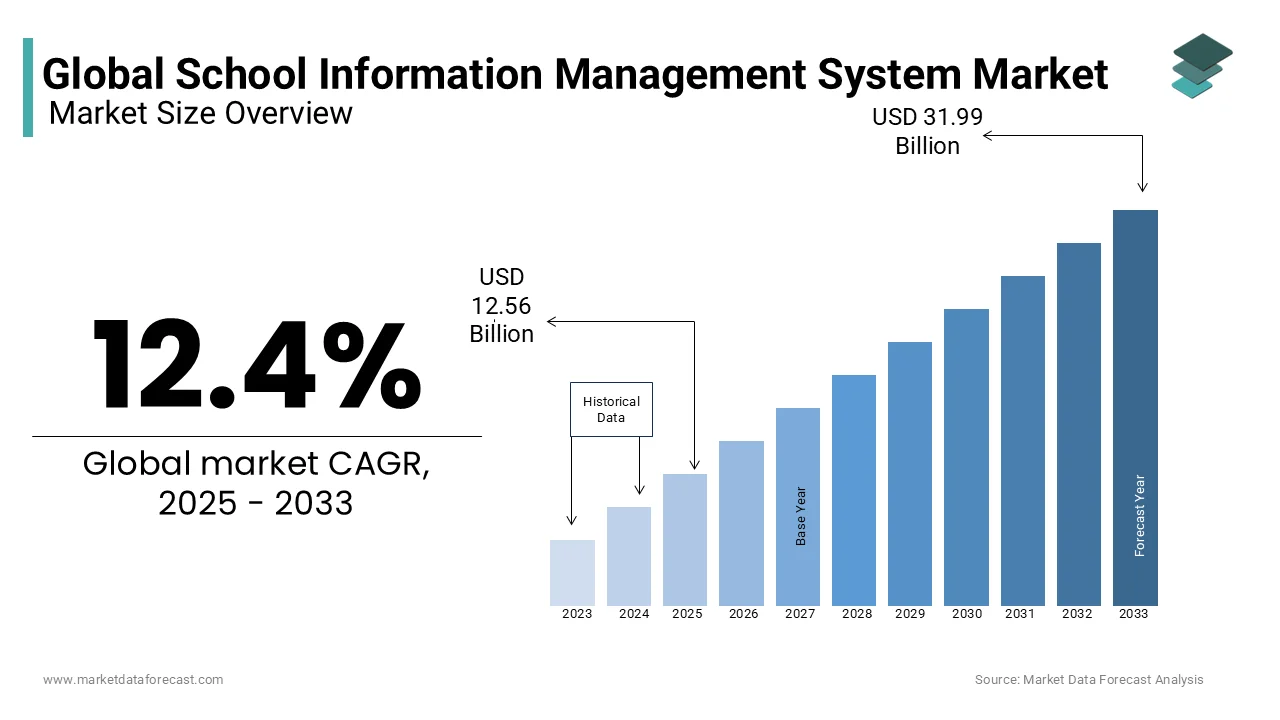
A School Information Management System (SIMS) (also known as a Student Information System (SIS) or School Management Information System (MIS)) is a centralized digital software platform that schools use to store, manage, and automate student, academic, and administrative records in one place. These systems integrate student records, attendance tracking, grading, fee management, and parent engagement into unified interfaces. According to the National Center for Education Statistics, data from the K-12 Student Information Systems market reports indicate that over 85% of U.S. public schools utilize digital record-keeping and student data management. This widespread digitization necessitates robust software solutions capable of handling complex institutional workflows efficiently. As per UNESCO, the mean level of global public education expenditure fell to 4.3% of total GDP in 2022, down from 4.6% in 2015. The investment climate directly supports the adoption of sophisticated management systems across diverse geographies. In addition, the definition includes cloud-based and on-premises deployments tailored for K-12, higher education, and vocational training centers. Key functionalities encompass curriculum planning, library management, and regulatory compliance reporting. Vendors increasingly incorporate artificial intelligence for predictive analytics and personalized learning pathways. Data security and interoperability with third-party applications remain critical considerations for purchasers. This market serves as the technological backbone enabling educational institutions to focus resources on pedagogical outcomes rather than manual administration.
MARKET DRIVERS
Government Mandates for Digital Transformation in Education
Government initiatives mandating digital record-keeping and standardized reporting propel the school information management system market. This creates compulsory demand across public education sectors. Educational authorities worldwide are implementing policies that require real-time data submission for funding allocation and performance monitoring. According to studies, member states in Europe frequently establish and update localized digital education roadmaps to modernize their public administration frameworks. This regulatory alignment forces institutions to upgrade legacy systems or adopt new compliant platforms immediately. As per research, school systems utilize variable funding pipelines such as Title IV, Part A grants to finance school infrastructure upgrades. This targeted funding removes financial barriers for underfunded districts seeking comprehensive management solutions. Compliance requirements extend beyond basic record-keeping to include privacy safeguards, accessibility standards, and longitudinal data tracking. Schools must demonstrate system capabilities during audits to maintain accreditation and funding eligibility. Vendors respond by developing region-specific modules addressing local regulatory nuances. The mandatory nature of these mandates ensures sustained demand independent of discretionary budget cycles. Institutions view these systems not as optional enhancements but as operational necessities for legal and financial viability. This driver creates a stable baseline of market activity driven by policy rather than preference.
Increasing Demand for Data-Driven Decision Making
The growing emphasis on evidence-based educational management drives the school information management system market. This transforms raw data into actionable strategic insights. Administrators increasingly rely on analytics to optimize resource allocation, improve student retention, and enhance instructional effectiveness. According to the OECD Programme for International Student Assessment, baseline institutional practices and local operational environments drive broad educational performance adjustments across multi-year cycles. This correlation validates the tangible benefits of sophisticated information systems for academic leadership. As per reports, local district administrators commonly review data management systems to balance operational transparency with localized infrastructure priorities. This preference shifts purchasing decisions toward platforms offering advanced visualization and predictive modeling features. Stakeholders demand real-time dashboards showing enrollment trends, attendance patterns, and financial health metrics. Teachers utilize granular performance data to personalize interventions and track intervention efficacy. Parents expect transparent access to academic progress through dedicated portals. The ability to aggregate disparate data sources into unified reports reduces administrative burden significantly. This driver expands market scope beyond transactional processing toward strategic intelligence platforms. Vendors compete on analytical depth and user-friendly presentation of complex datasets.
MARKET RESTRAINTS
Budgetary Constraints in Public Education Systems
Chronic underfunding in public education restricts the school information management system market. This limits purchasing power for comprehensive software solutions. Many institutions operate with fixed budgets that cannot accommodate recurring subscription fees or implementation costs. According to studies, educational institutions frequently face strained technology budgets when trying to adapt to rapidly increasing operational requirements. This financial gap forces administrators to prioritize immediate instructional needs over administrative system upgrades. As per research, low-income nations routinely dedicate a constrained portion of their absolute public spending to school infrastructure, leaving limited resources for systemic digital transformation. Schools often resort to fragmented free tools or outdated legacy systems that lack integration capabilities. Procurement cycles are lengthy and bureaucratic, delaying necessary technology refreshes for years. Vendors face pressure to offer tiered pricing or freemium models that may compromise feature completeness. Budget uncertainty makes long-term contractual commitments risky for both buyers and sellers. Maintenance and training costs further strain limited resources after initial purchase. This restraint disproportionately affects rural and underserved communities, widening the digital divide. Market growth remains uneven as affluent private institutions adopt premium solutions while public schools lag behind. Financial sustainability concerns hinder universal adoption despite clear operational benefits.
Data Privacy Regulations and Compliance Burdens
Stringent data protection laws impede the school information management system market. This increases development complexity and liability exposure for vendors and institutions. Educational records contain sensitive personal information requiring rigorous safeguarding measures under multiple jurisdictions. According to the International Association of Privacy Professionals, over 130 countries now have comprehensive data protection legislation enacted globally. This regulatory fragmentation forces vendors to maintain multiple compliance frameworks, increasing operational costs significantly. According to reports, public school systems encounter systemic administrative bottlenecks and operational challenges when aligning their legacy digital records with evolving student data privacy laws. Noncompliance risks include substantial fines, reputational damage, and loss of public trust. Institutions hesitate to adopt cloud-based systems due to concerns about third-party data handling and cross-border transfers. Vendors must invest heavily in encryption, access controls, and audit logging features that add technical complexity. Regular security assessments and certification renewals consume resources better spent on innovation. Parental consent requirements for data collection create administrative overhead during enrollment. Fear of breaches leads some schools to avoid digital systems entirely despite efficiency gains. This restraint slows market expansion as stakeholders navigate evolving legal landscapes cautiously.
MARKET OPPORTUNITIES
Integration of Artificial Intelligence for Predictive Analytics
The incorporation of artificial intelligence offers a significant opportunity for the school information management system market. This enables proactive student support and operational optimization. Machine learning algorithms can identify at-risk students before academic failure occurs through pattern recognition in attendance and grade data. According to sources, predictive systems and targeted feedback frameworks are increasingly evaluated for their capacity to enhance institutional student retention pipelines. The measurable impact demonstrates a clear value proposition for AI-enhanced management systems. As per studies, software and IT buyers in global enterprises routinely expand cloud deployment architectures across a spectrum of public and private environments. The spending shift creates demand for platforms with embedded intelligence rather than standalone analytics tools. AI automates routine administrative tasks like scheduling and communication routing, freeing staff for higher-value activities. Natural language processing enables chatbot interfaces for parent and student inquiries, reducing support workload. Personalized learning recommendations adapt content delivery based on individual performance patterns. Early warning systems alert counselors to behavioral changes requiring intervention. Vendors differentiate offerings through proprietary algorithms trained on diverse educational datasets. This opportunity transforms systems from passive record keepers into active participants in student success. Ethical AI development addressing bias concerns becomes a competitive advantage.
Expansion into Emerging Markets with Growing Enrollment
Rising student populations in developing regions create a pathway for the growth of the school information management system market. This market expansion is primarily facilitated through first-time digital adoption. Countries experiencing demographic bulges require scalable infrastructure to manage expanding educational systems efficiently. According to research, regional school enrollment numbers in Sub-Saharan Africa continue to climb significantly in response to shifting urban population trends and domestic school fee reforms. This growth necessitates automated systems to handle administrative complexity at scale. As per the Asian Development Bank, governments across developing Asian economies actively implement infrastructure modernization budgets to target broad regional economic integration. This public investment creates immediate market entry points for international and local vendors. Mobile-first solutions address connectivity limitations while reaching underserved communities. Lightweight platforms optimized for low-bandwidth environments enable deployment where traditional systems fail. Public-private partnerships facilitate affordable access through subsidized licensing models. Localization of interfaces and content builds trust among non-English-speaking users. Leapfrogging legacy paper-based systems allows direct adoption of modern cloud architectures. Demographic momentum ensures long-term demand growth independent of economic fluctuations. Vendors establishing early presence gain brand loyalty and market share advantages. This opportunity balances commercial potential with social impact in education access.
MARKET CHALLENGES
Interoperability Issues Across Disparate Systems
The lack of standardized data exchange protocols is a significant challenge to the school information management system market. This technical deficiency creates siloed information ecosystems that inherently reduce overall system utility. Educational institutions typically operate multiple specialized applications that cannot communicate seamlessly with core management platforms. According to sources, school districts often deploy a wide ecosystem of disparate software applications, which can result in low technical integration across platforms. This fragmentation forces manual data reentry, increasing error rates and staff workload significantly. As per studies, fragmented technical infrastructure across public schools generates substantial downstream administrative redundancies and hidden operational overhead costs every year. This inefficiency undermines the value proposition of comprehensive management systems. Vendors use proprietary formats to create vendor lock-in, hindering institutional flexibility. The absence of universal standards complicates data migration during system transitions. Real-time synchronization between attendance, grading, and finance modules remains technically difficult. API limitations restrict third-party integrations even when desired. Schools struggle to obtain holistic views of student performance across disconnected platforms. This challenge requires industry-wide collaboration on open standards like OneRoster and LTI. Until resolved, interoperability gaps limit the transformative potential of digital management systems.
Resistance to Change Among Educational Staff
Cultural resistance to technological adoption slows down the expansion of the school information management system market. This undermines implementation success and return on investment. Many educators and administrators prefer familiar manual processes despite documented inefficiencies. According to research, 70% of organizational change initiatives fail primarily due to employee resistance rather than technical deficiencies. This statistic applies directly to school environments where technology fatigue is prevalent among overworked staff. As per reports, many educators indicate they require more comprehensive training and ongoing support to feel fully proficient with newly introduced educational software systems. Insufficient professional development leaves users frustrated and unable to leverage system capabilities effectively. Tenured staff may view automation as threatening job security or devaluing professional expertise. Poorly designed user interfaces exacerbate adoption barriers, especially for less tech-savvy personnel. Change management is often neglected during procurement, focusing on features rather than people. Negative experiences with previous failed implementations create lasting skepticism. Resistance manifests as workarounds that bypass the system's intended workflows. This challenge requires sustained investment in training, support, and stakeholder engagement throughout implementation cycles. Technical excellence alone cannot overcome human factors determining actual usage patterns and realized benefits.
SEGMENTAL ANALYSIS
By Deployment Mode Insights
In 2025, the cloud-based segment held the largest share in the school information management system market because of its scalability, lower upfront costs, and ease of access. Educational institutions prefer this model as it eliminates the need for extensive on-site server infrastructure and dedicated IT maintenance staff. According to sources, modern academic institutions frequently transition enterprise assets and enterprise resource planning software to cloud systems to address operational scalability. This massive shift reflects the desire for remote accessibility and automatic software updates without manual intervention. As per studies, state technology directors prioritize modernization strategies across public infrastructure networks to streamline baseline operations. This financial efficiency is crucial for budget-constrained public school districts seeking modernization. The ability to scale resources up or down based on enrollment fluctuations provides operational flexibility. Data backup and disaster recovery are managed by service providers, ensuring business continuity. Teachers and administrators can access real-time data from any location, facilitating remote work and collaboration. Security protocols offered by major cloud providers often exceed what individual schools can implement independently. This segment leads because it aligns with the broader trend of digital transformation in education. The subscription-based pricing model allows for predictable annual budgeting rather than large capital expenditures.
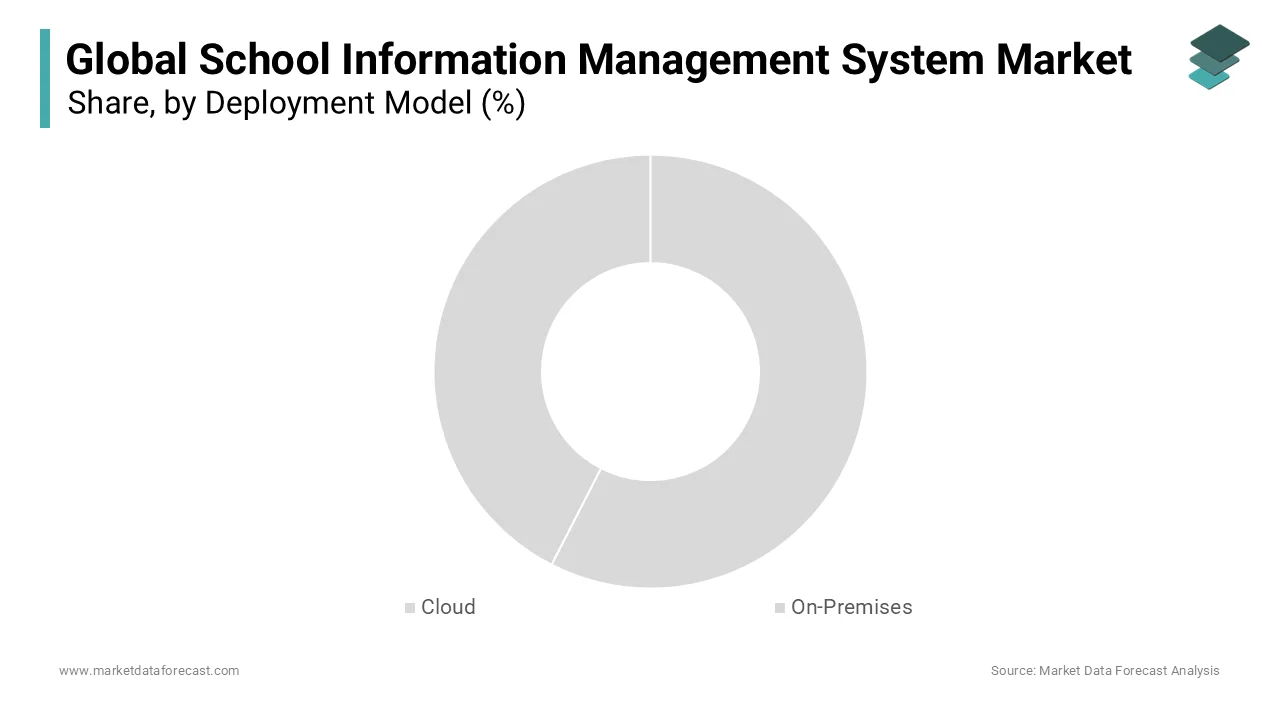
The cloud-based segment is also the fastest-growing in the school information management system market due to urgent needs for remote learning capabilities and data centralization. The pandemic accelerated this trend, but post-pandemic retention remains high due to proven efficiencies. According to reports, localized institutional investments in digital learning modules fluctuate significantly based on venture capital trends and regional policy shifts. This sustained growth indicates that cloud adoption is not a temporary spike but a structural shift in educational infrastructure. According to sources, organizational management approaches increasingly integrate digital system layers to mitigate systemic personnel changes. This strategic intent drives rapid procurement of cloud native management systems. Emerging markets are leapfrogging on-premises infrastructure entirely, moving directly to cloud solutions. The speed of deployment allows schools to go live in weeks rather than months. Automatic compliance updates ensure institutions meet changing regulatory requirements without technical overhead. Integration with other cloud-based learning tools creates a seamless ecosystem for users. The elasticity of cloud resources handles peak loads during enrollment periods effortlessly. This segment grows fastest because it offers the only viable path for scalable digital transformation. Vendors are discontinuing on-premises support, forcing migration and further accelerating growth. The network effects of cloud platforms enhance value as more users join shared ecosystems.
By Modules Insights
The student assessment segment was the most prominent in 2025 and occupied a commanding share of the school information management system market. This prominence was supported by the fact that grading and performance tracking are core daily functions for educators. These modules automate the calculation of grades, generation of report cards, and analysis of test results. According to studies, public school educators designate a large portion of their out-of-class operational duties to reviewing assignments and organizing grade files. This time-saving potential drives widespread adoption of integrated assessment features. As per research, learning management systems are frequently leveraged by faculty members to coordinate baseline course information and course content distribution. The module ensures accuracy in calculations, reducing disputes with students and parents. It supports various grading scales and weighted categories, accommodating diverse curriculum requirements. Real-time feedback allows students to monitor their progress and identify areas for improvement. Parents gain immediate visibility into academic performance through linked portals, enhancing engagement. The data generated supports institutional reporting and accreditation processes efficiently. Standardization of assessment records facilitates transfer of credits between institutions. This segment leads because it addresses the most frequent and high-stakes administrative task in schools. Continuous updates incorporate new pedagogical approaches like competency-based grading. The centrality of assessment to the educational mission ensures its dominance in module selection.
The finance management segment is expanding rapidly in the school information management system market as institutions face increasing pressure to optimize budgets and ensure transparency. Schools need robust tools to handle tuition collection, payroll, procurement, and grant management efficiently. According to the National Association of College and University Business Officers, a supplemental policy update issued by the National Institutes of Health established a standard indirect cost rate of 15 percent for facilities and administrative expenses. This cost pressure drives adoption of integrated finance modules that reduce manual errors and fraud risks. As per research, local school districts count designated software acquisitions as a capital expense within their accounting systems. The module automates invoicing and payment reconciliation, speeding up cash flow cycles. It provides real-time visibility into budget utilization, preventing overspending in departments. Integration with student information systems ensures accurate billing based on enrollment status. Advanced analytics help administrators forecast revenue and plan resource allocation strategically. Compliance with tax laws and funding regulations is automated, reducing legal exposure. The shift toward online payment gateways enhances convenience for parents and guardians. This segment grows fastest because financial sustainability is becoming a critical survival factor for educational institutions. Donors and government bodies require detailed financial reporting that these modules facilitate.
REGIONAL ANALYSIS
North America School Information Management System Market Analysis
North America dominated the school information management system market and accounted for a substantial share in 2025. This dominance was driven by high penetration rates and sophisticated feature adoption. The region benefits from well-established digital infrastructure and substantial funding for educational technology. According to the National Center for Education Statistics, historical data indicated that 99% of public schools were wired for Internet access by the year 2002. This connectivity supports real-time data synchronization and remote access for stakeholders. As per studies, national IT organizations maintain formal program assessment models across multiple academic terms to review certification frameworks. Schools prioritize interoperability and data security due to strict privacy laws like FERPA and PIPEDA. Vendors compete on advanced analytics and artificial intelligence capabilities to differentiate offerings. The market sees high demand for mobile accessible platforms supporting parent engagement. District-level consolidations drive procurement of enterprise-grade solutions over standalone tools. Professional development programs ensure staff can effectively utilize complex system features. The region serves as a testing ground for innovative functionalities before global release. High labor costs motivate automation of administrative tasks to improve operational efficiency. Regulatory compliance requirements shape product design and data handling practices significantly.

Europe School Information Management System Market Analysis
Europe followed closely behind in the school information management system market in 2025. The region has strong data privacy regulations and fragmented national systems. Countries vary widely in adoption levels, with Northern Europe leading in digital integration. According to sources, local school systems routinely update their communication frameworks and internal databases to align with national digital reporting standards. This widespread baseline creates opportunities for upgrades and deeper integration. As per the European Commission, the Digital Education Action Plan supports the objective of ensuring that 70% of 16 to 74 year olds should have at least basic digital skills by 2025. This policy drive stimulates public sector procurement of compliant management systems. GDPR compliance is a primary concern influencing vendor selection and system architecture. Localized solutions dominate in countries like Germany and France due to language and regulatory specificities. Cross-border interoperability remains a challenge, limiting pan-European platform adoption. Governments emphasize open standards to prevent vendor lock-in and promote competition. Funding from structural funds supports digital transformation in less developed regions. Teachers value user-friendly interfaces that minimize training requirements. The market grows steadily as legacy systems are replaced with modern cloud-based alternatives. Privacy by design principles are embedded in new product developments.
Asia Pacific School Information Management System Market Analysis
The Asia Pacific region is quickly accelerating in the School Information Management System Market because of rapid urbanization and government digitalization initiatives. Large student populations in China, India, and Southeast Asia create massive demand for scalable administrative solutions. According to studies, multilateral development banks actively track technical infrastructure grants to optimize resource distribution across emerging economies. This surge reflects prioritization of digital infrastructure to manage expanding educational systems. As per the Ministry of Education in India, the National Education Policy 2020 mandates the creation of a comprehensive academic bank of credits requiring robust digital management systems. This regulatory mandate drives institutional adoption of standardized platforms. Mobile-first solutions are crucial due to high smartphone penetration and variable broadband access. Private schools lead adoption, seeking competitive advantages through enhanced parent communication. Government schools follow with subsidized programs aiming to reduce administrative burdens. Local vendors compete effectively by offering affordable and culturally adapted products. Cloud adoption is accelerating as institutions bypass legacy on-premises infrastructure. Language localization and multi-currency support are essential features for regional success. The market offers vast potential for vendors who can navigate diverse regulatory environments. Public-private partnerships facilitate large-scale deployments in rural areas.
Latin America School Information Management System Market Analysis
Latin America is moving ahead steadily in the school information management system market due to increasing internet access and a focus on educational equity. Brazil and Mexico lead regional adoption driven by large public education systems seeking efficiency improvements. According to reports, digital expansion initiatives across Latin American school districts prioritize structural access to remote platforms to narrow longstanding educational disparities. This expansion necessitates backend infrastructure to track enrollment and resource distribution. As per sources, national ministries route connectivity funding through specialized regional school enhancement programs to expand terrestrial and satellite networks. Improved connectivity enables cloud-based system usage in previously underserved areas. Economic volatility influences purchasing power, favoring affordable subscription models over large capital investments. Private international schools drive demand for premium features like multilingual support and global curriculum alignment. Government initiatives aim to reduce dropout rates through better data tracking and early warning systems. Local distributors play a key role in navigating bureaucratic procurement processes. Mobile accessibility is critical as many parents rely on smartphones for communication. The market grows as digital literacy among administrators improves. Challenges remain in rural areas with limited technical support infrastructure. Opportunities exist in providing offline-capable solutions for intermittent connectivity zones.
Middle East and Africa School Information Management System Market Analysis
The Middle East and Africa region is expanding gradually in the school information management system market through ambitious smart education visions and infrastructure development. Gulf countries lead in adopting advanced technologies as part of economic diversification strategies. According to the UAE Ministry of Education, the Mohammed bin Rashid Smart Learning Initiative was launched to encompass smart classes across schools and distribute tablets to students. This top-down approach ensures rapid and uniform adoption across the nation. As per the African Union Commission, the Continental Education Strategy for Africa 2026-2035 outlines key strategic areas including resources and enabling environments, teachers, and basic education, with digitalization and artificial intelligence as cross-cutting themes. This strategic focus attracts international vendors and investment into the region. High income disparity means market segmentation is sharp between elite private institutions and underfunded public schools. International curricula in private schools drive demand for globally recognized management platforms. Government projects in Saudi Arabia and Qatar involve large-scale digital transformation contracts. Connectivity challenges in parts of Africa require robust offline capabilities and local server options. Mobile money integration facilitates fee collection in regions with low banking penetration. Cultural preferences for direct communication influence parent portal design. The market grows as governments prioritize education quality and transparency. Partnerships with local telecom providers help overcome infrastructure barriers.
COMPETITIVE LANDSCAPE
The School Information Management System Market features a moderately consolidated competitive landscape with established technology providers and emerging niche players vying for institutional contracts. Competition centers on system interoperability, ease of use, and comprehensive data analytics capabilities. Major players strive to build ecosystem lock-in by integrating student information with learning and financial modules. The barrier to entry is moderate due to high switching costs and complex implementation requirements for schools. Regional specialists compete on localized compliance features and personalized customer support services. Innovation in artificial intelligence and predictive analytics drives product differentiation and value addition. Strategic partnerships with hardware vendors and internet service providers create bundled offerings that simplify procurement. Digital transformation initiatives by governments stimulate demand for modern cloud-based platforms. Reputation management through successful case studies and peer recommendations is critical for market success. Operators must continuously update security protocols to address evolving cyber threats and privacy regulations. The focus on user experience design serves as a key differentiator for non-technical staff. Collaborative networks among vendors promote standardization and data exchange protocols. The market rewards brands that balance technological sophistication with practical usability and reliable support.
KEY MARKET PLAYERS
The leading companies operating in the global school information management system market include:
- Ellucian Company L.P.
- Foradian Technologies
- PowerSchool Inc.
- Hobsons
- Jenzabar, Inc.
- Oracle Corporation
- Skyward Inc.
- Web School ERP
- Creatrix Campus
- Skolaro
- feKara
- Infinite Campus
- Gibbon
TOP PLAYERS IN THE MARKET
- PowerSchool Inc. operates as a global leader in the School Information Management System Market by providing comprehensive K-12 administrative and instructional solutions. The company focuses on integrating student information systems with learning management tools to create unified educational ecosystems. PowerSchool recently enhanced its platform with advanced analytics capabilities that help educators identify at-risk students early. This innovation supports data-driven interventions and improves overall student outcomes significantly. The organization actively partners with state education agencies to ensure compliance with regional reporting standards. Their cloud-based architecture ensures scalability for large school districts while maintaining robust security protocols. PowerSchool invests heavily in user experience design to simplify complex administrative tasks for staff. Recent updates include mobile applications that facilitate seamless communication between teachers and parents. The brand leverages its extensive customer base to drive continuous product improvement through feedback loops. These efforts strengthen its reputation for reliability and comprehensive feature sets. PowerSchool continues to expand its global footprint through strategic acquisitions of niche educational technology providers. This approach allows it to offer specialized modules for diverse educational needs.
- Infinite Campus strengthens its position in the School Information Management System Market by offering a single database solution that eliminates data silos. The company serves K-12 districts and higher education institutions with a focus on real-time data accuracy. Infinite Campus recently launched new financial management modules that integrate seamlessly with student records. This integration reduces administrative redundancy and improves budget tracking efficiency for institutions. The organization emphasizes interoperability with third-party applications through open application programming interfaces. Their support teams provide extensive training resources to ensure successful implementation and adoption. Infinite Campus prioritizes data security by adhering to strict industry standards and regular audits. Recent enhancements include artificial intelligence features that automate routine scheduling and enrollment processes. The company engages actively with user communities to gather insights for future development. These collaborative efforts foster strong loyalty among long-term clients. Infinite Campus continues to innovate by adding predictive analytics tools for institutional planning. This strategy positions them as a trusted partner for complex educational management challenges.
- Skyward Inc. contributes significantly to the School Information Management System Market through its user-friendly interface and robust community support. The company specializes in providing intuitive software solutions for small- to medium-sized school districts. Skyward recently updated its family access portal to improve mobile responsiveness and ease of use. This enhancement increases parent engagement by making academic and attendance data more accessible. The organization focuses on affordability without compromising essential functionality for budget-conscious institutions. Their implementation process is designed to be rapid and minimally disruptive to school operations. Skyward offers comprehensive professional development programs to empower staff members effectively. Recent integrations with state reporting systems streamline compliance tasks for administrators. The company maintains a strong presence in North America through dedicated regional support teams. Customer feedback drives their iterative development cycle, ensuring relevant feature updates. Skyward continues to expand its module offerings to include human resources and inventory management. This holistic approach addresses diverse administrative needs within educational institutions efficiently.
TOP STRATEGIES USED BY THE KEY MARKET PARTICIPANTS
Key market participants employ several strategies to strengthen their positions. First, they prioritize research and development to integrate artificial intelligence and predictive analytics. Second, they expand global reach through strategic acquisitions of regional software providers. Third, they enhance interoperability by adopting open standards and application programming interfaces. Fourth, they focus on customer success programs to improve retention and reduce churn. Fifth, they develop mobile-first solutions to accommodate remote access needs.
MARKET SEGMENTATION
This research report on the global market for school information management systems has been segmented and sub-segmented based on deployment model, operating system, modules, and region.
By Deployment Model
-
Cloud
-
On-Premises
By Operating System
-
iOS
-
Android
-
Windows
By Modules
-
Student Assessment
-
Finance Management
-
Human Resources
By Region
-
North America
-
APAC
-
Europe
-
MEA
-
Latin America