- Product Description Description
- Table of Contents TOC
- List of Table & Figure LOT
- Get Free Sample PDF Sample PDF
Market Size, 2025
$10.36 BnMarket Estimate, 2026
$11.64 BnMarket Forecast, 2034
$29.67 BnCAGR, 2026–2034
12.40%Executive Summary: Acellular Dermal Matrices Market
- Market Scope: Comprehensive global acellular dermal matrices market analysis covering source materials, application sectors, end-user segments, regional market leadership, and tissue-engineering drivers.
- Market Valuation: Valued at USD 10.36 billion (2025), estimated at USD 11.64 billion (2026), and projected to reach USD 29.67 billion by 2034, registering a strong CAGR of 12.40% (2026–2034).
- Primary Growth Drivers: Rising regenerative surgeries, plastic surgery applications, root coverage and soft-tissue correction procedures, increasing cases of severe wounds (such as diabetic ulcers), an expanding elderly population requiring tissue repair, advances in tissue engineering and regenerative medicine, and improvements in global healthcare infrastructure.
Key Market Segment Metrics (2026–2034)
| Category | Leading Segment (2025 Position) | Fastest-Growing Segment |
|---|---|---|
| By Source Material | Human allograft and multi-source biological tissue matrices | Porcine dermis (predicted to witness the highest growth, supported by morphological similarity to human dermis) |
| By Application | Reconstruction procedures (account for a significant market share) | Complex wound management, diabetic foot ulcers, and aesthetic plastic surgery |
| By End User | Hospitals and clinics (supported by increasing adoption of advanced treatment technologies) | Ambulatory surgical centers and specialized wound-care clinics |
| By Region / Country | North America (holds the lion’s share, with the United States dominating; Europe remains significant) | Asia-Pacific (projected to grow at a considerable rate due to rising healthcare investments) |
Major Market Players & Market Structure
Market Structure: Highly competitive global regenerative medicine and tissue-repair landscape featuring major healthcare conglomerates and specialized biotech enterprises competing intensely on regenerative-medicine innovation, tissue-engineering advances, product safety and efficacy enhancements, and the development of sophisticated reconstruction and wound-care solutions.
Key Companies: Johnson & Johnson, AbbVie, Integra LifeSciences, Smith & Nephew, Tissue Regenix, Zimmer Biomet, Stryker, Baxter International, Harbor MedTech, 3M, BioHorizons, Cook Group, LifeNet Health, PolyNovo, Geistlich Pharma, and Olaregen Therapeutix.
 Download Free Sample Report
Global Acellular Dermal Matrices Market Size
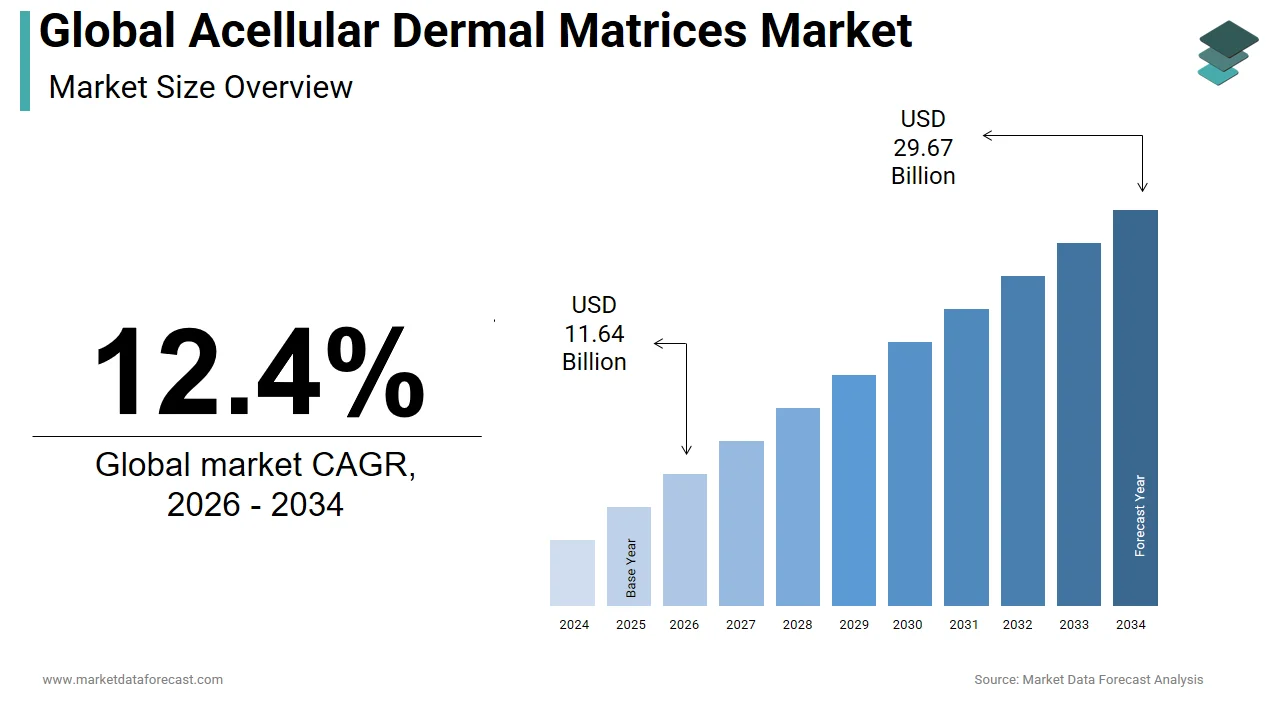
The global acellular dermal matrices market was valued at USD 10.36 billion in 2025, is estimated to reach USD 11.64 billion in 2026, and is projected to reach USD 29.67 billion by 2034, growing at a CAGR of 12.40% from 2026 to 2034.
MARKET DRIVERS
The rising cases of regenerative surgeries and bone graft treatments are the primary factors for the growth of the global acellular dermal matrices market. Also, the exponential growth in the elderly population worldwide that requires tissue repair and regeneration is another factor driving the global market growth. In addition, the spike in procedures like plastic surgery, root coverage, soft tissue correction, and others are also driving the demand in this market. The surge in the cases of severe wounds like diabetic ulcers is another factor supporting the use of these matrices in the treatments. People's increasing purchasing power, coupled with the rising awareness about tissue reformation, is boosting the acellular dermal matrices market.
The supportive government regulations for the approval of these matrices in medical applications and the flourishing expenses in the healthcare sector by companies further promote the adoption of these methods and propel the market growth worldwide. Besides, the recent developments in tissue engineering and regenerative medicine, along with the constant efforts to improve safety and efficiency, are further supporting the acellular dermal matrices market. With the increasing globalization, the healthcare sector provides more opportunities for patients to access world-class treatment. Further, the trend of customized medicines and treatments according to the choice of people is impacting the market positively for acellular dermal matrices. Moreover, the continuous developments in the healthcare infrastructure, such as artificial intelligence and collaboration robotics, along with collaborations among service providers and research centers, are touted to create lucrative opportunities for the global acellular dermal matrices market.
MARKET RESTRAINTS
The major constraint to the acellular dermal matrices market is the high set-up costs for the development of these matrices and the following expenses for the patients. Although the governments are supporting the development of acellular dermal matrices in tissue reformation applications, the stringent norms associated with the safety and complexities involved are acting as a challenge for quick movement in this business. In addition, the lack of proper standardization and reimbursement options related to these treatments is limiting a certain portion of the patient population to search for other affordable procedures. Although awareness about these procedures is gaining prominence, there is still a huge gap in terms of understanding the benefits and encouraging people to follow strict religious practices, which is a concerning aspect for the acellular dermal matrices market. Besides, the issues related to complexities involved in the surgical procedures, the absence of skilled practitioners in most parts of the world, delayed development of new products due to economic uncertainties and conditions of market saturation can pose a serious threat to the acellular dermal matrices business in the coming years.
REPORT COVERAGE
| REPORT METRIC | DETAILS |
| Market Size Available | 2025 to 2034 |
| Base Year | 2025 |
| Forecast Period | 2026 to 2034 |
| Segments Covered | By Source, Application, End Use and Region |
| Various Analyses Covered | Global, Regional and country Level Analysis, Segment-Level Analysis, Drivers, Restraints, Opportunities, Challenges; PESTLE Analysis; Porter’s Five Forces Analysis, Competitive Landscape, Analyst Overview of Investment Opportunities |
| Regions Covered | North America, Europe, Asia Pacific, Latin America, the Middle East, and Africa |
SEGMENT ANALYSIS
By Source Insights
The porcine dermis is predicted to witness the highest growth in the global acellular dermal matrices market due to the increased debates about replacing the human extracted tissues or the human dermis in several procedures. Derived from pigs, porcine collagen is often considered as an alternative to the human dermis due to the morphological similarity. Porcine dermis finds huge application in treatments like diabetic ulcers, pressure ulcers, second-degree fire burns, Moh’s surgical wounds and venous ulcers.

By Application Insights
The reconstruction procedures accounted for a significant share in the world market for acellular dermal matrices due to the spike in demand for these treatments among elderly demographics. For instance, breast reconstruction surgery is more prevalent among patients who undergo mastectomy. In addition, the increasing number of fire accidents and burn victims worldwide is supposed to improve the market for acute wounds in the same period.
By End-Use Insights
The blooming healthcare infrastructure and the adoption of advanced technologies in the treatments of various ailments are supporting the business in the hospitals and clinics segment, which is also anticipated to propel in the foreseen period.
REGIONAL ANALYSIS
North America registered the lion’s share in the global acellular dermal matrices market. The USA and Canada are the leading areas in the North American region. With the presence of some of the market giants, North America offers huge innovation opportunities for the growth of the acellular dermal matrices. The advanced medical sector, approval of new applications and increase in the number of patients with tissue deformities are fuelling the business growth in this area. The USA accounts for the dominant share in North America due to the increasing investments by companies in research and development activities. In addition, the number of reconstruction surgeries is rapidly expanding in this region, supporting the market demand.

The Asia Pacific is predicted to grow at a considerable rate in this market over the forecast period due to the increasing population with soft tissue defects and chronic wounds like diabetes ulcers. The continuous developments in the healthcare industry and investments in innovative technologies are supposed to fuel this local market. In addition, the rising awareness about the acellular dermal matrices in reconstruction treatments is encouraging more patients to turn towards them. Moreover, the spike in lifestyle-related diseases among all demographics is further estimated to drive the growth in the APAC market indirectly.
Europe is also a significant market for acellular dermal matrices because of the availability of state-of-the-art medical facilities and specialized treatment options. The growing adaptation of acellular dermal matrices in advanced wound care solutions and favorable insurance policies in countries like the United Kingdom, Germany, etc., is boosting the European market growth.
Latin America has a relatively smaller presence in the global acellular dermal matrices market compared to the above-mentioned regions. However, the spike in demand for advanced treatments, established regulations, and growing investments in research activities will create a huge opportunity for the Latin American market in the future.
The Middle East and Africa region have also been smaller players in the acellular dermal matrices market. Recently, some of the nations like South Africa, Saudi Arabia and the United Arab Emirates started focusing on improving the conventional healthcare infrastructure, thereby improving the research in advanced medical practices, which can be a boon to the business for acellular dermal matrices in these nations.
KEY MARKET PLAYERS
Johnson & Johnson, AbbVie Inc., Dickinson and Company, Integra LifeSciences Corporation, Smith & Nephew Plc., Tissue Regenix, Zimmer Biomet Holdings, Inc., Stryker Corporation, Baxter International Inc., Harbor MedTech, Inc., MLM Biologics Inc., EnColl Corporation, 3M, CG Bio Inc., BioHorizons, Inc., Reprise Biomedical, HansBioMed, Becton, Cook Group, LifeNet Health, Organogeneis Holdings Inc., PolyNovo Limited, In2Bones Global, Geistlich Pharma AG and Olaregen Therapeutix, Inc.
RECENT MARKET DEVELOPMENTS
- In May 2023, a leading non-profit allograft provider in the USA, AlloSource, introduced its AlloMend Duo acellular dermal matrices. AlloMend offers great assistance to surgeons in treating soft tissue reconstruction in a natural healing process.
- In May 2023, Sientra, Inc., a notable aesthetics company in the USA, confirmed that its product Portfinder was approved by the Food Drug and Administration (FDA). Portfinder enhances the tissue expander filling sessions for the patients, offering a precise port location for the practitioners.
- In October 2023, MTF Biologics obtained positive approval from the FDA to implement the usage of its FlexHD Pliable device, acellular dermal matrices derived from human skin, in the procedure of breast reconstruction.
MARKET SEGMENTATION
This research report on the global acellular dermal matrices market has been segmented and sub-segmented into the source, application, end use and region.
By Source
- Human Dermis
- Porcine Dermis
- Bovine Dermis
- Others
By Application
- Reconstruction Procedures
- Chronic Wounds
- Acute Wounds
- Orthopaedics
- Dental
- Others
By End-Use
- Hospitals and Clinics
- Ambulatory Surgical Centres
- In-office Settings
By Region
- North America
- Europe
- Asia Pacific
- Latin America
- The Middle East and Africa