- Product Description Description
- Table of Contents TOC
- List of Table & Figure LOT
- Get Free Sample PDF Sample PDF
Market Size, 2025
$36.51 BnMarket Estimate, 2026
$38.67 BnMarket Forecast, 2034
$61.21 BnCAGR, 2026–2034
5.91%Global AdBlue Market Size
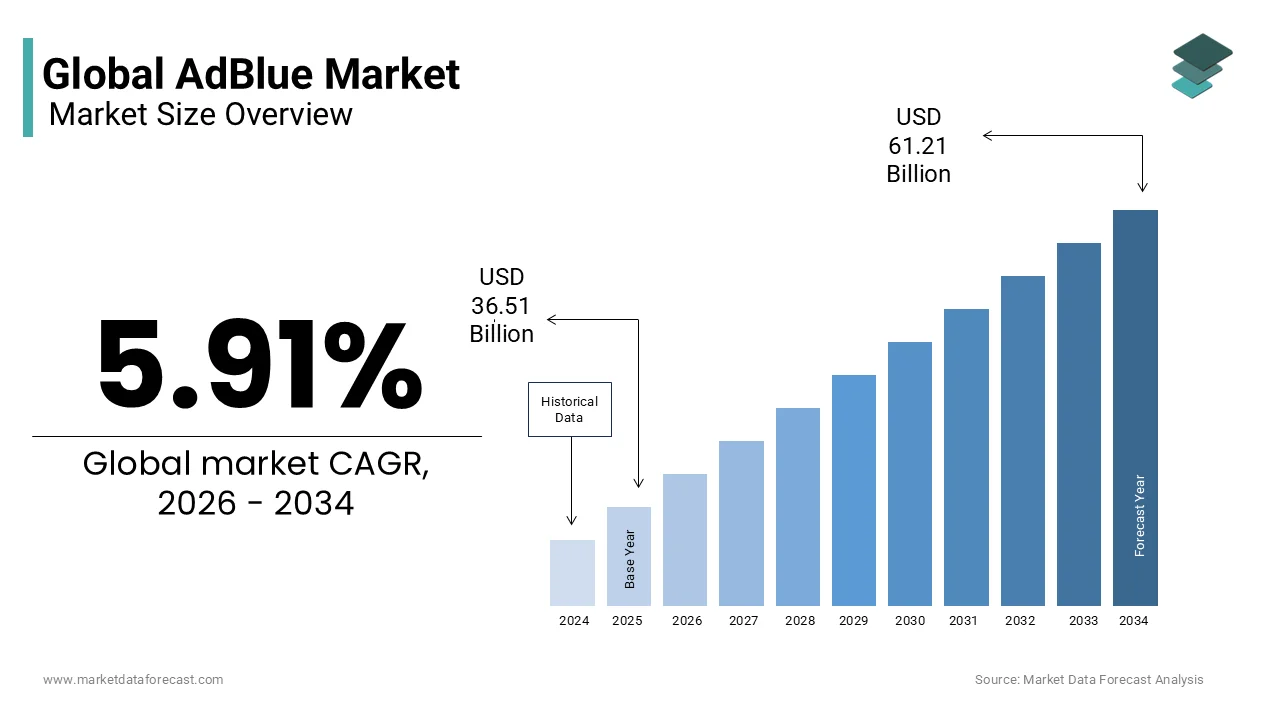
The global adblue market size was valued at USD 36.51 billion in 2025, and is expected to be worth USD 61.21 billion by 2034 from USD 38.67 billion by 2026. The market is growing at a CAGR of 5.91% during the forecast period.
AdBlue is an aqueous urea solution used in Selective Catalytic Reduction (SCR) systems to reduce nitrogen oxide (NOx) emissions from diesel engines. It plays a pivotal role in helping automotive and industrial sectors comply with stringent environmental regulations targeting air pollution. According to the World Health Organization, air pollution is responsible for approximately 4.2 million premature deaths globally each year with the urgent demand for cleaner technologies. The International Energy Agency stated that road transport accounts for nearly 40% of global NOx emissions, making emission-control solutions like AdBlue indispensable.
MARKET DRIVERS
Stringent Environmental Regulations and Compliance
The enforcement of tougher emission standards is a primary factor propelling the growth of AdBlue market. As per the European Union’s Euro VI standards mandate a drastic reduction of NOx emissions in heavy-duty vehicles by nearly 80% compared to Euro V levels, which is forcing vehicle manufacturers and fleet operators to adopt SCR systems. Similarly, India implemented Bharat Stage VI standards in 2020, which limit NOx emissions from diesel engines to 80 mg/km for passenger vehicles, pushing the widespread use of AdBlue.
Expanding Diesel Vehicle Fleet in Emerging Economies
The Emerging countries are witnessing an increasing reliance on diesel-powered commercial vehicles for logistics and freight transport, which is additionally to propel the growth of Adblue market. According to the International Road Transport Union, road freight accounts for over 85% of inland transport in Asia, particularly in countries like China and India. For instance, India’s Ministry of Road Transport reported that the number of registered goods vehicles crossed 10 million in 2021, reflecting the rising scale of diesel-powered mobility.
MARKET RESTRAINTS
High Production and Logistics Costs of Urea-based Solutions
AdBlue is composed of high-purity urea by making its production sensitive to volatility in urea prices. According to the Food and Agriculture Organization, global urea prices surged by over 70% in 2022 due to supply chain disruptions and increased natural gas costs, the key feedstock for urea production. These fluctuations directly increase the cost of producing AdBlue, which places pressure on both manufacturers and fleet operators. Furthermore, AdBlue requires specialized handling and distribution systems due to its sensitivity to contamination and freezing below -11°C, adding to logistical expenses. In emerging countries, insufficient distribution infrastructure and storage capabilities exacerbate these costs are restraining the growth of Adblue market.
Shift Towards Electric Vehicles (EVs)
The rapid adoption of electric mobility is also hindering the growth of Adblue market. According to the International Energy Agency, global EV sales surpassed 14 million units in 2023, accounting for nearly 18% of total car sales, up from just 4% in 2020. Governments are incentivizing EV adoption through subsidies and infrastructure expansion, aiming to phase out internal combustion engines. The European Union has announced plans to ban the sale of new fossil-fuel-powered cars by 2035, while China aims for 40% of new vehicle sales to be electric by 2030.
MARKET OPPORTUNITIES
Rising Adoption in Off-road and Industrial Applications
The expansion of the off-road machinery, agricultural equipment, and power generation is elevating the growth of Adblue market. The United States Environmental Protection Agency has mandated Tier 4 Final standards for non-road diesel engines, requiring up to a 90% reduction in NOx emissions. Similarly, China has implemented Stage IV standards for construction machinery, creating demand for SCR systems in mining and agricultural vehicles. As per Food and Agriculture Organization, the Asia Pacific region accounts for over 60% of global tractor sales with the potential for AdBlue use beyond conventional trucks.
Growth in Marine and Shipping Sector Compliance
The tightening environmental regulations in the maritime industry is additionally to enhance the growth of Adblue market. The International Maritime Organization (IMO) enforced the IMO Tier III standard in 2021, requiring an 80% reduction in NOx emissions for vessels operating in Emission Control Areas such as North America and Northern Europe. According to UNCTAD, over 80% of global trade volume is transported by sea, making compliance technologies like SCR essential for fleet operators. AdBlue use in marine diesel engines is expected to expand as shipping companies seek cost-effective solutions to meet emission norms.
MARKET CHALLENGES
Risk of Adulteration and Quality Issues
AdBlue must meet strict ISO 22241 quality standards, as impurities can damage SCR systems and compromise emission control efficiency. In regions with less regulatory oversight, adulteration using low-grade urea or water dilution is a major issue. According to the European Automobile Manufacturers Association, poor-quality AdBlue can increase NOx emissions by up to 40% and cause severe engine damage, leading to costly repairs for vehicle owners. This risk undermines consumer trust and slows adoption in markets where counterfeit or substandard products circulate widely. Addressing this challenge requires stricter enforcement and broader investment in certified distribution channels.
Infrastructure Gaps in Emerging Markets
Many developing regions lack the necessary refilling infrastructure for AdBlue for long-haul freight operations is certainly to hamper the growth of Adblue market. The International Energy Agency reported that infrastructure readiness remains a barrier in Asia and Africa, where access to certified AdBlue pumps is limited along highways. Fleet operators often rely on packaged containers rather than integrated dispensing systems, raising costs and complicating supply chain logistics. Additionally, inadequate cold-chain storage facilities in regions with extreme climates hinder the safe handling of AdBlue.
REPORT COVERAGE
| REPORT METRIC | DETAILS |
| Market Size Available | 2025 to 2034 |
| Base Year | 2025 |
| Forecast Period | 2026 to 2034 |
| CAGR | 5.91% |
| Segments Covered | By Usage Method, Application, and Region. |
| Various Analyses Covered | Global, Regional & Country Level Analysis, Segment-Level Analysis, DROC, PESTLE Analysis, Porter’s Five Forces Analysis, Competitive Landscape, Analyst Overview of Investment Opportunities |
| Regions Covered | North America, Europe, APAC, Latin America, Middle East & Africa |
| Market Leaders Profiled | Yara International ASA, Kingspan, Ford Motor Company Limited, TotalEnergies, OCI, Hitachi Construction Machinery (Europe) NV (Netherlands), CF Industries, Hindustan Petroleum Corporation Ltd, Shell plc, Nissan Chemical Corporation, BASF SE, Guangzhou EverBlue Technology Co., Ltd., Bharat Petroleum Corporation Limited, and Cummins Inc., and Others. |
SEGMENTAL ANALYSIS
By Usage Method Insights
The post-combustion method segment was accounted in holding a dominant share of Adblue market. This dominance stems from the effectiveness of SCR in reducing nitrogen oxides (NOx) by up to 90%, which is crucial for compliance with Euro VI, US EPA, and Bharat Stage VI regulations. The United Nations Economic Commission for Europe stated that heavy-duty diesel trucks contribute nearly 40% of road transport NOx emissions, making post-combustion solutions indispensable.
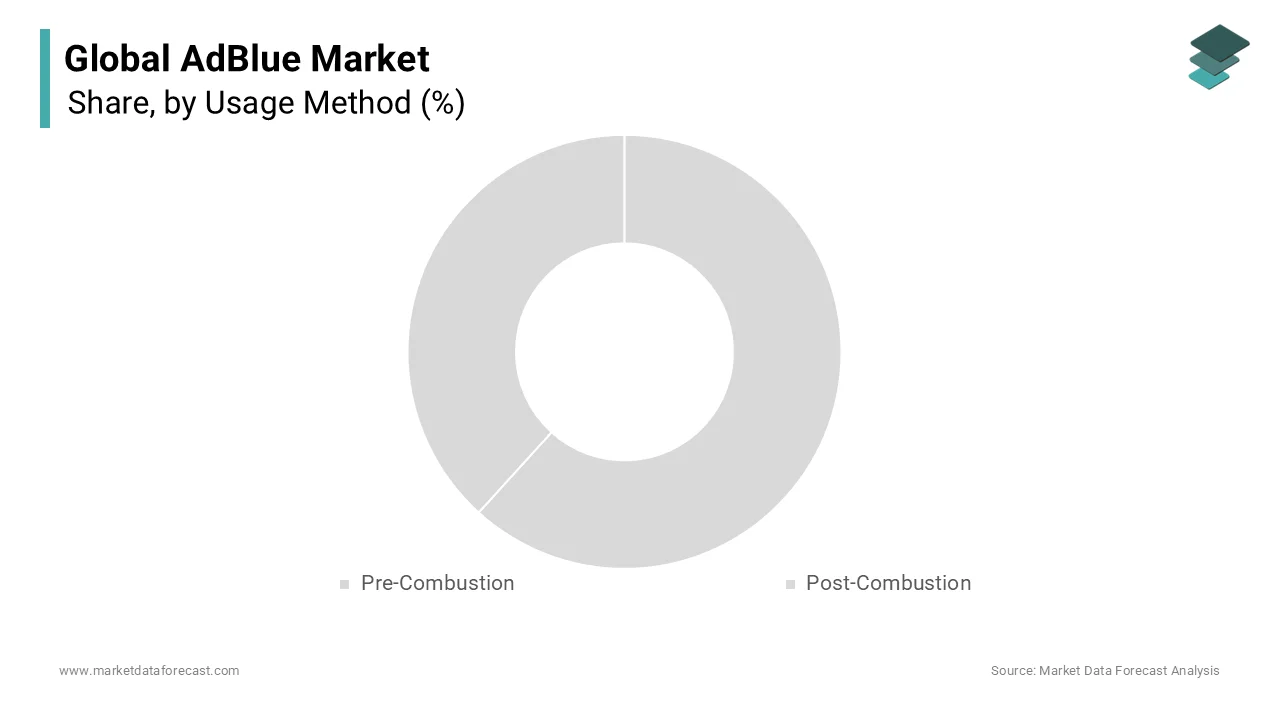
The pre-combustion methods segment is likely to grow with an expected CAGR of 6.3% during the forecast period with the increasing interest in hybrid diesel technologies and efforts to improve engine efficiency without costly retrofits. According to the US Department of Energy, improved fuel conditioning technologies can reduce particulate matter emissions by 30% while lowering fuel consumption by 4–5%, which is creating a cost-saving incentive.
By Application Insights
The commercial vehicles segment was the largest and held significant share of the AdBlue market in 2025 with the fact that medium- and heavy-duty trucks consume significantly higher volumes of diesel per kilometer compared to passenger cars. According to the International Energy Agency, global freight demand is expected to increase by 50% by 2050 due to rising e-commerce and logistics expansion.
The passenger cars segment is expected to grow with an expected CAGR of 7.2% during the forecast period. This surge is closely linked to the enforcement of strict Euro VI norms in Europe and China VI regulations in Asia, both of which mandate NOx reductions in diesel passenger cars. The European Commission found that diesel passenger vehicles accounted for nearly 45% of the car fleet in Europe in 2022.
REGIONAL ANALYSIS
Europe Market Analysis
Europe was the top performer of the global AdBlue market by holding 32.1% of share in 2025. According to the European Environment Agency, road transport contributes nearly 39% of total NOx emissions in the region, necessitating advanced solutions like AdBlue. Germany, France, and the UK are particularly strong contributors due to their large logistics and passenger car industries. The EU’s commitment to reducing greenhouse gases by 55% by 2030 further sustains AdBlue consumption as fleets continue upgrading to meet Euro VI standards.
Asia Pacific Market Analysis
Asia Pacific AI in medical imaging market was positioned second by holding 21.2% of share in 2025 with China and India being pivotal growth drivers. The China VI legislation, introduced in 2021, has accelerated SCR adoption across heavy-duty trucks, while India’s Bharat Stage VI norms have driven similar trends since 2020. According to the International Energy Agency, Asia accounts for more than 50% of global freight transport activity by ensuring steady demand for AdBlue.
North America Market Analysis
North America AdBlue market growth is anticipated to grow eventually in the next coming years. The Environmental Protection Agency’s emission standards for heavy-duty trucks, which will tighten further in 2027, ensure consistent market expansion. The US Energy Information Administration reported that trucking moves over 72% of the nation’s freight by weight, reflecting the sector’s massive diesel dependence. AdBlue usage in North America is also supported by robust infrastructure, with widespread DEF availability across truck stops and fueling stations.
Latin America Market Analysis
Latin America AdBlue market is likely to grow with Brazil and Mexico leading adoption. Regulatory tightening has accelerated since Brazil adopted Proconve P8 standards in 2023, harmonized with Euro VI, requiring SCR systems in new diesel vehicles.
Middle East & Africa Market Analysis
The Middle East & Africa market growth is likely to have a steady growth in the next coming years. According to the International Transport Forum, commercial vehicle ownership in Africa is growing at nearly 5% annually due to rising urbanization and trade flows. Meanwhile, the Gulf Cooperation Council’s efforts to improve air quality standards have introduced SCR-equipped heavy trucks into the regional market.
COMPETITIVE LANDSCAPE
KEY MARKET PLAYERS
- Yara International ASA
- Kingspan
- Ford Motor Company Limited
- TotalEnergies
- OCI
- Hitachi Construction Machinery (Europe) NV. (Netherlands)
- CF Industries
- Hindustan Petroleum Corporation Ltd
- Shell plc
- Nissan Chemical Corporation
- BASF SE
- Guangzhou EverBlue Technology Co., Ltd.
- Bharat Petroleum Corporation Limited
- Cummins Inc.
TOP STRATEGIES USED BY KEY MARKET PLAYERS
Key players in the AdBlue market are adopting three prominent strategies to strengthen their positions. First, they are expanding regional production and distribution networks, ensuring supply reliability in high-growth markets such as India and China, where infrastructure challenges remain. Second, companies are emphasizing strategic collaborations and joint ventures with logistics providers, fuel retailers, and OEMs to secure long-term contracts. Third, major producers are investing in R&D for product innovation, particularly focusing on improving AdBlue shelf life in hot climates and enhancing purity standards to prevent SCR system damage.
COMPETITION OVERVIEW
The AdBlue market is characterized by intense competition as global chemical manufacturers, filtration specialists, and regional suppliers vie for dominance in compliance-driven demand sectors. Yara, BASF, and Cummins lead in Asia Pacific, supported by their strong infrastructure and technology-driven solutions, while regional distributors add localized flexibility. Regulatory enforcement, such as Euro VI, China VI, and Bharat Stage VI standards, has amplified the need for reliable AdBlue supply, intensifying competition. Players are differentiating themselves through pricing strategies, distribution efficiency, and product quality assurance. Furthermore, sustainability commitments and alignment with government emission targets add another dimension to competition.
TOP PLAYERS IN THE MARKET
- Yara International has established itself as a leading AdBlue supplier in Asia Pacific through its extensive DEF production and distribution network. The company has invested in regional supply hubs in China and Australia to meet the surging demand driven by stricter emission standards. In 2023, Yara strengthened its presence by expanding its partnership with logistics operators in India to enhance bulk DEF supply. The company also emphasizes sustainability, aligning with government initiatives to reduce nitrogen oxide emissions from diesel fleets. Its integrated supply chain model ensures reliability for both commercial fleets and passenger vehicles in high-demand Asian markets.
- BASF has played a vital role in the Asia Pacific AdBlue sector by leveraging its expertise in chemical solutions to provide high-quality urea-based DEF. In 2022, the company expanded its production footprint in China to support the adoption of China VI standards in heavy-duty vehicles. BASF’s focus lies in product innovation, with ongoing research to enhance purity levels and prolong storage stability in high-temperature regions. Its collaborative efforts with regional distributors allow it to serve both industrial transport operators and retail fueling networks efficiently. The company’s push for local manufacturing has reduced reliance on imports and increased responsiveness to demand surges.
- Cummins Filtration has reinforced its AdBlue offerings in Asia Pacific by aligning them with its broader engine and emissions control systems. In 2023, Cummins launched initiatives to expand its DEF availability in Southeast Asia, targeting heavy-duty truck operators transitioning to Bharat Stage VI and equivalent norms. Its AdBlue solutions are marketed under the Fleetguard brand, ensuring compatibility with a wide range of SCR systems. Cummins has also invested in digital platforms for fleet management, integrating AdBlue usage monitoring to improve efficiency. This dual approach of product supply and digital support strengthens its customer base across India, China, and ASEAN markets.
MARKET SEGMENTATION
This research report on the global AdBlue market is segmented and sub-segmented into the following categories.
By Usage Method
- Pre-Combustion
- Post-Combustion
By Application
- Commercial Vehicles
- Passenger Cars
- Railway Trains
- Others
By Region
- North America
- Europe
- Asia Pacific
- Latin America
- Middle East & Africa