- Product Description Description
- Table of Contents TOC
- List of Table & Figure LOT
- Get Free Sample PDF Sample PDF
Market Size, 2025
$78.03 BnMarket Estimate, 2026
$82.83 BnMarket Forecast, 2034
$133.52 BnCAGR, 2026–2034
6.15%Global Adhesives & Sealants Market Size
The global adhesives & sealants market size was valued at USD 78.03 billion in 2025 and is expected to reach USD 133.52 billion by 2034 from USD 82.83 billion in 2026. The market is projected to grow at a CAGR of 6.15%.
The adhesives and sealants are a diverse array of chemical formulations engineered to bond, seal, and protect materials across industrial, commercial, and consumer applications. Unlike mechanical fasteners, these substances provide continuous stress distribution, enhance structural integrity, and offer resistance to environmental factors such as moisture, temperature fluctuations, and vibration. As per the International Maritime Organization, it requires marine-grade sealants in all commercial vessels to ensure watertight integrity, with over 60,000 ships globally complying with these standards. These regulatory and operational imperatives enhance the crucial role adhesives and sealants play in safety, efficiency, and durability across built environments and engineered systems.
MARKET DRIVERS
Green Building Surge Drives Adhesives & Sealants Demand
The global surge in sustainable construction and green building certifications is significantly driving the growth of Adhesives and Sealants Market. The integration of high-performance sealants in insulation systems, window glazing, and façade joints significantly improves energy efficiency by minimizing air leakage and thermal bridging. As per the European Commission reports that over 14,000 new buildings in the EU received energy performance certifications in 2023, with nearly 70% incorporating advanced polyurethane or silicone sealants for passive house compliance. For Instance, in North America, the U.S. Department of Energy states that air sealing alone can reduce heating and cooling energy use by 15–30%, which is prompting widespread adoption in residential and commercial retrofits. This shift toward energy-conscious design is transforming sealants from auxiliary materials into essential components of climate-responsive architecture.
EV Adoption Accelerates Adhesives & Sealants Innovation
The proliferation of electric vehicles (EVs), which rely extensively on specialized adhesives and sealants for battery assembly, thermal management, and noise reduction is boosting the Adhesives and Sealants Markt growth. The EV battery packs require thermally conductive adhesives to dissipate heat and structural sealants to maintain enclosure integrity under vibration and thermal cycling. As per the International Energy Agency, over 14 million electric cars were sold globally in 2023, a 35% increase from the previous year, is driving unprecedented demand for bonding solutions. According to the Fraunhofer Institute for Chemical Technology confirms that each EV battery module uses approximately 3.2 kilograms of adhesives and sealants, which is nearly double the amount used in internal combustion engine vehicles. As per the Society of Automotive Engineers, escalates that over 80% of EV manufacturers now use structural sealants in motor housings to dampen electromagnetic noise. This technological shift is not only increasing volume consumption but also accelerating innovation in electrically insulating and flame-retardant formulations.
MARKET RESTRAINTS
Health Risks from Isocyanate-Based Formulations Rise
The persistent reliance on isocyanate-based chemistries, particularly in polyurethane systems, which pose significant health and handling risks leading to restricted growth of Adhesives and Sealants Market. The exposure to diisocyanates, a key component in many high-performance sealants, can trigger respiratory sensitization and occupational asthma. As per the European Chemicals Agency, the estimated number of new diisocyanate-related occupational asthma cases in the EU per year is much lower, ranging from 2,350 to 7,269. In response, the agency implemented mandatory training for professional users in 2023, by affecting over thousands of workers across construction and automotive sectors. As per the U.S. Occupational Safety and Health Administration has also intensified enforcement by issuing over 300 citations in 2023 for inadequate isocyanate exposure controls. These regulatory actions increase operational complexity and training costs for applicators is discouraging adoption in small-scale or informal construction settings. The resulting compliance burden slows market penetration, particularly in developing economies where safety infrastructure remains underdeveloped.
Raw Material Supply Chain Instability Limits Growth
Supply chain fragility for critical raw materials such as siloxanes, epichlorohydrin, and methylene diphenyl diisocyanate (MDI) presents another prominent restraint for Adhesives and Sealants Market growth. These chemicals are concentrated in a few global production hubs is making the market vulnerable to geopolitical disruptions and logistical outputs. As per the International Trade Administration, China accounts for over 60% of global siloxane production, which is a base ingredient for silicone sealants, while Middle Eastern and European facilities dominate MDI supply. According to the American Chemistry Council, in 2021 Texas petrochemical freeze, halted 80% of U.S. isocyanate production for six weeks, is causing widespread delays in construction and appliance manufacturing. The vulnerabilities force manufacturers to maintain higher inventory levels and invest in alternative sourcing, increasing costs and complicating long-term planning in a capital-intensive industry.
MARKET OPPORTUNITIES
Self-Healing Sealants Unlock Infrastructure Potential
The development of self-healing and stimuli-responsive sealants, particularly for infrastructure and aerospace applications is creating growth opportunities for Adhesives and Sealants Market. These advanced materials can autonomously repair micro-cracks caused by thermal cycling, mechanical stress, or environmental degradation, which is significantly extending service life. In civil engineering, the UK’s Infrastructure and Projects Authority reports that 35% of bridge maintenance costs are attributed to joint and seal deterioration is creating a compelling case for durable alternatives. Researchers at the University of Cambridge have developed micro-encapsulated sealants that activate upon crack formation, with field trials showing a 70% reduction in water ingress in concrete structures. The integration of such technologies in high-value sectors not only reduces lifecycle costs but also enables predictive maintenance models is positioning smart sealants as a fundamental of next-generation resilient infrastructure.
Digital Dispensing Systems Revolutionize Applications
The adoption of digital dispensing and monitoring systems in adhesive and sealant application processes is emerging opportunities in the growth of Adhesives and Sealants Market. These technologies enhance precision, reduce waste, and ensure consistent bond quality in automated manufacturing environments. According to the Association for Advancing Automation, more than half of automotive assembly lines in Germany now use robotic dispensing systems with real-time viscosity and flow control. As per the International Electrotechnical Commission, digital adhesive monitoring has reduced defect rates by up to 40% in solar panel lamination processes. In construction, the Building Research Establishment states that smart sealant applicators equipped with IoT sensors have improved sealing accuracy in prefabricated façade installations. Companies like Henkel and Sika are integrating these systems with cloud-based analytics platforms to provide predictive maintenance and quality assurance. This convergence of materials science and digitalization is redefining performance standards by enabling real-time traceability and compliance in safety-critical applications across industries.
MARKET CHALLENGES
Durability Issues Under Stress Challenge Market Growth
The difficulty in achieving long-term durability in dynamic environments, particularly under cyclic mechanical stress and extreme weather conditions is posing significant challenges in expansion of Adhesives and Sealants Market. Sealants used in façade joints, bridge expansion joints, and railcar assemblies are subjected to continuous movement, UV exposure, and temperature extremes is leading to premature failure. As per the German Institute for Building Technology, half of the façade sealant failures in high-rise buildings occur within the first ten years of service due to inadequate movement accommodation. According to the Transportation Research Board states that 30% of rail infrastructure maintenance in North America is linked to degraded joint sealants is resulting in water ingress and corrosion. The performance limitations necessitate frequent reapplication is increasing lifecycle costs and reducing confidence in adhesive-based solutions despite their initial advantages.
Recycling Difficulties Hinder Circular Economy Goals
Recycling and end-of-life management of bonded assemblies, particularly in composite materials and multi-material products is creating challenges for Adhesives and Sealants Market growth. Traditional adhesives create permanent bonds that complicate disassembly and material recovery is undermining circular economy goals. In 2023, approximately 22.4% of municipal waste was landfilled across the EU, and the total amount of waste going to landfills has been decreasing. Researchers at the Karlsruhe Institute of Technology have identified that de-bonding processes for structural adhesives require energy inputs up to five times higher than mechanical disassembly. These limitations are prompting industry-wide efforts to develop reversible or heat-triggered debonding adhesives, but commercial scalability remains limited is posing a significant barrier to sustainable material flows.
REPORT COVERAGE
| REPORT METRIC | DETAILS |
| Market Size Available | 2025 to 2034 |
| Base Year | 2025 |
| Forecast Period | 2026 to 2034 |
| CAGR | 6.15% |
| Segments Covered | By Adhesive Technology, Sealant Resin, Application, and Region. |
| Various Analyses Covered | Global, Regional & Country Level Analysis, Segment-Level Analysis, DROC, PESTLE Analysis, Porter’s Five Forces Analysis, Competitive Landscape, Analyst Overview of Investment Opportunities |
| Regions Covered | North America, Europe, APAC, Latin America, Middle East & Africa |
| Market Leaders Profiled | Sika, Henkel, Illinois Tool Works, Arkema, 3M, Huntsman, and H.B. Fuller, and Others. |
SEGMENTAL ANALYSIS
By Adhesive Technology Insights
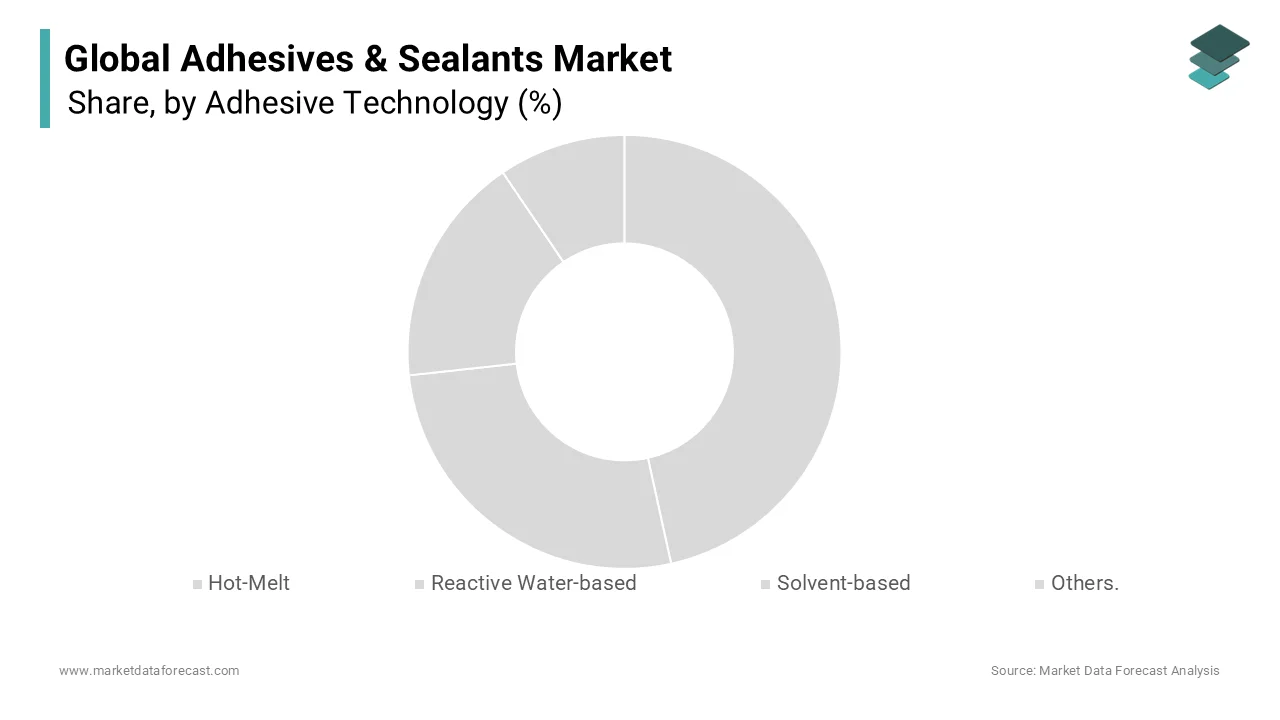
The water-based adhesive technology segment dominated the global Adhesives and Sealants Market with largest share of 37.2% in 2025. The stringent environmental regulations limiting volatile organic compound (VOC) emissions across industrial applications is majorly driving the segment growth rate. Water-based adhesives utilize water as a dispersion medium, by significantly reducing hazardous air pollutants compared to solvent-based systems. According to the European Environment Agency, in the European Union, more than half of industrial adhesive use now complies with VOC limits under the Solvents Emissions Directive. As per the American Coatings Association, that water-based formulations represent more than 90% of adhesive usage in paper and board lamination, which is driven by their non-flammability, ease of cleanup, and compatibility with high-speed converting lines.
The reactive adhesives segment is predicted to expand at a CAGR of 8.9% from 2026 to 2034 in Adhesives and Sealants Market. This rapid growth stems from their ability to form strong, durable, and often structural bonds through chemical curing mechanisms such as moisture, heat, or UV initiation. Reactive adhesives, including epoxies, polyurethanes, and cyanoacrylates, are increasingly significant in high-performance sectors like automotive, aerospace, and renewable energy. As per the Society of Automotive Engineers reports that over 60% of modern vehicle body-in-white assemblies now incorporate reactive structural adhesives to enhance crashworthiness and reduce weight. For Instance, The Global Wind Energy Council confirmed that a record 117 GW of new wind capacity was installed globally in 2023. This represented a 50% year-on-year increase from 2022. Furthermore, NASA’s Materials and Processes Division states that reactive sealants are essential in spacecraft encapsulation due to their outgassing resistance and thermal stability, which is reinforcing their role in mission-critical applications.
By Application Insights
The building and construction segment is the largest end-user segment in Adhesives and Sealants Market by accounting for 35.6% of share in 2025. The growth is anchored in the sector’s extensive use of bonding and sealing materials for flooring, tiling, façade systems, and insulation assemblies. The shift from mechanical fasteners to adhesive-based solutions enhances structural continuity, reduces thermal bridging, and improves aesthetic outcomes. According to the International Labour Organization, global construction output reached $15.46 trillion in 2023, with residential and commercial construction growing at 5.3% year-on-year. For Instance, the World Green Building Council states that over 40% of new commercial buildings in North America and Europe now require continuous air sealing, which is increasing sealant usage by up to 30% per square meter. In Asia, the ASEAN Secretariat states that modular construction is relying heavily on structural adhesives for panel joining, which accounts for 26% of all new high-rise developments in Singapore and Malaysia. These trends reflect a systemic transformation in construction methodologies, where adhesives are no longer auxiliary but integral to energy efficiency and structural performance.
The automotive and transportation segment is anticipated to grow at a CAGR of 9.2% from 2026 to 2034 in Adhesives and Sealants Market. The transition to lightweight, electric, and autonomous vehicles, where adhesives replace traditional welding and riveting to reduce mass and improve safety is boosting the growth of segment revenue. As per the International Energy Agency report, that global electric vehicle sales surpassed 14 million units in 2023, each requiring 15–20 kg of adhesives and sealants, which is 30% more than internal combustion engine vehicles. According to the Fraunhofer Institute for Manufacturing Technology, that battery enclosures in EVs demand thermally conductive, flame-retardant adhesives to manage heat and prevent thermal runaway. For Instance, the International Union of Railways states that most of high-speed trains now use structural adhesives in carbody construction to dampen vibration and reduce noise.
By Sealant Resin Insights
Silicone sealants segment led the global Adhesives and Sealants Market by holding 42.5% of share in 2025. Their supremacy is attributed to exceptional performance in extreme environments, including resistance to UV radiation, temperature fluctuations, and moisture. These properties make silicone sealants indispensable in construction, automotive, and electronics applications requiring long-term durability. In the renewable energy sector, the International Renewable Energy Agency states that 100% of photovoltaic modules installed in 2023 utilized silicone-based edge seals to prevent moisture ingress and delamination. As per the U.S. Department of Energy and the National Institute of Standards and Technology (NIST) confirm that air leakage in commercial buildings results in significant energy consumption.
Polyurethane sealants segment is estimated to grow at a CAGR of 8.6% from 2026 to 2034 in Adhesives and Sealants Market. This growth is driven by rising demand in construction and automotive applications requiring flexible, durable, and structurally supportive joints. Polyurethane sealants offer superior elongation, adhesion to diverse substrates, and resistance to dynamic movement, by making them ideal for expansion joints in bridges, highways, and prefabricated buildings. According to the European Road Federation report, few of the new bridge constructions in Europe use polyurethane sealants in deck joints to withstand heavy traffic loads and thermal cycling. As per the UK’s Building Research Establishment, polyurethane sealants reduce water ingress by up to 50% in modular façade systems compared to traditional alternatives by enhancing building longevity and reducing maintenance costs.
REGIONAL ANALYSIS
Asia Pacific Market Analysis
Asia Pacific leads the global Adhesives and Sealants Market by accounting for 44.7% of share in 2025. As the world’s manufacturing and construction hub, the region’s demand is propelled by rapid urbanization, infrastructure expansion, and industrialization. China alone consumes over half of the region’s adhesives, which is driven by its dominance in electronics, automotive, and green building sectors. As per the National Bureau of Statistics of China indicates that fixed asset investment in infrastructure reached $9.8 trillion in 2023, which is fueling demand for structural sealants and bonding agents. For Instance, India’s Smart Cities Mission has initiated over thousands of projects requiring advanced sealing solution. Meanwhile, Southeast Asia’s packaging industry, particularly in Vietnam and Indonesia, is growing at 7.4% annually, is increasing reliance on water-based and hot-melt adhesives.
Europe Market Analysis
Europe Market remains as a leader in sustainable and high-performance adhesive technologies. Germany, France, and Italy form the core of industrial demand, particularly in automotive, aerospace, and premium packaging. As per the German Engineering Federation reports that over 80% of industrial robots in German manufacturing lines use precision adhesives for component assembly. For Instance, the European Commission’s Green Deal has accelerated the adoption of bio-based and low-VOC formulations, with over 30% of new adhesive products launched in 2023 classified as eco-labeled. As per the UK’s Infrastructure and Projects Authority states that 70% of new rail projects now specify reactive sealants for joint durability. Stringent REACH regulations and carbon neutrality targets are reshaping product development by positioning Europe as a pioneer in environmentally compliant and technically advanced adhesive solutions.
North America Market Analysis
North America Market is significantly growing with the United States serving as the primary driver of demand. The region’s strength lies in high-value applications in aerospace, healthcare, and energy. As per the Boeing and Lockheed Martin use over 1,800 tons of structural adhesives annually in aircraft production. According to the U.S. Department of Energy confirms that over 32,400 MW of new solar capacity installed in 2023 relied on silicone sealants for panel encapsulation. Moreover, the FDA has approved over 100 new medical adhesive devices since 2022, which is reflecting growing use in wound care and diagnostics. For Instance, the Infrastructure Investment and Jobs Act has allocated $1.2 trillion for transportation and water systems, which is directly boosting demand for durable sealants in bridges and pipelines.
Latin America Market Analysis
Latin America Market is expanding rapidly, with Brazil emerging as the regional leader due to its diversified industrial base. According to Abiquim reported extremely poor performance for the overall Brazilian chemical sector in 2023, with production at a 17-year low in July. The association highlighted a significant trade deficit and strong competition from imports in 2023, which resulted in low domestic production and utilization rates for the chemical industry. The country’s footwear sector, producing over 850 million pairs annually, relies heavily on polyurethane and solvent-free adhesives for sole bonding. As per the Latin American Packaging Association, Argentina and Mexico are expanding their packaging industries, with flexible packaging demand growing at 6.5% per year. However, economic volatility and import dependencies on raw materials constrain growth.
Middle East and Africa Market Analysis
The Middle East and African Market is extensively growing across the world. According to the Saudi Ministry of Transport confirms that over $35 billion is being invested in NEOM and Qiddiya infrastructure is requiring extensive use of fire-resistant and acoustic sealants. As per the Dubai Supreme Council of Energy reports that over 18,000 solar installations in 2023 used silicone adhesives for photovoltaic panel assembly. South Africa remains the industrial hub, with its automotive sector consuming over 50,000 tons of adhesives annually. However, limited local manufacturing and logistical challenges hinder broader market penetration.
COMPETITIVE LANDSCAPE
KEY MARKET PLAYERS
Some of the key players dominating the global adhesives & sealants market are
- Sika (Switzerland)
- Henkel (Germany)
- Illinois Tool Works (US)
- Arkema (France)
- 3M (US)
- Huntsman (US)
- H.B. Fuller (US)
TOP STRATEGIES USED BY THE KEY MARKET PLAYERS
Key players in the Adhesives and Sealants Market are leveraging technological innovation, regional expansion, sustainability-driven product development, strategic acquisitions, and digital integration to consolidate their competitive standing. Companies are investing heavily in R&D to formulate bio-based, low-emission, and high-performance bonding solutions aligned with global environmental regulations. Expansion of localized manufacturing and technical support centers enhances supply chain resilience and customer proximity. Mergers and acquisitions are being utilized to acquire niche technologies, particularly in reactive and smart adhesives. Firms are also integrating digital tools such as predictive dispensing systems and cloud-based performance analytics to deliver value-added services. Collaborations with end-users in automotive, construction, and electronics enable co-engineering of application-specific solutions is ensuring long-term engagement and differentiation in a technically demanding and rapidly evolving marketplace.
COMPETITION OVERVIEW
The competition in the Adhesives and Sealants Market is intensifying as global leaders and regional players for dominance through technological differentiation and strategic agility. Multinational corporations maintain an edge with advanced R&D, global supply chains, and established brand credibility, particularly in high-performance and regulated sectors. However, regional manufacturers are gaining traction by offering cost-competitive, localized solutions tailored to specific industrial needs. The battleground for innovation has shifted toward sustainability, with bio-based formulations, recyclable bonding systems, and low-VOC technologies becoming key differentiators. Digitalization of application processes and lifecycle performance monitoring is further redefining service models. Geopolitical shifts, raw material volatility, and evolving regulatory landscapes are compelling firms to strengthen local production and secure supply chains is reshaping competitive dynamics across regions and end-use industries.
TOP PLAYERS IN THE MARKET
- Henkel AG & Co. KGaA plays a pivotal role in shaping the Adhesives and Sealants Market through its Loctite and Bonderite brands, is delivering advanced bonding and sealing solutions across electronics, automotive, and construction sectors. The company has intensified its regional focus on sustainable innovation, launching low-VOC, water-based adhesives tailored for China’s packaging and furniture industries. In 2023, Henkel inaugurated a new application technology center in Shanghai, which is dedicated to developing electric vehicle battery bonding systems and smart dispensing solutions. It has also expanded production capacity in Indonesia to meet rising demand for hygiene and labeling adhesives.
- 3M Company maintains a strong footprint in the Adhesives and Sealants Market through its diverse portfolio of tapes, structural adhesives, and specialty sealants. The firm has deepened its presence in high-tech manufacturing by expanding production of acrylic and silicone-based solutions in Japan and South Korea for semiconductor and display assembly. In 2023, 3M introduced a new line of flame-retardant polyurethane sealants in India, is designed for fire-safe building joints in high-rise developments. It also partnered with leading EV manufacturers in Taiwan to co-develop thermally conductive adhesives for battery thermal management. Through its technical service hubs in Singapore and Australia, 3M provides on-site engineering support, by enhancing product integration and reliability.
- Sika AG has significantly expanded its influence in Asia Pacific by focusing on construction and infrastructure sealants, particularly in rapidly urbanizing markets. The Swiss firm has strengthened its regional capabilities through the opening of a state-of-the-art innovation center in Singapore in early 2023, is dedicated to developing next-generation silicone and polyurethane sealants for façade, rail, and renewable energy applications. Sika has also intensified collaborations with major contractors in India and Australia on large-scale infrastructure projects, including metro systems and solar farms. In 2025, it launched a bio-based sealant for green building applications in Thailand, which is aligning with regional sustainability mandates.
Global Adhesives and Sealants Market News
- In September 2025, Henkel officially launched its bio-based hot melt adhesive, Technomelt Supra 079 Eco Cool. The product combines bio-based materials with low-temperature application for energy efficiency, specifically for packaging applications.
- In May 2023, Sika completed its acquisition of the MBCC Group, following the necessary regulatory approvals. The acquisition of the Germany-based MBCC Group strengthened Sika's market position globally and expanded its offerings across construction chemicals and systems, including those for structural glazing and façade bonding.
- In July 2026, Arkema announced a $20 million investment in a new Rilsan® Clear transparent polyamide unit in Singapore. This expansion is scheduled to be operational in early 2026 and will support high-performance materials for industries like electronics and healthcare.
- In May 2026, H.B. Fuller did announce an expansion of its manufacturing capabilities in the IMEA (India, Middle East, and Africa) region.
MARKET SEGMENTATION
This research report on the global adhesives & sealants market is segmented and sub-segmented into the following categories.
By Adhesive Technology
- Hot-Melt
- Reactive Water-based
- Solvent-based
- Others.
By Sealant Resin
- Silicone
- Polyurethane
- Plastisol
- Emulsion
- Butyl
- Polysulfide
- Others
By Application
- Paper & Packaging
- Building & Construction
- Consumer
- Automotive & Transportation
- Woodworking
- Others
By Region
- North America
- Europe
- Asia Pacific
- Latin America
- The Middle East and Africa