- Product Description Description
- Table of Contents TOC
- List of Table & Figure LOT
- Get Free Sample PDF Sample PDF
Market Size, 2025
$17.24 BnMarket Estimate, 2026
$18.65 BnMarket Forecast, 2034
$34.93 BnCAGR, 2026–2034
8.16%Global Advanced Gear Shifter System Market Size, Growth, Trends & Forecast (2026–2034)
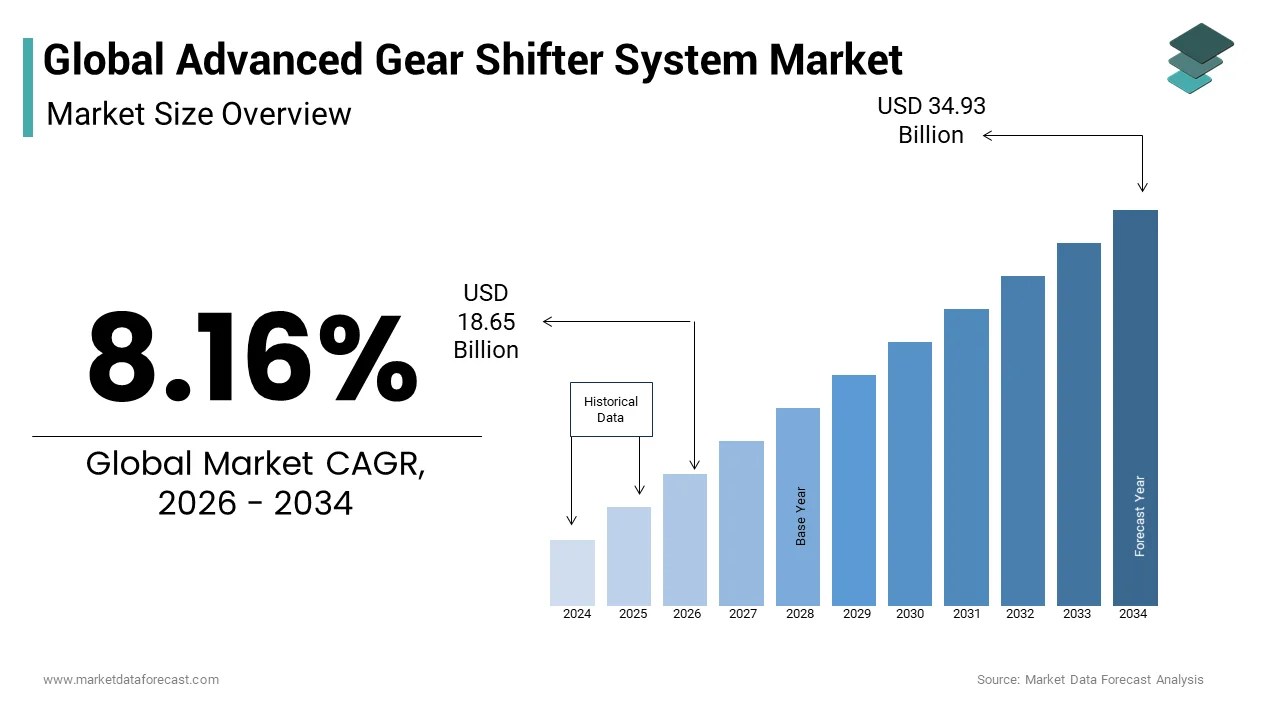
The global advanced gear shifter system market size was valued at USD 17.24 billion in 2025, is anticipated to reach USD 18.65 billion in 2026, and is projected to scale up to USD 34.93 billion by 2034, registering a compound annual growth rate (CAGR) of 8.16% during the forecast period from 2026 to 2034. Driven by a transition from conventional mechanical links to electronic shift-by-wire architectures, rising consumer demand for interior ergonomics, and the rapid expansion of electric and autonomous vehicle platforms, the global market continues to experience steady expansion.
Key Executive Metrics (At-a-Glance)
- 2025 Base Valuation: USD 17.24 Billion
- 2026 Current Valuation: USD 18.65 Billion
- 2034 Forecast Valuation: USD 34.93 Billion
- Compound Annual Growth Rate (CAGR): 8.16% (2026–2034)
- Dominant Technology Segment: Automatic Shifter (commanding a major share in conventional ICE and hybrid platforms)
- Fastest-Growing Technology Segment: Shift-by-Wire (projected at a 12.4% CAGR, driven by EV and autonomous vehicle integration)
- Dominant Component Segment: Electronic Control Unit (ECU) (acting as the central processing brain for digital safety interlocks)
- Fastest-Growing Component Segment: Solenoid Actuator (projected at an 11.8% CAGR for high-force density mechanical engagement)
- Dominant Vehicle Segment: Light Duty Vehicle (leading regional and global production volumes)
- Fastest-Growing Vehicle Segment: Commercial Vehicle (projected at a 13.2% CAGR due to fleet automation and driver shortage mitigation)
- Dominant EV Segment: Battery Electric Vehicle (BEV) (occupying a commanding market share via simplified transmission layouts)
- Fastest-Growing EV Segment: Plug-in Hybrid Electric Vehicle (PHEV) (projected at a 14.6% CAGR, blending electric and thermal powertrain coordination)
- Dominant Region: Global / Cross-Regional (backed by major automotive manufacturing hubs in North America, Europe, and APAC)
Core Market Drivers
- Enhanced Interior Ergonomics and Comfort: Consumer preference for sophisticated vehicle interiors, spatial efficiency, larger center console storage, and tactile feedback mechanisms.
- Safety Regulations and ADAS Integration: Mandatory requirements for electronic controls that integrate smoothly with advanced driver assistance systems, automatic emergency braking, and cybersecurity protocols.
Primary Market Restraints & Challenges
- Financial and Maintenance Hurdles: High development, calibration, and component costs affecting budget vehicle segments, alongside complex electronic service infrastructure requirements and potential semiconductor supply chain vulnerabilities.
Global Advanced Gear Shifter System Market Segmentation Breakdown
| Segment Category | Largest Market Segment | Fastest-Growing Market Segment |
|---|---|---|
| By Technology | Automatic Shifter (Dominant volume via mature ICE and hybrid supply chains) | Shift-By-Wire (12.4% CAGR; essential for autonomous and EV architectures) |
| By Component | Electronic Control Unit (ECU) (Central processing node for safety and data exchange) | Solenoid Actuator (11.8% CAGR; miniaturized high-force density movement) |
| By Vehicle Type | Light Duty Vehicle (Largest passenger car and SUV production share globally) | Commercial Vehicle (13.2% CAGR; driven by fleet automation and driver assistance) |
| By Electric Vehicle | Battery Electric Vehicle (BEV) (Commanding share using minimalist electronic selectors) | Plug-in Hybrid Electric Vehicle (PHEV) (14.6% CAGR; multi-source powertrain coordination) |
Major Industry Players Profiled
Key enterprises shaping the global advanced gear shifter system market include Delta Kogyo Co., Ltd., Eissmann Group Automotive, Fujikiko Co. Ltd., GHSP, Kongsberg Automotive, Leopold Kostal GmbH & Co. KG, M&T ALLIED TECHNOLOGIES.CO.LTD., Orscheln Products, and Sila Group.
 Download Free Sample Report
Global Advanced Gear Shifter System Market Size
The global advanced gear shifter system market was valued at USD 17.24 billion in 2025 and is anticipated to reach a valuation of USD 18.65 billion in 2026, and USD 34.93 billion by 2034, growing at a CAGR of 8.16%, from 2026 to 2034.
MARKET OVERVIEW
An Advanced Gear Shifter System is a modern, electronic technology used in vehicles to change gears without using old-fashioned, heavy mechanical cables or rods. These systems include shift by wire technologies rotary dials push button interfaces and touch sensitive panels that enhance driver convenience and vehicle interior design flexibility. As per the International Organization of Motor Vehicle Manufacturers, global passenger car production exceeded 68 million units in 2023 within total motor vehicle output. According to the European Automobile Manufacturers Association, the European Union produced 18.1 million motor vehicles with an increasing transition toward advanced electronic and automatic transmission architectures. These advanced systems integrate seamlessly with autonomous driving features and connected vehicle architectures enabling smoother powertrain coordination and improved fuel efficiency through optimized gear timing. The transition from conventional lever based systems to sophisticated electronic alternatives represents a fundamental shift in vehicle human machine interface design prioritizing ergonomics safety and aesthetic minimalism. Automotive suppliers continue investing in research and development to refine haptic feedback mechanisms and reduce system latency ensuring reliable performance across diverse driving conditions while meeting stringent functional safety standards required for critical vehicle control components.
MARKET DRIVERS
Rising Consumer Preference For Enhanced Driving Comfort And Interior Ergonomics Drives Adoption
Rising consumer demand for sophisticated and easy-to-use vehicle interiors is fueling growth in the advanced gear shifter system market. This trend has prompted manufacturers to prioritize advanced gear shifter systems that deliver a superior tactile experience and spatial efficiency. According to J.D. Power, a significant majority of new vehicle buyers strongly prioritize high-quality digital layouts and touchscreens during their product evaluation. As per the Society of Motor Manufacturers and Traders indicators, advanced interior architectures and electronic controls are expanding within premium car categories to enhance standard layout ergonomics. This preference stems from the ability of advanced systems to free up center console space enabling larger storage compartments wireless charging pads and streamlined control layouts that appeal to modern sensibilities. According to studies, premium automotive manufacturers are accelerating the standard deployment of digital features and high-end technological integrations across luxury vehicle platforms. The ergonomic benefits extend beyond aesthetics as electronic systems reduce physical effort required for gear changes minimizing driver fatigue during extended journeys. Furthermore these systems facilitate customizable shift patterns allowing drivers to select sport comfort or eco modes through simple interface adjustments enhancing personalization options that resonate strongly with contemporary buyers seeking tailored driving experiences.
Stringent Safety Regulations Mandating Integration With Advanced Driver Assistance Systems Accelerate Implementation
Regulatory frameworks worldwide increasingly require seamless integration between transmission control and advanced driver assistance systems, which further propels the advanced gear shifter system market. This is creating mandatory demand for electronic gear shifting technologies capable of precise digital communication. As per the European New Car Assessment Programme protocols, safety rating updates incorporate strict evaluation criteria for advanced driver assistance systems, automatic emergency steering, and driver monitoring technologies. According to National Highway Traffic Safety Administration data, vehicle manufacturers must equip all new light vehicles with standard automatic emergency braking systems to drastically lower collision rates. As per United Nations Economic Commission for Europe regulation number 155, vehicle manufacturers must enforce rigorous cybersecurity architectures to protect vehicle communication networks against cyber threats. These regulatory pressures compel automakers to abandon legacy mechanical designs in favor of electronically controlled alternatives that satisfy both safety certification requirements and functional compatibility with increasingly complex vehicle automation architectures that define next generation mobility solutions.
MARKET RESTRAINTS
High Development And Calibration Costs Impede Widespread Entry For Budget Segment Manufacturers
The substantial financial investment required for developing, validating, and calibrating advanced gear shifter systems creates significant barriers for manufacturers in the global market. This is especially true when targeting affordable vehicle segments where cost sensitivity remains paramount. As per studies, approximately 95% of consumers in expanding automotive markets are willing to pay for advanced features and software-driven digital mobility options. According to the Center for Automotive Research, global automotive manufacturers announced investments of more than 24 billion dollars in expanding international production hubs to optimize localized assembly pipelines. Small and medium sized vehicle manufacturers particularly in emerging markets face disproportionate burden as they lack economies of scale to negotiate favorable pricing with specialized component suppliers. The complexity of integrating these systems with diverse powertrain configurations including hybrid electric and internal combustion variants further escalates engineering expenses requiring customized calibration for each application. Consequently many affordable vehicle platforms retain traditional mechanical solutions limiting market penetration of advanced gear shifters primarily to mid range and premium segments where consumers demonstrate greater willingness to pay for technological enhancements.
Complexity In Aftermarket Service And Repair Infrastructure Creates Maintenance Challenges
The intricate electronic architecture of these systems creates substantial difficulties for independent repair facilities and aftermarket service providers, which impedes the expansion of the advanced gear shifter system market. These businesses traditionally handle mechanical transmission components with straightforward diagnostic and replacement procedures. According to the National Institute for Automotive Service Excellence, the advanced light-duty hybrid and electrical vehicle specialist test requires technicians to demonstrate proficiency in handling computerized brake-shifter interlock systems and specialized diagnostic sequences. As per the Motor Industry Association, automotive service operations are increasingly transitioning from hardware-centric component replacement to integrated digital fleet diagnostics and software validation. According to Consumer Reports consumer sentiment analysis, rising vehicle affordability pressures and weakening traditional brand loyalty are actively forcing automotive retailers to alter their long-term service and customer retention models. The specialized nature of these systems means that minor electrical faults often necessitate complete module replacement rather than component level repair inflating maintenance costs substantially.
MARKET OPPORTUNITIES
Expansion Of Electric Vehicle Production Creates Substantial Growth Potential For Electronic Shifters
The accelerating global transition toward electric vehicles presents unprecedented opportunities for manufacturers in the advanced gear shifter system market. This is because electric powertrains inherently require simplified transmission architectures that pair naturally with compact electronic selection interfaces. In addition, as per the International Energy Agency, global electric vehicle sales surpassed 14 million units in 2023, representing 18% of total light-duty vehicle registrations and establishing a rapidly expanding addressable market for shift-by-wire technologies. According to European Alternative Fuels Observatory, regional infrastructure networks are expanding high-power public charging hubs to actively accommodate growing passenger vehicle fleets. As per sources, international car manufacturers are expanding luxury cabin features and advanced digital configurations to fulfill changing consumer expectations. The modular nature of electronic shifters allows seamless integration with various electric motor configurations and battery layouts providing designers freedom to optimize cabin space utilization while maintaining intuitive user interfaces that align with electric vehicle brand positioning focused on innovation and futuristic appeal.
Integration With Connected Vehicle Ecosystems Enables Over The Air Updates And Personalization Features
The convergence of advanced gear shifter systems with connected vehicle architectures opens lucrative opportunities for software-driven customization, continuous functionality enhancement, and data-driven service models, which are anticipated to fuel the expansion of the advanced gear shifter system market. These innovations extend product value far beyond the initial hardware sale. As per studies, software-defined architectures are reshaping vehicle development pipelines by allowing manufacturers to continually deploy functional over-the-air performance enhancements. According to the GSM Association connected mobility updates, automotive ecosystem players are deploying standardized embedded SIM frameworks to streamline international network authentication for smart devices. As per source, luxury automotive manufacturers are integrating tailored user profiles and dynamic performance configurations within their digital infotainment applications. The software centric approach transforms gear shifters from static hardware components into evolving digital interfaces that improve over time delivering ongoing value to consumers while providing manufacturers with continuous touchpoints for customer interaction and monetization opportunities in the expanding digital automotive ecosystem.
MARKET CHALLENGES
Supply Chain Vulnerabilities For Specialized Electronic Components Disrupt Production Continuity
The reliance on specialized semiconductors, sensors, and microcontrollers for these systems exposes manufacturers to supply chain disruptions, which limits the growth of the advanced gear shifter system market. These disruptions severely impact production schedules and delivery commitments during periods of component scarcity. According to AlixPartners consulting firm, the global automotive industry lost approximately 210 billion dollars in revenue during 2021 alone strictly due to widespread semiconductor shortages. As per Semiconductor Industry Association, automotive end-use products represented 12.7% of total global semiconductor market demand. According to European automotive supplier performance indicators, electronic system manufacturers are transitioning components away from hardware bottlenecks to scale software-defined vehicle architectures. The geopolitical tensions affecting rare earth element supplies further compound vulnerabilities as these materials are critical for manufacturing precision actuators and magnetic sensors within shifter assemblies.
Cybersecurity Threats Targeting Electronic Transmission Controls Raise Functional Safety Concerns
The increasing connectivity and software dependence of advanced gear shifter systems introduce significant cybersecurity vulnerabilities that malicious actors could exploit to compromise vehicle control integrity, in turn constraining the expansion of the advanced gear shifter system market. This exploitation poses serious safety risks and erodes consumer trust in electronic transmission technologies. According to Upstream Security, a historical 99% surge in global automotive cybersecurity incidents occurred specifically between the years 2019 and 2020. As per United Nations Regulation number 155, automotive manufacturers must establish a comprehensive cybersecurity management system that monitors vehicle fleets using advanced intrusion detection frameworks. According to sources, automotive supply entities are building data-driven capabilities to smoothly integrate connected vehicle architectures and improve consumer mobility experiences. The security concerns necessitate continuous software monitoring regular vulnerability patching and extensive penetration testing throughout the vehicle lifecycle imposing ongoing operational burdens on manufacturers while raising consumer apprehension about relying on electronically controlled critical safety systems that could become targets for sophisticated cyber attacks.
REPORT COVERAGE
| REPORT METRIC | DETAILS |
| Market Size Available | 2025 to 2034 |
| Base Year | 2025 |
| Forecast Period | 2026 to 2034 |
| CAGR | 8.16% |
| Segments Covered | By Technology, Component, Vehicle, and Region. |
|
Various Analyses Covered | Global, Regional and Country Level Analysis; Segment-Level Analysis, DROC, PESTLE Analysis, Porter’s Five Forces Analysis, Competitive Landscape, Analyst Overview of Investment Opportunities |
| Regions Covered | North America, Europe, APAC, Latin America, Middle East & Africa |
| Market Leaders Profiled | Delta Kogyo Co., Ltd., Eissmann Group Automotive, Fujikiko Co. Ltd., GHSP, Kongsberg Automotive, Leopold Kostal GmbH & Co. KG, M&T ALLIED TECHNOLOGIES.CO.LTD., Orscheln Products, Sila Group, and Others. |
SEGMENTAL ANALYSIS
By Technology Insights
Automatic Shifter
The automatic shifter segment led the Advanced Gear Shifter System Market and captured a significant share in 2025. This leading position of the segment was attributed to its widespread adoption in conventional internal combustion engine vehicles and hybrid platforms that dominate global automotive sales volumes. Moreover, this segment includes traditional electronic automatic transmission selectors that have replaced mechanical linkages while retaining familiar lever or console mounted designs that consumers readily accept without requiring significant behavioral adaptation. Automotive manufacturers benefit from mature production ecosystems for automatic shifters which leverage existing supply chains and assembly line configurations that minimize capital expenditure requirements during vehicle platform development cycles. According to research, commercial vehicle manufacturers are accelerating the deployment of automated and automatic transmissions across major logistics fleets. As per Society of Automotive Engineers standards, car manufacturers must design automatic transmission gear shifters following strict manual control sequences to optimize operational safety. The cost advantage enables automakers to offer electronic shifting features across broader vehicle portfolios including entry level segments where price sensitivity remains high.
End users demonstrate strong preference for automatic shifter interfaces that mirror traditional gear selection mechanisms they have operated throughout their driving history eliminating the need for retraining or adjustment periods when transitioning between vehicle models or brands. According to survey data a portion of drivers rated familiar gear selector layouts as important or very important factors influencing purchase decisions indicating that radical interface changes such as push button or rotary dial systems face resistance from mainstream buyers who prioritize intuitive operation. As per American Automobile Association, advanced electronic shift configurations require specific ergonomic consideration to eliminate driver error during gear selection. As per Human Factors and Ergonomics Society automotive research, user-centered design for electronic shift buttons directly impacts human driving performance and safety during complex maneuvers. The performance advantage stems from muscle memory developed over years of driving experience which automatic shifters preserve while still delivering electronic precision and integration benefits.
Shift-By-Wire
The shift-by-wire segment is likely to experience the fastest CAGR of 12.4% during the forecast period due to its essential role in enabling autonomous driving capabilities, electric vehicle architectures, and innovative interior design concepts that redefine cabin space utilization.
Shift by wire technology provides the digital foundation required for seamless communication between transmission control systems and autonomous driving modules that must execute gear changes without human intervention during automated parking traffic jam assist and self driving operations. According to National Highway Traffic Safety Administration safety mandates, automatic transmission vehicles must feature electronic starter interlocks that prevent engine ignition unless the shifter is in a secure position. As per the Society of Automotive Engineers technological roadmaps, shift-by-wire capability serves as a critical, prerequisite subsystem for conditional automation and Level 3+ vehicle operations. As per studies, autonomous shuttle platforms rely extensively on drive-by-wire and shift-by-wire mechatronic control systems to eliminate mechanical cockpits entirely. The elimination of mechanical components also reduces vehicle weight per system contributing to improved energy efficiency in electric autonomous platforms.
Automotive designers increasingly specify shift by wire systems to liberate center console real estate enabling innovative storage solutions minimalist aesthetics and flexible cabin configurations that differentiate premium vehicles in competitive luxury segments. According to BMW Group, the adoption of electronic toggle and shift-by-wire configurations is reshaping cabin space distribution by eliminating high-profile mechanical shift levers. As per Mercedes-Benz, placing the electronic shifter on the steering wheel column effectively frees up the center console for advanced cabin comfort features. The ergonomic benefits extend to accessibility as shift by wire buttons or touch panels can be positioned at optimal heights and angles for drivers of varying statures unlike fixed mechanical levers that constrain placement options. According to Audi, advanced shift-by-wire integration is expanding past premium vehicle categories into mass-market segments to streamline standardized digital interior layouts.
By Component Insights
Electronic Control Unit
In 2025, the electronic control unit segment held the majority share in the Advanced Gear Shifter System Market because it served as the central processing brain that interpreted driver inputs, managed safety interlocks, coordinated with powertrain systems, and executed gear selection commands with precise timing and reliability. Electronic control units incorporate multiple layers of functional safety mechanisms including dual core processors watchdog timers and fail safe protocols that ensure gear selection integrity even during partial system failures making them indispensable for meeting stringent automotive safety standards. According to ISO 26262 functional safety standard guidelines, electrical and electronic architectures are systematically evaluated to determine the appropriate automotive safety integrity levels for localized hazard mitigation. As per Bosch, modern electronic control modules utilize advanced internal network interfaces to coordinate real-time data transfers across powertrain systems. As per sources, component production processes enforce rigorous electronic stress monitoring to support long-term vehicle operating lifetimes.
Electronic control units serve as gateway nodes within vehicle controller area network and ethernet architectures facilitating bidirectional data exchange with engine control modules transmission controllers braking systems and infotainment platforms that enable coordinated vehicle behavior. According to Vector Informatik, high-speed electronic control networks integrate modern backbone architectures to process multiple localized physical layers efficiently. As per GSM Association mobile mobility updates, automotive companies are standardizing embedded cellular modules to provide scalable over-the-air software capabilities for global vehicle fleets. According to ZF Friedrichshafen technology roadmaps, advanced transmission software structures are incorporating smart shifting features to optimize mechanical efficiency during long-distance driving cycles. The ability to log diagnostic trouble codes and transmit them to service centers via telematics systems allows proactive maintenance scheduling reducing unexpected breakdowns. This network integration capability transforms electronic control units from simple input processors into intelligent vehicle subsystems that contribute to overall vehicle performance optimization.
Solenoid Actuator
The solenoid actuator segment is expected to exhibit a noteworthy CAGR of 11.8% from 2026 to 2034, owing to the increasing adoption of compact high force density actuators that provide precise mechanical movement for gear engagement in shift by wire systems while maintaining reliability under demanding automotive operating conditions. Solenoid actuators have undergone significant size reduction through advanced magnetic materials and optimized coil designs allowing manufacturers to integrate them into tight spaces within electric vehicle powertrains and transmission assemblies where packaging constraints are severe. As per IEEE Transactions on Vehicular Technology engineering reports, advanced magnetic materials are continuously being developed to improve the operational density of compact electromechanical components. As per BorgWarner, the manufacturing transition toward miniaturized electromechanical components supports overall vehicle weight optimization targets to improve baseline efficiency. The simplified mechanical design of solenoid actuators eliminates need for hydraulic pumps fluid reservoirs and sealing systems reducing potential leak points and maintenance requirements which aligns with electric vehicle philosophy of minimal moving parts.
Modern solenoid actuators deliver faster gear engagement times and lower power consumption compared to legacy technologies making them ideal for applications requiring rapid sequential gear changes and energy conscious operation in hybrid and electric vehicles. According to SAE International technical papers, pulse width modulation control strategies are widely implemented to optimize the structural actuation performance of electromechanical components. The precise positional control offered by solenoid actuators allows for smoother gear engagement with reduced shock loads on transmission components extending drivetrain longevity. These performance advantages drive specification in performance oriented electric vehicles where rapid torque delivery and efficient energy management are critical competitive differentiators.
By Vehicle Insights
Light Duty Vehicle
The light duty vehicle segment dominated the Advanced Gear Shifter System Market and accounted for a substantial share in 2025. This dominance of the segment was driven by high production volumes of passenger cars sport utility vehicles and light trucks that increasingly feature electronic shifting as standard or optional equipment across all trim levels. Light duty vehicles represent the largest automotive segment globally with significant annual production creating substantial addressable market for advanced gear shifter systems as manufacturers compete on interior technology and convenience features. As per OICA international data, global passenger car production reached 68.3 million units in 2023 within total commercial and passenger vehicle outputs. According to J.D. Power automotive studies, mainstream consumers increasingly prioritize digital screens and comprehensive cockpit technology arrays when selecting mid-tier and premium vehicles. As per Toyota Motor Corporation North American, popular passenger models are aggressively standardizing high-end interior layouts and touchscreens to fulfill changing vehicle segment standards. The competitive intensity in light duty vehicle market forces manufacturers to include advanced features even in base trims to maintain perceived value propositions.
Government mandates targeting improved fuel economy and reduced emissions compel light duty vehicle manufacturers to adopt lightweight electronic gear shifter systems that eliminate heavy mechanical linkages and contribute to overall vehicle mass reduction goals. As per National Highway Traffic Safety Administration regulations, light-duty vehicles must achieve an average industry-wide fleet fuel economy of approximately 49 miles per gallon by 2026. According to the International Council on Clean Transportation, vehicle structural weight reduction strategies focus heavily on high-strength lightweight metals and optimized body-in-white manufacturing. As per Volkswagen Group engineering reviews, modern hatchback platforms reduce operational fuel consumption through advanced engine thermal management and structural aerodynamics. The cumulative effect of these incremental weight savings across millions of vehicles produces significant aggregate emissions reductions helping manufacturers comply with corporate average fuel economy standards while avoiding substantial regulatory penalties.
Commercial Vehicle
The commercial vehicle segment is predicted to witness the highest CAGR of 13.2% over the forecast period. This rapid expansion is propelled by increasing automation in logistics fleets driver shortage mitigation strategies and regulatory requirements for enhanced safety in heavy duty applications. Commercial vehicle operators are rapidly deploying advanced driver assistance systems and semi autonomous technologies for highway platooning automated docking and yard maneuvering applications that necessitate shift by wire interfaces capable of software controlled gear selection without driver input. According to American Trucking Associations fleet operational data, commercial logistics entities are increasing deployments of advanced radar-based collision mitigation systems to bolster highway safety. As per Volvo Trucks, automated manual transmissions leverage software-driven electronic clutch modulation to extend physical driveline lifespan under heavy loading. According to Federal Motor Carrier Safety Administration, the standard deployment of automatic emergency braking helps prevent catastrophic front-to-rear heavy tractor-trailer collisions.
The persistent commercial driver shortage prompting fleet operators to seek vehicles with improved ergonomics and simplified operation that reduce driver fatigue and make professional driving more attractive to younger demographics unfamiliar with traditional manual or automated manual transmissions. According to Bureau of Labor Statistics, national employment metrics for heavy and tractor-trailer truck drivers are expected to demonstrate consistent steady growth over the current decade. As per Paccar Inc, heavy-duty truck cockpits prioritize pneumatic seating structures and wrap-around dashboard clusters to reduce long-haul driver fatigue. According to transportation carrier retention surveys, large fleet transport operators scale up competitive sign-on bonuses and predictable regional dispatch schedules to maximize driver retention.
By Electric Vehicle Insights
Battery Electric Vehicle
The battery-electric vehicle segment was the largest in 2025 and occupied a commanding share of the Advanced Gear Shifter System Market. This prominence was supported by the fact that pure electric powertrains inherently require only simple forward, neutral, and reverse selection that electronic shifters handle efficiently, while supporting the minimalist interior design philosophy central to electric vehicle brand identity. Battery electric vehicles utilize single speed reduction gearboxes or two speed transmissions that eliminate need for complex multi gear shifting mechanisms making electronic push button or rotary dial selectors ideal interface solutions that match the simplified mechanical architecture. According to the International Energy Agency, accelerating production metrics indicate that clean energy deployment trends are fundamentally redefining the worldwide automotive component industry. As per Tesla, the automaker integrates screen-based controls and automated shift-by-wire mechanics to orchestrate directional transitions across its newest sedan and SUV architectures. According to Rivian Automotive cabin layouts, electric utility trucks deploy multi-functional steering column stalks to activate driving gears and maximize lower center storage architecture. The absence of clutch pedals and gear levers in battery electric vehicles creates unique interior design opportunities that manufacturers exploit through shift by wire systems.
Electric vehicle manufacturers leverage unique gear shifter designs as visual and tactile brand signatures that distinguish their products from conventional automobiles and reinforce positioning as technology forward mobility solutions appealing to early adopters and environmentally conscious consumers. According to J.D. Power electric vehicle experience indexes, baseline consumer satisfaction is heavily influenced by real-world driving range, touchscreen responsiveness, and overall cabin build quality. As per Lucid Motors, luxury electric sports sedans deploy streamlined, column-mounted electronic shift hardware rather than center console levers to choose travel directions. According to NIO intelligent cockpit metrics, drivers interact with an artificial intelligence companion module to adjust climate controls and digital navigation systems using voice operations. These innovative interfaces create memorable ownership experiences that strengthen emotional connection to electric vehicle brands while generating word of mouth promotion that accelerates market penetration beyond traditional advertising channels.
Plug-in Hybrid Electric Vehicle
The plug-in hybrid electric vehicle segment is estimated to register the fastest CAGR of 14.6% between 2026 and 2034. This quick surge is fuelled by transitional consumer preferences combining electric commuting capability with gasoline powered long distance flexibility requiring sophisticated transmission control that electronic shifters facilitate. Plug-in hybrid electric vehicles combine internal combustion engines with electric motors and battery packs requiring intricate coordination between multiple power sources during mode transitions acceleration events and regenerative braking scenarios that electronic shift by wire systems manage through high speed digital communication. As per Argonne National Laboratory, hybrid multi-energy powertrains dynamically modulate split-torque systems to maximize laboratory fuel economy over standard urban driving schedules. According to Toyota Motor Corporation technical descriptions, advanced hybrid vehicles combine planetary gearsets with dual electric motor-generators to continuously alter powertrain torque distribution. As per Ford Motor Company efficiency reviews, plug-in hybrid crossover architectures deploy electronic shift-by-wire dials to eliminate interior space constraints and lower assembly mass. This sophisticated powertrain management capability positions electronic shifters as essential enablers of plug-in hybrid functionality rather than mere convenience features.
Policy measures promoting plug-in hybrid adoption through tax credits purchase subsidies and corporate fleet mandates are driving rapid expansion of this segment creating substantial demand for advanced gear shifter systems tailored to hybrid applications. According to the International Council on Clean Transportation, regional automotive subsidies are increasingly tying economic incentives directly to strict maximum vehicle weight and minimum battery capacity baselines. As per United States Internal Revenue Service updates, clean vehicle tax credit eligibilities dictate that automotive models must satisfy strict domestic component sourcing and assembly criteria to qualify for federal incentives. Corporate fleet managers increasingly specify plug-in hybrids to meet sustainability targets while maintaining operational flexibility. As per California Air Resources Board, auto manufacturers acquire regulatory compliance credits by scaling up the market deployment of qualified advanced battery vehicles.
REGIONAL ANALYSIS
North America Market Analysis
North America occupies a significant position in the advanced gear shifter system market. This position of the North American market was supported by the high consumer acceptance of electronic interfaces, a strong presence of premium automotive brands, and a regulatory environment favoring vehicle automation and safety enhancements. As per OICA, the expanding regional volume of light-duty and commercial passenger vehicles in North America highlights a mature automotive market that directly impacts baseline component deployment. According to Alliance for Automotive Innovation, industry leaders actively advocate for uniform national deployment frameworks to safely integrate connected vehicle software and advanced driver assistance modules. As per National Highway Traffic Safety Administration guidelines, federal safety programs are incorporating rigid performance evaluations for automated crash avoidance networks and mandatory automatic emergency braking systems. The presence of major automotive technology suppliers including BorgWarner Delphi Technologies and Nexteer Automotive ensures robust local supply chain supporting rapid innovation and cost competitive manufacturing.
Europe Market Analysis
Europe was the next prominent region in the advanced gear shifter market and captured a 32.7% share in 2025. This growth of the European market was driven by stringent environmental regulations premium vehicle concentration and leading electric vehicle adoption rates that naturally favor electronic shifting technologies aligned with sustainable mobility objectives. Germany France and United Kingdom are serving as primary consumption centers. As per European Automobile Manufacturers Association industry reviews, regional auto plants are prioritizing automated assembly solutions to streamline international production runs for commercial and passenger markets. According to European Commission environmental updates, regional zero-emission targets are accelerating massive capital investments toward high-output public charging infrastructure and cleaner transport networks. As per BMW Group product development updates, luxury automotive designs are increasingly integrating streamlined shift-by-wire controls on the steering column to maximize center console space. According to the European New Car Assessment Programme safety testing update, overall vehicle evaluation scoring maps apply strict testing standards for vulnerable road user protection and automatic emergency steering functionality.
Asia Pacific Market Analysis
Asia Pacific was the top performer and the fastest growing region in the advanced gear shifter system market and accounted for a 35.6% share in 2025. This expansion was fueled by an expanding middle class, rising vehicle ownership rates, aggressive electric vehicle policies, and increasing local manufacturing capacity for premium vehicles incorporating electronic interfaces. China Japan South Korea and India are serving as key growth engines. As per OICA, motor vehicle production in the Asia-Pacific region exceeded 50 million units, maintaining the area's position as the world's largest vehicle manufacturing base. According to the China Association of Automobile Manufacturers, annual sales of new energy vehicles in China reached 9.495 million units, representing a 37.9% year-on-year increase. Japanese manufacturers including Toyota Honda and Nissan are rapidly expanding shift by wire adoption across domestic and export models. As per Japan Automobile Manufacturers Association industry overviews, domestic vehicle manufacturers are accelerating the integration of electrified platforms and advanced electronic controls across passenger car lines. South Korean government green new deal policy provides subsidies for electric and hybrid vehicles accelerating adoption of associated technologies including advanced gear shifters. According to Ministry of Trade, Industry and Energy policy roadmaps, South Korea is expanding national fiscal incentives to accelerate the domestic adoption and export competitiveness of eco-friendly mobility platforms.
Latin America Market Analysis
Latin-America is a rising player in the advanced gear shifter system market because of gradual technology adoption concentrated in premium vehicle segments, and expansion as local manufacturing evolves and consumer purchasing power increases across major economies. As per OICA, total motor vehicle production across South America reached over 3.1 million units, driven predominantly by manufacturing facilities in Brazil and Argentina. According to the Brazilian Automotive Industry Association ANFAVEA, vehicle manufacturers in Brazil produced over 2.3 million vehicles while expanding hybrid vehicle investments to modernize regional assembly lines. Mexican automotive manufacturing hub produces vehicles for both domestic consumption and North American export with many export bound models featuring advanced gear shifters influencing local market expectations as consumers gain exposure to technology through international travel and media. As per ADEFA, light commercial pickup truck assembly in Argentina represents the primary driver of national automotive exports across neighboring Latin American trading partners. The gradual improvement in road infrastructure and expansion of authorized service networks capable of maintaining electronic systems is reducing adoption barriers.
Middle East And Africa Market Analysis
The Middle East and Africa region is expected to grow notably in the advanced gear shifter system market from 2026 to 2034, due to luxury vehicle preference in Gulf Cooperation Council countries gradual infrastructure development in South Africa and increasing presence of international automotive brands introducing technology rich models. As per OICA, automotive output across the African continent reached over 1.1 million vehicles, anchored by production clusters in South Africa and Morocco. According to Gulf Cooperation Council economic trade statistics, regional vehicle imports are heavily weighted toward high-displacement utility models and luxury passenger classifications. As per automotive retail indicators in Saudi Arabia, premium vehicle buyers consistently demonstrate high demand for full-size luxury sport utility vehicles with advanced driver-assist configurations. South African automotive industry benefits from local manufacturing agreements requiring certain technology content levels. The harsh desert climate in Gulf countries favors electronic shifters over mechanical linkages because sealed electronic components resist sand intrusion better than exposed cables and levers.
COMPETITIVE LANDSCAPE
The competitive landscape of the Advanced Gear Shifter System Market features intense rivalry among established automotive suppliers and emerging technology specialists striving to capture growing demand for electronic transmission controls. Major participants compete primarily on technological innovation product reliability and ability to provide comprehensive system integration services that simplify manufacturer adoption processes. Price pressure remains significant particularly in high volume segments forcing companies to optimize production efficiency and achieve economies of scale through standardized platform approaches. Differentiation increasingly depends on software capabilities including customizable user interfaces predictive analytics and cybersecurity protection rather than hardware specifications alone. New entrants from consumer electronics sector bring fresh perspectives on human machine interaction design challenging traditional automotive suppliers to accelerate innovation cycles. Collaborative ecosystems involving semiconductor firms software developers and original equipment manufacturers are becoming essential for delivering holistic solutions that address complex vehicle architecture requirements. Geographic expansion into Asia Pacific regions offers growth opportunities but requires adaptation to local regulatory frameworks and consumer preferences. Intellectual property protection through patents remains critical defensive strategy as technology complexity increases and imitation risks rise. Customer retention relies heavily on after sales support quality and ability to provide timely software updates addressing emerging issues proactively.
KEY MARKET PLAYERS
The key players profiled in the report for the market include
- Delta Kogyo Co., Ltd.
- Eissmann Group Automotive
- Fujikiko Co. Ltd.
- Bosch
- Continental AG
- ZF Friedrichshafen
- GHSP
- Kongsberg Automotive
- Leopold Kostal GmbH & Co. KG
- M&T ALLIED TECHNOLOGIES.CO.LTD
- Orscheln Products
- Sila Group
Top Players In The Market
- Bosch continues to lead innovation in electronic transmission controls by developing highly integrated shift by wire modules that combine sensor processing and actuation within compact housings. The company recently launched its next generation smart shifter platform featuring enhanced haptic feedback and seamless integration with autonomous driving systems. Bosch collaborates closely with major automakers to customize interface designs that align with specific brand identities while maintaining rigorous functional safety standards. Their investment in local manufacturing facilities across Asia and Europe ensures rapid supply chain responsiveness and cost efficiency for high volume production programs. This strategic focus on modular design allows automotive manufacturers to scale technology adoption from entry level to luxury segments without extensive reengineering efforts.
- ZF Friedrichshafen strengthens its position through comprehensive system integration capabilities that merge gear selection mechanisms with transmission control software and vehicle network architectures. The company introduced advanced rotary dial shifters with customizable lighting and tactile response profiles tailored for electric vehicle platforms requiring minimalist interior layouts. ZF actively partners with semiconductor suppliers to secure long term component availability ensuring uninterrupted production for global automotive clients. Their engineering centers develop proprietary algorithms that optimize shift timing based on real time driving conditions improving energy efficiency and performance. Recent expansions in North American technical support infrastructure enable faster prototype development and validation cycles for regional customers seeking localized solutions.
- Continental AG drives market advancement by leveraging expertise in human machine interface design to create intuitive touch sensitive and button based gear selectors that enhance driver experience. The company unveiled innovative surface mounted shifter technologies that integrate seamlessly into dashboard materials reducing visual clutter and maximizing cabin space utilization. Continental invests heavily in cybersecurity measures to protect electronic shifting systems from potential digital threats ensuring compliance with evolving global regulations. Their collaboration with software firms enables over the air update capabilities allowing continuous feature enhancement and performance optimization throughout vehicle lifecycle. Strategic alliances with electric vehicle startups facilitate early adoption of cutting edge shifting technologies in emerging mobility platforms targeting tech savvy consumers.
Top Strategies Used By Key Market Participants
Key players in the Advanced Gear Shifter System Market prioritize strategic partnerships with automotive original equipment manufacturers to co develop customized solutions that meet specific brand requirements and accelerate time to market. Companies invest substantially in research and development to enhance haptic feedback mechanisms reduce system latency and improve functional safety compliance with international standards. Expansion of manufacturing footprint in emerging economies helps reduce production costs and mitigate supply chain risks associated with geopolitical tensions. Integration of artificial intelligence algorithms enables predictive maintenance features and personalized user experiences that differentiate products in competitive landscape. Focus on lightweight materials and compact designs supports electric vehicle efficiency goals while meeting stringent environmental regulations. Continuous innovation in connectivity features allows seamless over the air updates and remote diagnostics enhancing long term customer satisfaction and loyalty.
MARKET SEGMENTATION
This market research report on the global advanced gear shifter system market is segmented and sub-segmented into the following categories.
By Technology
- Automatic Shifter
- Shift-By-Wire (SBW)
By Component
- Can Module
- Electronic Control Unit (ECU)
- Solenoid Actuator
- Others
By Region
- North America
- Latin America
- Europe
- Asia Pacific
- Middle East & Africa