- Product Description Description
- Table of Contents TOC
- List of Table & Figure LOT
- Get Free Sample PDF Sample PDF
Market Size, 2025
$7.74 BnMarket Estimate, 2026
$8.17 BnMarket Forecast, 2034
$12.51 BnCAGR, 2026–2034
5.48%Executive Summary: Africa Air Conditioner Market
- Market Scope: Comprehensive analysis of the Africa air conditioner market covering types (split, window, VRF, central HVAC), technologies (inverter, non-inverter), end-users (residential, commercial), distribution channels, and regional country hubs.
- Market Valuation: Valued at USD 7.74 billion in 2025, estimated at USD 8.17 billion in 2026, and projected to reach USD 12.51 billion by 2034, registering a healthy CAGR of 5.48% over the forecast period from 2026 to 2034.
- Primary Growth Drivers: Rapid urbanization and expansion of modern commercial infrastructure; rising middle-class disposable incomes and changing lifestyle preferences; adoption of solar-powered and hybrid cooling systems addressing grid instability. Key restraints include unreliable power infrastructure, high upfront purchase and operating costs, and a shortage of skilled HVAC technicians.
Key Market Segment Metrics
| Category | Leading Segment (Base Position) | Fastest-Growing Segment |
|---|---|---|
| By Type | Split and Multi-Split AC (captures 54.6% of total unit sales in 2025 due to high energy efficiency, quiet operation, and aesthetic appeal) | Variable Refrigerant Flow (VRF) (projected at a fastest CAGR of 14.2% driven by demand for scalable, intelligent commercial cooling) |
| By Technology | Non-Inverter (accounts for 58.2% of sales in 2025 driven by lower upfront costs for price-sensitive urban households) | Inverter Technology (growing at a fastest CAGR of 13.7% fueled by rising electricity tariffs and energy-saving awareness) |
| By End-User | Residential (commands 61.6% of installations in 2025 backed by expanding middle-income housing developments and urban heatwaves) | Commercial (growing at a CAGR of 12.8% driven by modern retail, healthcare, and corporate real estate expansion) |
| By Distribution Channel | Multi-Brand Stores (leads with 47.1% of sales value in 2025 offering wide brand variety, comparison, and trusted after-sales service) | Online Stores (projected at a fastest CAGR of 16.5% backed by smartphone adoption, digital payments, and e-commerce expansion) |
| By Region / Country | South Africa (holds a leading 23.2% regional value share in 2025 due to advanced urban infrastructure and commercial real estate) | Nigeria, Egypt & Ethiopia (rapidly expanding volume markets propelled by urban middle-class growth and infrastructure projects) |
Major Market Players & Market Structure
Market Structure: Fragmented and highly competitive landscape featuring global multinational original equipment manufacturers (OEMs) dominating premium inverter segments alongside regional distributors capturing volume via affordability and local footprint.
Key Companies: Daikin Middle East and Africa FZE, LG Electronics, Gree Electric Appliances, Samsung Electronics Co. Ltd., Midea Middle East, Carrier Fzc, Sharp Middle East Fze, Haier Electronics Group, Dunham-Bush International, and Trane Inc.
Africa Air Conditioner Market Size
The Africa Air Conditioner Market is projected to grow from USD 7.74 billion in 2025 to USD 8.17 billion in 2026 and reach USD 12.51 billion by 2034, registering a CAGR of 5.48% from 2026 to 2034.
Air conditioner refers to the cooling systems, including split units, window units, and central HVAC, across residential, commercial, and institutional sectors on the continent. With rising urban temperatures and expanding middle-class populations, demand for thermal comfort is intensifying, particularly in equatorial and arid regions. The sector is further shaped by energy access constraints, import dependencies, and evolving consumer awareness of energy efficiency and environmental impact.
MARKET DRIVERS
Rapid Urbanization and Expansion of Modern Commercial Infrastructure
The accelerated pace of urbanization across Africa is a primary catalyst for air conditioner adoption, particularly in newly developed commercial and mixed-use spaces. Africa is urbanizing rapidly. This demographic shift is fueling construction of shopping malls, office towers, and hospitality facilities that require climate control.
Rising Middle-Class Income and Changing Lifestyle Preferences
Growing disposable income among Africa’s urban middle class is transforming residential cooling behavior, with air conditioners transitioning from luxury items to aspirational necessities. Africa’s middle class is growing, many of whom reside in high-temperature zones such as coastal West Africa and the Sahel. This shift is further amplified by digital retail platforms offering installment payment plans, making AC units more accessible to a broader demographic.
MARKET RESTRAINTS
Unreliable and Limited Electricity Supply
The widespread instability of power infrastructure severely limits the operational viability of air conditioning systems across much of Africa. According to the International Energy Agency (IEA), millions of people in sub-Saharan Africa lack access to reliable electricity, and even urban centers face frequent outages. Besides, voltage fluctuations damage sensitive HVAC components, increasing maintenance costs. These constraints discourage long-term investment in cooling systems, particularly in regions where grid reliability remains a critical bottleneck.
High Initial Purchase and Operating Costs
The financial burden associated with acquiring and running air conditioners remains a significant barrier to mass adoption. AC units are expensive relative to income in countries like Kenya and Uganda. Operating costs are further exacerbated by high electricity tariffs. This economic reality limits ownership to high-income brackets and commercial entities, restricting market penetration. As a result, many consumers resort to cheaper, less effective alternatives like fans or evaporative coolers, constraining sectoral growth.
MARKET OPPORTUNITIES
Adoption of Solar-Powered and Hybrid Air Conditioning Systems
The integration of solar photovoltaic technology with air conditioning presents a transformative opportunity for off-grid and under-electrified regions. Solar-powered AC systems can reduce grid dependency, making them viable in areas with abundant sunlight but unstable power supply. Companies like Zola Electric and Sun King are commercializing DC-powered inverter AC units that operate directly from solar panels, eliminating the need for inverters and batteries. These innovations are expanding cooling access to rural clinics and SMEs, creating a new market segment aligned with sustainable development goals.
Growth of Smart and Energy-Efficient AC Technologies
Advancements in inverter and smart cooling technologies are unlocking new demand among energy-conscious consumers and green building developers. Also, inverter AC units consume less energy than conventional models, a critical advantage in markets with high electricity costs. Manufacturers such as Daikin and LG are introducing Wi-Fi-enabled units with AI-driven temperature optimization, appealing to tech-savvy urban buyers. Additionally, green building certifications like EDGE and LEED are incentivizing developers in Egypt and Rwanda to install high-efficiency HVAC systems, fostering a shift toward sustainable cooling solutions.
MARKET CHALLENGES
Proliferation of Low-Quality and Non-Compliant AC Units
The influx of substandard air conditioners, often imported from informal channels, undermines system performance, energy efficiency, and safety. These units often use outdated compressors, non-inverter technology, and ozone-depleting refrigerants like R-22, violating the Montreal Protocol. The lack of enforcement and consumer awareness perpetuates the dominance of inefficient models, increasing long-term energy consumption and environmental harm, while eroding trust in legitimate brands.
Shortage of Skilled HVAC Technicians and Service Infrastructure
The effective installation, maintenance, and repair of air conditioning systems require specialized technical expertise, yet Africa faces a critical shortage of certified HVAC professionals. The skills gap leads to improper installations, refrigerant leaks, and premature system failures. The absence of manufacturer-backed training centers and spare parts distribution networks, especially in rural areas, limits after-sales support and hampers customer confidence in long-term ownership.
REPORT COVERAGE
| REPORT METRIC | DETAILS |
| Market Size Available | 2025 to 2034 |
| Base Year | 2025 |
| Forecast Period | 2026 to 2034 |
| Segments Covered | By Type, Technology, End-User, Distribution Channel, and Region. |
| Various Analyses Covered | Global, Regional and Country Level Analysis; Segment-Level Analysis; DROC; PESTLE Analysis; Porter’s Five Forces Analysis; Competitive Landscape; Analyst Overview of Investment Opportunities |
| Regions Covered | Sudan, Egypt, Kenya, Ethiopia, South Africa, and the rest of Africa |
| Market Leaders Profiled | Airconditioning & Heating International Carrier Fzc, Daikin Middle East and Africa FZE, Samsung Electronics Co. Ltd., LG Electronics, Midea Middle East, Sharp Middle East Fze, Haier Electronics Group Co., Ltd., Dunham-Bush International (Africa) (PTY) Ltd, Trane Inc., Gree Electric Appliances, Inc. Of Zhuhai, and Others. |
SEGMENTAL ANALYSIS
By Type Insights
The split and multi-split AC segment dominated the Africa air conditioner market by capturing 54.6% of total unit sales in 2025. This growth of segment is due to its superior energy efficiency, quieter operation, and aesthetic appeal compared to window units, making it ideal for modern residential and commercial spaces. The flexibility of multi-split configurations, allowing multiple indoor units connected to a single outdoor compressor, further enhances their suitability for medium-sized homes and office suites across Nairobi, Accra, and Addis Ababa. The rising construction of energy-efficient buildings in urban centers is a key driver of this segment’s dominance. Besides, government initiatives such as Rwanda’s Green Building Code incentivize high-efficiency cooling solutions, accelerating adoption. The availability of inverter-compatible split units, which reduce energy consumption, has further strengthened their market position. Manufacturers like Daikin, LG, and Gree have localized distribution and service networks across West and East Africa, ensuring accessibility and after-sales support, reinforcing consumer confidence and sustained demand.
The Variable Refrigerant Flow (VRF) segment is projected to register the highest CAGR of 14.2% from 2025 to 2033. This rapid expansion is driven by increasing demand for scalable, intelligent cooling solutions in large commercial and institutional buildings. VRF systems offer precise temperature control across multiple zones, making them ideal for hotels, hospitals, and mixed-use developments. A further critical factor accelerating VRF adoption is its integration with smart building management systems (BMS). Additionally, international developers and multinational tenants require advanced HVAC infrastructure, compelling real estate developers to adopt VRF technology to remain competitive in premium leasing markets.
By Technology Insights
The non-inverter segment was the prevailing technology in the Africa air conditioner market by accounting for 58.2% of total unit sales in 2025. This dominance is primarily due to its lower upfront cost, making it more accessible to price-sensitive consumers across low- and middle-income urban households. In Nigeria, where the average monthly income in Lagos is approximately USD 280, non-inverter units remain the most affordable option for basic cooling. These units are widely available through informal retail channels and are often the default choice for first-time buyers seeking immediate thermal relief. The limited availability of reliable electricity, which reduces the perceived value of energy savings, is a major factor sustaining the non-inverter segment’s growth. Like, only limited share of urban households in sub-Saharan Africa enjoy consistent grid supply, diminishing the operational advantage of inverter technology. In countries like Uganda and Malawi, consumers prioritize affordability and durability over efficiency. Until grid stability and consumer awareness improve, non-inverter units will continue to dominate volume-based market share.
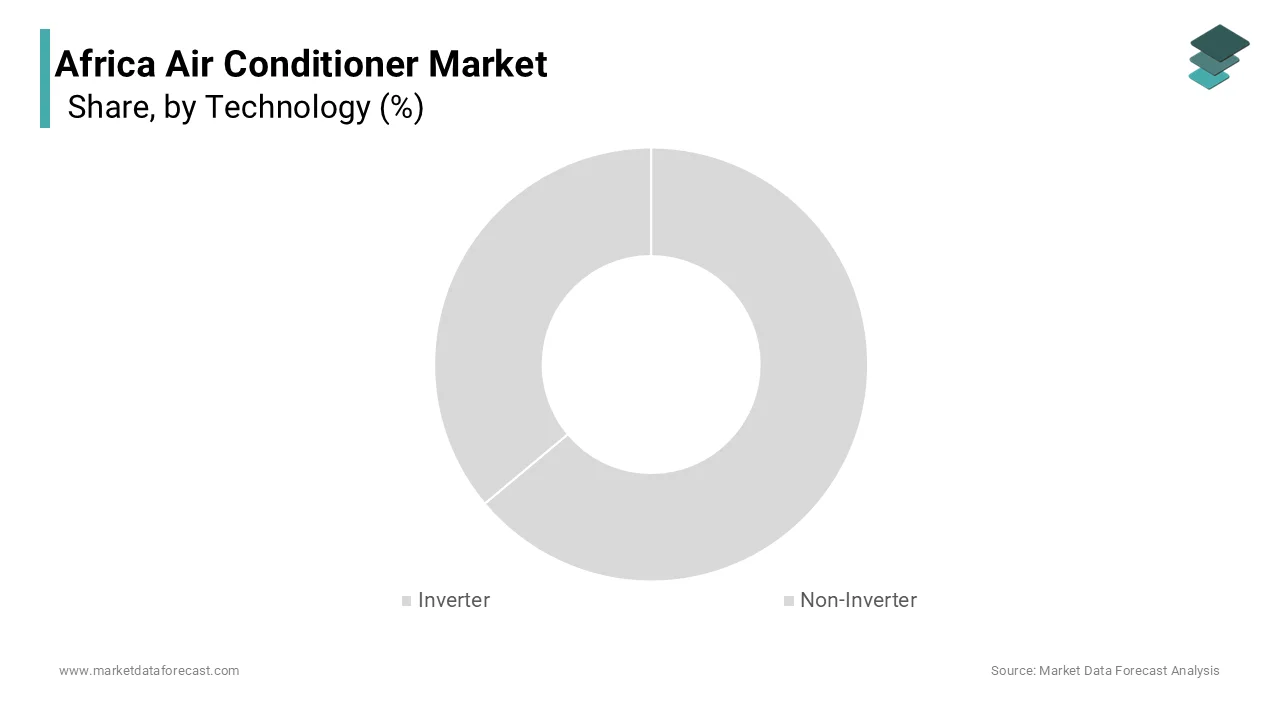
The inverter technology segment is growing at the fastest rate, with a projected CAGR of 13.7% between 2025 and 2033. This growth is fueled by rising electricity costs and increasing consumer awareness of long-term energy savings. Inverter ACs adjust compressor speed based on cooling demand, reducing energy consumption compared to fixed-speed models. Sales of inverter models in Cape Town and Durban grew year-on-year, driven by both residential and commercial demand. A further driver is the expansion of green building standards and energy labeling programs. Also, some African countries have implemented mandatory minimum energy performance standards (MEPS) for air conditioners, favoring inverter-based systems. Retailers like Game and Jumia now highlight energy efficiency ratings in product listings, influencing purchasing decisions. Besdies, financing options such as pay-as-you-go (PAYG) models from companies like PayAir are enabling middle-income consumers to afford higher-priced inverter units. These trends reflect a structural shift toward sustainable cooling, positioning inverter technology as the future benchmark for residential and commercial HVAC systems.
By End-User Insights
The residential segment was the commanding end-user in the Africa air conditioner market by accounting for 61.6% of total unit installations in 2025. This dominance is driven by the rapid expansion of middle-income housing developments in major cities, where thermal comfort is increasingly viewed as a standard feature. In Ghana, newly constructed apartments in East Legon and Airport City include pre-installed split AC units. Rising urban temperatures and extended heatwaves have also heightened consumer demand for indoor cooling, particularly in coastal and inland equatorial zones where humidity levels exceed 70% for much of the year. The proliferation of mortgage-backed and developer-financed housing projects targeting the aspirational class is a key factor behind the residential segment’s progress. Additionally, digital marketplaces like Jiji and OLX have expanded access to second-hand and reconditioned AC units, broadening ownership beyond high-income brackets. In cities, landlords also sometimes install AC units to increase rental yields, reflecting a shift in tenant expectations. This cultural transformation in living standards is embedding air conditioning into the fabric of urban residential life.
The commercial segment is emerging as the fastest-growing end-user category and is projected to grow at a CAGR of 12.8% from 2025 to 2033. This surge is driven by the expansion of modern retail, healthcare, and financial infrastructure across Africa. In recent years, Nigeria opened many new shopping malls in Lagos and Abuja, each requiring centralized or multi-split cooling systems. Banks, telecom offices, and data centers also mandate climate control to protect equipment and ensure employee productivity. Like, in Africa, most of 4G/5G base stations operate in temperature-regulated enclosures, necessitating continuous cooling. An additional catalyst is the rise of international franchising and foreign direct investment (FDI) in hospitality and retail. Global chains such as Starbucks, Shoprite, and Hilton require strict indoor climate standards, compelling local developers to install high-efficiency HVAC systems. Additionally, green building certifications like EDGE and LEED are being adopted in Egypt and South Africa, pushing developers to install advanced cooling technologies. These institutional requirements are transforming commercial real estate into a high-value, technology-driven HVAC market, outpacing residential growth in value and complexity.
By Distribution Channel Insights
The multi-brand stores segment led the Africa air conditioner market by capturing 47.1% of total sales value in 2025. These stores, such as Kathleeen in Nigeria and Jumia Mall in Kenya, offer a wide range of AC brands under one roof, enabling consumers to compare models, prices, and features before purchasing. Their physical presence in urban shopping districts and industrial zones provides immediate access to technical staff and demonstration units, which is critical for high-involvement purchases. The trust consumers place in established retail chains for authenticity and after-sales service is a major driver of this segment’s dominance. These retailers often partner with manufacturers to offer installation, maintenance, and spare parts, reducing post-purchase risk. Additionally, financing arrangements such as installment plans and credit partnerships with banks enhance affordability. Their hybrid model, combining physical presence with basic e-commerce integration, positions them as the preferred channel for informed, high-value purchases.
The online stores segment is experiencing the fastest growth, with a projected CAGR of 16.5% between 2025 and 2033. This surge is driven by rising smartphone penetration, digital payment adoption, and improved logistics networks in urban Africa. Platforms like Jumia, Takealot, and Konga now feature dedicated HVAC sections with detailed product specifications, customer reviews, and virtual consultations. A further factor accelerating online channel growth is the expansion of direct-to-consumer (DTC) models by global brands. Companies like LG and Daikin have launched localized e-commerce portals offering bundled installation and extended warranties, bypassing traditional intermediaries. Social media marketing and influencer endorsements on Instagram and TikTok are also shaping purchasing behavior among younger consumers.
REGIONAL ANALYSIS
South Africa
South Africa held a leading position in the Middle East and Africa air conditioner market by accounting for 23.2% of regional value demand in 2025. The country’s advanced urban infrastructure, high disposable income levels, and prevalence of modern commercial real estate drive sustained demand for premium cooling systems. With a significant portion of households in Gauteng and Western Cape experiencing frequent power outages, consumers are increasingly investing in energy-efficient inverter and solar-compatible AC units to reduce grid dependency. Additionally, green building certifications such as Green Star SA are mandating high-efficiency HVAC systems in new developments, accelerating the shift toward sustainable cooling technologies.
Egypt
Egypt plays a pivotal role in North Africa’s air conditioning landscape. The country’s hot desert climate and rapid urbanization have created robust demand for both residential and commercial cooling. Moreover, rising electricity tariffs have accelerated the adoption of inverter technology, with sales of energy-efficient models growing.
Nigeria
Nigeria stands as the largest volume market in sub-Saharan Africa. Despite grid instability, demand for air conditioners is surging among the urban middle and upper classes, particularly in Lagos, Abuja, and Port Harcourt. Like, a substantial number of households in major cities now own at least one AC unit. Rising temperatures and increased construction of gated communities and shopping malls are key demand drivers. Retailers like Kara and Jumia have introduced installment payment plans, making ACs more accessible. However, the prevalence of substandard units from informal markets remains a challenge.
Kenya
Kenya occupies a strategic position as East Africa’s air conditioning hub. The country’s growing tech sector, expanding middle class, and construction boom in Nairobi and Mombasa are fueling demand for modern cooling solutions. The Energy and Petroleum Regulatory Authority (EPRA) has implemented minimum energy performance standards (MEPS), promoting the adoption of inverter technology. Additionally, solar-powered AC systems are gaining traction in off-grid regions, supported by initiatives.
Ethiopia
Ethiopia is emerging as a high-growth market. The government’s Industrial Parks Development Corporation has mandated climate control in all manufacturing zones to protect sensitive equipment. Moreover, rising urban temperatures are increasing consumer demand for thermal comfort, signaling long-term market potential.
KEY MARKET PLAYERS AND COMPETITIVE LANDSCAPE
Airconditioning & Heating International Carrier Fzc, Daikin Middle East and Africa FZE, Samsung Electronics Co. Ltd., LG Electronics, Midea Middle East, Sharp Middle East Fze, Haier Electronics Group Co., Ltd., Dunham-Bush International (Africa) (PTY) Ltd, Trane Inc., Gree Electric Appliances, Inc. Of Zhuhai, are the key players in the Africa air conditioner market.
The competition in the Africa air conditioner market is intensifying as global OEMs, regional distributors, and emerging local assemblers compete across technological, pricing, and service dimensions. While multinational brands dominate the premium segment with inverter and smart cooling solutions, regional players leverage cost advantages and distribution reach to capture volume. The market is fragmented by geography, with North Africa favoring high-efficiency models and West Africa driven by affordability. Innovation is shifting toward solar integration, hybrid systems, and IoT-enabled controls, reflecting global trends adapted to African constraints. After-sales service, warranty terms, and financing options have become critical differentiators. As urbanization and climate pressures grow, the race is on to balance performance, sustainability, and accessibility in a market poised for structural transformation.
TOP PLAYERS IN THE MARKET
Daikin Industries, Ltd.
Daikin has established a strong foothold in the Africa air conditioner market through strategic partnerships, localized service networks, and technology transfer from its dominant Asia-Pacific operations. The company supplies energy-efficient inverter and VRF systems across South Africa, Kenya, and Egypt, targeting commercial buildings and premium residential projects. Drawing from its leadership in Japan and Southeast Asia, where it holds a major share in smart and solar-integrated cooling, Daikin has introduced AI-driven climate control units in African markets. These innovations enhance operational efficiency and align with green building standards, positioning Daikin as a premium provider of future-ready cooling solutions.
LG Electronics
LG Electronics has expanded its presence across Africa by offering a diverse portfolio of inverter split units, window ACs, and smart cooling systems with mobile app integration. The company has strengthened its distribution through partnerships with major retailers like Game and Jumia while investing in localized marketing campaigns that emphasize energy savings and durability. The company also launched a pay-as-you-go financing pilot in Uganda, enabling middle-income consumers to access high-end units. By integrating Asia-Pacific innovations with African consumer behavior insights, LG is enhancing affordability and brand loyalty in a competitive market.
Gree Electric Appliances Inc.
Gree has rapidly grown its footprint in Africa by offering competitively priced, energy-efficient air conditioners through a network of multi-brand dealers and e-commerce platforms. The company supplies a wide range of split and window units in Nigeria, Egypt, and South Africa, emphasizing durability and performance in extreme heat. The company has also established regional service centers in Lagos and Addis Ababa to improve maintenance response times. By transferring cost-effective manufacturing models and inverter technologies from its Asia-Pacific operations, Gree is positioning itself as a reliable, value-driven brand in Africa’s evolving HVAC sector.
TOP STRATEGIES USED BY KEY MARKET PLAYERS
Key players in the Africa air conditioner market are leveraging product localization, digital sales channels, and after-sales service expansion to strengthen their market position. Companies are adapting inverter and solar-compatible models to suit Africa’s unstable power conditions and high ambient temperatures. Strategic partnerships with real estate developers and government projects ensure integration into new buildings. Brands are investing in technician training programs to address the skills gap and improve installation quality. E-commerce platforms and installment payment models are being utilized to enhance affordability and reach. Additionally, firms are emphasizing energy efficiency and smart features to align with green building standards and differentiate in a competitive landscape shaped by rising consumer awareness and environmental regulations.
RECENT HAPPENINGS IN THE MARKET
- In March 2023, Daikin inaugurated a technical training center in Nairobi, aimed at certifying 500 HVAC technicians annually to improve installation and maintenance standards across East Africa.
- In June 2023, LG Electronics launched a solar-powered inverter AC model in Nigeria, designed to operate efficiently during grid outages and reduce dependency on diesel generators.
- In September 2023, Gree Electric partnered with a Kenyan renewable energy company to deploy hybrid air conditioning systems in off-grid healthcare facilities across rural counties.
- In January 2024, Daikin signed a supply agreement with Egypt’s New Urban Communities Authority to provide energy-efficient VRF systems for government buildings in the New Administrative Capital.
- In April 2024, LG Electronics introduced a mobile-based installment payment platform in Uganda, enabling middle-income consumers to purchase premium air conditioners through flexible financing.
MARKET SEGMENTATION
This research report on the Africa air conditioner market is segmented and sub-segmented into the following categories.
By Type
- Window AC
- Split and Multi-Split AC
- Packaged AC
- Variable Refrigerant Flow (VRF)
- Central AC
- Others
By Technology
- Inverter
- Non-Inverter
By End-User
- Residential
- Commercial
By Distribution Channel
- Multi-Brand Stores
- Exclusive Stores
- Online Stores
By Region
- Sudan
- Egypt
- Kenya
- Ethiopia
- South Africa
- Rest of Africa