Asia Pacific Commercial Air Conditioner Market Size, Share, Growth, Trends, And Forecast Research Report, Segmented By Type, Refrigerant, End-User, And Country (India, China, Japan, South Korea, Australia, New Zealand, Thailand, Malaysia, Vietnam, Philippines, Indonesia, Singapore and Rest of APAC), Industry Analysis From (2026 to 2034)
Market Size, 2025
$14.04 BnMarket Estimate, 2026
$14.68 BnMarket Forecast, 2034
$20.95 BnCAGR, 2026–2034
4.55%Asia Pacific Commercial Air Conditioner Market Size
The Asia Pacific commercial air conditioner market was valued at USD 14.04 billion in 2025 and is anticipated to reach USD 14.68 billion in 2026 and USD 20.95 billion by 2034, growing at a CAGR of 4.55%, 2026 to 2034.
A commercial air conditioner is a type of cooling system designed for non-residential applications, including office buildings, shopping malls, hospitals, educational institutions, and industrial facilities. These systems vary from centralized HVAC units to modular and energy-efficient models tailored for specific commercial requirements. As urbanization accelerates across the region, there is a growing emphasis on climate control in commercial infrastructure, driven by rising indoor comfort expectations and stringent regulatory norms promoting energy efficiency.
According to the Asian Development Bank, the Asia Pacific region accounted for over 60% of global urban population growth between 2010 and 2020. This rapid urban expansion has spurred extensive construction activity, especially in countries like India, Indonesia, and Vietnam.
MARKET DRIVERS
Rising Urbanization and Commercial Infrastructure Development
Urbanization across the Asia Pacific region is a key catalyst driving demand for commercial air conditioning systems. As per the United Nations Department of Economic and Social Affairs, approximately 50% of the region’s population lived in urban areas in 2020, a figure expected to rise to nearly 65% by 2050. This demographic shift has triggered massive investments in commercial infrastructure, particularly in emerging economies such as India, the Philippines, and Thailand.
In India alone, the Ministry of Housing and Urban Affairs reported that over 2,000 commercial projects were sanctioned in 2023, covering retail, hospitality, and office spaces, each requiring robust climate control solutions. Similarly, in China, despite a slowing residential property market, commercial real estate investment remained resilient, with new office developments increasing by 7.2% year-over-year in 2023, according to Colliers International. These developments necessitate advanced air conditioning systems to ensure occupant comfort and compliance with environmental standards.
Moreover, the proliferation of smart cities and green building certifications, such as LEED and GRIHA, has encouraged the integration of energy-efficient HVAC systems.
Growing Demand for Energy-Efficient Cooling Solutions
Businesses across the Asia Pacific are prioritizing energy-efficient commercial air conditioning systems because energy costs are escalating and environmental concerns are intensifying. According to the International Energy Agency (IEA), the region’s cooling-related electricity demand could triple by 2040 if current trends persist. To mitigate this, companies are increasingly adopting high-efficiency variable refrigerant flow (VRF) systems, heat recovery chillers, and smart thermostatic controls.
Japan stands out as a leader in this transition, with over 70% of newly installed commercial AC systems in 2023 featuring inverter technology, which significantly reduces power consumption. These systems can cut energy usage compared to conventional units.
Additionally, multinational corporations operating in the region are aligning their sustainability goals with local regulations. For instance, in Australia, major retail chains such as Woolworths and Coles have retrofitted their stores with R32 refrigerant-based systems, which offer lower global warming potential.
MARKET RESTRAINTS
High Initial Installation Costs and Maintenance Expenses
The substantial capital required for installation and ongoing maintenance is one of the primary challenges impeding the growth of the Asia Pacific commercial air conditioner market. Advanced HVAC systems, especially those incorporating VRF technology or AI-driven climate controls, often require significant upfront investment.
In developing economies like Vietnam and Bangladesh, where budget constraints are more pronounced, many small and medium enterprises (SMEs) opt for cheaper, less efficient alternatives. Moreover, maintenance costs pose another economic burden. As per a study by the Indian Society of Heating, Refrigerating and Air Conditioning Engineers (ISHRAE), annual maintenance expenses for high-end commercial HVAC systems can exceed 10% of the initial installation cost. This financial barrier discourages widespread adoption, particularly in regions where return on investment timelines are long.
Regulatory Complexity and Compliance Challenges
Regulatory frameworks governing refrigerants and energy efficiency vary widely across Asia Pacific nations, creating compliance hurdles for manufacturers and installers. Countries such as Australia and Japan enforce strict adherence to refrigerant phase-down schedules under the Kigali Amendment, while others like India and Indonesia are still in transitional phases. As per the Australian Government's Department of Climate Change, Energy, the Environment and Water, the import of high-global-warming-potential (GWP) refrigerants has been capped since 2021, forcing businesses to adopt alternatives like R32 or CO₂-based systems. However, transitioning to these refrigerants requires retrofitting or replacing existing systems, which adds to operational costs. In contrast, countries like Malaysia and Thailand lack unified national standards for commercial HVAC systems, leading to inconsistent enforcement and product quality discrepancies. These complexities are limiting the market penetration of advanced air conditioning systems in several parts of the Asia Pacific.
MARKET OPPORTUNITY
Expansion of Smart City Projects Across the Asia Pacific
The proliferation of smart city initiatives presents a significant opportunity for the commercial air conditioner market in the Asia Pacific. Governments across the region are investing heavily in intelligent infrastructure that integrates IoT-enabled systems, including smart HVAC units capable of remote monitoring and adaptive temperature control. This technological shift is offering a lucrative avenue for HVAC manufacturers and service providers across the Asia Pacific.
Adoption of Renewable Energy-Powered Cooling Systems
The growing integration of renewable energy sources into commercial infrastructure is opening new avenues for the Asia Pacific commercial air conditioner market. Businesses are increasingly leveraging solar, wind, and geothermal energy to power HVAC systems, reducing dependency on fossil fuels and lowering operational costs. Australia has emerged as a leader in this domain, with large-scale commercial buildings such as the Melbourne Convention Centre utilizing solar-assisted absorption chillers. As per the Clean Energy Council of Australia, such systems can reduce grid reliance by up to 50%, making them attractive for corporate sustainability strategies. Similarly, in Japan, Hitachi and Daikin have introduced hybrid cooling solutions that combine photovoltaic panels with high-efficiency compressors, gaining traction in office complexes and healthcare facilities.
MARKET CHALLENGES
Supply Chain Disruptions and Component Shortages
Geopolitical tensions, raw material shortages, and logistical bottlenecks are causing persistent supply chain disruptions, which are a major challenge for the Asia Pacific commercial air conditioner market. Key components such as compressors, copper coils, and refrigerants are sourced from a limited number of suppliers, making the industry vulnerable to production halts. In India, the Confederation of Indian Industry (CII) reported a 20% increase in lead times for imported compressor units, affecting delivery schedules for large-scale commercial projects. Furthermore, trade restrictions imposed during the Russia-Ukraine conflict impacted the availability of critical raw materials like aluminum and nickel, essential for manufacturing heat exchangers and condensers. These disruptions not only inflate costs but also delay project completions, straining relationships between developers and HVAC vendors.
Skilled Labor Shortage in HVAC Installation and Servicing
Despite rising demand for sophisticated commercial air conditioning systems, the Asia Pacific region faces a severe shortage of skilled technicians and engineers capable of installing and maintaining advanced HVAC equipment. This skills gap hampers market growth, especially in rapidly developing countries where technical training programs lag behind technological advancements.
In India, the National Skill Development Corporation (NSDC) identified HVAC servicing as one of the top five sectors facing workforce shortages, with less than 30% of available labor trained in modern refrigeration techniques. This deficiency results in higher repair costs and reduced system efficiency, deterring potential buyers from investing in premium units. To address this challenge, several governments and private entities have initiated vocational training programs.
REPORT COVERAGE
| REPORT METRIC | DETAILS |
| Market Size Available | 2025 to 2034 |
| Base Year | 2025 |
| Forecast Period | 2026 to 2034 |
| CAGR | 4.55% |
| Segments Covered | By Type, Refrigerant, End-User, and By Country |
| Various Analyses Covered | Global, Regional & Country Level Analysis, Segment-Level Analysis, DROC, PESTLE Analysis, Porter’s Five Forces Analysis, Competitive Landscape, Analyst Overview on Investment Opportunities |
| Regions Covered | India, China, Japan, South Korea, Australia, New Zealand, Thailand, Malaysia, Vietnam, Philippines, Indonesia, Singapore, and the rest of APAC |
| Market Leaders Profiled | Carrier (U.S.), DAIKIN INDUSTRIES, Ltd. (Japan), Johnson Controls (Ireland), Mitsubishi Electric Corporation (Japan), LG Electronics (South Korea), SAMSUNG (South Korea), Trane (Ingersoll Rand) (Ireland), Blue Star Limited (India), FUJITSU (Japan), AIREDALE INTERNATIONAL AIR CONDITIONING LTD. (U.K.). |
SEGMENTAL ANALYSIS
By Type Insights
Packaged Air Conditioners
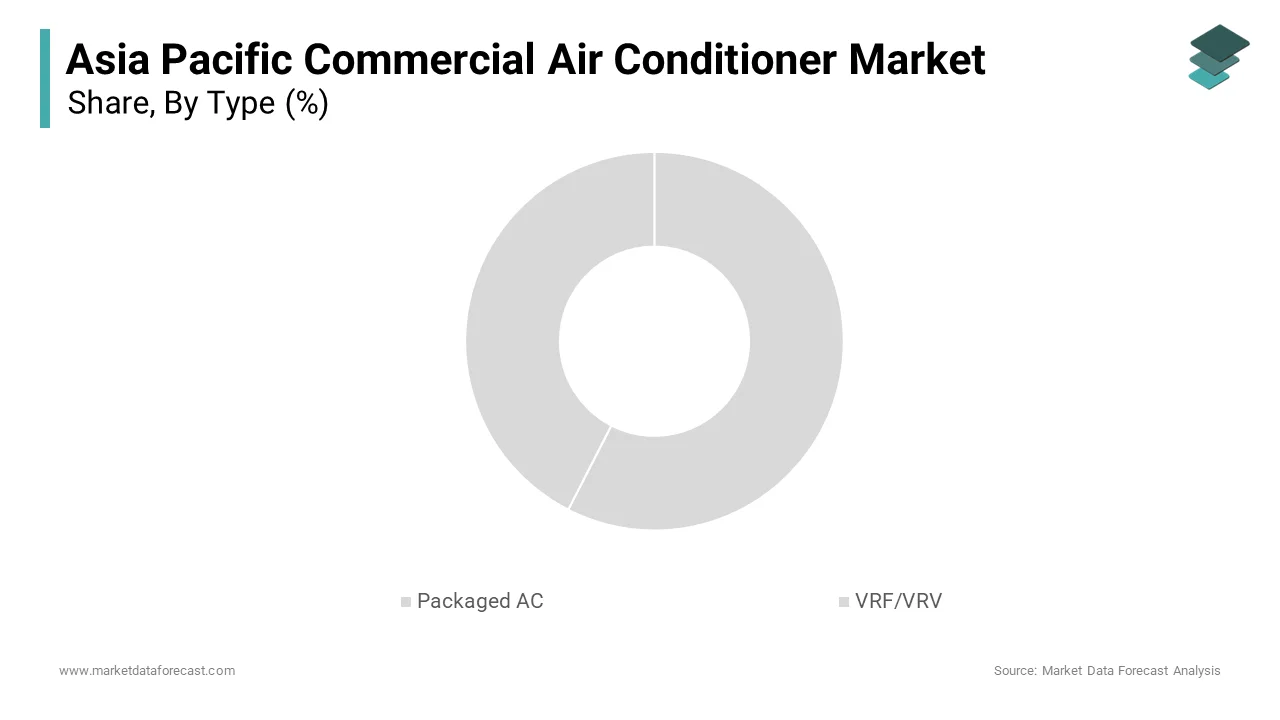
The packaged air conditioners segment dominated the Asia Pacific commercial air conditioner market by accounting for 52.1% of total revenue in 2023. Their ease of installation, cost-effectiveness, and adaptability to a variety of building types are driving the dominance of the packaged AC segment. This segment includes rooftop units, self-contained systems, and modular cooling solutions widely used in retail spaces, small offices, and hospitality establishments. Moreover, government initiatives promoting energy efficiency have spurred the adoption of high-efficiency packaged units. In South Korea, the Korea Energy Economics Institute indicates that sales of energy-efficient packaged ACs grew by 14% in 2023, driven by subsidies under the national energy conservation program.
VRF/VRV Systems
The Variable Refrigerant Flow (VRF)/Variable Refrigerant Volume (VRV) systems segment is the fastest-growing in the Asia Pacific commercial air conditioner market and is projected to expand at a CAGR of 9.4% between 2025 and 2033. These systems offer superior energy efficiency, zoning capabilities, and scalability, making them ideal for large commercial complexes such as office towers, shopping malls, and healthcare facilities. The Japanese Ministry of Economy, Trade, and Industry (METI) attributes this growth to stringent energy efficiency regulations and rising demand for smart building automation. In China, as per the Ministry of Housing and Urban-Rural Development, VRF system installations in Tier-1 cities like Shanghai and Beijing rose by 11% in 2023, driven by green building certifications and the need for precise climate control in high-rise developments.
By Refrigerant Insights
R-410A/R-407C Refrigerants
The R-410A and R-407C refrigerant segments collectively hold the largest share of the Asia Pacific commercial air conditioner market, with 47.3% of total refrigerant usage in 2025. These hydrofluorocarbon (HFC)-based refrigerants are widely adopted due to their proven performance, availability, and compatibility with existing HVAC equipment across various commercial applications. Despite environmental concerns regarding high global warming potential (GWP), these refrigerants continue to dominate due to regulatory delays in enforcing phase-down schedules in several regional markets.
R-32 Refrigerant
The R-32 segment is the fastest-growing refrigerant in the Asia Pacific commercial air conditioner market and is projected to grow at a CAGR of 12.6% through 2033. This low-global-warming-potential (GWP) refrigerant offers an optimal balance between energy efficiency and environmental compliance, making it a preferred choice among manufacturers and policymakers alike.
As per the Japan Refrigeration and Air Conditioning Industry Association (JRAIA), R-32-based commercial units accounted for 38% of all HVAC sales in Japan in 2023, with Daikin and Mitsubishi leading the transition. According to the Ministry of Economy, Trade and Industry (METI), R-32 reduces GWP by approximately 75% compared to R-410A while maintaining similar performance levels, making it a viable alternative under the Kigali Amendment framework.
By End-User Insights
Retail Sector
The retail sector is the largest end-user segment in the Asia Pacific commercial air conditioner market by capturing 25.3% of total revenue in 2023. Shopping malls, hypermarkets, department stores, and specialty retail outlets require consistent indoor climate control to enhance customer comfort and preserve perishable goods, driving extensive HVAC installations. In China, as per the China Chain Store & Franchise Association, modern retail formats now cover over 500 million square meters of commercial space, each requiring advanced air conditioning systems to manage foot traffic and maintain ambient temperatures.
Healthcare Sector
The healthcare sector is the fastest-growing end-user segment in the Asia Pacific commercial air conditioner market and is expected to expand at a CAGR of 10.2% from 2025 to 2033. Hospitals, clinics, laboratories, and pharmaceutical facilities require highly controlled indoor environments to ensure patient safety, equipment functionality, and compliance with medical standards. In South Korea, the Ministry of Health and Welfare mandates strict temperature and humidity controls in biopharmaceutical manufacturing units, boosting demand for specialized air conditioning units.
COUNTRY-LEVEL ANALYSIS
China Commercial Air Conditioner Market Analysis
China held the largest share of the Asia Pacific commercial air conditioner market of 28.4% of total revenue in 2025. As the region’s economic powerhouse, China’s vast commercial real estate sector drives substantial demand for HVAC systems across office complexes, shopping centers, and industrial facilities. As per the Chinese Academy of Building Sciences, energy-efficient VRF systems are increasingly replacing traditional chillers in high-rise developments, driven by stricter building codes and sustainability mandates. Additionally, the National Development and Reform Commission has mandated that all new commercial buildings achieve minimum energy performance standards, pushing developers toward eco-friendly cooling solutions.
India Commercial Air Conditioner Market Analysis
India is rapidly expanding in the Asia Pacific commercial air conditioner market. The country’s burgeoning urbanization, expanding retail footprint, and growing investments in smart infrastructure are key drivers fueling HVAC demand. As per the Indian Society of Heating, Refrigerating and Air Conditioning Engineers (ISHRAE), commercial buildings consume over 35% of the nation’s electricity, with cooling accounting for nearly half of this usage. To curb energy demand, the Bureau of Energy Efficiency introduced star labeling for commercial HVAC units, encouraging businesses to adopt high-efficiency models. Moreover, the Smart Cities Mission and Production-Linked Incentive (PLI) scheme for white goods manufacturing are accelerating market growth, positioning India as a key player in the regional HVAC landscape.
Japan Commercial Air Conditioner Market Analysis
Japan commands a significant portion of the Asia Pacific commercial air conditioner market, distinguished by its technological leadership and early adoption of advanced HVAC systems. The country serves as a hub for innovation, with major manufacturers like Daikin, Mitsubishi Electric, and Fujitsu General pioneering next-generation VRF and heat recovery technologies. Furthermore, Japan leads in hydrogen-cooled and CO₂ refrigerant-based HVAC systems, aligning with global decarbonization goals.
South Korea Commercial Air Conditioner Market Analysis
South Korea accounts for a notable share of the Asia Pacific commercial air conditioner market, driven by stringent environmental policies and rapid digital transformation in building management. The country has been proactive in enforcing energy efficiency standards and promoting smart HVAC solutions tailored for commercial applications. Additionally, the Korean Smart City initiative mandates the integration of IoT-enabled HVAC systems in new commercial constructions, enabling real-time monitoring and adaptive cooling.
Australia Commercial Air Conditioner Market Analysis
Australia is characterized by a strong emphasis on sustainability and regulatory compliance. The country’s commercial HVAC sector is shaped by ambitious net-zero targets and evolving building codes that favor energy-efficient cooling systems.
COMPETITIVE LANDSCAPE
The competition in the Asia Pacific commercial air conditioner market is intense and dynamic, shaped by a mix of global giants and regional manufacturers striving to capture market share. While established players leverage their technological expertise and brand strength, local firms capitalize on cost advantages and deep-rooted distribution networks. Innovation remains a key battleground, with companies racing to develop next-generation HVAC systems that offer superior energy efficiency, smart connectivity, and environmental compliance. Additionally, the growing emphasis on sustainability has prompted manufacturers to align their product portfolios with international climate goals, intensifying rivalry in eco-friendly cooling solutions. As urbanization accelerates and commercial infrastructure expands across emerging economies, companies are also focusing on after-sales services, customization, and digital integration to differentiate themselves in a crowded marketplace.
KEY MARKET PLAYERS
These are the market players that are dominating the Asia Pacific commercial air conditioner market.
- Carrier (U.S.)
- DAIKIN INDUSTRIES, Ltd. (Japan)
- Johnson Controls (Ireland)
- Mitsubishi Electric Corporation (Japan)
- LG Electronics (South Korea)
- SAMSUNG (South Korea)
- Trane (Ingersoll Rand) (Ireland)
- Blue Star Limited (India)
- FUJITSU (Japan)
- AIREDALE INTERNATIONAL AIR CONDITIONING LTD. (U.K.).
Top Players In The Market
- Daikin is a dominant force in the Asia Pacific commercial air conditioner market, known for pioneering Variable Refrigerant Flow (VRF) technology. The company has consistently led innovation by introducing energy-efficient and environmentally sustainable HVAC solutions. With a strong presence across major markets like China, India, and Southeast Asia, Daikin’s focus on R&D and strategic partnerships has reinforced its leadership. Its product portfolio spans from compact multi-split systems to large-scale chillers tailored for commercial applications, making it a preferred choice among architects and building developers.
- Mitsubishi Electric is a key player in the region, recognized for its high-performance VRF systems and precision engineering. The company has built a reputation for reliability and technological excellence, catering to both new constructions and retrofitting projects. In the Asia Pacific, Mitsubishi Electric has expanded through localized manufacturing units and distribution networks, ensuring adaptability to regional climatic conditions and regulatory standards. Its commitment to sustainability and digital integration in HVAC controls has further strengthened its market position.
- Johnson Controls is a global leader with a significant footprint in the Asia Pacific commercial air conditioner market. Through its YORK® brand, the company offers a broad spectrum of HVAC solutions, including chillers, packaged units, and smart control systems. Johnson Controls emphasizes integrated building management platforms that enhance energy efficiency and operational performance. By investing in green technologies and forming strategic alliances with local partners, the company has maintained a strong presence in both established and emerging markets across the region.
Top Strategies Used By Key Market Participants
One major strategy employed by leading players is continuous innovation and development of energy-efficient products, particularly those aligned with global environmental regulations such as the Kigali Amendment. Companies are focusing on low-GWP refrigerants and advanced compressor technologies to meet evolving sustainability demands while maintaining performance.
Another critical approach is strategic partnerships and collaborations where manufacturers team up with real estate developers, government bodies, and technology providers to integrate HVAC systems into smart infrastructure projects. These collaborations help companies gain early access to upcoming construction opportunities and influence design specifications.
Lastly, localized production and supply chain optimization play a vital role in strengthening market presence. Major players are expanding manufacturing facilities within the Asia Pacific to reduce lead times, cut costs, and comply with regional standards, thereby improving responsiveness to local market dynamics and customer needs.
RECENT MARKET NEWS
- In May 2025, Daikin launched an AI-powered building energy management system specifically designed for commercial applications across the Asia Pacific. This platform enables real-time monitoring and adaptive temperature control, enhancing overall HVAC efficiency in large-scale buildings.
- In March 2025, Mitsubishi Electric partnered with a Singapore-based smart building solutions provider to integrate its VRF systems with IoT-enabled automation tools. The collaboration aimed at offering more intelligent and responsive climate control for commercial spaces in urban settings.
- In February 2025, Johnson Controls announced a joint venture with an Indian HVAC components manufacturer to localize production and improve supply chain resilience. The move was intended to support rapid expansion in South and Southeast Asia while reducing operational costs.
- In July 2025, Hitachi Global introduced a new line of hybrid air conditioning units combining solar power with conventional grid input, targeting commercial buildings in off-grid and semi-urban areas across Indonesia and the Philippines.
- In September 2025, LG Electronics unveiled a next-generation modular cooling solution for the retail and hospitality sectors in South Korea. The system allows flexible installation and scalable capacity adjustments, catering to evolving commercial cooling demands in dense urban environments.
MARKET SEGMENTATION
This research report on the Asia Pacific commercial air conditioner market is segmented and sub-segmented into the following categories.
By Type
- Packaged AC
- VRF/VRV
By Refrigerant
- R-32
- R-410A/R-407C
- R-600A/ R-290
- Others (R-22 and Others)
By End-User
- Healthcare
- Educational/Institutional
- Public/Government
- Retail
- Hospitality
- Manufacturing
By Country
- India
- China
- Japan
- South Korea
- Australia
- New Zealand
- Thailand
- Malaysia
- Vietnam
- Philippines
- Indonesia
- Singapore
- Rest of APAC
Frequently Asked Questions
What drives demand for commercial air conditioners in Asia Pacific?
Urban growth, climate change, and rising commercial infrastructure fuel the market's expansion across the region.
Which sectors use commercial air conditioners the most?
Office buildings, shopping malls, hospitals, and hotels are leading users due to their continuous cooling needs.
How does energy efficiency impact purchasing decisions?
Businesses increasingly choose units with high energy efficiency ratings to save costs and meet sustainability goals.
Are there popular new technologies shaping the market?
Smart systems and inverter-based air conditioners are gaining traction for their improved performance and lower energy use.
Which countries are the biggest markets in Asia Pacific?
China, Japan, and India dominate thanks to rapid urbanization, economic growth, and large-scale construction.
What are current challenges for businesses buying commercial air conditioners?
Fluctuating energy prices, varying regional regulations, and upfront costs are common hurdles for buyers.
Is there a trend toward environmentally friendly refrigerants?
Yes, many buyers now prioritize air conditioners using eco-friendly refrigerants to comply with green standards.
How do after-sales services impact market competitiveness?
Reliable maintenance and support services influence purchasing decisions, with buyers valuing easy access to repairs.
What role do government policies play in the market?
Incentives and mandatory efficiency standards push manufacturers to innovate and offer advanced, compliant units.
How fast is the Asia Pacific market expected to grow?
The market is forecast for steady growth, driven by development projects and rising demand for advanced cooling solutions.
Related Reports
Access the study in MULTIPLE FORMATS
Purchase options starting from
$ 2000
Didn’t find what you’re looking for?
TALK TO OUR ANALYST TEAM
Need something within your budget?
NO WORRIES! WE GOT YOU COVERED!
Call us on: +1 888 702 9696 (U.S Toll Free)
Write to us: sales@marketdataforecast.com