- Product Description Description
- Table of Contents TOC
- List of Table & Figure LOT
- Get Free Sample PDF Sample PDF
Market Size, 2025
$15.71 BnMarket Estimate, 2026
$17 BnMarket Forecast, 2034
$31.93 BnCAGR, 2026–2034
8.20%Africa Animation Market Size
The Africa animation market was valued at USD 15.71 billion in 2025, is estimated to reach USD 17 billion in 2026, and is projected to reach USD 31.93 billion by 2034, growing at a CAGR of 8.20% from 2026 to 2034.
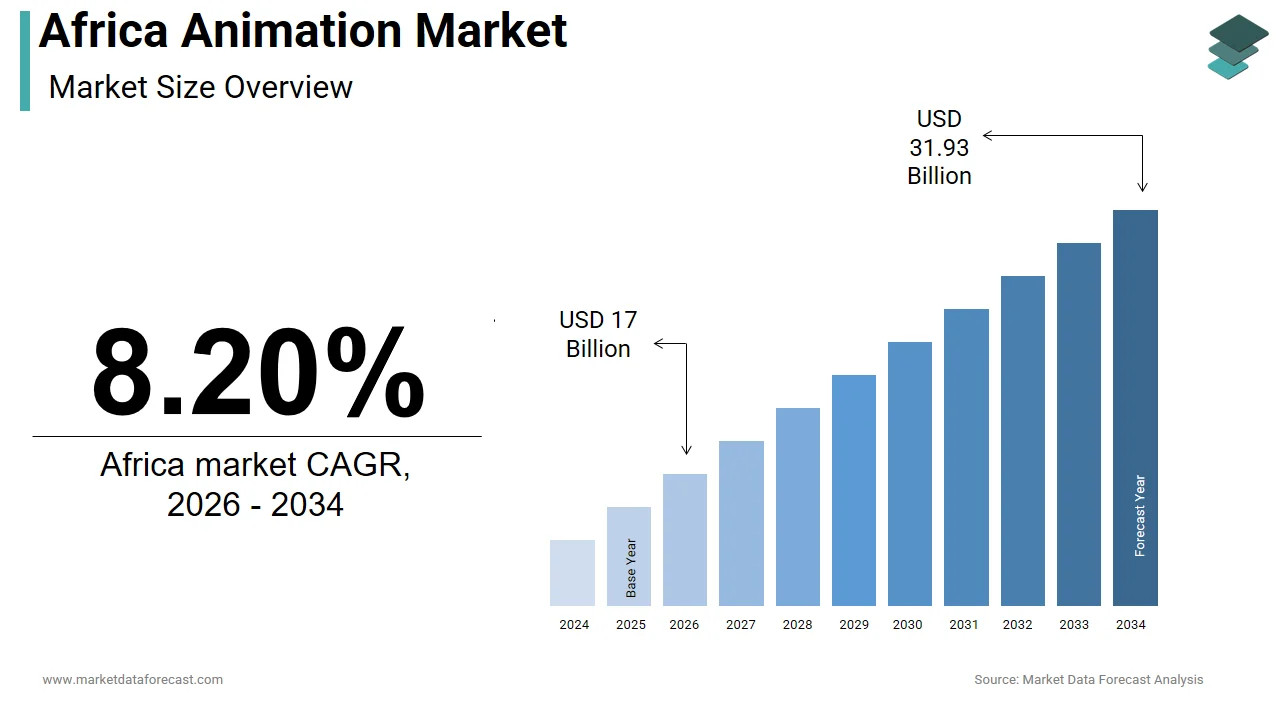
Animation refers to the ecosystem of digital storytelling, 2D/3D content creation, and animated media production across the continent, encompassing entertainment, education, advertising, and gaming. While historically underrepresented, the sector is gaining momentum through localized narratives and digital innovation. As per UNESCO, a notable number of animation studios were formally registered in sub-Saharan Africa by 2023. As per the African Union’s Digital Transformation Strategy, creative industries, including animation, contributed significantly to the continent’s GDP in 2022. Mobile internet penetration surged considerably, enabling broader access to animated content, particularly among youth. Platforms like Netflix and Showmax have begun commissioning African animated series, reflecting growing recognition of the region’s creative potential and cultural authenticity in visual storytelling.
MARKET DRIVERS
Expansion of Youth-Oriented Digital Content Platforms
Africa’s digital-native youth population is fueling demand for animated content tailored to local cultures and languages. According to the United Nations Children's Fund (UNICEF), 60% of Africa’s population is under the age of 25, creating a vast audience for mobile-first animated entertainment. In Nigeria, the edutainment platform WhizKids reported a large volume of monthly active users, delivering curriculum-aligned animated lessons in English, Yoruba, and Hausa. The proliferation of affordable smartphones and data bundles has enabled platforms like YouTube and TikTok to become primary distribution channels for short-form animated content, particularly in urban centers. This cultural resonance and accessibility are transforming animation into a mainstream medium for education and entertainment.
Government and Institutional Support for Creative Industries
Several African governments are implementing policies and funding initiatives to nurture animation as part of broader creative economy strategies. South Africa’s Department of Sports, Arts and Culture allocated substantial funding in 2023 to support digital content creators, including animators, through the Creative Economy Fund. In Rwanda, the government launched the Kigali Animation Hub in 2022, offering training, studio space, and seed funding to emerging studios, with over 120 creatives trained by mid-2023, as per the Rwanda Development Board. Ghana’s National Film Authority has integrated animation into its film incentive program, providing tax rebates for local productions. Additionally, the African Development Bank’s Creative Africa Nexus initiative has facilitated over USD 15 million in financing for creative startups since 2021, enabling animation firms to scale production and access international markets.
MARKET RESTRAINTS
Limited Access to High-Performance Production Technology
Many African animation studios operate with outdated hardware and software, constraining their ability to produce high-quality, competitive content. Moreover, only a limited share of creative professionals in sub-Saharan Africa have consistent access to computers capable of rendering 3D animation, severely limiting output capacity. In Uganda, the cost of a professional-grade workstation is more than the average annual income, making it unaffordable for independent animators. Software licensing fees for tools like Autodesk Maya or Adobe Creative Suite further exacerbate the barrier.
Inadequate Intellectual Property Protection Frameworks
Weak enforcement of intellectual property (IP) rights discourages investment and innovation in the African animation sector. Only South Africa currently has specialized IP courts within the continent. This lack of legal recourse deters private funding and international co-productions, as investors hesitate to back projects without asset security. In Ethiopia, animators often delay or abandon commercial releases. Without a robust legal infrastructure, the monetization of original characters and storylines remains precarious, stifling long-term industry growth.
MARKET OPPORTUNITIES
Localization of Educational and Health Awareness Content
Animation is increasingly being leveraged to deliver accessible, engaging educational and public health messaging across diverse linguistic and literacy levels. With indigenous languages spoken across Africa, animation offers a scalable solution for multilingual content delivery, particularly in regions with low literacy rates, positioning the sector as a vital tool for social development and digital inclusion.
Growth of Pan-African Streaming and Co-Production Networks
The rise of regional content platforms is enabling African animators to bypass traditional gatekeepers and reach continental audiences. The African Union’s Pan-African Cultural Calendar has funded cross-border collaborations. Animation studios are forming collectives like the African Animation Network (AAN), which connects several studios across countries, facilitating resource sharing and joint ventures. These networks reduce production costs and amplify visibility, enabling African narratives to compete globally while fostering regional creative synergy.
MARKET CHALLENGES
Brain Drain of Skilled Animators to International Markets
Despite growing talent pools, many trained African animators migrate to Europe, North America, or Asia for better opportunities, depriving the local industry of expertise. The lack of sustainable career pathways, coupled with limited project funding, makes long-term retention difficult. Countries like Egypt and Tunisia report a deficit of senior mentors in animation schools, as experienced professionals leave for international studios. This exodus weakens institutional knowledge transfer and delays the maturation of homegrown production ecosystems.
Fragmented Distribution and Monetization Pathways
African animators face significant hurdles in monetizing content due to fragmented distribution channels and underdeveloped licensing models. Also, only limited share of African animated content is distributed through formal licensing agreements. Subscription-based platforms are still nascent, and piracy undermines potential income. Additionally, cross-border broadcasting rights are poorly harmonized, complicating regional syndication. Without standardized monetization frameworks and regional content exchange agreements, animators struggle to achieve financial sustainability, limiting the sector’s ability to transition from project-based to business-oriented models.
REPORT COVERAGE
| REPORT METRIC | DETAILS |
| Market Size Available | 2025 to 2034 |
| Base Year | 2025 |
| Forecast Period | 2026 to 2034 |
| Segments Covered | By Type, Component, Industry, and Region. |
| Various Analyses Covered | Global, Regional and Country-Level Analysis, Segment-Level Analysis, Drivers, Restraints, Opportunities, Challenges; PESTLE Analysis; Porter’s Five Forces Analysis, Competitive Landscape, Analyst Overview of Investment Opportunities |
| Countries Covered | Sudan, Egypt, Kenya, Ethiopia, Ghana, South Africa, Rest of Africa |
| Market Leaders Profiled | AnimaxFYB Studios, Anthill Studios, Avandu Vosi, eLimu, Fatboy Animations Ltd, Growthpad Digital Media Group, Hueman Studios, Komotion Studios, Strika Entertainment (Pty) Ltd, Studio Bolland, Sunrise Productions and Triggerfish Animation Studios (Pty) Ltd. |
SEGMENTAL ANALYSIS
By Type Insights
The 2D animation (vector-based) segment dominated the Africa animation market by capturing an estimated 47.3% share of total production activity in 2024. This dominance is primarily driven by its cost-effectiveness and compatibility with low-resource environments. In Nigeria, most of animated content produced for television and digital platforms is vector-based 2D, owing to lower rendering demands and accessibility of software such as Adobe Animate and Toon Boom. The format is particularly suited for mobile delivery, where file size and data consumption are critical. Besides, 2D animation aligns well with African storytelling aesthetics, flat perspectives, bold colors, and stylized characters, making it ideal for culturally resonant narratives in series. Its adaptability for both entertainment and educational use further solidifies its leadership across the continent.
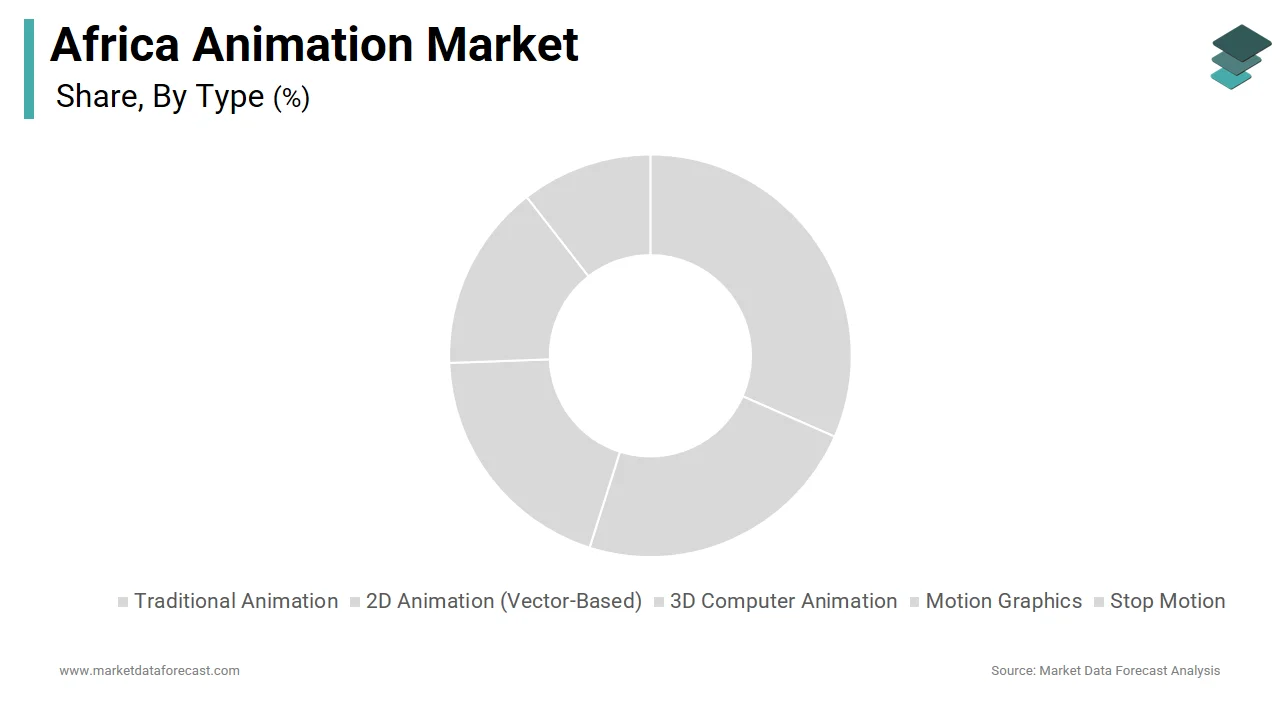
The 3D computer animation segment is the fastest-growing type and is recording a CAGR of 13.6% between 2025 and 203. This surge is fueled by rising demand for high-impact visuals in advertising, gaming, and international co-productions. South African studios such as Triggerfish and Blazing Samurai have pioneered 3D feature films that have premiered on Netflix, increasing regional visibility and investment interest. Advancements in cloud rendering and affordable GPU leasing platforms like AWS and RenderStreet have reduced technical barriers. Furthermore, the integration of 3D animation in virtual reality (VR) training modules for mining and healthcare sectors in Zambia and Botswana is expanding its industrial applications beyond entertainment.
By Component Insights
The services segment held the largest share of the Africa animation market at 65.3% of total revenue in 2024 This dominance is due to the project-based nature of animation production, where studios generate income through commissioned content creation for broadcasters, NGOs, and corporate clients. The freelance economy is also expanding, with platforms like Upwork and Fiverr enabling African animators to access global clients. Also, independent animators operated as service providers across the continent, reinforcing the sector’s labor-intensive, output-driven model.
The software component is the fastest-growing segment and is achieving a CAGR of 11.8% from 2025 to 203. This growth is driven by increased adoption of cloud-based and subscription-model animation tools, which reduce upfront costs. In Ghana, the number of licensed animation software users rose following the introduction of localized payment options for Adobe Creative Cloud and Toon Boom. Open-source platforms like Krita and Synfig Studio are also gaining traction in university programs. Additionally, regional distributors like SoftCom in Nigeria now offer bundled training and software leasing, improving accessibility. As studios scale, demand for specialized rigging, rendering, and compositing tools is accelerating software market expansion.
By Industry Insights
The media and entertainment industry was the prominent end-user by commanding 56.4% of the Africa animation market in 2024. This dominance is anchored in the rising demand for original African content on streaming platforms and broadcast television. Netflix’s Supa Team 4, produced by South Africa’s Triggerfish, became the first African animated series on the platform. Hence, the appetite for relatable, high-energy animated entertainment continues to drive investment and production volume.
The education sector is the fastest-growing application area, expanding at a CAGR of 15.2% between 2021 and 2023, as per UNESCO’s Global Education Monitoring Report. This growth is driven by the integration of animated content into national digital learning strategies. Animated videos have proven particularly effective in low-literacy regions. With donor support and government digitization agendas, education is emerging as a sustainable revenue stream for animators.
COUNTRY-LEVEL ANALYSIS
South Africa Animation Market Insights
South Africa leads the African animation market with a 28% share, recognized as the continent’s most advanced hub for professional production and international collaboration. As per the National Film and Video Foundation (NFVF), the country hosts several registered animation studios, including globally acclaimed firms like Triggerfish and Sunrise Productions. South Africa’s robust broadband infrastructure and skilled English-speaking workforce enable seamless integration into global pipelines. The country’s animated series, marking a milestone in export potential. With strong institutional backing and technical training at institutions like AFDA, South Africa remains the creative and technological leader in African animation.
Nigeria Animation Market Insights
Nigeria holds a significant market share which is driven by its massive youth population, vibrant storytelling culture, and rapid digital adoption. Lagos-based studios like Sparrow Productions and Qwema Animations are pioneering Yoruba and Pidgin-language content, resonating with local audiences. YouTube serves as a primary distribution channel, with Nigerian animated channels collectively amassing millions of views annually. The rise of mobile data affordability and homegrown streaming platforms like IROKOtv+ is accelerating content consumption and creator monetization.
Kenya Animation Market Insights
Kenya commands a notable share of the market and is distinguished by its innovation-driven animation ecosystem and strong public-private partnerships. The government’s Digital Literacy Programme has integrated local animations into primary school tablets. Studios like Kuush Films and Joonko Labs have secured contracts with international organizations, including UNICEF and the World Bank, to produce health and civic education animations. With high English fluency, growing tech literacy, and proximity to East African markets, Kenya is positioning itself as a center for purpose-driven animated content.
Egypt Animation Market Insights
Egypt is characterized by a long-standing tradition in visual storytelling and a growing digital content industry. The Ministry of Communications and Information Technology launched the Digital Egypt Pioneers Initiative, training in animation and digital arts between 2021 and 2023. Egyptian animators have gained recognition for Islamic-themed educational series, which have been translated into many languages. The country’s strategic location and cultural influence across the Arab world make it a gateway for pan-Arab animated content. With increasing investment in creative tech parks, Egypt is expanding its footprint in both entertainment and instructional animation.
Ghana Animation Market Insights
Ghana is emerging as a dynamic player due to policy support and youth-driven creative entrepreneurship. The government’s One District One Creative Centre (1D1CC) initiative has established animation labs in multiple regional hubs, training a number of young creatives. Ghanaian animators are increasingly collaborating with Nigerian and South African studios, enhancing cross-border content exchange. The proliferation of animation festivals like AnimaFest Ghana has boosted visibility and networking. With English as the primary language and a stable digital environment, Ghana is becoming a key incubator for next-generation African animators.
COMPETITIVE LANDSCAPE
Competition in the African animation market is evolving from isolated freelance efforts to structured studio rivalries driven by storytelling quality, technological adoption, and distribution reach. While South African studios lead in technical excellence and global partnerships, Nigerian and Kenyan creators dominate in cultural relevance and digital virality. Independent animators face challenges in scaling due to limited funding, but collective platforms and pan-African collaborations are fostering resilience. The rise of streaming services and mobile content consumption is intensifying the race for original intellectual property. Success increasingly depends on a studio’s ability to balance artistic authenticity with commercial viability, positioning innovation and localization as the core determinants of competitive advantage in the African animation market.
KEY MARKET PLAYERS
Some of the noteworthy companies in the Africa animation market profiled in this report are
- AnimaxFYB Studios
- Anthill Studios
- Avandu Vosi
- eLimu
- Fatboy Animations Ltd
- Growthpad Digital Media Group
- Hueman Studios
- Komotion Studios
- Strika Entertainment (Pty) Ltd
- Studio Bolland
- Sunrise Productions
- Triggerfish Animation Studios (Pty) Ltd
TOP LEADING PLAYERS IN THE MARKET
- Triggerfish Animation Studios, headquartered in Cape Town, South Africa, has emerged as a pioneering force in African animation, renowned for producing high-quality, continent-rooted content with global appeal. The studio strengthened its position in 2023 by launching Kizazi Moto: Generation Fire, a collection of Afro-futurist animated shorts that premiered on Disney+ in over 100 countries, marking a milestone in African storytelling visibility. Triggerfish has also expanded its training arm, Triggerfish Academy, launching mentorship programs across Nigeria, Kenya, and Rwanda to nurture emerging talent. In 2024, the studio partnered with Japan’s Toei Animation for a cross-cultural exchange initiative, facilitating skill development and co-creation opportunities. Through strategic international distribution and localized narratives, Triggerfish continues to elevate the profile of African animation on the global stage.
- Kuush Films, based in Nairobi, Kenya, has carved a niche in socially impactful animation, blending entertainment with education for public service campaigns. In 2022, the studio collaborated with UNICEF to produce Lena and the Cheetah, an animated series promoting girls’ education and climate awareness, which reached over 12 million viewers across East Africa via DStv and YouTube. Kuush Films launched its original content platform, Kuush Play, in early 2024, hosting Swahili-language animations tailored to regional audiences. The studio has also developed mobile-optimized micro-animations for low-bandwidth environments, enhancing accessibility in rural areas. By securing grants from the African Development Bank and partnering with local telecom providers for zero-rated content delivery, Kuush Films is redefining animation as a tool for development and community engagement.
- Sparrow Productions, a Lagos-based animation studio, has gained prominence for producing culturally resonant content in indigenous Nigerian languages. In 2023, the studio released Òrìsà Adventures, a Yoruba-language animated series inspired by traditional mythology, which amassed over 15 million views on YouTube within six months. Sparrow Productions enhanced its production capacity by integrating AI-assisted animation tools to streamline workflows and reduce turnaround time. The company also launched a mobile app in 2024 offering bite-sized animated stories for children, supported by voiceovers in Hausa, Igbo, and Pidgin English. Through collaborations with local educators and cultural institutions, Sparrow is bridging generational gaps in oral storytelling while modernizing African folklore for digital audiences, reinforcing its role as a cultural innovator in the africa animation market.
TOP STRATEGIES USED BY THE KEY MARKET PARTICIPANTS
Key players in the African animation market are leveraging cultural authenticity, strategic partnerships, and digital distribution to strengthen their foothold. Studios are prioritizing local languages and folklore to create relatable content that resonates across demographics. Collaborations with international broadcasters and streamers enhance global visibility and funding access. Investment in training academies and freelance networks is building sustainable talent pipelines. Cloud-based production tools and mobile-first delivery models are improving scalability and reach in low-bandwidth regions. Additionally, animators are diversifying into edutainment and public service campaigns, securing support from NGOs and government agencies, ensuring financial viability beyond commercial entertainment.
RECENT MARKET DEVELOPMENTS
- In July 2023, Triggerfish Animation Studios premiered Kizazi Moto: Generation Fire on Disney+, showcasing Afro-futurist storytelling to a global audience and elevating the profile of the African animation market.
- In March 2022, Kuush Films launched Lena and the Cheetah, an educational animated series distributed across East Africa in partnership with UNICEF, enhancing its impact in the African animation market.
- In October 2023, Sparrow Productions released Òrìsà Adventures, a Yoruba-language animated series that achieved 15 million views on YouTube, strengthening cultural representation in the African animation market.
- In January 2024, Triggerfish Academy expanded its mentorship program to Rwanda and Uganda, training over 300 animators and building regional capacity in the African animation market.
- In May 2024, Kuush Films introduced zero-rated mobile animations in collaboration with Safaricom, enabling free access to educational content and expanding reach in the African animation market.
MARKET SEGMENTATION
This Africa animation market research report is segmented and sub-segmented into the following categories.
By Type
- Traditional Animation
- 2D Animation (Vector-Based)
- 3D Computer Animation
- Motion Graphics
- Stop Motion
By Component
- Software
- Services
- Consulting
- Support and Maintenance
- Integration and Deployment
- Education and Training
By Deployment
- On-premises
- Cloud-based
By Industry
- Media and Entertainment
- Education
- Construction and Architecture
- Healthcare
- Manufacturing
- Others
By Country
- Sudan
- Egypt
- Kenya
- Ethiopia
- Ghana
- South Africa
- Rest of Africa