- Product Description Description
- Table of Contents TOC
- List of Table & Figure LOT
- Get Free Sample PDF Sample PDF
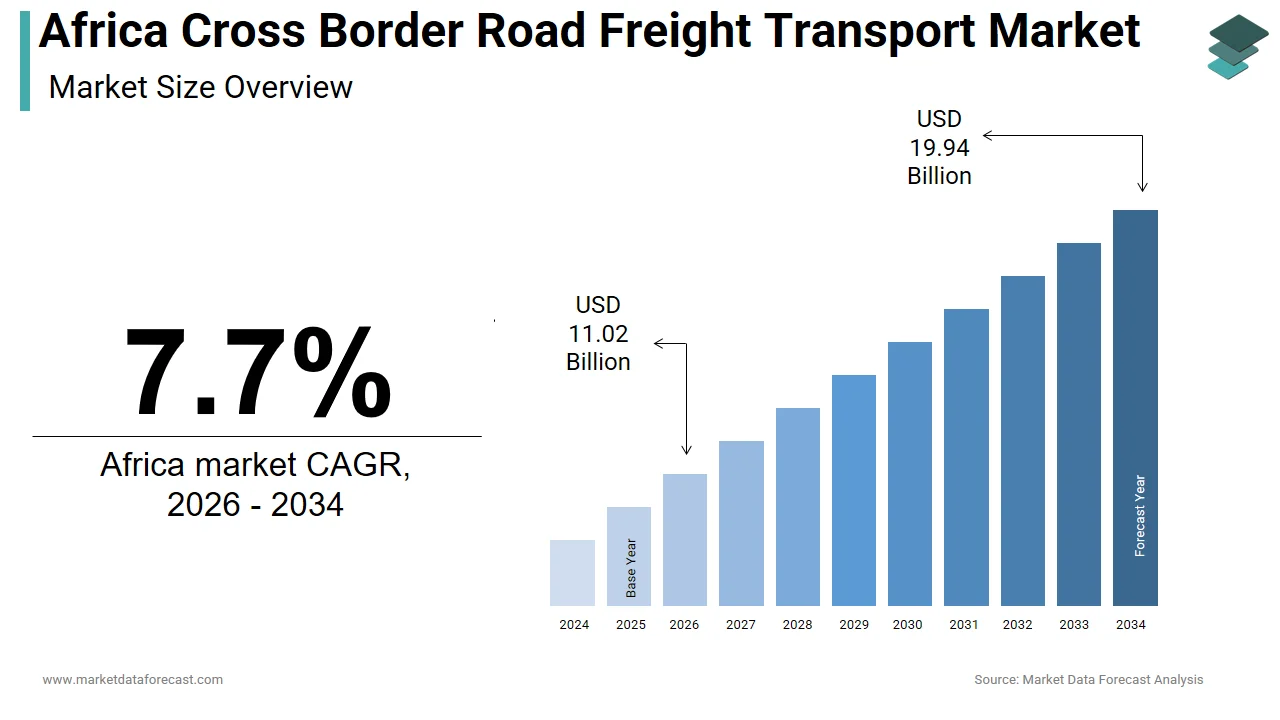
Market Size, 2025
$10.23 BnMarket Estimate, 2026
$11.02 BnMarket Forecast, 2034
$19.94 BnCAGR, 2026–2034
7.7%Africa Cross-Border Road Freight Transport Market Size
The Africa cross-border road freight transport market was valued at USD 10.23 billion in 2025, is estimated to reach USD 11.02 billion in 2026, and is projected to reach USD 19.94 billion by 2034, growing at a CAGR of 7.7% from 2026 to 2034.
Cross border road freight transport refers to the movement of goods by truck across national boundaries within the continent, serving as the backbone of intra-African trade. Despite the existence of railways and maritime routes, road transport accounts for over 80% of freight movement between African countries, according to the African Development Bank. The African Union estimates that only 18% of total African trade occurs within the continent, but the African Continental Free Trade Area (AfCFTA), operational since 2021, aims to increase this through streamlined logistics and reduced trade barriers. Border delays are rampant. This sector is not merely a logistical function but a critical determinant of supply chain resilience and regional economic integration.
MARKET DRIVERS
Expansion of Regional Trade Agreements
The operationalization of the African Continental Free Trade Area (AfCFTA) has catalyzed a structural shift in intra-African trade, directly stimulating demand for cross-border road freight services. As of January 2024, many African countries had submitted tariff reduction schedules, facilitating the movement of goods across previously restricted sectors, according to the AfCFTA Secretariat. This policy integration has led to a year-on-year increase in cross-border trucking volumes between West and East Africa from 2022 to 2023. In the Southern African Development Community (SADC) region, harmonized customs procedures under the SADC Trade Protocol have reduced border clearance times at key posts like Chirundu (Zimbabwe-Zambia), enhancing freight predictability. These institutional advancements are transforming road freight from a fragmented, informal activity into a strategic enabler of continental supply chains.
Growth of Agri-Logistics and Perishable Goods Trade
The rising trade in perishable agricultural commodities is intensifying reliance on reliable cross-border road freight networks. Africa produces over 50 million metric tons of fruits and vegetables annually, yet post-harvest losses exceed 30% due to inadequate cold chain logistics, as per the Food and Agriculture Organization (FAO). To address this, specialized refrigerated trucking services have expanded along corridors such as Mombasa–Kampala–Kigali and Durban–Johannesburg–Lusaka. Between 2021 and 2023, the number of refrigerated trucks operating in East Africa increased. In West Africa, the export of horticultural produce from Kenya and Ghana to neighboring landlocked countries like Uganda and Burkina Faso has driven a rise in dedicated refrigerated freight movements. This demand for time-sensitive, temperature-controlled transport is reshaping fleet composition and route optimization strategies.
MARKET RESTRAINTS
Inadequate Road Infrastructure and Maintenance Gaps
The poor condition of transnational highways, particularly in Central and West Africa, is a fundamental constraint to efficient cross-border road freight. The Trans-Sahelian Highway, linking Dakar to N’Djamena, remains unpaved for its length, causing average truck speeds to drop during rainy seasons, as reported by the Economic Community of West African States (ECOWAS). In Angola, despite recent investments, high degradation of provincial roads is classified as degraded, limiting connectivity to Namibia and the Democratic Republic of Congo. These infrastructure deficits increase vehicle wear, fuel consumption, and delivery delays, making long-haul freight economically unviable in many corridors and discouraging private investment in fleet modernization.
Proliferation of Informal Checkpoints and Extortion
Truck operators across Africa continue to face systemic harassment at unofficial checkpoints, which significantly inflate transit costs and erode operational efficiency. In Nigeria, there are widespread illegal checkpoints on major highways, with enforcement agencies responsible for a notable share of these. Also, many of truckers in the Lagos–Kano corridor reported daily bribe payments. These practices not only increase freight prices but also distort competition, favoring informal operators over licensed firms that comply with regulations, thereby undermining formalization efforts.
MARKET OPPORTUNITIES
Digitalization of Border Clearance through TIR and ASYCUDA Systems
The adoption of international digital customs systems presents a transformative opportunity to streamline cross-border freight operations. The TIR Convention, administered by the IRU, has been implemented in 12 African countries as of 2024, enabling secure, paperless transit of goods from origin to destination with reduced physical inspections. According to the United Nations Economic Commission for Europe, TIR-enabled shipments in Morocco and Tunisia have reduced border processing time. Similarly, the World Bank’s ASYCUDA (Automated System for Customs Data) is now operational in over 30 African nations, including Ethiopia and Senegal, improving customs clearance efficiency by 40% on average, as per UNCTAD. These systems enhance cargo security, reduce corruption risks, and enable real-time tracking, making road freight more predictable and attractive for formal trade actors seeking compliance and speed.
Integration of Fleet Telematics and GPS Monitoring
The deployment of telematics and GPS tracking systems is revolutionizing fleet management in Africa’s cross-border freight sector. Major large trucking companies in South Africa and Kenya utilize real-time monitoring to track vehicle location, fuel usage, and driver behavior. In Uganda, there has been a reduction in cargo theft after mandating GPS installation for member fleets operating on the Northern Corridor. Fleet operators like Transnet Freight Rail’s road division have piloted IoT sensors to monitor refrigerated cargo conditions across the Durban–Gaborone route, minimizing spoilage. Private sector investment in digital dashboards and predictive maintenance algorithms is improving vehicle uptime and route planning accuracy, enabling operators to meet just-in-time delivery expectations and compete more effectively in regional value chains.
MARKET CHALLENGES
Fragmented Regulatory Frameworks and Licensing Barriers
Cross-border road freight operators face a labyrinth of divergent national regulations, including vehicle standards, driver licensing, and insurance requirements, which hinder seamless operations. Like, only a limited number of Africa’s 54 countries recognize international driving permits under the 1949 Geneva Convention, forcing drivers to obtain multiple national licenses. This regulatory fragmentation increases administrative costs and delays, with some operators spending a significant portion of transit time on documentation. Harmonizing legal frameworks remains a political and institutional challenge, limiting the scalability of pan-African logistics providers.
Fuel Price Volatility and Limited Access to Refueling Infrastructure
Fuel cost instability and uneven refueling access pose critical operational risks for long-haul trucking across In remote corridors, fuel stations are sparse, making long-haul trucking dependent on careful fuel planning. Truckers often carry extra fuel in unauthorized containers, increasing safety hazards. Without coordinated investment in fuel supply chains and price stabilization mechanisms, transport operators remain vulnerable to external shocks, constraining route expansion and service reliability.
REPORT COVERAGE
| REPORT METRIC | DETAILS |
| Market Size Available | 2025 to 2034 |
| Base Year | 2025 |
| Forecast Period | 2026 to 2034 |
| Segments Covered | By End-User and Region. |
| Various Analyses Covered | Global, Regional and Country-Level Analysis, Segment-Level Analysis, Drivers, Restraints, Opportunities, Challenges; PESTLE Analysis; Porter’s Five Forces Analysis, Competitive Landscape, Analyst Overview of Investment Opportunities |
| Countries Covered | Sudan, Egypt, Kenya, Ethiopia, Ghana, South Africa, Rest of Africa |
| Market Leaders Profiled | DSV South Africa (Pty) Ltd, DHL Freight Forwarding, Unitrans Supply Chain Solutions (Pty) Ltd, CEVA Logistics, and Cargo Carriers (Pty) Ltd. |
SEGMENTAL ANALYSIS
By End User Insights
The distributive trade segment dominated the Africa cross border road freight transport market by accounting for 35.7% of total freight volume in 2024. This preeminence of the segment is credited to the sector’s reliance on road transport to move imported and locally produced consumer goods across fragmented national markets. The expansion of informal cross-border trade (ICBT), which constitutes a notable share of total intra-African commerce, is a primary driver, particularly in regions such as East and Southern Africa. As per the International Labour Organization, a significant portion of women in the Great Lakes region engage in informal trade, often relying on small trucks and minibuses to transport food, textiles, and electronics across borders. In the Democratic Republic of Congo, daily truck flows from Uganda and Rwanda into Goma and Bukavu is high, primarily carrying packaged consumer goods, according to the East African Community Secretariat. This segment thrives on high-frequency, short-haul movements, making road freight indispensable despite inefficiencies. A further key factor underpinning the dominance of distributive trade is the rapid growth of urban retail ecosystems. Supermarket chains and wholesale distributors increasingly depend on just-in-time delivery models, necessitating reliable cross-border logistics. In West Africa, the Lagos–Abidjan–Ouagadougou corridor handles substantial tons of retail goods annually, with most transported by road. The absence of integrated rail freight and port congestion further entrenches road transport as the default mode, reinforcing the centrality of distributive trade in shaping freight demand.
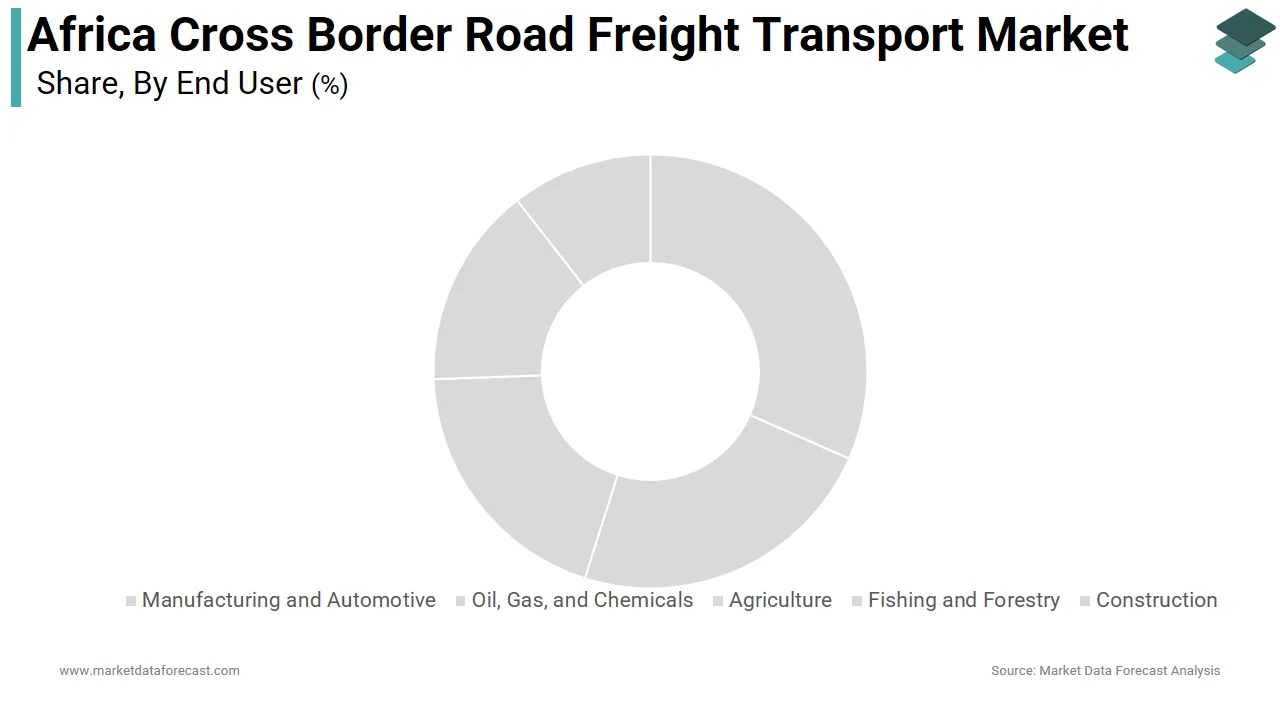
The pharmaceutical and healthcare segment is the fastest-growing end user in the Africa cross border road freight market and is likely expanding at a CAGR of 11.6% during the forecast period. This surge is primarily driven by increased regional coordination in health supply chains, particularly after the COVID-19 pandemic exposed critical vulnerabilities in medical logistics. The establishment of the African Union’s Partnerships for African Vaccine Manufacturing (PAVM) in 2022 has catalyzed cross-border movement of vaccines, active pharmaceutical ingredients (APIs), and medical devices. An additional pivotal driver is the institutionalization of regional health procurement pools. The Africa Medical Supplies Platform (AMSP), launched by the African Union, facilitated the cross-border delivery of $1.3 billion worth of medical goods between 2021 and 2023, relying heavily on road freight for last-mile distribution, according to the African Union Development Agency (AUDA-NEPAD). Countries like Rwanda and Ghana have emerged as pharmaceutical logistics hubs, with Kigali serving as a central distribution node for Central and East Africa. The expansion of the African Medicines Agency (AMA), operational as of 2023, is harmonizing regulatory approvals, reducing delays at borders for medical cargo.
COUNTRY-LEVEL ANALYSIS
South Africa Cross Border Road Freight Transport Market Insights
South Africa secured a central position in the Africa cross border road freight transport market by contributing 26.7% of the region’s total cross-border freight tonnage in 2024. As a logistical gateway to Southern Africa, the country hosts the most developed road network and a concentration of modern freight terminals, particularly in Gauteng, Durban, and Cape Town. The Port of Durban alone handles over 60% of South Africa’s containerized cargo, much of which is trucked to landlocked neighbors, including Zimbabwe, Zambia, and the Democratic Republic of Congo. According to the National Treasury, over 78,000 trucks crossed South Africa’s borders annually under the SADC Free Movement of Goods Protocol in 2023. The country’s adherence to international customs standards, including ASYCUDA and TIR, enhances transit efficiency, while private sector investment in fleet modernization supports high-capacity, time-sensitive deliveries across regional corridors.
Kenya Cross Border Road Freight Transport Market Insights
Kenya serves as the principal freight corridor hub for East Africa and the wider Horn of Africa. Its strategic location, anchored by the Port of Mombasa, the largest seaport in East and Central Africa, makes it the primary entry point for goods destined for Uganda, Rwanda, South Sudan, and eastern DRC. A significant share of Uganda’s imports transits through Kenya by road, with a substantial volume of truck crossings recorded at the Malaba and Busia borders in 2023. The Northern Corridor Integration Projects Authority has reduced average transit time from Mombasa to Kampala by 30% since 2020 through digital customs clearance and weighbridge automation. Additionally, Kenya’s investment in the Lamu Port-South Sudan-Ethiopia Transport (LAPSSET) corridor aims to divert freight from congested routes, further solidifying its role as a regional logistics anchor.
Egypt Cross Border Road Freight Transport Market Insights
Egypt occupies a pivotal logistical position in North Africa and the Middle East. Its proximity to the Suez Canal enables the transshipment of global cargo into African and Arab markets, with a major share of goods entering via Alexandria and Port Said, subsequently transported by truck to Sudan, Libya, and the Levant. Cross-border traffic has seen an increase in freight traffic since 2022. Egypt also serves as a key node for overland trade with Gulf states via the Arab League’s Arab Free Trade Area (GAFTA), facilitating the movement of construction materials, foodstuffs, and industrial goods. Despite political instability in neighboring countries, Egypt’s centralized customs system and growing use of electronic cargo tracking have enhanced freight predictability and regional connectivity.
Ethiopia Cross Border Road Freight Transport Market Insights
Ethiopia has emerged as a rapidly expanding freight market in the Horn of Africa. The country’s industrialization drive, particularly in textile, pharmaceutical, and agro-processing zones, has intensified demand for imported raw materials and export logistics. The majority of Ethiopia’s international freight moves via road, primarily through Djibouti’s port, which handled a significant quantity of Ethiopian cargo in 2023. There has been a year-on-year increase in cross-border truck movements to Kenya and Sudan between 2022 and 2023. The government’s push for regional integration, including participation in the AfCFTA and investment in the Addis Ababa–Djibouti highway, has improved transit times and reduced cargo damage, positioning Ethiopia as a rising logistics hub in East Africa.
Nigeria Cross Border Road Freight Transport Market Insights
Nigeria is a dominant force in West African cross-border road freight. As the region’s largest economy and most populous nation, Nigeria serves as a major consumer and distribution center for goods flowing into and across West Africa. The Lagos–Abidjan–Ouagadougou corridor, one of the busiest in Africa, sees heavy truck crossings monthly, transporting food, electronics, and manufactured goods. Despite chronic border closures and regulatory bottlenecks, informal trade remains robust, with most of goods moving via unofficial routes. Recent efforts to digitize customs through the National Single Window system have reduced clearance times by 25%, according to Nigeria’s Federal Ministry of Finance. As regional integration advances, Nigeria’s centrality in West African freight dynamics is expected to grow, contingent on infrastructure and policy reforms.
COMPETITIVE LANDSCAPE
Competition in the Africa cross border road freight transport market is evolving from fragmented, informal operations to structured rivalry between formal logistics firms and regional conglomerates. While thousands of small-scale operators dominate local routes, multinational players are gaining ground through technology, compliance, and scale. The absence of standardized regulations across borders creates both entry barriers and arbitrage opportunities, allowing agile firms to exploit inefficiencies. Differentiation is increasingly based on reliability, digital integration, and value-added services such as cold chain management and customs brokerage. Public-private collaboration on infrastructure and digital trade corridors is reshaping competitive dynamics. Companies investing in data analytics, fleet modernization, and cross-border partnerships are positioning themselves as leaders in a market transitioning from survival-based logistics to strategic supply chain integration.
KEY MARKET PLAYERS
Some of the noteworthy companies in the Africa cross border road freight transport market profiled in this report are
- DSV South Africa (Pty) Ltd
- DHL Freight Forwarding
- Unitrans Supply Chain Solutions (Pty) Ltd
- CEVA Logistics
- Cargo Carriers (Pty) Ltd
TOP LEADING PLAYERS IN THE MARKET
- Barloworld Logistics, a South Africa-based integrated freight solutions provider, operates across 15 African countries, offering specialized cross-border road transport for mining, automotive, and retail sectors. The company has strengthened its regional footprint by investing in temperature-controlled fleets and digital freight management platforms that enable real-time cargo tracking across high-risk corridors such as Durban to Kinshasa. Barloworld has also expanded its inland depot network in Zambia and Angola, reducing dependency on port congestion. By integrating predictive analytics for route optimization and fuel efficiency, the company enhances reliability in markets plagued by infrastructure deficits, positioning itself as a leader in compliant, technology-driven cross-border logistics.
- Bidvest International Logistics, a division of South Africa’s Bidvest Group, delivers end-to-end cross-border freight services across Sub-Saharan Africa, with a strong presence in East, Central, and Southern Africa. The company specializes in high-value and time-sensitive cargo, including automotive parts, pharmaceuticals, and industrial equipment. It has also established dedicated trade lanes for AfCFTA-participating nations, pre-clearing documentation to reduce dwell times at checkpoints. Bidvest collaborates with regional customs agencies to pilot paperless transit under the TIR system, enhancing compliance and speed. Its investment in cold chain logistics has supported vaccine distribution across Rwanda and Uganda, reinforcing its role in critical supply chains.
- DHL Global Forwarding maintains a strategic presence in Africa’s cross-border road freight sector, leveraging its global network to connect intra-African trade with international supply chains. The company operates dedicated road corridors linking South Africa, Kenya, and Nigeria to neighboring landlocked countries, integrating road freight with air and sea logistics for multimodal solutions. It has also partnered with the African Union to support the rollout of the AfCFTA Digital Trade Facilitation Framework, promoting standardized e-documents. By deploying electric trucks in urban distribution zones in Cape Town and Nairobi, DHL is advancing sustainable freight, setting a benchmark for environmental compliance in a traditionally carbon-intensive sector.
TOP STRATEGIES USED BY KEY MARKET PARTICIPANTS
Key players in the Africa cross border road freight transport market are deploying multimodal integration, digital freight platforms, and regulatory compliance systems to enhance competitiveness. Companies are investing in GPS and IoT-enabled fleet tracking to improve transparency and reduce cargo theft. Strategic partnerships with customs authorities and regional economic communities facilitate faster border clearance through TIR and ASYCUDA adoption. Expansion into high-growth corridors linked to special economic zones and mining hubs is accelerating. Firms are also formalizing informal logistics networks by onboarding independent truckers into digital marketplaces. Sustainability initiatives, including alternative fuel vehicles and carbon reporting, are emerging as differentiators. Talent development in logistics management and cross-border compliance is being prioritized to support operational excellence in complex regulatory environments.
RECENT MARKET DEVELOPMENTS
- In January 2023, Barloworld Logistics launched a blockchain-based digital freight documentation system across its Southern African routes, enabling seamless customs verification and reducing border delays by up to 40% on the Durban–Lusaka corridor.
- In May 2023, Bidvest International Logistics deployed a continent-wide telematics network across its fleet, providing real-time cargo monitoring and predictive maintenance alerts to improve delivery reliability in high-risk transit zones.
- In September 2023, DHL Global Forwarding introduced a digital freight exchange in Nairobi, connecting independent truckers with verified cargo loads and optimizing vehicle utilization across East African trade lanes.
- In February 2024, Barloworld Logistics expanded its cold chain infrastructure in Angola, establishing temperature-controlled warehousing and distribution routes to serve pharmaceutical and food importers in Luanda and beyond.
- In June 2024, Bidvest International Logistics partnered with the East African Community to pilot automated e-permit processing for cross-border trucks, reducing administrative delays at the Namanga border between Kenya and Tanzania.
MARKET SEGMENTATION
This Africa cross border road freight transport market research report is segmented and sub-segmented into the following categories.
By End User
- Manufacturing and Automotive
- Oil, Gas, and Chemicals
- Agriculture
- Fishing and Forestry
- Construction
- Distributive Trade
- Pharmaceutical and Healthcare
- Other End Users (Telecommunications, Food, and Beverage, etc.)
By Country
- Sudan
- Egypt
- Kenya
- Ethiopia
- Ghana
- South Africa
- Rest of Africa