- Product Description Description
- Table of Contents TOC
- List of Table & Figure LOT
- Get Free Sample PDF Sample PDF
Market Size, 2025
$17.58 BnMarket Estimate, 2026
$19.38 BnMarket Forecast, 2034
$42.34 BnCAGR, 2026–2034
10.26%Executive Summary: Africa Electric Vehicle Market
- Market Scope: Comprehensive market assessment of the African electric vehicle sector covering propulsion types, vehicle classes, drive configurations, country-level profiles, and unique off-grid/renewable microgrid integration dynamics.
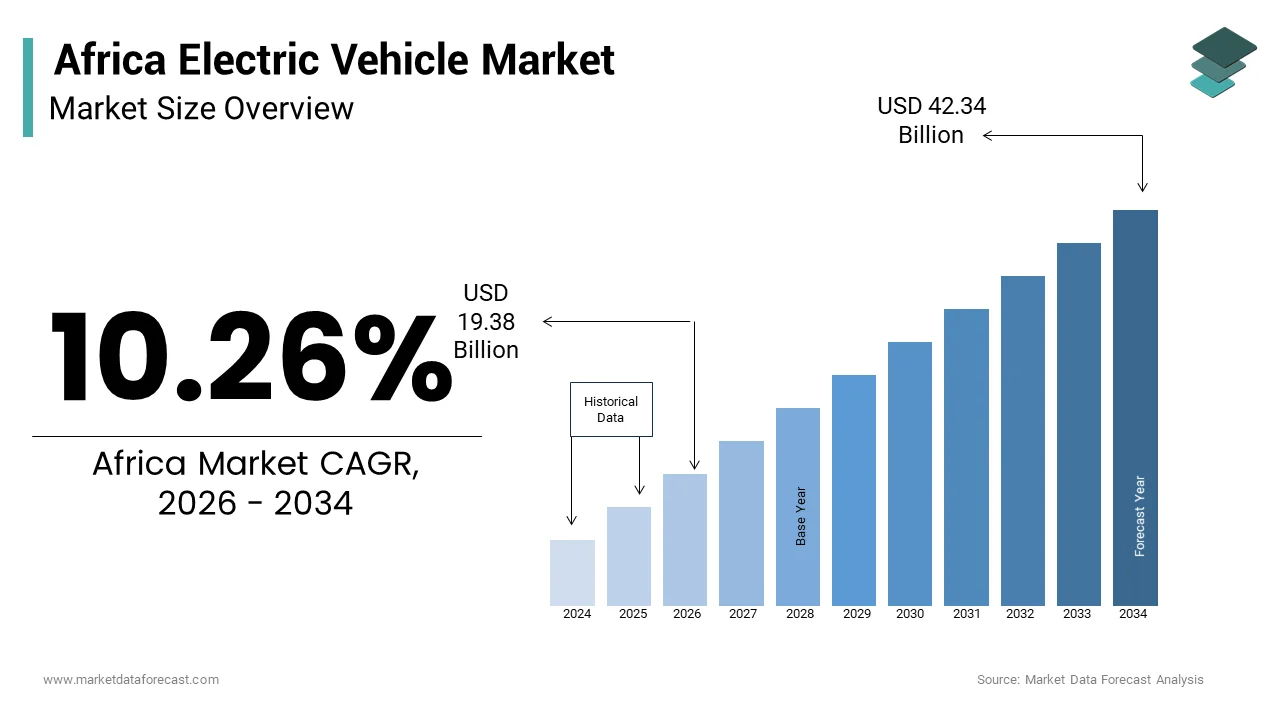
- Market Valuation: Valued at USD 17.58 billion in 2025, estimated at USD 19.38 billion in 2026, and projected to reach USD 42.34 billion by 2034, registering a robust CAGR of 10.26% from 2026 to 2034.
- Primary Growth Drivers: Rapid expansion of two- and three-wheeled electric micro-mobility in urban logistics/ride-hailing, urban air quality imperatives, integration of renewable energy microgrids with EV charging, and leapfrogging potential in decentralized transport systems.
Key Market Segment Metrics (2026–2034)
| Category | Leading Segment Position | Fastest-Growing / Key Growth Segment |
|---|---|---|
| By Propulsion Type | Battery Electric Vehicles (BEVs) (dominated with 62.5% market share in 2024 due to simplicity and off-grid solar compatibility) | Fuel Cell Electric Vehicles (FCEVs) (projected to expand at the highest CAGR of 24.7% from 2025 to 2033, driven by heavy-duty transport and South Africa’s Hydrogen Valley) |
| By Vehicle Type | Passenger Cars (led with 57.4% of total registrations in 2024, supported by urban middle-class demand and affordable imported/locally assembled used/new models) | Commercial Vehicles (projected to grow at a CAGR of 18.3% between 2025 and 2033 via urban e-logistics and freight decarbonization) |
| By Vehicle Drive Type | Front-wheel Drive (FWD) (commanded 67.3% share in 2024 for compact/subcompact urban layout efficiency and lower costs) | All-wheel Drive (AWD) (projected to grow at a CAGR of 16.9% from 2025 to 2033 for off-road, mining, and emergency response use) |
| By Country / Region | South Africa (held 31.7% MEA market share in 2024 as an industrialized manufacturing and innovation center) | Kenya, Egypt, and Morocco (rapidly scaling micro-mobility, domestic assembly quotas, and duty incentives) |
Major Market Players & Market Structure
Market Structure: Evolving competitive ecosystem where global automotive conglomerates (BMW, Renault-Nissan) compete and collaborate with localized innovators (such as Kenya's Mobius Motors) focusing on off-grid resilience, local assembly, and solar-integrated charging networks.
Key Companies: Nissan Motor Co. Ltd, Volkswagen AG, Tesla Inc, Toyota Motor Corporation, BMW AG, Kia Corporation, Volvo Car Corporation, Mercedes-Benz Group, Rivian Automotive Inc., and Groupe Renault.
Africa Electric Vehicle Market Size
The African electric vehicle market size was valued at USD 17.58 billion in 2025 and is anticipated to reach USD 19.38 billion in 2026 to reach USD 42.34 billion by 2034, growing at a CAGR of 10.26% during the forecast period from 2026 to 2034.
The electric vehicle (EV) market covers the adoption, infrastructure development, and policy frameworks supporting battery-powered road transport across the continent. Unlike conventional markets driven primarily by consumer demand, Africa’s EV transition is being shaped by urban air quality imperatives, energy access innovation, and leapfrogging potential in mobility systems. Like, urban dwellers in sub-Saharan Africa are exposed to air pollution levels exceeding safe thresholds. Millions of people lack grid connectivity, fostering interest in decentralized energy ecosystems where EVs can integrate with off-grid solar charging.
MARKET DRIVERS
The rapid expansion of two- and three-wheeled electric mobility in urban logistics and ride-hailing services is a pivotal driver of the African EV market. As per the United Nations Economic Commission for Africa, two-wheelers constitute a dominant share of motorized vehicles in cities, serving as primary modes for last-mile delivery and passenger transit. Kenya’s Access Afya program deploys e-motos for rural healthcare logistics. These lightweight EVs require lower capital investment, consume less energy, and align with existing informal transport networks. Thus, electrified micro-mobility is emerging as a scalable, low-disruption solution for decarbonizing Africa’s most active transport segment.
The integration of renewable energy microgrids with EV charging infrastructure, enabling sustainable mobility in off-grid and peri-urban areas, is another critical driver. In Nigeria, the Lagos Island Solar Initiative has deployed photovoltaic charging stations for e-buses and e-taxis. These hybrid energy-mobility systems bypass the limitations of centralized grids and reduce lifecycle emissions. Hence, the continent possesses unparalleled potential to anchor EV adoption in clean, distributed energy ecosystems.
MARKET RESTRAINTS
The absence of standardized charging infrastructure and technical regulations across national borders is a major restraint impeding the African EV market. Like, only some out of 55 African countries have established national EV charging standards. In West Africa, a single EV model may require different charging configurations to operate, undermining cross-border mobility and fleet scalability. This fragmentation discourages automakers and fleet operators from large-scale deployment. Additionally, the lack of harmonized grid codes for EV integration complicates utility planning. Without regional alignment, the continent risks developing isolated, inefficient networks that hinder the emergence of a cohesive, transnational EV ecosystem.
The high import duty and taxation on EVs, which drastically inflate consumer prices and limit affordability, are another significant restraint. Also, several African nations impose high import tariffs on EVs are high, with additional levies on batteries and components. In Zimbabwe, the total tax burden on an imported EV is high. Even in countries promoting EV adoption, such as Kenya and Rwanda, reduced tariffs apply only to specific models or diplomatic imports, excluding mass-market buyers. These fiscal policies, originally designed to protect domestic fossil fuel revenues and local assembly industries, now act as structural barriers to clean mobility, perpetuating reliance on used internal combustion engine vehicles.
MARKET OPPORTUNITIES
The repurposing of retired EV batteries for decentralized energy storage in off-grid communities is a transformative opportunity. Also, millions of Africans live beyond the reach of centralized electricity, relying on diesel generators and kerosene. A single decommissioned EV battery retains up to 70% of its original capacity, sufficient to power a small health clinic or community center for years. In South Africa, Stellenbosch University’s ReCell project has demonstrated that second-life EV batteries can reduce the cost of solar mini-grids. Automakers have partnered with local energy firms in Uganda and Senegal to pilot such systems. This circular economy model not only extends battery utility but also creates a parallel value chain, where EV adoption directly supports rural electrification, enhancing the socio-economic justification for electrified transport.
The localization of EV assembly and component manufacturing through Special Economic Zones (SEZs) and industrial policy incentives is another emerging opportunity. The African Continental Free Trade Area further enables regional supply chain integration. By reducing import dependency and creating skilled jobs, localized production transforms EVs from imported commodities into engines of industrial development, fostering long-term market sustainability.
MARKET CHALLENGES
The fragility of national power grids, which struggle to support widespread EV charging without destabilization, is a critical challenge facing the African EV market. Also, sub-Saharan Africa accounts for a low share of the global population but only some of the electricity generation capacity, with frequent load-shedding in countries like South Africa and Ghana. In Lagos, reliance on diesel-powered backup systems negates the environmental benefits of EVs. Without substantial grid modernization, EV adoption risks becoming a niche phenomenon, disconnected from the broader energy system.
The lack of a skilled technical workforce for EV maintenance, battery servicing, and charging infrastructure management is another pressing challenge. Moreover, fewer technical training institutions across the continent offer curricula in electric drivetrains or high-voltage safety protocols. In Nigeria, only a few certified EV technicians serve a population of over 200 million. This deficit leads to prolonged downtimes, unsafe repair practices, and premature vehicle retirement. The International Labour Organization warns that without urgent investment in vocational training, the continent could face a shortfall of EV technicians in the coming years. Furthermore, the absence of standardized certification hampers cross-border employability and service quality. This human capital gap undermines consumer confidence and increases the total cost of ownership, threatening the long-term viability of EV ecosystems in African markets.
REPORT COVERAGE
| REPORT METRIC | DETAILS |
| Market Size Available | 2025 to 2034 |
| Base Year | 2025 |
| Forecast Period | 2026 to 2034 |
| CAGR | 10.26% |
| Segments Covered | By Propulsion, Vehicle, Vehicle Drive, Region |
| Various Analyses Covered | Global, Regional, and Country Level Analysis; Segment-Level Analysis; DROC; PESTLE Analysis; Porter’s Five Forces Analysis; Competitive Landscape; Analyst Overview of Investment Opportunities |
| Regions Covered | Sudan, Egypt, Kenya, Ethiopia, South Africa, Rest of Africa |
| Market Leaders Profiled | Nissan Motor Co. Ltd, Volkswagen AG, Tesla Inc, Toyota Motor Corporation, BMW AG, Kia Corporation, Volvo Car Corporation, Mercedes-Benz Group, Rivian Automotive Inc., Groupe Renault |
SEGMENT ANALYSIS
By Propulsion Insights
The Battery Electric Vehicles (BEVs) segment dominated the African electric vehicle market by capturing 62.5% of total EV sales in 2024. This lead position is because of their alignment with urban mobility needs and compatibility with decentralized energy systems. In Nairobi, e-motos and e-tuktuks—nearly all battery-powered—account for two-thirds of registered EVs. BEVs are favored for their simplicity, lower maintenance requirements, and absence of hybrid complexity, making them ideal for informal transport operators. BEVs can be charged using standalone solar systems, a critical advantage in regions where grid access is unreliable. Their scalability in micro-mobility applications and synergy with off-grid electrification strategies solidify BEVs as the cornerstone of Africa’s electric transition.
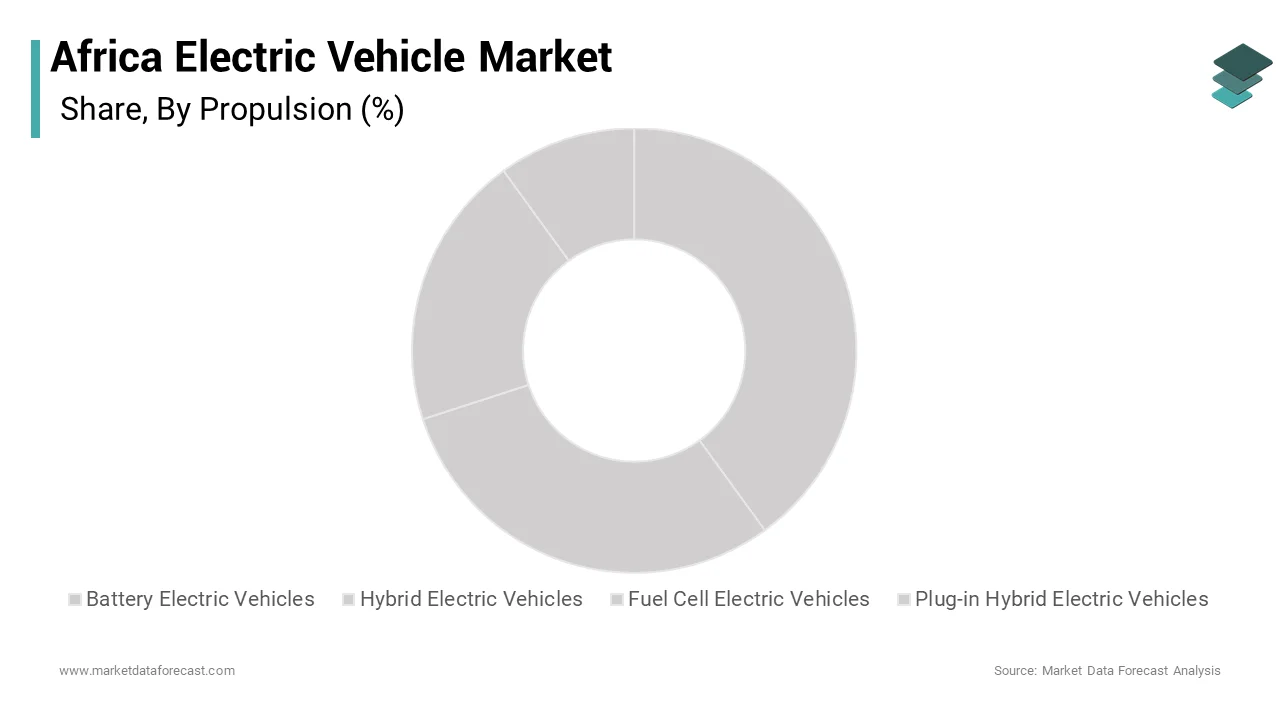
The Fuel Cell Electric Vehicles (FCEVs) segment is registering the highest growth trajectory in the African EV market and is projected to expand at a CAGR of 24.7% from 2025 to 2033. While currently minimal in volume, this surge is driven by pilot projects in heavy-duty transport and mining sectors where battery limitations in range and charging time are prohibitive. South Africa’s Hydrogen Valley initiative, launched in 2022, aims to establish a green hydrogen corridor linking Johannesburg, Pretoria, and Durban, with plans to deploy hydrogen-powered buses and freight trucks by 2026. The Council for Scientific and Industrial Research confirms that platinum group metals, abundant in South Africa, are essential catalysts for proton-exchange membrane fuel cells, positioning the country as a potential hub for FCEV component production. These strategic national investments are transforming FCEVs from niche demonstrators into long-term mobility solutions.
By Vehicle Insights
The Passenger Cars segment led under this category in the African EV market by accounting for 57.4% of total EV registrations in 2024. This dominance is primarily driven by rising urban middle-class demand, government import incentives, and the influx of affordable used EVs from Europe and Japan. In Morocco, the Renault-Nissan alliance has localized production of the Dacia Spring EV, priced below USD 20,000, making it the most accessible electric car in North Africa. Egypt saw an increase in EV passenger car imports between 2021 and 2023, spurred by tax reductions on fully electric models. Additionally, ride-hailing platforms like Bolt and Uber are incentivizing drivers to switch to EVs in cities such as Cape Town and Accra, where air quality regulations are tightening. These socio-economic and regulatory dynamics sustain passenger cars as the primary vector for EV diffusion.
The Commercial Vehicles segment is emerging as the fastest-growing category in the African EV market and is anticipated to grow at a CAGR of 18.3% between 2025 and 2033. This acceleration is fueled by the expansion of e-logistics fleets in urban centers and the economic advantages of electrified freight. In Kenya, companies have deployed electric three-wheelers and light-duty trucks for last-mile delivery, reducing operational costs compared to diesel counterparts. Also, urban freight demand will increase sharply due to e-commerce growth, intensifying pressure to decarbonize logistics. With high utilization rates and predictable routes, commercial fleets offer optimal conditions for rapid ROI on EV investments, driving disproportionate adoption in this segment.
By Vehicle Drive Insights
The Front-wheel Drive (FWD) configuration segment represented the largest category in the African EV market by commanding an estimated 67.3% share of electric vehicle sales in 2024. This dominance is rooted in the prevalence of compact and subcompact EVs designed for urban environments, where FWD offers superior space efficiency, lower manufacturing costs, and enhanced traction on paved roads. Most imported and locally assembled EVs, including the Dacia Spring in Morocco and the Mobius EV in Kenya, utilize FWD layouts to maximize cabin space and minimize energy consumption. Additionally, FWD systems require fewer mechanical components, reducing maintenance complexity—a critical advantage in regions with limited technical infrastructure. As urbanization accelerates and city-centric transport models expand, FWD remains the default architecture for cost-effective, scalable electric mobility.
The All-wheel Drive (AWD) segment is experiencing the most rapid growth in the Africana EV market and is projected to grow at a CAGR of 16.9% from 2025 to 2033. This surge is driven by demand in off-road, mining, and emergency response applications where traction and reliability are paramount. Also, mining companies are adopting electric AWD support vehicles for underground operations, where zero-emission performance and high torque delivery enhance safety and efficiency. Additionally, humanitarian agencies such as the Red Cross are deploying electric AWD ambulances in flood-prone regions of Mozambique and Malawi, where conventional vehicles often fail during rainy seasons. With EVs offering instant torque vectoring and regenerative braking, AWD systems are becoming more energy-efficient, overcoming earlier concerns about battery drain and positioning AWD as a high-value segment in specialized African terrains.
COUNTRY-LEVEL ANALYSIS
South Africa Electric Vehicle Market Analysis
South Africa held a commanding position in the MEA EV market by securing an estimated 31.7% share in 2024. As the continent’s most industrialized economy, it hosts the only active EV assembly plants, including BMW’s Plant Rosslyn, producing the fully electric iX1. The government’s Automotive Production and Jobs Plan offers incentives for local EV manufacturing, attracting substantial investments since 2020. The Council for Scientific and Industrial Research confirms that South Africa holthe ds majority of the world’s known platinum reserves, essential for fuel cell catalysts, positioning it as a future hub for hydrogen-based EVs. Despite grid instability, the country leads in policy development, pilot projects, and technical training, making it the continent’s primary EV innovation center.
Egypt Electric Vehicle Market Analysis
Egypt is also a top MEA EV market, which is leveraging its strategic location and industrial base to drive electrification. The government launched the Egypt Makes Electric Vehicles initiative in 2022, aiming to localize 45% of EV components by 2026, as reported by the Ministry of Trade and Industry. The World Bank notes that Egypt’s urban population exceeds 43 million, creating massive demand for affordable transport solutions. In 2023, the Central Bank introduced low-interest financing for EV purchases, resulting in a year-on-year increase in registrations. Thus, Egypt is rapidly scaling infrastructure and consumer access, solidifying its role as a North African EV gateway.
Morocco Electric Vehicle Market Analysis
Morocco is distinguished by its advanced automotive manufacturing ecosystem and renewable energy integration. Home to the largest vehicle plant in Africa—Renault-Nissan in Tangier, it produced over 400,000 vehicles in 2023, with plans to shift 30% toward hybrid and electric models by 2026. The Ministry of Energy reports that Morocco generates 40% of its electricity from renewables, creating a clean foundation for EV adoption. In 2023, the government reduced import duties on EVs to 10% and launched the Dacia Spring at USD 18,500, the lowest price point in North Africa. These synergies between industrial policy and green energy make Morocco a model for sustainable EV deployment.
Kenya Electric Vehicle Market Analysis
Kenya is emerging as a leader in micro-mobility and policy innovation despite limited manufacturing capacity. Nairobi has the highest density of EV charging stations in East Africa. The government waived import duties on EVs until 2025, catalyzing an increase in registrations. Mobius Motors, a local firm, launched Africa’s first mass-produced electric pickup truck, tailored for rough terrain and off-grid charging. Hence, Kenya’s electricity is among the cleanest in Africa, enhancing the environmental value of EVs. These factors position Kenya as a pioneer in context-specific, sustainable electrification.
UAE Electric Vehicle Market Analysis
UAE accounts for a notable share of the broader MEA EV market, functioning as a technology incubator and investment conduit into African mobility projects. Although geographically outside Africa, the UAE exerts significant influence through funding, innovation transfer, and regional partnerships. The Abu Dhabi Fund for Development has financed EV charging networks in the region, while Masdar City’s smart grid technologies are being adapted for use. In 2023, the UAE launched the Africa Green Mobility Initiative, pledging millions for EV infrastructure across many African nations. Emirati firms like Falcon Electric are co-developing solar-charged e-buses with Kenyan startups. This outward-facing strategy enables the UAE to shape Africa’s EV trajectory through soft power, technical expertise, and cross-border financing, reinforcing its strategic market presence.
COMPETITIVE LANDSCAPE
The competition in the African EV market is evolving beyond brand rivalry into a contest of ecosystem integration and contextual innovation. Global automakers compete with regional startups on adaptability rather than just performance or price. Incumbents leverage manufacturing scale and technological heritage, while local firms counter with terrain-specific designs and off-grid compatibility. The absence of entrenched dealership networks allows new entrants to build direct-to-user models and digital service platforms. Differentiation increasingly hinges on charging accessibility, battery lifecycle management, and alignment with decentralized energy systems. Strategic positioning is shaped by partnerships with governments, utilities, and fintech firms. As urbanization and air quality concerns intensify, the race is not merely for market share but for influence in defining the continent’s sustainable mobility paradigm.
KEY MARKET PLAYERS
These are the market players that are dominating the African electric vehicle market?
- Nissan Motor Co. Ltd
- Volkswagen AG
- Tesla Inc
- Toyota Motor Corporation
- BMW AG
- Kia Corporation
- Volvo Car Corporation
- Mercedes-Benz Group
- Rivian Automotive Inc.
- Groupe Renault
Top Players In The Market
- BMW Group has established a strategic foothold in the African electric vehicle market through localized production and infrastructure collaboration. The company launched full-scale assembly of the fully electric iX1 at its Plant Rosslyn in South Africa in early 2023, marking the first luxury EV produced on the continent. BMW has partnered with South Africa’s Department of Trade, Industry, and Competition to develop a domestic battery component supply chain, aiming to reduce import dependency. Additionally, BMW initiated a technician training program with the Tshwane University of Technology to build local EV maintenance capacity. By integrating manufacturing, after-sales support, and energy infrastructure, BMW is positioning itself as a long-term player in Africa’s premium electrified mobility ecosystem.
- Renault-Nissan Alliance has leveraged its manufacturing strength in Morocco to drive electric vehicle accessibility across North and West Africa. In 2023, the alliance began local assembly of the Dacia Spring EV at its Tangier plant, offering the most affordable electric car in the region. The vehicle is designed for urban environments and integrates with Morocco’s expanding solar-powered charging network. The company also partnered with the African Development Bank to finance EV leasing programs for small businesses in Senegal and Côte d'Ivoire. By combining cost-effective production, innovative charging solutions, and inclusive financing, the alliance is accelerating EV adoption beyond elite urban consumers and into the mainstream transport economy.
- Mobius Motors, a Kenya-based automotive innovator, has redefined the African EV landscape by designing rugged, low-cost electric vehicles tailored for regional terrain and energy conditions. In late 2023, the company launched the Mobius EV2, a battery-electric pickup truck with a modular design enabling solar charging and off-grid operation. The vehicle targets smallholder farmers, logistics providers, and government agencies in rural areas where road conditions and grid instability limit conventional EV use. It also secured technical support from Strathmore University’s Energy Research Centre to optimize battery performance in high-temperature environments. By prioritizing affordability, durability, and energy independence, Mobius is pioneering a uniquely African approach to electrified mobility that challenges imported models.
- Key players in the Africanana EV market are deploying multifaceted strategies to establish dominance in a nascent and fragmented landscape. Localization of assembly and component manufacturing is a primary focus, reducing import costs and enhancing affordability. Companies are forming public-private partnerships to co-develop charging infrastructure and secure policy incentives. Strategic alliances with renewable energy providers enable solar-integrated charging solutions, critical in off-grid regions. Fleet electrification programs targeting ride-hailing and delivery services are being prioritized to demonstrate ROI and build consumer confidence. Workforce development through technical training ensures long-term serviceability. Additionally, innovative financing models, including leasing and pay-as-you-drive schemes, are being introduced to overcome purchasing power limitations. These strategies collectively address structural barriers while fostering ecosystem resilience and scalability.
RECENT MARKET NEWS
- In February 2023, BMW began local assembly of the fully electric iX1 at its Plant Rosslyn in South Africa, becoming the first luxury automaker to produce EVs on the continent.
- In June 2023, Renault-Nissan started manufacturing the Dacia Spring EV at its Tangier plant in Morocco, offering Africa’s most affordable electric car.
- In September 2023, Mobius Motors launched the EV2, a rugged electric pickup truck designed for off-grid operation in rural Kenya.
- In January 2024, Renault introduced a battery-swapping pilot in Casablanca in partnership with Morocco’s national utility ONEE.
- In April 2024, BMW deployed 60 fast-charging units across Johannesburg and Cape Town through collaborations with GridCars and City Power to strengthen its charging infrastructure network in the African EV market.
MARKET SEGMENTATION
This research report on the African electric vehicle market is segmented and sub-segmented into the following categories.
By Propulsion Type
- Battery Electric Vehicles
- Hybrid Electric Vehicles
- Fuel Cell Electric Vehicles
- Plug-in Hybrid Electric Vehicles
By Vehicle Type
- Passenger Cars
- Commercial Vehicles
By Vehicle Drive Type
- Front-wheel
- Drive Rear-wheel
- Drive All-wheel Drive
By Country
- Sudan
- Egypt
- Kenya
- Ethiopia
- South Africa
- Rest of Africa